3.2.1.5-01 The concept of the ‘global commons’. The rights of all to the benefits of the global commons. Acknowledgement that the rights of all people to sustainable development must also acknowledge the need to protect the global commons.A level only
3.2.1.5.1-01 An outline of the contemporary geography, including climate, of Antarctica (including the Southern Ocean as far north as the Antarctic Convergence) to demonstrate its role as a global common and illustrate its vulnerability to global economic pressures and environmental change.A level only
3.2.1.5.1-02 Threats to Antarctica arising from: • climate change • fishing and whaling • the search for mineral resources • tourism and scientific research.A level only
3.2.1.5.1-03 Critical appraisal of the developing governance of Antarctica. International government organisations to include United Nations (UN) agencies such as United Nations Environment Programme (UNEP) and the International Whaling Commission. The Antarctic Treaty (1959), the Protocol on Environmental Protection to the Antarctic Treaty (1991); IWC Whaling Moratorium (1982) – their purpose, scope and systems for inspection and enforcement.A level only
3.2.1.5.1-04 The role of NGOs in monitoring threats and enhancing protection of Antarctica.A level only
3.2.1.5.1-05 Analysis and assessment of the geographical consequences of global governance for citizens and places in Antarctica and elsewhere to specifically consider how global governance underlies and impacts on students’ and other people's lives across the globe.A level only
‘Global governance of the global commons has a direct impact on your life and the lives of people across the globe.’ Critically assess the extent to which you agree with this statement.
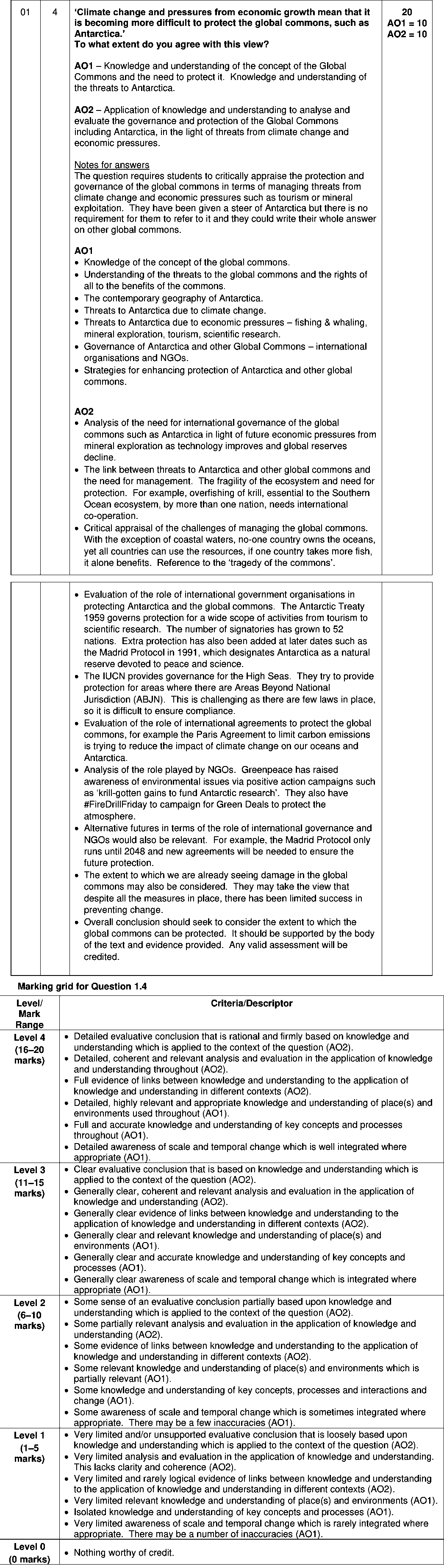
‘Climate change and pressures from economic growth mean that it is becoming more difficult to protect the global commons, such as Antarctica.’ To what extent do you agree with this view?
Tap a question to zoom it. The figures open above it; the mark scheme (with its levels and indicative content) and the examiner's comment open underneath.
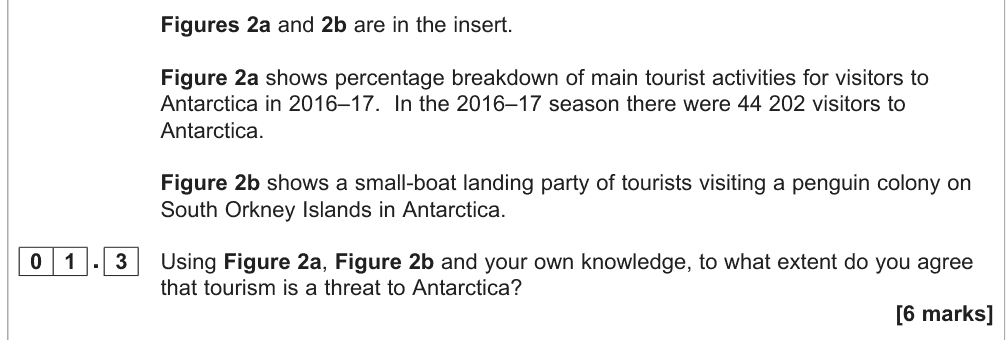
June 2025 · Paper 2 · Q1.36 marksmark schemeStimulus
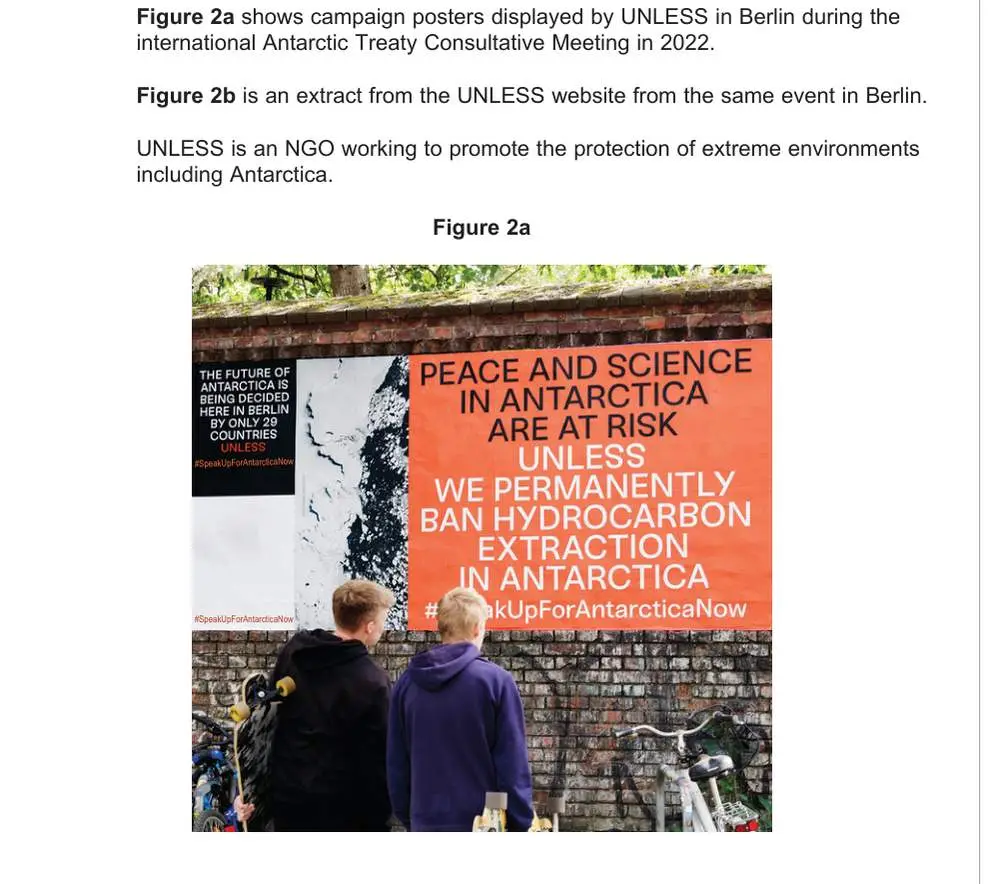
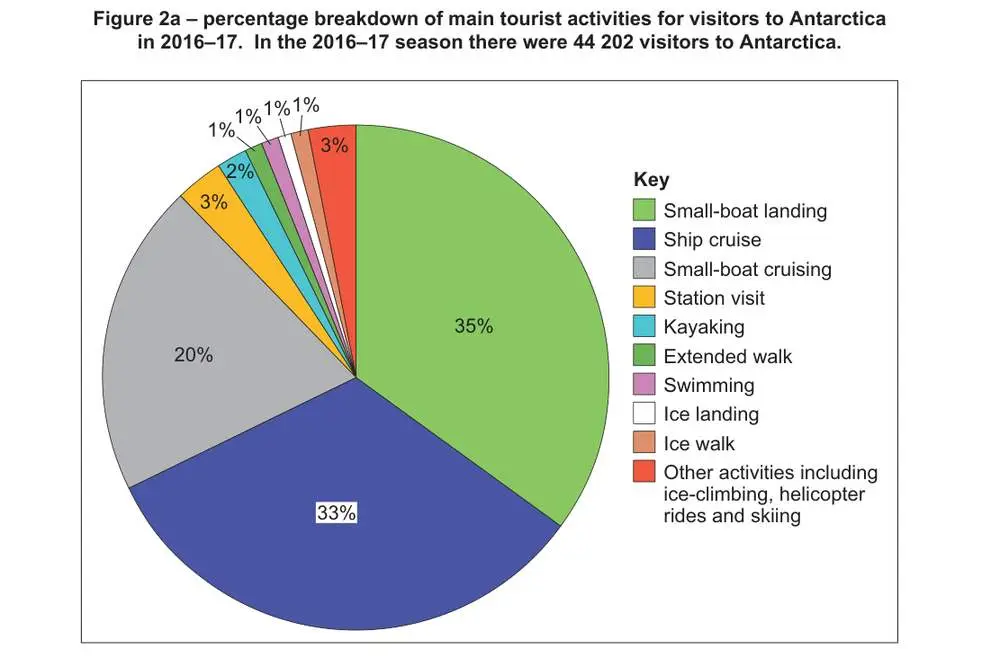
Figure 2a
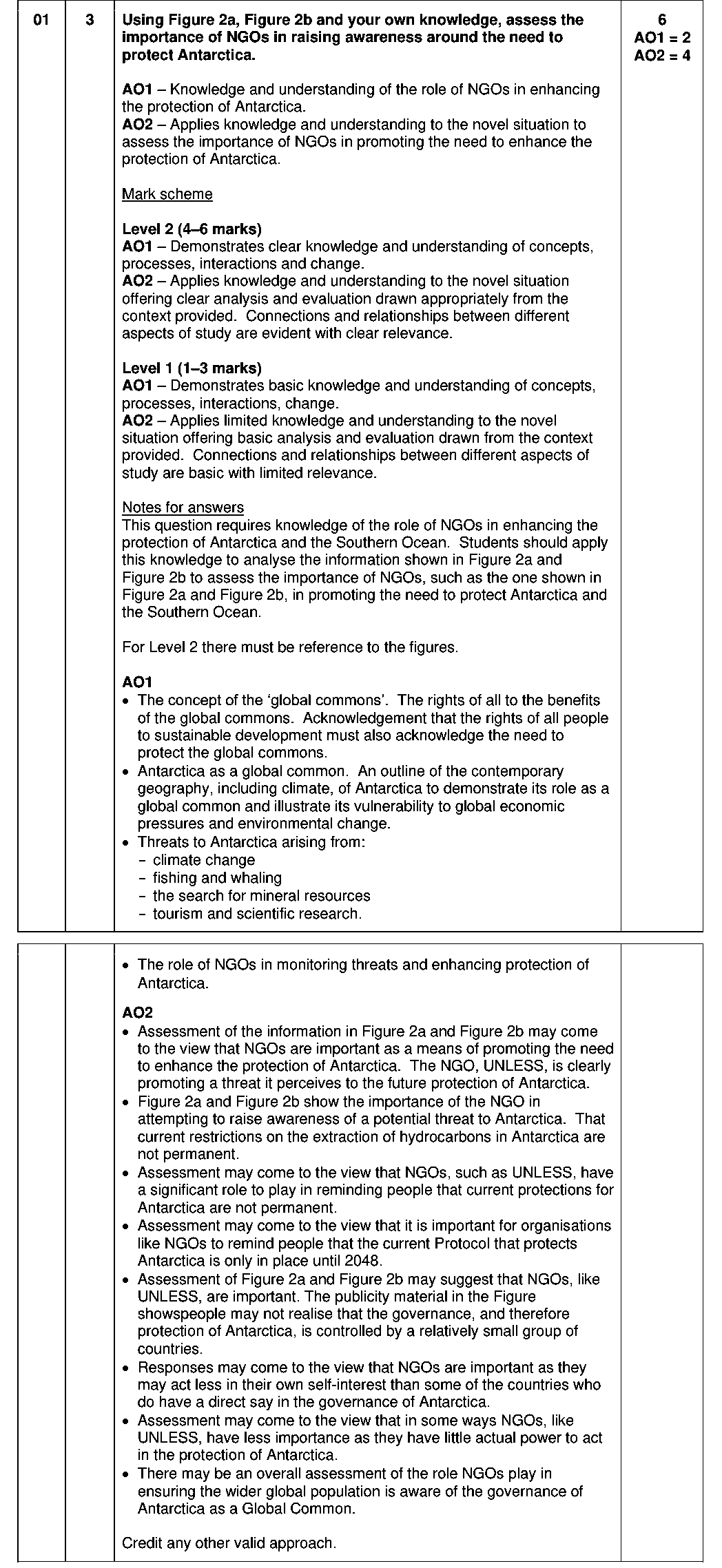
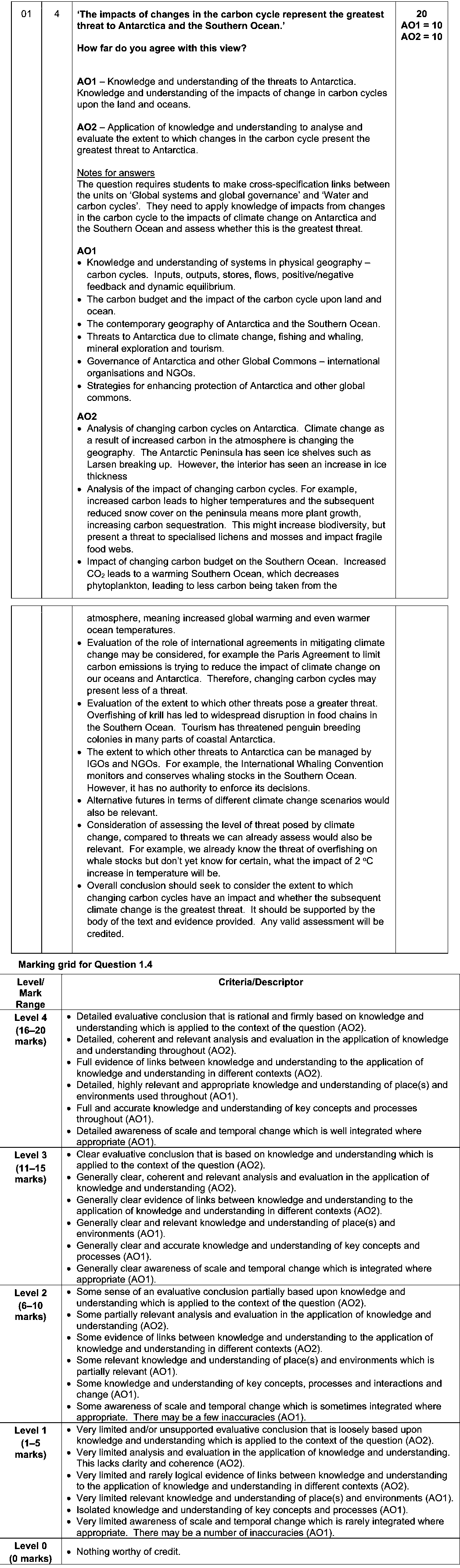
Mark scheme, including the levels and indicative content
Examiner's comment
In the 6- and 9-mark questions (AO1 & AO2) that used novel stimulus material there was evidence of some student confidence and clear application of knowledge and understanding. Most of the 6- and 9-mark questions evidenced some good subject knowledge and application. However, students could achieve higher marks within Level 2 or 3 by making their assessments and evaluations more explicit. These questions are based on the novel resources, designed to assess students’ abilities in how well they can apply their understanding of the specification topic to unfamiliar scenarios. Students should integrate their own knowledge and understanding, with the information presented in the novel material to answer the question. In both of the 6- and 9-mark questions, AO2 has a greater bearing on the distribution of marks, so the assessment or evaluation is more significant. Students should use their ‘own knowledge’ (AO1) to support their reasons. Students obtaining Level 1 in these questions often do not address the question posed or lean towards a description of the novel resources. Question 01.3 and 02.3 scored almost identical mean marks into low Level 2. Question 01.3 showed students had knowledge of the role of NGOs and could assess their importance in raising awareness in the protection of Antarctica.
Notes from the mark scheme and report
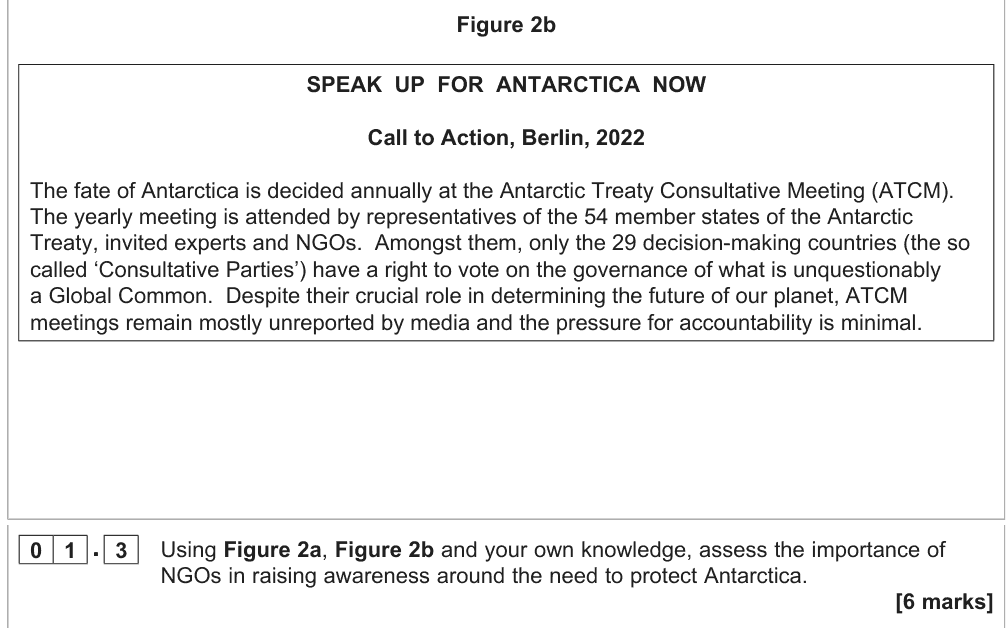
AO1 2, AO2 4: assess the NGO (UNLESS) campaign raising awareness that the ban on hydrocarbon extraction is not permanent (Protocol to 2048) and that ATCM decisions go unreported
must refer to the figures for Level 2
June 2024 · Paper 2 · Q1.420 marksmark scheme20-mark essay
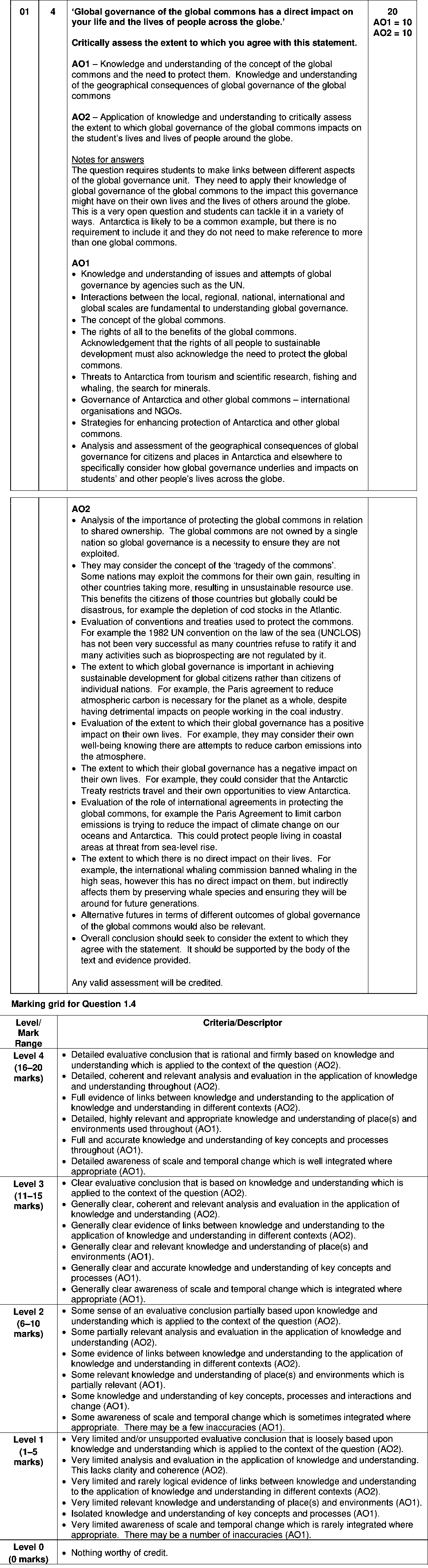
Mark scheme, including the levels and indicative content
Examiner's comment
The 20-mark essay questions continue to illustrate the strong subject knowledge, evaluative skills and preparation of many students. These questions differentiate well, and the increasing confidence shown in these was demonstrated with over 60% of entries attaining at least Level 3. The key is always to demonstrably address the question and to ensure that the application of knowledge and understanding (AO2) is evident with AO1 knowledge used in support. The best responses are clearly organised, follow a logical structure and take a clear and sustained line of reasoning before reaching a conclusion based on the evidence provided. At the other end of the scale, less successful responses can be attributed to a number of reasons – maybe the student misreads the question, sometimes they start out with good intent but then drift away from the question focus – a brief plan is often a precursor to a good response. Some students just do not know the relevant subject content – either they did not learn it or failed to effectively revise it. Sometimes responses can include examples that are over-simplified, out-dated or clichéd and there is limited evidence of deep knowledge and understanding. In 1.4 there was strong subject knowledge relating to the governance of the global commons (policies and issues pertaining to Antarctica were most frequently seen) and in 2.4 students demonstrated good knowledge and understating of either their local or distant place study in assessing the role of endogenous factors shaping lived experience. This example of a response to 1.4 shows a very good understanding of the global commons, detailed knowledge and understanding of policies to manage / mitigate impacts on Antarctica and climate change and possible impacts on lives of people around the world. The answer shows a detailed understanding of these approaches and makes effective evaluative statements before coming to a clear conclusion. This was assessed in Level 4 and it was awarded 20 marks. Responses do not need to be ‘perfect’ to be given this mark.
Notes from the mark scheme and report
links governance of the global commons (usually Antarctica: Treaty, Madrid Protocol, IWC, climate agreements) to impacts on the student's own and others' lives
Level 4 example scored 20
June 2023 · Paper 2 · Q1.420 marksmark schemeSynoptic
Mark scheme, including the levels and indicative content
Examiner's comment
The 20 mark responses in all 5 questions produced some interesting and considered responses from many students although some leaned very heavily on some outdated and clichéd views of places or made contrasts between places that were difficult to compare in a meaningful way. As mentioned in the introduction, there were some very clear and focused 20-mark responses and it is apparent that students are well-trained for these questions. Good practice was seen with responses that start with a clear position statement and then developed a clear thread with evidence from valid examples. This balance of AO1 and AO2 is the way to good marks. There should be a final conclusion that clearly links back to the question set. Where students did not perform as well in the essay questions, the opposite characteristics were often evident - namely, no clear position statement, copious AO1 retelling case study knowledge without application and an absent, vague or unsubstantiated conclusion. The cross-specification synoptic question this series appeared in unit 1 - 20 mark question Q1.4 was a particularly well-answered question. Many students relished the opportunity to discuss the threats posed by climate change, tourism, fishing and whaling, scientific research and potential future resource exploitation student and they were clearly able to link this part of the Human Geography specification to the Water and Carbon unit of Paper 1. Arguments were often well-constructed with good AO1 knowledge of the threats and strategies to manage them. For example, in Q1.4 there was plenty of detailed knowledge of Antarctica and the Southern Ocean, the threats from both climate change and the changing carbon budget along with other issues such as fishing and whaling, tourism, scientific research and the future prospect of resource exploitation. Students were also conversant with the organisations and agreements in place to manage Antarctica and could provide effective critique. The example below illustrates all of these characteristics and was awarded Level 4, 18 marks. In Q1.4 some students failed to consider threats beyond climate change or drifted into a discussion of the causes of climate change such as deforestation of the rainforests. (The existence of polar bears in Antarctica was an all too frequent worry!). The example below is a student response to Q1.4 and whilst is presents a view it is clear there is a lack of depth and detail with regard to the subject content. It just gets into Level 2 and was awarded 6 marks. The synoptic question appears once each series in either Paper 1 or Paper 2 and makes links across specification content. The question illustrated above was the synoptic question linking between the Physical and Human geography content of the specification. It was approached well by the vast majority of students and scored the highest mean mark of all the 20 mark questions. Students were able to make the links between the carbon cycle, climate change and the extent of the threats to Antarctica and the Southern Ocean as well as considering other threats facing the region. In Q1.4 there was often very detailed knowledge of the threats alongside the organisations and policies / agreements being put in place. Many students could make effective connections to the physical side of the changes with good knowledge of systems, feedback loops and dynamic equilibrium. The longer-term future was also a feature of many responses and students considered the possibility of Antarctica being ‘opened up’ to exploitation of fossil fuel and mineral resources as more ice melts and protocols come to the end of their life span. There was certainly good evidence of synoptic thinking in the responses to this question. Those students who did not respond so well in this question often had a very basic or absent understanding of the carbon cycle and its effects on Antarctica, sometimes their discussion was directed more to the worldwide causes of climate change or they failed to appreciate the range of other threats in the region.
Notes from the mark scheme and report
synoptic question (links Global governance with Water and carbon cycles): carbon-cycle change (ice-shelf break-up, ocean warming and acidification, phytoplankton feedback) weighed against fishing, whaling, tourism, research and future mining, with governance
highest-mean 20-mark question
do not drift into causes of climate change
June 2022 · Paper 2 · Q1.14 marksmark schemePoint-marked
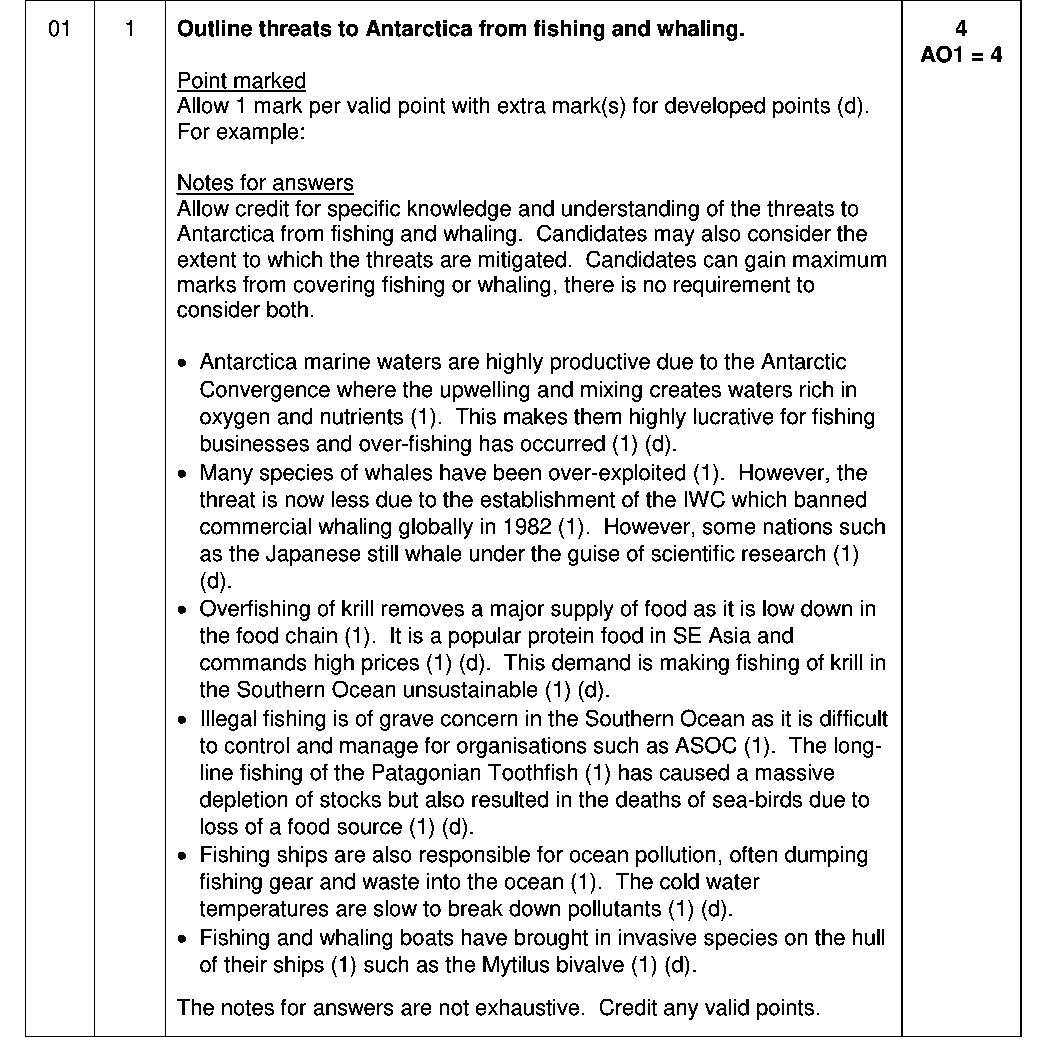
Mark scheme
Examiner's comment
This question was answered well by a large majority of students. A high proportion reached 3 or 4 marks. Most students focused on the negative changes to food webs/chains and the threat of extinction. Better responses went on to develop these points and add support through specific examples. Weaker responses tended to focus on vague threats eg ‘whaling impacts food chains’, without any qualification as to what the impact was. This was not creditworthy.
Notes from the mark scheme and report
point marked
full marks possible from fishing or whaling alone
overfishing of krill and toothfish, food-web effects, illegal fishing, pollution, invasive species, whaling under 'scientific research'
vague threats such as 'whaling impacts food chains' with no stated impact not credited
June 2022 · Paper 2 · Q1.26 marksmark schemeData analysis
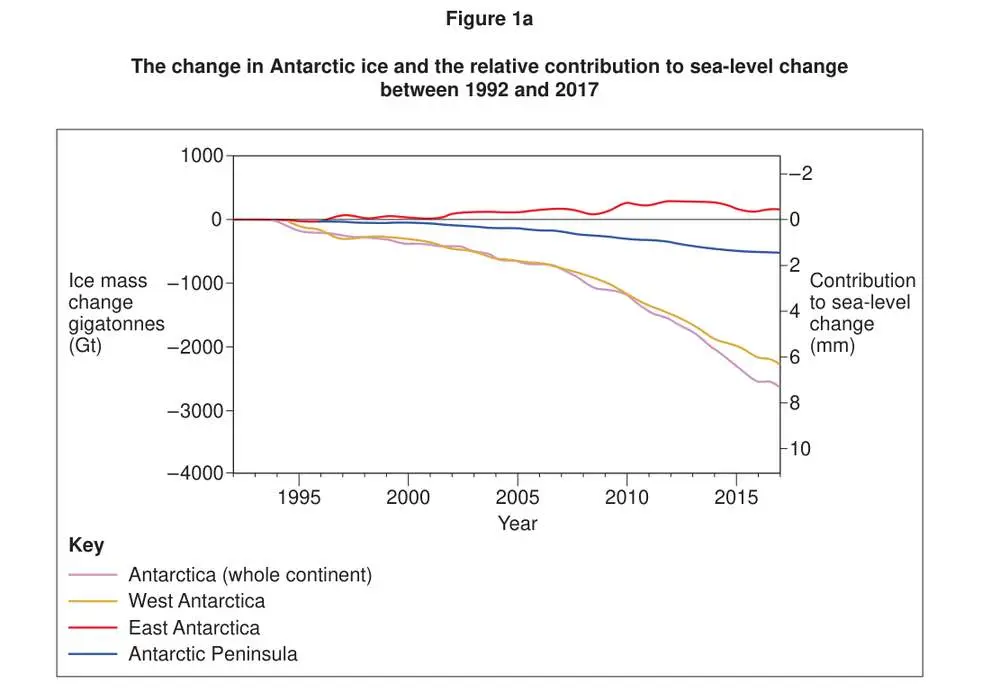
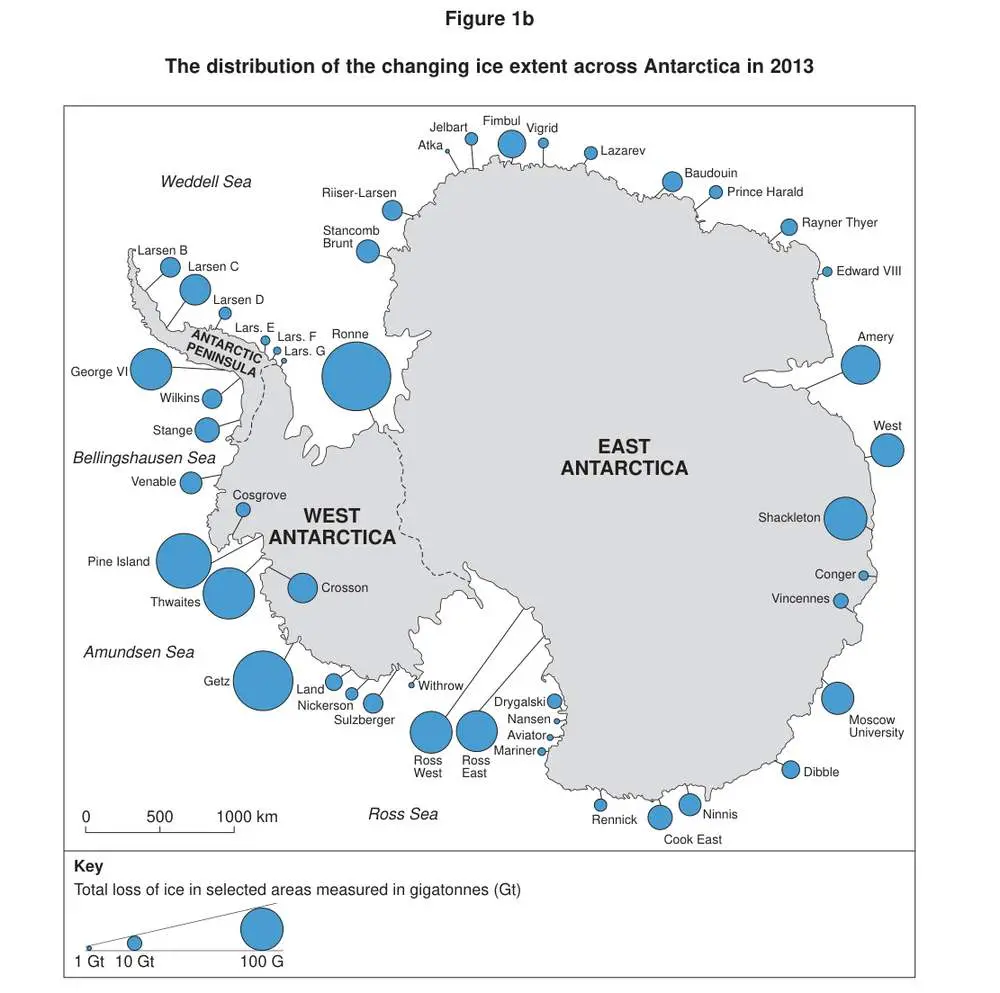
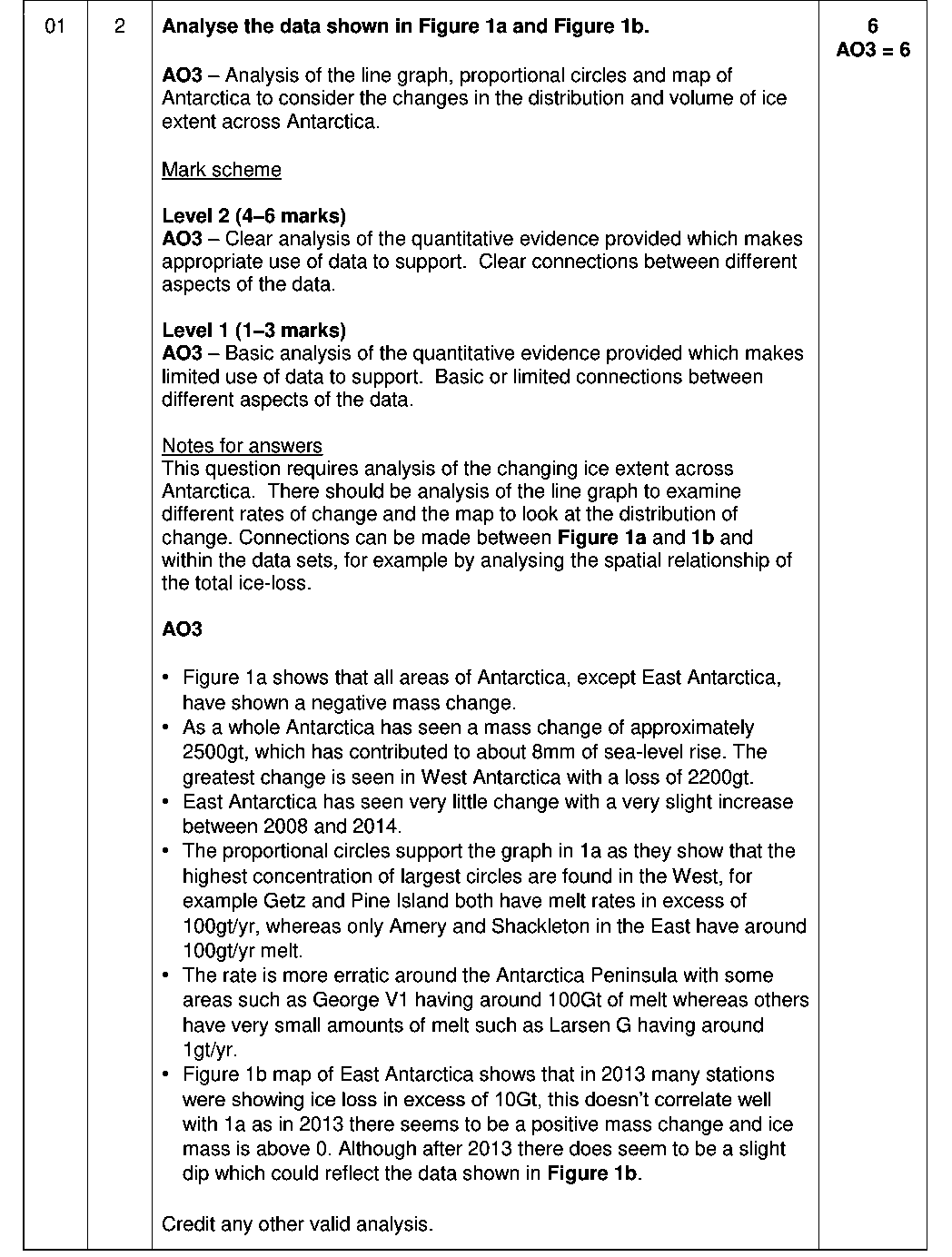
Figures 1a, 1b
Mark scheme, including the levels and indicative content
Examiner's comment
This was the highest performing AO3 question on the paper, with three-quarters of students achieving L2. Most students were able to use Figure 1a to pick out the main trends, focusing on Antarctica overall, then looking at the breakdown of the different regions. They were able to support the trends with data. Weaker answers often failed to pick up on the reduction in sea-level as a result of an increase in ice-mass in East Antarctica. The better responses went on to look for connections with Figure 1b and used examples of stations to support the trends seen in Figure 1b.
Notes from the mark scheme and report
AO3: whole continent lost about 2500 Gt (about 8 mm sea-level rise), West Antarctica most, East Antarctica slight gain
proportional circles show largest losses in the west (Getz, Pine Island)
connect the two figures
weaker answers missed the East's ice gain lowering sea level
November 2021 · Paper 2 · Q1.420 marksmark scheme20-mark essay
Mark scheme, including the levels and indicative content
Notes from the mark scheme and report
appraise how far climate change and economic pressures (fishing, minerals, tourism) make the global commons harder to protect, weighed against governance (Antarctic Treaty, Madrid Protocol, IWC, NGOs)
Antarctica is a steer, other global commons accepted
November 2020 · Paper 2 · Q1.36 marksmark schemeStimulus
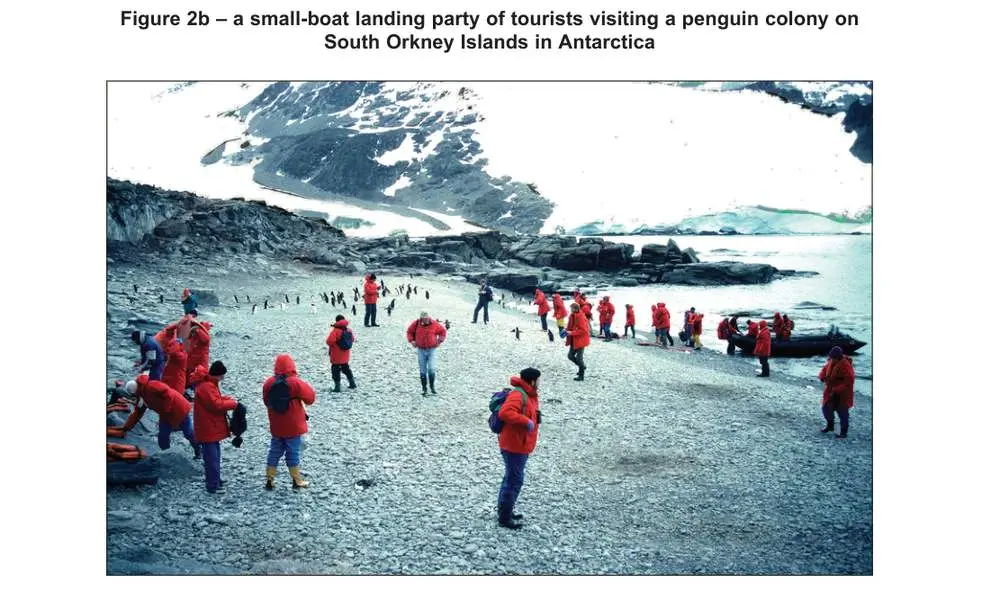
Figures 2a, 2b
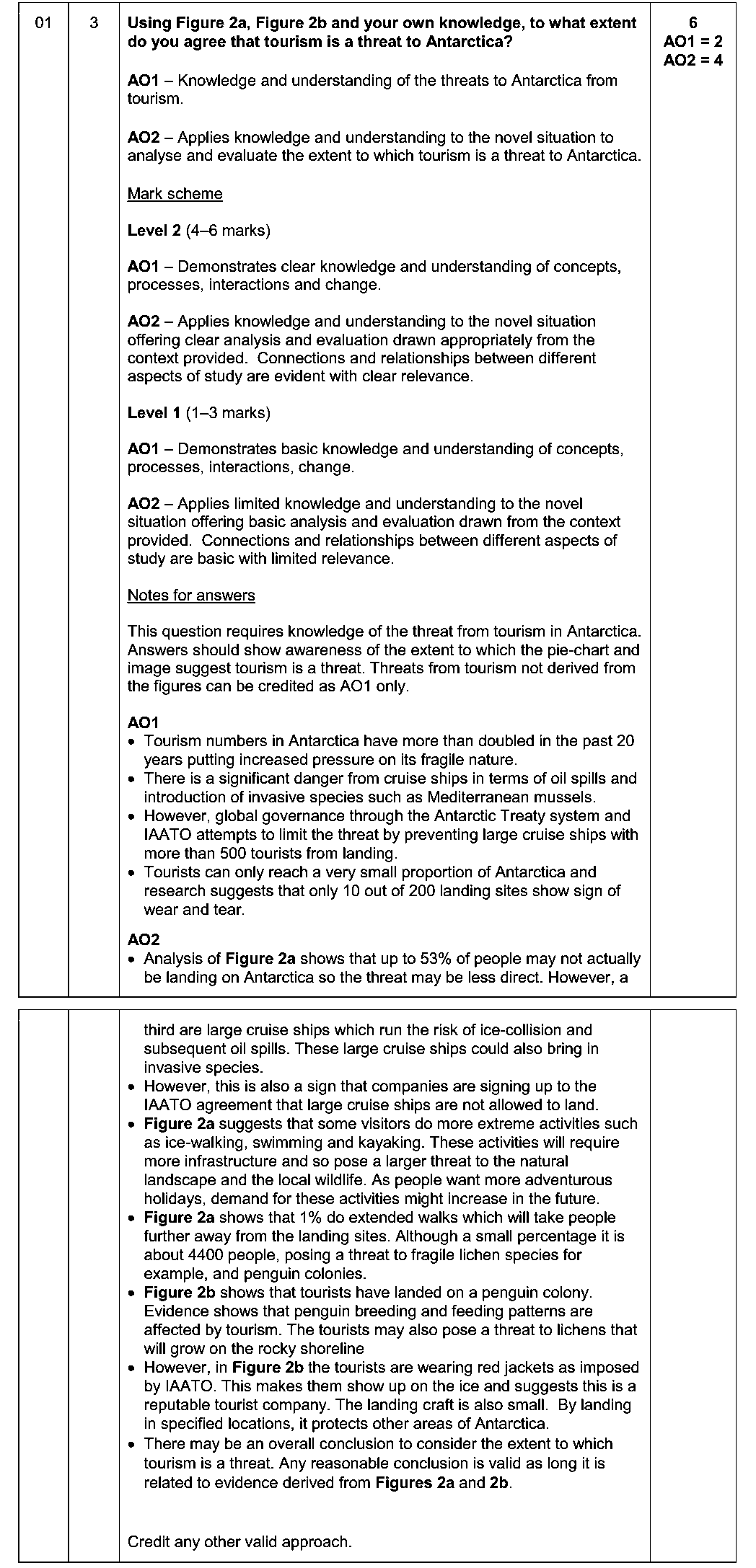
Mark scheme, including the levels and indicative content
Notes from the mark scheme and report
AO1 2, AO2 4: apply threats (cruise ships, oil spills, invasive species, wildlife disturbance) and IAATO/Antarctic Treaty limits to the pie chart and photo
threats not drawn from the figures are AO1 only
June 2019 · Paper 2 · Q1.420 marksmark scheme20-mark essay
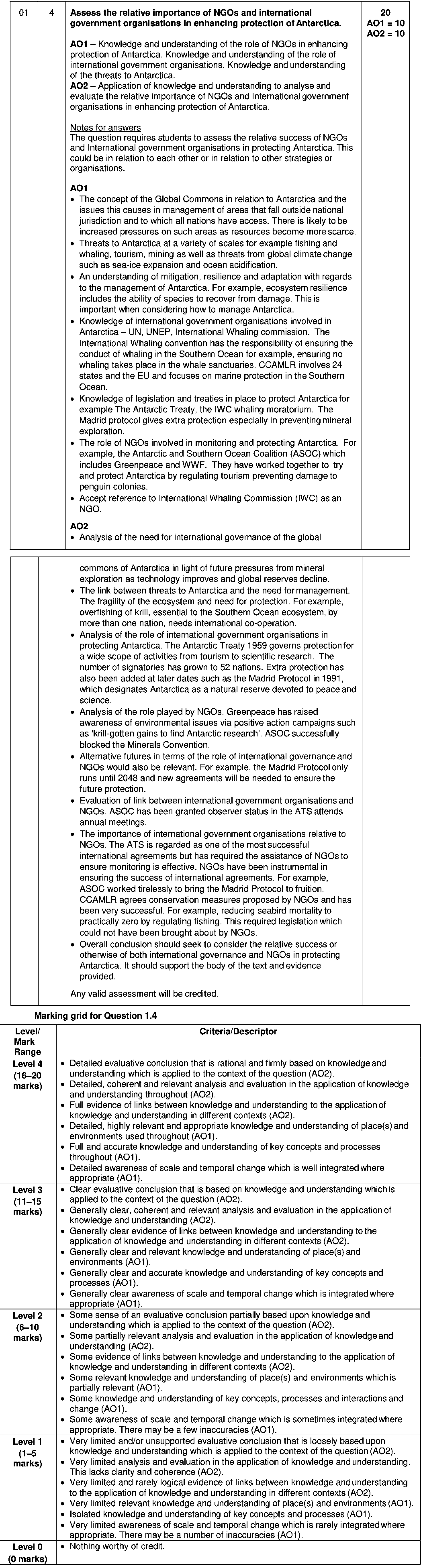
Mark scheme, including the levels and indicative content
Examiner's comment
Some of the responses to this question were simply outstanding. Students often displayed extensive knowledge of Antarctic NGOs and IGOs and were then able to evaluate their specific success in protecting Antarctica. The most successful answers dealt with all aspects of the question, addressing the command to thoroughly evaluate relative importance in enhancing protection. Some of the better answers also considered that NGOs and IGOs are more successful when they work together and a considered view of the future threats and need for enhanced protection, demonstrating the breadth with which students can tackle these 20 mark questions. Less effective responses frequently relied on knowledge and understanding of the threats to Antarctica or the strategies used to protect it, without marrying the two together. Others relied heavily on the Antarctic Treaty and failed to consider other strategies. Such responses tended to reflect a lack of understanding of the demands of the question. Some responses referred to specific strategies without identifying them as either NGOs or IGOs and therefore did not address the question successfully.
Notes from the mark scheme and report
must weigh NGOs (ASOC, Greenpeace, WWF) against IGOs and treaties (Antarctic Treaty, Madrid Protocol, CCAMLR, IWC) and link them to specific threats
IWC may be credited as an NGO
weaker answers relied on the Antarctic Treaty alone or listed threats without linking to protection
June 2018 · Paper 2 · Q1.14 marksmark schemePoint-marked
Mark scheme
Examiner's comment
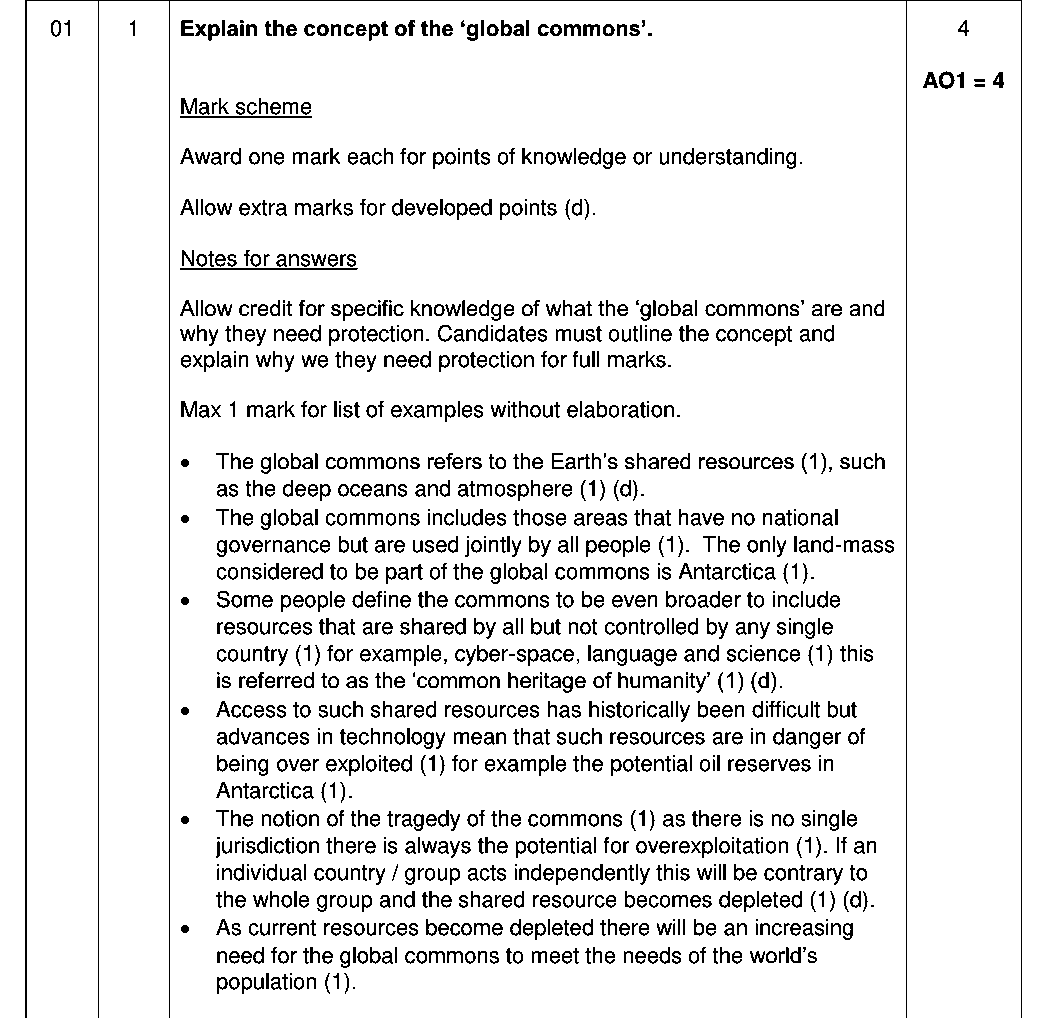
Almost all students had some knowledge of the global commons and were able to illustrate it with examples. However very few were able to access maximum marks. Students needed to provide more detail in these short-answer questions. Many gave only a basic definition and examples scoring 2 marks.
Notes from the mark scheme and report
point marked with developed points (d)
must outline the concept and say why the commons need protection for full marks
max 1 for a list of examples
many gave only a basic definition plus examples (2 marks)
June 2018 · Paper 2 · Q1.26 marksmark schemeData analysis
Mark scheme, including the levels and indicative content
Examiner's comment
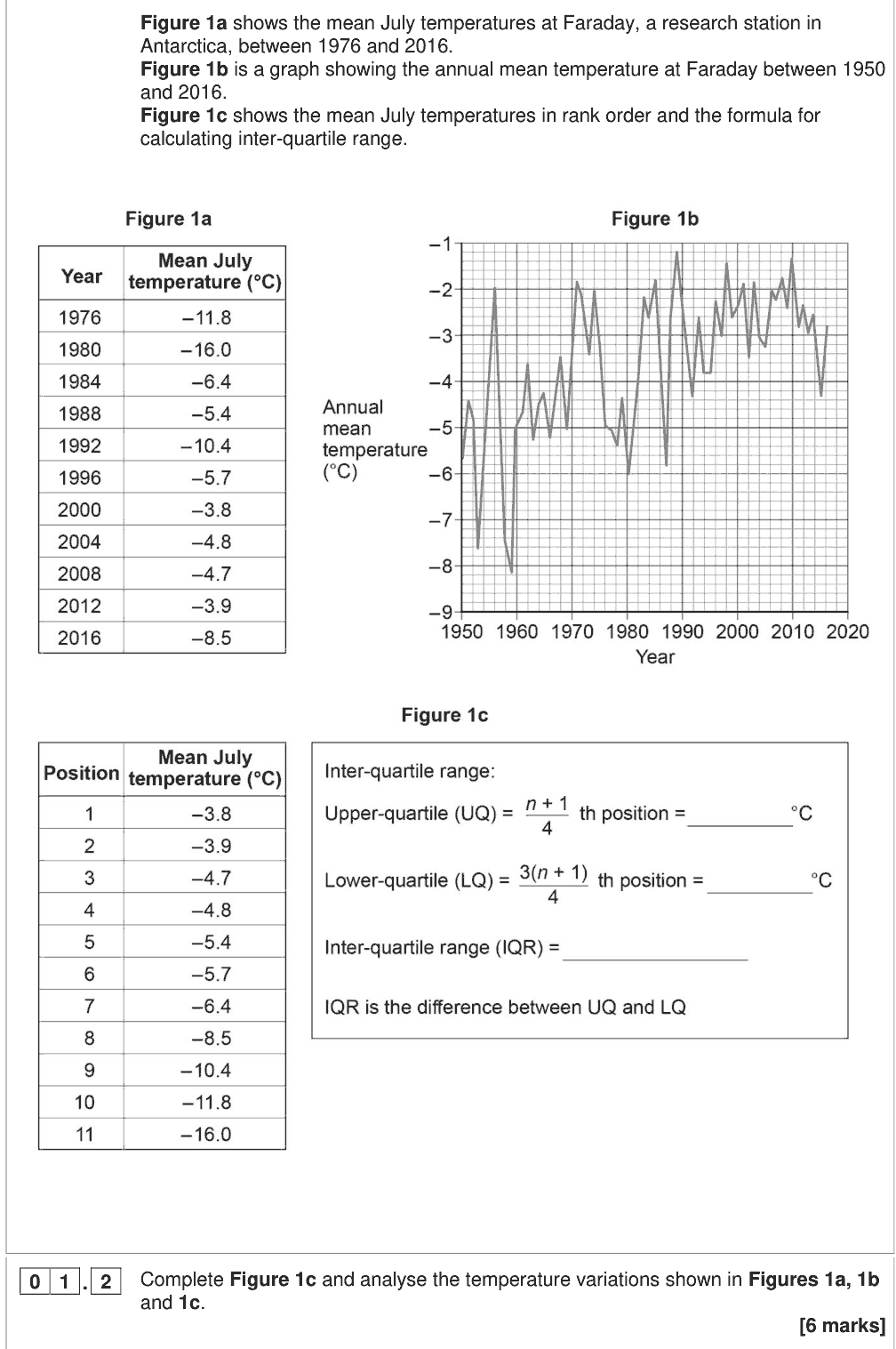
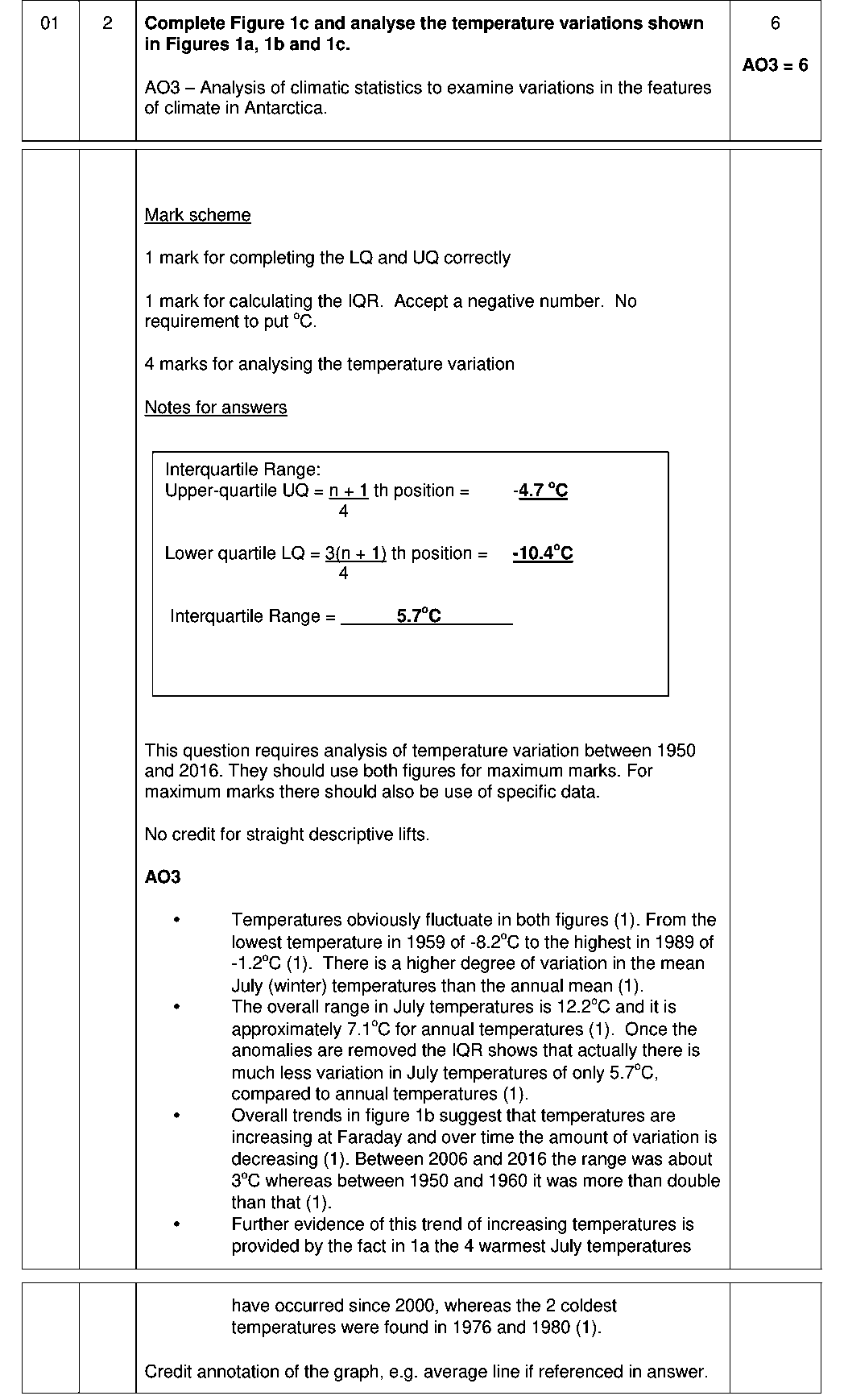
AO3 applied in this paper whenever a stimulus resource was used with the command analyse, for example 1.2, 2.2, 3.5, 4.5 and 5.5. The main issue here was that many students offered answers which better addressed AO2 requirements by applying their knowledge (offering reasons for patterns, for example) and this was fundamentally not creditworthy. The command ‘analyse’ in this context, required students to engage with the data and deconstruct the information. Furthermore students should be encouraged to manipulate data rather than simply describe it, as description does not constitute analysis. For the first part of this question, students were required to calculate the IQR using the formulas given. IQR is a range and therefore should not generate a negative number. When calculated correctly the IQR was 5.7oC. However, many students wrote -5.7oC. This may have been because the numbers were all negative or it may have been due to some students taking the UQ from the LQ. In geography, it is conventional to rank the highest value (in a data set) as one. Allowance was made for students who gave a negative value. Some students simply gave the position (i.e. 3rd and 9th) and this was not credited. Far too many students were unable to do the IQR at all – geographical and maths skills need to be taught and embedded as part of the A level course. The analysis that followed the calculation frequently was very imprecise. Far too many students use phrases such as ‘it increased by around ’. They needed to be more precise and show accurate use of data. Analysis is not simple description so there was no credit for simply lifting data without any context. It was very clear when students were versed in what ‘analysis’ means and they were able to deal with the question effectively. These students scored well by looking at overall trends, making connections between Figures 1a and 1b and manipulating data effectively in support. For example, many noted that the lowest July temperature in Figure 1a in 1980 also corresponded with the lowest mean annual temperature for those years at -6oC.
Notes from the mark scheme and report
1 mark UQ and LQ, 1 mark IQR, 4 marks analysis
Answer: UQ -4.7 °C, LQ -10.4 °C, IQR 5.7 °C (negative value accepted
positions alone not credited)
AO3 only: explaining patterns not credited
use precise data and link Figures 1a and 1b
Specimen set 1 · Paper 2 · Q1.26 marksmark schemeData analysis
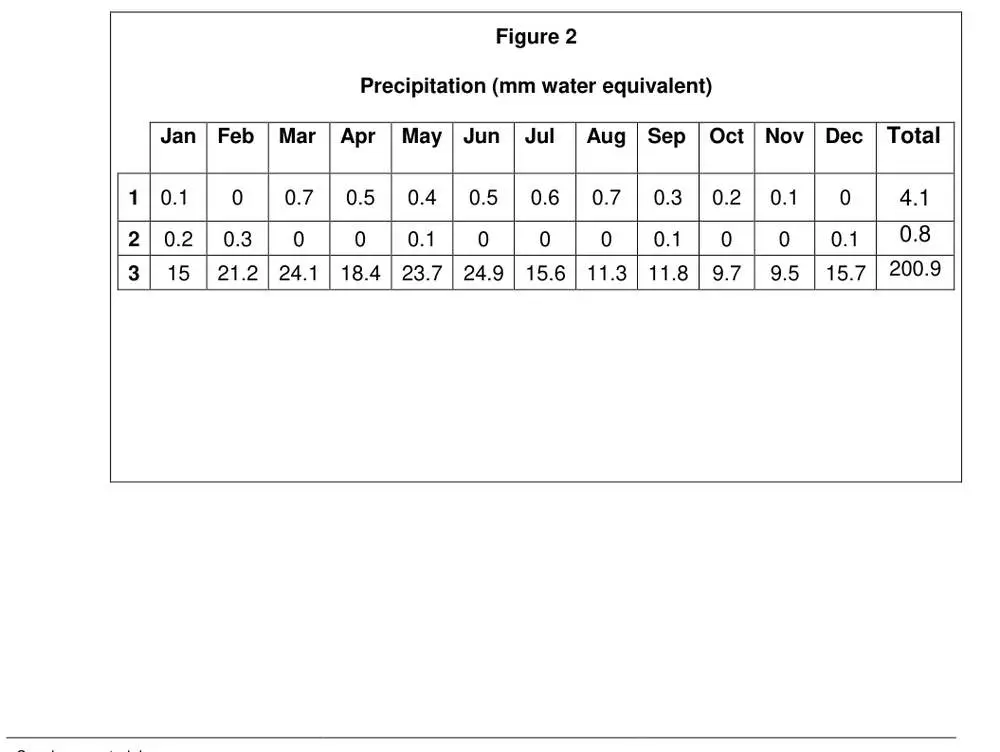
Figures 1, 2
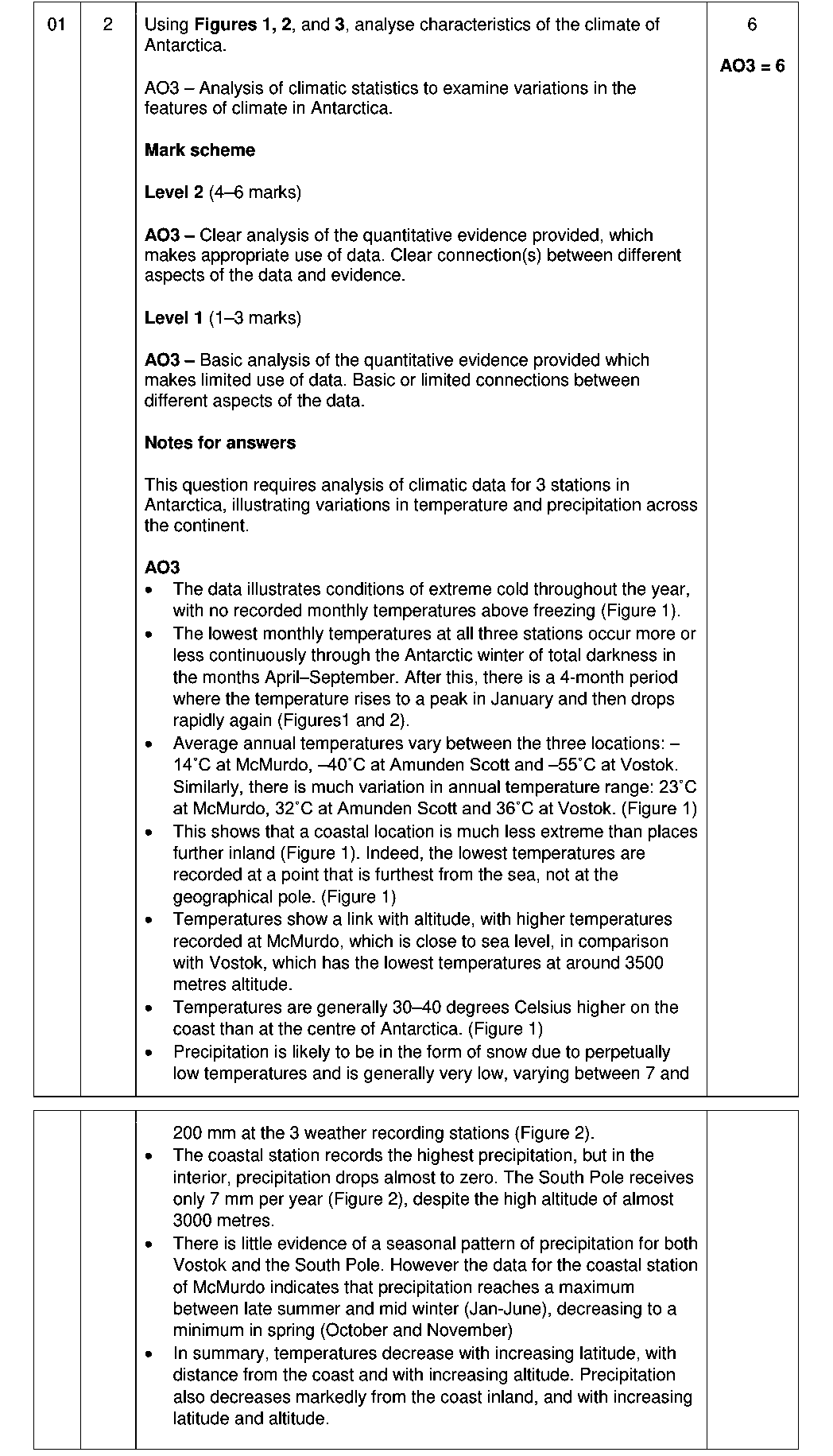
Mark scheme, including the levels and indicative content
Notes from the mark scheme and report
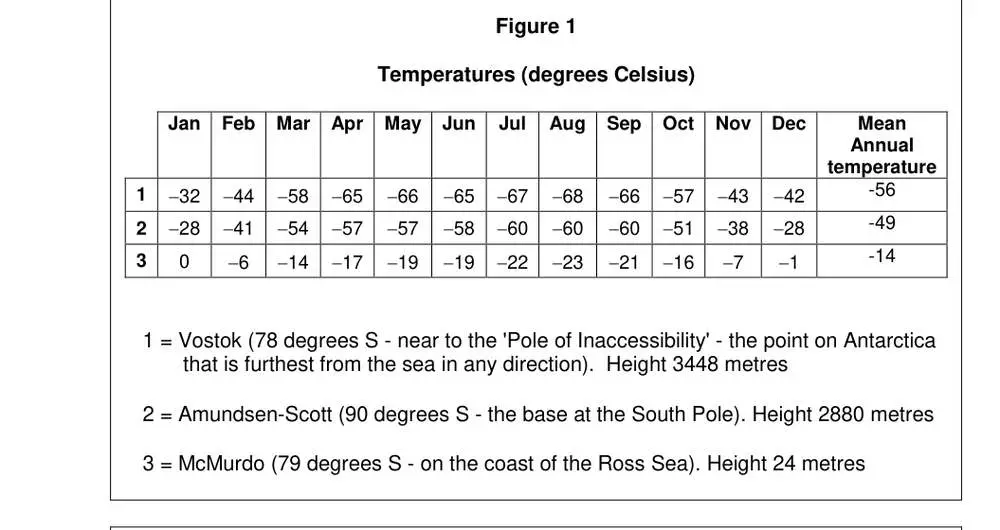
AO3: all monthly temperatures below freezing
coldest Apr–Sep in polar night
coast (McMurdo −14 °C, 200.9 mm) far milder and wetter than inland/high stations (Vostok −56 °C, 4.1 mm)
link to altitude, distance from sea and day length (Figure 3)
Specimen set 1 · Paper 2 · Q1.420 marksmark scheme20-mark essay
Mark scheme, including the levels and indicative content
Notes from the mark scheme and report
weigh threats under globalisation (fishing/IUU, krill, tourism, minerals, climate change) against governance (Antarctic Treaty, Madrid Protocol, CCAMLR, IWC, NGOs) to judge sustainability
Work with an AQA Geography tutor
Essays stuck in the middle levels, or losing marks on the data questions? Book a trial lesson with a specialist AQA Geography tutor.