3.1.6.3-01 The concept of the biome. The global distribution of major terrestrial biomes.A level only
3.1.6.3-02 The nature of two contrasting biomes: tropical rainforest and savanna grassland to include: • the main characteristics of each biome • ecological responses to the climate, soil and soil moisture budget – adaptations by flora and fauna • human activity and its impact on each biome • typical development issues in each biome to include changes in population, economic development, agricultural extension and intensification, implications for biodiversity and sustainability.A level only
‘It is simply not possible to find a true balance between biodiversity and sustainable economic development in savanna grasslands. Economic development will always come at the expense of biodiversity.’ To what extent do you agree with this view?
Tap a question to zoom it. The figures open above it; the mark scheme (with its levels and indicative content) and the examiner's comment open underneath.
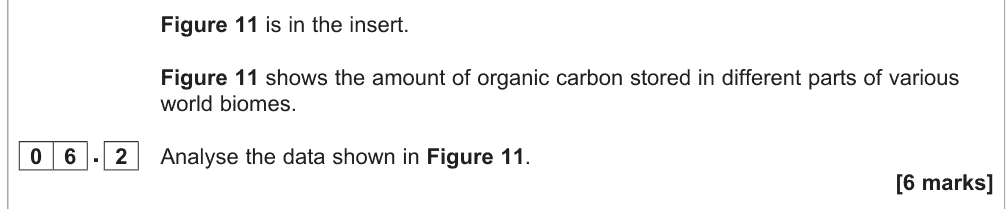
June 2025 · Paper 1 · Q6.26 marksmark schemeData analysis
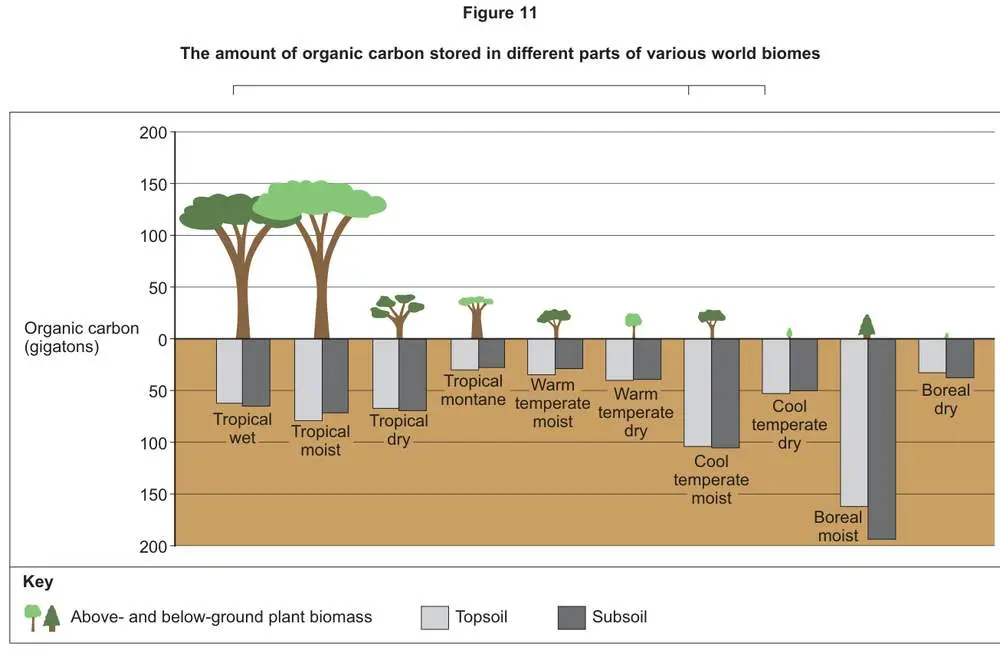
Figure 11
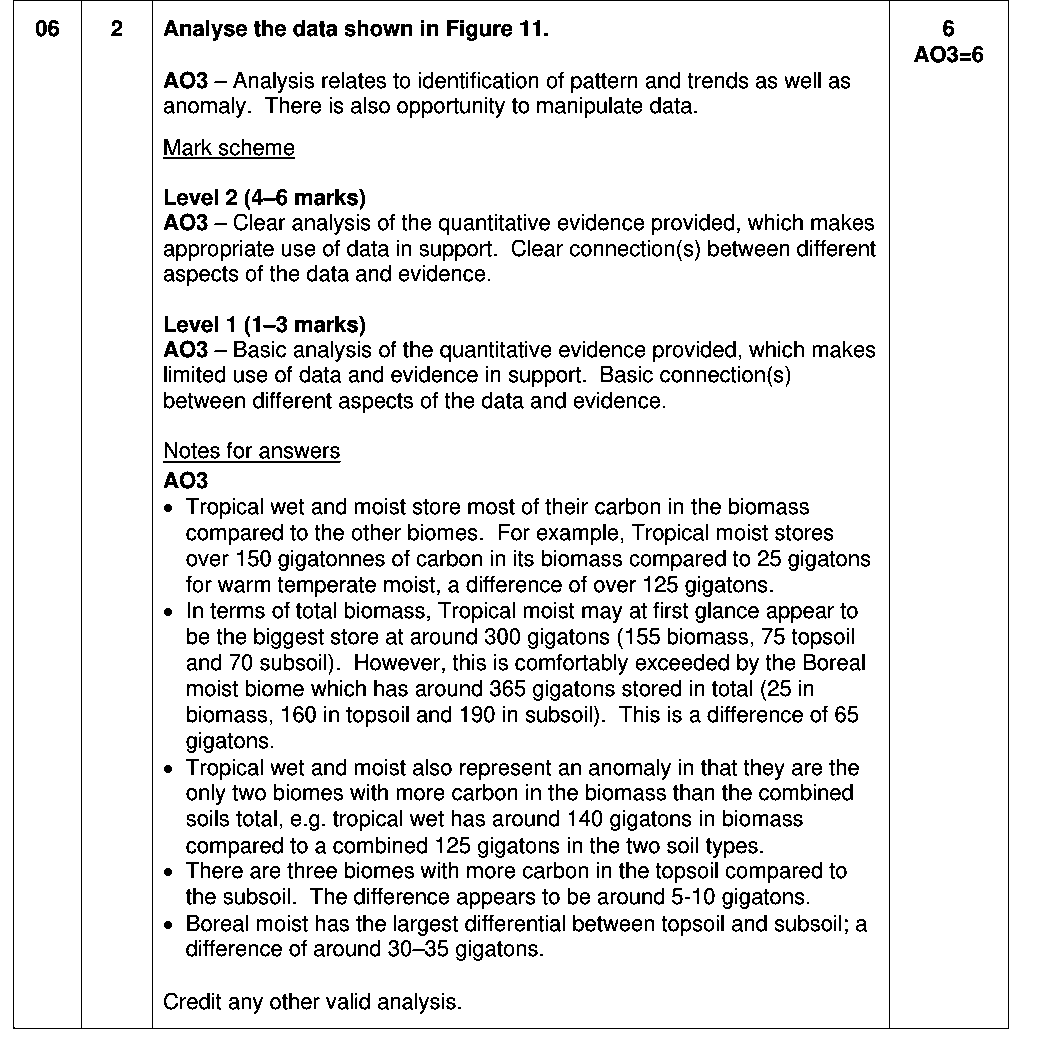
Mark scheme, including the levels and indicative content
Examiner's comment
These questions assess how students interpret, analyse and evaluate data, evidence and resources. In general, analysis and interpretation of map evidence requires further development. Question 01.2, 04.2 and 06.2 were very accessible. Students coped with these graphically based questions, identifying patterns, manipulating data and picking out anomalies in support.
Notes from the mark scheme and report
AO3: tropical wet/moist store most carbon in biomass (only biomes with more in biomass than soil), but boreal moist has the largest total, mostly in soil
topsoil vs subsoil differences
manipulate values
June 2025 · Paper 1 · Q6.49 marksmark schemeSynoptic
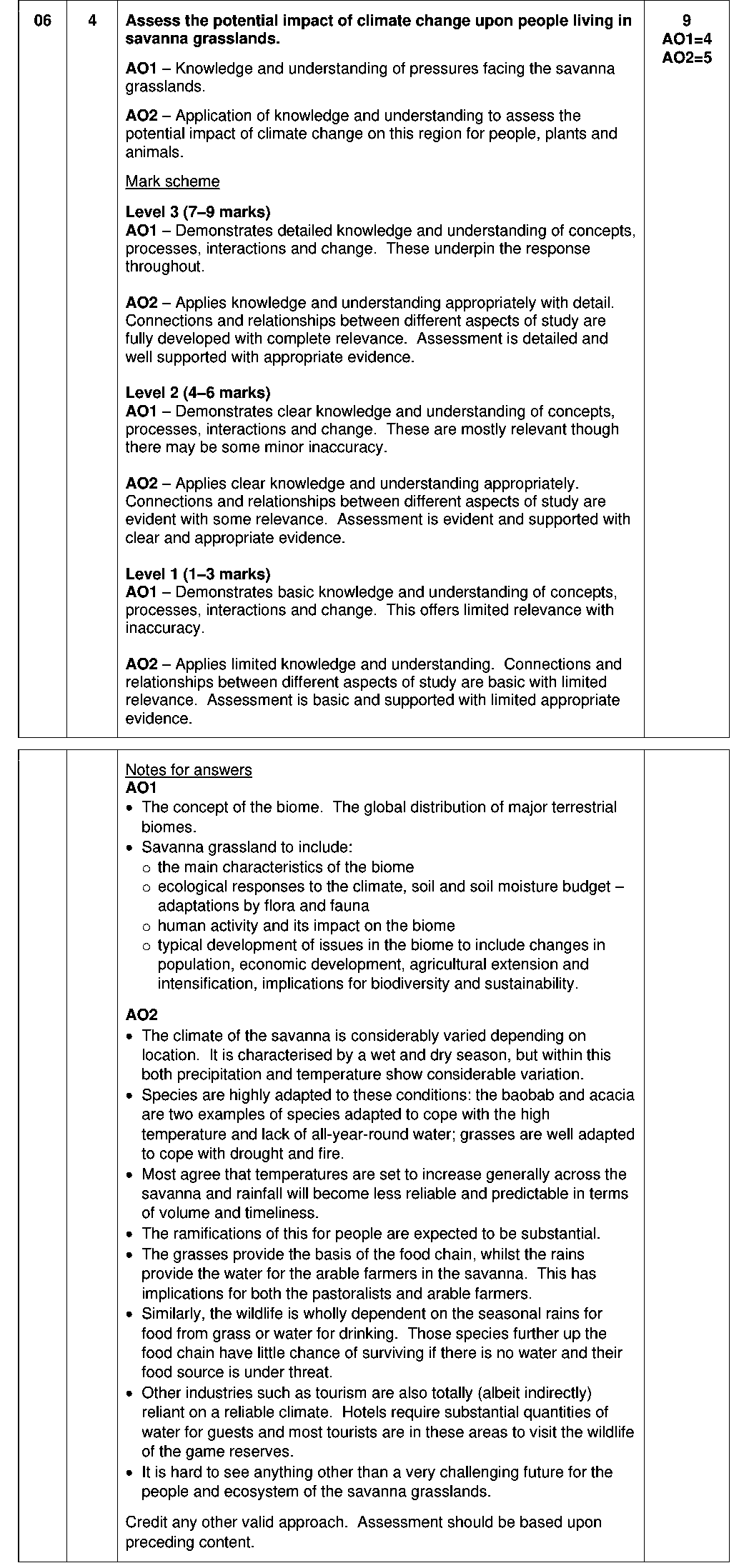
Mark scheme, including the levels and indicative content
Examiner's comment
These questions assess knowledge and understanding of links made within or across specification units. The 9-mark AO1/AO2 questions in Section C produced similar outcomes, though question 06.4 was a little stronger more generally. Question 06.4 (AO1 & AO2) (9 marks) required consideration of the likely impacts of climate change on savanna grasslands, with a particularly focus upon people. So, whilst climate change initially affects the natural environment, it was the knock-on effects to people which really triggered the credit. This response offered strong knowledge and understanding but also applied this well to show understanding of how people may face negative impacts arising out of the changes. Level 3 (9 marks)
Notes from the mark scheme and report
report groups this as the synoptic 9-mark question
focus on people: less reliable rains and higher temperatures affecting pastoralists, arable farmers, water supply and wildlife tourism
climate impacts on the natural environment only credited via knock-on effects for people
June 2023 · Paper 1 · Q6.520 marksmark scheme20-mark essay
Mark scheme, including the levels and indicative content
Examiner's comment
For the 20-mark questions there was a more physical focus to most of the questions in this series. Those that prepared well (and, crucially, those that read the questions carefully), comfortably scored Level 3/4. It was pleasing to see so many well-constructed essays. Typically many students asserted their own position in relation to the question at the outset (AO2 – argument) before proceeding to argue their points (AO2) and back this up with solid subject knowledge (AO1). Their conclusions then often returned to the theme of the question and pulled together the previously argued points into one closing paragraph. Generally, new content should not be introduced into the conclusion. Also supporting knowledge and understanding should be relevant and be used to help articulate the position in relation to the question. Those who read the questions carefully, answered the question in a clear structure and supported this with detailed knowledge easily accessed Level 3/4. Q6.5 was an accessible question for most students. Knowledge of development pressures facing the Amazon and the Savanna was generally impressive. Students were generally well prepared for Q.6.5. Many had strong support on the development pressures though they needed to remain focused and not drift in to general pressures faced these locations.
Notes from the mark scheme and report
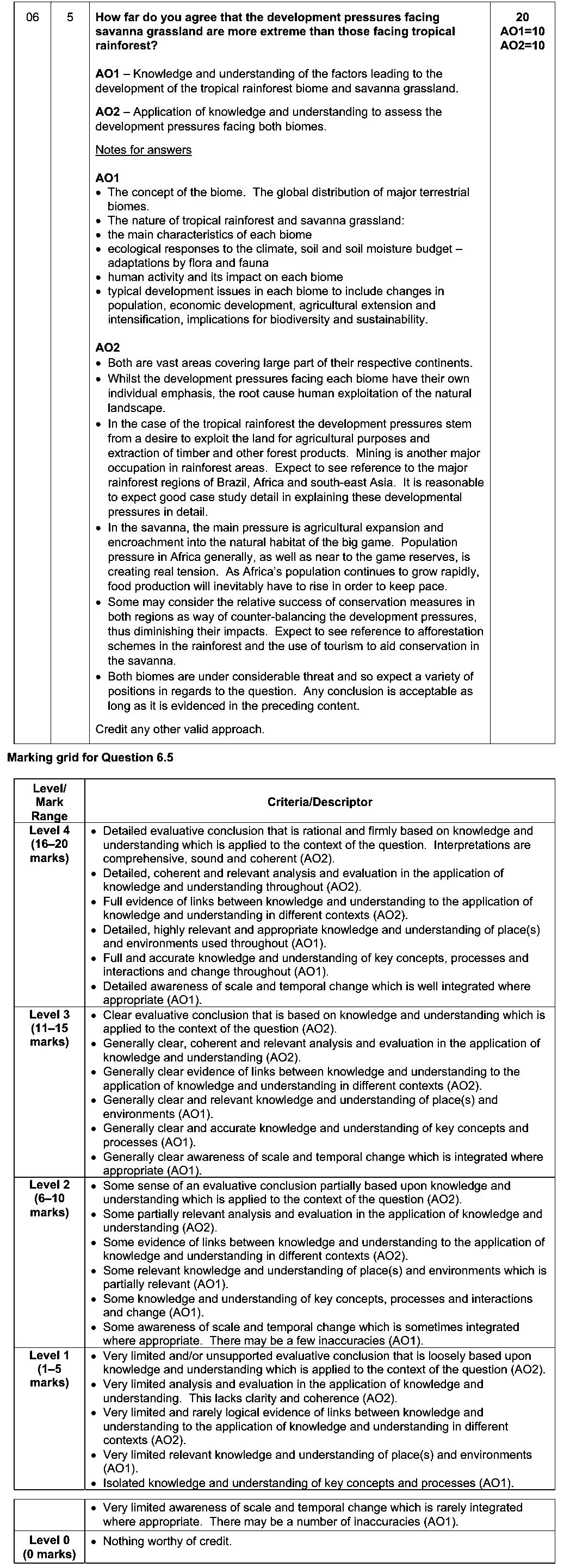
compare development pressures: rainforest (farming, logging, mining) vs savanna (agricultural expansion, population growth, game reserves)
conservation as counterweight
stay focused on development pressures
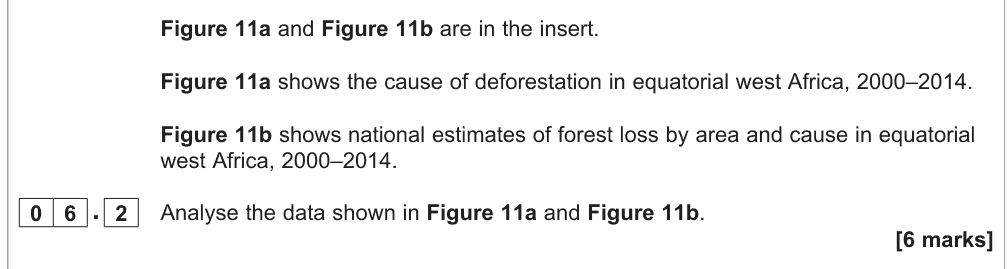
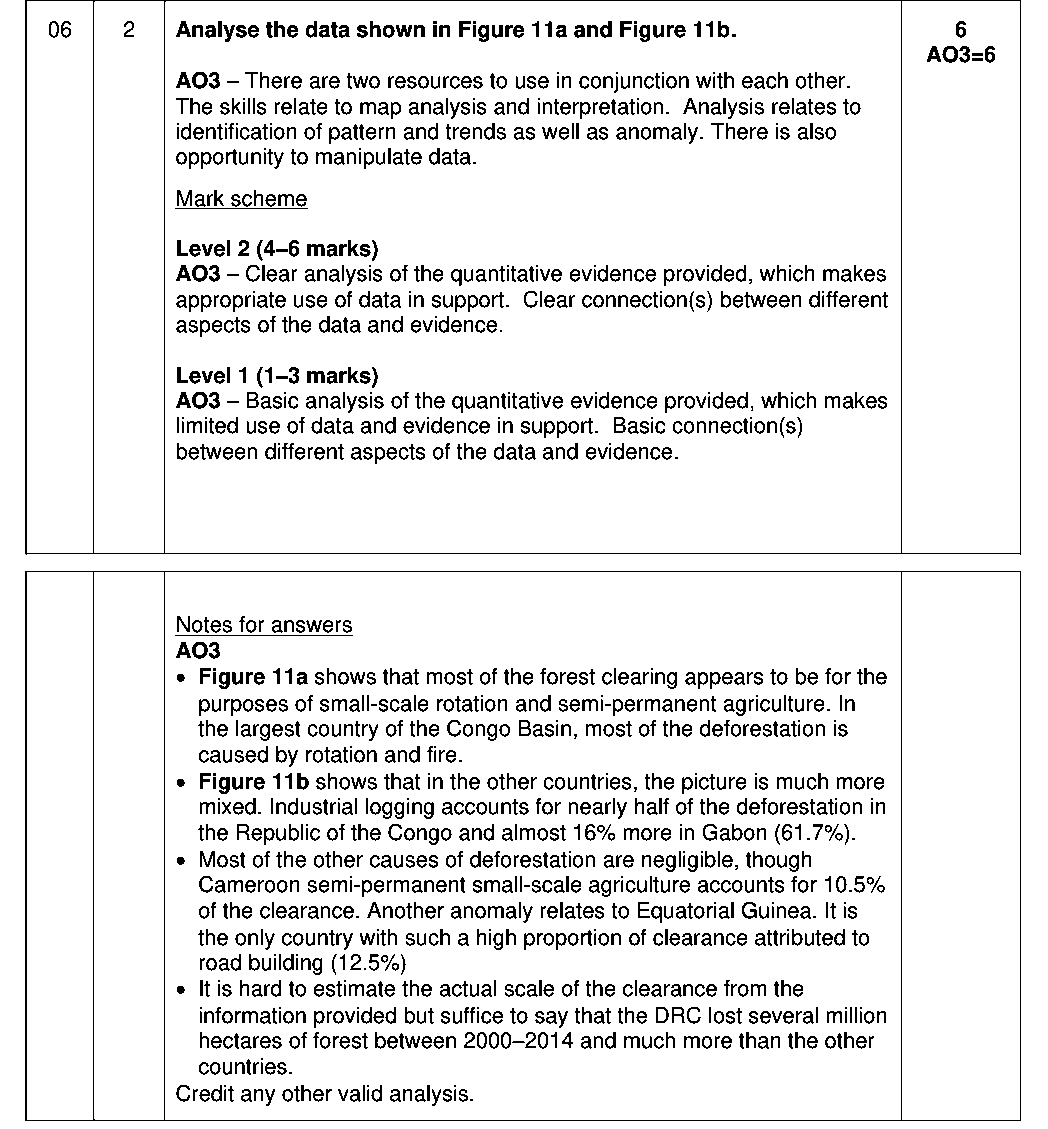
June 2022 · Paper 1 · Q6.26 marksmark schemeData analysis
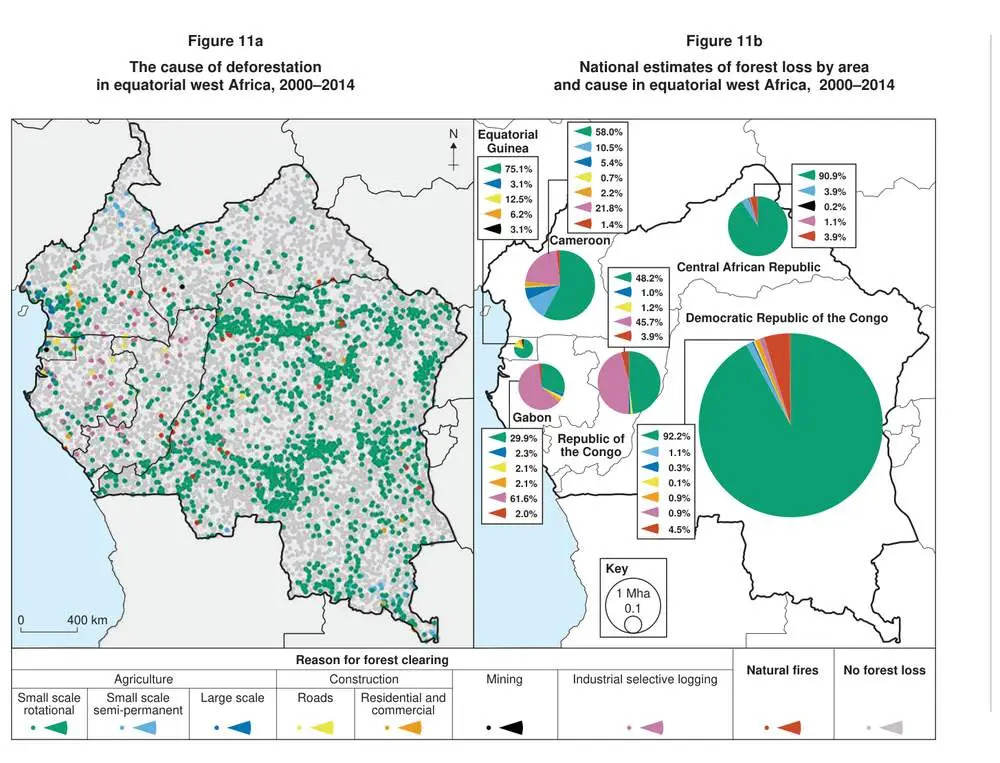
Figure 11a
Mark scheme, including the levels and indicative content
Examiner's comment
There was plenty to analyse in this question. Stronger responses took an overview of the trends and patterns and then used some data to exemplify. Manipulation of data was relatively easy to perform but some seemed to do this without connecting to patterns or anomalies. It was also possible to connect different aspects of the data e.g. the dot maps and pie charts. This is a key feature of a Level 2 response and some need more practice on this skill.
Notes from the mark scheme and report
AO3: dot map and proportional pie charts of causes of forest loss
small-scale rotational agriculture dominant (DRC 92.2%), industrial logging in Republic of the Congo and Gabon, roads in Equatorial Guinea as anomaly
connect the two figures for Level 2
June 2022 · Paper 1 · Q6.39 marksmark schemeStimulus
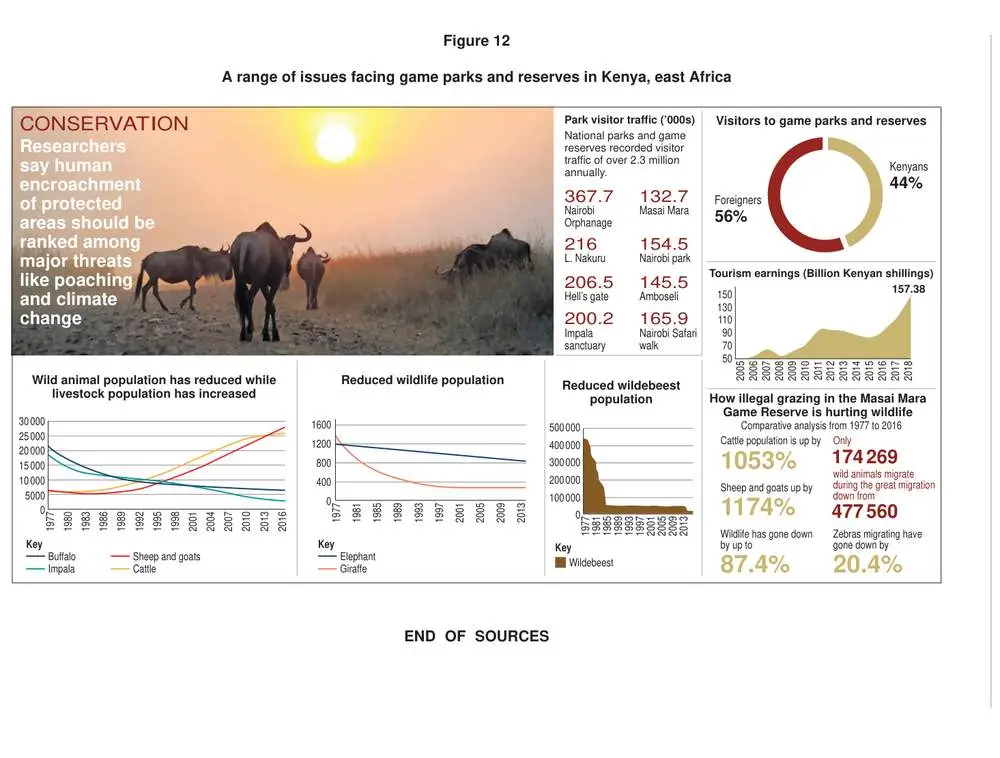
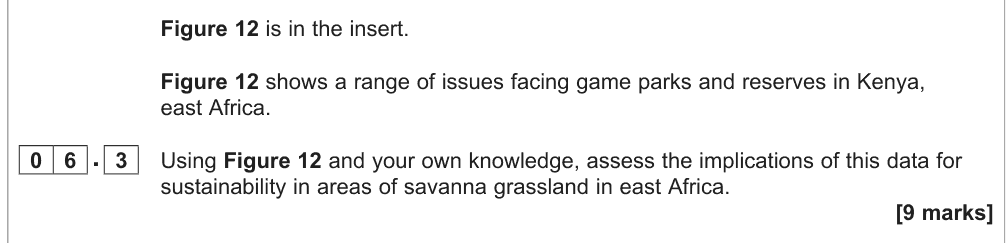
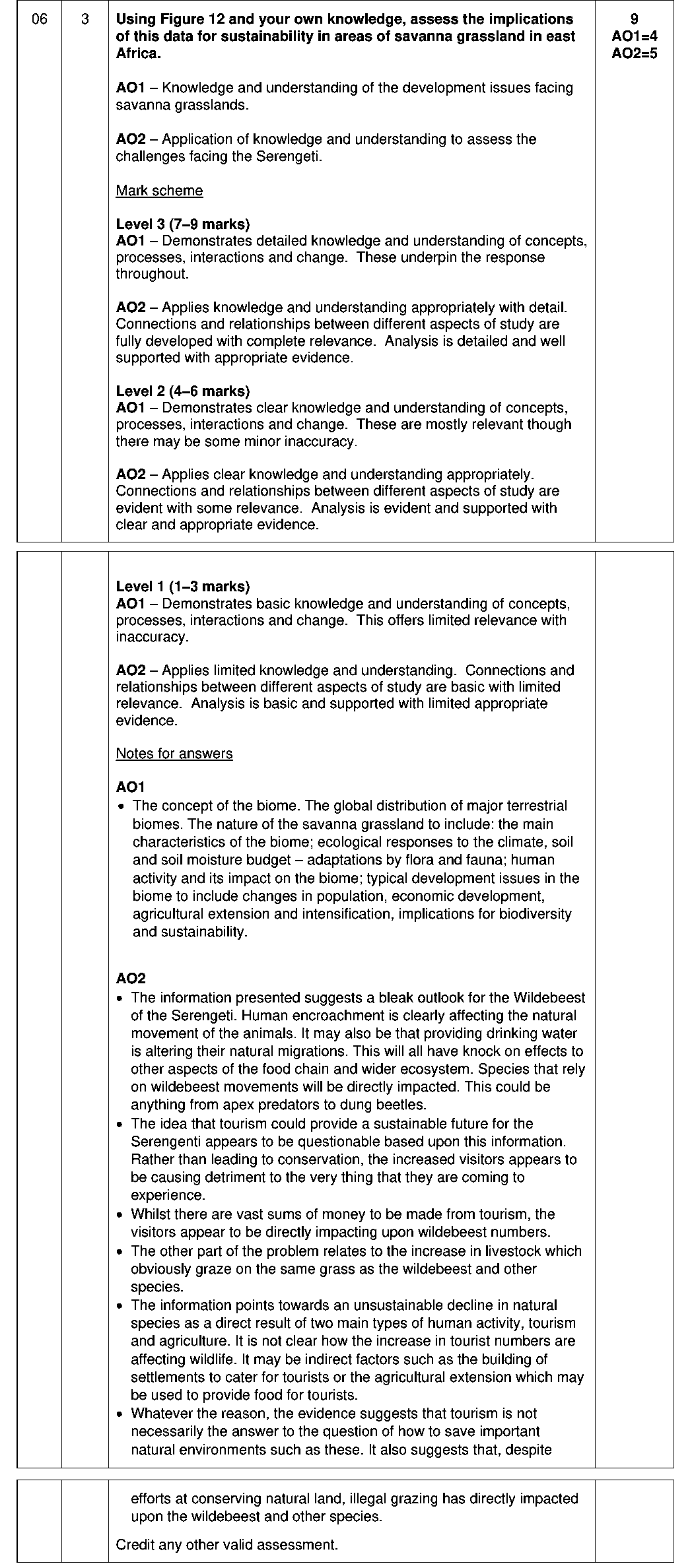
Figure 12
Mark scheme, including the levels and indicative content
Examiner's comment
There was plenty of evidence that the issues facing the Savanna can only really lead to the conclusion that current human activity is highly unsustainable, not least due to the dramatic decline in big game. Some brought in their knowledge and understanding of the impact of farming on the biodiversity and soils and this was an effective approach. Those who described / analysed the data without applying their own knowledge or drawing a conclusion on the implications of the data, scored little or no credit.
Notes from the mark scheme and report
apply knowledge of savanna development issues (grazing, tourism, encroachment, biodiversity, soils) to judge sustainability - evidence points to unsustainable decline of wildlife
describing or analysing the data alone scored little
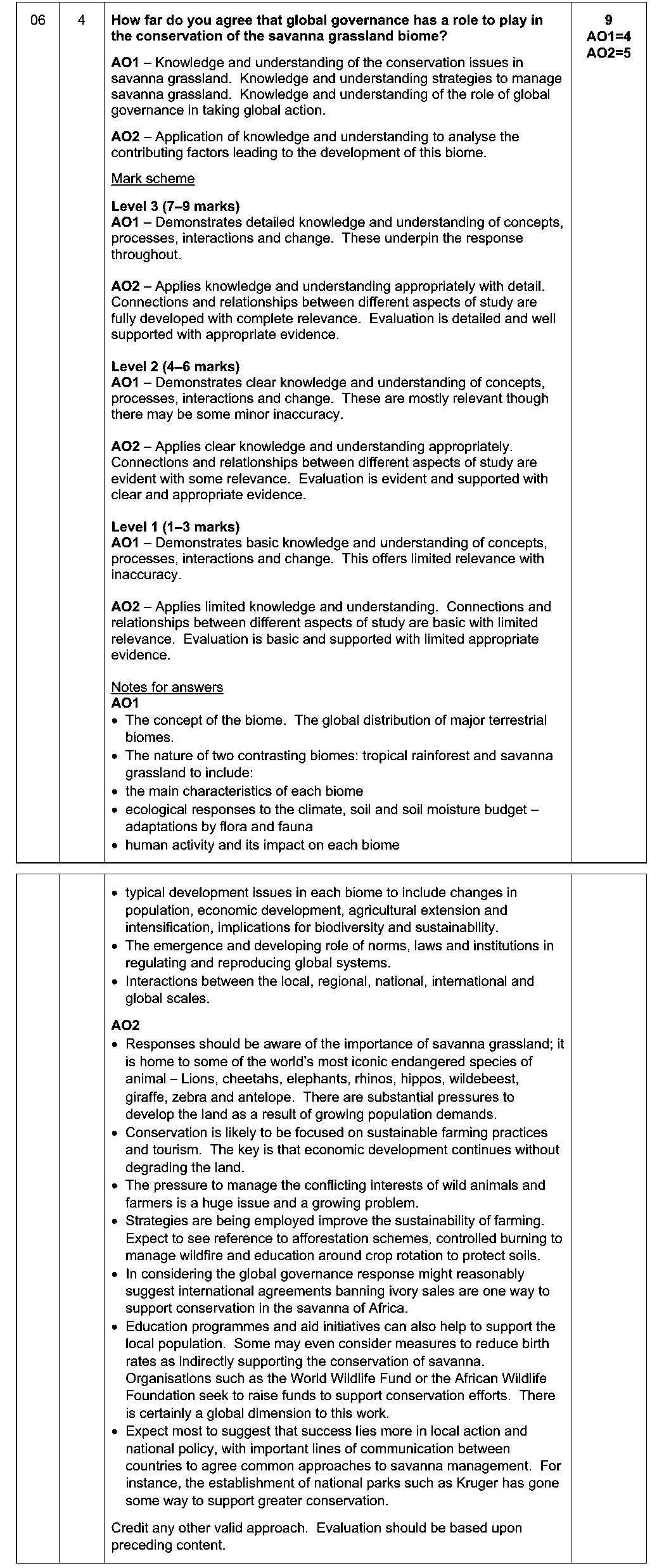
November 2021 · Paper 1 · Q6.49 marksmark schemeSynoptic
Mark scheme, including the levels and indicative content
Notes from the mark scheme and report
links Ecosystems with Global governance: ivory bans and international aid versus local sustainable farming, tourism and community conservation in the savanna
November 2021 · Paper 1 · Q6.520 marksmark scheme20-mark essay
Mark scheme, including the levels and indicative content
Notes from the mark scheme and report
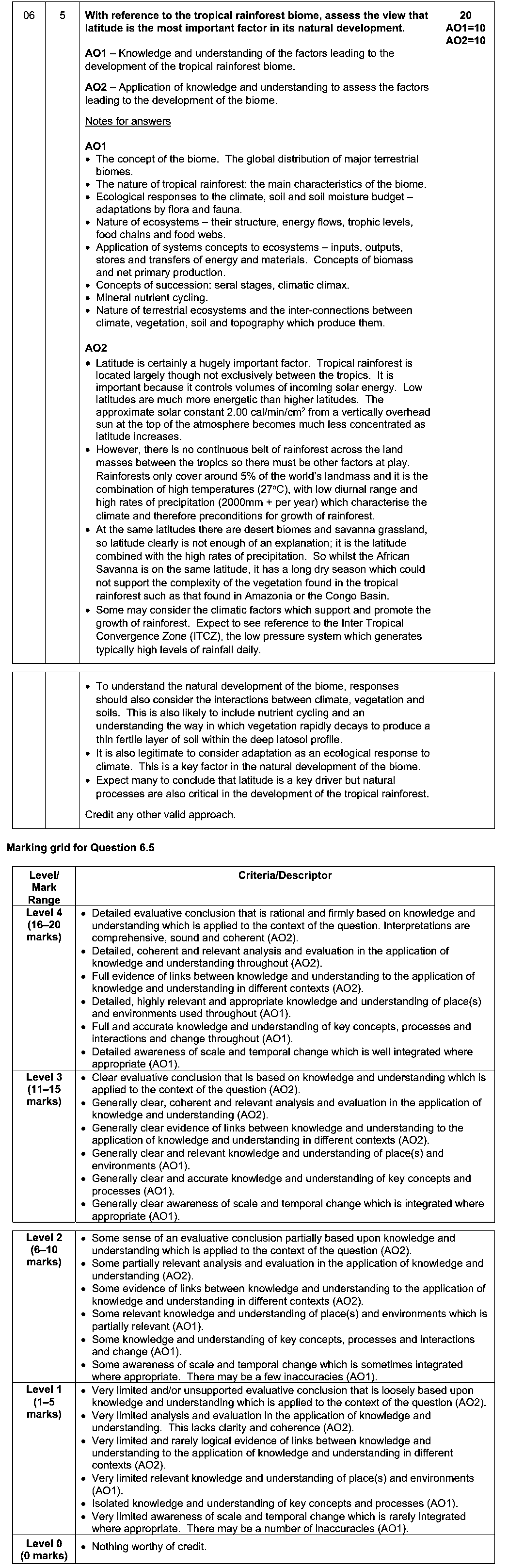
latitude controls insolation, but high rainfall, low seasonality, soils and nutrient cycling also matter
savanna and deserts at the same latitude show latitude alone is not enough
November 2020 · Paper 1 · Q6.49 marksmark scheme9-mark essay
Mark scheme, including the levels and indicative content
Notes from the mark scheme and report
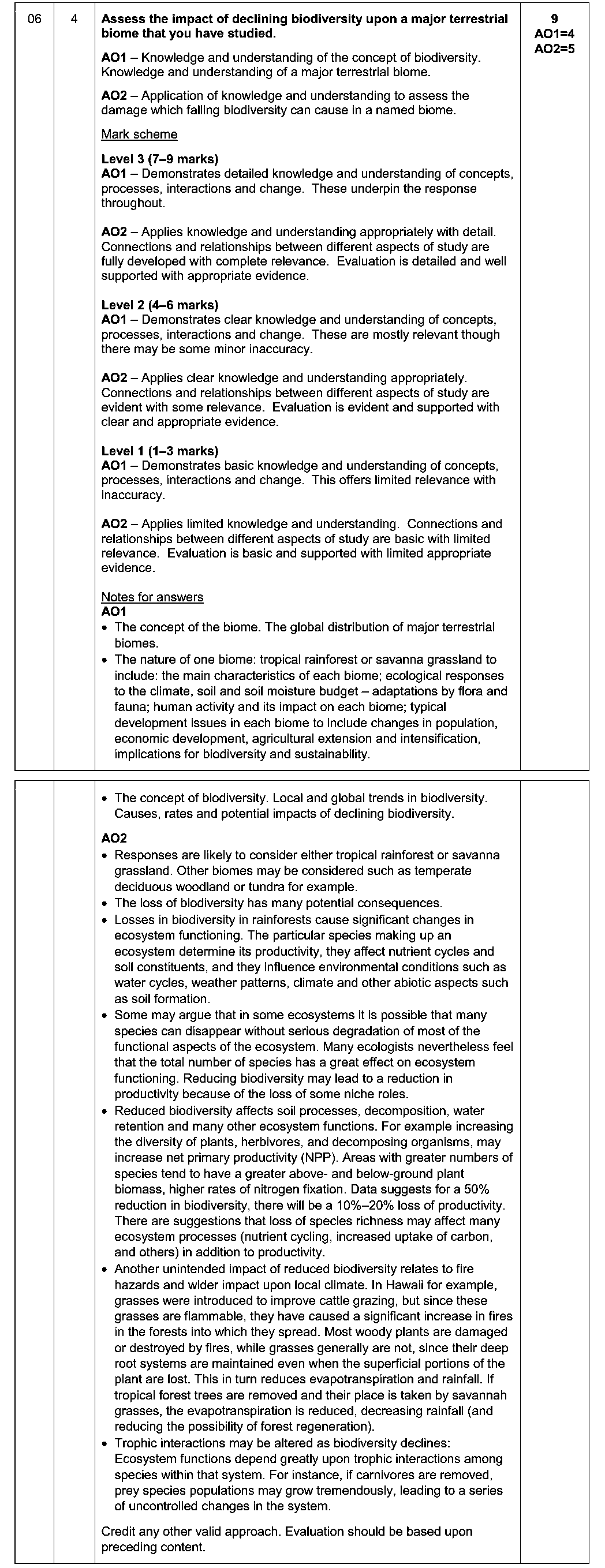
named biome (rainforest or savanna): loss of species reduces productivity, nutrient cycling and resilience, alters trophic interactions and local climate (e.g. Hawaii grasses and fire)
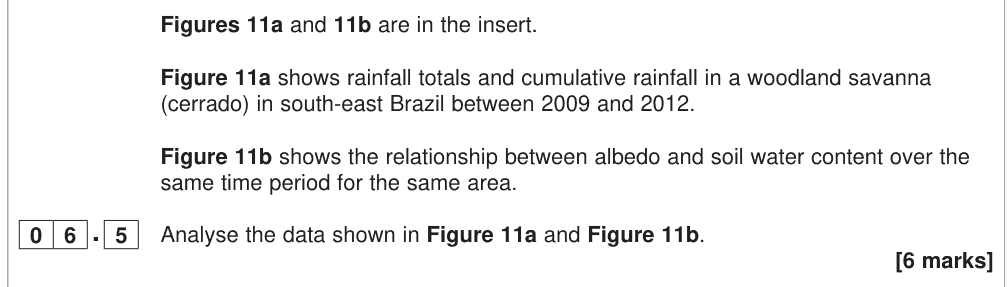
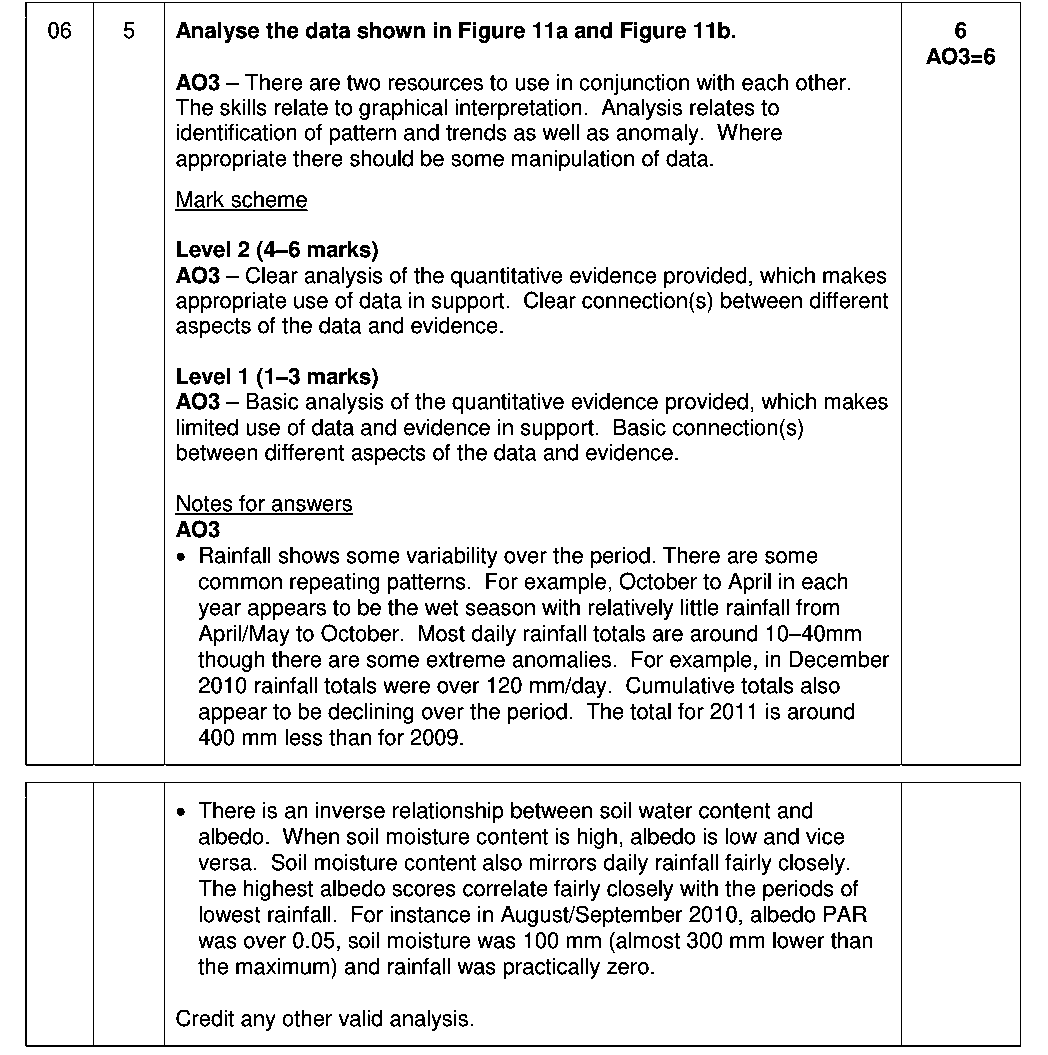
June 2019 · Paper 1 · Q6.56 marksmark schemeData analysis
Figures 11a, 11b
Mark scheme, including the levels and indicative content
Examiner's comment
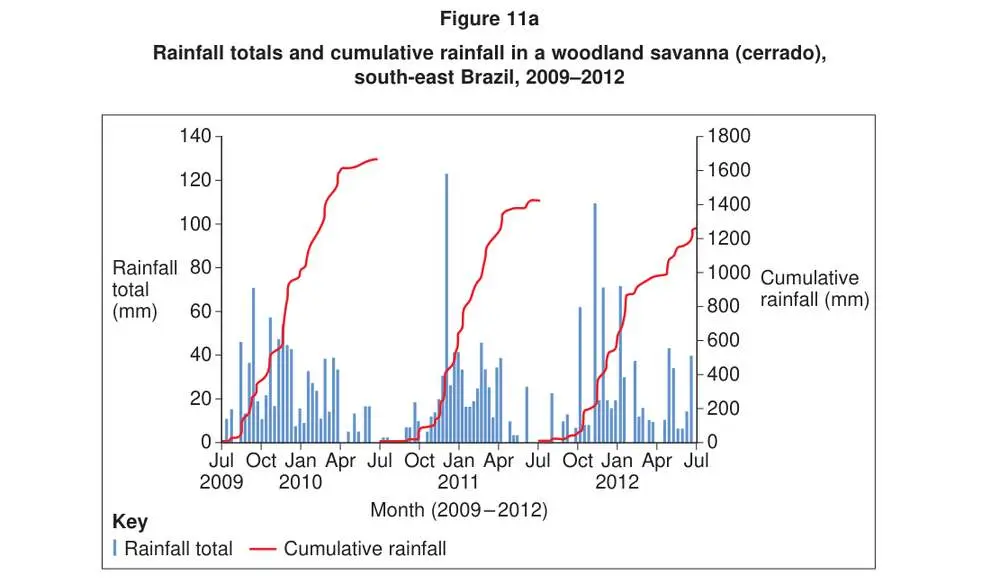
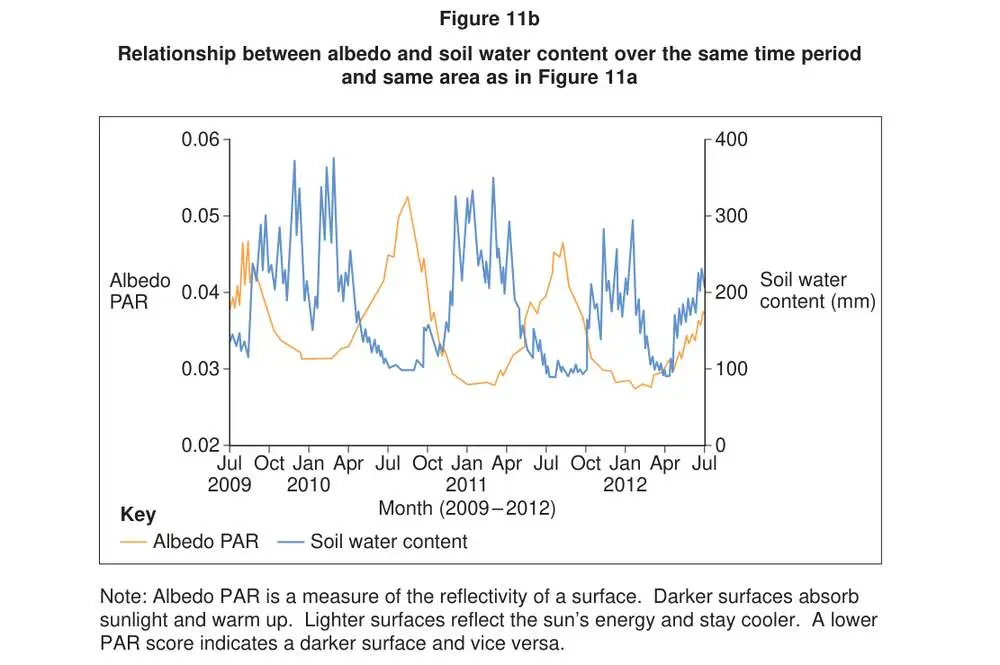
Whilst the associated resource presented something of a challenge, many responses did access level 2, despite its complexity. Many saw the connection between cumulative rainfall and soil water content. Equally many saw the inverse relationship between soil moisture and albedo. Data manipulation was a little less effective with seemingly obvious opportunities missed by some. It is always good practice on these sorts of question to support points made with some data which has been manipulated in some way.
Notes from the mark scheme and report
AO3: wet season Oct-Apr, extreme anomaly Dec 2010, cumulative totals fall (~400 mm less in 2011)
inverse relationship between soil water and albedo
manipulated data expected
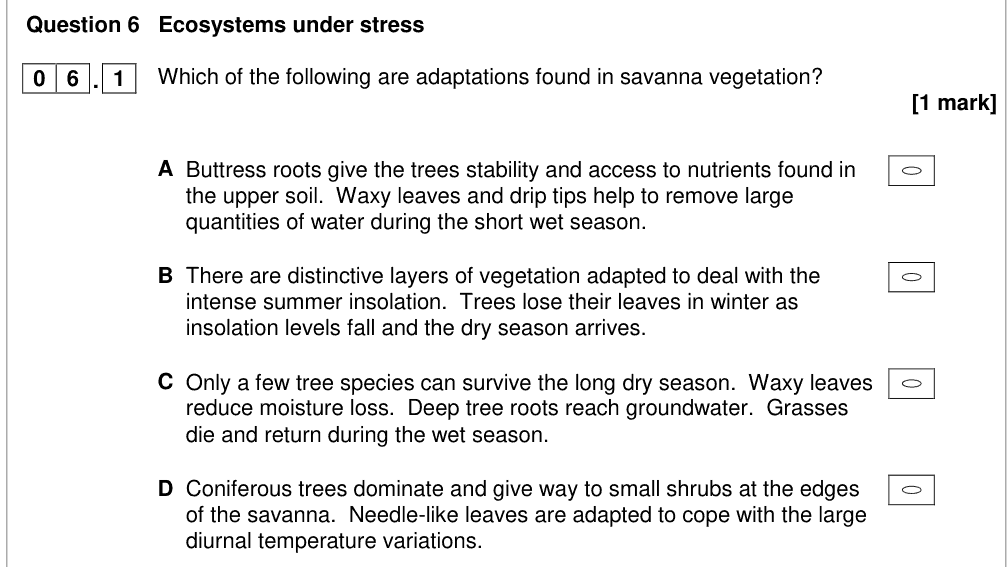
June 2018 · Paper 1 · Q6.11 markmark schemeMultiple choice
Answer
C
Mark scheme
Examiner's comment
This was the least popular option in Section C. C was the correct answer. There was no particular pattern in students selecting alternative distractors. If they did not know the answer, they appeared to guess at one of the three alternatives.
Notes from the mark scheme and report
Answer: C
few drought-tolerant trees, waxy leaves, deep roots, grasses die back in the dry season
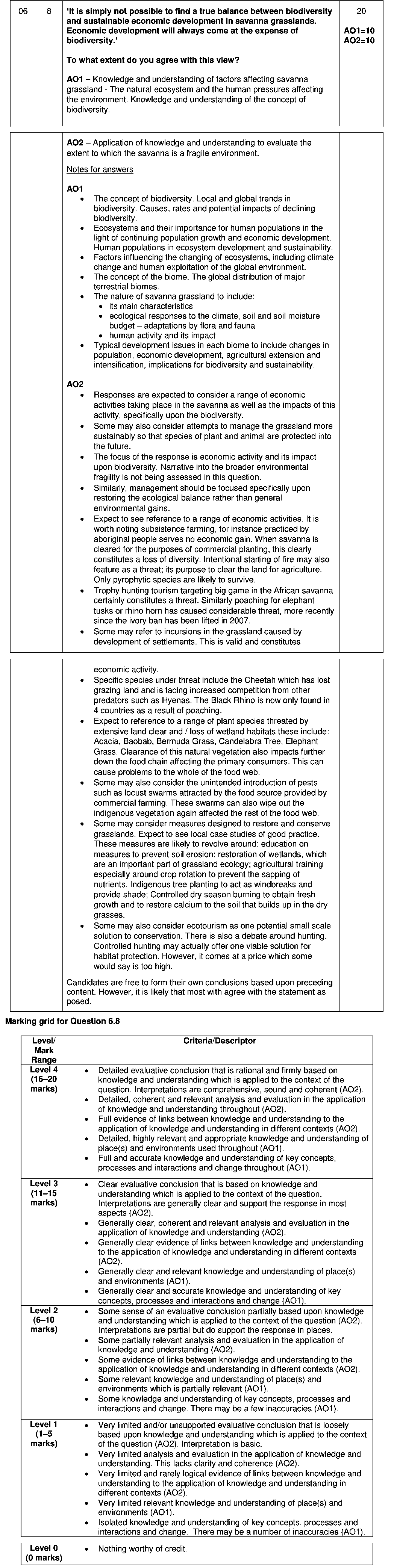
June 2018 · Paper 1 · Q6.820 marksmark scheme20-mark essay
Mark scheme, including the levels and indicative content
Examiner's comment
The best responses took the opportunity to consider the threats affecting the savanna grasslands. They showed awareness of the development pressures, population pressures and the resultant impact on the natural environment. However, in terms of actual biodiversity, few responses actually considered the species being affected. Some did address big game and the loss of habitat, but few considered flora and the loss of habitat or the clearance of natural ecosystems for commercial farming. Centres teaching this unit should consider actual species of plants and animals which are affected by competing interests upon the land which they occupy. Sustainability did feature in many responses. They considered measures being taken to protect and conserve the natural environment whilst ‘cashing in’ on tourism. This was a valid approach and certainly addressed the terms of the question. Case study support did feature, but as with most of the longer tariff questions, it did not come through strongly in terms of depth and detail. This is certainly something which students should consider in preparation for future series.
Notes from the mark scheme and report
focus on economic activity (commercial farming, burning, hunting, poaching, settlement) and its effect on savanna biodiversity, set against conservation and ecotourism
name actual plant and animal species affected
case-study depth often weak
Specimen set 1 · Paper 1 · Q6.26 marksmark schemeData analysis
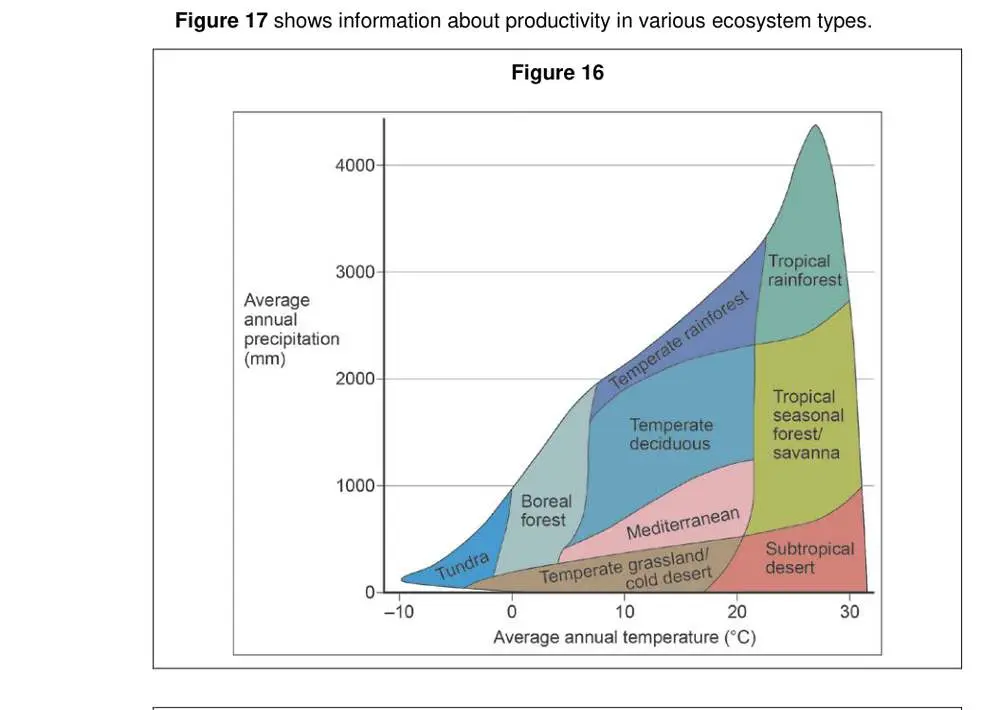
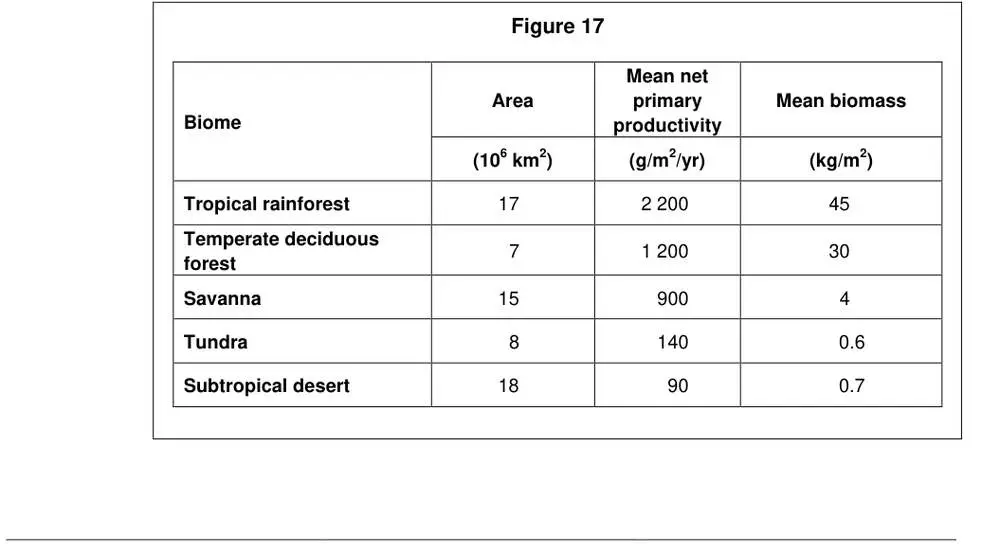
Figures 16, 17
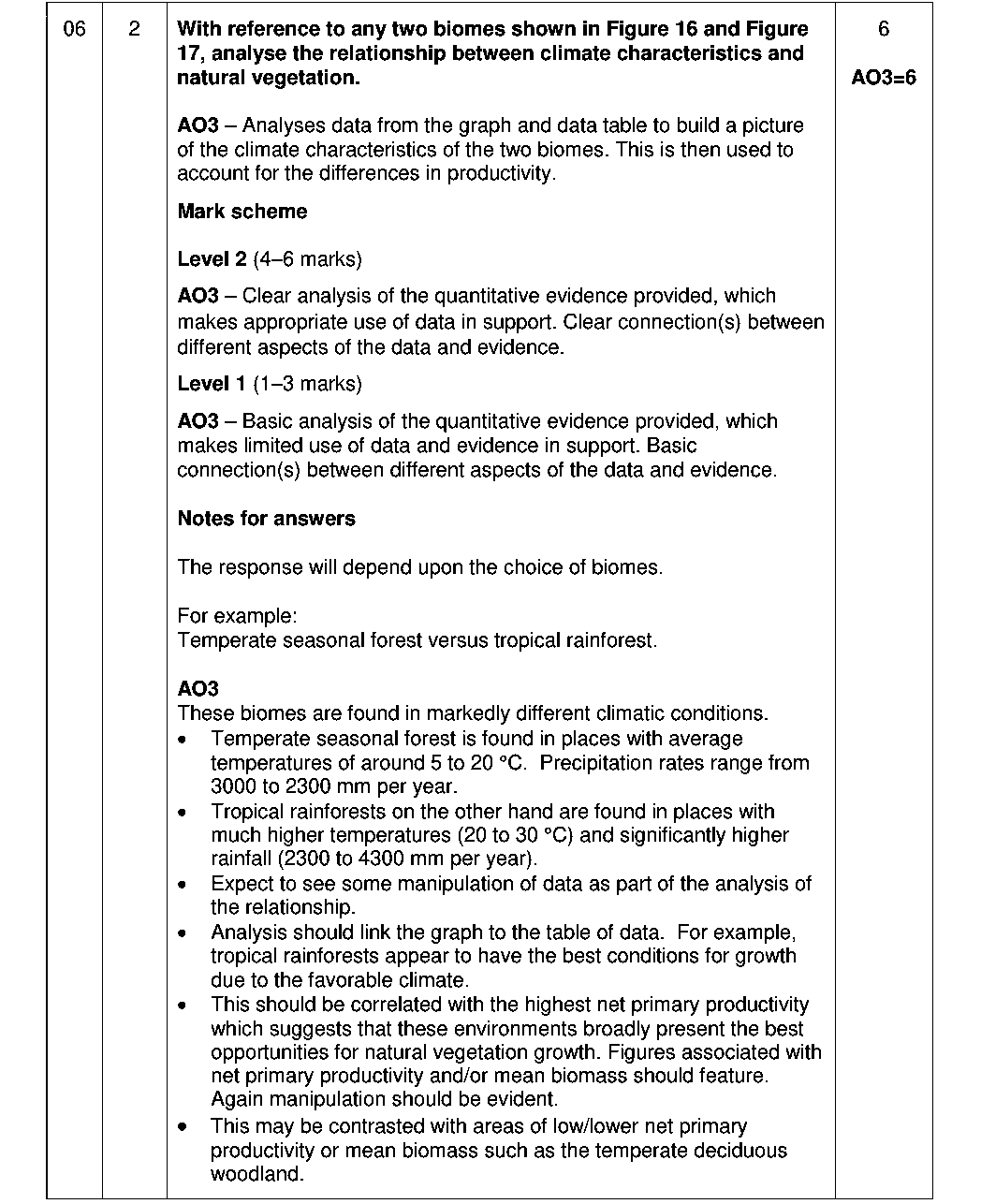
Mark scheme, including the levels and indicative content
Notes from the mark scheme and report
AO3: for two biomes, link climate ranges (rainforest 20–30 °C, 2300–4300 mm) to NPP and biomass from the table (rainforest 2200 g/m²/yr, 45 kg/m²)
manipulate data
Specimen set 1 · Paper 1 · Q6.39 marksmark schemeSynoptic
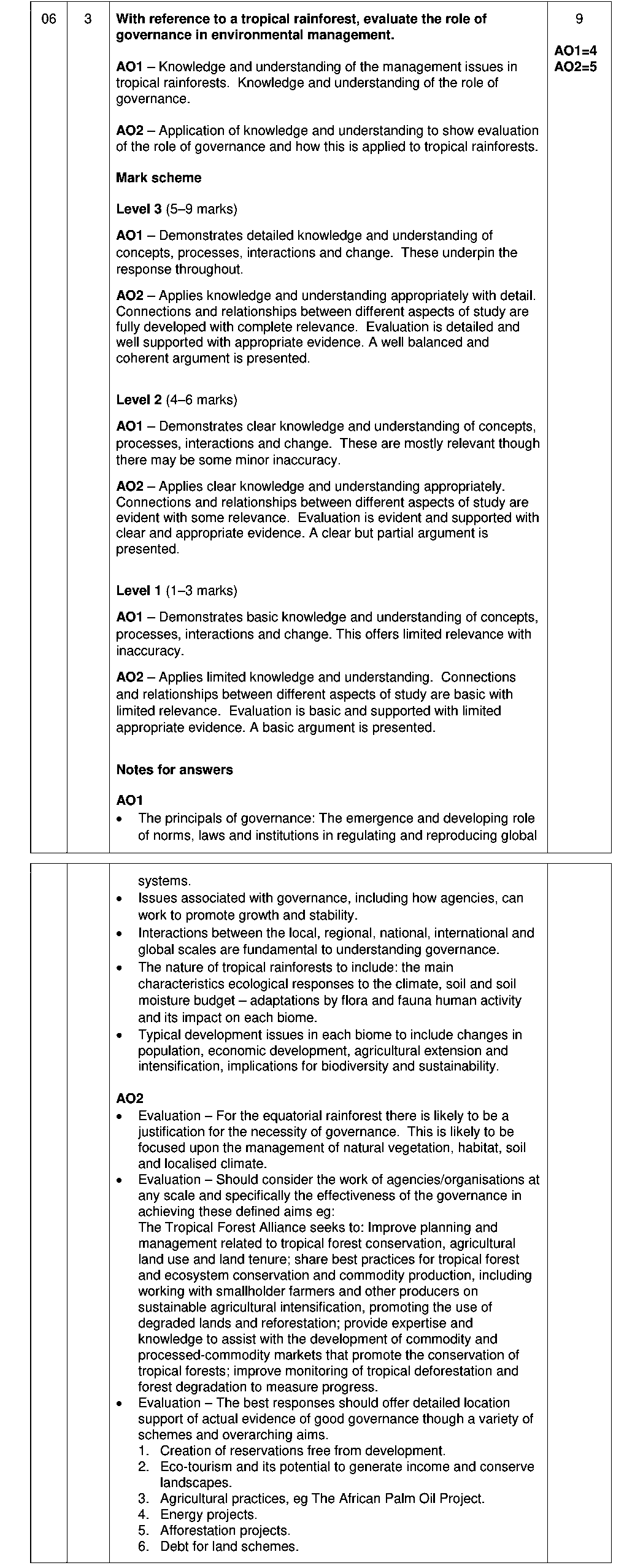
Mark scheme, including the levels and indicative content
Notes from the mark scheme and report
synoptic (links Ecosystems with Global governance): role of laws, agencies and NGOs at different scales (e.g. Tropical Forest Alliance, national protection) in managing a named rainforest
Work with an AQA Geography tutor
Essays stuck in the middle levels, or losing marks on the data questions? Book a trial lesson with a specialist AQA Geography tutor.