Tap a question to zoom it. The figures open above it; the mark scheme (with its levels and indicative content) and the examiner's comment open underneath.
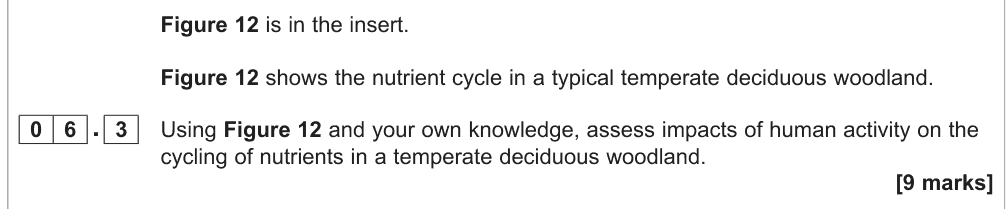
June 2025 · Paper 1 · Q6.39 marksmark schemeStimulus
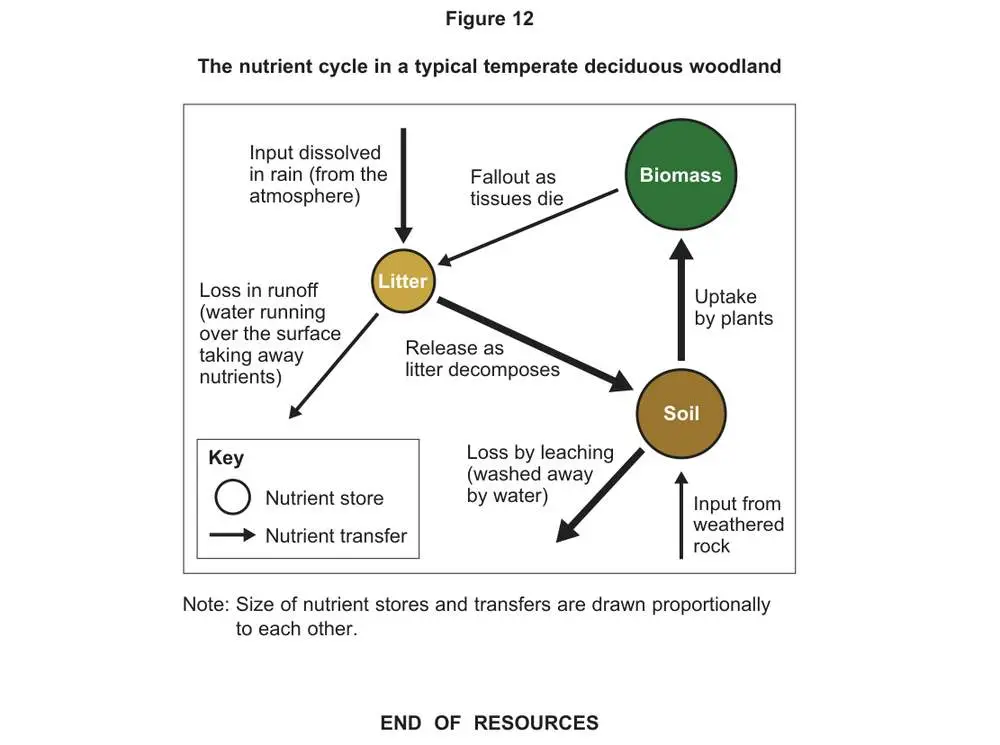
Figure 12
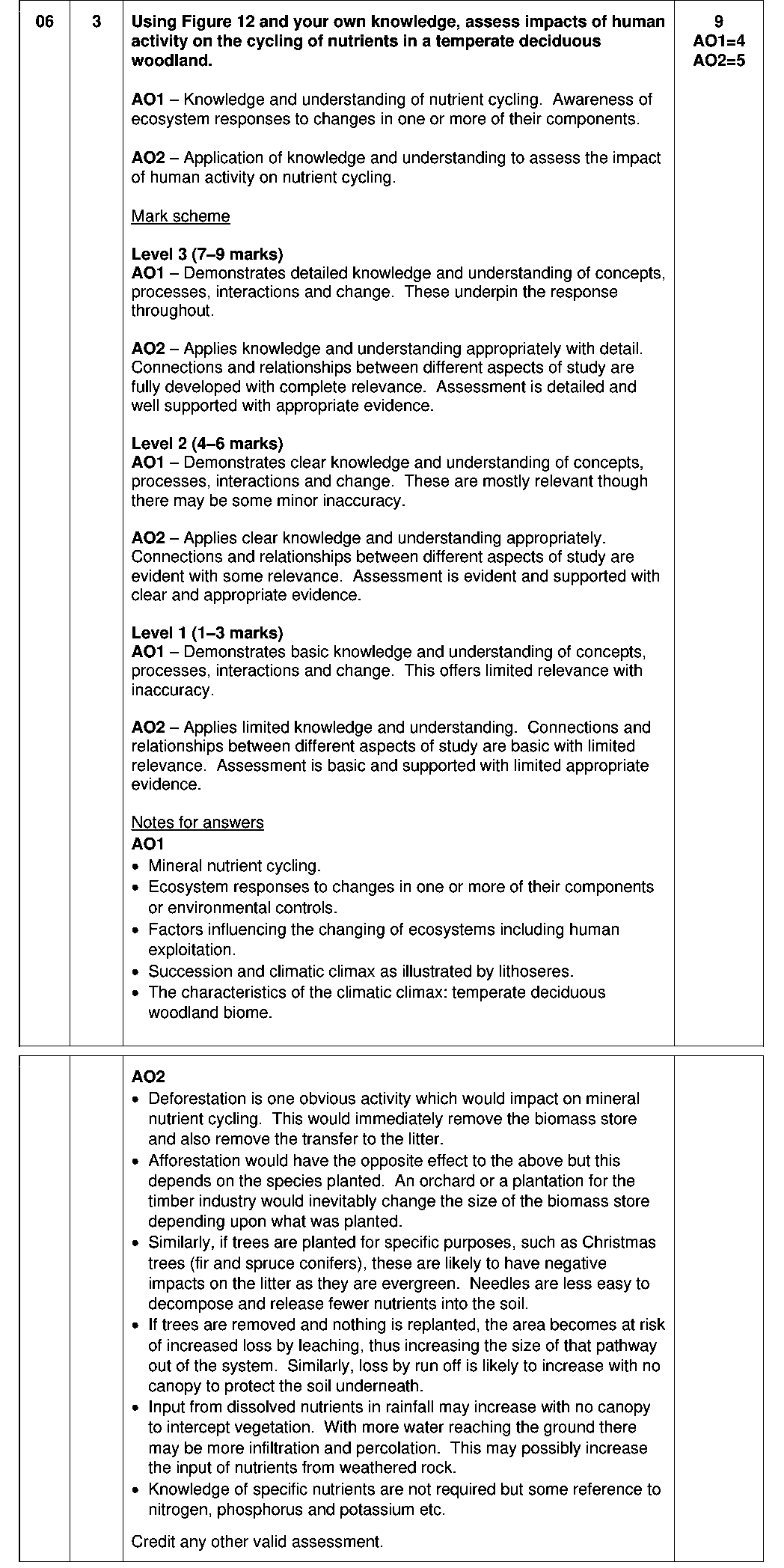
Mark scheme, including the levels and indicative content
Examiner's comment
These questions assess knowledge and understanding when applied to novel situations (resource prompts). These are quite challenging questions, which students do often find to be quite difficult in general. The key to success is to quickly ascertain what the resource shows and which part of the specification is being targeted. Once this is established, students simply need to answer the question being posed, drawing upon relevant learned material as part of that unit. In question 06.3 (AO1 & AO2) (9 marks) a simplified nutrient cycle was displayed. Students needed to consider how human activity might affect different aspects of both the stores and transfers. The best responses showed how knock-on effects could occur within the cycle once one part is disrupted. This was a strong level 3 response. This response did rather well on detailing the impact of human activity on some aspects of the nutrient cycle but could have been a little broader. For example, when considering deforestation, a little more detail was needed on how this disrupts the cycle. Cutting down trees exposes soil to potentially increased leaching whilst also reducing the litter, which provides the soil with one important source of nutrients. Nevertheless, this was a strong level 3 response. Level 3 (8 marks)
Notes from the mark scheme and report
apply human activities (deforestation, conifer planting, farming) to stores and transfers of the nutrient cycle: loss of biomass and litter, more leaching and runoff
best answers traced knock-on effects through the cycle
June 2024 · Paper 1 · Q6.520 marksmark scheme20-mark essay
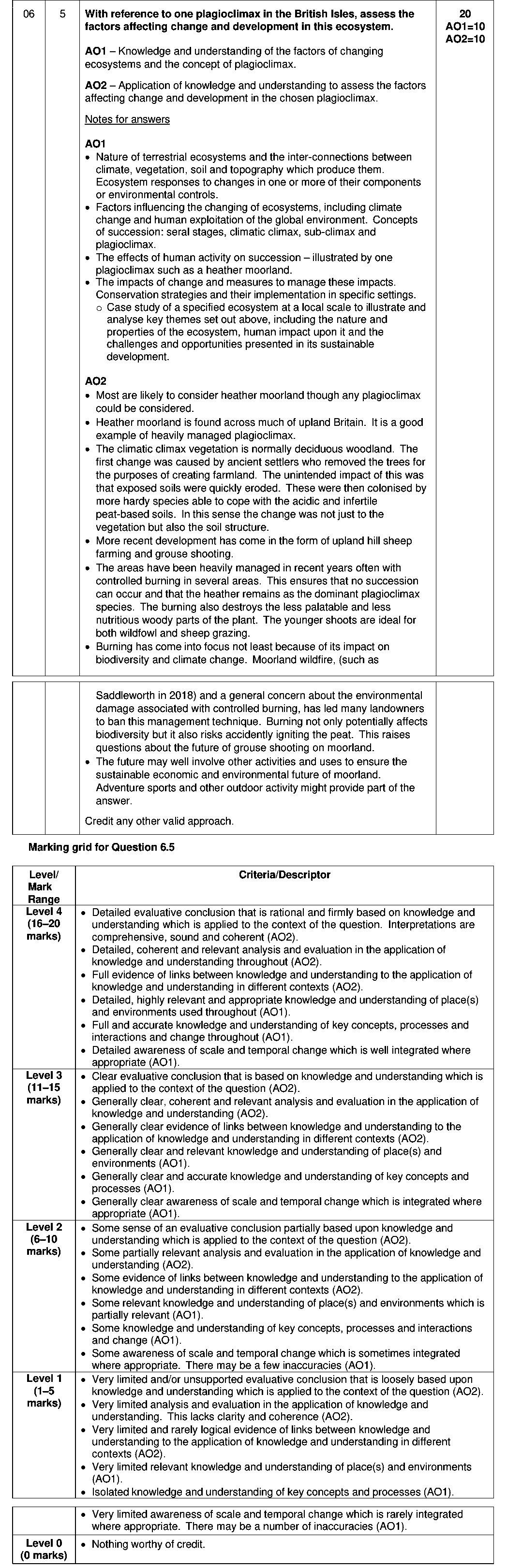
Mark scheme, including the levels and indicative content
Examiner's comment
The 20-mark questions are a major differentiator on this paper. In this series, it was also very evident that those who prepared well gained access to the full range of marks. The best responses evidence a deep and secure knowledge and understanding of the specification area/s being tested. Attention to detail is always strong and case study support is almost always very accurate. Less successful responses tend to fall down for a number of reasons. Students sometimes misread the question or, in the heat of examination, may not fully grasp what is required. In such circumstances they may tend towards knowledge recital and only touch on what is required to actually answer the question.
Notes from the mark scheme and report
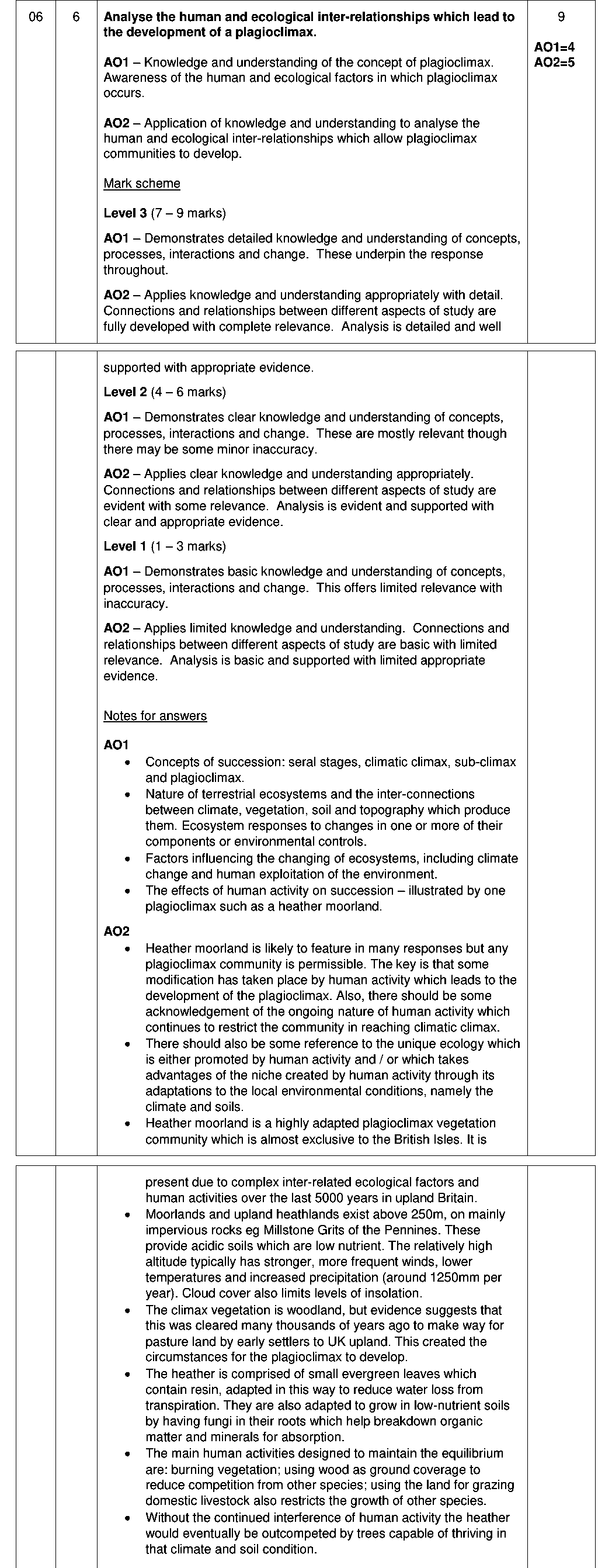
any plagioclimax in the British Isles (most chose heather moorland): burning, grazing, drainage, conservation management
must assess factors affecting change and development
June 2022 · Paper 1 · Q6.14 marksmark schemePoint-marked
Mark scheme
Examiner's comment
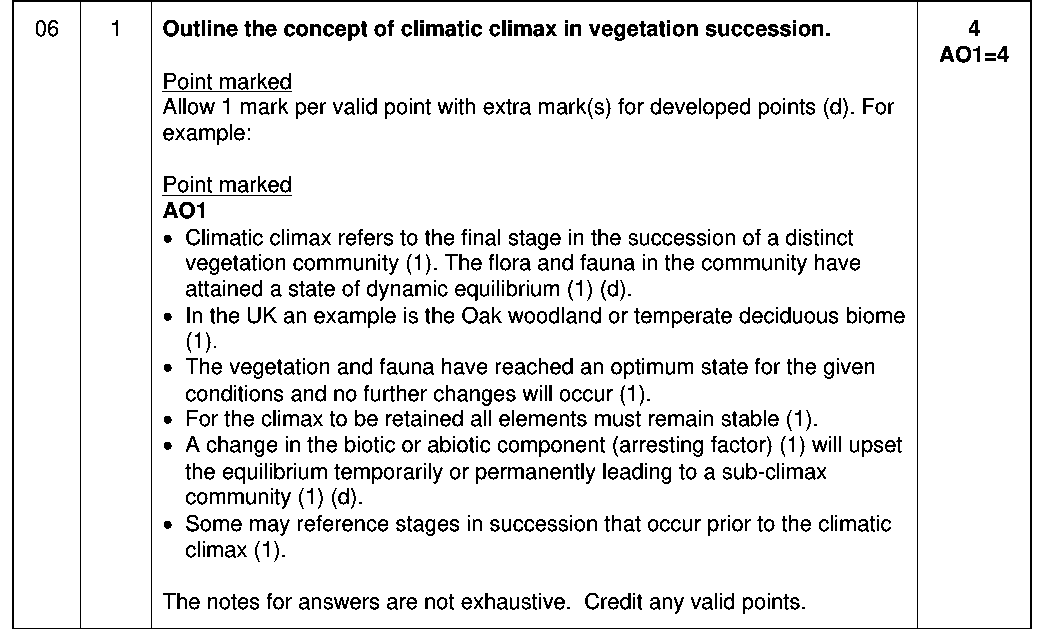
The few who attempted this unit found this question to be relatively accessible with a mean mark of 2.24. Most were able to define climatic climax with relative ease. This was often related to the concept of dynamic equilibrium in the biosphere. Stronger responses related the climax to the stages in succession. Approximately 15% then went on to score full marks with this sort of approach.
Notes from the mark scheme and report
point marked
final stable stage of succession in dynamic equilibrium with the climate (e.g. oak woodland in the UK), arresting factors produce sub-climax
mean 2.24
June 2022 · Paper 1 · Q6.49 marksmark scheme9-mark essay
Mark scheme, including the levels and indicative content
Examiner's comment
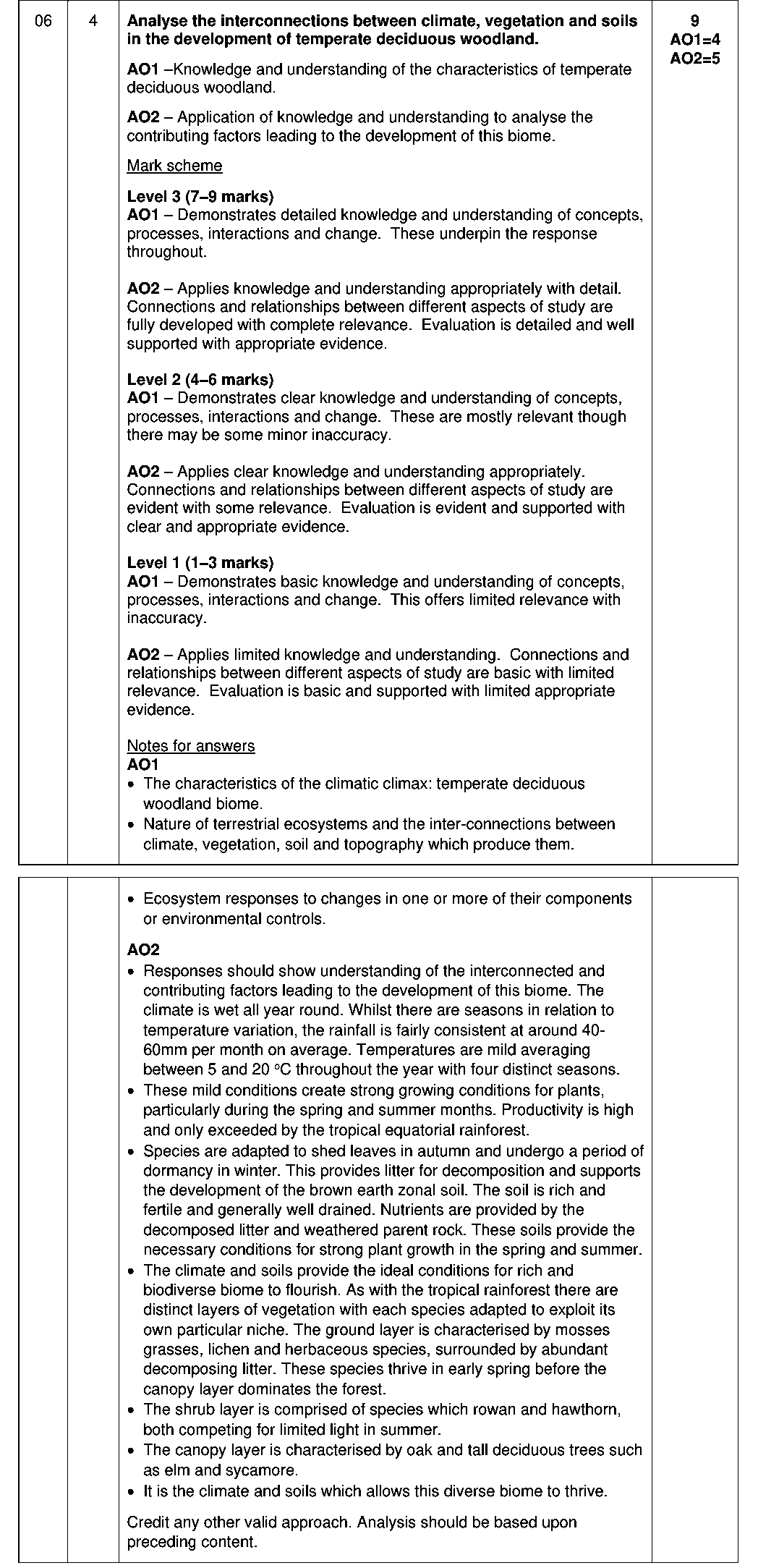
Most were able to describe the climate, vegetation and soils of the temperate deciduous woodland but the question was about the interconnections. For this, students needed to show understanding of how climate affects vegetation and how vegetation affects the development of the brown earth soils. There was also opportunity to relate this to nutrient cycling and exemplify this with the carbon cycle for example.
Notes from the mark scheme and report
must analyse interconnections, not describe each element: mild wet climate drives productivity, leaf fall supplies litter forming brown earth, nutrient cycling feeds growth
November 2021 · Paper 1 · Q6.14 marksmark schemePoint-marked
Mark scheme
Notes from the mark scheme and report
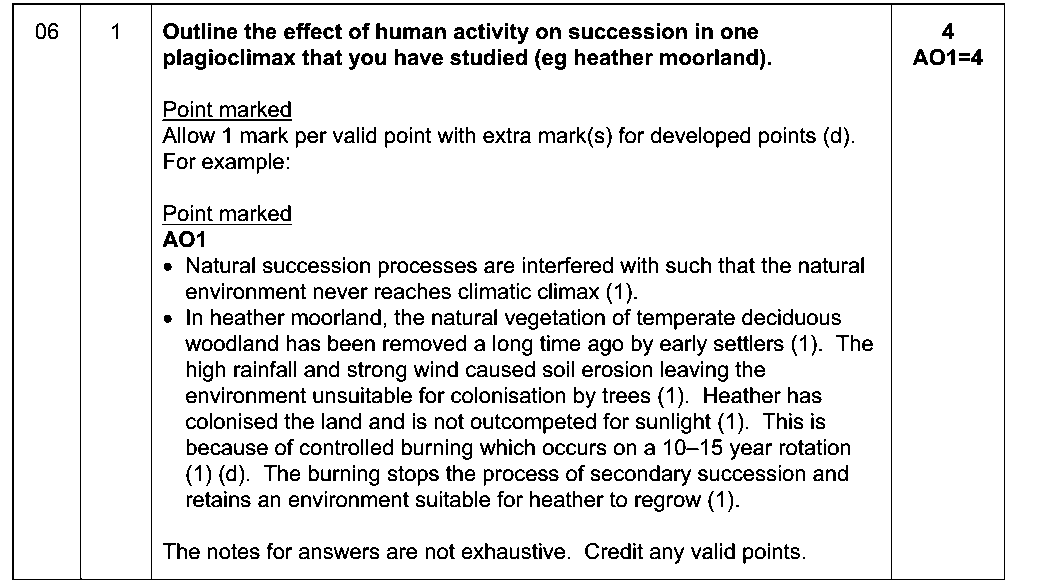
one named plagioclimax (e.g. heather moorland): woodland clearance, soil erosion, rotational burning and grazing arrest succession before climax
November 2020 · Paper 1 · Q6.14 marksmark schemePoint-marked
Mark scheme
Notes from the mark scheme and report
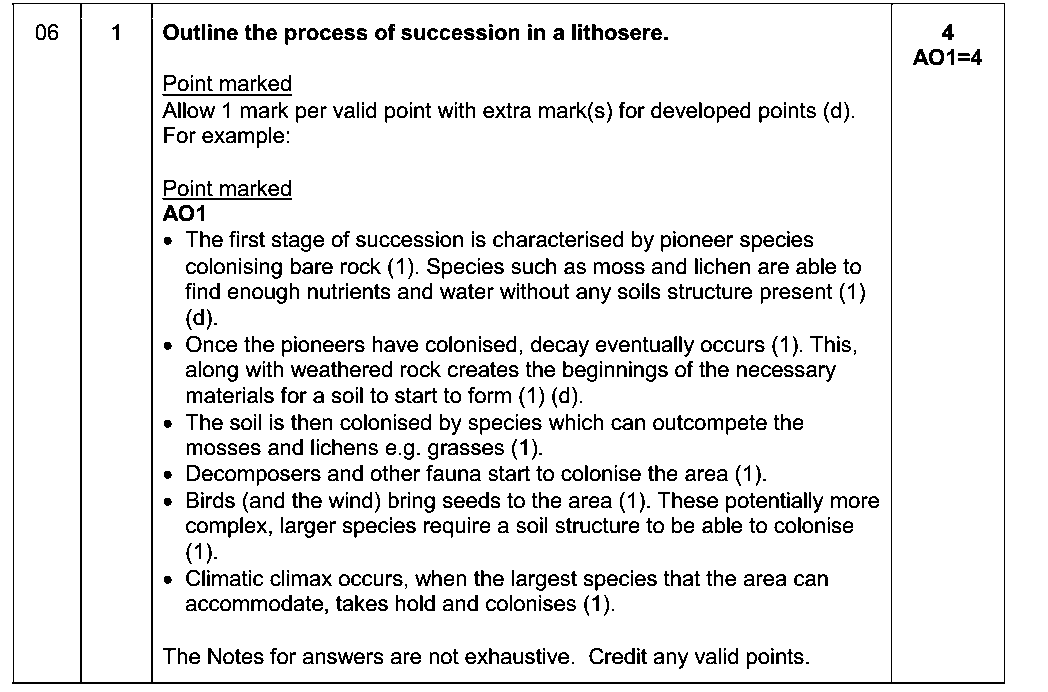
pioneers (lichens, mosses) on bare rock, decay and weathering form soil, grasses then larger species outcompete, climatic climax
June 2019 · Paper 1 · Q6.69 marksmark schemeStimulus
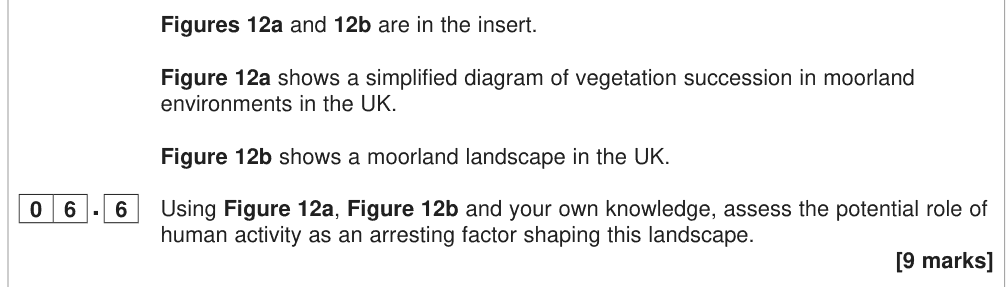
Figures 12a, 12b
Mark scheme, including the levels and indicative content
Examiner's comment
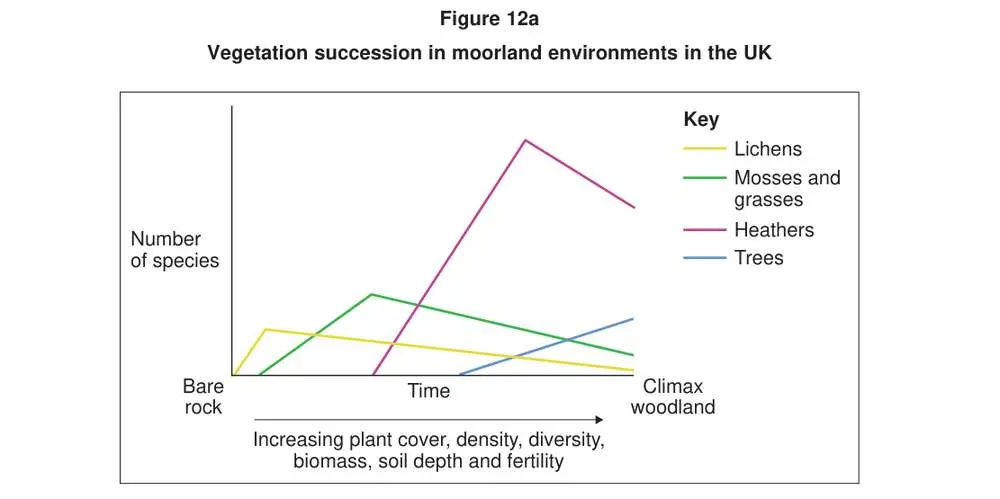
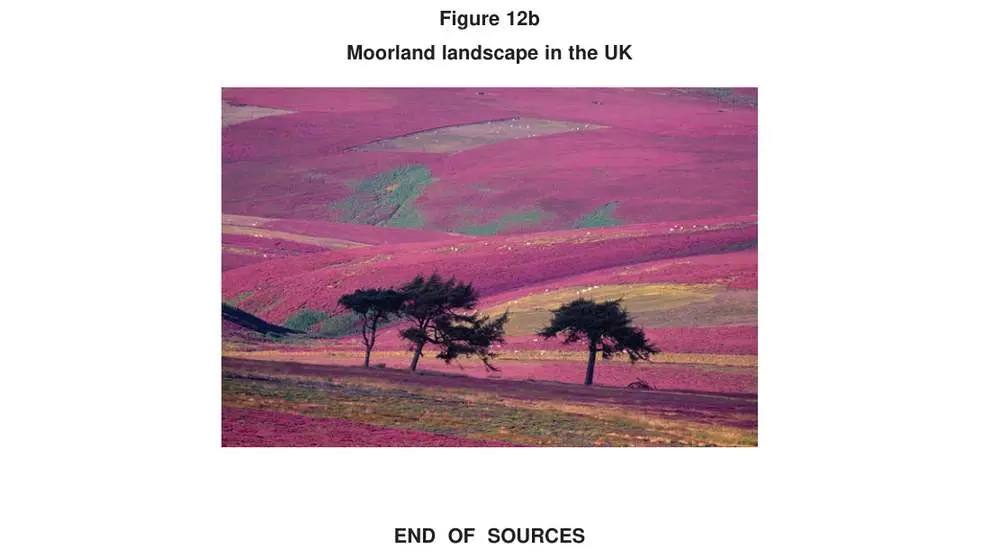
Many students had studied moorland but missed some obvious opportunities to explore plagioclimax. The resources were trying to direct students towards the fact that this area should have a climax woodland as its dominant vegetation. However, Figure 12b shows virtually no trees, clear evidence of heather and some obvious human activity taking place in the background, namely farming and vegetation management/clearance. Those students who picked up the connection between the resources readily accessed credit. Those that did not produced limited and generalised responses not adequately applied to the resource.
Notes from the mark scheme and report
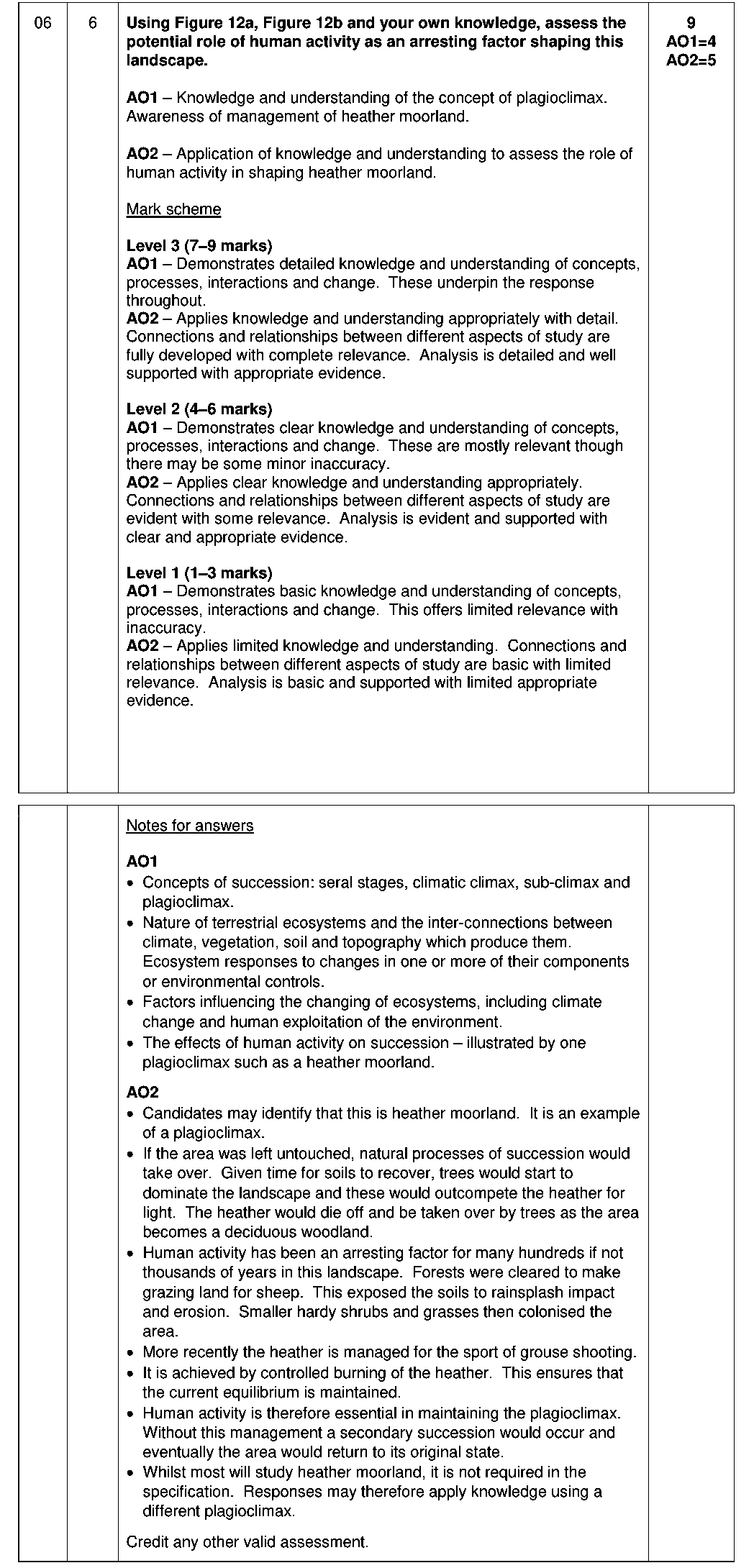
heather moorland plagioclimax: woodland climax arrested by clearance, grazing and controlled burning for grouse
must connect Figure 12a with the treeless photo
June 2018 · Paper 1 · Q6.69 marksmark scheme9-mark essay
Mark scheme, including the levels and indicative content
Examiner's comment
Many simply described the impact of human activity upon natural environments such as the heather moorland in the UK. They considered deforestation and the use of land for the purposes of sheep farming and the development of game habitats such as pheasant for shooting. Such responses never really got to grips with the complexity of the question i.e. the seral stage development, the arresting factors of human activity and the resultant development of the plagioclimax.
Notes from the mark scheme and report
explain how continued human activity (burning, grazing, drainage) arrests succession and how adapted species exploit the niche, e.g. heather moorland
weaker answers only described human impacts without seral stages or arresting factors
Specimen set 1 · Paper 1 · Q6.49 marksmark scheme9-mark essay
Mark scheme, including the levels and indicative content
Notes from the mark scheme and report
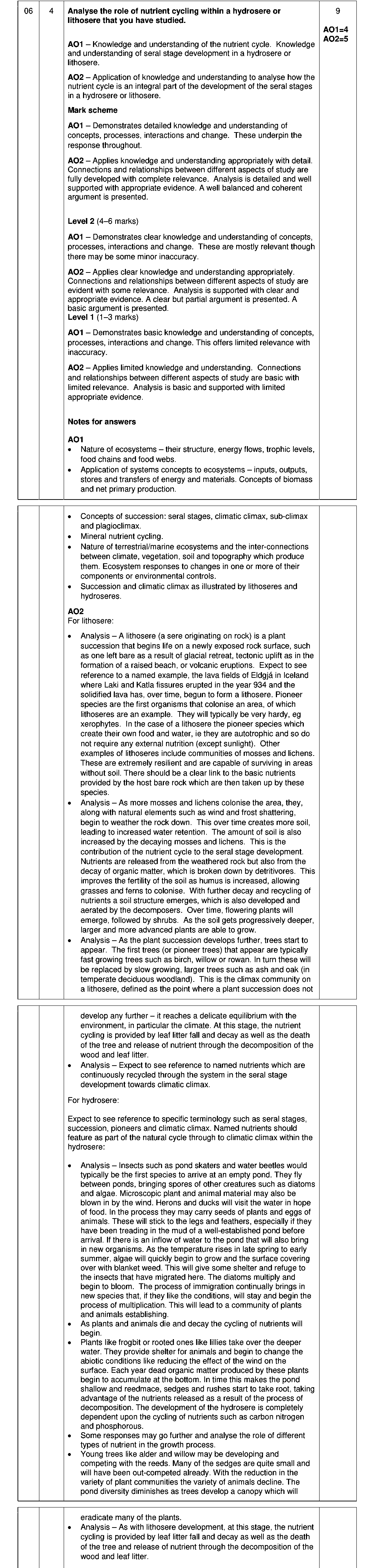
analyse how nutrient stores and flows change through seral stages of a named lithosere or hydrosere (pioneer weathering and humus build-up to climax)
Work with an AQA Geography tutor
Essays stuck in the middle levels, or losing marks on the data questions? Book a trial lesson with a specialist AQA Geography tutor.