A-level Paper 1 Section B (option); AS Paper 1 Section A (option)
Level
AS and A level
Specification
3.1.3.4, 3.1.3.5, 3.1.3.6, 4 content points
Since 2017
25 question parts, 15 of them essays
Specification
3.1.3.4-01 Human intervention in coastal landscapes. Traditional approaches to coastal flood and erosion risk: hard and soft engineering. Sustainable approaches to coastal flood risk and coastal erosion management: shoreline management/integrated coastal zone management.
3.1.3.5-01 Students must engage with a range of quantitative and relevant qualitative skills, within the theme landscape systems. These should include observation skills, measurement and geospatial mapping skills and data manipulation and statistical skills applied to field measurements.
3.1.3.6-01 Case study(ies) of coastal environment(s) at a local scale to illustrate and analyse fundamental coastal processes, their landscape outcomes as set out above and engage with field data and challenges represented in their sustainable management.
3.1.3.6-02 Case study of a contrasting coastal landscape beyond the UK to illustrate and analyse how it presents risks and opportunities for human occupation and development and evaluate human responses of resilience, mitigation and adaptation.
‘Adaptation will become more important than mitigation as a response to predicted sea level rise for people living in coastal environments.’ To what extent do you agree with this view?
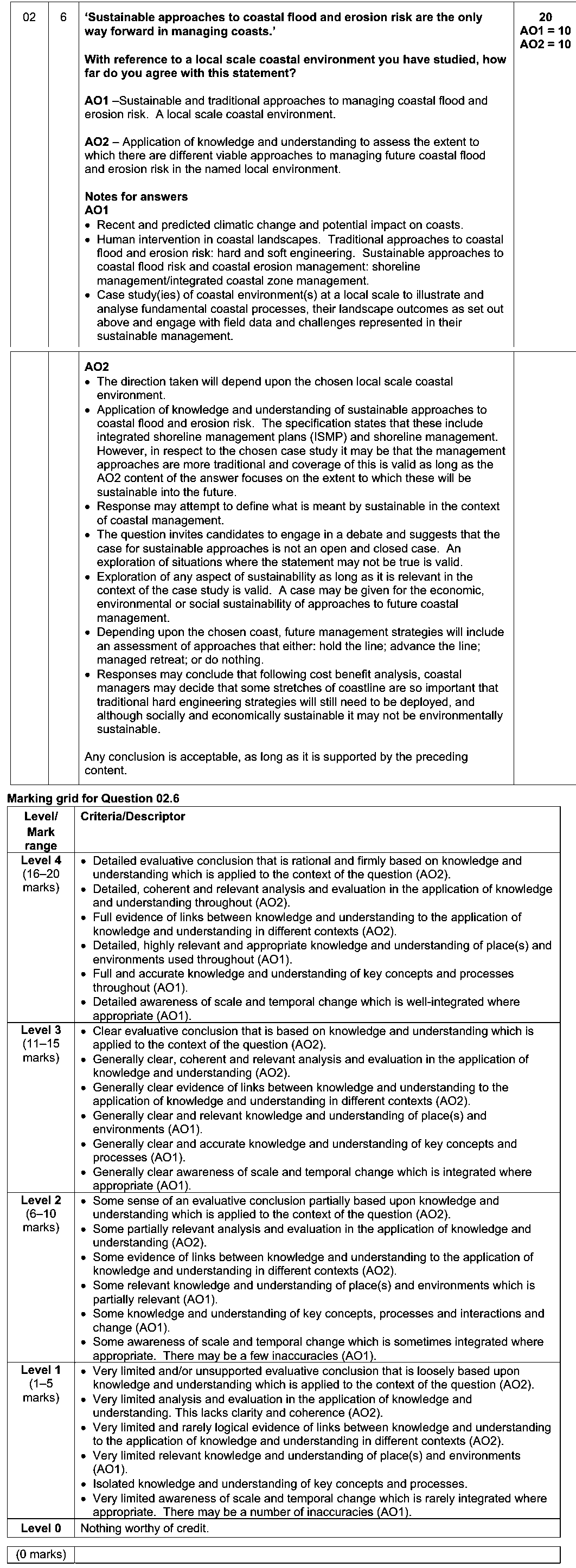
‘Sustainable approaches to coastal flood and erosion risk are the only way forward in managing coasts.’ With reference to a local scale coastal environment you have studied, how far do you agree with this statement?
With reference to a coastal landscape beyond the UK that you have studied, assess the extent to which people will be able to successfully adapt to the risks they face in living on the coast in the future.
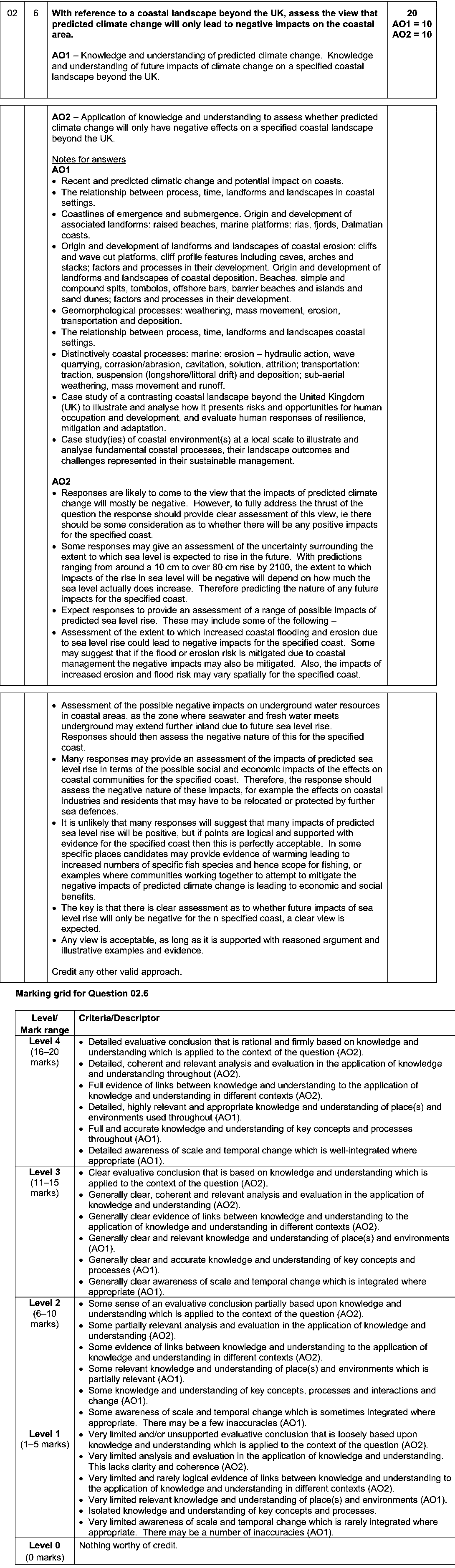
With reference to a coastal landscape beyond the UK, assess the view that predicted climate change will only lead to negative impacts on the coastal area.
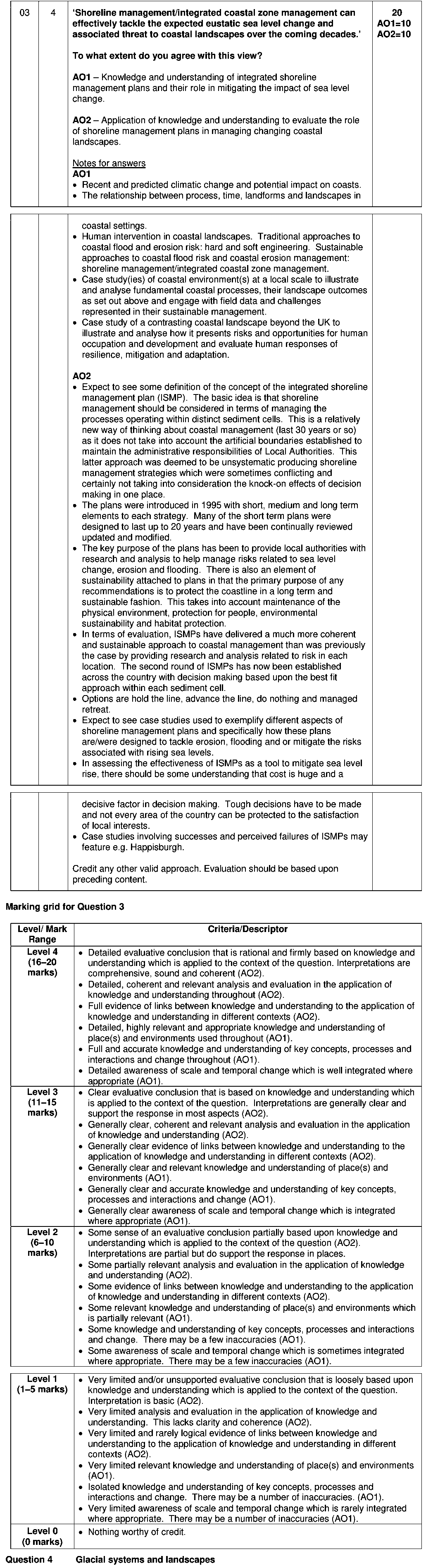
‘Shoreline management/integrated coastal zone management can effectively tackle the expected eustatic sea level change and associated threat to coastal landscapes over the coming decades.’ To what extent do you agree with this view?
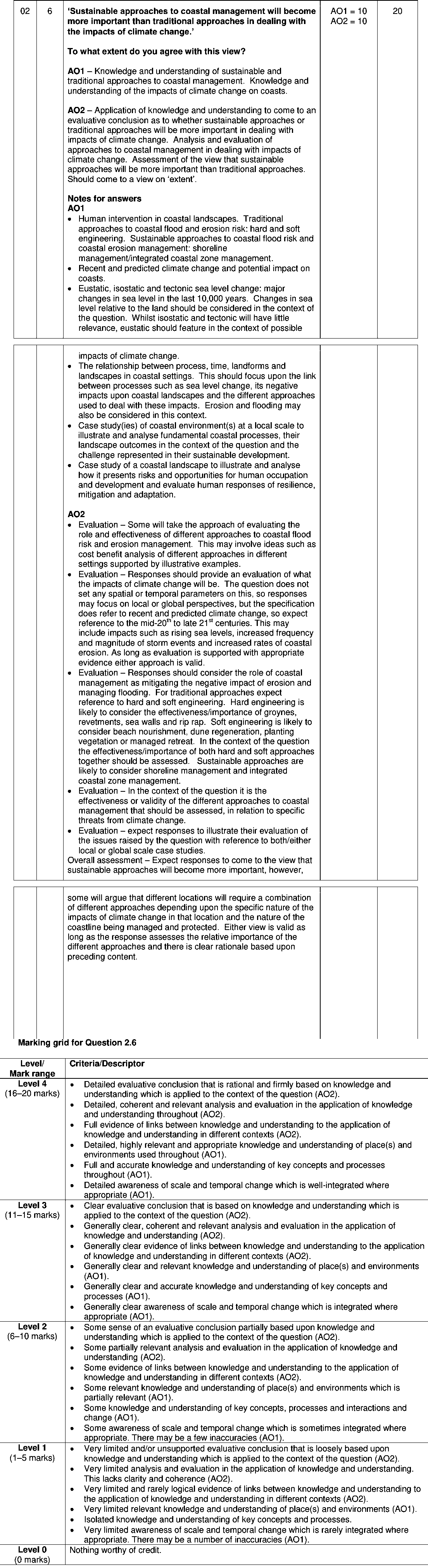
‘Sustainable approaches to coastal management will become more important than traditional approaches in dealing with the impacts of climate change.’ To what extent do you agree with this view?
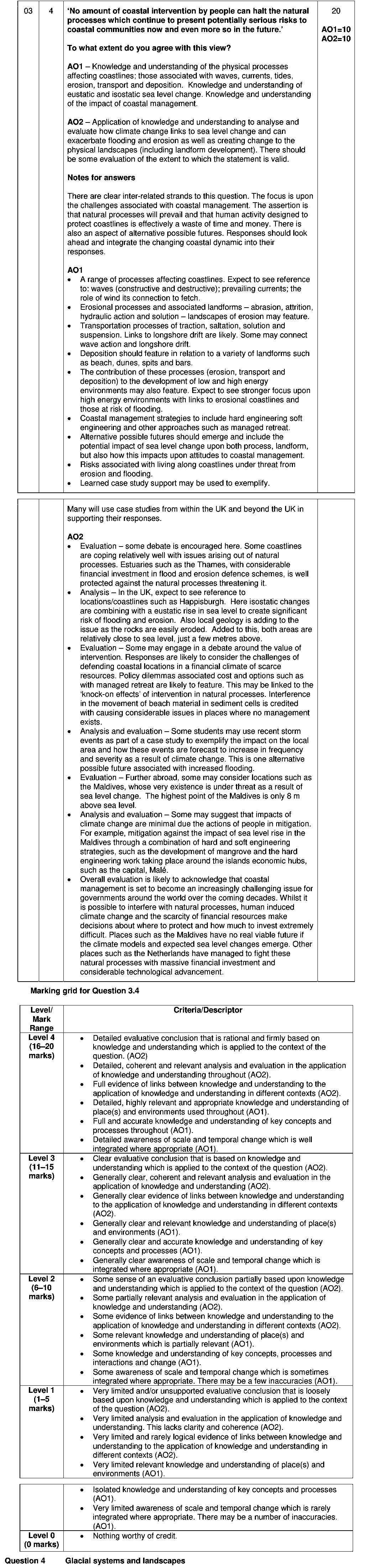
‘No amount of coastal intervention by people can halt the natural processes which continue to present potentially serious risks to coastal communities now and even more so in the future.’ To what extent do you agree with this view?
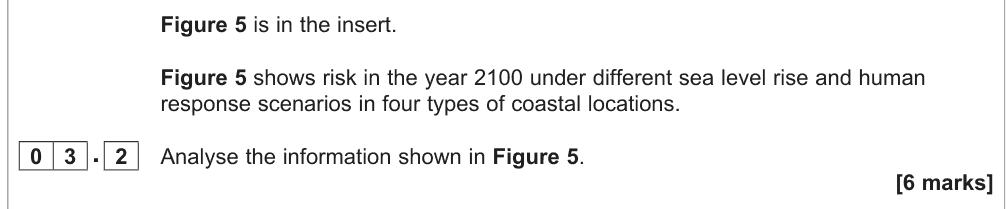
Tap a question to zoom it. The figures open above it; the mark scheme (with its levels and indicative content) and the examiner's comment open underneath.
June 2025 · Paper 1 · Q3.26 marksmark schemeData analysis
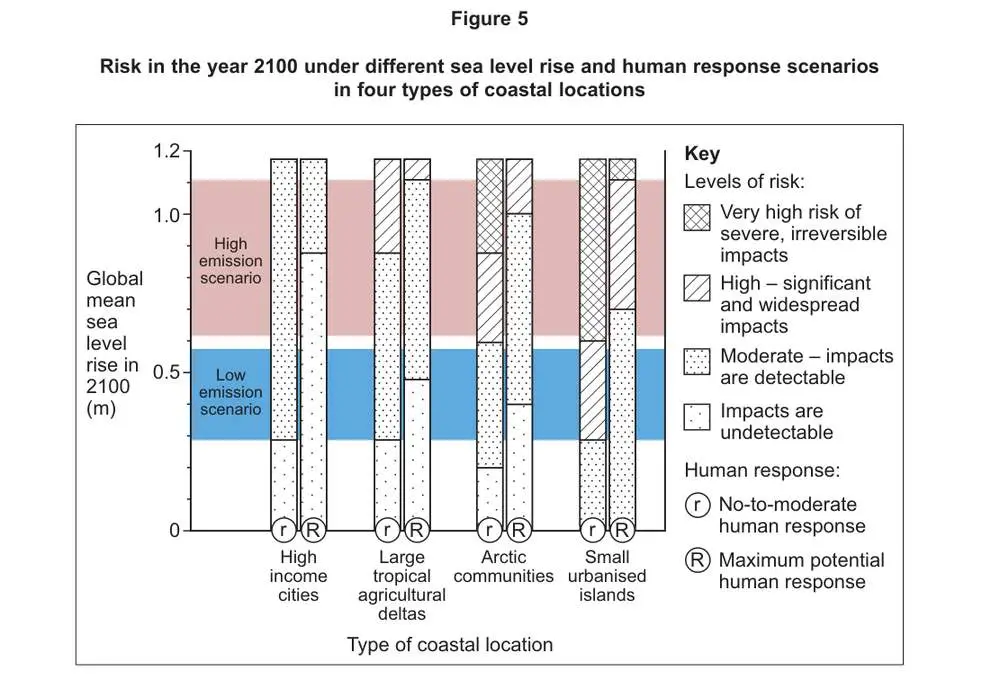
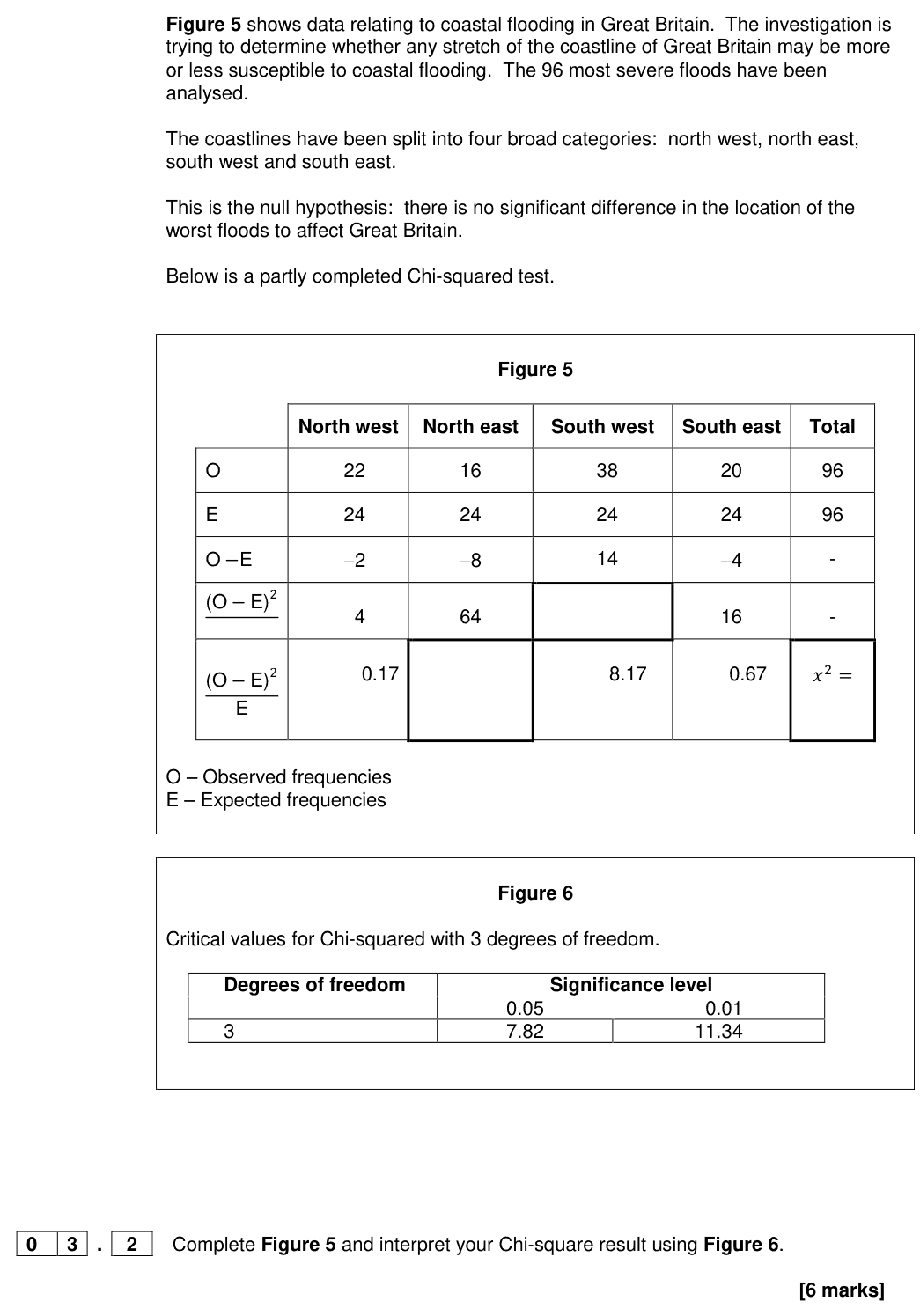
Figure 5
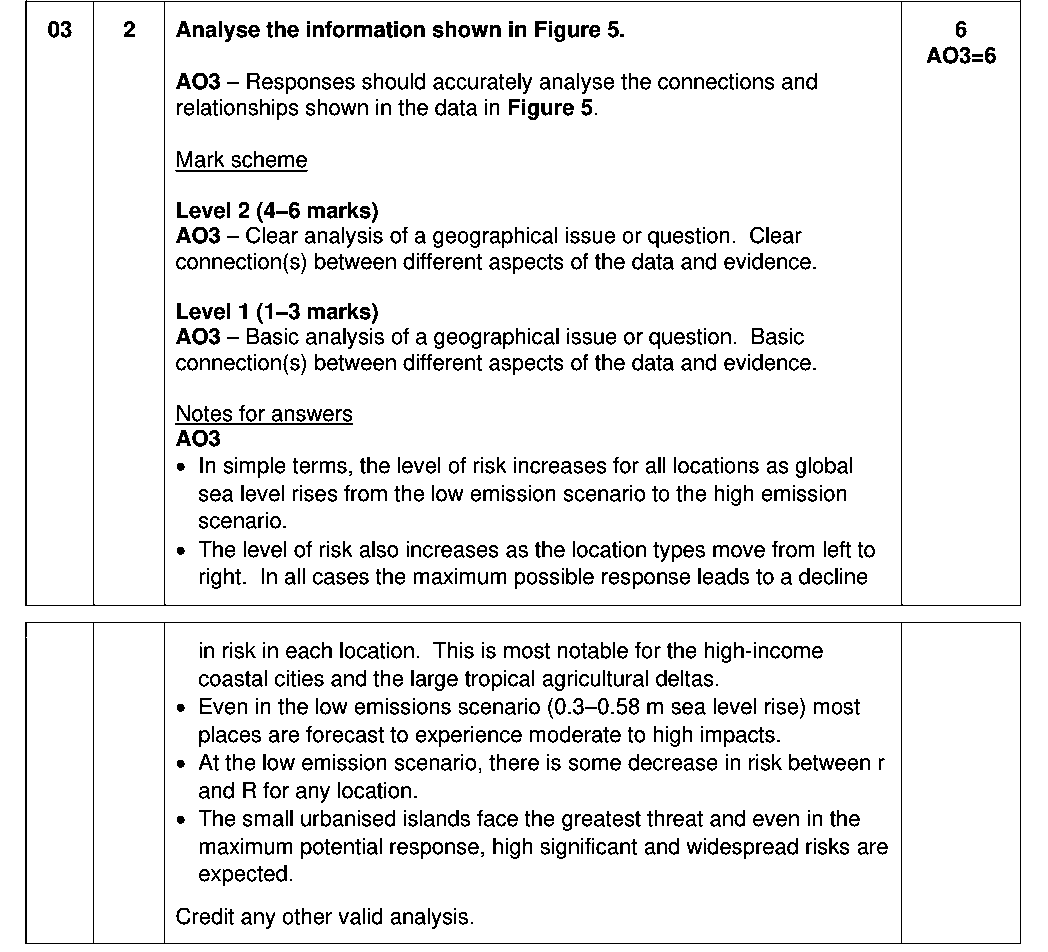
Mark scheme, including the levels and indicative content
Examiner's comment
These questions assess how students interpret, analyse and evaluate data, evidence and resources. In general, analysis and interpretation of map evidence requires further development. Some students found Question 03.2 on the coastal unit quite challenging. However, it was perhaps a little more simplistic than many realised. It showed three variables: different sea level change scenarios; no and maximum human response in the management of sea level changes and how these two variables affect potential impacts of sea level rise. Those that understood this information readily achieved the highest marks once they picked out patterns, anomalies and used some data in support. On question 03.2 (AO3) (6 marks), once students understood the three variables in the response it became relatively straightforward to access Level 2 and full marks. Even where there was minor misunderstanding, access to Level 2 was still possible. The response slightly misunderstood the y axis so full credit was not accessible. However, there was enough evidence to access the middle Level 2. Level 2 (5 marks)
Notes from the mark scheme and report
AO3: three variables - sea-level scenario, human response (r vs R) and location type
risk rises with sea level and from cities to small islands
maximum response lowers risk everywhere
small urbanised islands still high risk
misreading the y axis limited marks
June 2025 · Paper 1 · Q3.36 marksmark schemeStimulus
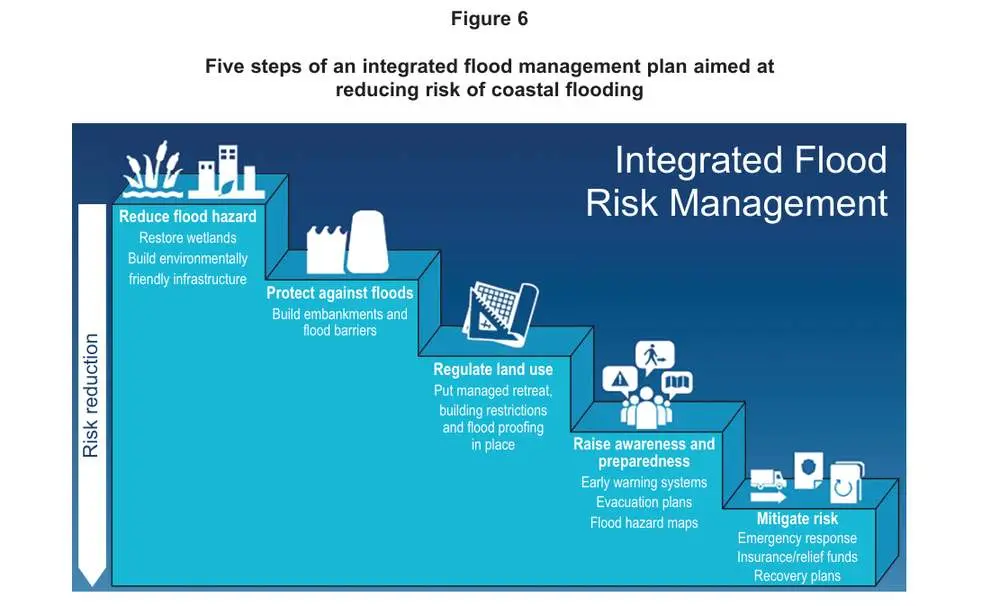
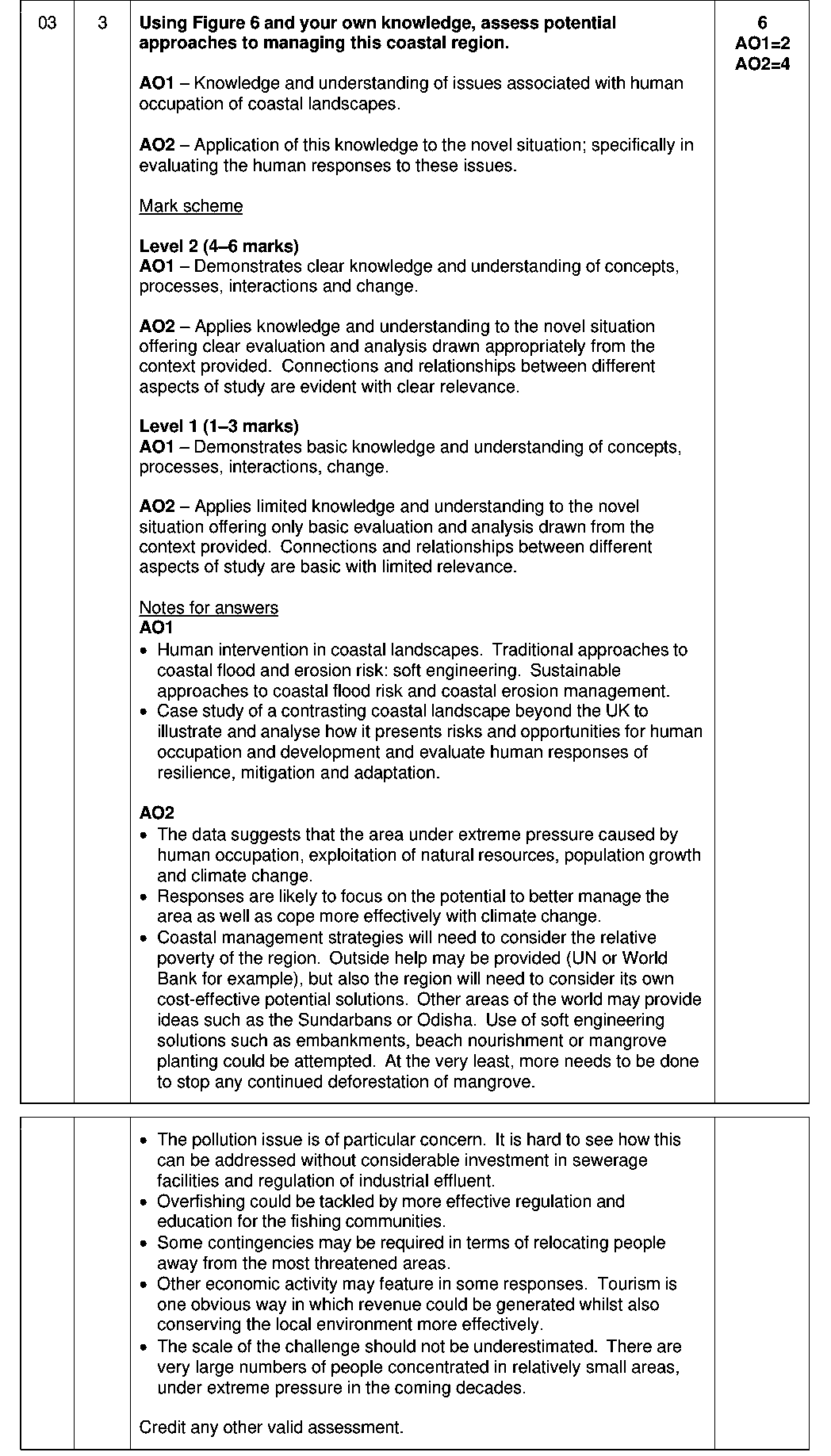
Figure 6
Mark scheme, including the levels and indicative content
Examiner's comment
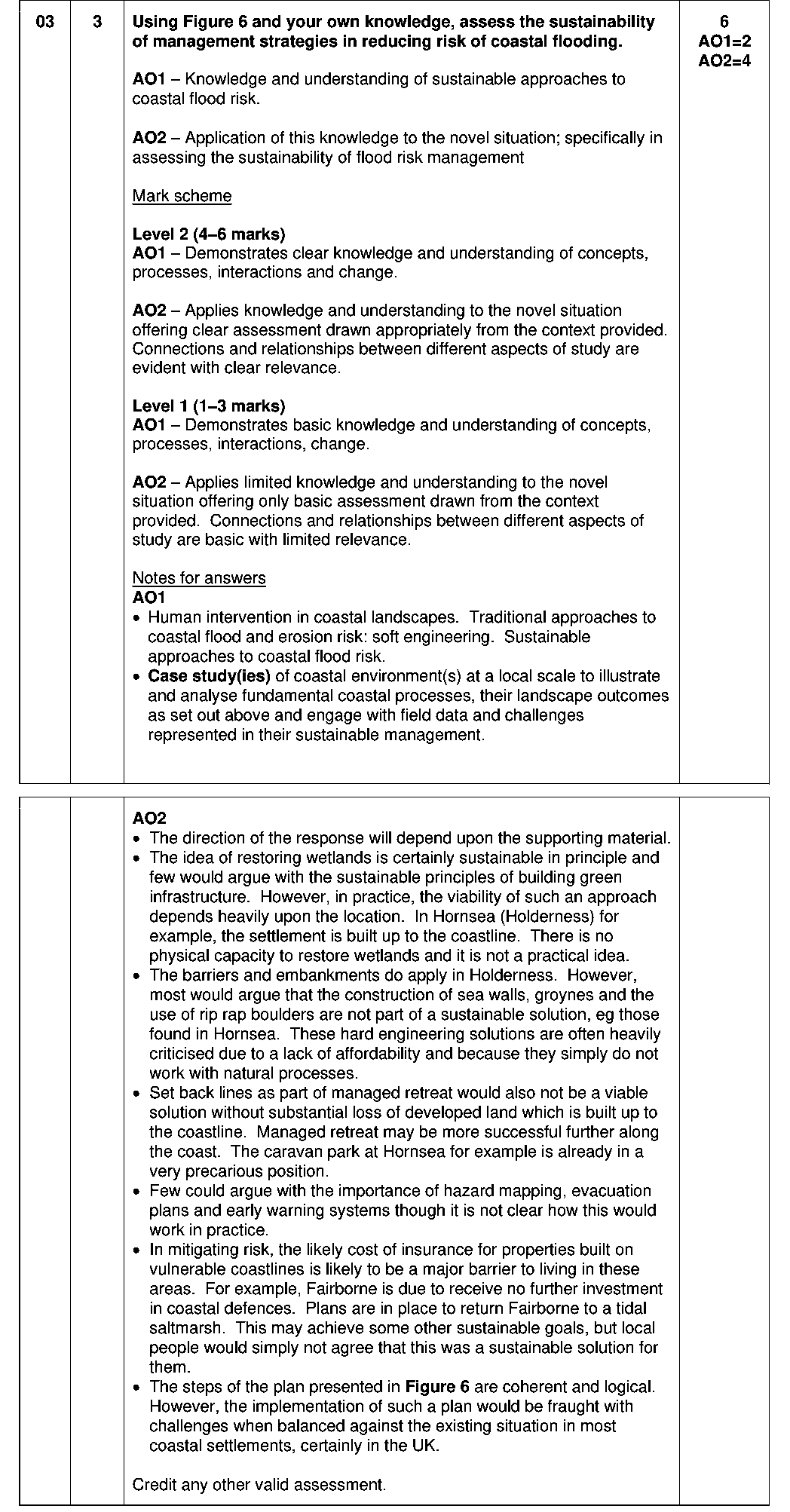
These questions assess knowledge and understanding when applied to novel situations (resource prompts). These are quite challenging questions, which students do often find to be quite difficult in general. The key to success is to quickly ascertain what the resource shows and which part of the specification is being targeted. Once this is established, students simply need to answer the question being posed, drawing upon relevant learned material as part of that unit. Question 03.3 did not really perform too well in novel situations. Students needed to assess the sustainability of different approaches to coastal management. It was much more simplistic than many realised. It did not require any detailed knowledge of the named approaches or case study recital. It was simply about showing understanding that some approaches (e.g. working with nature through soft engineering) are generally considered more sustainable than others (e.g. hard engineering). There was also some debate to be had around ideas of managed retreat in terms of its sustainability. Question 03.3 (AO1 & AO2) (6 marks), the coasts question, focused on different groups and types of coastal management strategies, many of which would be familiar to students. The resource was set out as a series of steps in an integrated approach. Students needed to consider each step and judge or assess the likely sustainability of the approach. For example, hard engineering schemes certainly perform a function in protecting a coastline. However, many argue that these are not in keeping the local environment and may disruption natural processes, causing issues elsewhere. Conversely many would argue that restoring wetlands is inherently sustainable as coastal impacts can be absorbed by the wetlands, whilst also creating natural habitats supporting a rejuvenated ecosystem. This response relied too heavily on case study support. It would benefit from more direct engagement with the resource and a clearer focus on addressing the specific demands of the question. Level 1 (2 marks)
Notes from the mark scheme and report
judge the sustainability of each step in the integrated plan: wetlands and green infrastructure more sustainable than embankments and barriers, debate over managed retreat, awareness and insurance
detailed case-study recall not needed and over-reliance on it scored poorly
June 2024 · AS Paper 1 · Q2.46 marksmark schemeData analysis
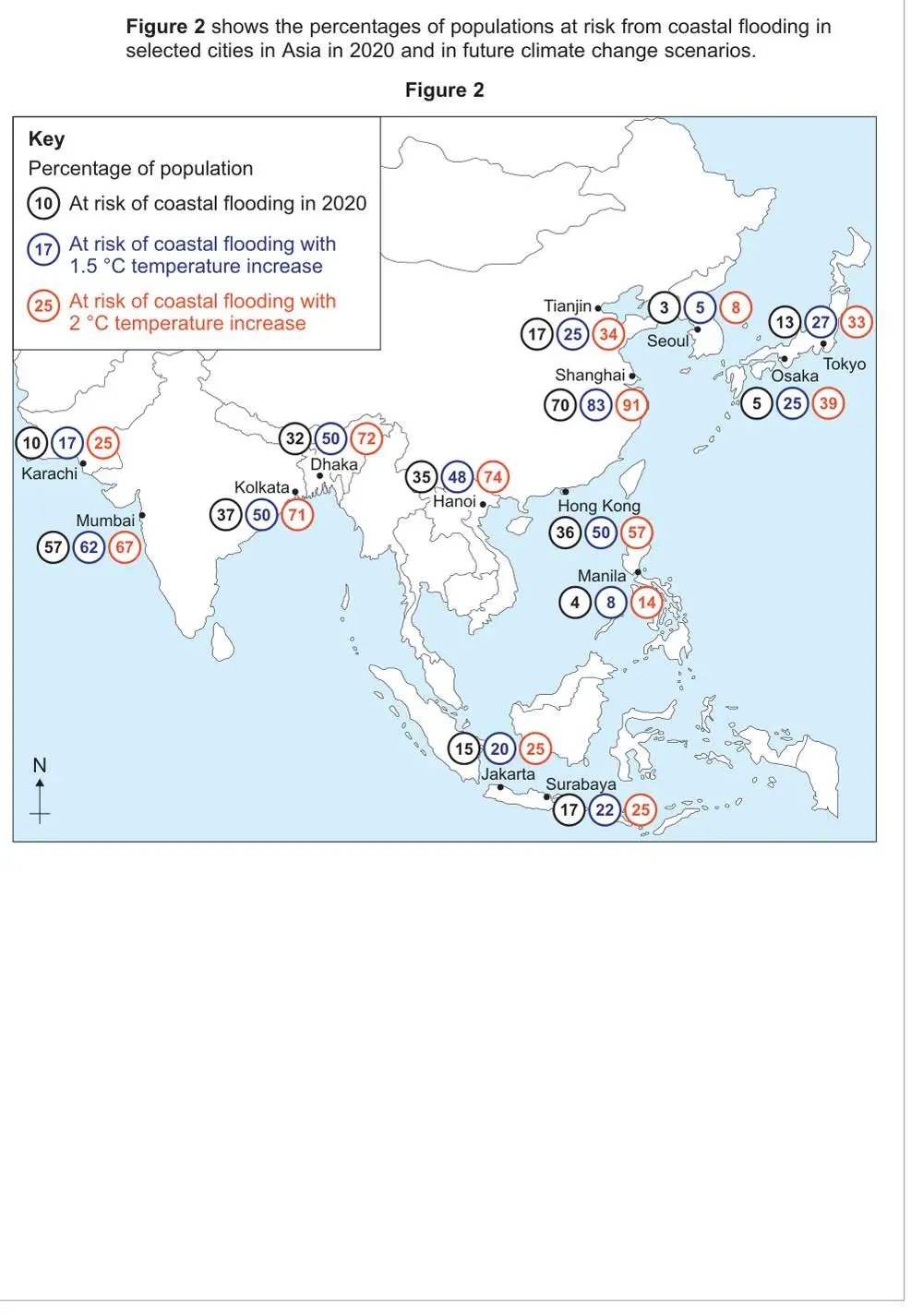
Figure 2
Mark scheme, including the levels and indicative content
Examiner's comment
These skills were tested whenever a stimulus resource was used, or numerical data was to be engaged with. On this paper this was the 6-mark skills question on each option, ie 1.4, 2.4, 3.4, 4.4 and 5.4. The main issue here was that many students demonstrated AO2 type answers by applying their knowledge, offering reasons for patterns for example, or too simply lifted data directly from the resource. This was not the question. The command ‘analyse’ in this context, simply required students to interface with the data, manipulate and deconstruct the information. Like the other AO3 skills questions on the paper, this proved very challenging for most students. The mean mark was 3.5/6. Less than ¼ of responses achieved 5 or 6 marks. Very few went beyond lifting individual numbers from the figure. Responses like this struggled to reach the top of Level 1. It was envisaged that having relatively straightforward data for 3 scenarios for the cities shown, that students would find it easy to make straightforward comparisons, which few did. Due to the amount of data, responses could access and move through Level 2 with clear comparison, or more detailed/sophisticated description of patterns within the data. The majority of students also struggled in this regard. It appeared that most were unfamiliar with dealing with data presented as percentages, and very few students could express percentage differences accurately. The best answers supported their points with clear use and manipulation of data, whilst weaker responses simply lifted values from the map. Few went beyond basic description of the data, with very few using or manipulating the data in a more sophisticated manner. Other responses did not score well as they quickly drifted into explanation or possible reasons for proportions of people at risk in different scenarios, this is AO2 and not valid in this AO3 question.
Notes from the mark scheme and report
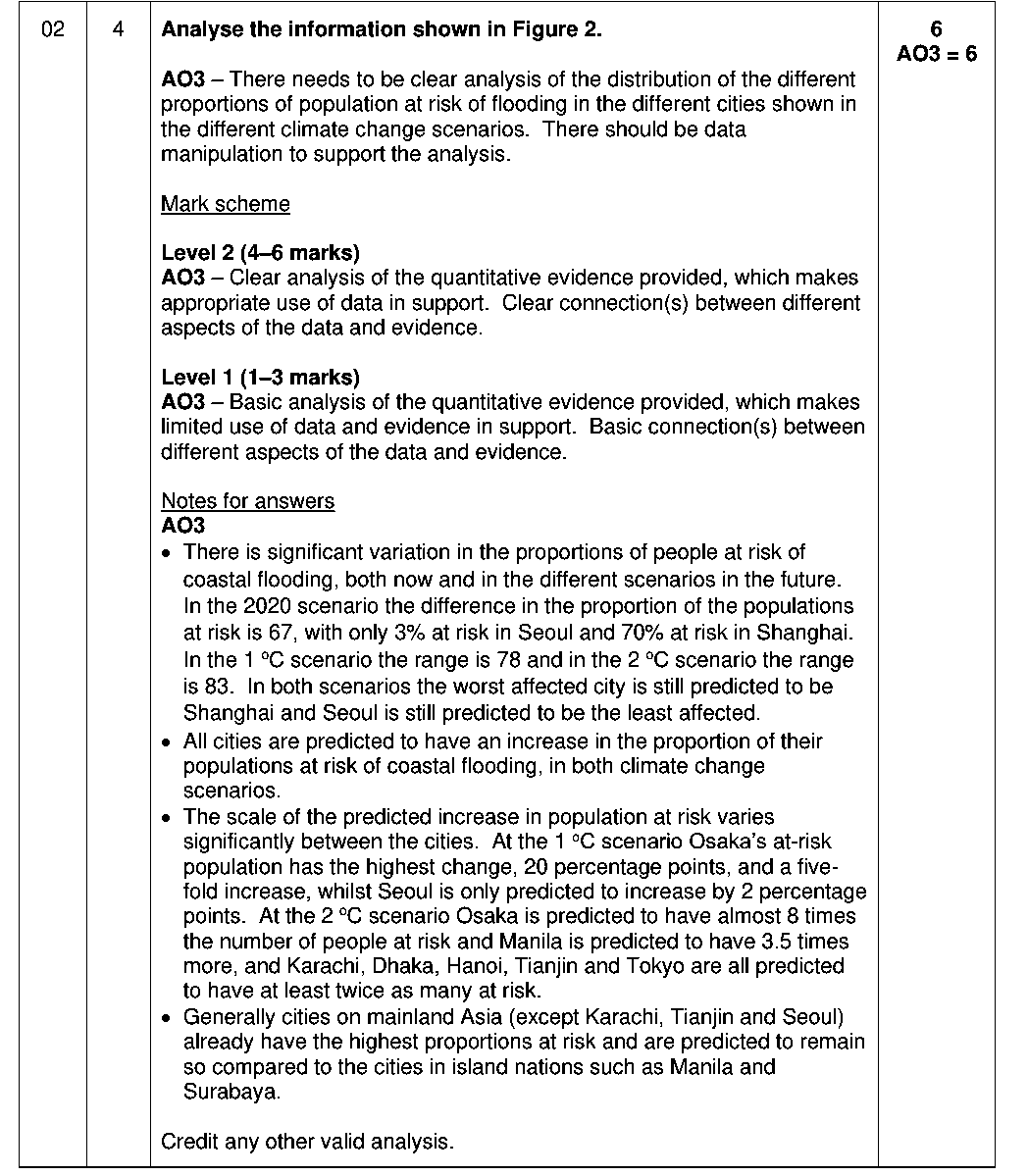
AO3: compare percentages at risk now and at 1.5 °C and 2 °C (Shanghai highest, Seoul lowest, range widens, Osaka fivefold rise)
express percentage-point differences accurately
no explanation
many struggled with percentage data
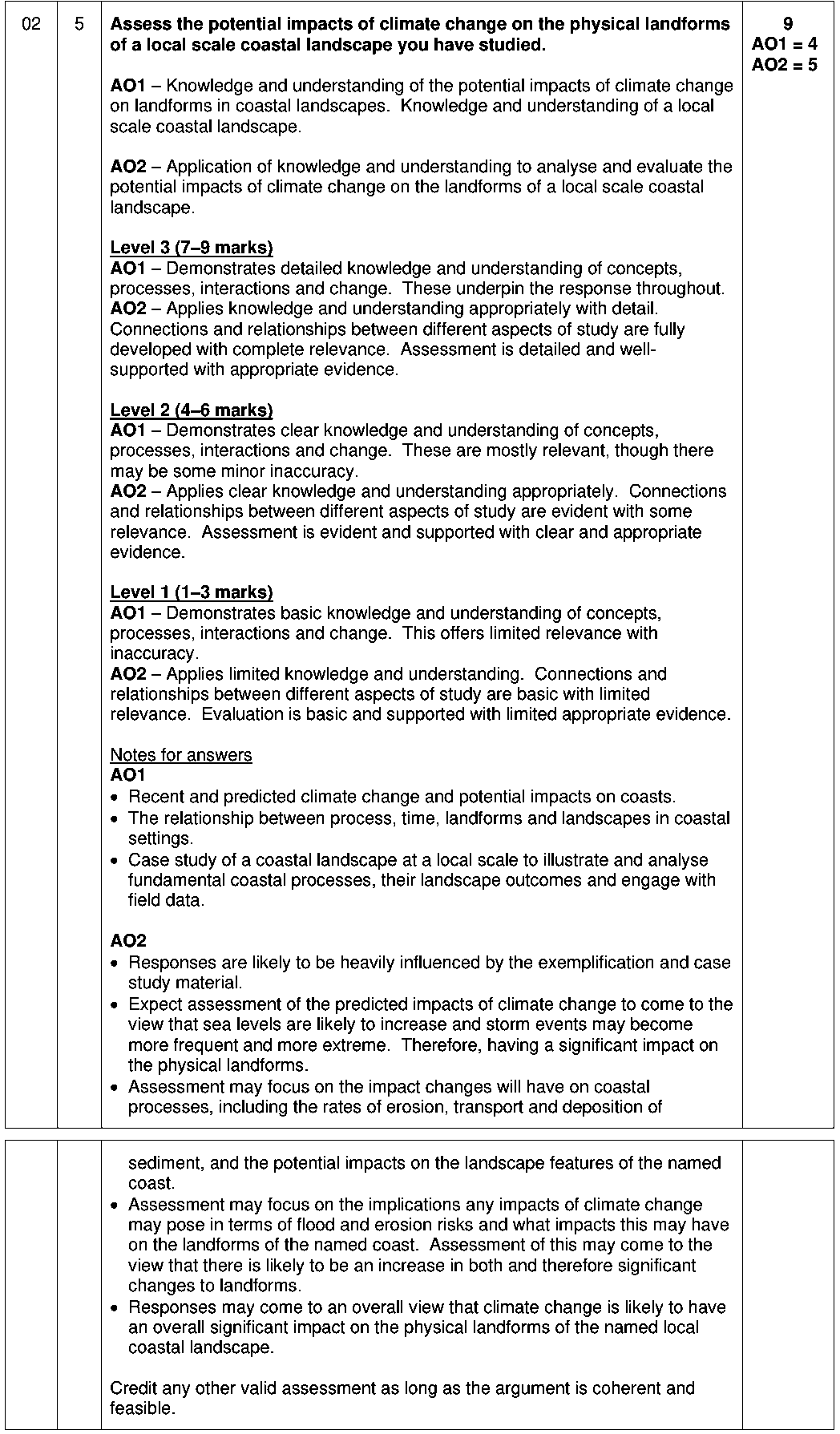
June 2024 · AS Paper 1 · Q2.59 marksmark scheme9-mark essay
Mark scheme, including the levels and indicative content
Examiner's comment
This question combined both AO1 and AO2 elements. This expected students to make links within the Coastal Environments specification, with specific reference to a local coastal environment they had studied. A very significant number of responses limited themselves due to a lack of focus on examples from appropriate scale coastal environments. Many simply referred to “The Holderness Coast.” This approach made it extremely difficult to identify specific physical landforms. For example reference to “cliffs on the Holderness Coast” could refer to hard resistant chalk cliffs at Flamborough, or any number of areas of less-resistant boulder clay cliffs, for example at Mappleton. As in previous series, it is hard to justify the entire length of the Holderness Coast as one distinct uniform local-scale coastal environment as envisaged in the specification, so unless students did name specific places and specific named landforms, such responses failed to score well. The wording of the specification does indicate that students could refer to local scale environments, so reference to different (appropriate scale) coastal environments was credit worth. Many responses were also limited due to poor quality written communication in terms of accurate reference to the past, present, or future tense. This was important as the question explicitly asked for focus on potential impacts. Whilst the highest marks were reserved for answers that explicitly referenced possible future impacts, credit was awarded for evaluation of accurate and specific impacts that may have recently happened, or be happening in the present, with the implication that they will continue to have an impact in the immediate future. Following the approach to marking outlined above, the average mark of 4.8 showed that most students did have fair knowledge and understanding of a range of impacts of climate change on the named coasts. About 1/3 of responses reached Level 3, showing that these students were able to give specific detail of predicted climate change, for example reference to possible 1-3 oC of warming and details of possible specific changes to sea levels and weather patterns that would result from this, with some detailed support.
Notes from the mark scheme and report
name specific local-scale places and landforms, not a whole coast such as 'the Holderness Coast'
future sea-level rise and storminess altering erosion, transport and deposition
explicit future focus needed for Level 3
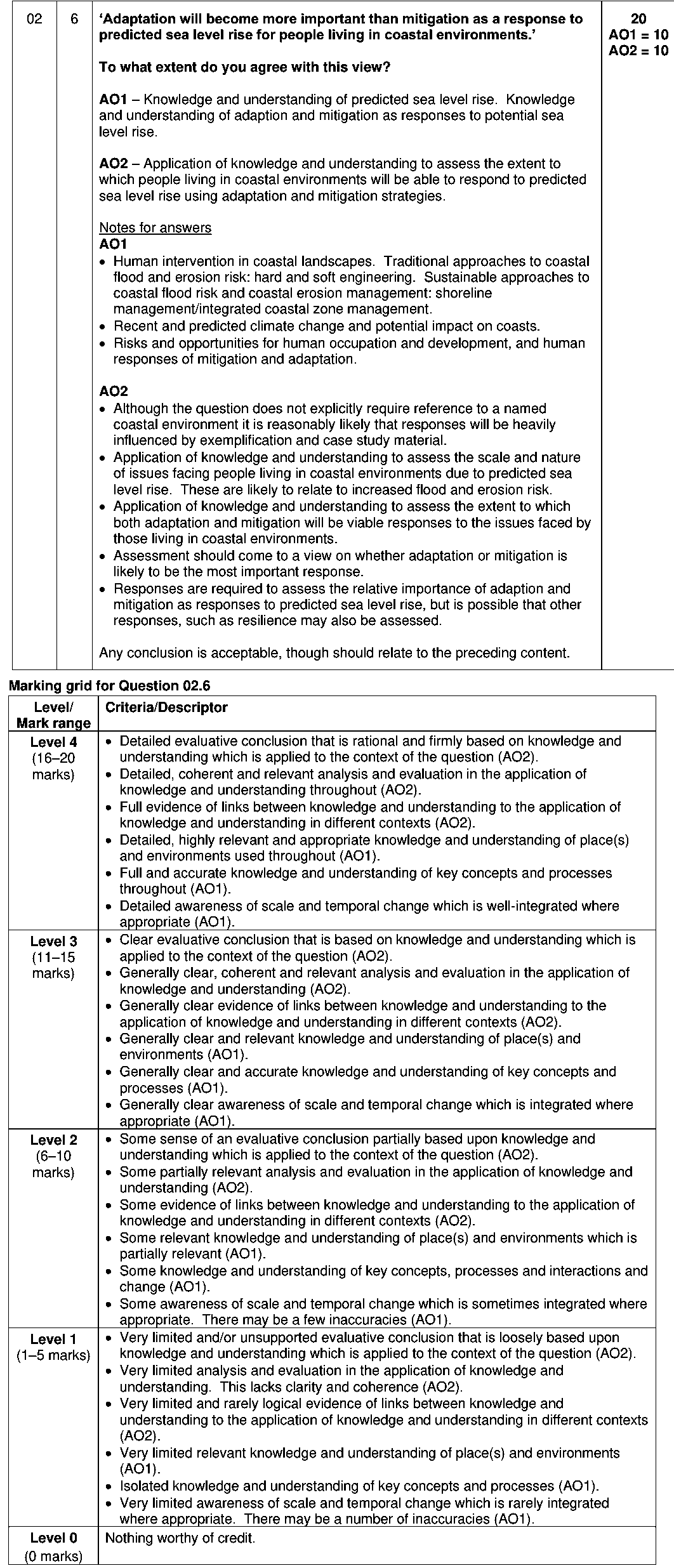
June 2024 · AS Paper 1 · Q2.620 marksmark scheme20-mark essay
Mark scheme, including the levels and indicative content
Examiner's comment
Around 2/3 of students were able to access this question well and produce good answers and reached Level 3 or better. The mean mark was 12.22, meaning only a smaller proportion featured the clarity or detail required to reach the highest levels of the mark scheme. The best students focused on specific details about possible predicted climate change meaning they were able to give clear specific details about the possible issues people would have to adapt to or mitigate against. Many answers showed little clear knowledge and understanding of the above, but more significantly most did not differentiate between adaptation and mitigation as different responses. The best answers engaged with this concept well and often referred to specific examples that clearly illustrated understanding of the difference between adaptation and mitigation. Although, not strictly prescribed by the question, the best responses were often supported with good clear case study detail.
Notes from the mark scheme and report
must distinguish adaptation from mitigation as responses to predicted sea-level rise (flood and erosion risk) and judge which will matter more
many did not separate the two
case-study detail helped though not required
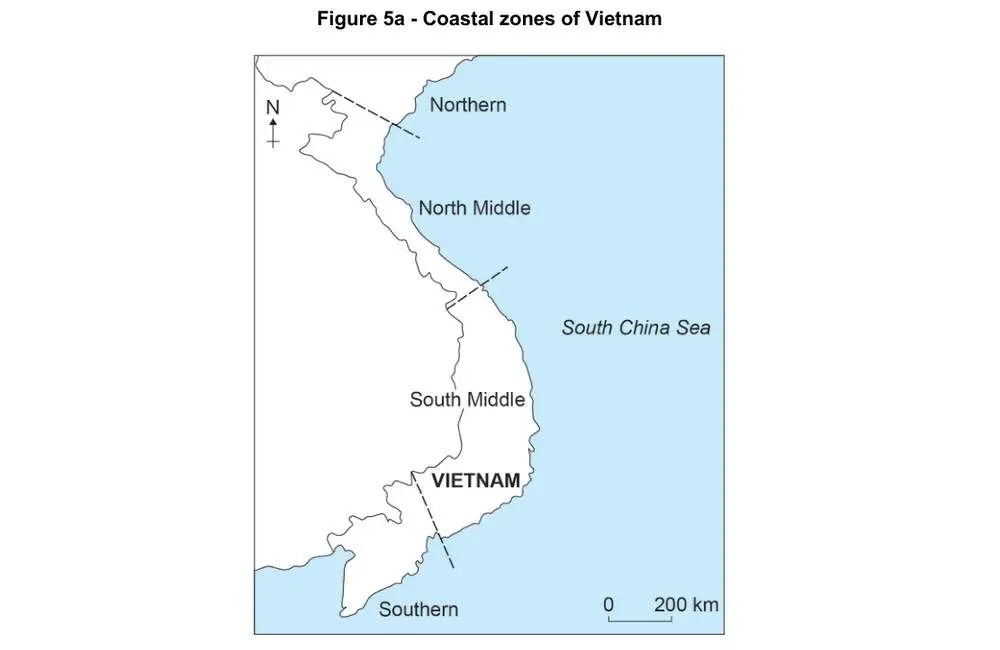
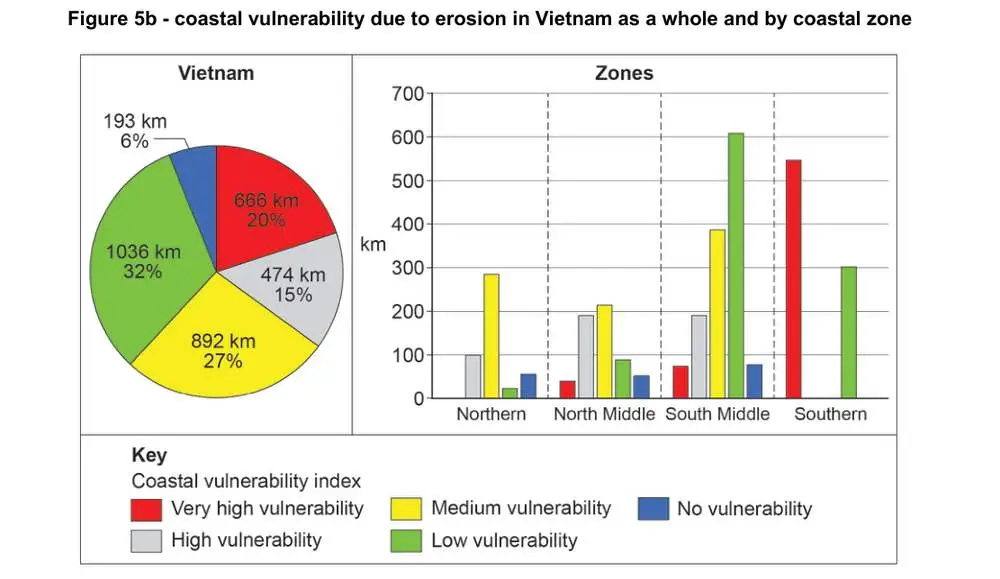
June 2024 · Paper 1 · Q3.26 marksmark schemeData analysis
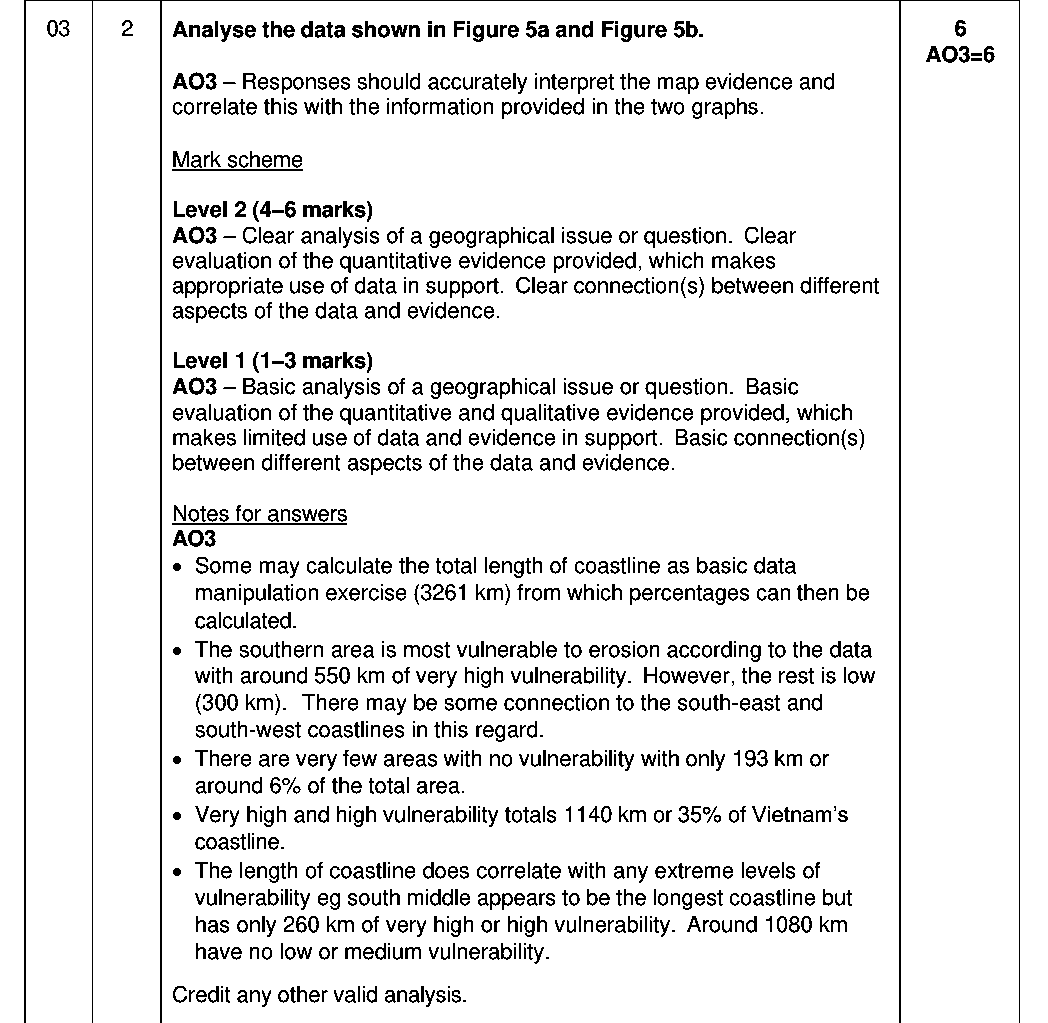
Figures 5a, 5b
Mark scheme, including the levels and indicative content
Examiner's comment
In terms of the skills questions, many required a degree of map interpretation. Where students were able to identify broad patterns as well as anomalies, Level 2 was readily accessed. There was also some opportunity to work with the data provided which many did successfully. For the skills questions (the .2 questions on each unit) we still had some who sought to explain patterns. This constituted AO2 and not AO3. There are still too many making this fundamental error. The best responses work the data and evidence in a concise fashion drawing out patterns in the data at the headline level i.e. the big picture. They are less focused on the minutiae of the data, except to exemplify the big picture. They often look for anomalies and try to exemplify them, explaining why they do not fit with the main trend. They do not attempt to explain them as this is not relevant to the Assessment Objective (AO3) being examined. Where possible data is used in support, even better where it is manipulated. Least successful responses fail to identify the major patterns, anomalies and often drift into explanations for the pattern, which is clearly AO2. Where there were opportunities to manipulate data, these were rarely taken or at best are only dealt with in a simplistic fashion.
Notes from the mark scheme and report
AO3: data manipulation expected (total coastline, percentages in each vulnerability class)
identify the most vulnerable zone and anomalies
no explanation
June 2024 · Paper 1 · Q3.36 marksmark schemeStimulus
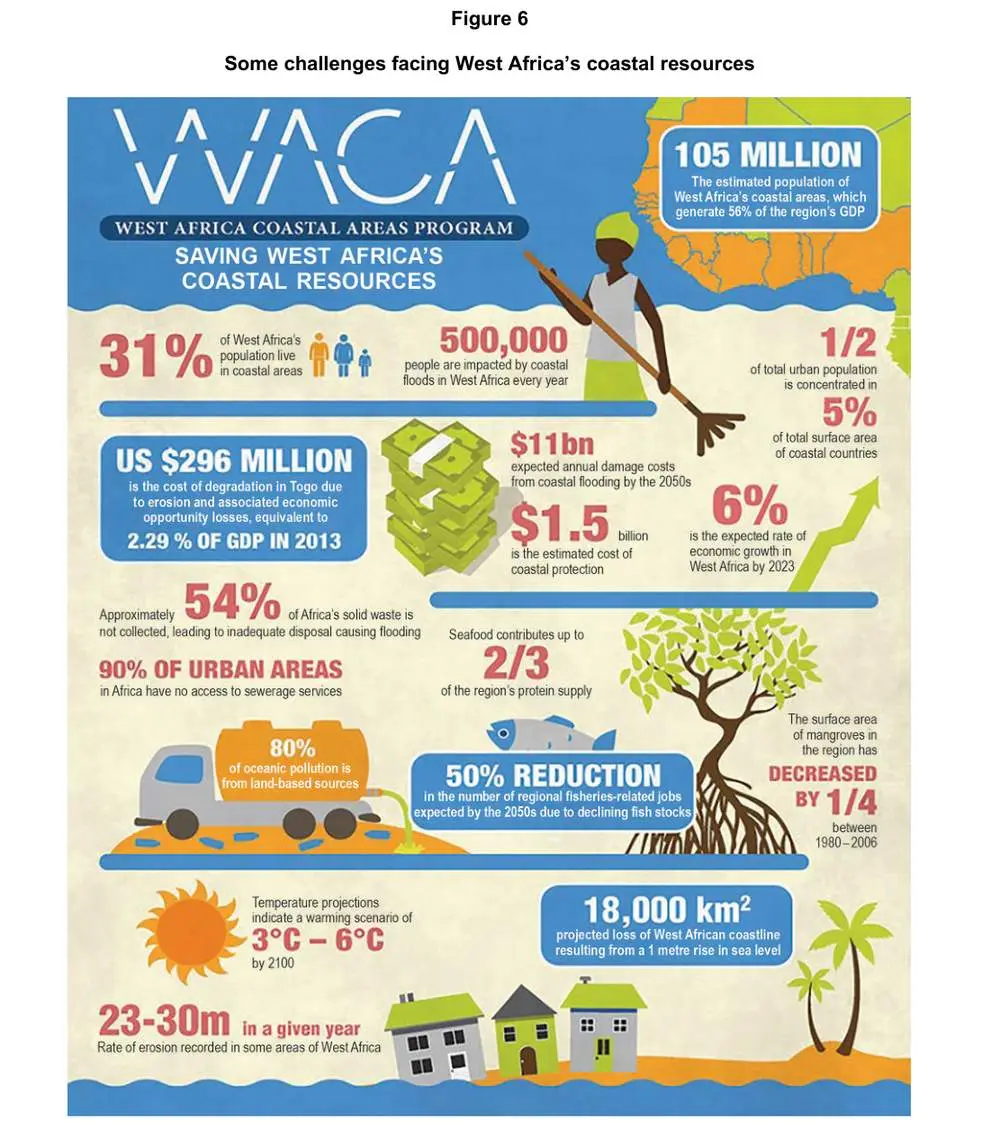
Figure 6
Mark scheme, including the levels and indicative content
Examiner's comment
For the novel situations (the .3 questions on each unit), many students have now got to grips with this style of question. The key is that students need to bring their own knowledge and understanding to the question i.e. bring something new which has not already been provided in helping to answer the question. For the novel situations (the .3 questions) those who reworked and regurgitated the information provided without bringing any of their prior learning, really struggled to score credit. The typical issue with questions of this nature is related to students either: interfacing solely with the resource and analysing it (i.e. demonstrating AO3); or simply drawing on knowledge linked to the thrust of the question without linking to the resource i.e. demonstrating AO1 only. In this question, the student should have used the resource to identify the coastal challenges and they should have offered sensible coastal management ideas in terms of how to manage these issues. Many only covered the basics of hard and soft engineering, despite opportunities to consider a much wider set of possible management ideas. As with all of these questions, no specific knowledge of place is required. This one scored Level 1 - 3 marks.
Notes from the mark scheme and report
use the resource to identify the coastal challenges and suggest suitable management
many offered only basic hard/soft engineering despite scope for wider ideas (ICZM, community and low-cost approaches)
no specific knowledge of place needed
weak example scored Level 1, 3 marks
June 2023 · AS Paper 1 · Q2.620 marksmark scheme20-mark essay
Mark scheme, including the levels and indicative content
Examiner's comment
Around 2/3 of students were able to access this question well and produce good answers reaching Level 3 or better. A smaller proportion had the clarity or detail required to reach Level 4 of the mark scheme. The best answers focused on specific local scale, named places. Meaning they were able to give clear specific details about the possible future flood and erosion issues, and specific management strategies. Many answers showed little clear knowledge and understanding of the concept of sustainable coastal management, as presented in the specification, as distinct from traditional approaches of hard and soft engineering. The best answers engaged with this concept well and often referred to sustainable coastal management being the central theme of ICZM and SMPs. Some responses were limited by use of exemplification and illustration at an inappropriate scale.
Notes from the mark scheme and report
named local-scale coast required
distinguish sustainable approaches (SMP, ICZM) from traditional hard and soft engineering and judge whether they are the only way forward
examples at the wrong scale limited marks
June 2023 · Paper 1 · Q3.36 marksmark schemeStimulus
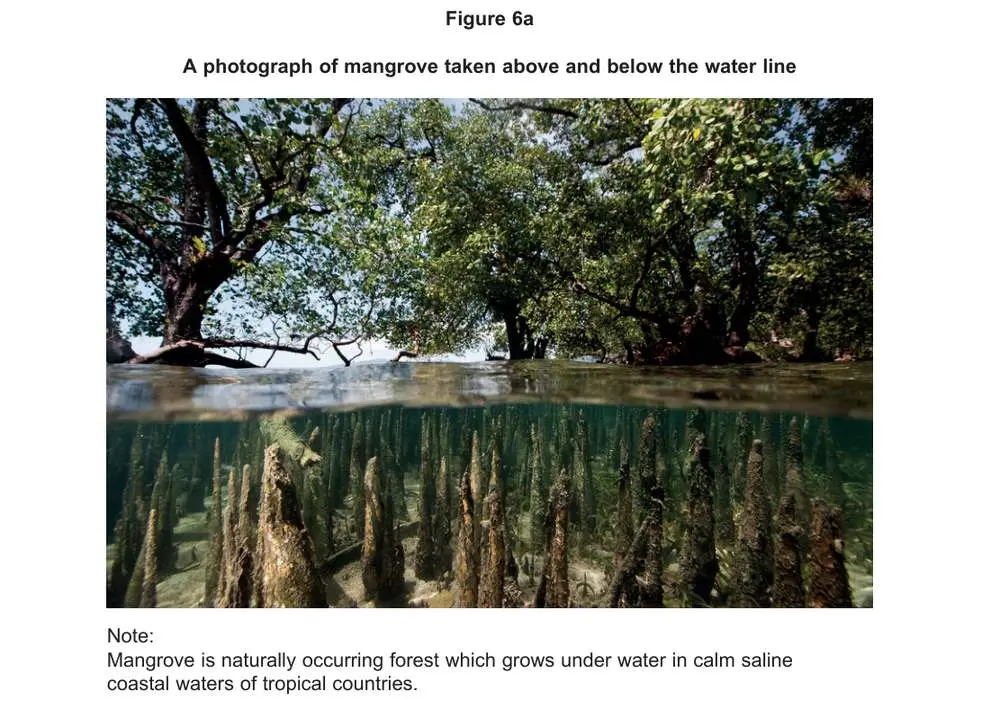
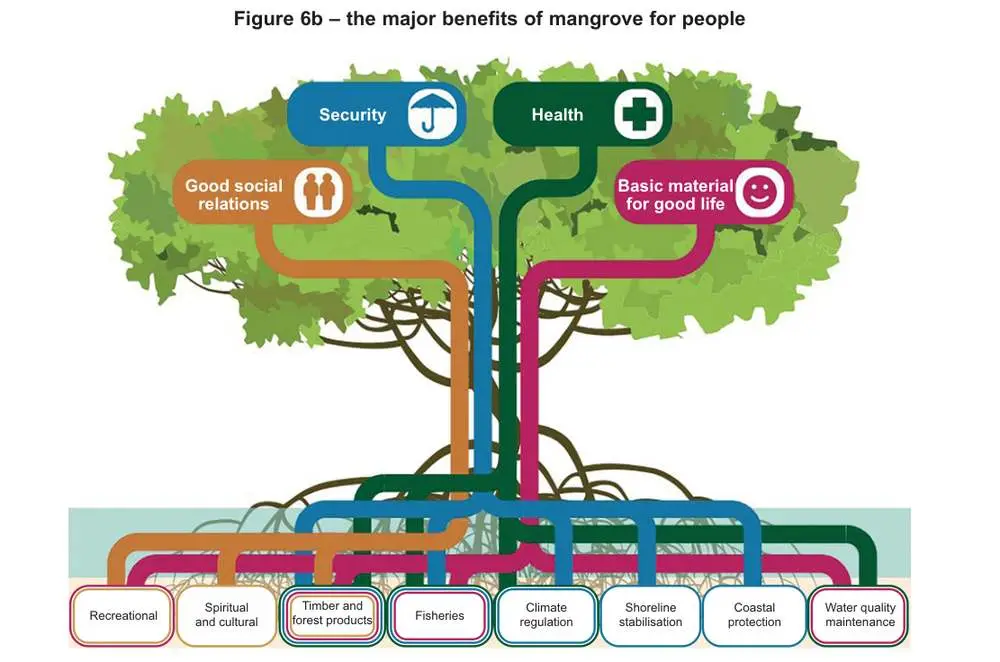
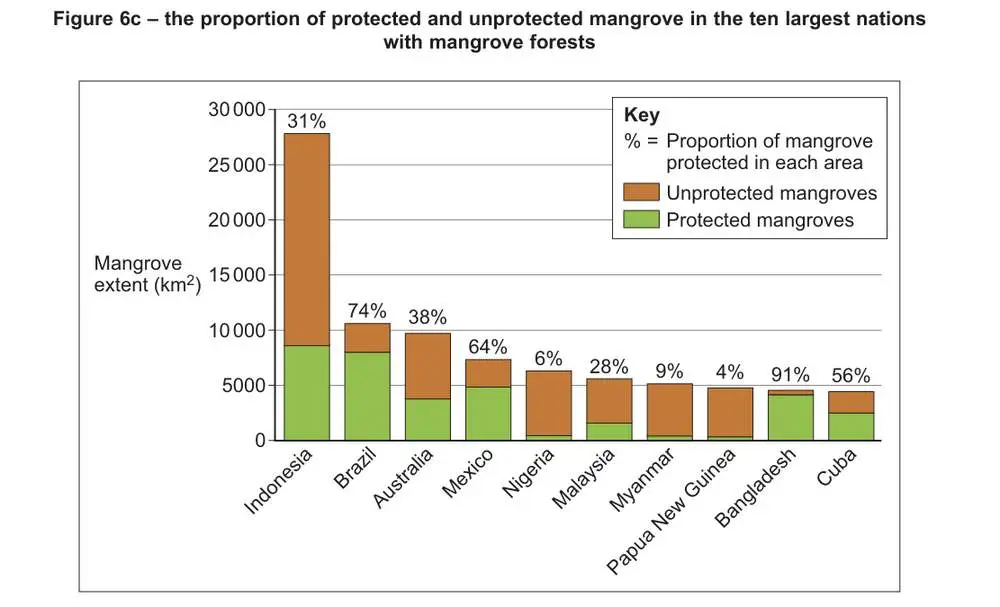
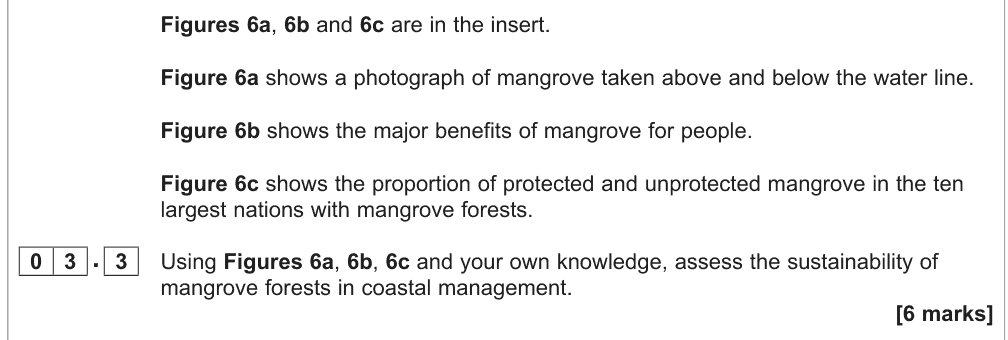
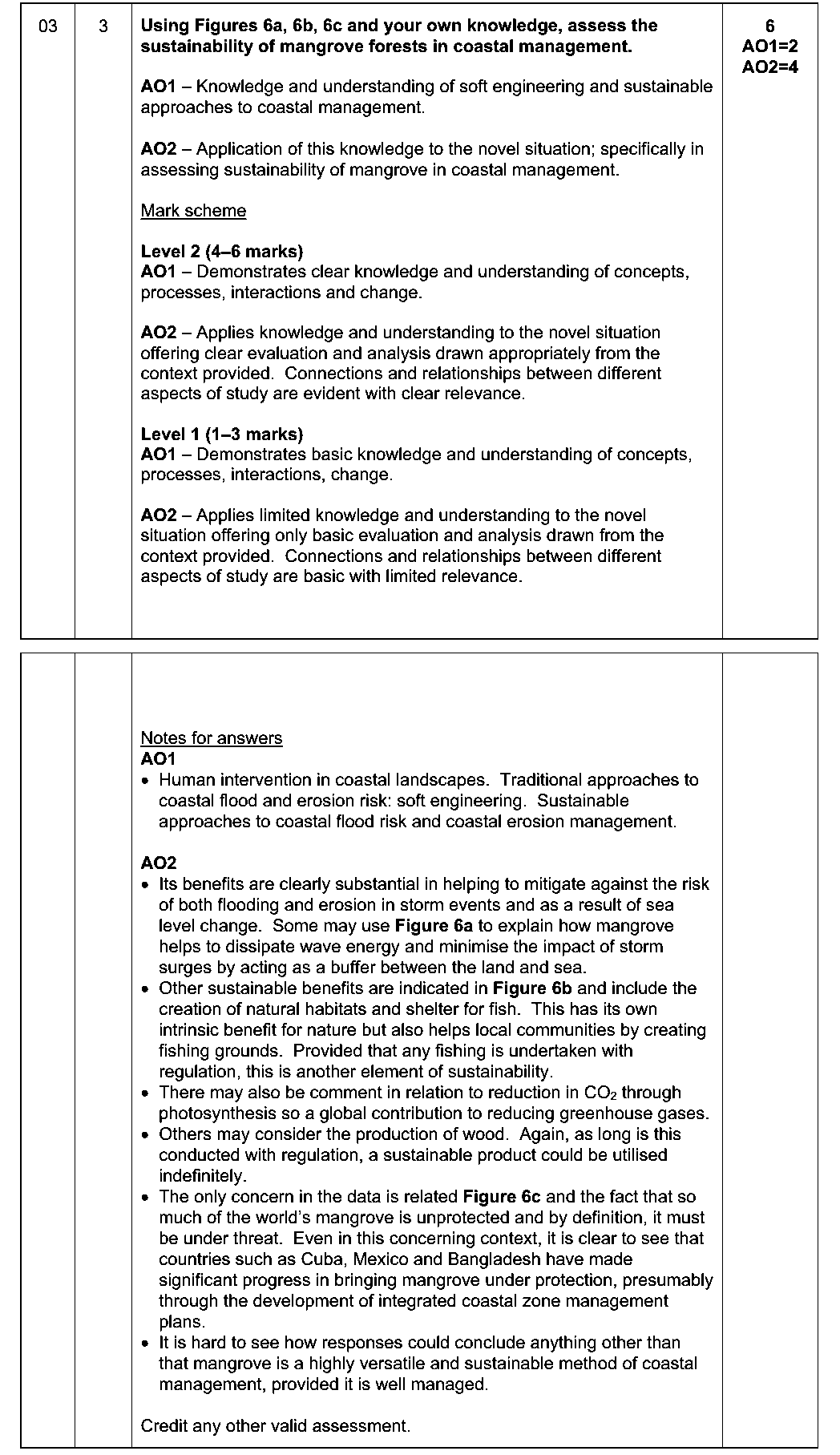
Figures 6a, 6b, 6c
Mark scheme, including the levels and indicative content
Examiner's comment
Understanding the focus of the novel situations questions and how the assessment objectives AO1 and AO2 are applied, still remains an issue for some students. This was specifically the case with the ‘x.3’ questions on all core and optional units. Many are still analysing data rather than applying knowledge to the resource provided. These questions require students to think on their feet. Students cannot simply interface with data in the resource, nor can they simply recite learned content. Instead they have to apply their learned knowledge and understanding to the novel situation. Less successful responses were those who simply regurgitated the data / information presented without drawing on their specification content. Similarly, there were some who recited knowledge without applying this to the context of the resource. Q.3.3, was generally successfully answered, most particularly where students engaged with the concept of sustainability and the information inferred by the data. Similarly, on Q.3.3, many were able to see the conflicting information about sustainability that was presented. The best saw how the graph presented a challenge to sustainability, with the photography being used to show how the root systems could defend against storm surges.
Notes from the mark scheme and report
mangroves dissipate wave energy and buffer storm surges, give fisheries, timber and carbon storage
much remains unprotected (Figure 6c) though Cuba, Mexico, Bangladesh protect most
best engaged with sustainability and the conflicting data
June 2023 · Paper 1 · Q3.420 marksmark scheme20-mark essay
Mark scheme, including the levels and indicative content
Examiner's comment
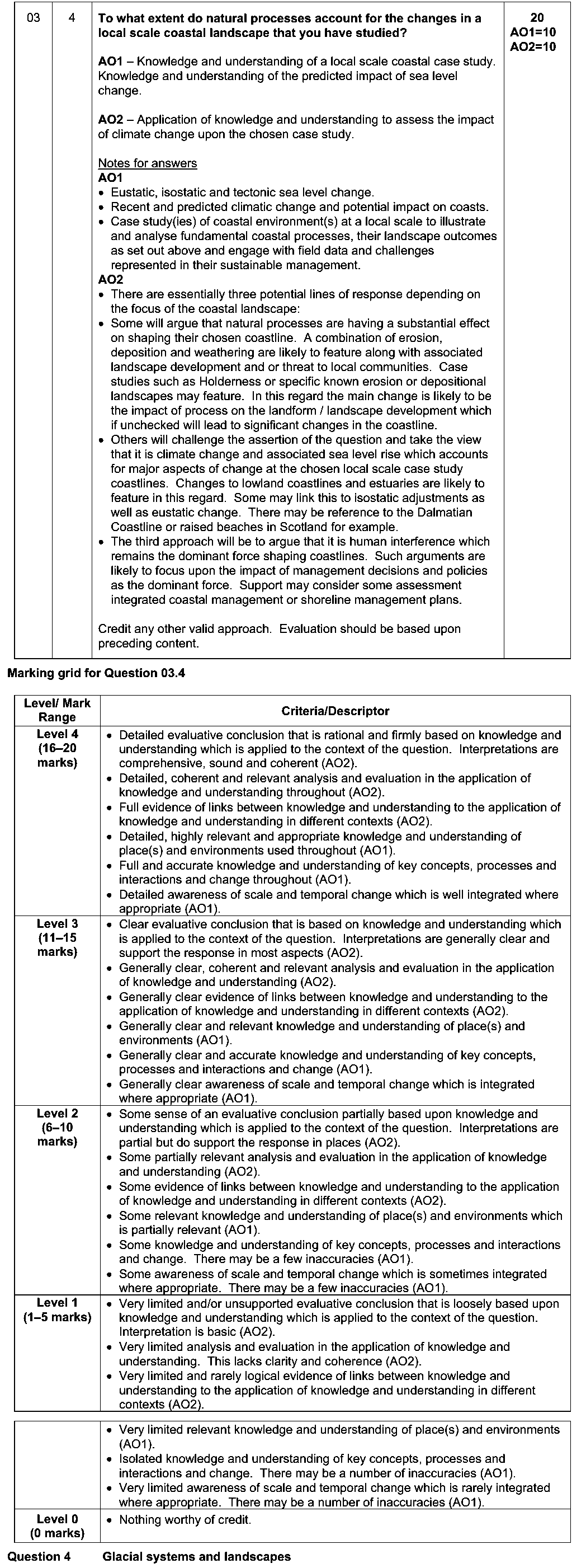
For the 20-mark questions there was a more physical focus to most of the questions in this series. Those that prepared well (and, crucially, those that read the questions carefully), comfortably scored Level 3/4. It was pleasing to see so many well-constructed essays. Typically many students asserted their own position in relation to the question at the outset (AO2 – argument) before proceeding to argue their points (AO2) and back this up with solid subject knowledge (AO1). Their conclusions then often returned to the theme of the question and pulled together the previously argued points into one closing paragraph. Generally, new content should not be introduced into the conclusion. Also supporting knowledge and understanding should be relevant and be used to help articulate the position in relation to the question. Those who read the questions carefully, answered the question in a clear structure and supported this with detailed knowledge easily accessed Level 3/4. Q.3.4 posed no major issues for students. Many considered natural process versus human impacts on coastlines, not least through coastal management. On Q.3.4 for example students offered strong arguments on the importance of natural factors in shaping coastal landscapes but then juxtaposed these with management. This was a valid route.
Notes from the mark scheme and report
own local-scale coast: natural erosion/deposition vs sea-level change vs human management (SMP/ICZM)
juxtaposing natural factors with management was a valid route
no major issues
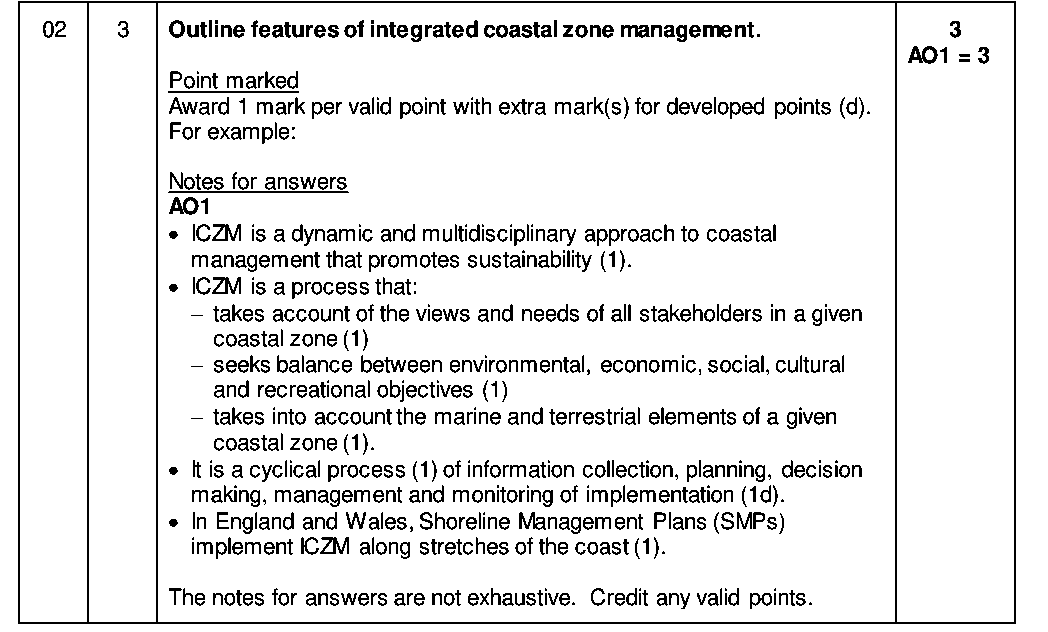
June 2022 · AS Paper 1 · Q2.33 marksmark schemeShort answer
Mark scheme
Examiner's comment
Around 20% of students achieved full marks with a similar proportion scoring zero, so the question clearly differentiated between responses. Most students clearly had some knowledge of integrated coastal zone management. Many of the responses that scored less well focused on, or just described, traditional ideas of hard and soft engineering.
Notes from the mark scheme and report
stakeholders, balance of environmental/economic/social aims, land and sea, cyclical process, SMPs
describing hard and soft engineering scored poorly
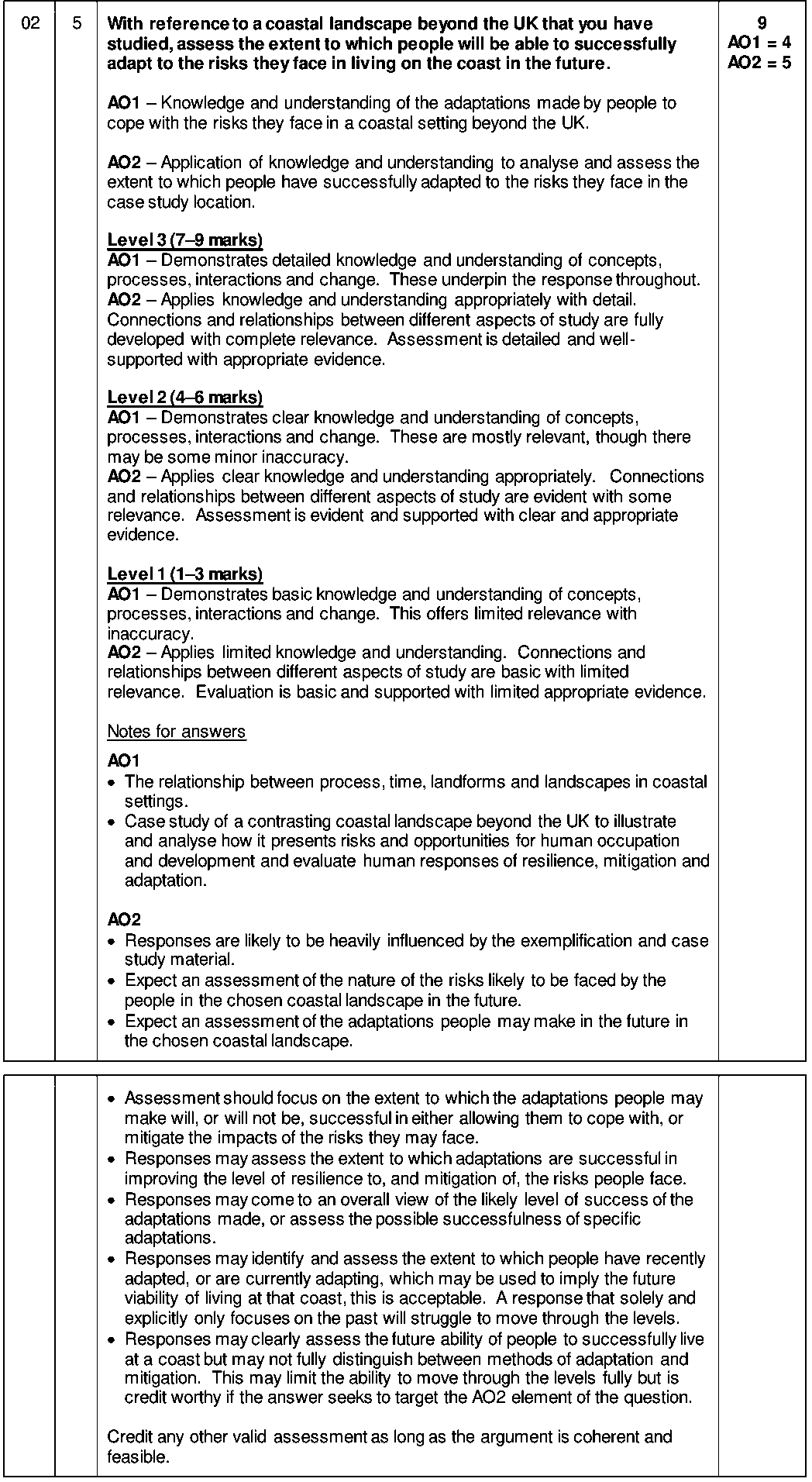
June 2022 · AS Paper 1 · Q2.59 marksmark scheme9-mark essay
Mark scheme, including the levels and indicative content
Examiner's comment
This question proved accessible to students around 90% of responses reached Level 2 or higher. The best answers gave clear assessment and supported their points with good specific details from their chosen case study. Many such responses also showed clear understanding of the specific future risks, with many showing clear understanding of issues relating to climate change, sea level rise and population pressures, amongst others. Weaker responses either did not focus on the future, or showed little appreciation of the concept of “adaptation”, and made general points about managing risks.
Notes from the mark scheme and report
assess future risks and how far adaptation will succeed in a named coast beyond the UK
weaker answers ignored the future or the idea of adaptation
about 90% Level 2 or above
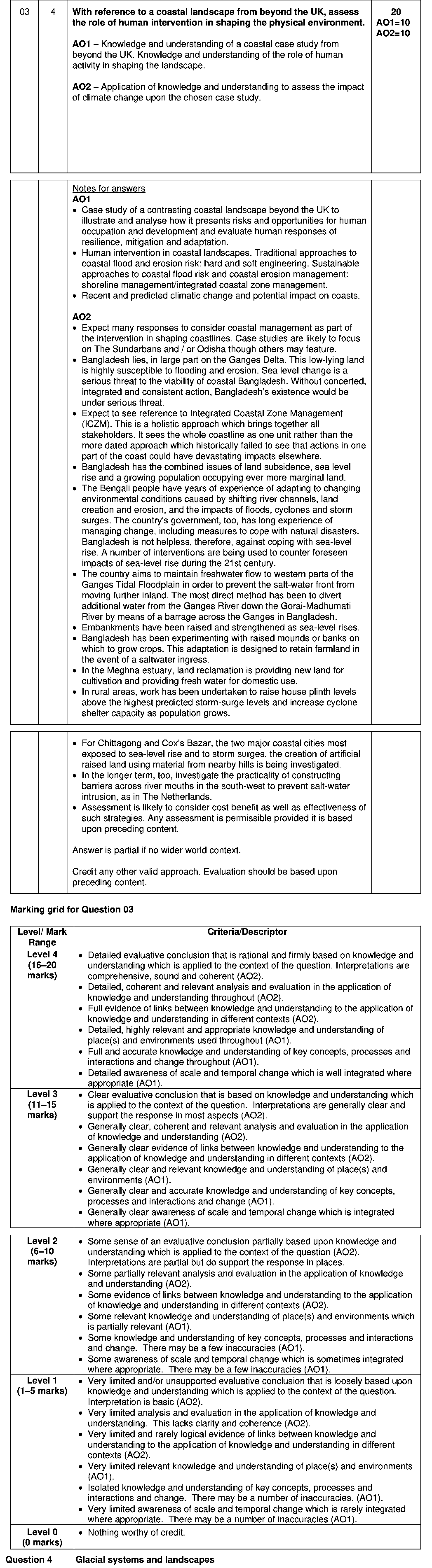
June 2022 · Paper 1 · Q3.420 marksmark scheme20-mark essay
Mark scheme, including the levels and indicative content
Examiner's comment
A small number missed the context of the question and wrote about a British case study. The mean mark was 11.47. Most chose Bangladesh (the Sundarbans), the Maldives or India (Odisha). Some responses were a little narrative in approach, writing about the challenges and issues facing the coastal regions without necessarily focusing on the question. More effective responses concentrated on the role of human intervention (intended or otherwise) and how this has affected the landscape. Coastal management (ICZMs), afforestation, fishing and tourism tended to feature here. Others contrasted this with natural processes and made broader links to global warming and its impact. This was also creditworthy.
Notes from the mark scheme and report
coastal landscape beyond the UK (Sundarbans, Maldives, Odisha)
focus on human intervention (ICZM, afforestation, fishing, tourism) shaping the physical landscape versus natural processes
British case studies missed the context
mean 11.47
mark scheme AO2 line wrongly refers to the impact of climate change
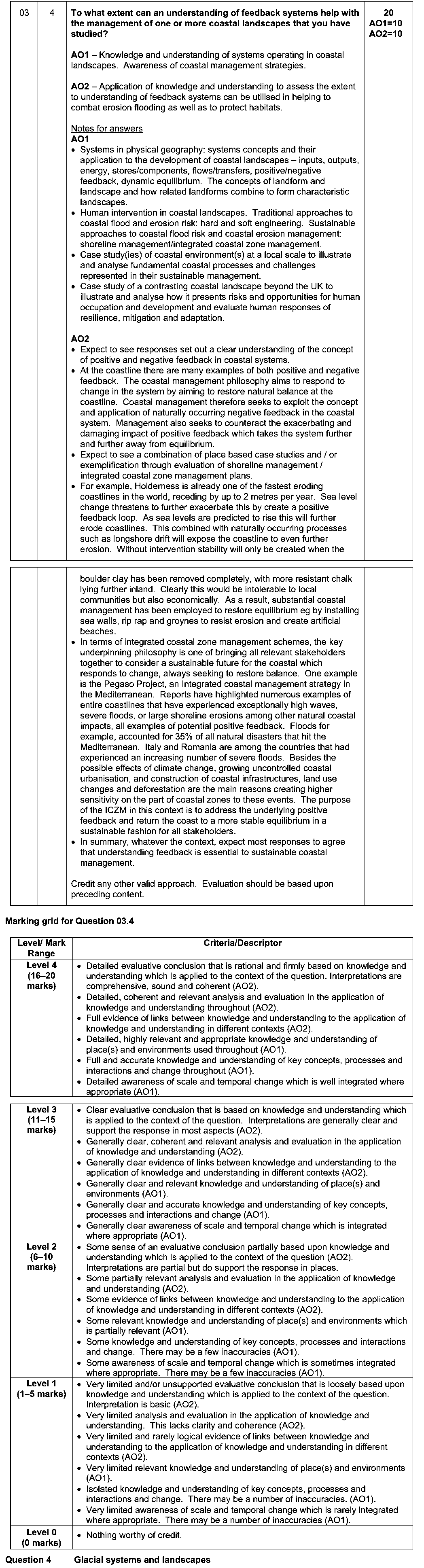
November 2021 · Paper 1 · Q3.420 marksmark scheme20-mark essay
Mark scheme, including the levels and indicative content
Notes from the mark scheme and report
management aims to use negative feedback and counter positive feedback (e.g. Holderness erosion, sediment cells, SMP/ICZM, managed realignment)
named coasts expected
November 2020 · AS Paper 1 · Q2.620 marksmark scheme20-mark essay
Mark scheme, including the levels and indicative content
Notes from the mark scheme and report
coastal landscape beyond the UK
assess whether predicted climate change (sea-level rise, storms) brings only negative impacts or some opportunities
November 2020 · Paper 1 · Q3.420 marksmark scheme20-mark essay
Mark scheme, including the levels and indicative content
Examiner's comment
On the extended 20 mark response Q3.4, many had evidently learned about coastal management and simply regurgitated this material and it was difficult to see the tangible link to the question. Some did incorporate management into their response by linking this to the mitigation of the predicted impact of climate change. This was a more effective approach.
Notes from the mark scheme and report
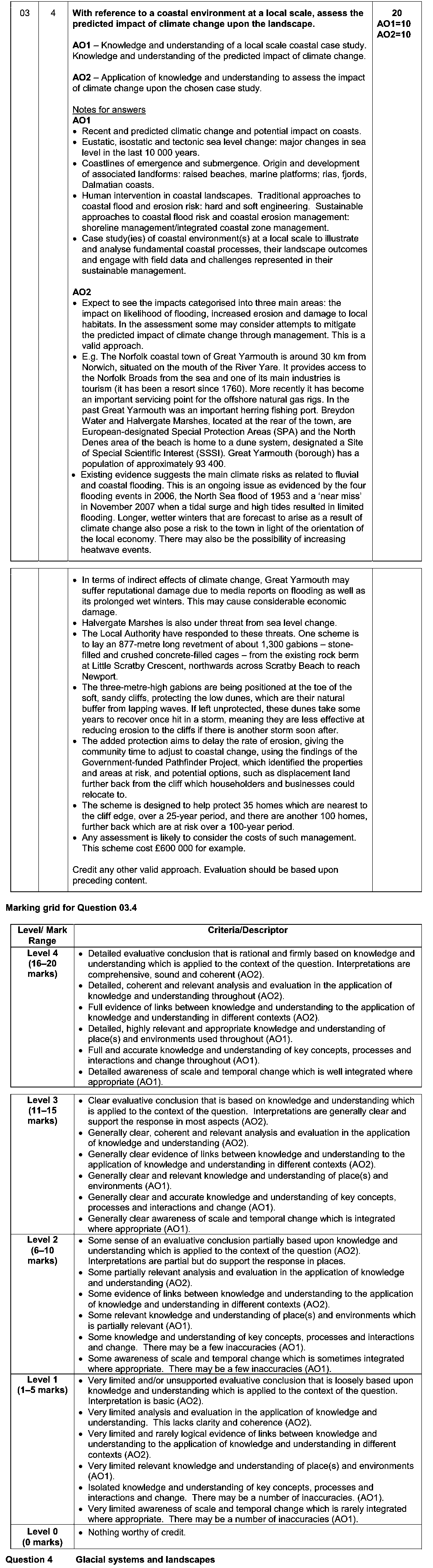
own local-scale coast (e.g. Great Yarmouth, Scratby): flood risk, erosion and habitat loss under predicted sea-level rise
management only relevant when linked to mitigating climate change impacts, regurgitated management scored poorly
June 2019 · AS Paper 1 · Q2.21 markmark schemeMultiple choice
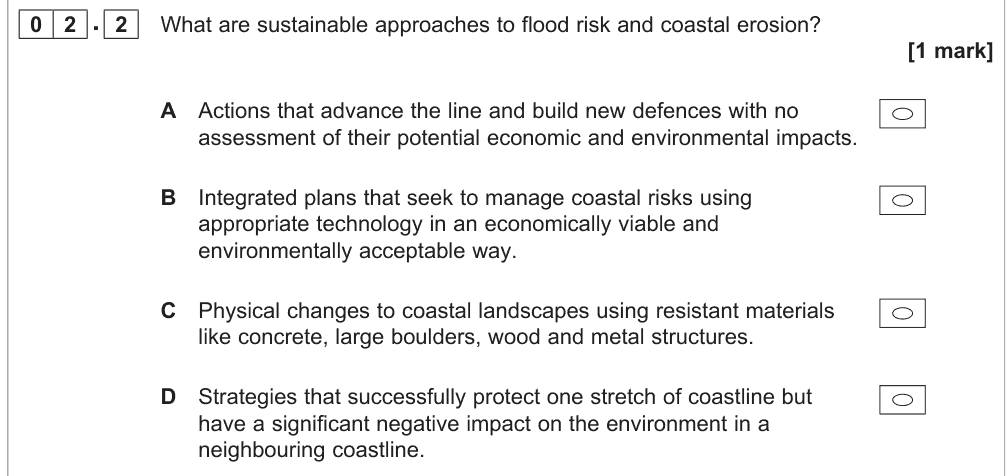
Answer
B
Mark scheme
Notes from the mark scheme and report
Answer: B
June 2019 · AS Paper 1 · Q2.620 marksmark scheme20-mark essay
Mark scheme, including the levels and indicative content
Notes from the mark scheme and report
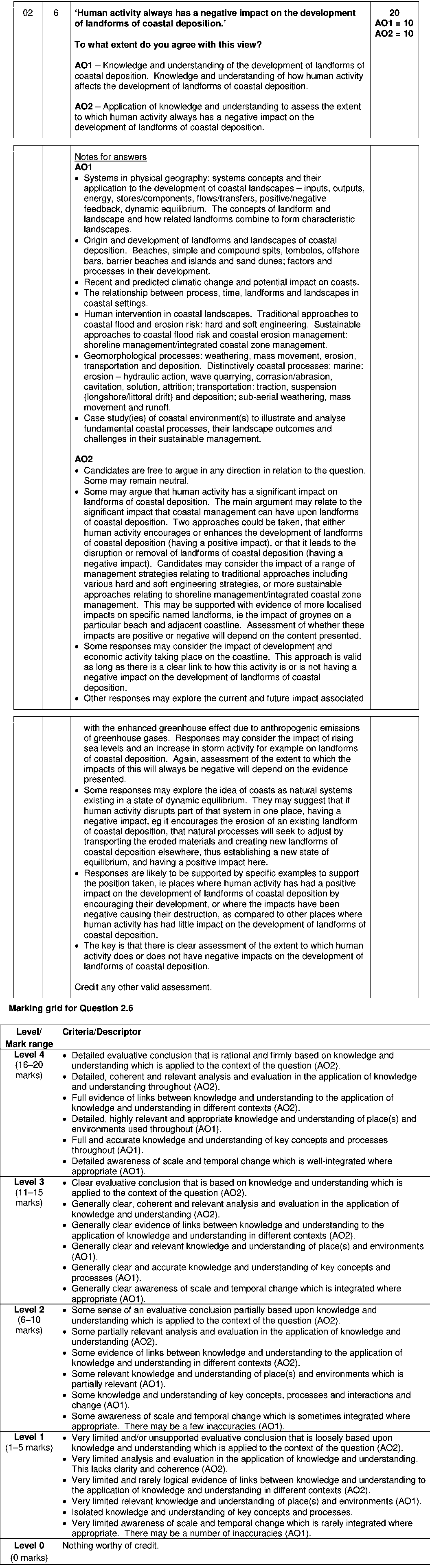
human impact on depositional landforms can be negative (groynes starving downdrift beaches) or positive (beach nourishment, dune stabilisation)
sea-level rise
dynamic equilibrium may rebuild landforms elsewhere
June 2019 · Paper 1 · Q3.420 marksmark scheme20-mark essay
Mark scheme, including the levels and indicative content
Examiner's comment
Shoreline Management Plans/Integrated Coastal Zone Management were implicit in a number of responses. Some simply considered the merits and costs of different approaches to coastal management. Whilst not strictly focused on the question, there was some credit for this approach. Holderness and Odisha featured in many responses though some simply evaluated the policies rather than dealing with the question in relation to the expected eustatic change. For instance, with Holderness, many referred to strategies in relation to coastal erosion and not the expected eustatic change in the coming decades. The best responses understood the basis of the approaches and were able to show how these plans, did at least attempt to take a broader, joined up approach to coastal management than perhaps has historically been the case.
Notes from the mark scheme and report
define SMP/ICZM by sediment cell, options (hold the line, managed retreat etc.) and cost limits
must link to expected eustatic rise, not just erosion (Holderness, Odisha, Happisburgh)
June 2018 · AS Paper 1 · Q2.620 marksmark scheme20-mark essay
Mark scheme, including the levels and indicative content
Examiner's comment
This question proved reasonably accessible to most candidates. 56% of students reached Level 3 or better. The thrust of the question was coastal management in the future in response to impacts of climate change. Many students did make clear reference to possible impacts of future climate change, with detail relating to possible sea level change and changing weather events. These generally scored well. The specification identifies “hard and soft engineering” as traditional approaches and “shoreline management/integrated coastal zone management” as sustainable approaches. Very few responses followed this interpretation. Most responses gave a debate between “hard” and “soft” engineering, with hard presented as the traditional approach and soft as the sustainable. This was credited and could score well as long as the assessment focused on their importance in terms of dealing with the impacts of climate change. Many misinterpreted the question and presented a debate focusing on which is more sustainable, hard or soft engineering. This was not the thrust of the question and did not score well. Many of the best responses were supported with specific detail from illustrative examples. These were often very perceptive and showed a clear engagement with specific issues places are going to face in the coming decades as sea levels rise and coastal populations increase. Many had detailed discussions about the costs and benefits of maintaining and enhancing current defences against making difficult land use planning decisions in the light of future impacts of climate change.
Notes from the mark scheme and report
spec treats hard and soft engineering as traditional and SMP/ICZM as sustainable, but hard vs soft debates were credited if focused on dealing with climate-change impacts
debating which is more sustainable missed the point
June 2017 · AS Paper 1 · Q2.620 marksmark scheme20-mark essay
Mark scheme, including the levels and indicative content
Examiner's comment
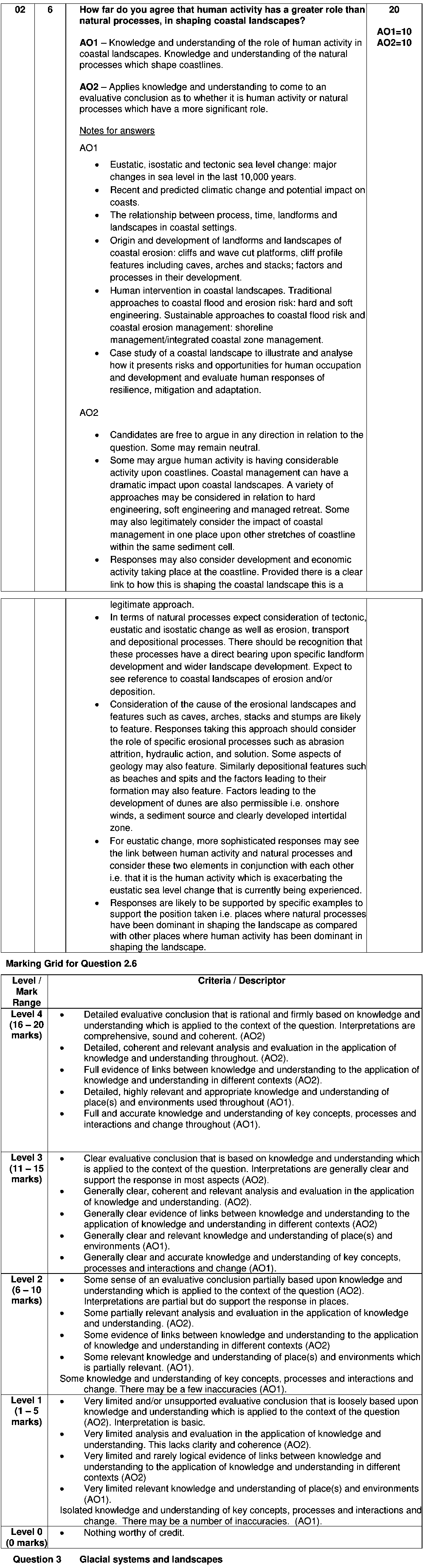
Students generally engaged well with this question but it also differentiated well. 58% accessed Level 3 or better with a clear focus upon the context of the question. Students were required to contrast the impact of human activity with natural processes upon coastlines. Some were a little unbalanced favouring one or the other. This was permissible if coherently argued. For human activity, many considered the role of intervention through coastal management and its unintended consequences, for instance at Hornsea on the Holderness coastline. For natural processes, many considered erosional and depositional processes and their impacts. Human induced climate change also featured and its association with sea level change. This was also a valid approach.
Notes from the mark scheme and report
weigh coastal management and its knock-on effects (e.g. Holderness) against erosion, deposition and sea-level change
human-driven climate change link credited
any balanced view accepted
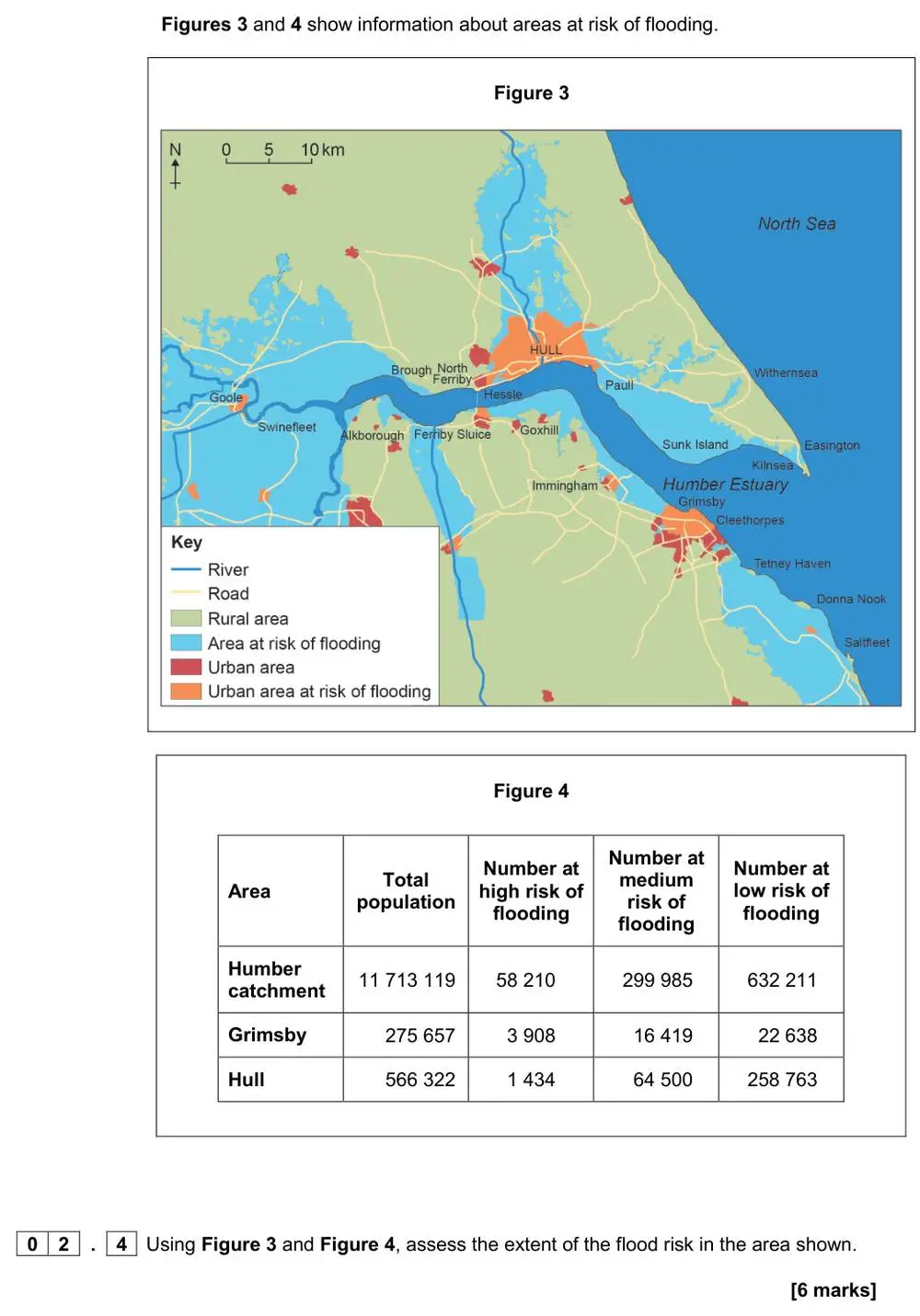
Specimen set 1 · AS Paper 1 · Q2.46 marksmark schemeData analysis
Mark scheme, including the levels and indicative content
Notes from the mark scheme and report
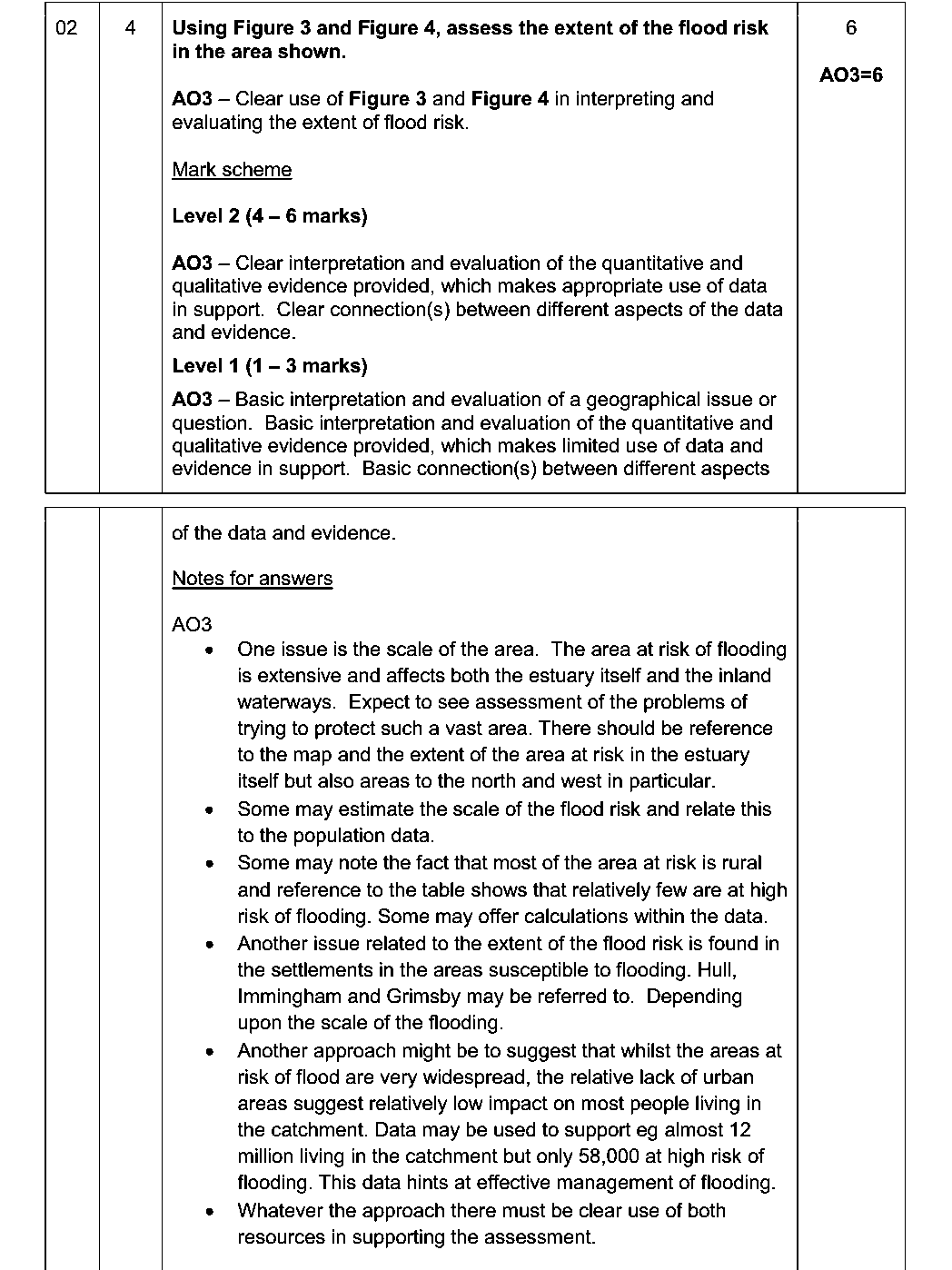
AO3: use the Humber flood-risk map and table together — very large area at risk around the estuary and inland, mostly rural
relatively few people at high risk (e.g. 58 210 of 11.7 million)
calculate proportions for Hull and Grimsby
comment on the difficulty of protecting such an area
Specimen set 1 · AS Paper 1 · Q2.620 marksmark scheme20-mark essay
Mark scheme, including the levels and indicative content
Notes from the mark scheme and report
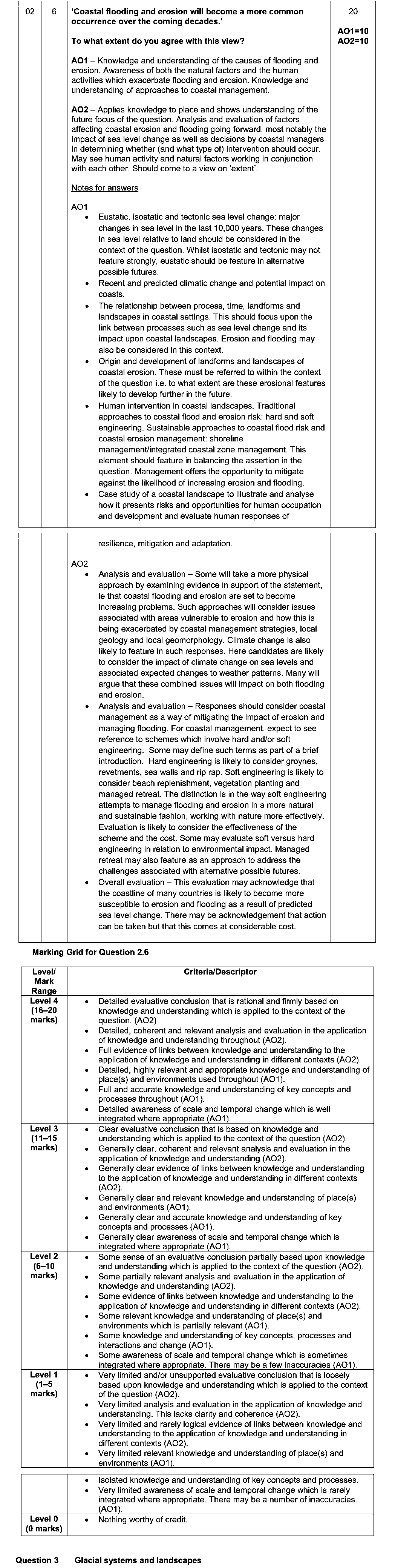
future flooding and erosion depend on eustatic sea-level rise and storminess from climate change plus management decisions (hold the line, managed retreat)
must reach a view on extent
Specimen set 1 · Paper 1 · Q3.26 marksmark schemeData analysis
Mark scheme, including the levels and indicative content
Notes from the mark scheme and report
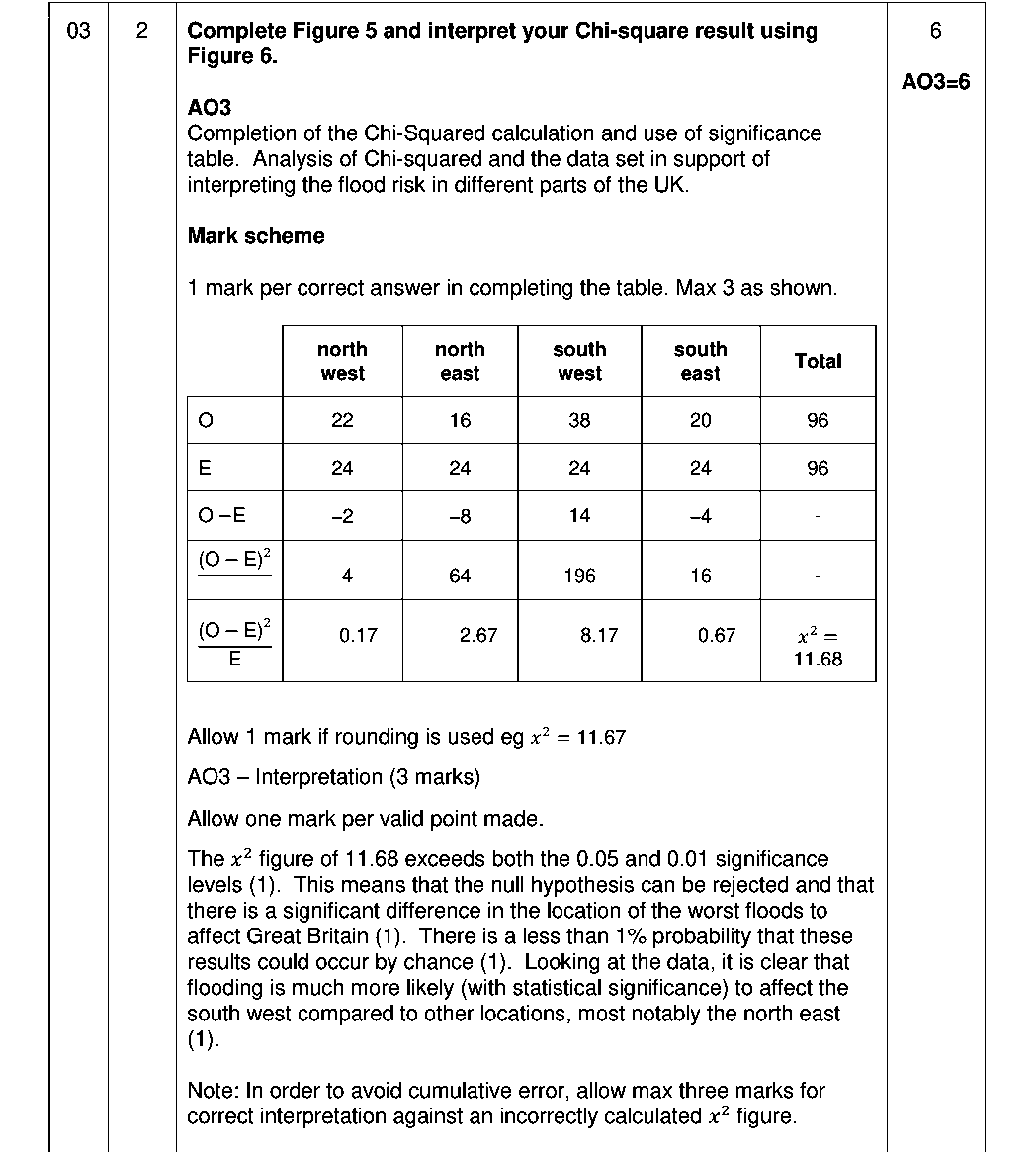
3 marks completing table: (O−E)² SW = 196, NE (O−E)²/E = 2.67
Answer: χ² = 11.68 (allow 11.67)
3 marks interpretation: exceeds 7.82 and 11.34, reject null hypothesis, <1% chance
south west most flood-prone
max 3 for correct interpretation of a wrong χ²
Specimen set 1 · Paper 1 · Q3.420 marksmark scheme20-mark essay
Mark scheme, including the levels and indicative content
Notes from the mark scheme and report
weigh the effectiveness of hard, soft and sustainable management (SMP, ICZM) against continuing natural processes and future sea-level rise and storminess
Work with an AQA Geography tutor
Essays stuck in the middle levels, or losing marks on the data questions? Book a trial lesson with a specialist AQA Geography tutor.