3.2.1.3-01 Global features and trends in the volume and pattern of international trade and investment associated with globalisation.A level only
3.2.1.3-02 Trading relationships and patterns between large, highly developed economies such as the United States, the European Union, emerging major economies such as China and India and smaller, less developed economies such as those in sub-Saharan Africa, southern Asia and Latin America.A level only
3.2.1.3-03 Differential access to markets associated with levels of economic development and trading agreements and its impacts on economic and societal well-being.A level only
3.2.1.3-04 The nature and role of transnational corporations (TNCs), including their spatial organisation, production, linkages, trading and marketing patterns, with a detailed reference to a specified TNC and its impacts on those countries in which it operates.A level only
3.2.1.3-05 World trade in at least one food commodity or one manufacturing product.A level only
3.2.1.3-06 Analysis and assessment of the geographical consequences of global systems to specifically consider how international trade and variable access to markets underly and impacts on students' and other people's lives across the globe.A level only
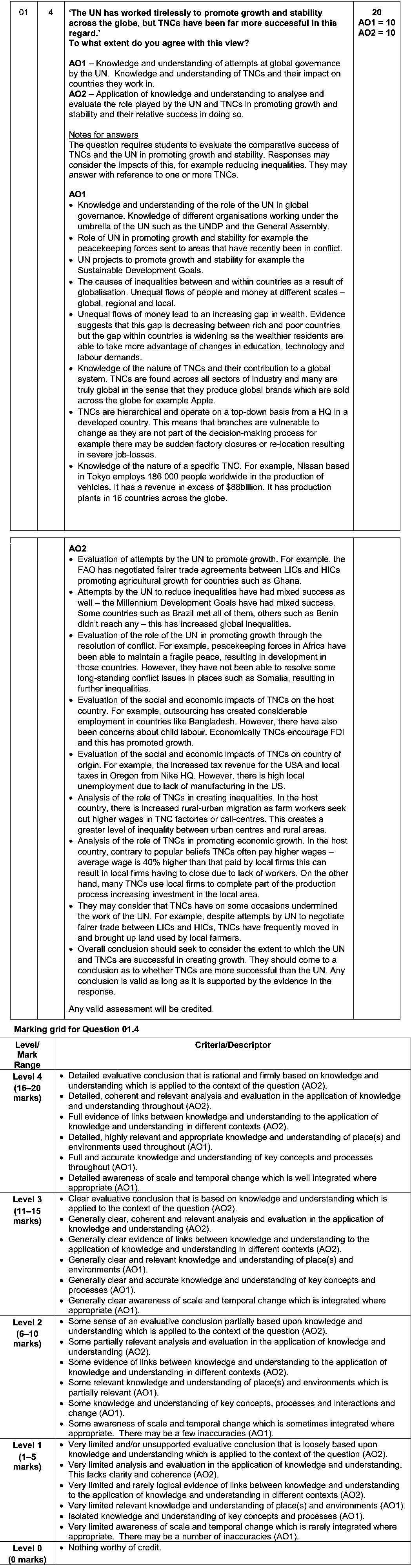
‘The UN has worked tirelessly to promote growth and stability across the globe, but TNCs have been far more successful in this regard.’ To what extent do you agree with this view?
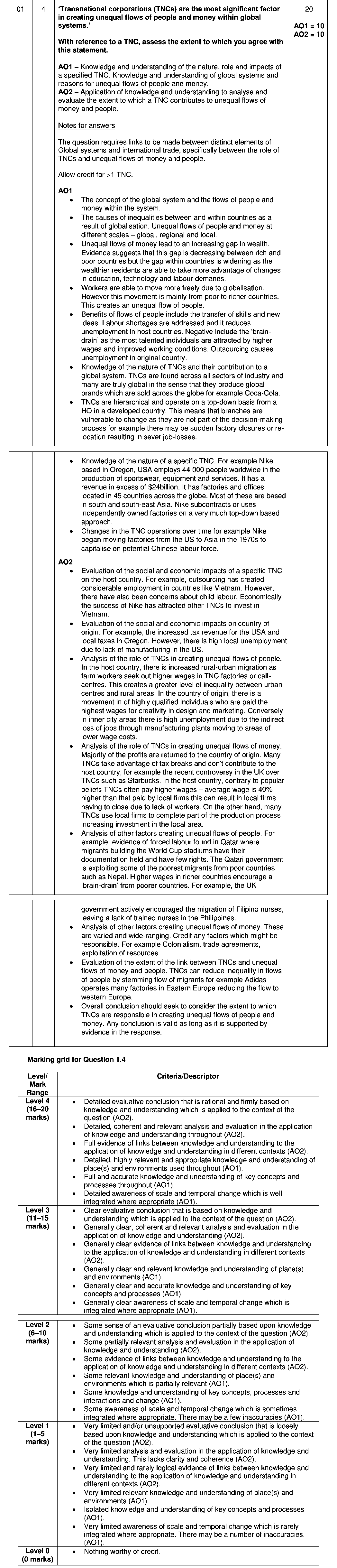
‘Transnational corporations (TNCs) are the most significant factor in creating unequal flows of people and money within global systems.’ With reference to a TNC, assess the extent to which you agree with this statement.
Tap a question to zoom it. The figures open above it; the mark scheme (with its levels and indicative content) and the examiner's comment open underneath.
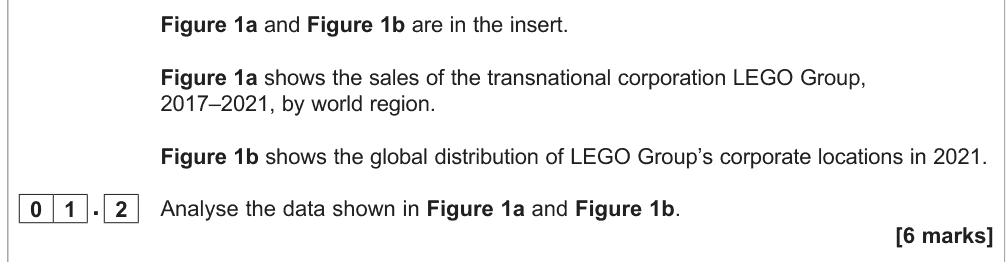
June 2025 · Paper 2 · Q1.26 marksmark schemeData analysis
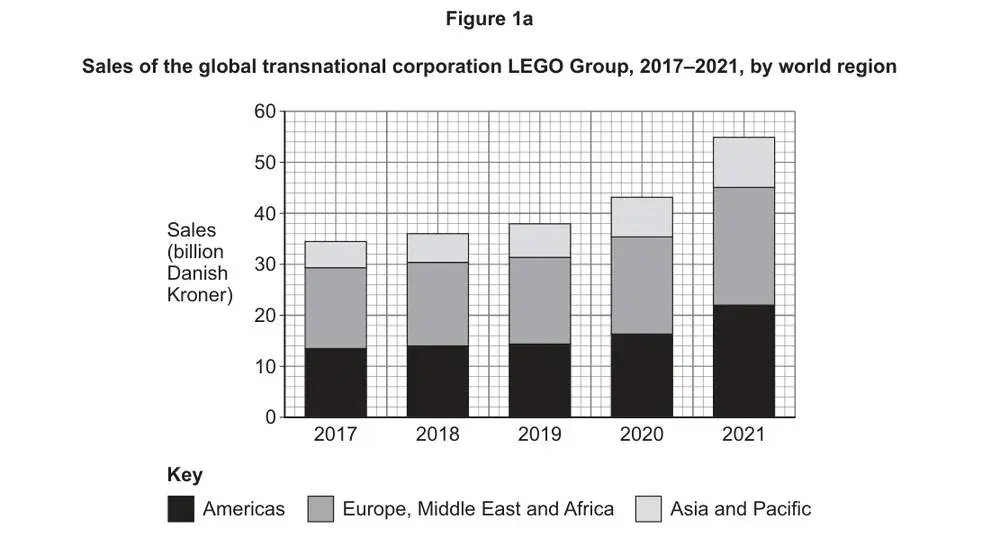
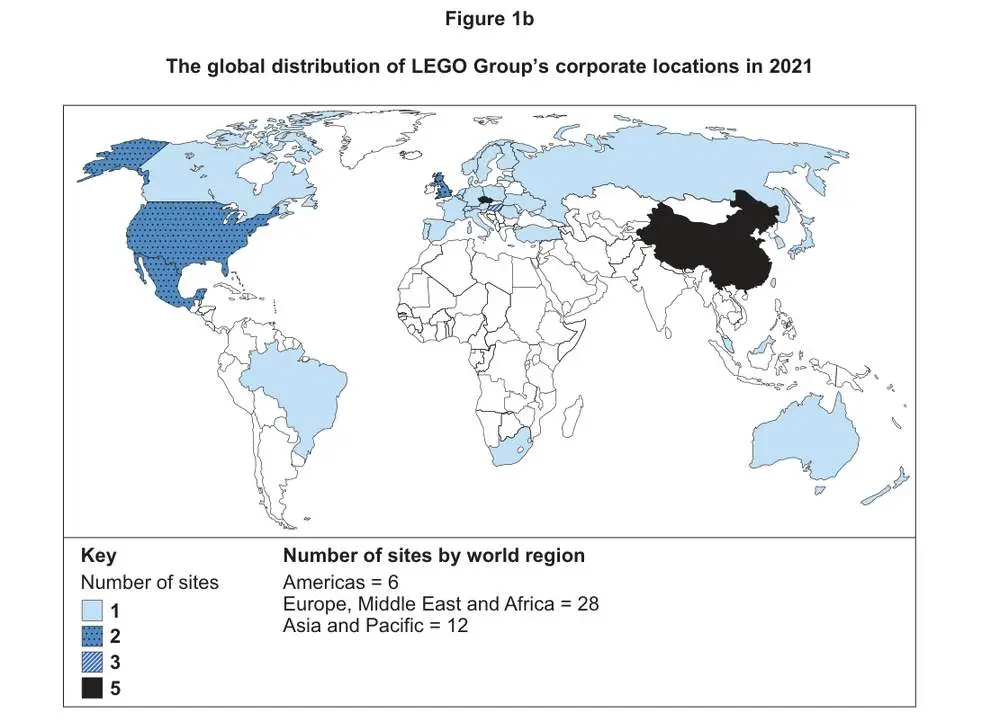
Figures 1a, 1b
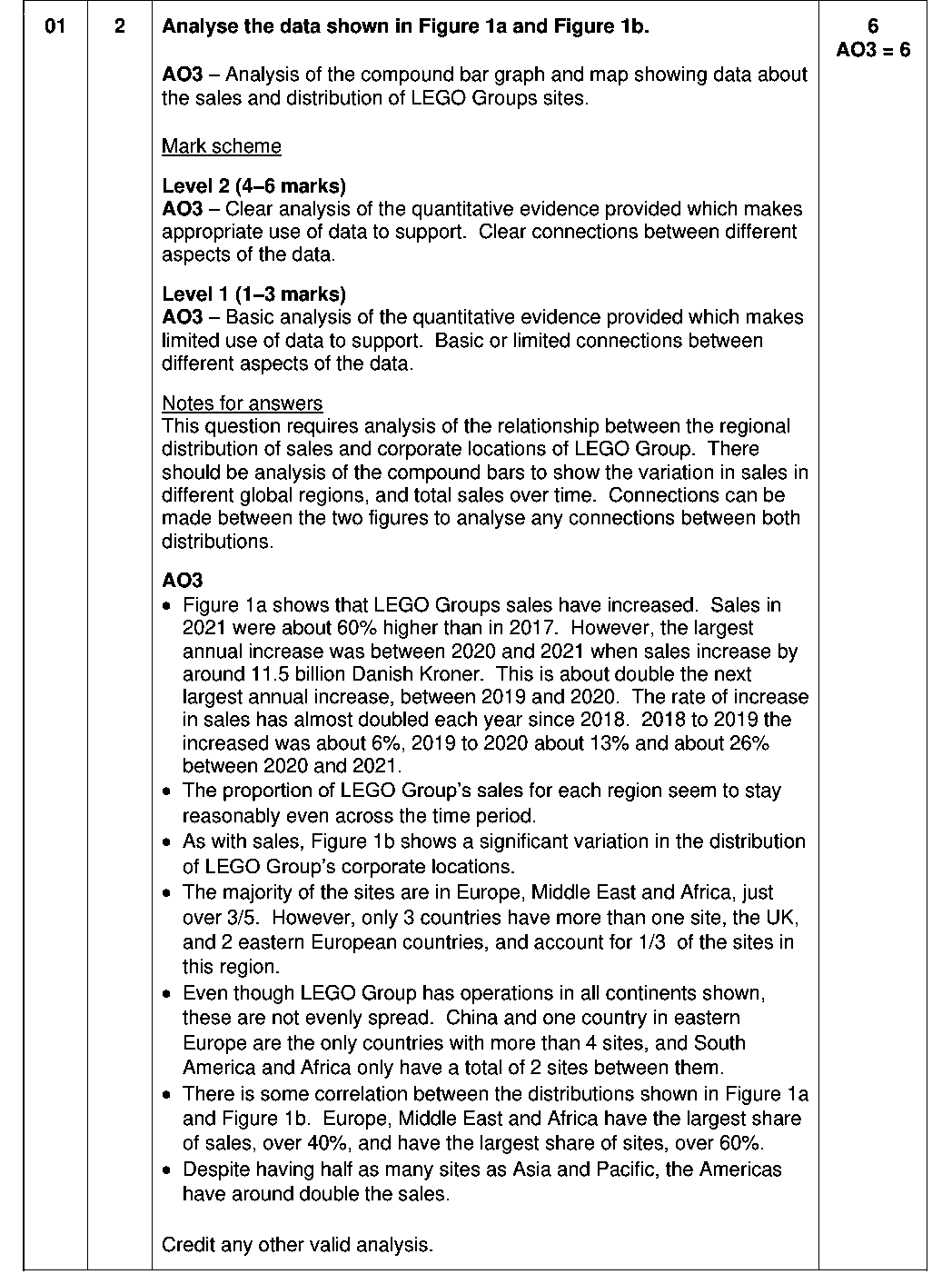
Mark scheme, including the levels and indicative content
Examiner's comment
AO3 questions provide students with the opportunity to apply geographical skills of analysis and interpretation to a variety of resources presenting geographical information. Many students accessed Level 2 by demonstrating analytical skills such as identifying overall patterns and trends, data manipulation, picking out anomalies, making connections between resources, and accurately interpreting scales and legends. In general, there were some errors made by students on the resources questions (AO3). The resources from the skills checklist used to present geographical information in this paper included bar graphs (simple, compound and comparative, using both linear and logarithmic scales), maps and comparative line graphs. To score well in the skills questions students should aim to apply relevant skills directly to the data provided. These skills may include identifying overall patterns (‘the big picture’), recognising trends within the data, accurately reading scales and interpreting values, exemplifying key points and reporting on anomalies and manipulating data further to add depth to their analysis. Less successful responses to these questions can have a somewhat disjointed feel to them, lacking a clear sense of the bigger picture. They may also contain errors due to reading the data incorrectly. This example uses data relating to the sales of LEGO and the global distribution of corporate locations. The response begins with an overview ‘there has been a year-on-year increase’ and shows that the scale was read with some degree of accuracy (‘21bn Kroner higher in 2021 compared to 2017’). There is some data manipulation (use of percentages) and the student comments on both resources (compound bars and the map). There are connections made between the two resources.
Notes from the mark scheme and report
AO3: sales up about 60% 2017–2021 with fastest rise 2020–21, regional shares stable
most sites in Europe/ME/Africa
Americas have half Asia-Pacific's sites but double the sales
connect both figures
June 2024 · Paper 2 · Q1.36 marksmark schemeStimulus
Mark scheme, including the levels and indicative content
Examiner's comment
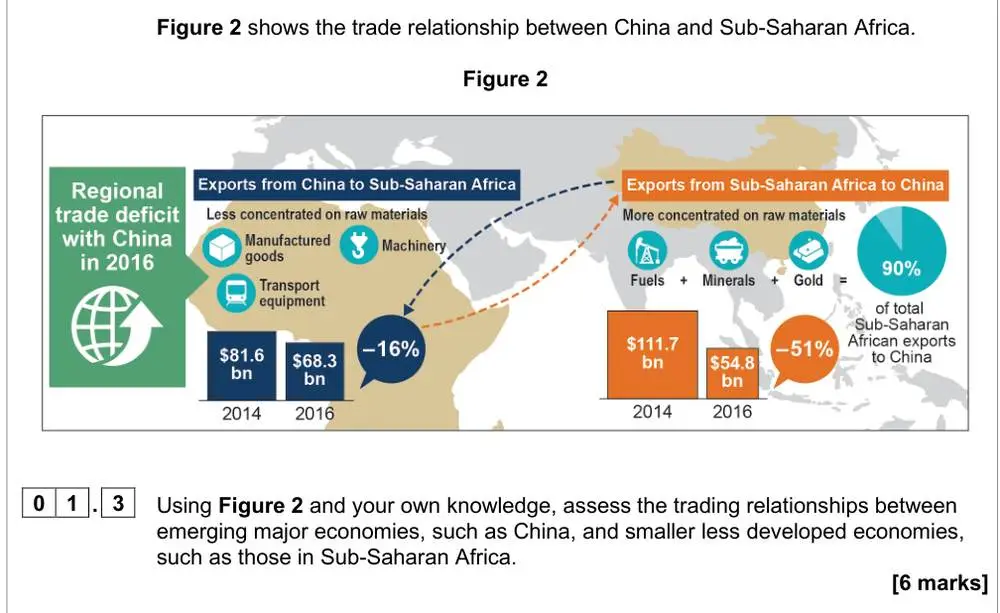
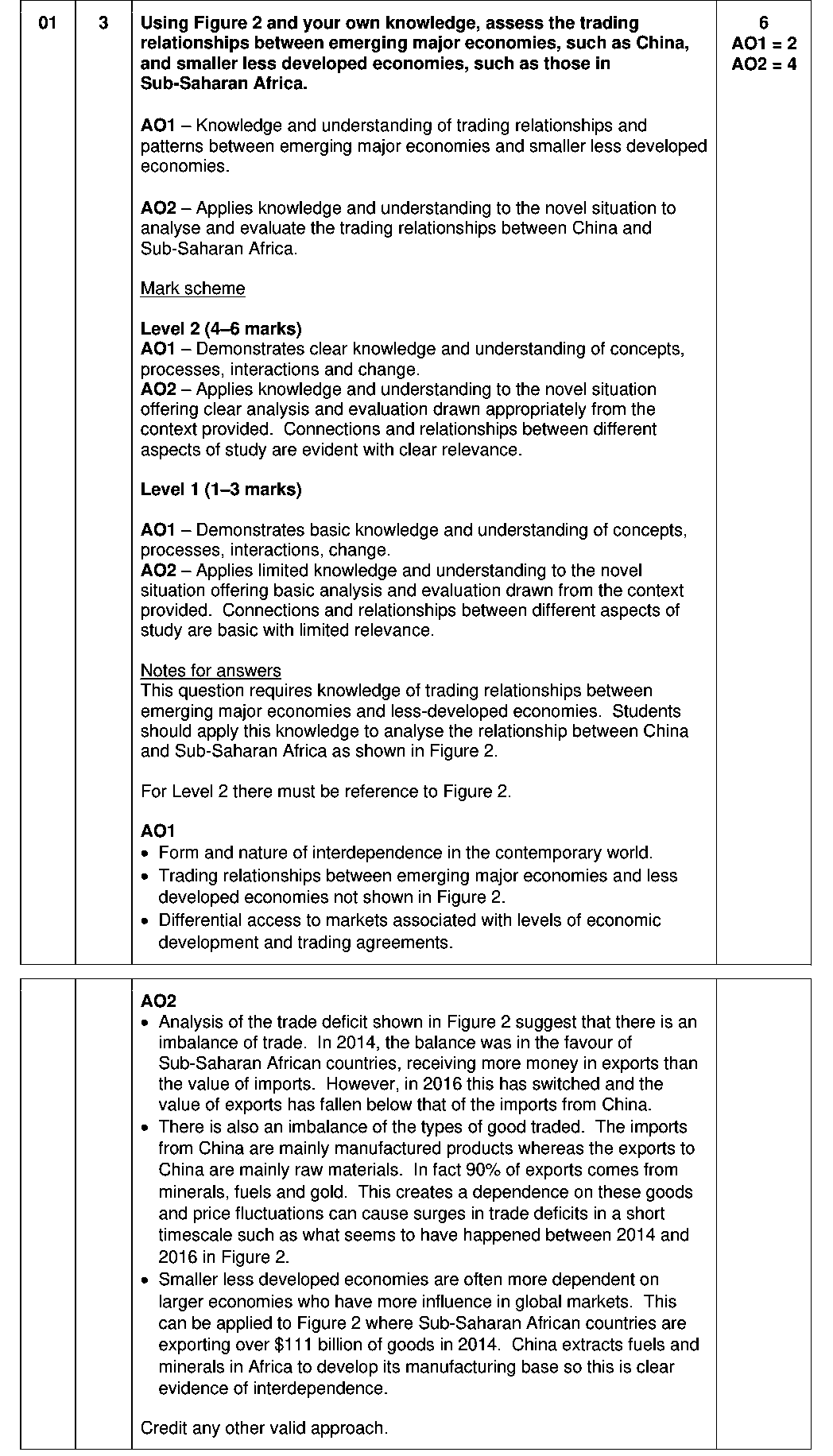
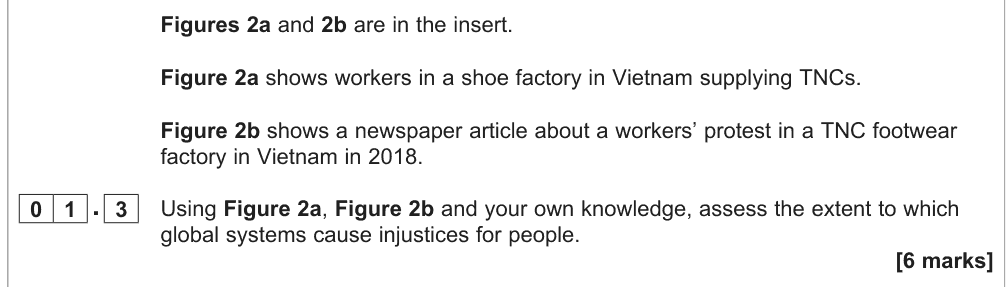
The AO1/AO2 questions using a novel resource, aim to test students’ abilities to apply their knowledge of a key idea to the situation presented and bring in some of their own knowledge to support their argument. In these questions, AO2 is more heavily weighted than AO1 and therefore the argument along with the application from the resource is key but ‘own knowledge’ as well also gains credit. When students do not score so well on these questions it can usually be put down to one of three things. Either, they analyse the resource (doing what they should be doing with the .2 questions), only comment on the resource as a route towards answering the question (so use none of their ‘own knowledge’) or the reverse where they use only their own knowledge (AO1) and do not interface with the resource (AO2). Relatively few students gave solely descriptive accounts of the novel resources provided in the .3 questions. Where this did occur, students only obtained credit in Level 1. In this next response, from Section 1, Global systems and global governance, the student clearly does what is required by assessing the trading relationships between China and sub-Saharan Africa, uses evidence from the resource to support the answer and includes some of their own knowledge to add weight to the response. It was assessed as Level 2, 6 marks.
Notes from the mark scheme and report
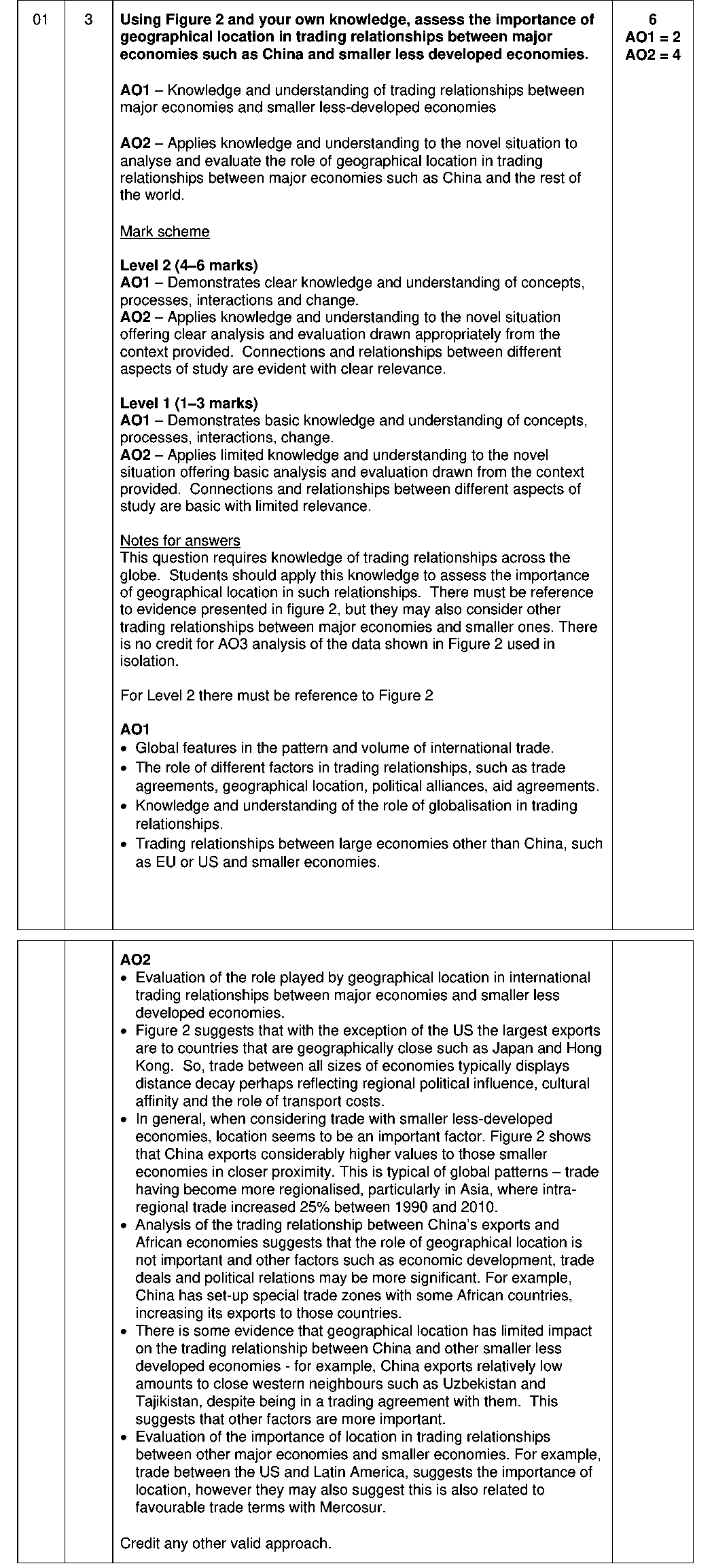
apply knowledge of trade between emerging and less developed economies to the China–Sub-Saharan Africa graphic (deficit reversed 2014–2016, raw materials v manufactures)
Level 2 needs reference to Figure 2
June 2023 · Paper 2 · Q1.26 marksmark schemeData analysis
Figures 1a, 1b
Mark scheme, including the levels and indicative content
Examiner's comment
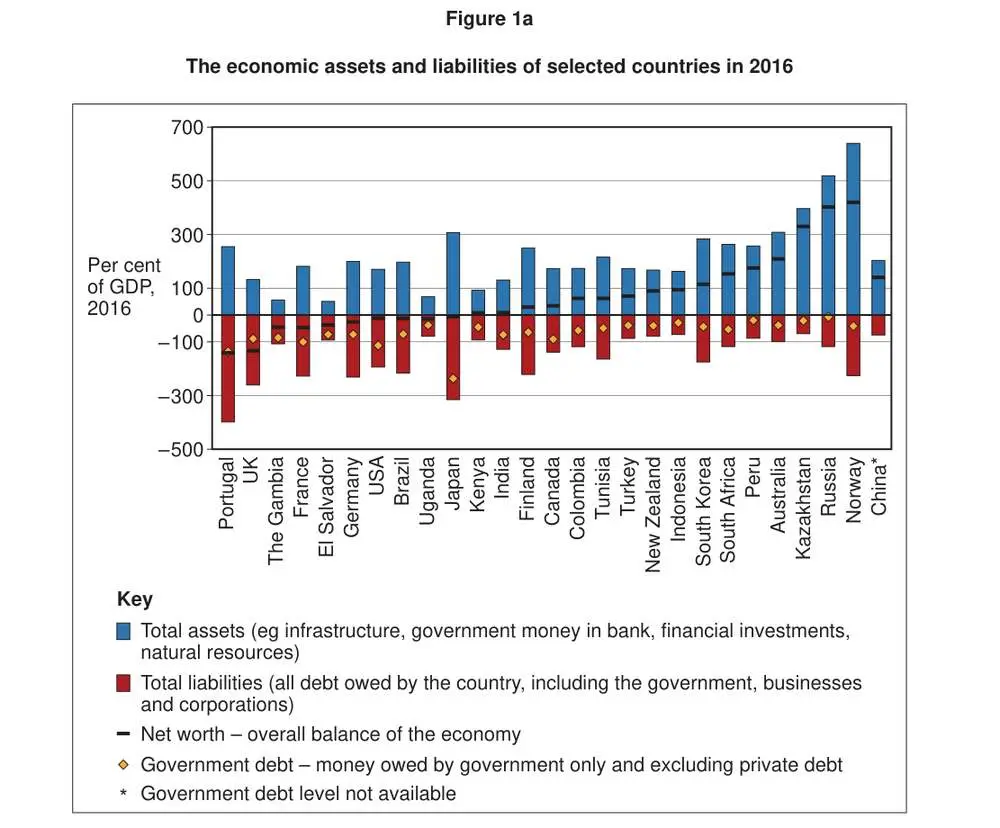
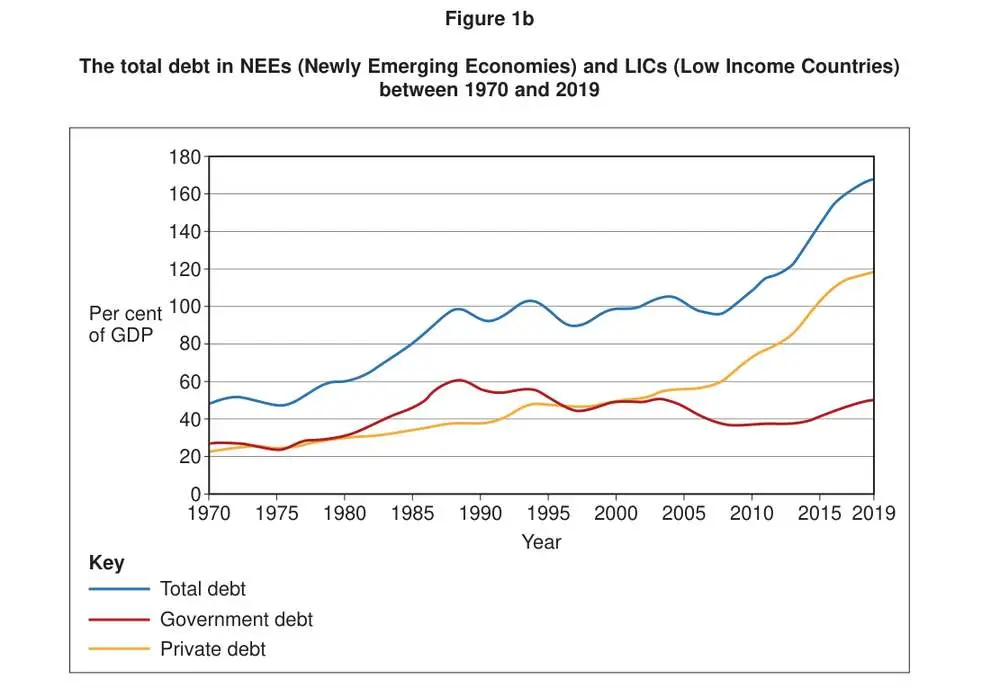
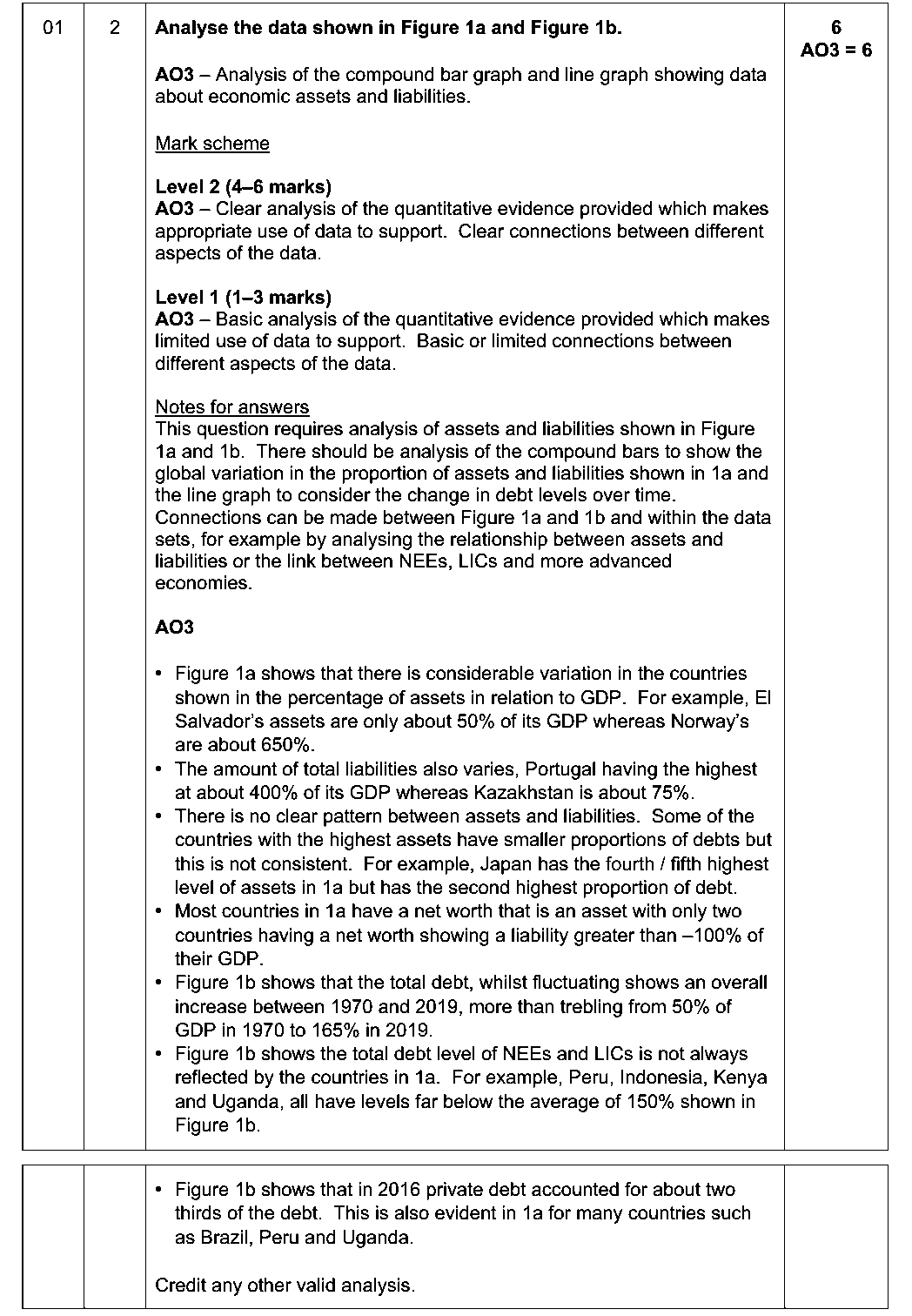
These questions, testing AO3, geographical skills, demand students demonstrate a particular skill, or show the ability to analyse, interpret or evaluate some form of geographical data presented as maps, graphs, tables or infographics. As with all of the questions in the examinations, students are required to ‘think on their feet’ and should be ready to deal with data and skills in any of the ways prescribed in the ‘skills checklist’ of the specification. It appeared that fewer students this year drifted from the analysis of the data into an attempt to explain the information presented. The data used in these questions is drawn from a variety of sources and is often complex, especially when seen for the first time and under the pressure of exam conditions. Students must therefore ensure they have studied the stem of the question and taken enough time to understand what is being shown and how. The should take time to read and understand scales, keys or other contextual information. Responses that have engaged with the data in this way are invariably better. In the AO3 questions, Q1.2 was quite demanding as the amount and complexity of data was significant and some struggled to analyse it successfully. Some had difficulty with Q1.2. The data presented had a lot of information and some students attempted to analyse many aspects of it consequently producing some rather confused responses. In the time and space available to answer these questions the strategy of looking at a ‘big picture’, identifying some useful illustrative data as evidence, showing some manipulation and links is sufficient to access level 2 without the need to comment on every aspect of the data shown
Notes from the mark scheme and report
AO3: variation in assets and liabilities as % of GDP (Norway about 650% assets, Portugal about 400% liabilities), no clear assets–liabilities link (Japan), NEE/LIC debt more than trebling 1970–2019, private debt about two-thirds
big picture plus selective data is enough for Level 2
June 2023 · Paper 2 · Q1.36 marksmark schemeStimulus
Figures 2a, 2b
A figure for this question was removed from AQA's published paper for copyright reasons.
Mark scheme, including the levels and indicative content
Examiner's comment
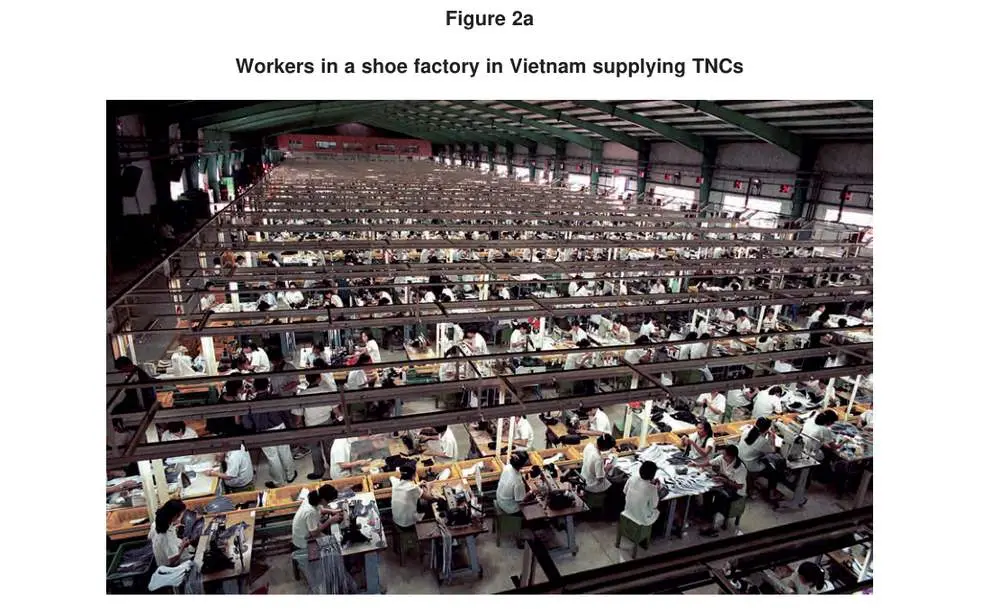
Those questions, X.3, which used stimulus resources (photographs, text, infographics) presenting novel situations generated suitable responses balancing use of the novel situation with students’ own knowledge and opinions. The 6 mark questions, X.3, assessing AO1 and AO2 using novel situations gave students the opportunity to assess and evaluate themes using the stimulus material. The resources used (photographs and text) enabled this quite well but some students did drift into an analysis of the resources, addressing AO3 which was not creditable. These questions gave students the platform to put forward informed opinions based upon subject matter they had studied and linking it to the unseen material. This type of question demands students focus on the key command within the question and evaluate, assess or discuss the relevant concept whilst making connections to the resource used. Consequently, students need to be ready to combine their knowledge and understanding with the stimulus material. Less successful responses tended to miss the command word (assess, discuss, evaluate…) and simply write about the topic (producing AO1 heavy answers) or failed to incorporate a link to the stimulus material. In the Global systems and global governance unit, Q1.3 was answered well. Students were able to engage with the novel resource and they used this to develop a clear perspective on the ways that globalisation (especially TNCs) can create injustices through the exploitation of their workers. Many responses quoted examples of particular TNCs or industries in which there had been notable cases of workers being underpaid, exposed to poor working conditions, long hours or labour restrictions, or indeed the victims of commercial building disasters. Some also balanced their answers with reference to the benefits brought by such organisations to workers and low income countries / NEEs. For example in Q1.3 some responses discussed injustices and the problems caused by TNCs without reference to figures 2a and 2b, or they simply described the information presented (lifting from figure 2b) instead of ‘using’ the information as a starting point for a discussion.
Notes from the mark scheme and report
Figure 2b (newspaper article) not reproduced in the published insert
apply knowledge of unequal power and TNC labour conditions to the Vietnam factory and protest
Level 2 must refer to Figure 2a and/or 2b
government policy as a counter-factor
lifting from the resource is not enough
June 2022 · Paper 2 · Q1.420 marksmark scheme20-mark essay
Mark scheme, including the levels and indicative content
Examiner's comment
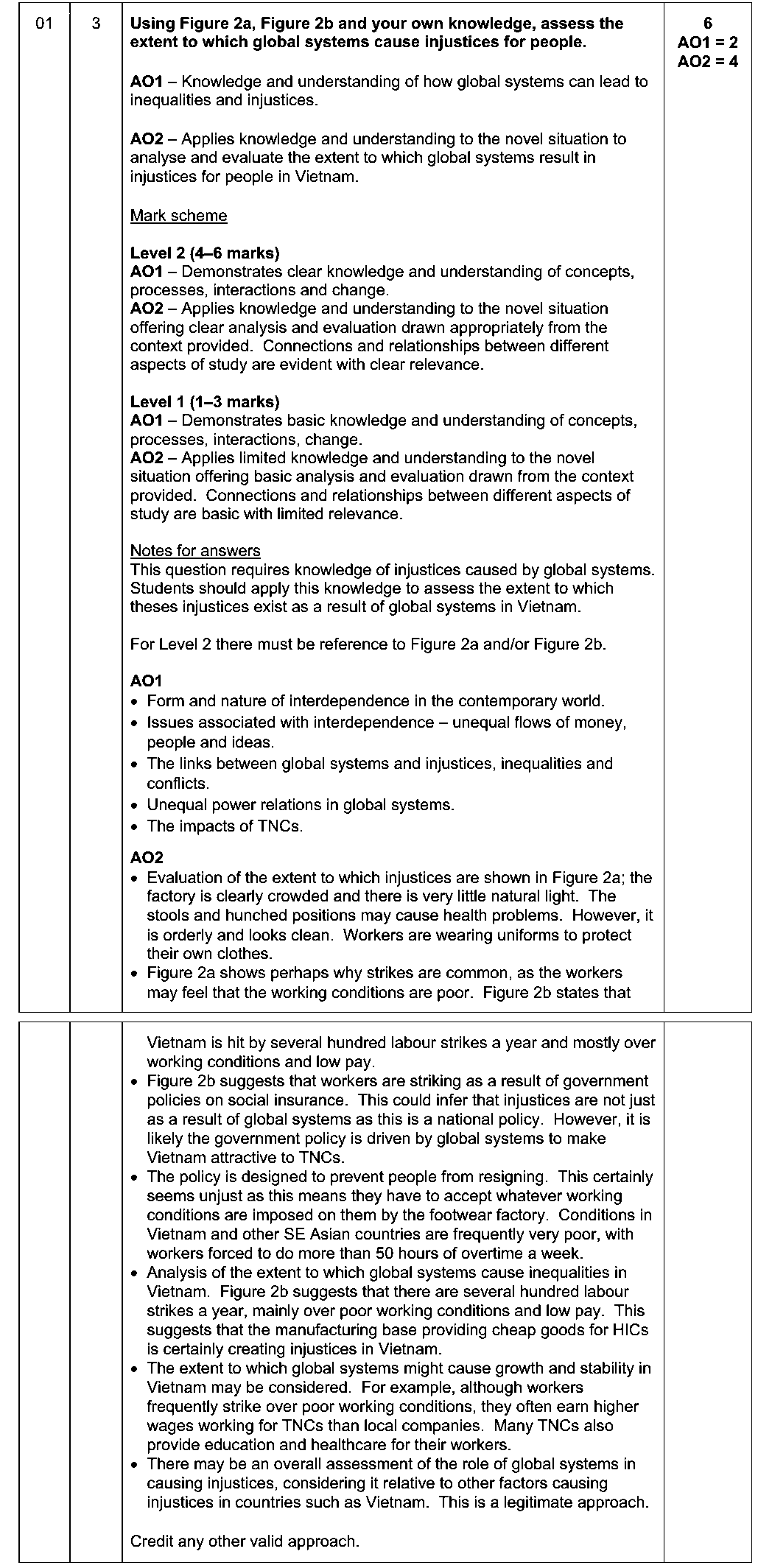
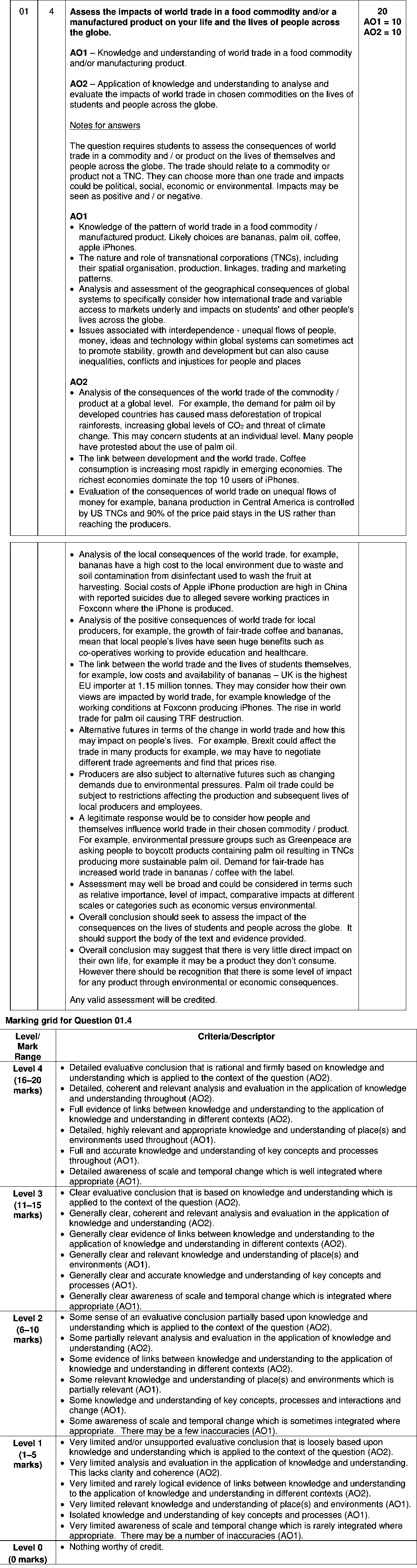
This question differentiated well. The most common choices of commodities were bananas and Apple iPhones, reflecting textbook content. The weaker responses were able to give some good AO1 knowledge about the commodity or product, and as a result very few failed to achieve L2. Many answers tended to draw very stark contrasts between the effects of trade in producer countries (all bad) and consumer countries (all good). Most students failed to address the impacts on their own lives and although there did not need to be balance for L4, we did expect at least some reference to this. The best students produced very sensitive and balanced answers and brought in many aspects of the trading relationships involved, producing quite a high proportion of very good L4 answers, with almost 20% of students achieving at least 16 marks out of 20. Most responses that scored well were of sufficient length and depth but quite a few had used continuation pages, without increasing the quality of their response. This suggests students need to be trained in producing succinct responses that answer the question without repetition.
Notes from the mark scheme and report
trade in a commodity or product (not a TNC) — bananas, palm oil, coffee, iPhones common
must include some reference to impacts on the student's own life for Level 4
avoid stark 'producers lose, consumers gain' contrasts
almost 20% scored 16+
November 2021 · Paper 2 · Q1.14 marksmark schemePoint-marked
Mark scheme
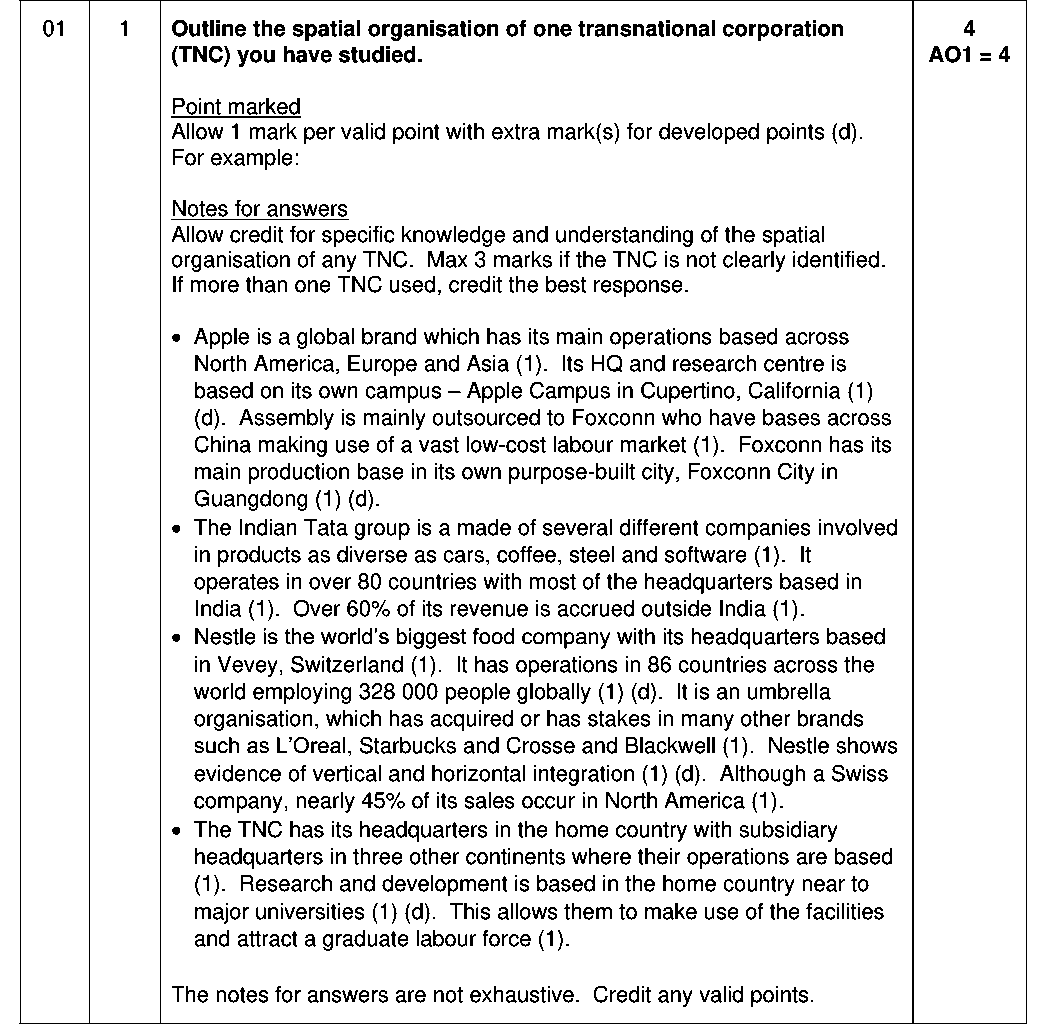
Notes from the mark scheme and report
point marked
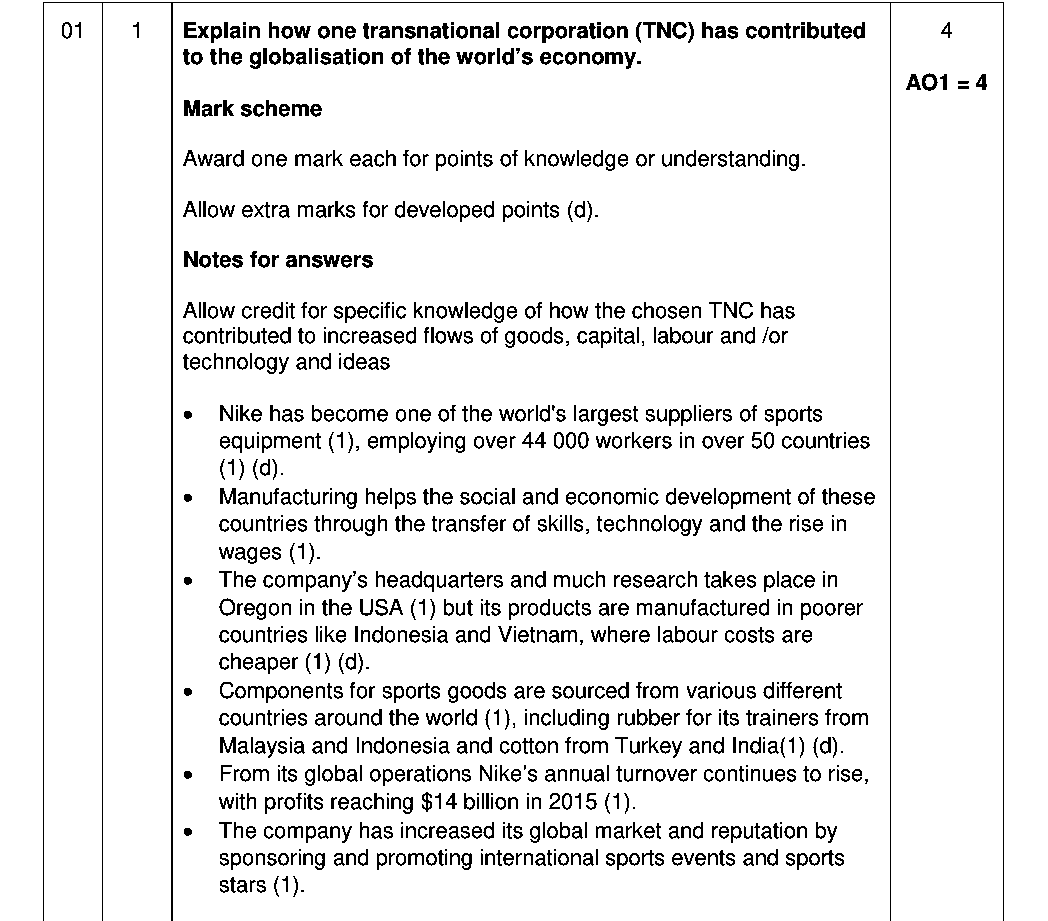
one named TNC (e.g. Apple HQ in Cupertino with assembly outsourced to Foxconn in China
Tata
Nestlé) — HQ, R&D, production and markets across countries
max 3 if the TNC is not clearly identified
best TNC credited if several
no examiners' report for this series
November 2021 · Paper 2 · Q1.36 marksmark schemeStimulus
Figure 2
Mark scheme, including the levels and indicative content
Notes from the mark scheme and report
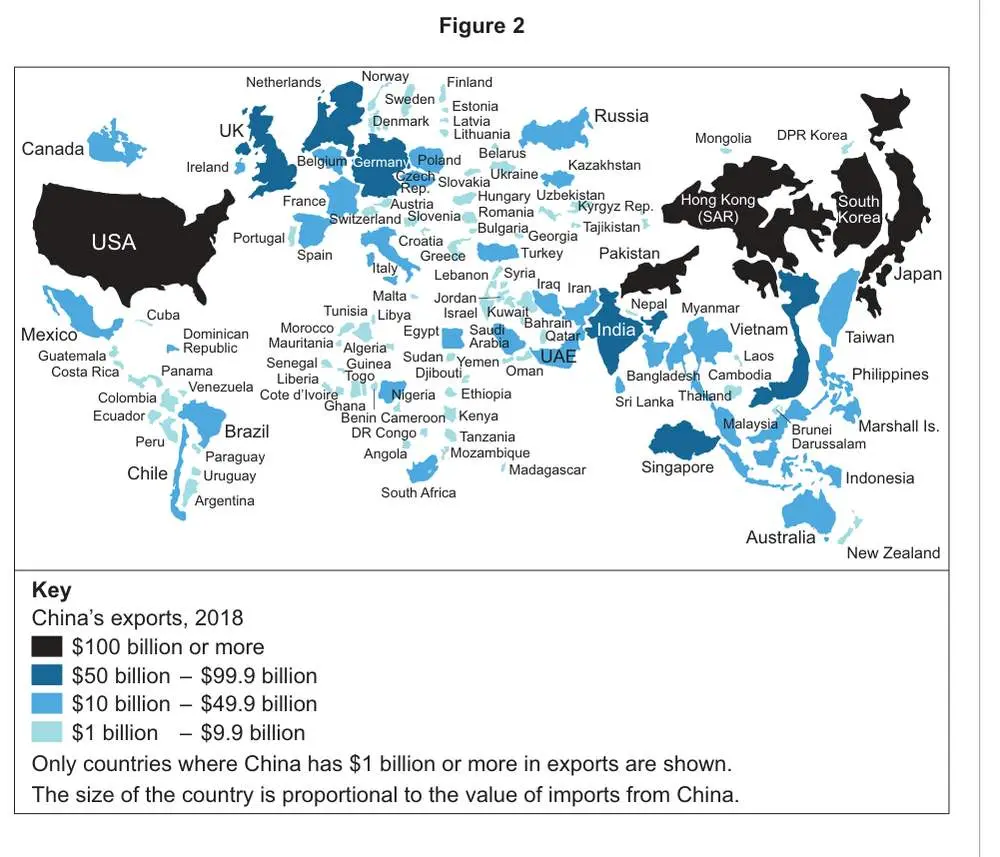
apply knowledge of trading relationships to the cartogram of China's exports: location matters (neighbouring Asian economies) but large distant markets (USA, EU) and trade agreements, aid and Belt and Road links also shape trade with smaller economies
Level 2 needs reference to Figure 2
analysis of the figure alone not credited
November 2020 · Paper 2 · Q1.14 marksmark schemePoint-marked
Mark scheme
Examiner's comment
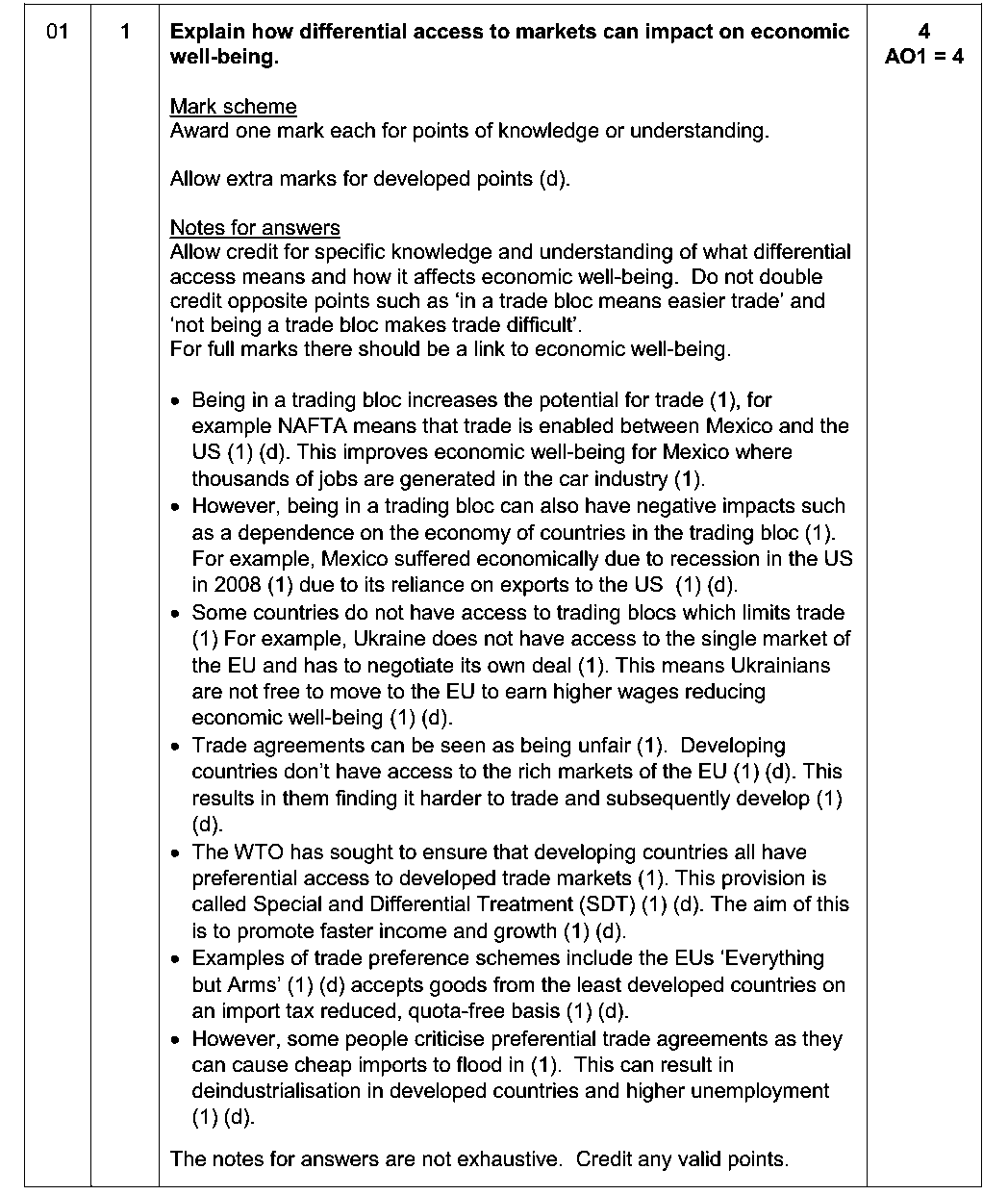
In general, Q1.1 showed the importance of learning key terms. Those who understood the concept of differential access were able to apply their knowledge, gaining further credit for deeper understanding and exemplars. As with Q1.1 and Q2.1, students must be encouraged to use examples to support their points in Q3.1.
Notes from the mark scheme and report
trade blocs, preferential schemes (e.g. Everything but Arms), unfair agreements
full marks need a link to economic well-being
do not double credit opposite points
examples earned extra credit
November 2020 · Paper 2 · Q1.420 marksmark scheme20-mark essay
Mark scheme, including the levels and indicative content
Examiner's comment
Q1.4 was the highest average scoring essay on the paper. More able students who had detailed knowledge of both TNCs and the UN were able to apply that knowledge the assess the relative success in promoting growth and stability. Weaker responses frequently indicated lack of understanding of the demands of the question.
Notes from the mark scheme and report
weigh the UN (peacekeeping, SDGs/MDGs, FAO) against TNCs (jobs, investment, but footloose and unequal) for growth and stability
highest-scoring essay on the paper
weaker answers misread the demands
June 2019 · Paper 2 · Q1.26 marksmark schemeData analysis
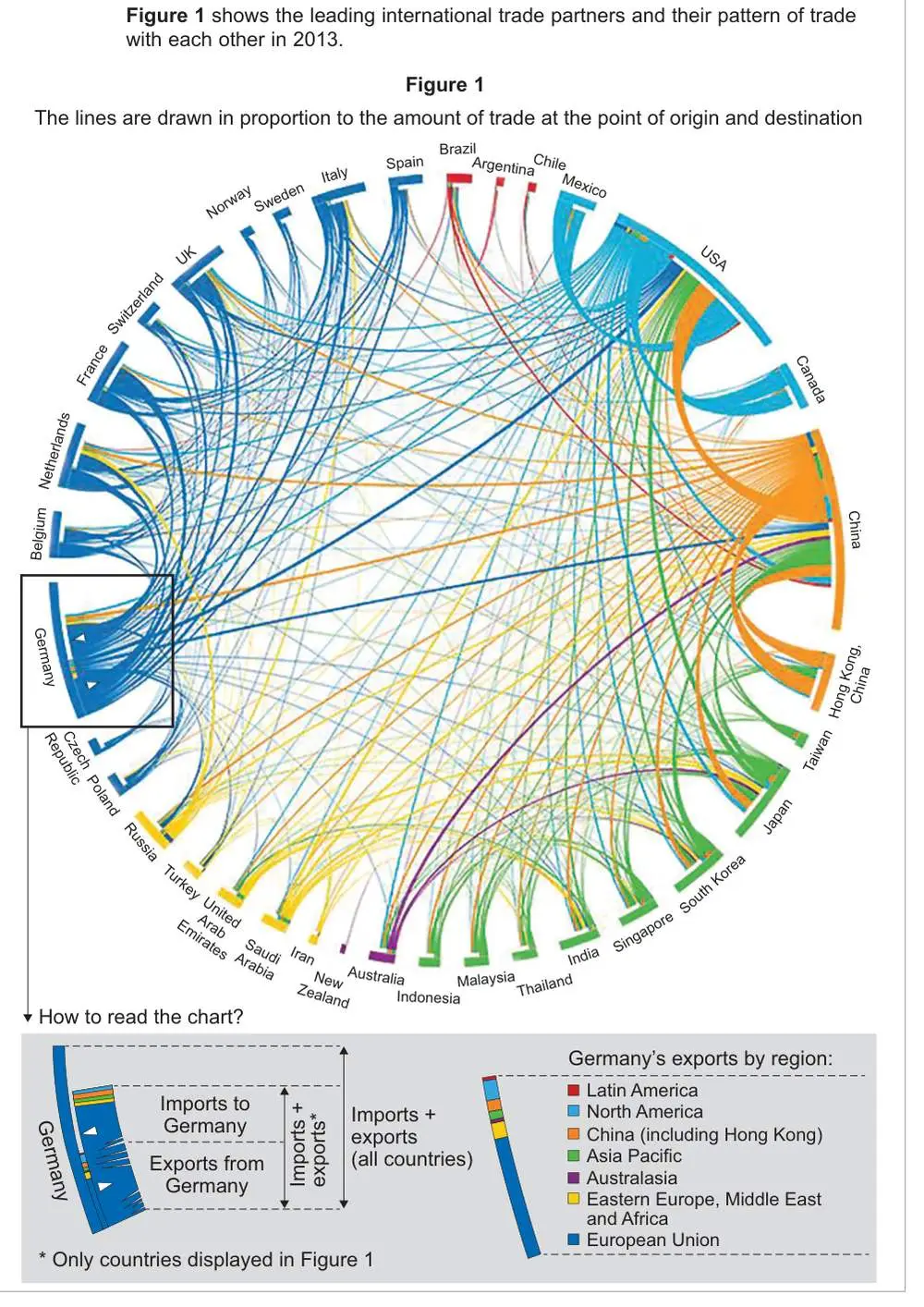
Figure 1
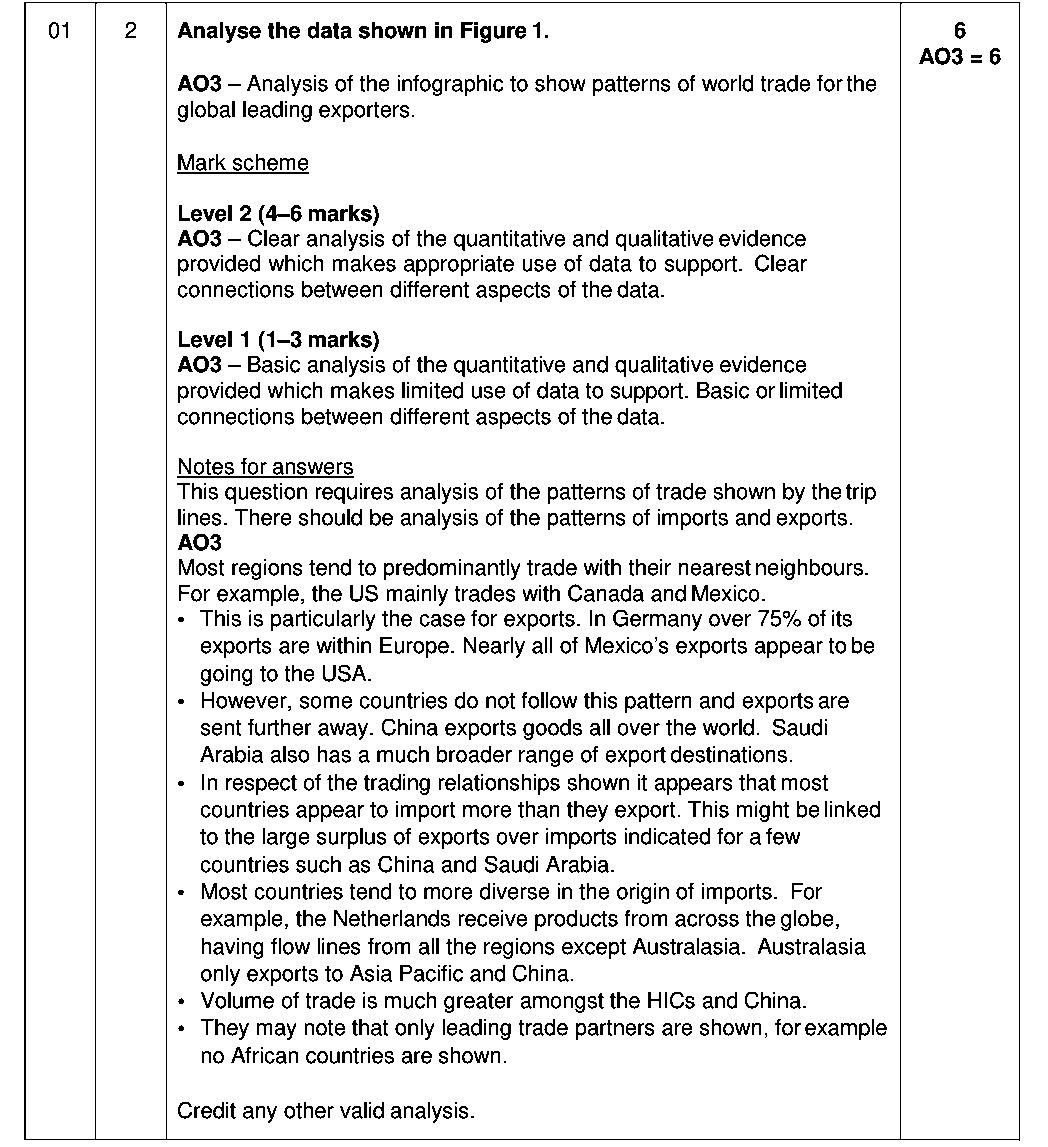
Mark scheme, including the levels and indicative content
Examiner's comment
AO3 skills were tested in this examination paper on the first 6 mark question in each unit, for example 1.2, 2.2, 3.5, 4.5 and 5.5. In this series the command ‘analyse’ was used on these questions. The command ‘analyse’ in this context simply required students to interface with the data and deconstruct the information. They needed to look for patterns and trends and analyse the connections both within the figure and between Figures where applicable. Students need to be encouraged to manipulate data rather than simply describing it, as this does not constitute analysis. Figure 1 was a challenging resource at first glance. However, students engaged very successfully with the resource with a majority accessing level 2. The more effective responses spent time looking at overarching patterns, exemplified them and then looked at examples that didn’t follow the pattern. For example, many noted that trade was predominantly with nearest neighbours, the EU countries having most of their trade with each other. Less effective answers focused on the three biggest trade partners, China, USA and Germany, and simply described who trade with whom, without considering patterns or proportions. Pleasingly, very few students attempted to explain the pattern.
Notes from the mark scheme and report
AO3 only: patterns in the trade-flow (trip line) chart, e.g. most trade with nearest neighbours, China and Saudi Arabia as exceptions, volume concentrated in HICs and China
no explanation
weaker answers just described China/USA/Germany links
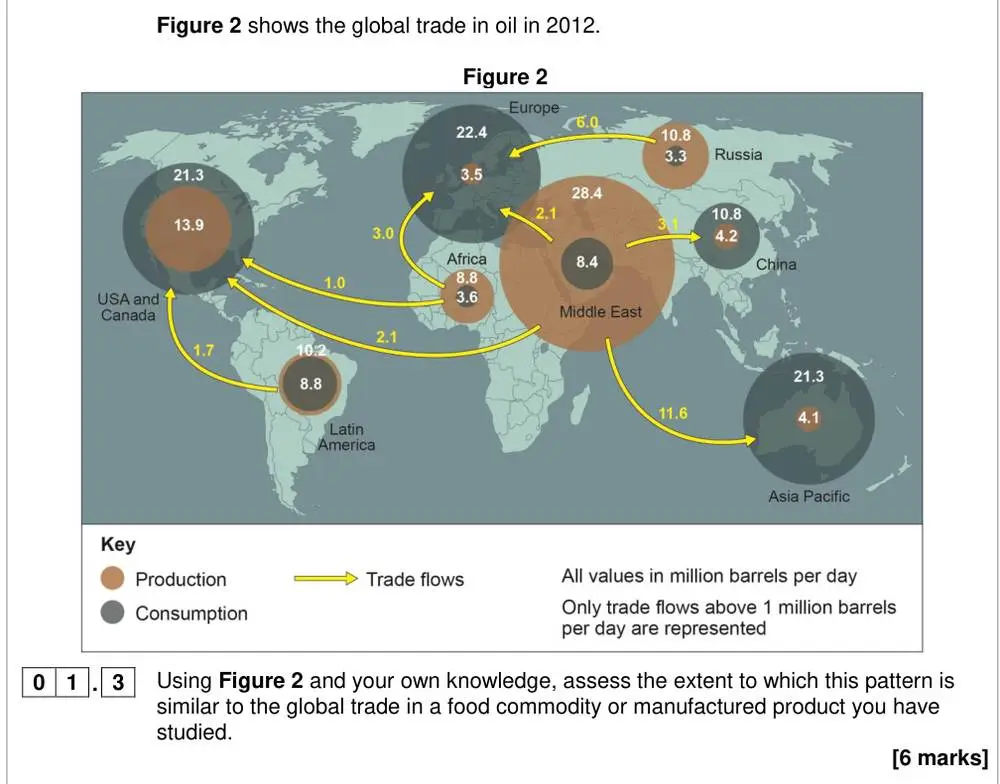
June 2018 · Paper 2 · Q1.36 marksmark schemeStimulus
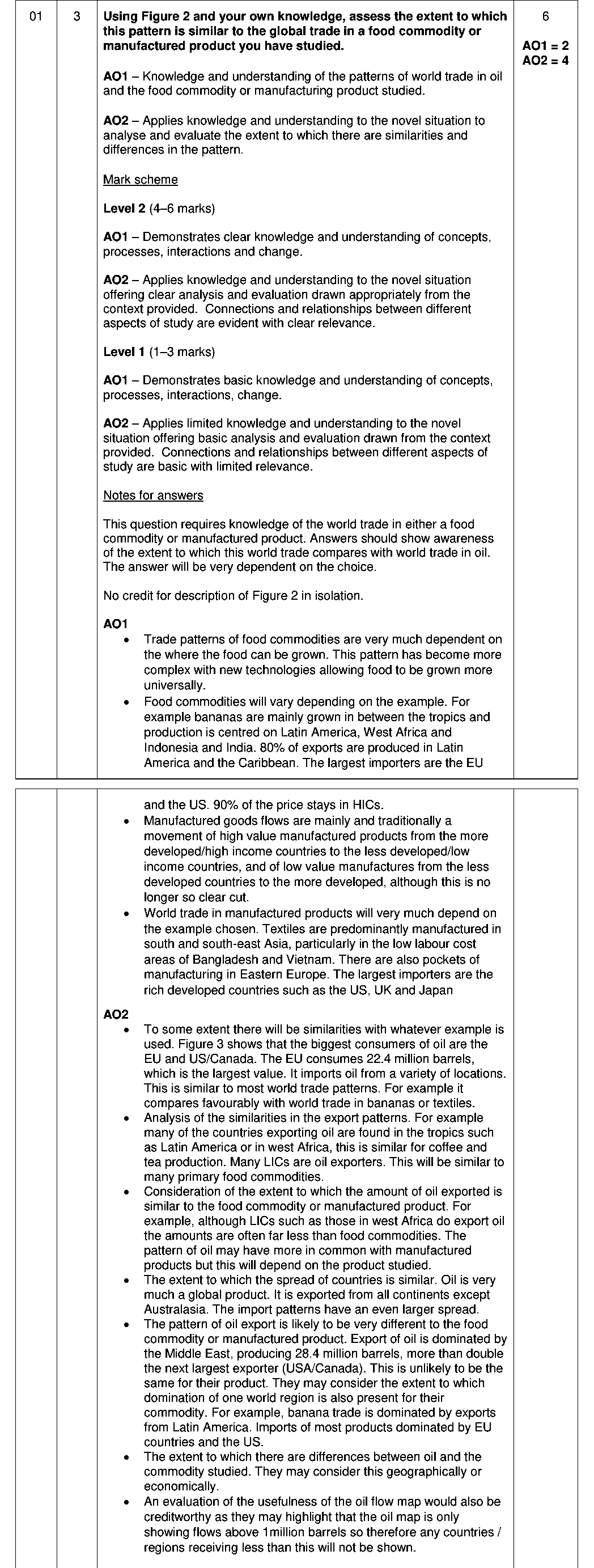
Mark scheme, including the levels and indicative content
Examiner's comment
This proved to be an accessible question for most students. Most frequently the product used was either bananas or coffee and the vast majority did seek to offer a comparison between the resource and the product. However, it is worth noting that there is no credit in these types of questions for simply describing the resource or analysing the data in the resource in isolation. Knowledge and understanding needs to be applied to the resource. In this case the best responses looked for similarities and differences between the studied product and the flows of oil in the figure. They also considered the extent to which they were similar. The best answers reflected a detailed knowledge of the trade flows of their product, referring to specific countries and facts. Some students did not state a product and simply referred generically to a foodstuff or manufactured product. This often resulted in low marks as there was no clear pattern to compare.
Notes from the mark scheme and report
compare oil flows with a studied food commodity or manufactured product (similarities and differences, extent)
no credit for describing Figure 2 alone
answers with no named product had no pattern to compare and scored low
June 2018 · Paper 2 · Q1.420 marksmark scheme20-mark essay
Mark scheme, including the levels and indicative content
Examiner's comment
Some of the responses to this question were simply outstanding. Students often had extensive knowledge of their chosen TNC (frequently Apple, Nike or Walmart) and were then able to apply this to unequal flows of money and people. The very best answers dealt with all aspects of the question, addressing the relative importance of TNCs in creating unequal flows by considering other factors such as conflict, globalisation or trading blocs. Some of the better answers also considered that TNCs could actually create more equal flows, demonstrating the breadth with which students could tackle these 20 mark questions. Weaker responses frequently relied on knowledge and understanding of the social and environmental impacts of TNCs with very implicit links to unequal flows. This tended to reflect a lack of understanding of the demands of the question.
Notes from the mark scheme and report
links TNCs with unequal flows of people and money
>1 TNC allowed
best answers weighed TNCs against other factors (conflict, trade blocs, globalisation) and noted TNCs can make flows more equal
weaker answers listed TNC impacts with only implicit links to flows
Specimen set 1 · Paper 2 · Q1.14 marksmark schemePoint-marked
Mark scheme
Notes from the mark scheme and report
point marked with developed points (d): one named TNC (e.g. Nike) – global sourcing, offshore manufacturing, HQ/R&D in home country, global marketing and sponsorship, flows of capital, labour and technology
Work with an AQA Geography tutor
Essays stuck in the middle levels, or losing marks on the data questions? Book a trial lesson with a specialist AQA Geography tutor.