3.1.6.6-01 The main characteristics of a distinctive local ecosystem (such as an area of heathland, managed parkland, pond, dune system). Ecological responses to the climate, soil and soil moisture budget – adaptations by flora and fauna.A level only
3.1.6.6-02 Local factors in ecological development and change (such as agriculture, urban change, the planned and unplanned introduction of new species).A level only
3.1.6.6-03 The impacts of change and measures to manage these impacts. Conservation strategies and their implementation in specific settings.A level only
3.1.6.7-01 Case study of a specified region experiencing ecological change to illustrate and analyse the nature of the change and the reasons for it, how the economic, social and political character of its community reflects its ecological setting and how the community is responding to change.A level only
3.1.6.7-02 Case study of a specified ecosystem at a local scale to illustrate and analyse key themes set out above, including the nature and properties of the ecosystem, human impact upon it and the challenges and opportunities presented in its sustainable development.A level only
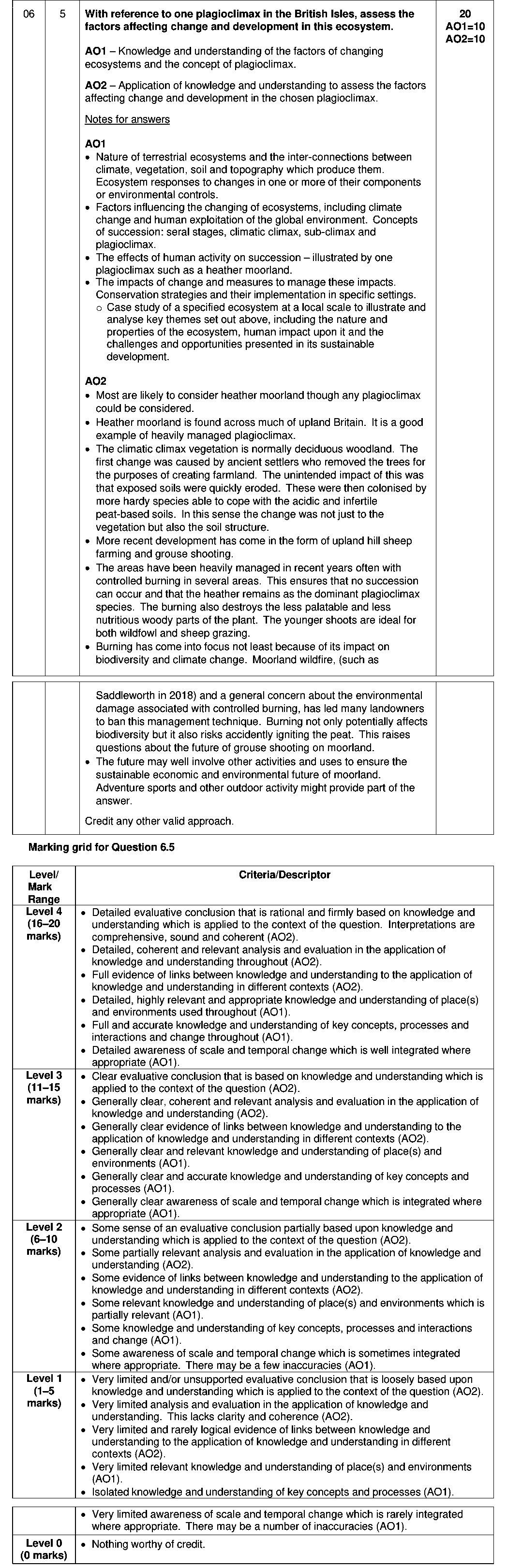
‘Changing attitudes towards sustainable tourism, recreation and conservation have meant that local scale ecosystems are no longer under threat.’ To what extent do you agree with this view?
Tap a question to zoom it. The figures open above it; the mark scheme (with its levels and indicative content) and the examiner's comment open underneath.
June 2024 · Paper 1 · Q6.520 marksmark scheme20-mark essay
Mark scheme, including the levels and indicative content
Examiner's comment
The 20-mark questions are a major differentiator on this paper. In this series, it was also very evident that those who prepared well gained access to the full range of marks. The best responses evidence a deep and secure knowledge and understanding of the specification area/s being tested. Attention to detail is always strong and case study support is almost always very accurate. Less successful responses tend to fall down for a number of reasons. Students sometimes misread the question or, in the heat of examination, may not fully grasp what is required. In such circumstances they may tend towards knowledge recital and only touch on what is required to actually answer the question.
Notes from the mark scheme and report
any plagioclimax in the British Isles (most chose heather moorland): burning, grazing, drainage, conservation management
must assess factors affecting change and development
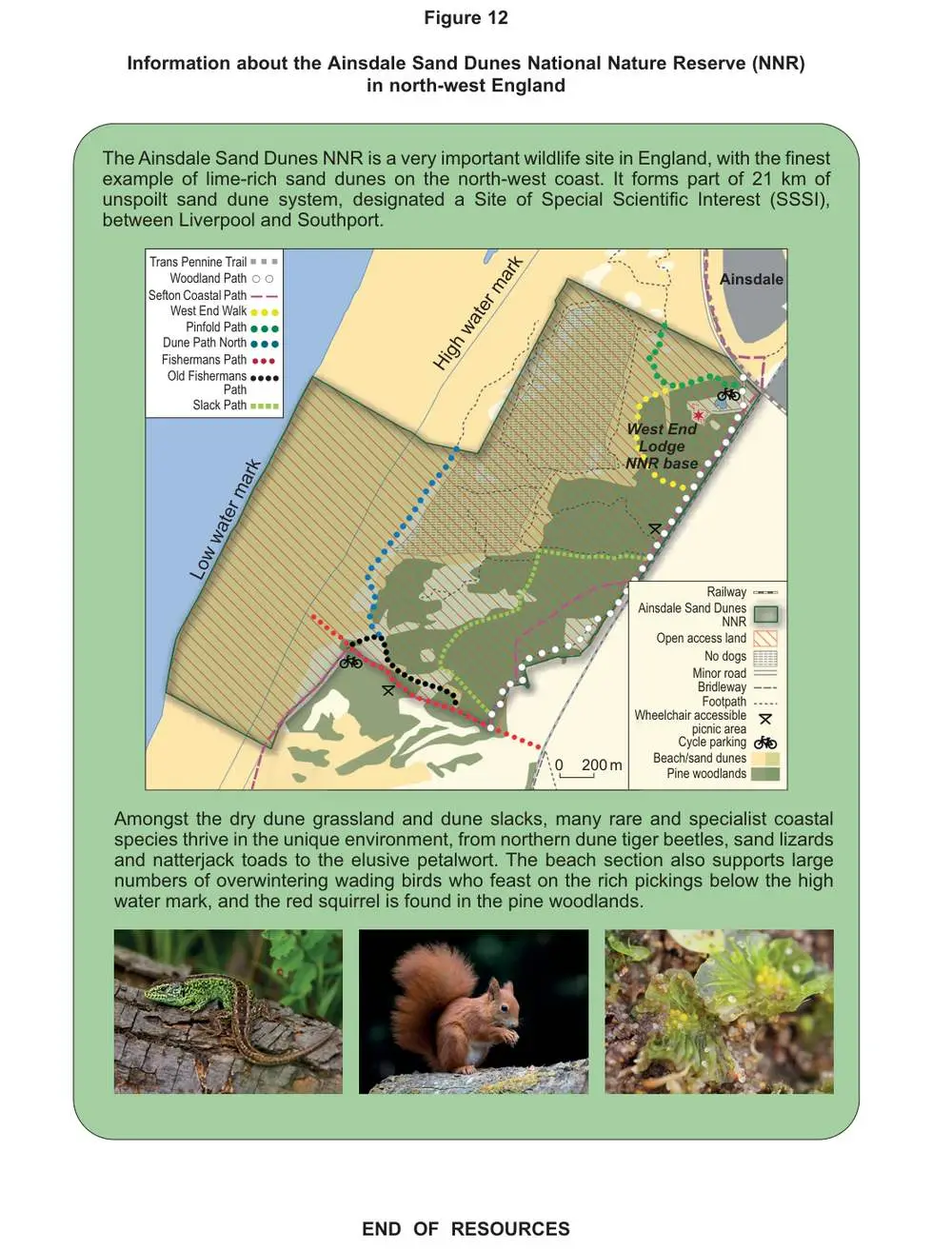
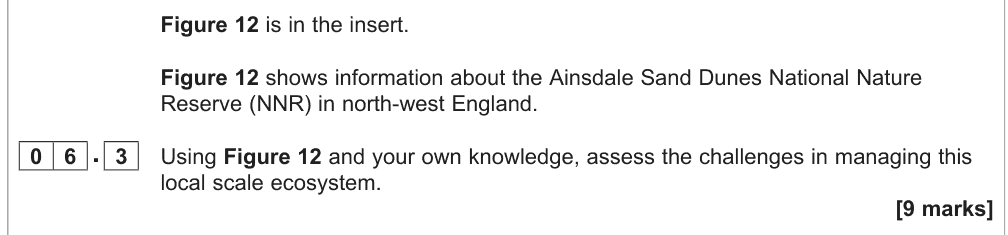
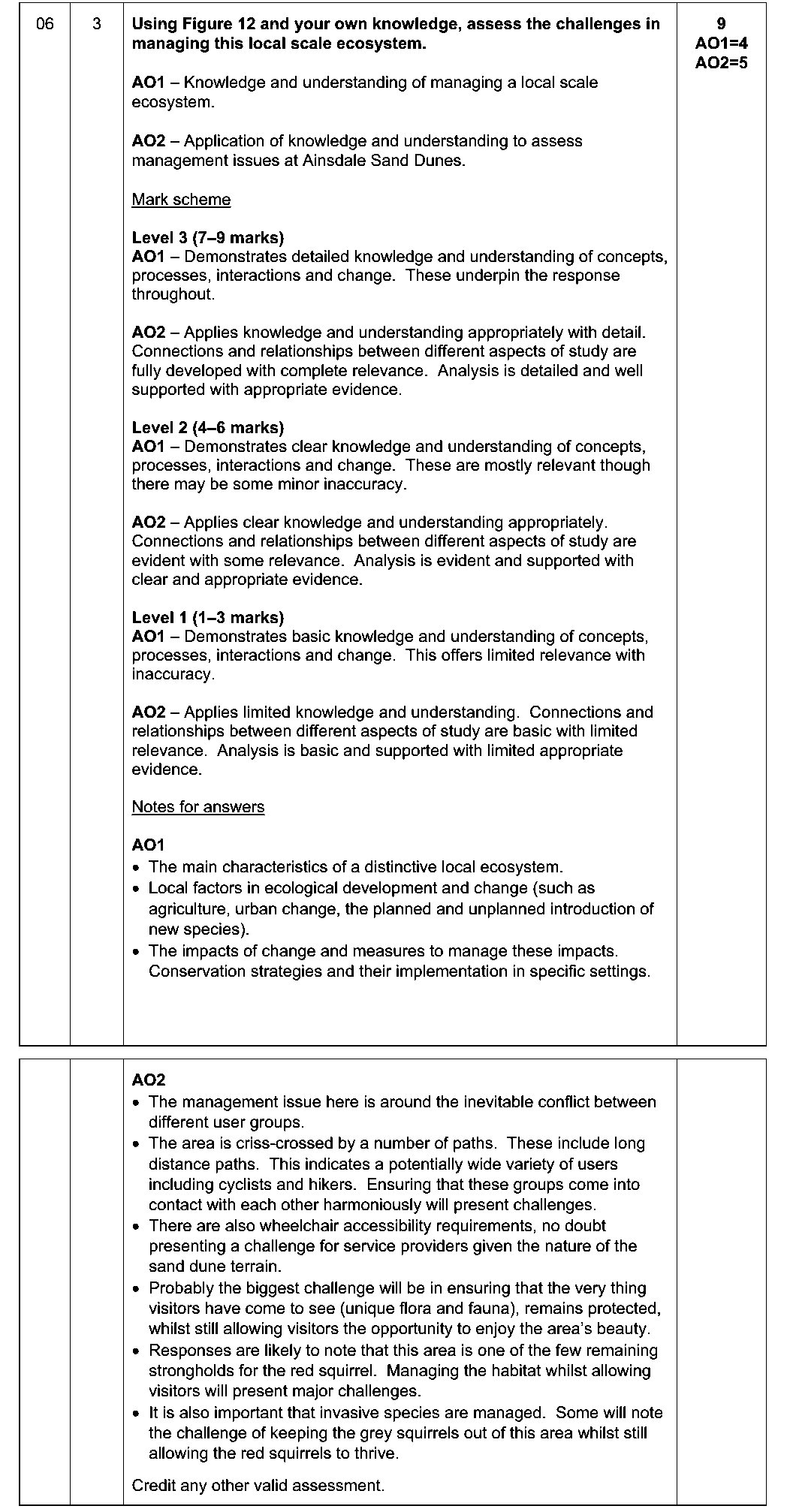
June 2023 · Paper 1 · Q6.39 marksmark schemeStimulus
Figure 12
Mark scheme, including the levels and indicative content
Examiner's comment
Understanding the focus of the novel situations questions and how the assessment objectives AO1 and AO2 are applied, still remains an issue for some students. This was specifically the case with the ‘x.3’ questions on all core and optional units. Many are still analysing data rather than applying knowledge to the resource provided. These questions require students to think on their feet. Students cannot simply interface with data in the resource, nor can they simply recite learned content. Instead they have to apply their learned knowledge and understanding to the novel situation. Less successful responses were those who simply regurgitated the data / information presented without drawing on their specification content. Similarly, there were some who recited knowledge without applying this to the context of the resource. For Q.6.3 there was quite a lot more alluded to than just the conflict between visitors and ecosystems through the interface of footpaths. Many failed to go beyond this. On Q.6.3 the main issue was the narrow nature of the tourism versus conservation argument put forward by many. Such responses needed to go further than just referring to the footpath encroachment into the ecosystem.
Notes from the mark scheme and report
Ainsdale dunes: conflicting users on footpaths and trails, accessibility, protecting rare species (red squirrel vs grey, natterjack toads) while allowing visitors
many went no further than footpath erosion
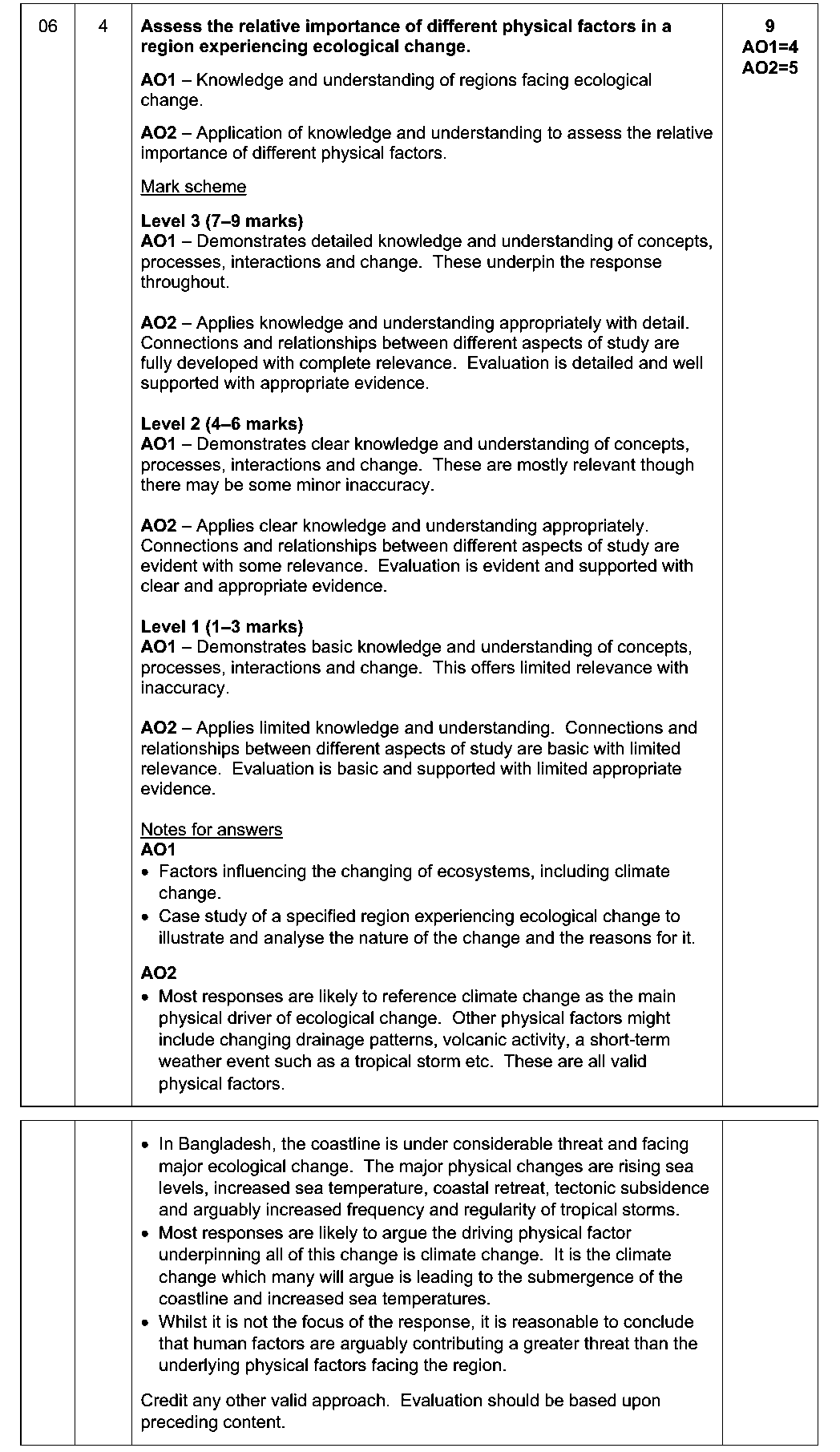
June 2023 · Paper 1 · Q6.49 marksmark scheme9-mark essay
Mark scheme, including the levels and indicative content
Examiner's comment
The 9-mark AO1/AO2 questions in Section C generally caused no major issues. The key differentiator was around those who understood the key terms of the specification (nuees ardentes in Q.5.4 and regions experiencing ecological change in Q.6.4). For Q.5.3 some students did not know what was meant by the term nuée ardente. Similarly, those students who did not understand what could be considered as a region experiencing ecological change also struggled to answer this question. The key point here is that understanding of the required content of the specification, including the geographic terms used, is absolutely key to a successful response. Q.5.3 was problematic if students did not what was meant by the term nuée ardente. Similarly, those students who did not understand what could be considered as a region experiencing ecological change (Q.6.3) also struggled to answer this question. Concerning Q.6.4, limited awareness of a region experiencing ecological change was a significant factor in many responses. Without a sound basis many students failed to progress their response.
Notes from the mark scheme and report
own region experiencing ecological change (e.g. Bangladesh coast): climate change, sea-level rise, sea temperature, subsidence, storms
human factors may be judged greater
many lacked a suitable region
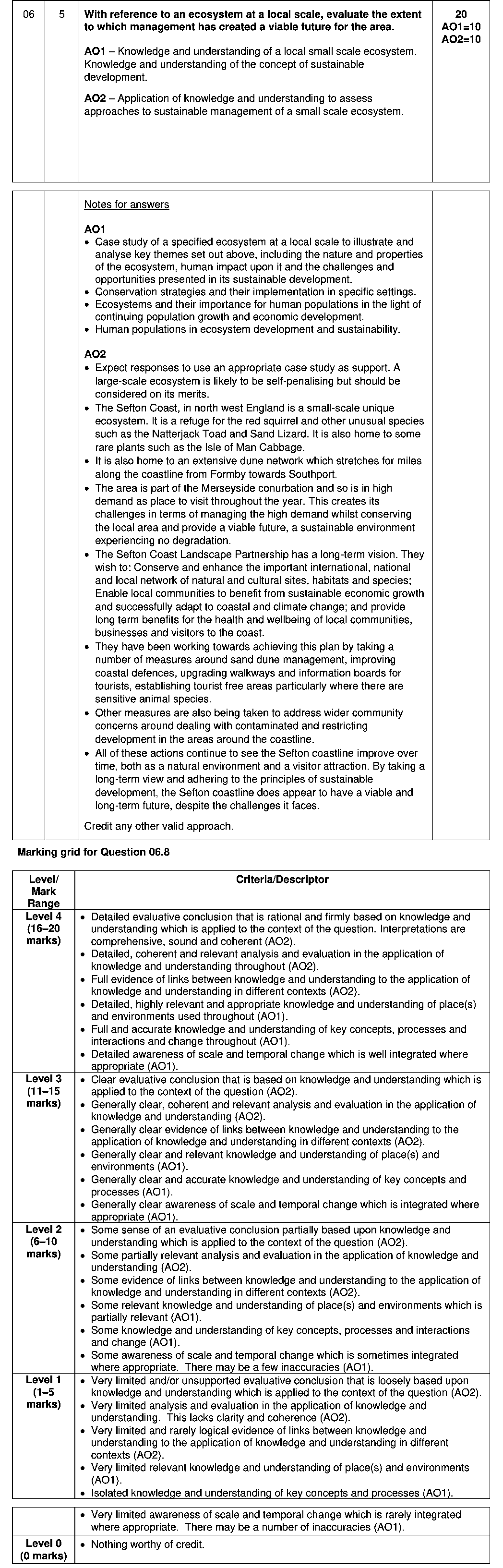
June 2022 · Paper 1 · Q6.520 marksmark scheme20-mark essay
Mark scheme, including the levels and indicative content
Examiner's comment
The local scale case study was generally well understood and case studies were readily available for the small number who attempted this option. The underlying focus was that of sustainability and weaker responses never really picked this up. Instead the responses simply described a learned case study. This could still score reasonable marks for AO1 but little credit for AO2. This became a feature of a partial L2 response. It was the evaluative comment which raised responses to Level 3 and Level 4, especially where the case study was appropriately detailed.
Notes from the mark scheme and report
local-scale ecosystem (e.g. Sefton Coast dunes) and how far management gives a viable sustainable future
a large-scale ecosystem is self-penalising
describing a learned case study gives AO1 but little AO2
mark scheme grid misprinted as 'Question 06.8'
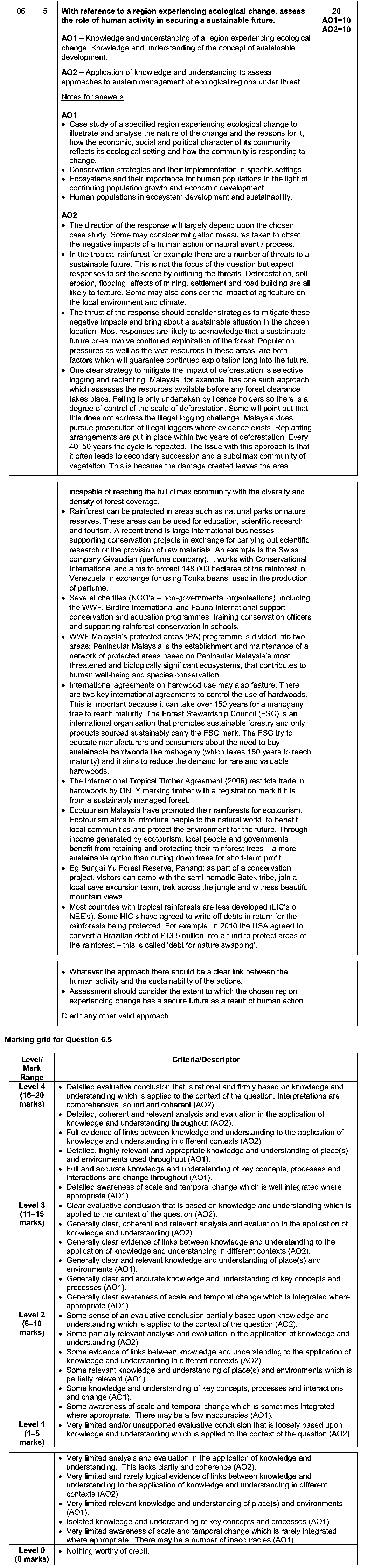
November 2020 · Paper 1 · Q6.520 marksmark scheme20-mark essay
Mark scheme, including the levels and indicative content
Notes from the mark scheme and report
own region experiencing ecological change (e.g. Malaysian rainforest): selective logging, protected areas, NGOs, FSC, ecotourism, debt-for-nature
must link human activity to a sustainable future
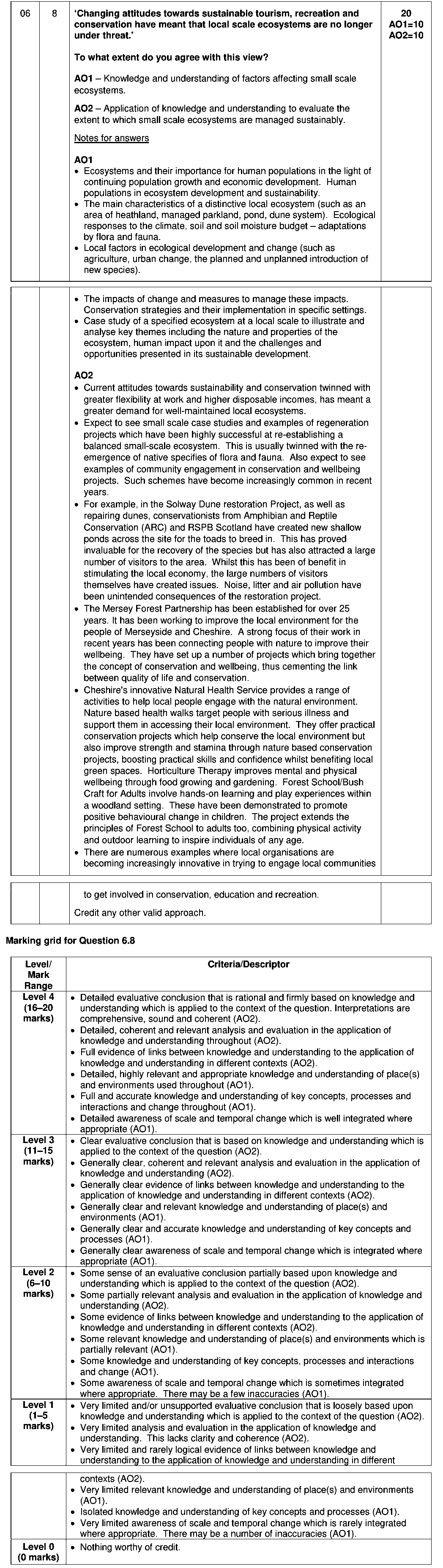
June 2019 · Paper 1 · Q6.820 marksmark scheme20-mark essay
Mark scheme, including the levels and indicative content
Examiner's comment
Most understood the small scale nature of the ecosystems in the question with relatively little drift into large scale ecosystems or biomes. Some interesting case studies emerged. Students did try to offer balance around the damaging nature of human activity and genuine attempts to achieve sustainability in such small scale environments. It depended upon the case study as to whether students agreed with the assertion of the question or not. Those who used small scale coastal ecosystems for example, were more negative in their outlook especially considering the issues taking place at coastlines generally. Such students found links between eustatic change and their small scale ecosystem. This was a legitimate creditworthy approach.
Notes from the mark scheme and report
small-scale ecosystems only (e.g. Solway dunes, Mersey Forest)
balance sustainable management against continuing pressures such as visitor impact and sea-level rise
Work with an AQA Geography tutor
Essays stuck in the middle levels, or losing marks on the data questions? Book a trial lesson with a specialist AQA Geography tutor.