3.1.6.5-01 The distribution and main characteristics of coral reef ecosystems. Environmental conditions associated with reef development.A level only
3.1.6.5-02 The following aspects should be examined with reference to a named, located coral reef: Factors in the health and survival of reefs: • Natural: Water temperature, acidity, salinity, algal blooms. • Human activity and its impact: Major drainage basin schemes, onshore development, desalination, pollution, tourism, fishing. • Future prospects for coral reefs.A level only
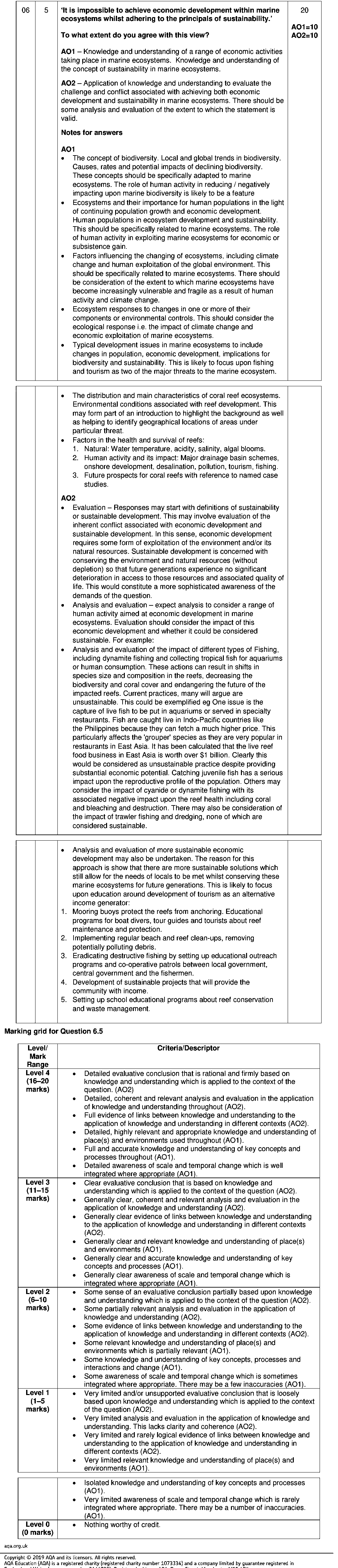
‘It is impossible to achieve economic development within marine ecosystems whilst adhering to the principles of sustainability.’ To what extent do you agree with this view?
Tap a question to zoom it. The figures open above it; the mark scheme (with its levels and indicative content) and the examiner's comment open underneath.
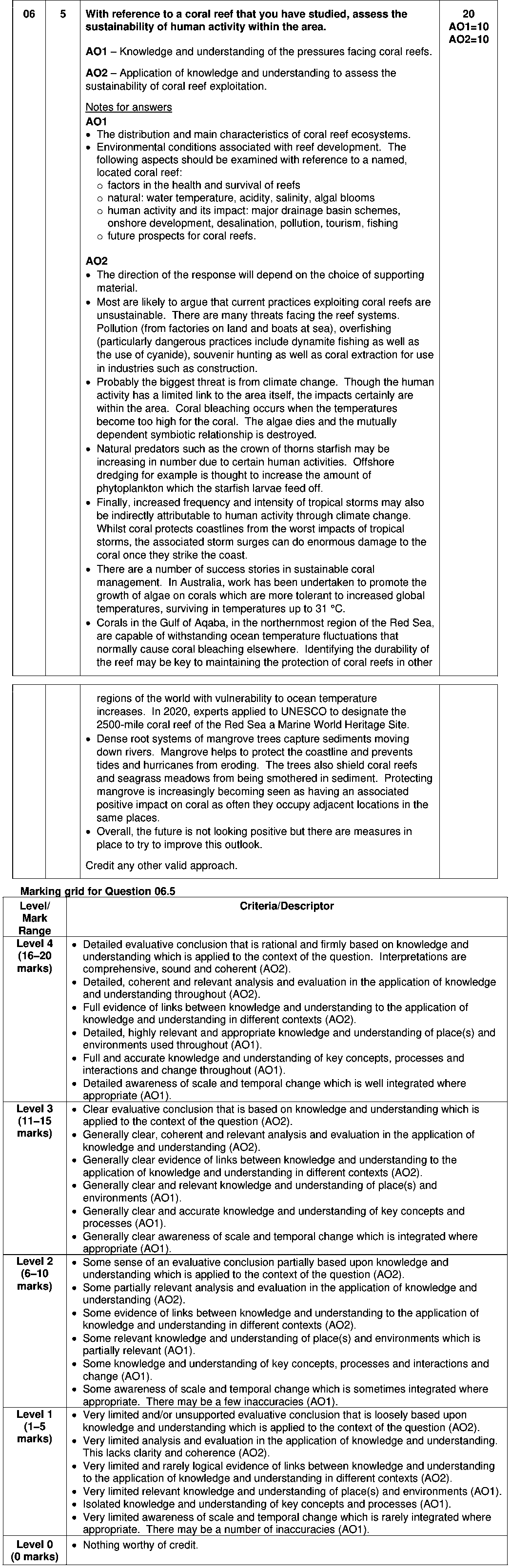
June 2025 · Paper 1 · Q6.520 marksmark scheme20-mark essay
Mark scheme, including the levels and indicative content
Examiner's comment
These questions assess knowledge, understanding and application: constructing arguments and drawing conclusions. These questions are designed to allow students to demonstrate links within different areas of the specification unit. Examiners expect to see secure underpinning knowledge and understanding as well as depth of support including case study material as appropriate. This should then be used to craft a balanced argument with a sustained line of reasoning. Students often look at more than one side of an argument. This is to be encouraged, but examiners would really hope to see a sustained argument which considered these different viewpoints, i.e. that they hold their own, well supported position throughout.
Notes from the mark scheme and report
named, located coral reef
assess sustainability of fishing, pollution, tourism, coral extraction and climate-driven bleaching against management successes (heat-tolerant corals, Gulf of Aqaba, mangroves, protected status)
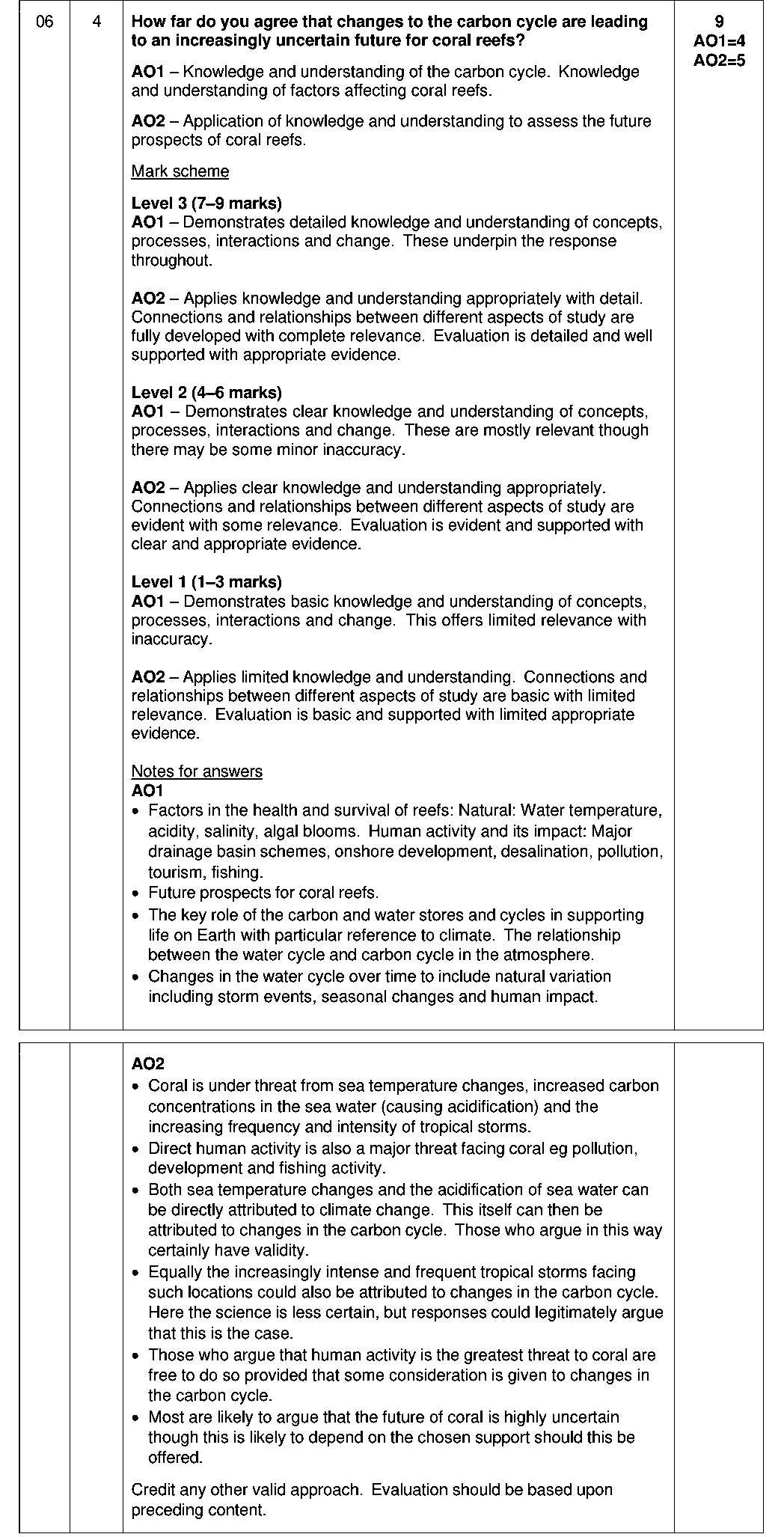
June 2024 · Paper 1 · Q6.49 marksmark schemeSynoptic
Mark scheme, including the levels and indicative content
Examiner's comment
For the 9-mark cross-specification questions this series (Q5.4 and Q6.4), it was really pleasing to see how many students readily attacked the questions with confidence and secure knowledge. Whilst the specification ‘fit’ was quite a natural one in both cases (links to the carbon cycle), it was really impressive to see so many students produce really strong responses with good underpinning knowledge. This series the cross-spec question was a very natural link between tropical storms and changes in the carbon cycle (Q5.4) or coral vulnerability and changes in the carbon cycle (Q6.4). We saw plenty of strong responses which clearly argued well with good support and a sustained line of reasoning. Weaker responses tend to rely too heavily on AO1 knowledge of content, concepts and processes. They are usually not well focused on the question and may fail to offer any assessment or evaluation where it is invariably required. The response below considers the impact of climate change on the Great Barrier Reef. Support is strong and other factors are also considered in a well-balanced response. Overall this scored Level 3 and 7 marks.
Notes from the mark scheme and report
synoptic question (links Ecosystems with water and carbon cycles): warming seas, acidification, storm damage plus direct human threats
balanced answers considering other factors scored well (Level 3, 7 marks example)
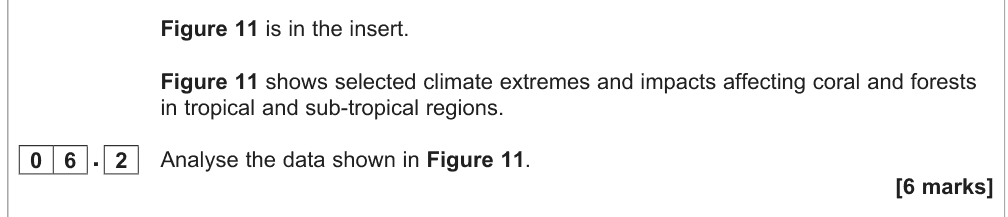
November 2021 · Paper 1 · Q6.26 marksmark schemeData analysis
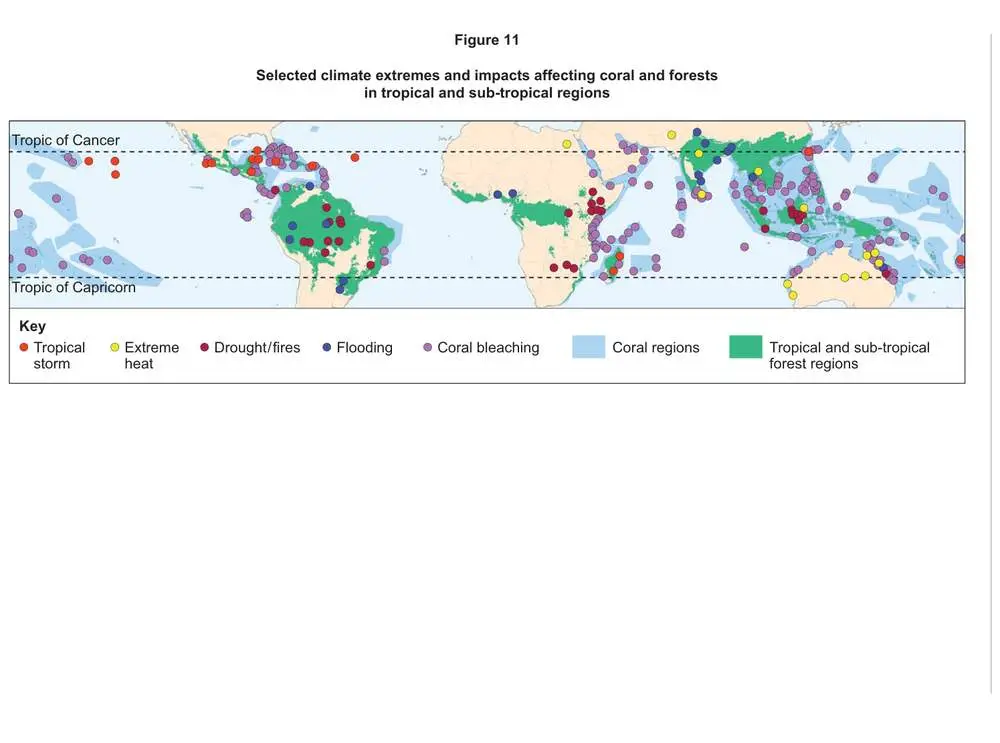
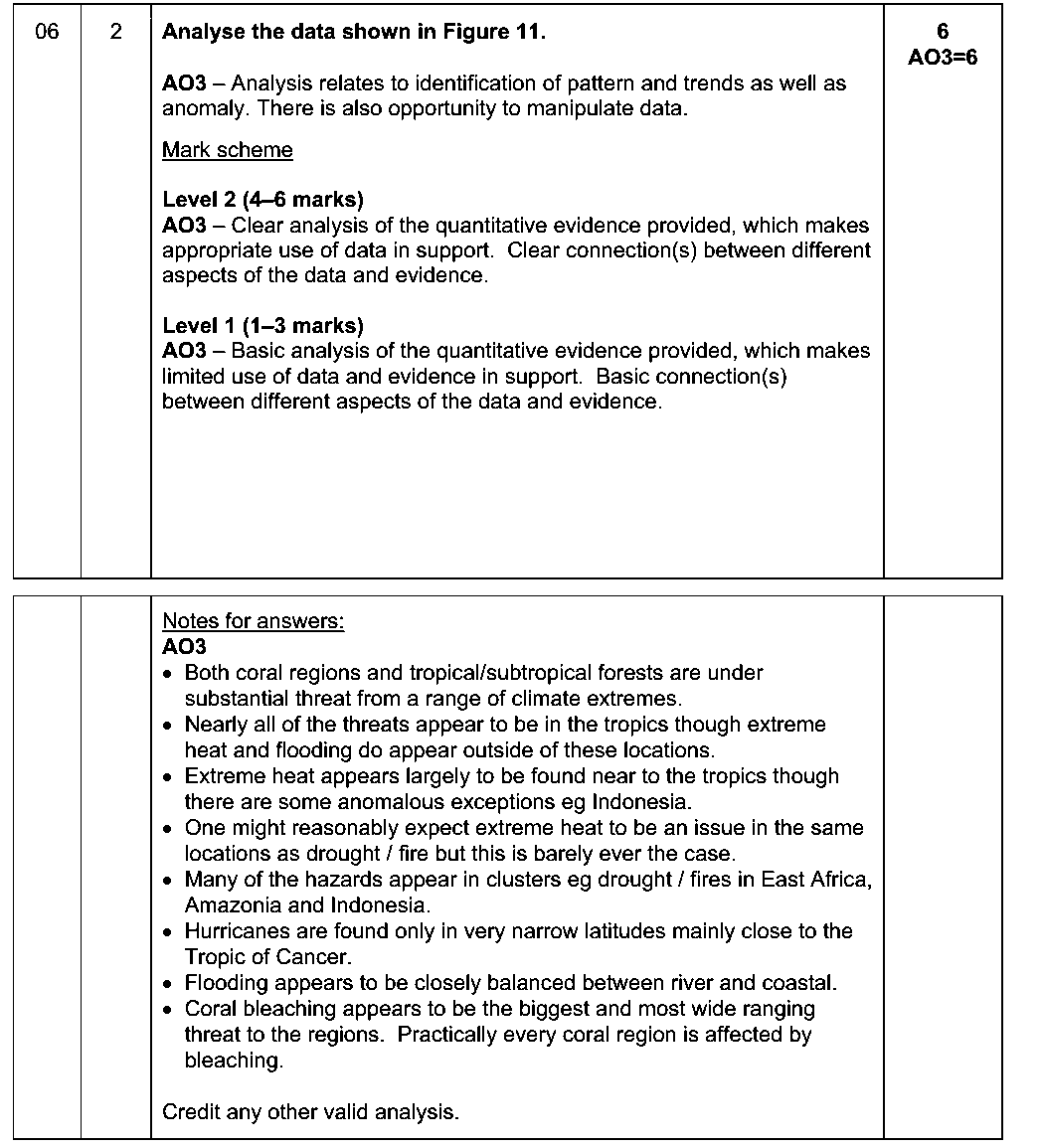
Figure 11
Mark scheme, including the levels and indicative content
Notes from the mark scheme and report
AO3: most extremes within the tropics, clusters of drought/fire (E Africa, Amazonia, Indonesia), hurricanes near the Tropic of Cancer, coral bleaching the most widespread threat
anomalies such as extreme heat rarely matching drought
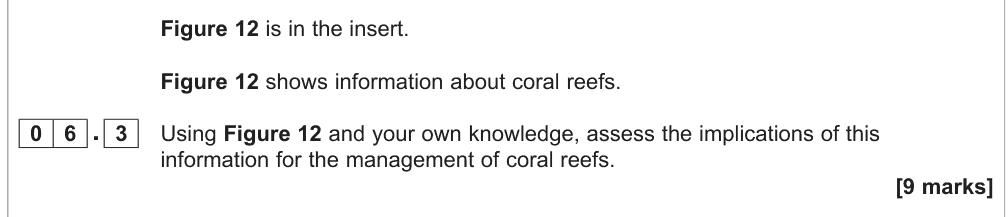
November 2021 · Paper 1 · Q6.39 marksmark schemeStimulus
Figure 12
A figure for this question was removed from AQA's published paper for copyright reasons.
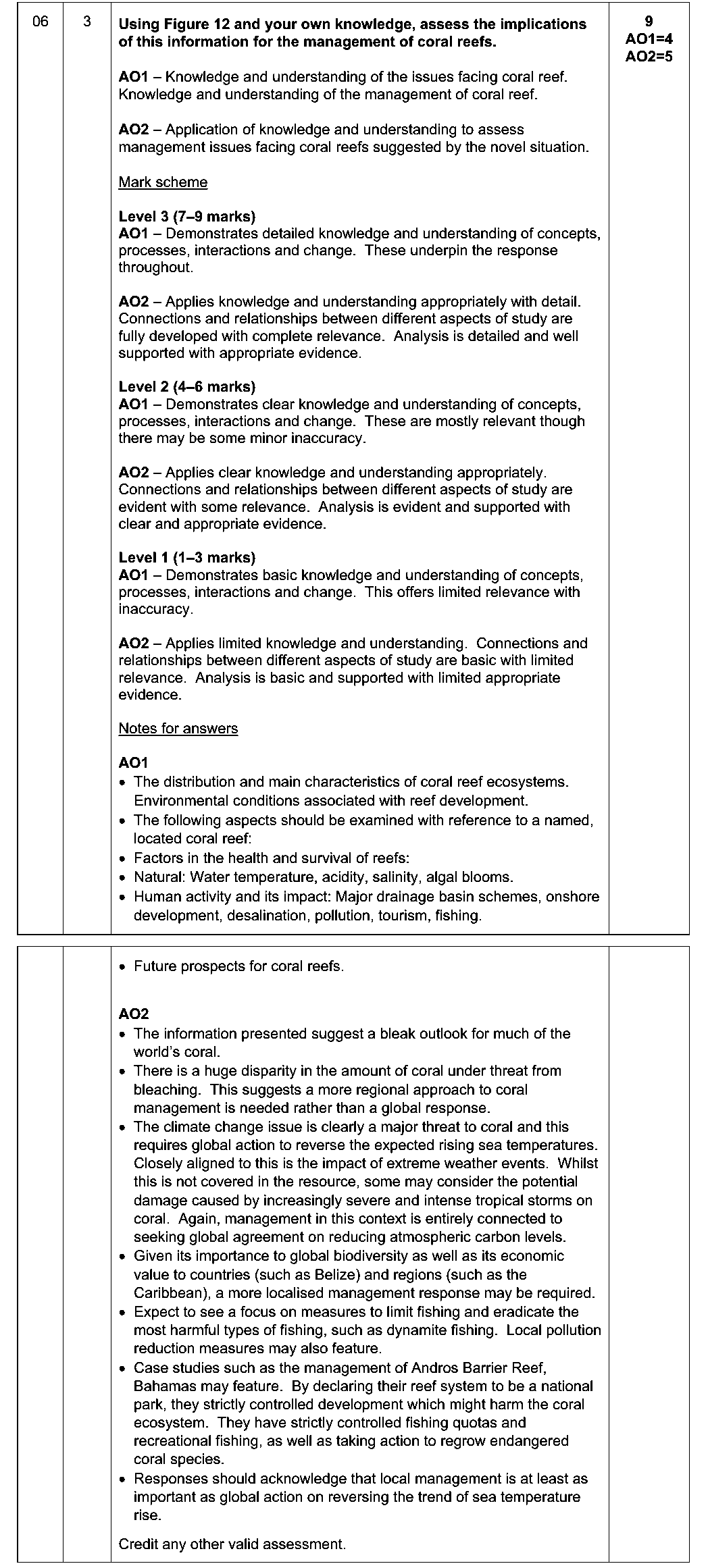
Mark scheme, including the levels and indicative content
Notes from the mark scheme and report
regional variation in bleaching suggests local management (fishing limits, pollution control, marine parks such as Andros) alongside global climate action
Figure 12 not reproduced in the published paper
November 2020 · Paper 1 · Q6.39 marksmark schemeStimulus
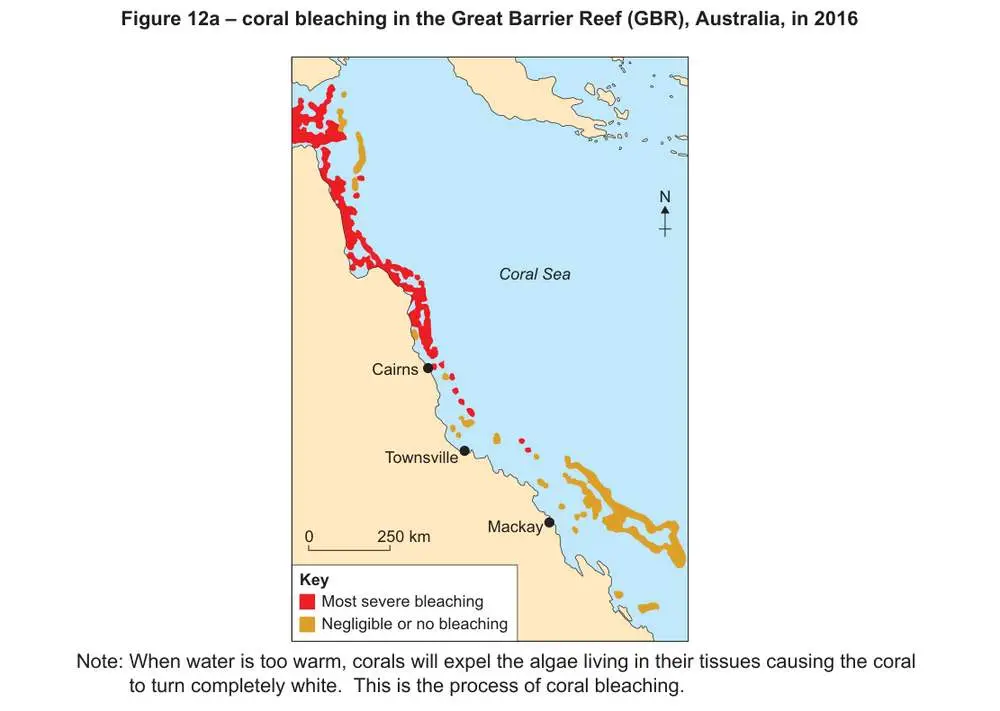
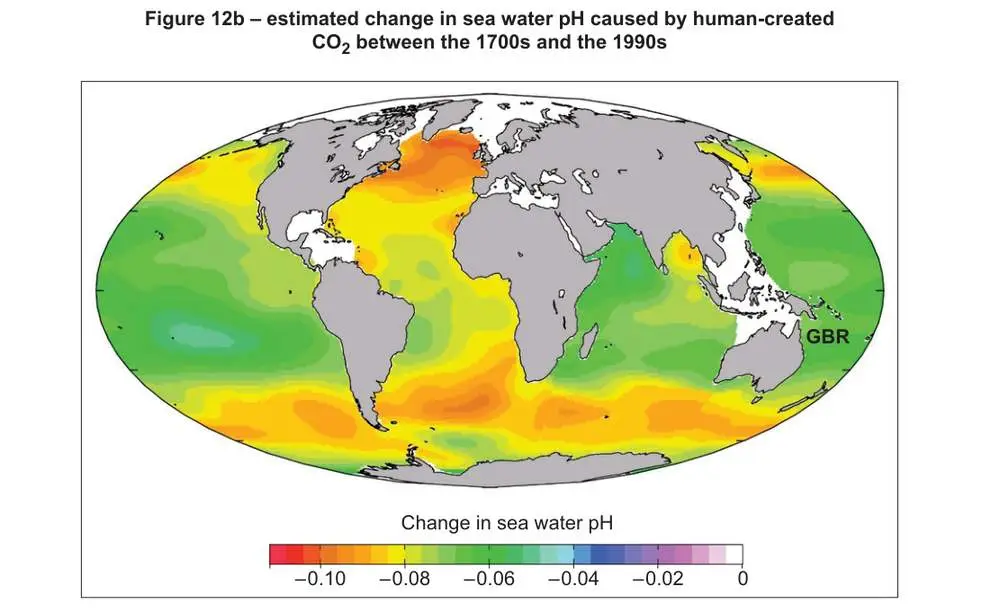
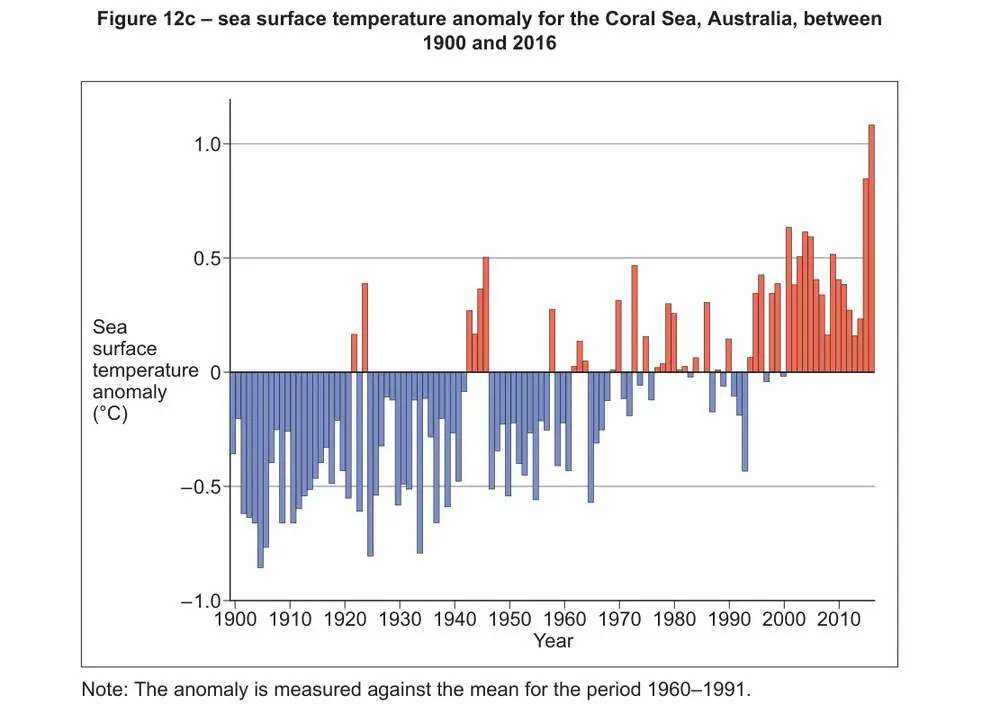
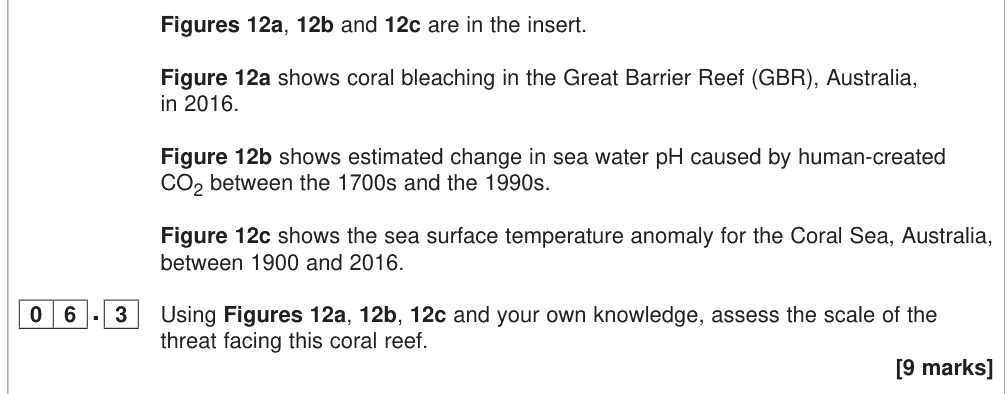
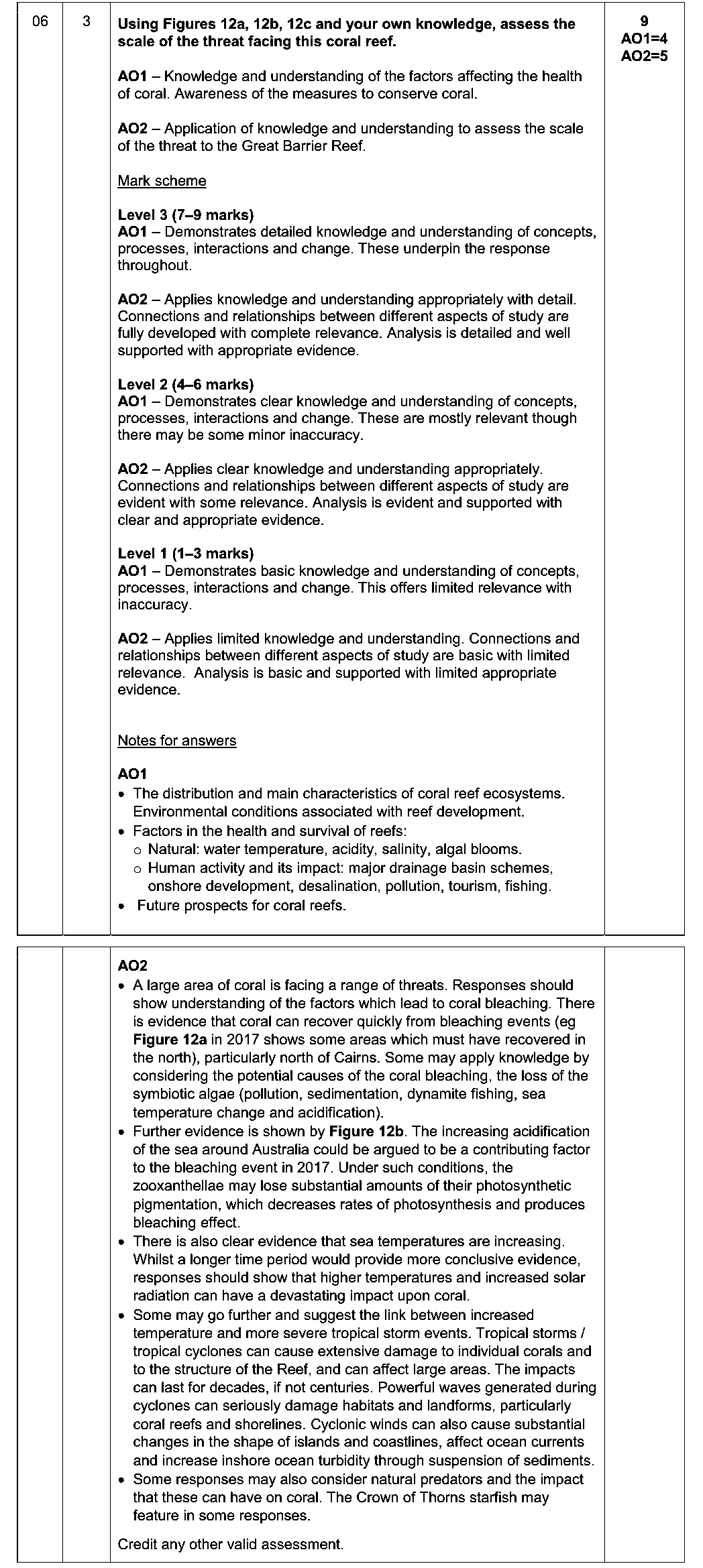
Figures 12a, 12b, 12c
Mark scheme, including the levels and indicative content
Notes from the mark scheme and report
bleaching mainly north of Cairns, acidification and rising sea temperature as causes, plus storms, pollution and crown-of-thorns
recovery possible
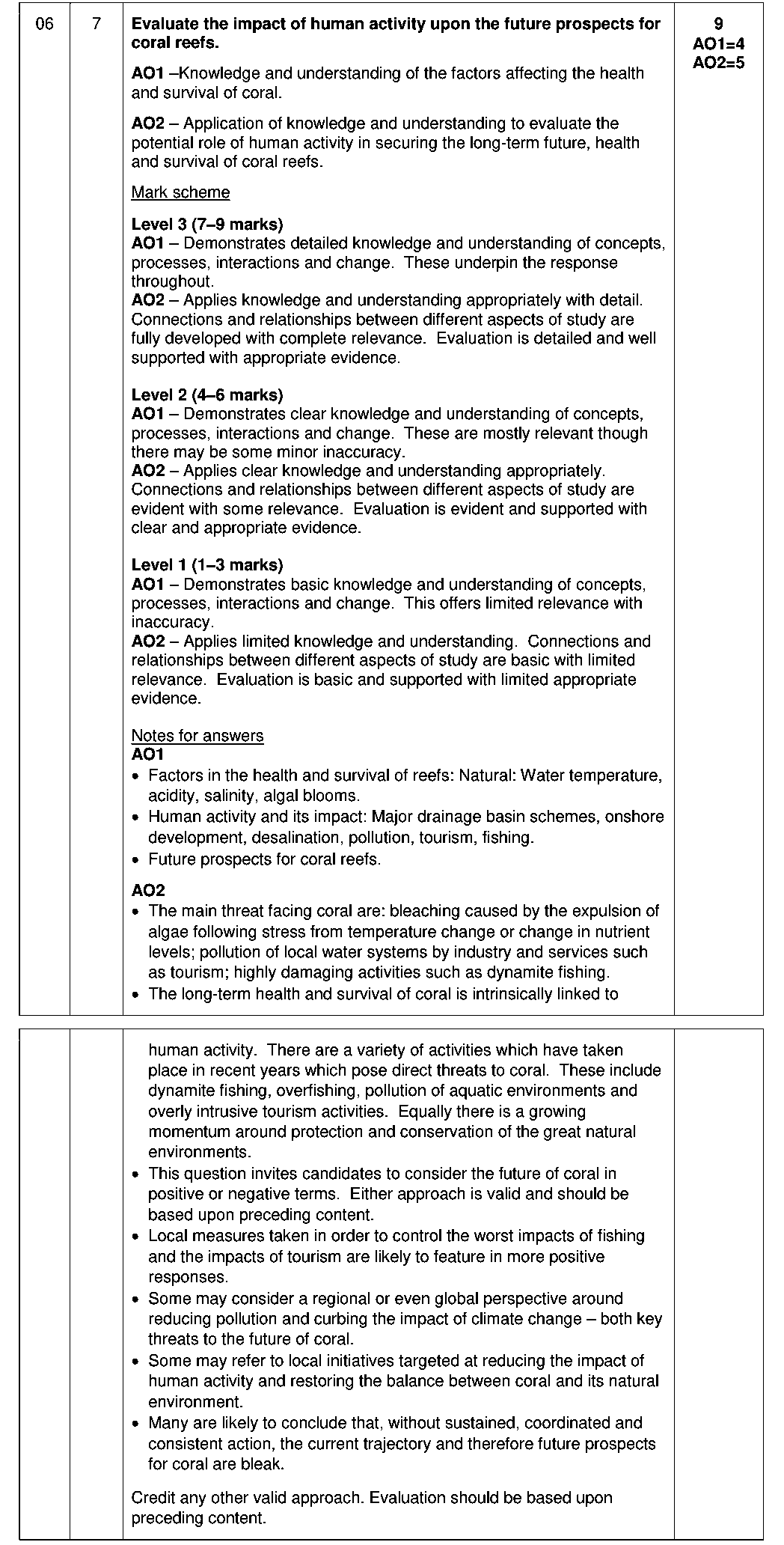
June 2019 · Paper 1 · Q6.79 marksmark scheme9-mark essay
Mark scheme, including the levels and indicative content
Examiner's comment
This was generally well done by many students. More responses tended to focus on negative impact of human activity upon coral, namely fishing, tourism, pollution and global warming. Some went further and considered conservation strategies as part of their possible future prospects. These constituted more rounded responses, though full credit was available for an entirely negative view.
Notes from the mark scheme and report
threats (bleaching, pollution, dynamite fishing, tourism, climate change) vs conservation
entirely negative view could gain full credit
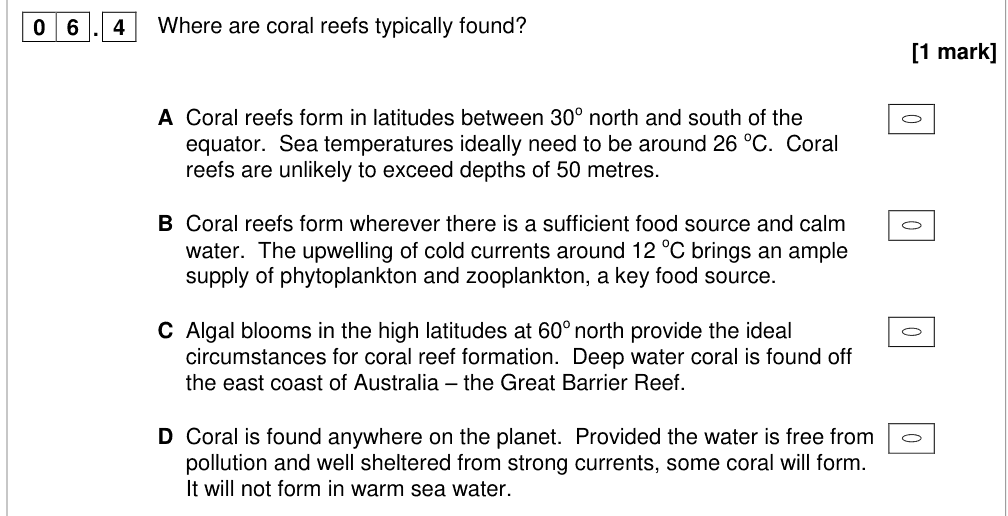
June 2018 · Paper 1 · Q6.41 markmark schemeMultiple choice
Answer
A
Mark scheme
Examiner's comment
Whilst coral is found in other parts of the world, it is typically found in locations identified by option A. Most Students correctly identified this.
Notes from the mark scheme and report
Answer: A
between 30°N and 30°S, about 26 °C, shallower than 50 m
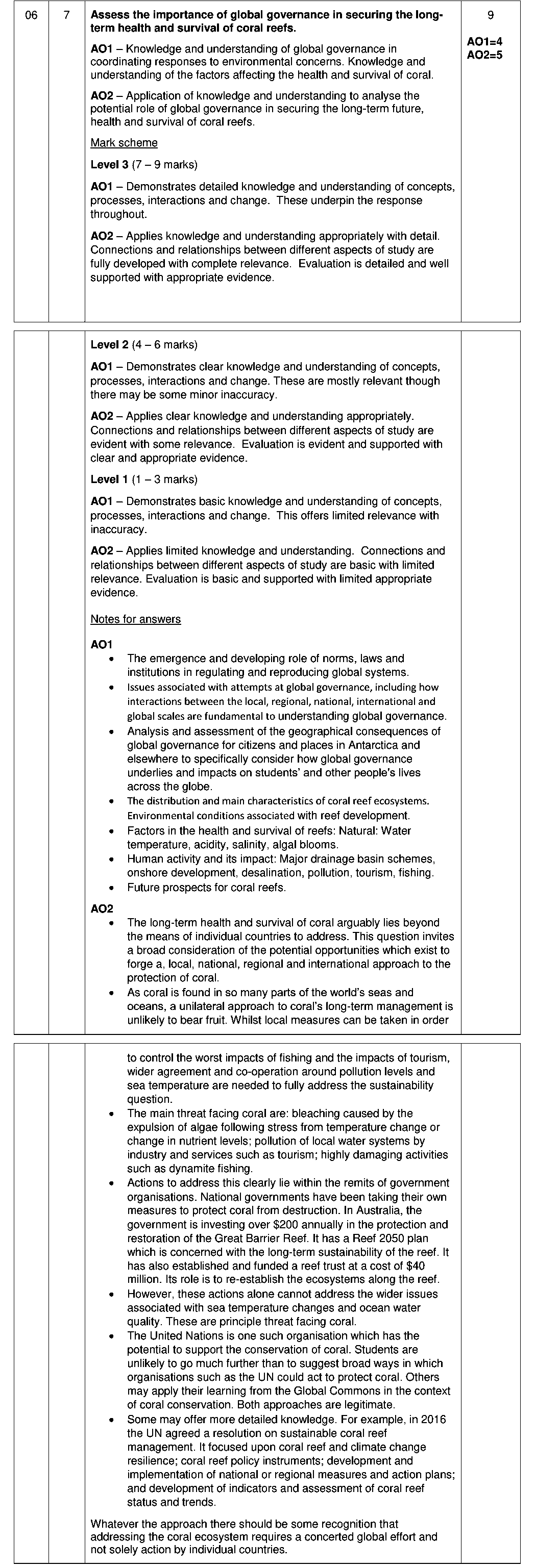
June 2018 · Paper 1 · Q6.79 marksmark schemeSynoptic
Mark scheme, including the levels and indicative content
Examiner's comment
One particular 9 mark question in this series, targeted links across the specification, these were found on both options in Section C (Question 5.7 and 6.7). This was a question which tested the application of knowledge and understanding by drawing two distinct areas of the specification together. In this case it was Global Systems and Governance and Ecosystems. Students were unlikely to be able to develop specific strategies of international co- ordination in addressing threats to coral. However many did consider opportunities to co-operate on climate change as well as reducing pollution and action around minimising the impact of tourism and certain types of fishing. Others chose to counterbalance global action with local action. This was a creditworthy approach.
Notes from the mark scheme and report
synoptic question (links Ecosystems with Global systems and global governance): international co-operation on climate change, pollution, tourism and fishing set against local action
specific coral governance not expected
Specimen set 1 · Paper 1 · Q6.520 marksmark scheme20-mark essay
Mark scheme, including the levels and indicative content
Notes from the mark scheme and report
weigh economic use of marine ecosystems (fishing, tourism, coastal development) against sustainability with a named reef or marine example
consider sustainable management successes
Work with an AQA Geography tutor
Essays stuck in the middle levels, or losing marks on the data questions? Book a trial lesson with a specialist AQA Geography tutor.