A-level Paper 1 Section C (option); AS Paper 1 Section B (option)
Level
AS and A level
Specification
3.1.5.2, 3 content points
Since 2017
17 question parts, 3 of them essays
Specification
3.1.5.2-01 Earth structure and internal energy sources. Plate tectonic theory of crustal evolution: tectonic plates; plate movement; gravitational sliding; ridge push, slab pull; convection currents and sea-floor spreading.
3.1.5.2-02 Destructive, constructive and conservative plate margins. Characteristic processes: seismicity and vulcanicity. Associated landforms: young fold mountains, rift valleys, ocean ridges, deep sea trenches and island arcs, volcanoes.
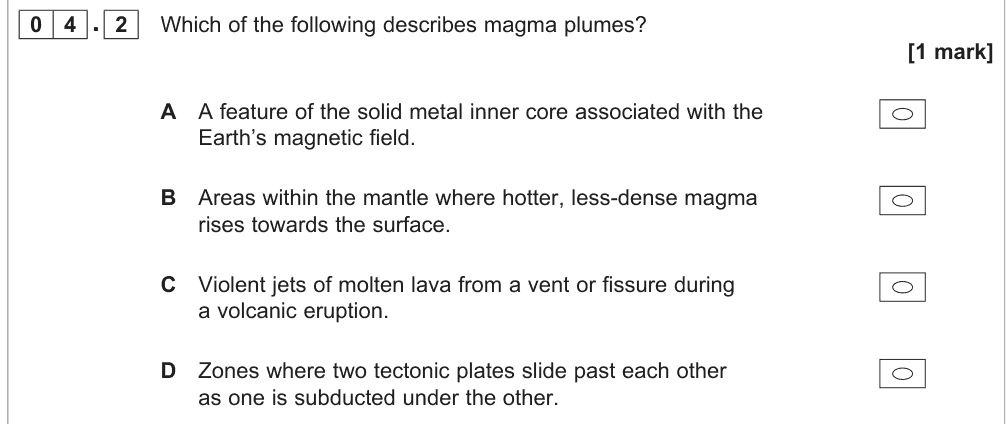
3.1.5.2-03 Magma plumes and their relationship to plate movement.
Tap a question to zoom it. The figures open above it; the mark scheme (with its levels and indicative content) and the examiner's comment open underneath.
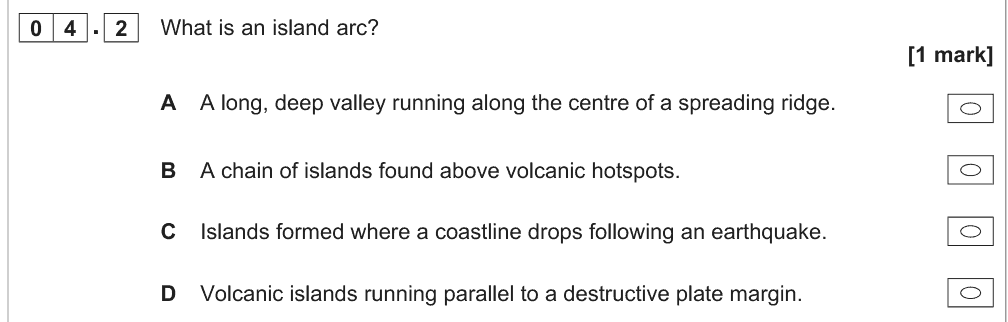
June 2025 · AS Paper 1 · Q4.21 markmark schemeMultiple choice
Answer
D
Mark scheme
Examiner's comment
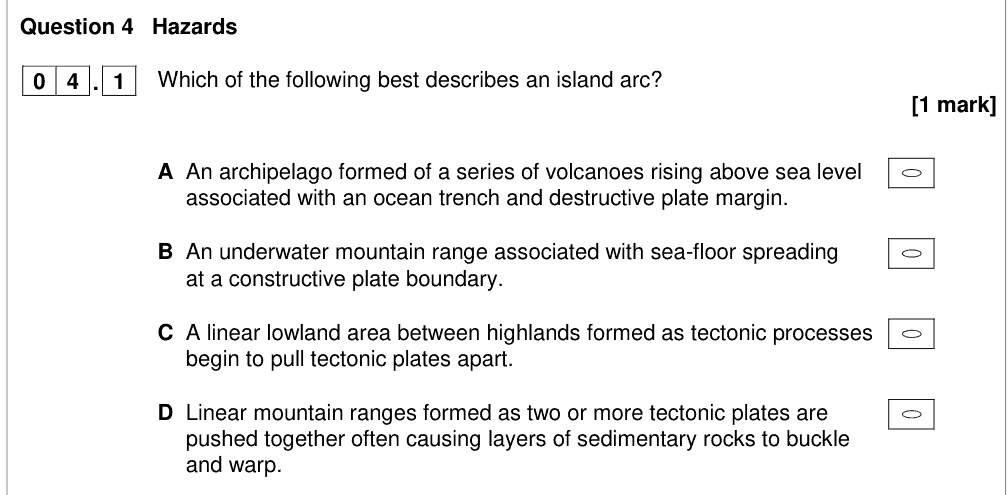
This question proved to be surprisingly difficult. Only 29% of students correctly identified D as an island arc. The vast majority chose B, which described a chain of islands associated with a hotspot. Examiners were surprised by this as island arcs are explicitly named on the specification, but island chains associated with hot spots are not.
Notes from the mark scheme and report
Answer: D
only 29% correct – most chose B (hotspot island chain)
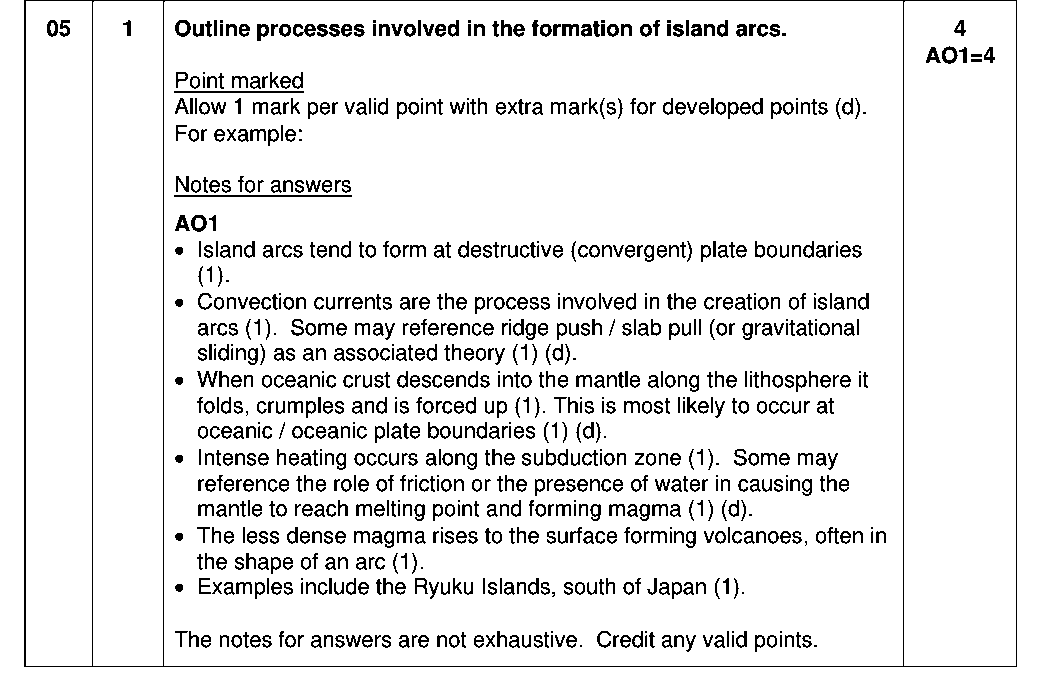
June 2025 · Paper 1 · Q5.14 marksmark schemePoint-marked
Mark scheme
Examiner's comment
These questions assess knowledge and understanding and require students to outline key processes, concepts, interaction and change. Four-mark questions performed well, provided the students had the appropriate level of understanding of the specification content. 4-mark questions are point marked. A mark may be awarded where a student makes a single relevant point and subsequent marks awarded (if applicable) where the student develops those points with additional knowledge. Question 05.1 about island arc formation produced a very polarised set of responses. Too many confused arcs with chains which have very different theories around their formation. On question 05.1 (AO1) (4 marks), this response demonstrates a sound understanding of the processes in the formation of island arcs. Examples were often creditworthy on these question types, though in this case, the student had already achieved maximum marks. This answer demonstrates a clear understanding of processes in the formation of island arcs. 4 marks. On question 05.1 (AO1) (4 marks), too many confused arcs with chains. Even very strong geographers, such as this one, made this fundamental error and lost relatively easy marks. Responses needed to start with ideas around destructive plate margins colliding, followed by subduction. This answer confused arcs with chains. 0 marks
Notes from the mark scheme and report
point marked
oceanic-oceanic destructive margin, subduction, melting (water, friction) forming magma that rises to make an arc of volcanic islands, e.g. Ryukyu Islands
many confused island arcs with hotspot island chains and scored nothing
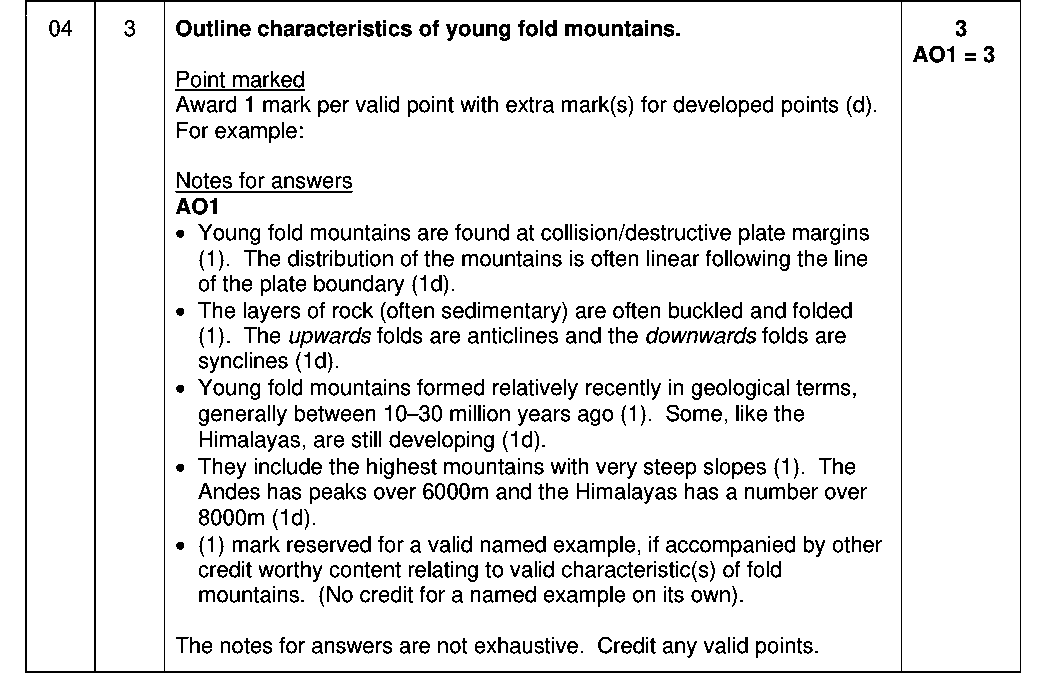
June 2024 · AS Paper 1 · Q4.33 marksmark schemeShort answer
Mark scheme
Examiner's comment
Performance on this question was a little disappointing. Fold mountains appeared to be unfamiliar to most students as the average score was only 1.03/3. Over ¼ of responses scored zero and only 10% achieved 3/3.
Notes from the mark scheme and report
point marked: collision margins, linear distribution, folded (often sedimentary) rock with anticlines and synclines, young (10–30 million years), high steep peaks
1 mark for a named example only with valid characteristics
poorly known (mean about 1/3)
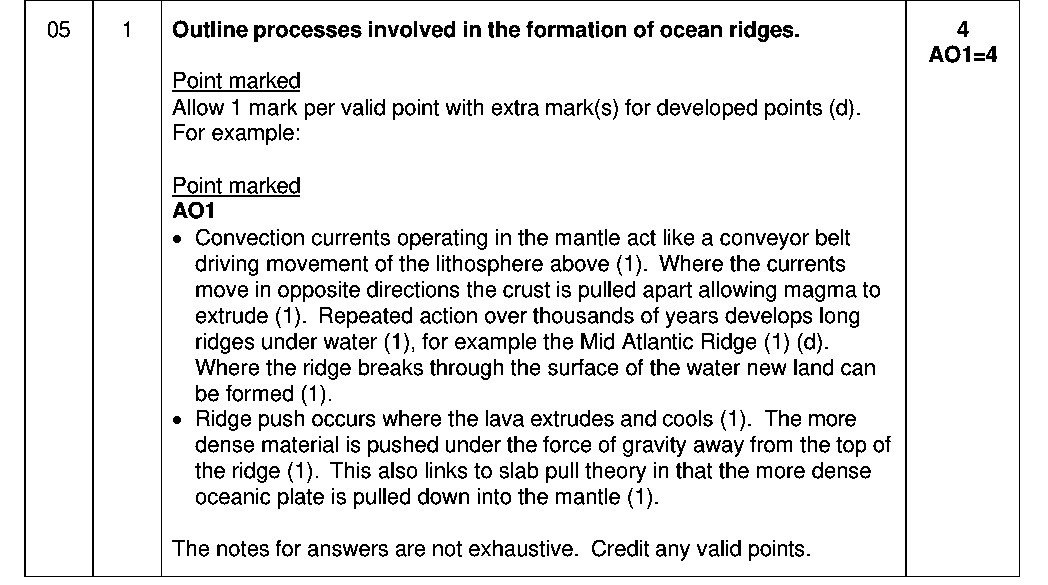
June 2024 · Paper 1 · Q5.14 marksmark schemePoint-marked
Mark scheme
Examiner's comment
The Section C, 4-mark questions had a heavy imbalance in favour of the Hazards unit and, provided students knew what an ocean ridge was, full credit was readily scored. On Q5.1, it was quite surprising to see so many confuse ridges with trenches. It was hard to find credit for those that did this. Despite some errors, the response below outlines the process involved in the formation of ocean ridges and scores 4 marks.
Notes from the mark scheme and report
convection currents / sea-floor spreading at constructive margins, ridge push and slab pull
many confused ridges with trenches and gained little credit
June 2023 · AS Paper 1 · Q4.21 markmark schemeMultiple choice
Answer
B
Mark scheme
Examiner's comment
Most students answered these multiple-choice questions correctly.
Notes from the mark scheme and report
Answer: B
magma plumes = areas in the mantle where hotter, less dense magma rises
June 2022 · AS Paper 1 · Q4.11 markmark schemeMultiple choice
Answer
B
Mark scheme
Examiner's comment
This question was accessible to the majority of students, but it differentiated quite well. Almost 70% correctly identified B as the correct option.
Notes from the mark scheme and report
Answer: B
almost 70% correct
June 2022 · AS Paper 1 · Q4.33 marksmark schemeShort answer
Mark scheme
Examiner's comment
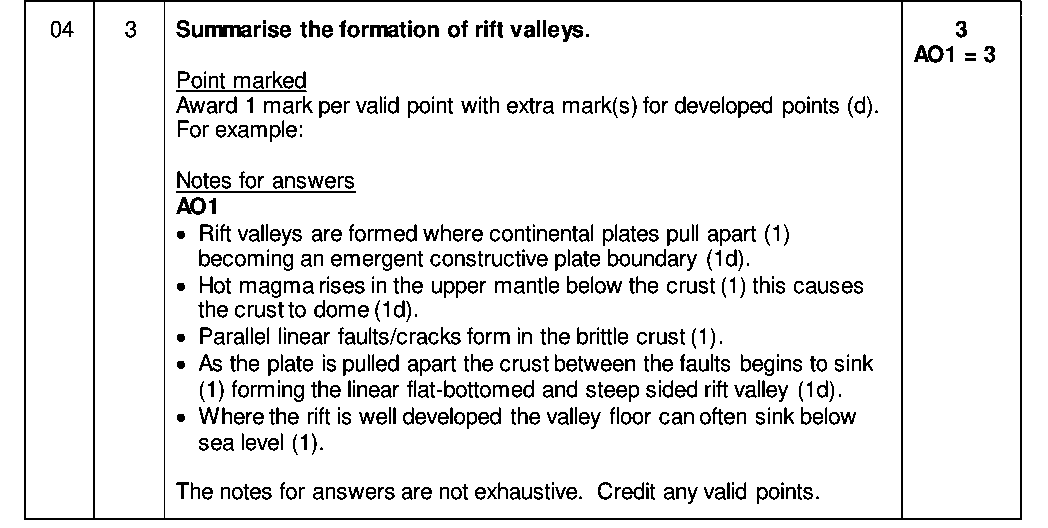
This question differentiated responses well. Around a quarter gained all 3 marks or scored zero. The best responses gave a succinct summary of the formation of rift valleys. Many gave a short clear sequence of formation. Surprisingly many students appeared very unfamiliar with rift valleys, some even suggested glaciers were involved in their formation.
Notes from the mark scheme and report
command printed as Summarise
plates diverge, magma doming, parallel faults, central block sinks
many unfamiliar with rift valleys
June 2022 · AS Paper 1 · Q4.59 marksmark scheme9-mark essay
Mark scheme, including the levels and indicative content
Examiner's comment
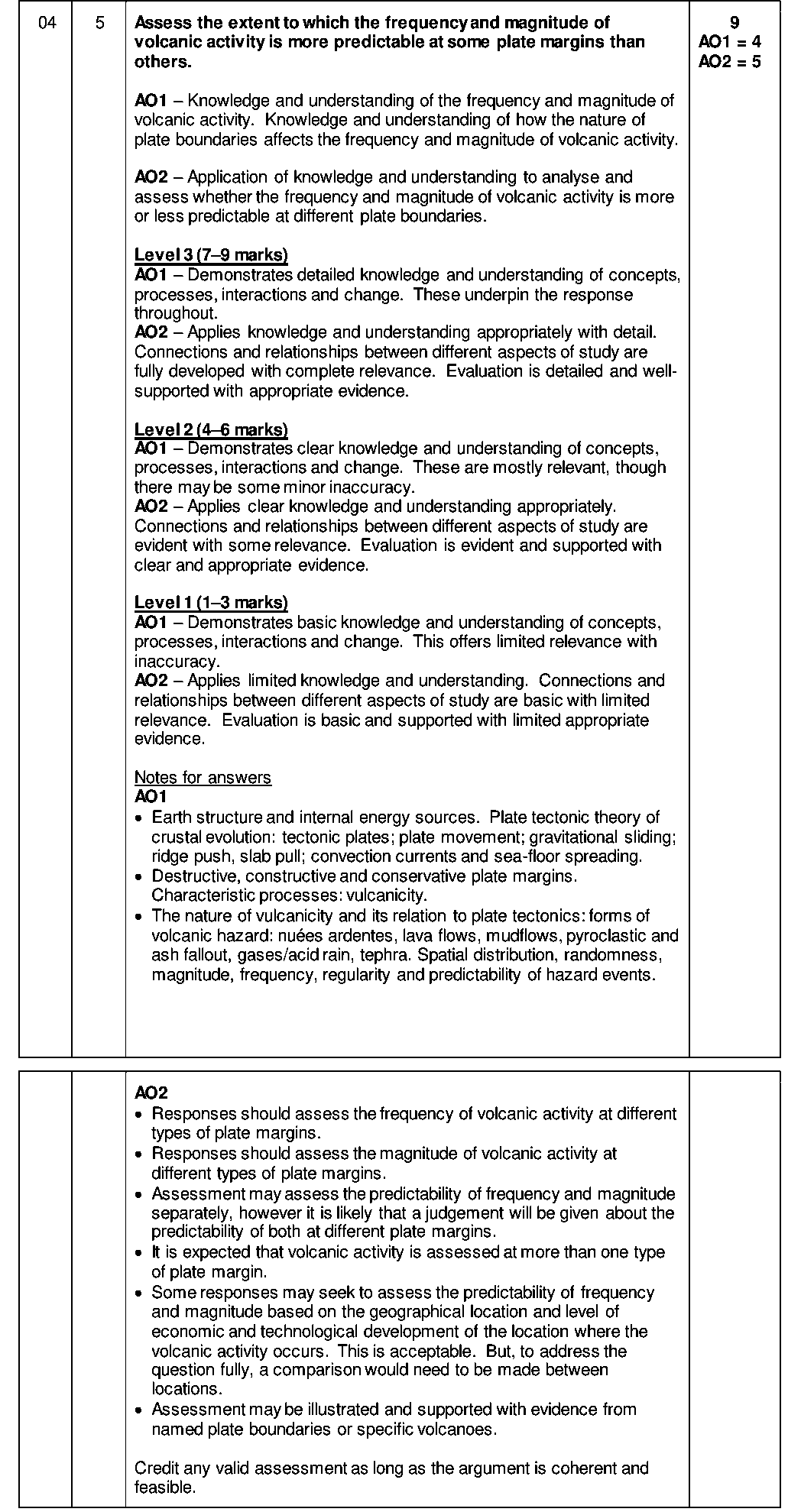
This question differentiated quite well, with almost 2/3 of students getting into Level 2 or higher, and only about 15% getting in to Level 3. The best responses had clear knowledge and understanding of the tectonic processes operating at different plate margins. These often also evidenced a clear grasp of how the nature of volcanic activity differed at these different boundaries. It was envisaged that most students would take a theoretical approach, and then possibly support points with some specific detail or evidence from a named example. Many did do this, but a significant number also made case studies of volcanoes in different tectonic settings the focus. This was creditworthy. Again, the best answers gave very clear assessment, and came to a clear view of the predictability of volcanic activity in different settings. The weakest answers displayed very little knowledge and understanding of either the nature of different plate margins or volcanic activity.
Notes from the mark scheme and report
compare frequency and magnitude of volcanic activity at different margins and judge predictability
case studies of volcanoes in different settings credited
only about 15% Level 3
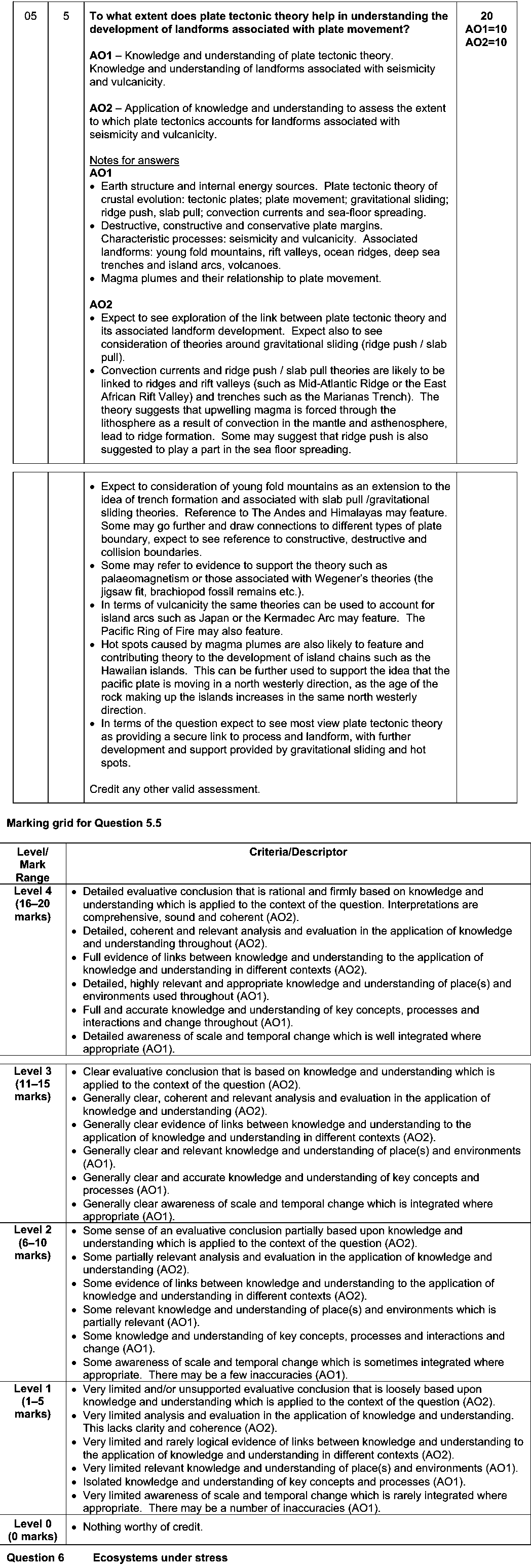
November 2021 · Paper 1 · Q5.520 marksmark scheme20-mark essay
Mark scheme, including the levels and indicative content
Notes from the mark scheme and report
link convection, ridge push and slab pull to ridges, rift valleys, trenches, fold mountains and island arcs
hotspots and evidence (palaeomagnetism) test the limits of the theory
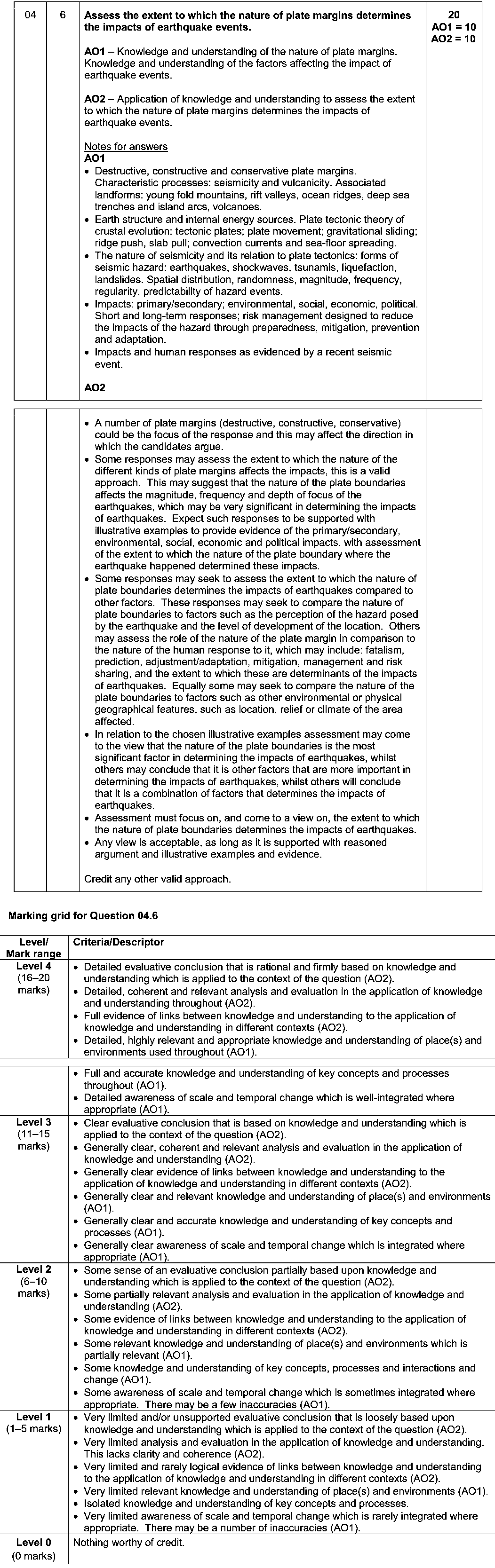
November 2020 · AS Paper 1 · Q4.620 marksmark scheme20-mark essay
Mark scheme, including the levels and indicative content
Notes from the mark scheme and report
assess how far margin type (magnitude, depth, frequency at destructive, constructive, conservative margins) determines earthquake impacts against development, preparedness, population density and building quality
use named events
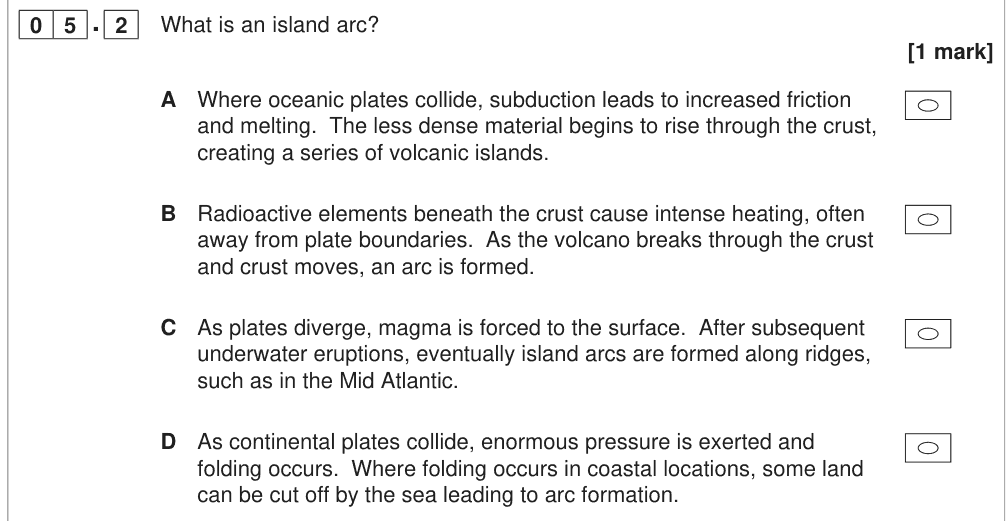
June 2019 · Paper 1 · Q5.21 markmark schemeMultiple choice
Answer
A
Mark scheme
Examiner's comment
Less than half were successful in this response, with many selecting distractor C, ie confusing island arcs with island chains.
Notes from the mark scheme and report
Answer: A
under half correct, many chose C (confusing island arcs with island chains)
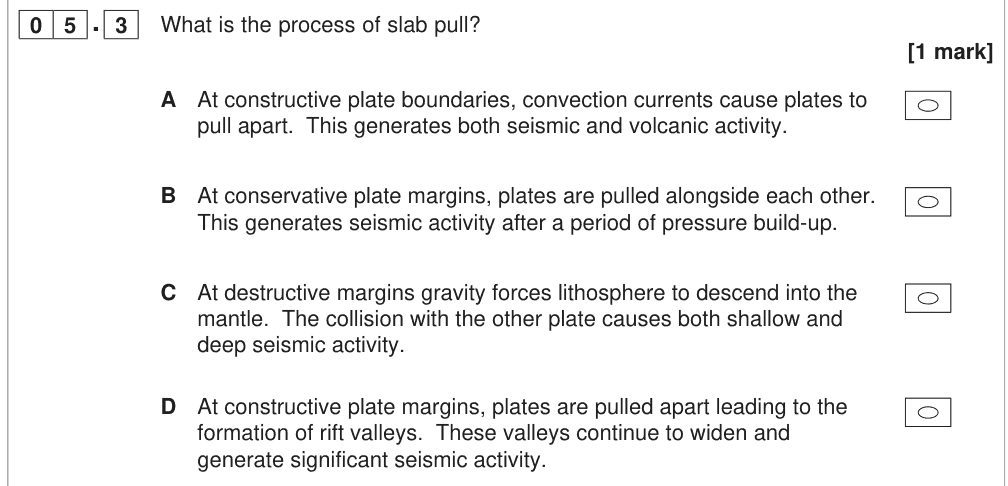
June 2019 · Paper 1 · Q5.31 markmark schemeMultiple choice
Answer
C
Mark scheme
Examiner's comment
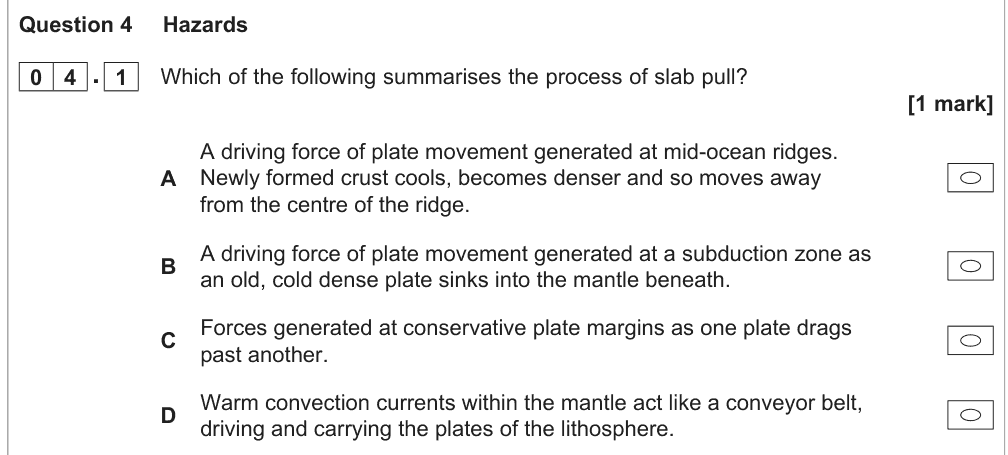
Over half identified C as the correct answer. Many selected distractor A i.e. confusing ridge push ideas with slab pull theories.
Notes from the mark scheme and report
Answer: C
many chose A (confusing slab pull with ridge push)
June 2018 · AS Paper 1 · Q4.11 markmark schemeMultiple choice
Answer
A
Mark scheme
Examiner's comment
71% of students accurately chose A as the correct answer.
Notes from the mark scheme and report
Answer: A
island arc = chain of volcanoes by an ocean trench at a destructive margin
71% correct
June 2018 · AS Paper 1 · Q4.33 marksmark schemeShort answer
Mark scheme
Examiner's comment
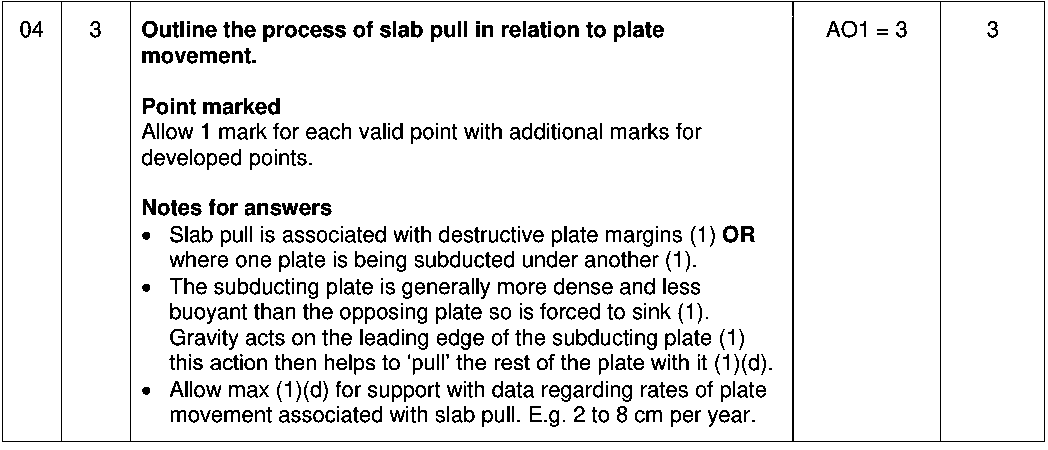
Many were well prepared for this and gave succinct summaries of the process, with a clear grasp of the role of gravity at destructive plate margins. Others clearly had little or no understanding of the process.
Notes from the mark scheme and report
point marked: at destructive margins the denser subducting plate sinks and gravity on its leading edge pulls the rest of the plate
data on rates (2–8 cm/yr) allowed as development
June 2018 · Paper 1 · Q5.11 markmark schemeMultiple choice
Answer
C
Mark scheme
Examiner's comment
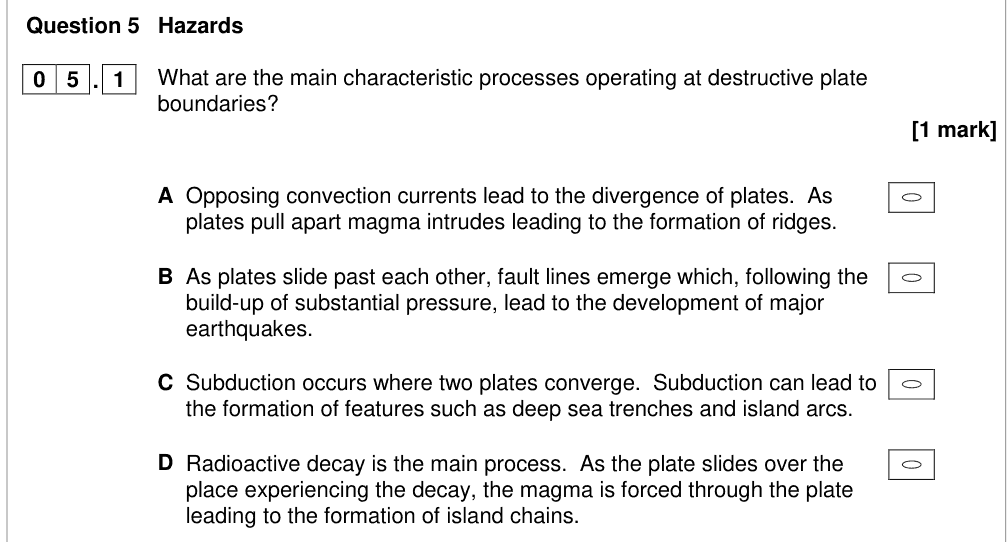
This option was by far the most popular of Section C. Most identified C as the correct answer. There was no specific pattern in choice of distractor for those who chose incorrectly.
Notes from the mark scheme and report
Answer: C
subduction where plates converge, forming trenches and island arcs
June 2017 · AS Paper 1 · Q4.11 markmark schemeMultiple choice
Answer
B
Mark scheme
Examiner's comment
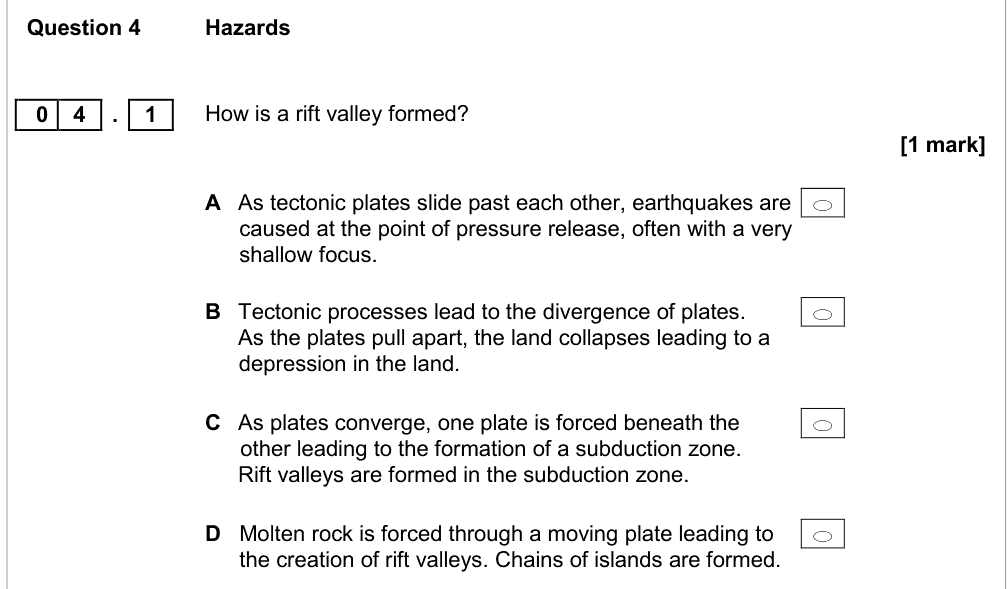
It was surprising to note that only 76% of responses showed knowledge of how a rift valley is formed. These are relatively straightforward marks for basic knowledge which some students are missing out on.
Notes from the mark scheme and report
Answer: B
76% correct
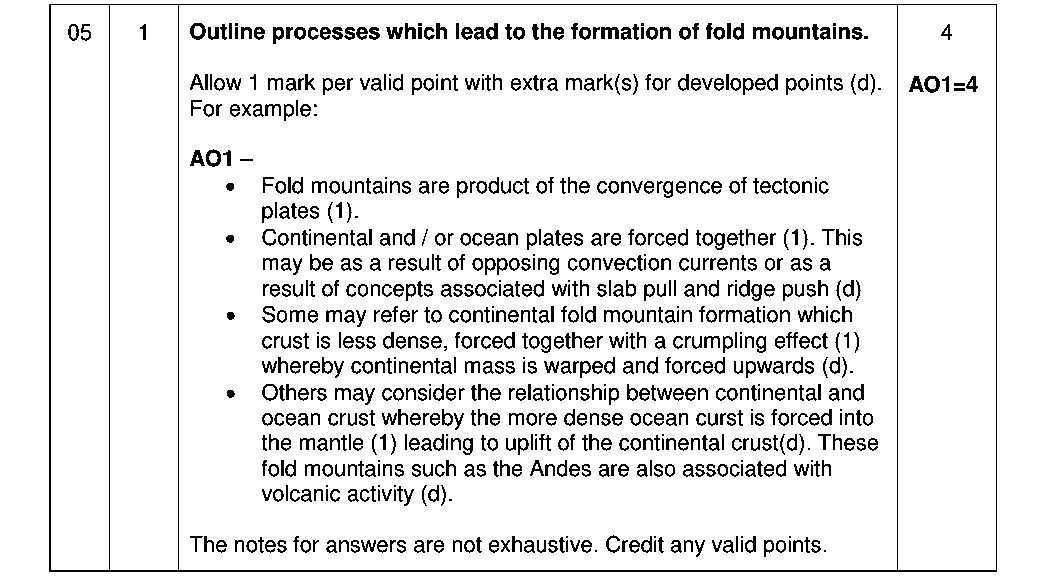
Specimen set 1 · Paper 1 · Q5.14 marksmark schemePoint-marked
Mark scheme
Notes from the mark scheme and report
point marked: convergence of plates, continental collision crumpling and uplift, ocean-continent subduction with uplift and volcanism (Andes), driven by convection or slab pull/ridge push
Work with an AQA Geography tutor
Essays stuck in the middle levels, or losing marks on the data questions? Book a trial lesson with a specialist AQA Geography tutor.