3.2.5.1-01 Concept of a resource. Resource classifications to include stock and flow resources. Stock resource evaluation: measured reserves, indicated reserves, inferred resources, possible resources. Natural resource development over time: exploration, exploitation, development. Concept of the resource frontier. Concept of resource peak.A level only
3.2.5.1-02 Sustainable resource development. Environmental Impact Assessment (EIA) in relation to resource development projects.A level only
3.2.5.2-01 Global patterns of production, consumption and trade/movements of energy and ore minerals. Global patterns of water availability and demand.A level only
3.2.5.2-02 The geopolitics of energy, ore mineral and water resource distributions, trade and management.A level only
3.2.5.6-01 Alternative energy, water and mineral ore futures and their relationship with a range of technological, economic, environmental and political developments.A level only
3.2.5.7-01 Case study of either water or energy or mineral ore resource issues in a global or specified regional setting to illustrate and analyse theme(s) set out above, their implications for the setting including the relationship between resource security and human welfare and attempts to manage the resource.A level only
3.2.5.7-02 Case study of a specified place to illustrate and analyse how aspects of its physical environment affects the availability and cost of water or energy or mineral ore and the way in which water or energy or mineral ore is used.A level only
‘Resources can be considered to be infinite because of increased economic development and associated technological advancements.’ With reference to mineral and/or energy resources, assess the extent to which you agree with this statement.
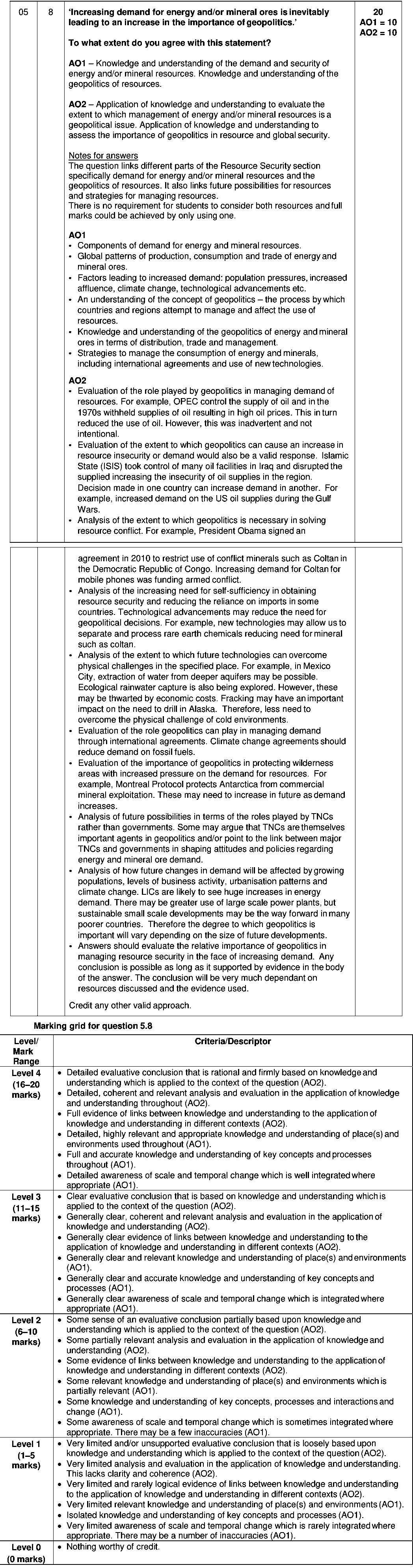
‘Increasing demand for energy and/or mineral ores is inevitably leading to an increase in the importance of geopolitics.’ To what extent do you agree with this statement?
‘Challenges presented by the physical environment affecting the availability and cost of a resource, will be overcome by future technological and economic developments.’ With reference to a specific place, to what extent do you agree with this statement?
Tap a question to zoom it. The figures open above it; the mark scheme (with its levels and indicative content) and the examiner's comment open underneath.
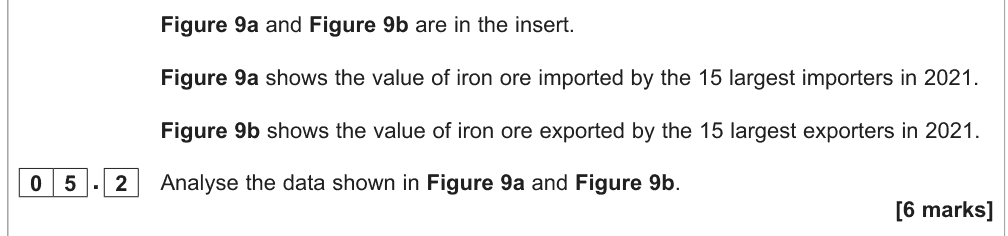
June 2025 · Paper 2 · Q5.26 marksmark schemeData analysis
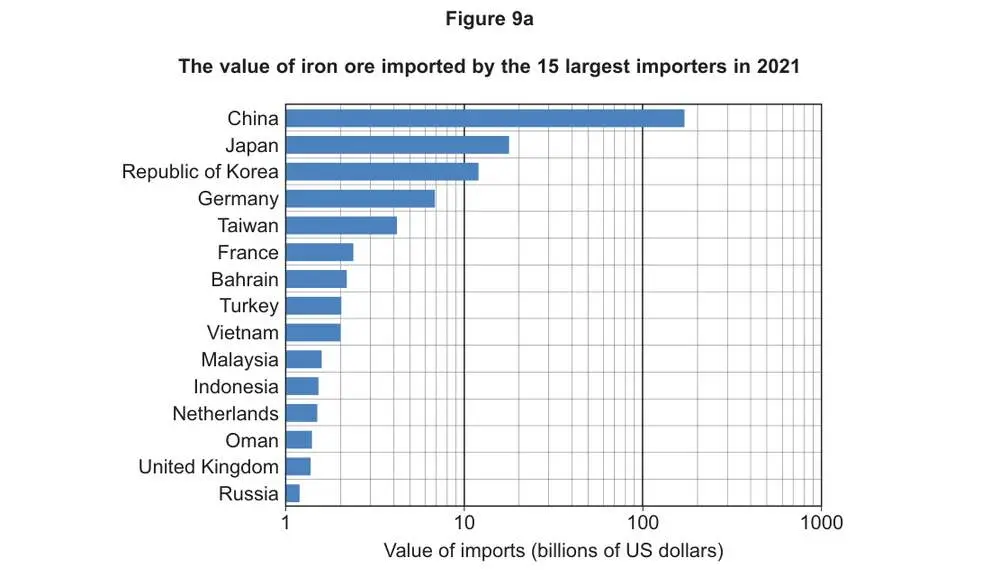
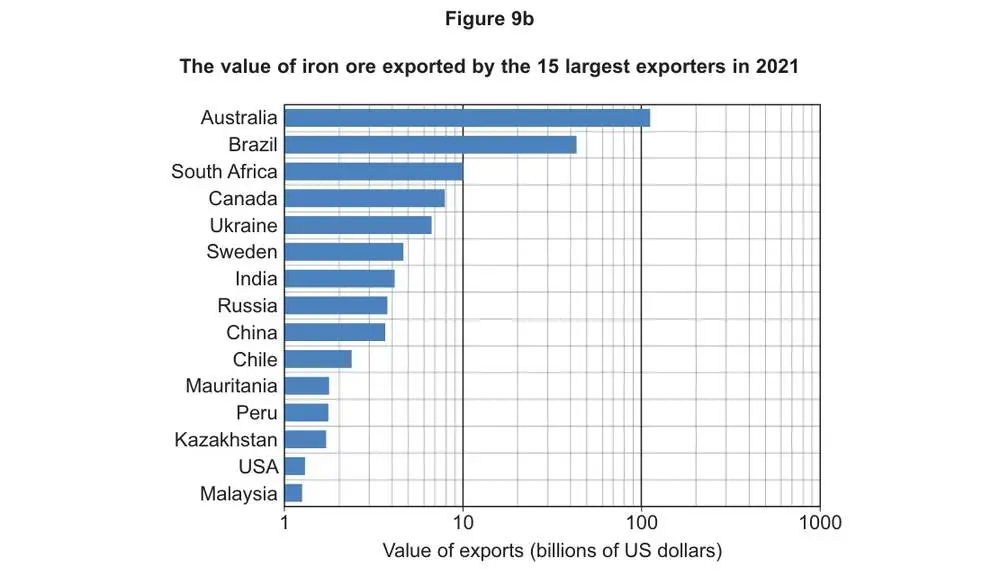
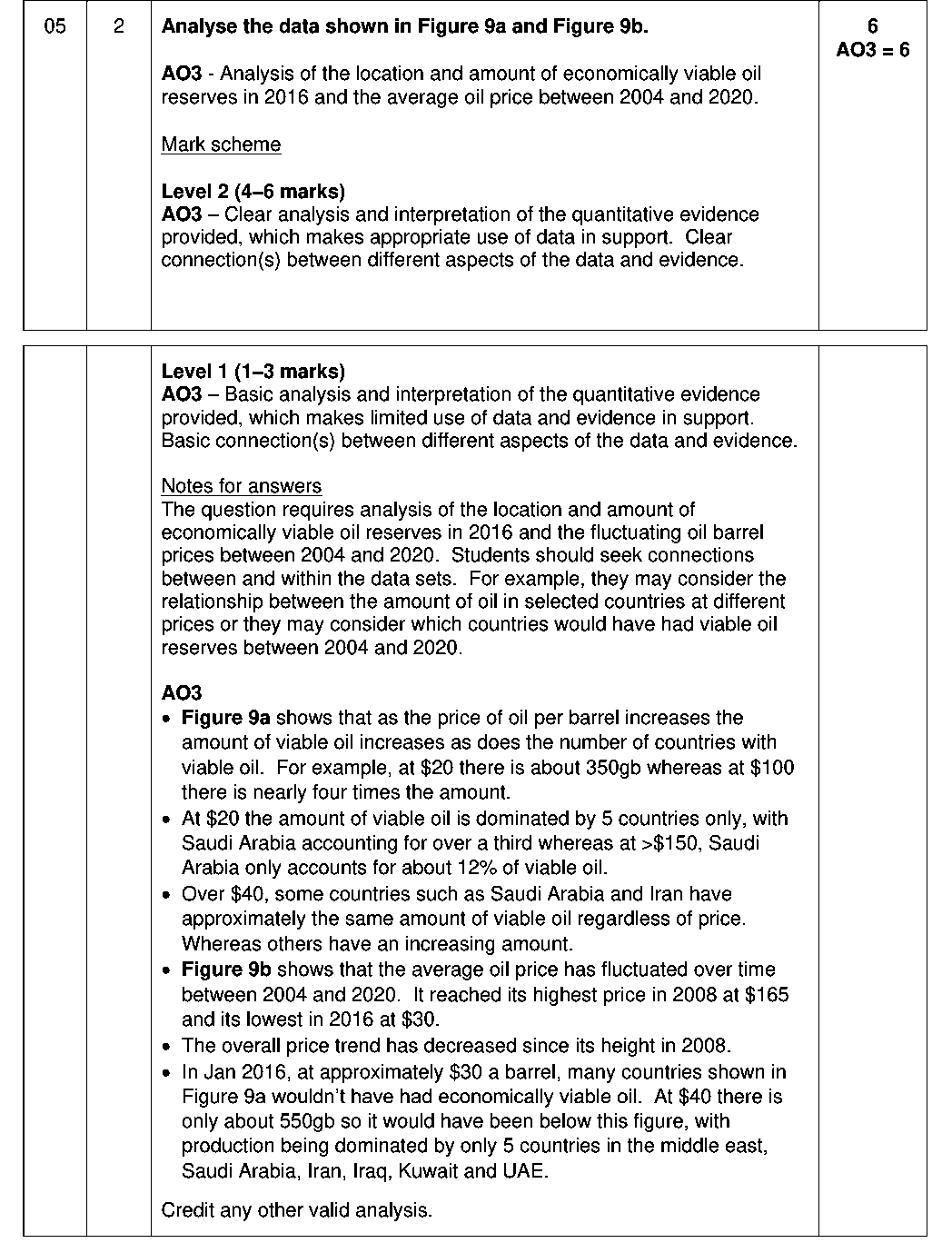
Figures 9a, 9b
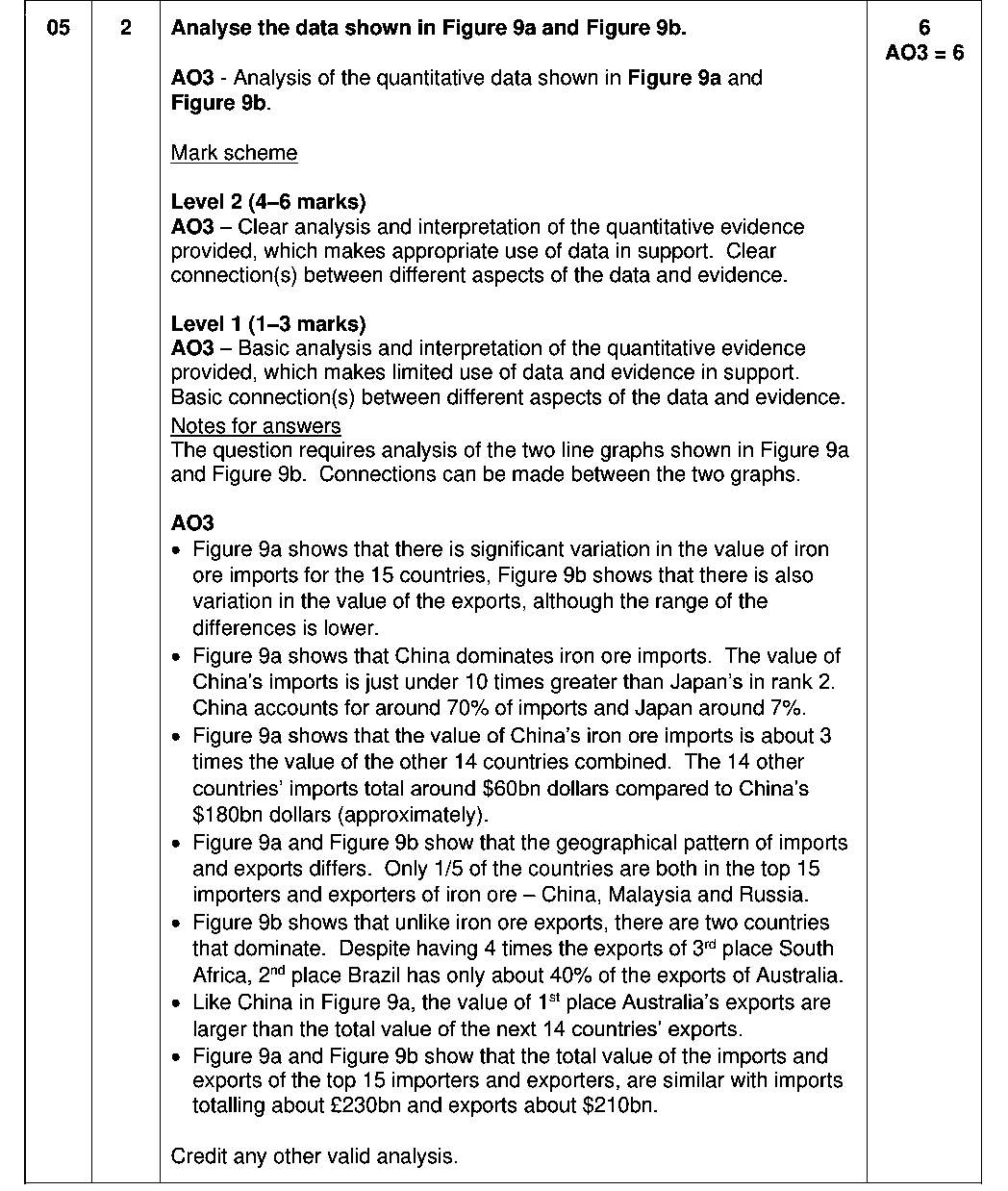
Mark scheme, including the levels and indicative content
Examiner's comment
AO3 questions provide students with the opportunity to apply geographical skills of analysis and interpretation to a variety of resources presenting geographical information. Many students accessed Level 2 by demonstrating analytical skills such as identifying overall patterns and trends, data manipulation, picking out anomalies, making connections between resources, and accurately interpreting scales and legends. In general, there were some errors made by students on the resources questions (AO3). The resources from the skills checklist used to present geographical information in this paper included bar graphs (simple, compound and comparative, using both linear and logarithmic scales), maps and comparative line graphs. To score well in the skills questions students should aim to apply relevant skills directly to the data provided. These skills may include identifying overall patterns (‘the big picture’), recognising trends within the data, accurately reading scales and interpreting values, exemplifying key points and reporting on anomalies and manipulating data further to add depth to their analysis. Less successful responses to these questions can have a somewhat disjointed feel to them, lacking a clear sense of the bigger picture. They may also contain errors due to reading the data incorrectly. In question 05.2, many students understood the logarithmic horizontal scale; however, some did not, and as a result, their analysis was incorrect and limited to Level 1.
Notes from the mark scheme and report
AO3: China about 70% of imports, roughly three times the other 14 combined
Australia and Brazil dominate exports
only China, Malaysia and Russia in both lists
misreading the log scale limited answers to Level 1
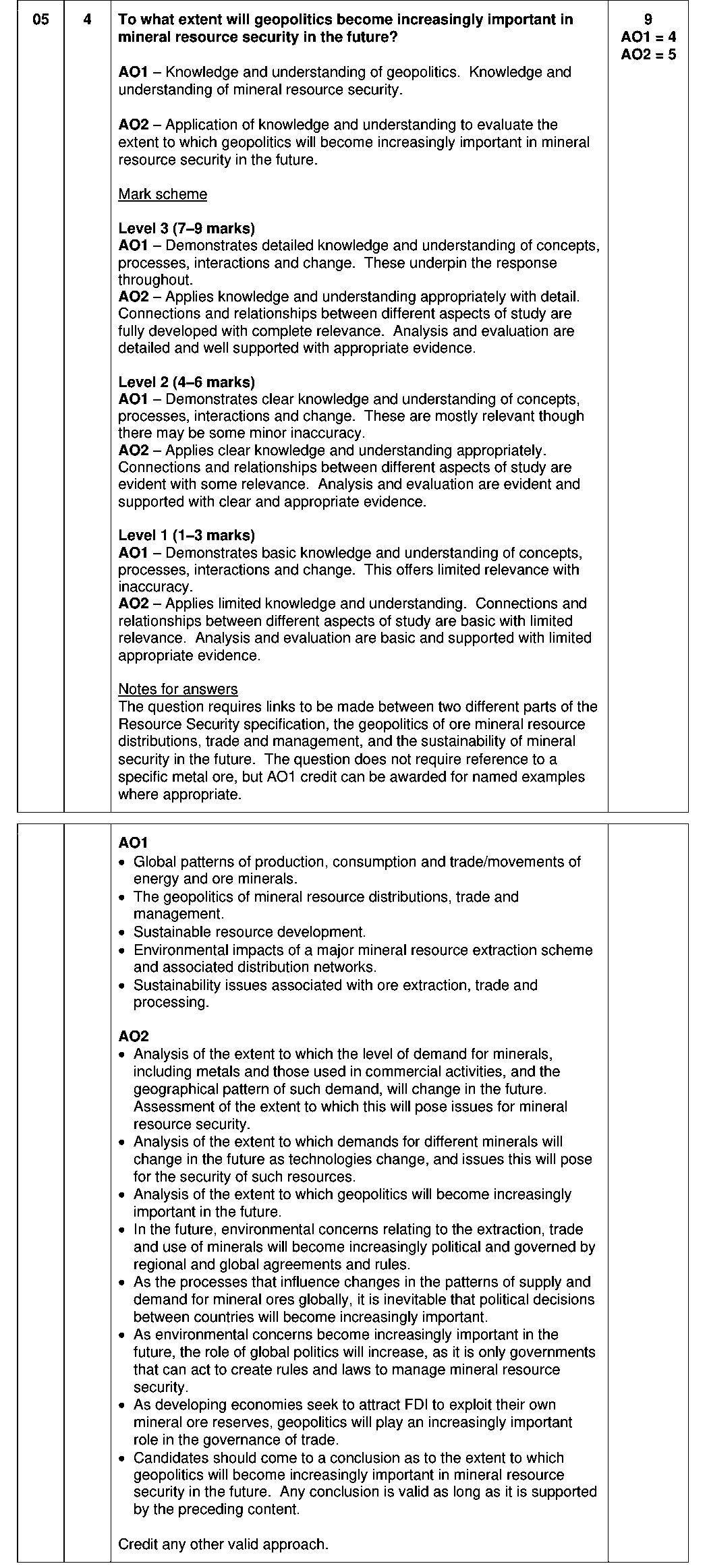
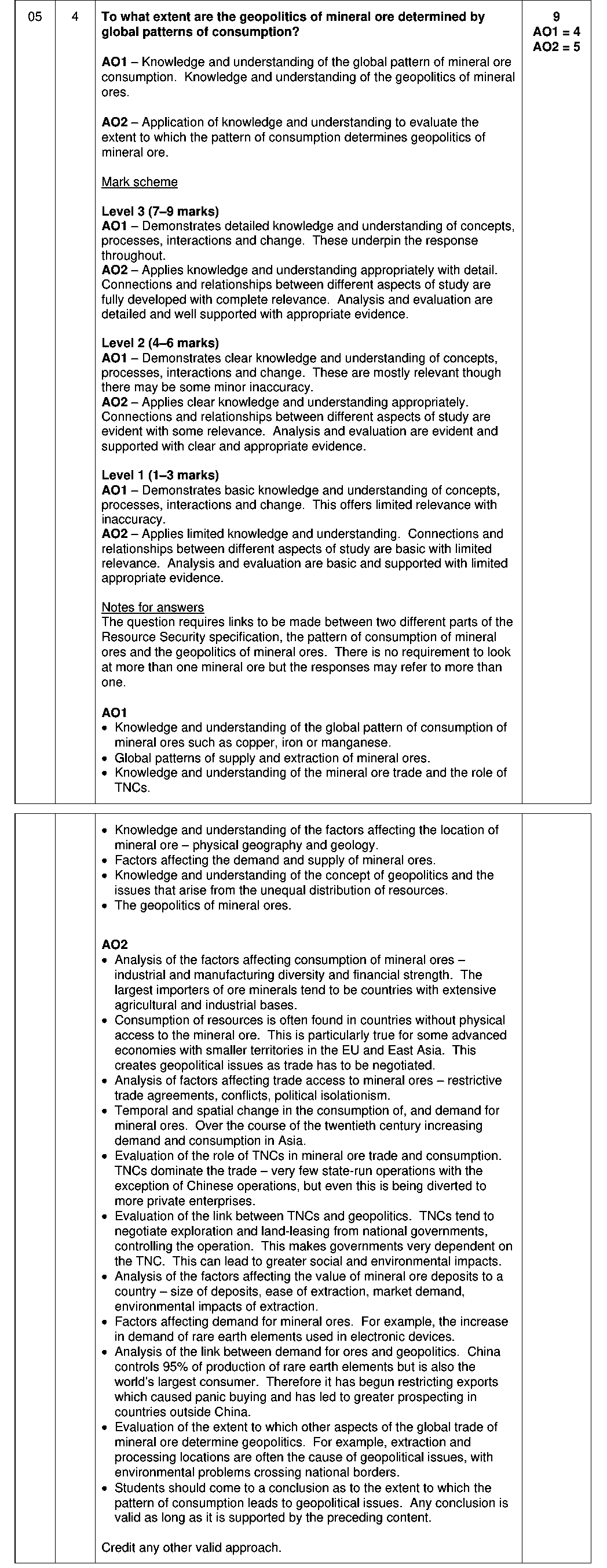
June 2025 · Paper 2 · Q5.49 marksmark scheme9-mark essay
Mark scheme, including the levels and indicative content
Examiner's comment
Most of the 6- and 9-mark questions evidenced some good subject knowledge and application. However, students could achieve higher marks within Level 2 or 3 by making their assessments and evaluations more explicit. The 9-mark questions, without the use of resources, test students’ subject knowledge and application in the optional themes. Responses should balance knowledge (AO1) with evaluation and assessment (AO2) to answer the question posed. Level 3 answers demonstrate detailed knowledge and understanding, make clear connections and views are well supported with evidence and examples. Responses that did not score well either lacked knowledge and understanding of the area of the specification being assessed, for example - sustainable cities, health factors at a local scale or mineral resource security - or a failed to really address the commands of the question (e.g. assess, to what extent). In Section C, each of the 9-mark questions showed mean scores of over 5.0, indicating mid-level 2 performance. Students showed knowledge and evaluation of sustainable cities, local-scale factors negatively impacting health, and the geopolitics of mineral resources.
Notes from the mark scheme and report
future mineral demand (e.g. battery metals), concentration of reserves, trade agreements, FDI and environmental rules
must judge whether geopolitics will become more important
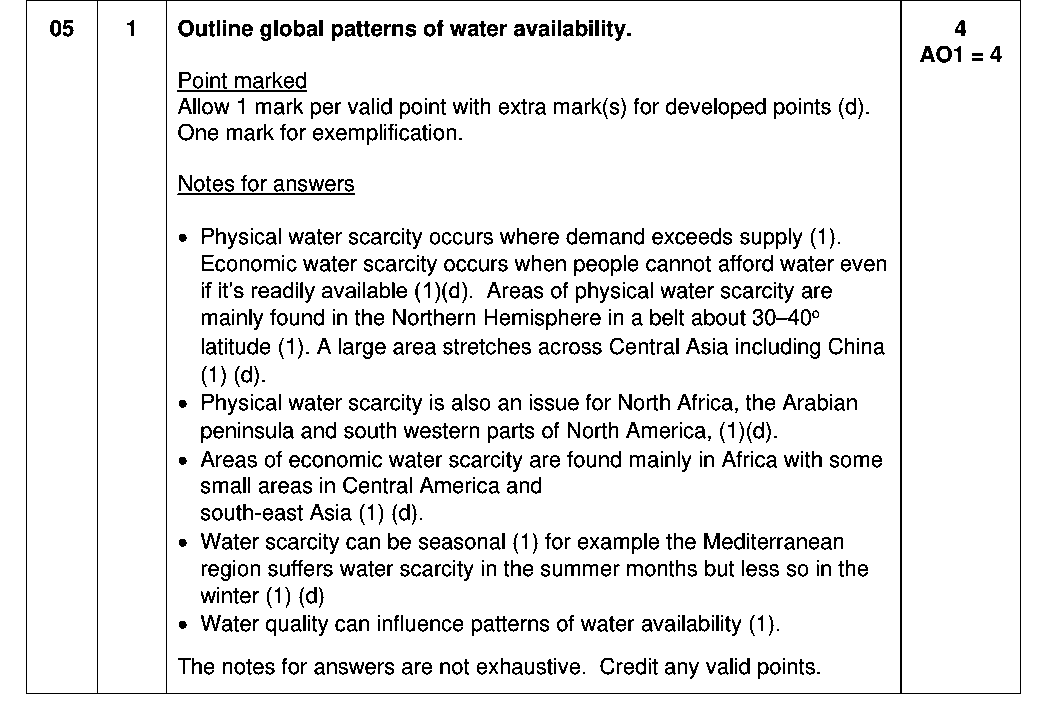
June 2024 · Paper 2 · Q5.14 marksmark schemePoint-marked
Mark scheme
Examiner's comment
In 5.1 the key was to outline the global pattern of water availability, whereas some responses took a more localised approach to their answers. 4-mark questions are point marked. A mark may be awarded where a student makes a single relevant point and subsequent marks awarded (if applicable) where the student develops those points with additional knowledge. To score well in these questions, students should aim to write a clear and focused responses that is are focused directly on the concept being assessed. Knowledge of the key area in the specification is vital and students should aim to construct a direct answer and provide a suitable example. The weaker responses to the 4 mark questions tend to show a poor understanding of the key concept or a vague / unclear awareness of the topic. These responses often confuse ideas and fail to state ideas clearly. A second example is shown below from Question 5.1. This was also awarded 4 marks and takes a straightforward global approach to outlining patterns of water availability. It is concise and gets the 4 AO1 marks in a clear and focused way.
Notes from the mark scheme and report
point marked: physical scarcity belt 30–40°N, North Africa, Middle East, SW North America
economic scarcity in Africa
seasonal variation
one mark for an example
must be global – local answers lost marks
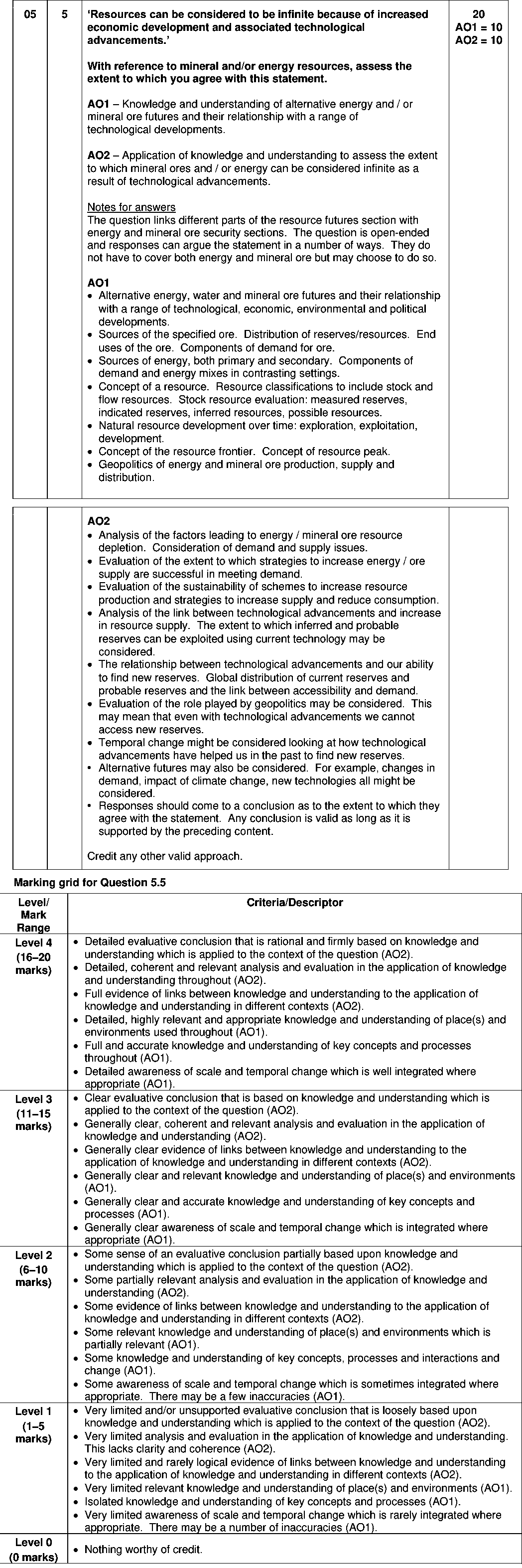
June 2024 · Paper 2 · Q5.520 marksmark scheme20-mark essay
Mark scheme, including the levels and indicative content
Examiner's comment
The 20-mark essay questions continue to illustrate the strong subject knowledge, evaluative skills and preparation of many students. These questions differentiate well, and the increasing confidence shown in these was demonstrated with over 60% of entries attaining at least Level 3. The key is always to demonstrably address the question and to ensure that the application of knowledge and understanding (AO2) is evident with AO1 knowledge used in support. The best responses are clearly organised, follow a logical structure and take a clear and sustained line of reasoning before reaching a conclusion based on the evidence provided. At the other end of the scale, less successful responses can be attributed to a number of reasons – maybe the student misreads the question, sometimes they start out with good intent but then drift away from the question focus – a brief plan is often a precursor to a good response. Some students just do not know the relevant subject content – either they did not learn it or failed to effectively revise it. Sometimes responses can include examples that are over-simplified, out-dated or clichéd and there is limited evidence of deep knowledge and understanding. A further example of a Level 4 response is taken from the Resource security option, 5.5 below. It shows detailed knowledge and understanding of the topic, utilises examples well and brings in some concepts showing wider geographical understanding. It also ends with a clear evaluative conclusion. This was awarded 18 marks in Level 4.
Notes from the mark scheme and report
weigh whether technology and economic development make minerals/energy effectively infinite (resource frontier, reserves reclassified, recycling, renewables) against finite stocks and peak
Level 4 example 18 marks
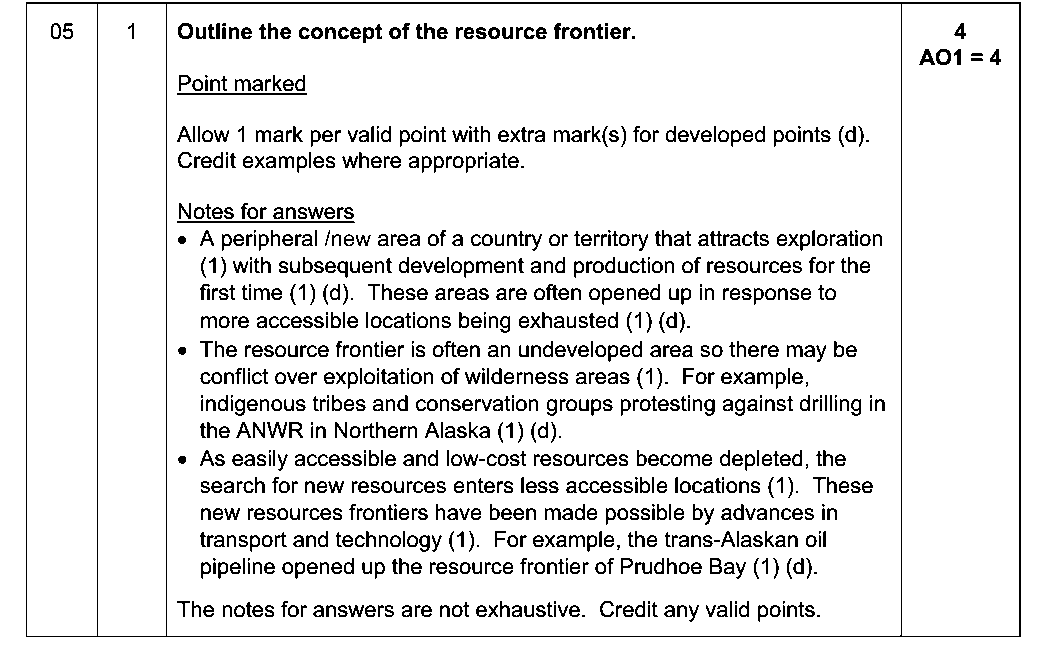
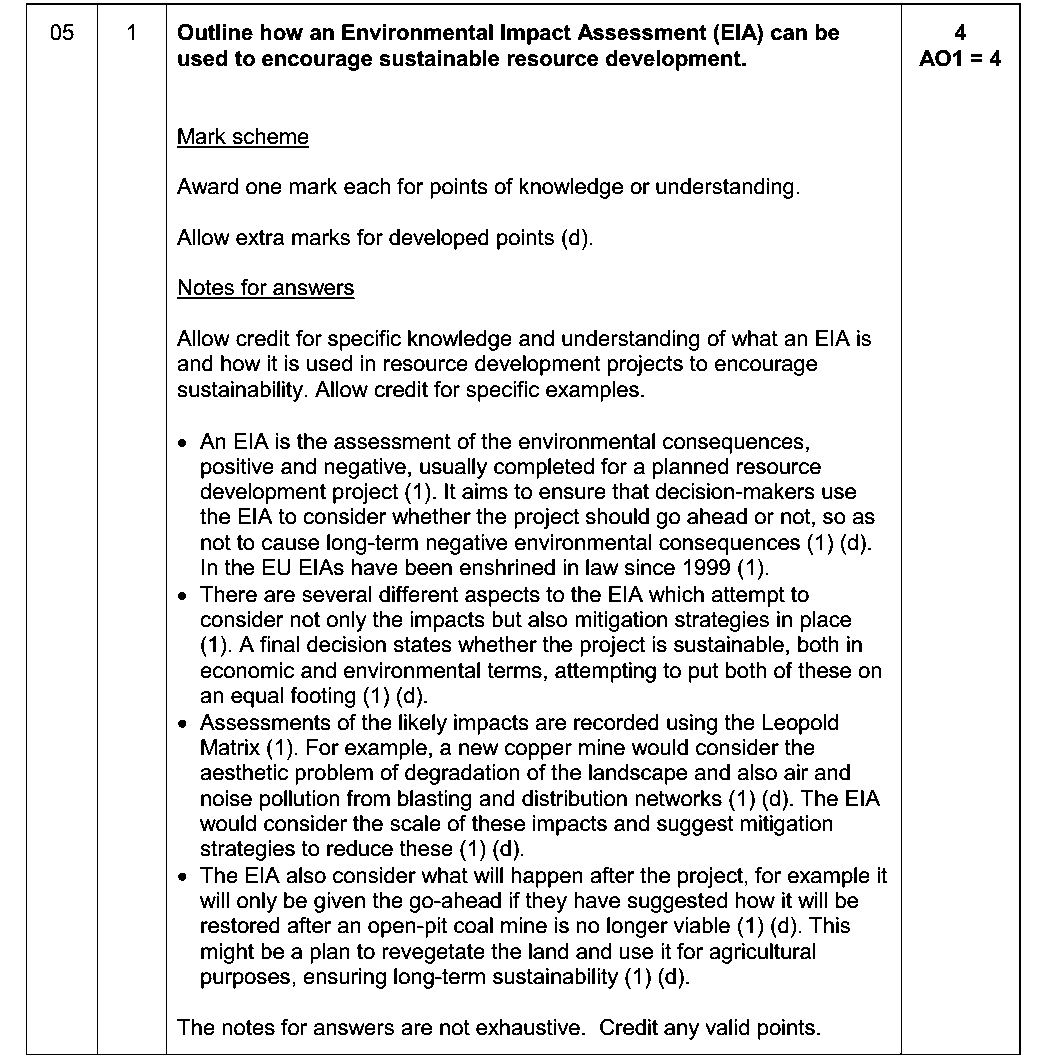
June 2023 · Paper 2 · Q5.14 marksmark schemePoint-marked
Mark scheme
Examiner's comment
The 4 mark (AO1) questions were answered well by some students but weaker students scored fewer marks as their responses often lacked clarity, purpose and direction - tending to skirt the focus concepts. In order to score well in these questions students should produce clear and straightforward responses that are focused on the concept being assessed. Subject knowledge is therefore paramount and then constructing a concise, focused response – often along the lines of ‘what is it”? Why is it important? Where does it happen? How might it be suitably illustrated? The key issue with the 4 mark AO1 questions is student subject knowledge. If students do not know the key concept then it is very difficult to gain credit. Secondly, answers that are unclear and unconvincing do not score well. A thorough review of all the key terms in the specification is good revision and exam preparation for this type of question. In Resource security option, Q5.1 like other 4 mark AO1 questions distinguished between students who had a firm grasp of the concept of the resource frontier and those who did not with marks reflecting this. Q5.1 was similar in that if there was knowledge of the concept of the resource frontier, then developing that with statements of what it is, where it might be found, a relevant example of a resource and location along with a comment on accessibility, controversy or other such issues, would also build to full marks.
Notes from the mark scheme and report
point marked: new or peripheral area opened for exploration and production as accessible reserves run out, enabled by technology and transport, often contested (ANWR, Prudhoe Bay)
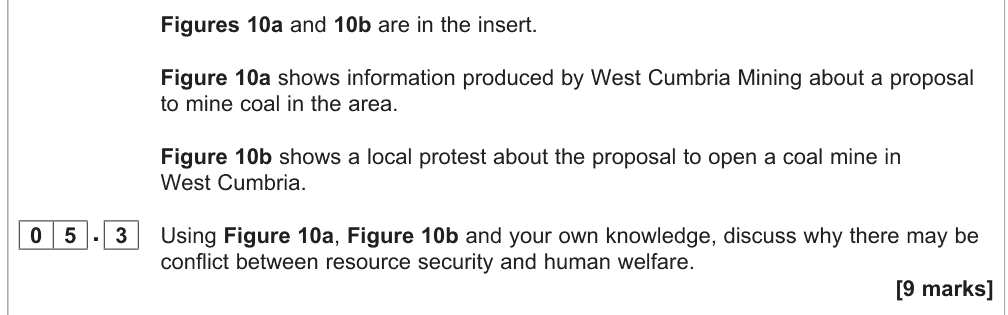
June 2023 · Paper 2 · Q5.39 marksmark schemeStimulus
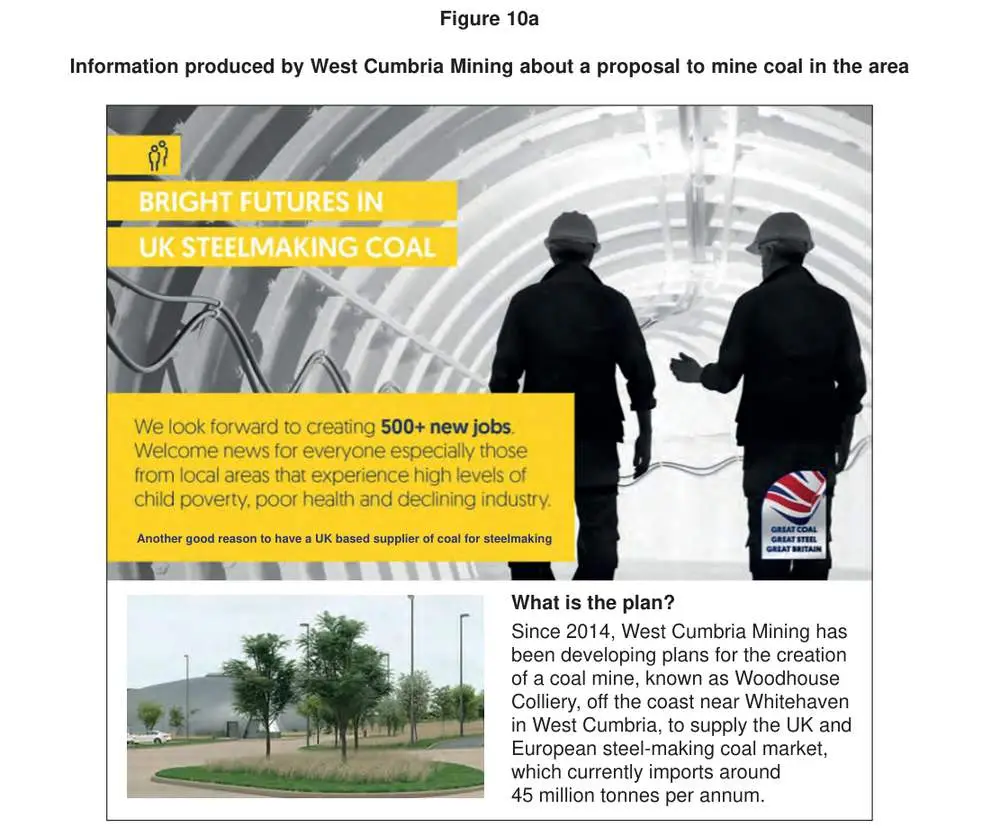
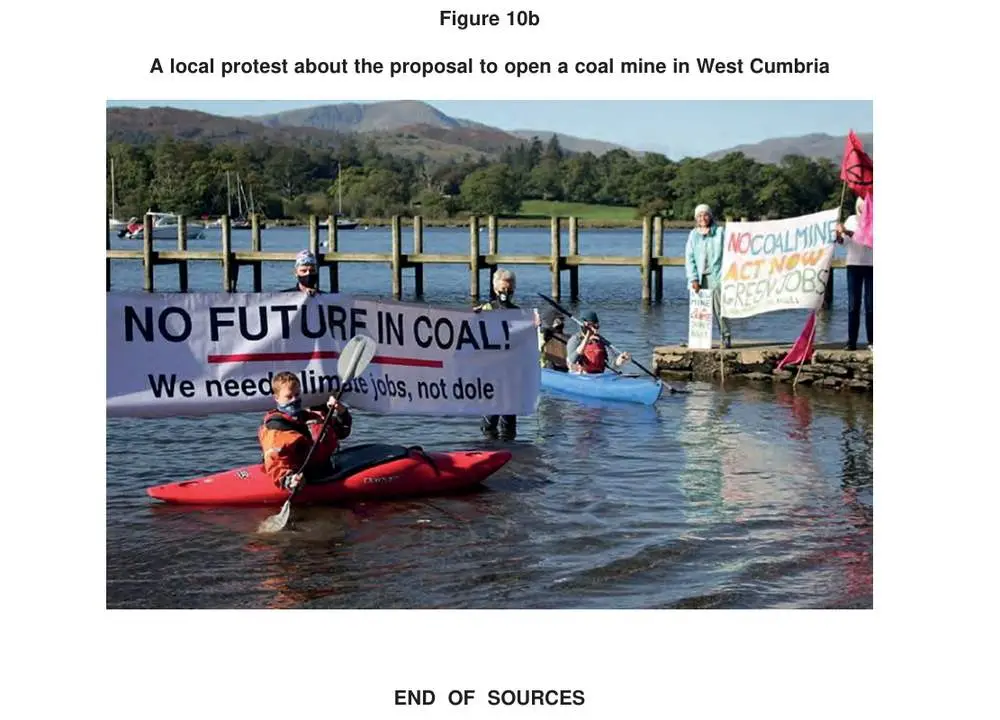
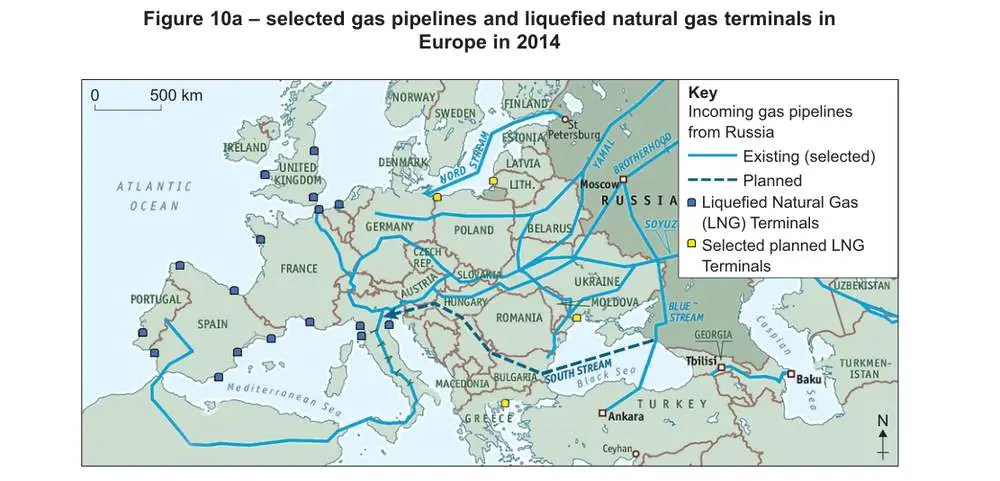
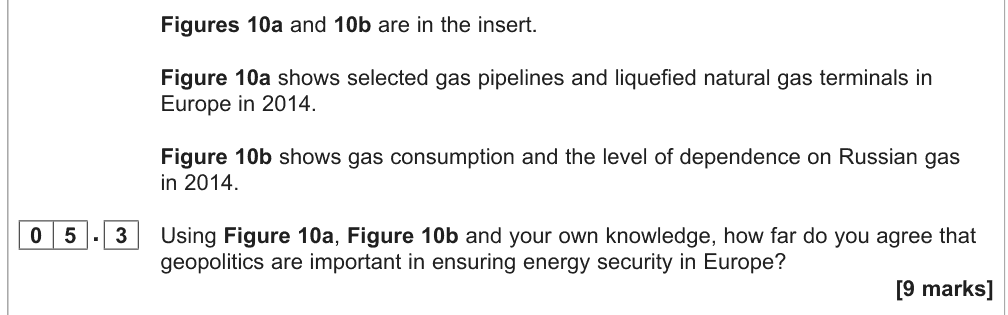
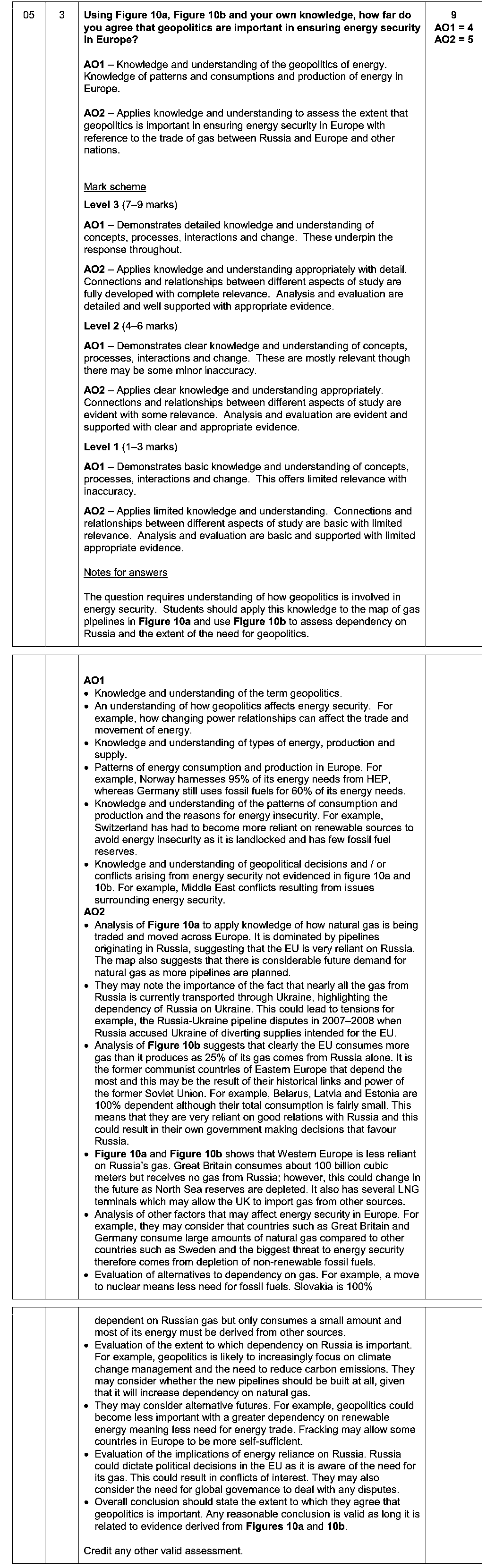
Figures 10a, 10b
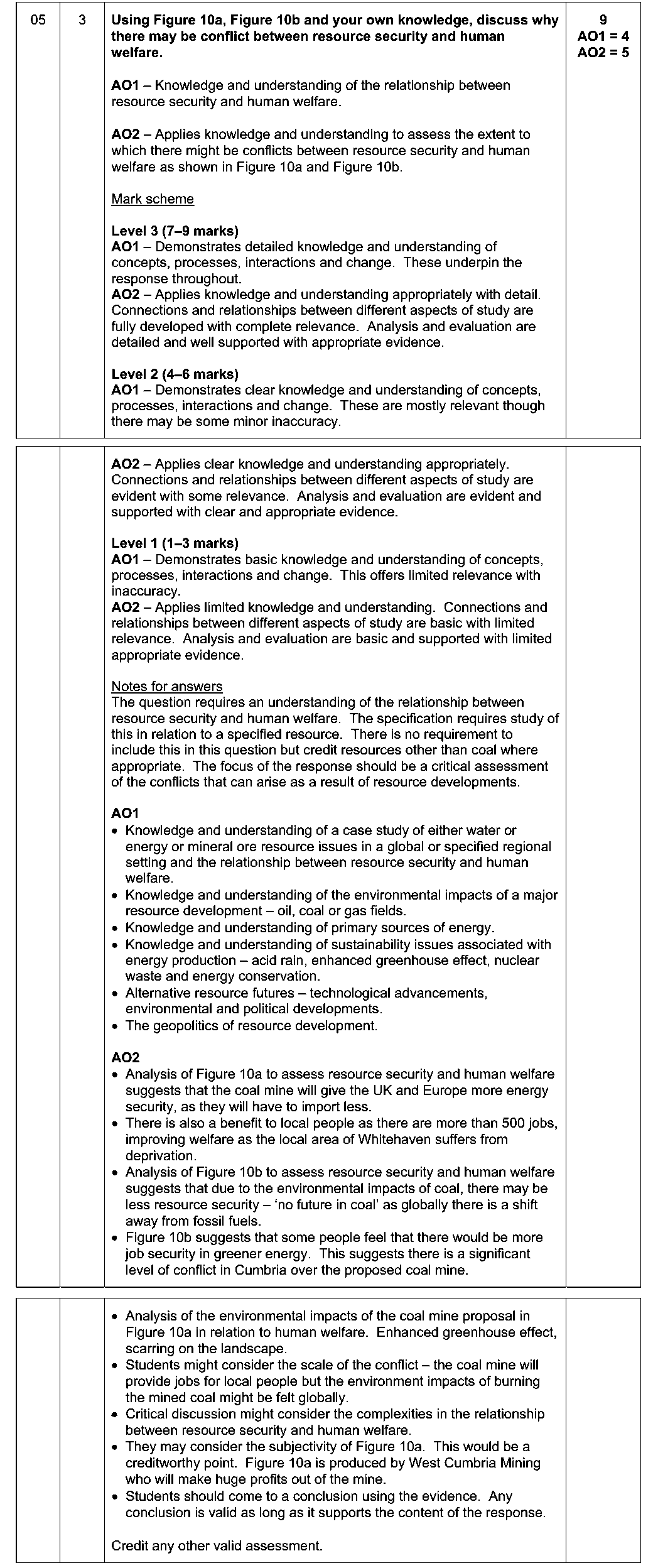
Mark scheme, including the levels and indicative content
Examiner's comment
Those questions, X.3, which used stimulus resources (photographs, text, infographics) presenting novel situations generated suitable responses balancing use of the novel situation with students’ own knowledge and opinions. The 6 mark questions, X.3, assessing AO1 and AO2 using novel situations gave students the opportunity to assess and evaluate themes using the stimulus material. The resources used (photographs and text) enabled this quite well but some students did drift into an analysis of the resources, addressing AO3 which was not creditable. These questions gave students the platform to put forward informed opinions based upon subject matter they had studied and linking it to the unseen material. This type of question demands students focus on the key command within the question and evaluate, assess or discuss the relevant concept whilst making connections to the resource used. Consequently, students need to be ready to combine their knowledge and understanding with the stimulus material. Less successful responses tended to miss the command word (assess, discuss, evaluate…) and simply write about the topic (producing AO1 heavy answers) or failed to incorporate a link to the stimulus material. The 9 mark questions in the option sections (.3 and .4) also gave students opportunity to evaluate, discuss and assess themes. Successful responses demonstrated familiarity with relevant concepts (such as urban recycling schemes, end uses of resources). Q5.3 was answered well. The novel resources prompted many effective discussions of the conflicts between resource security and human welfare, with the latter usually focused on the threat posed by further fossil fuel use and climate change.
Notes from the mark scheme and report
West Cumbria coal mine: jobs, local deprivation and UK steelmaking-coal security versus climate change, environment and protest
resources other than coal credited
June 2022 · Paper 2 · Q5.14 marksmark schemePoint-marked
Mark scheme
Examiner's comment
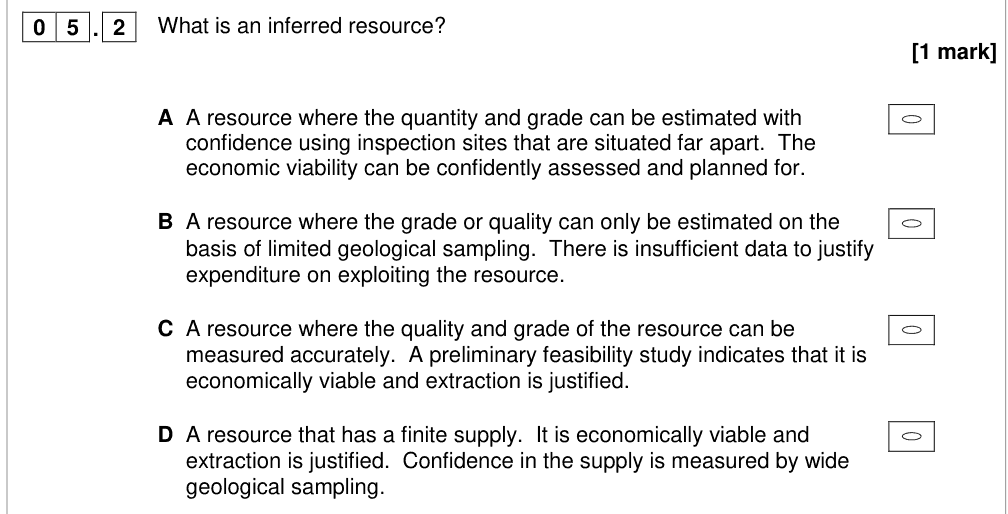
Very few students answered questions in this unit. Many students demonstrated poor knowledge of the two terms in the question. Most were able to gain two marks by giving simplistic definitions, and those scoring more highly went on to develop the differences for example, considering economic viability.
Notes from the mark scheme and report
point marked
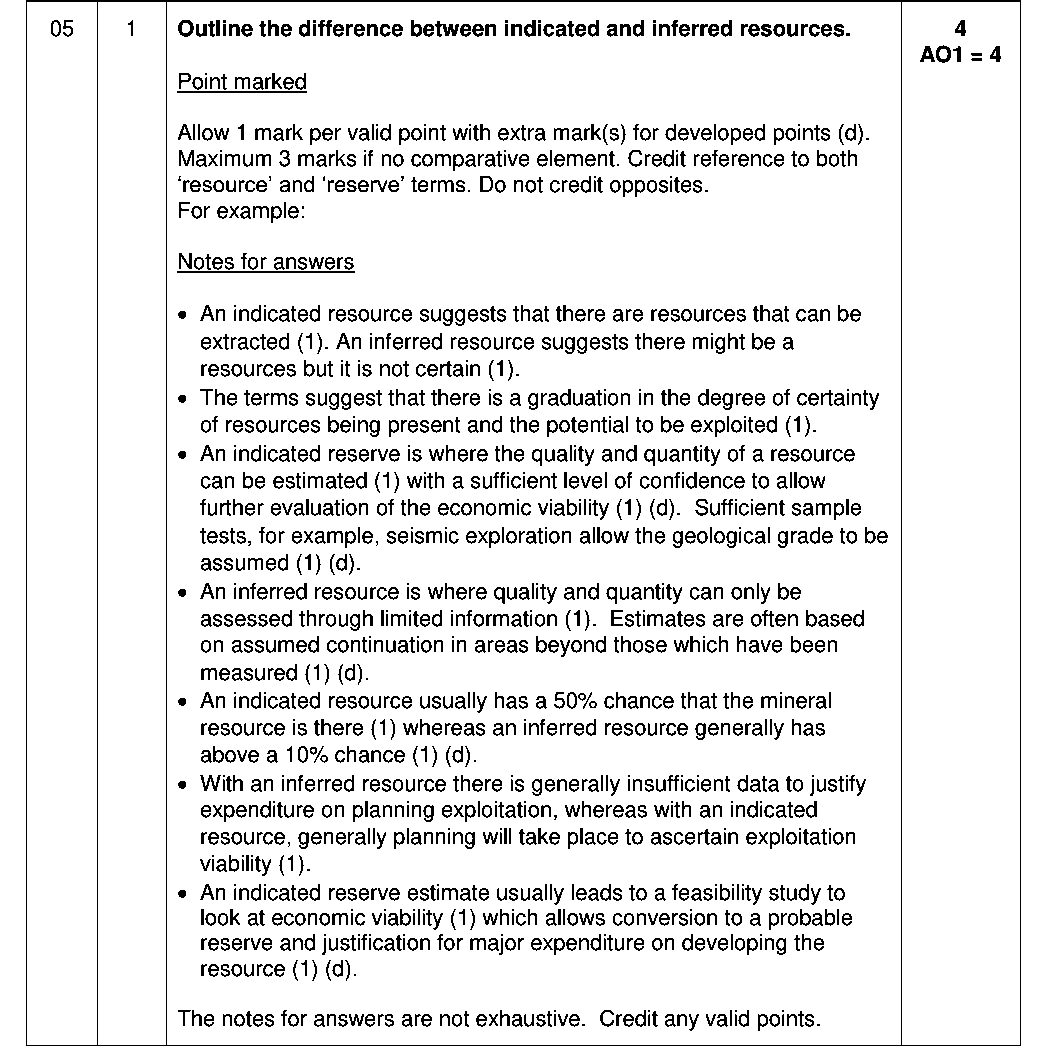
max 3 without a comparison: indicated resources estimated with enough confidence to assess economic viability, inferred resources based on limited data and assumed continuity
opposites not credited
November 2021 · Paper 2 · Q5.26 marksmark schemeData analysis
Figures 9a, 9b
A figure for this question was removed from AQA's published paper for copyright reasons.
Mark scheme, including the levels and indicative content
Notes from the mark scheme and report
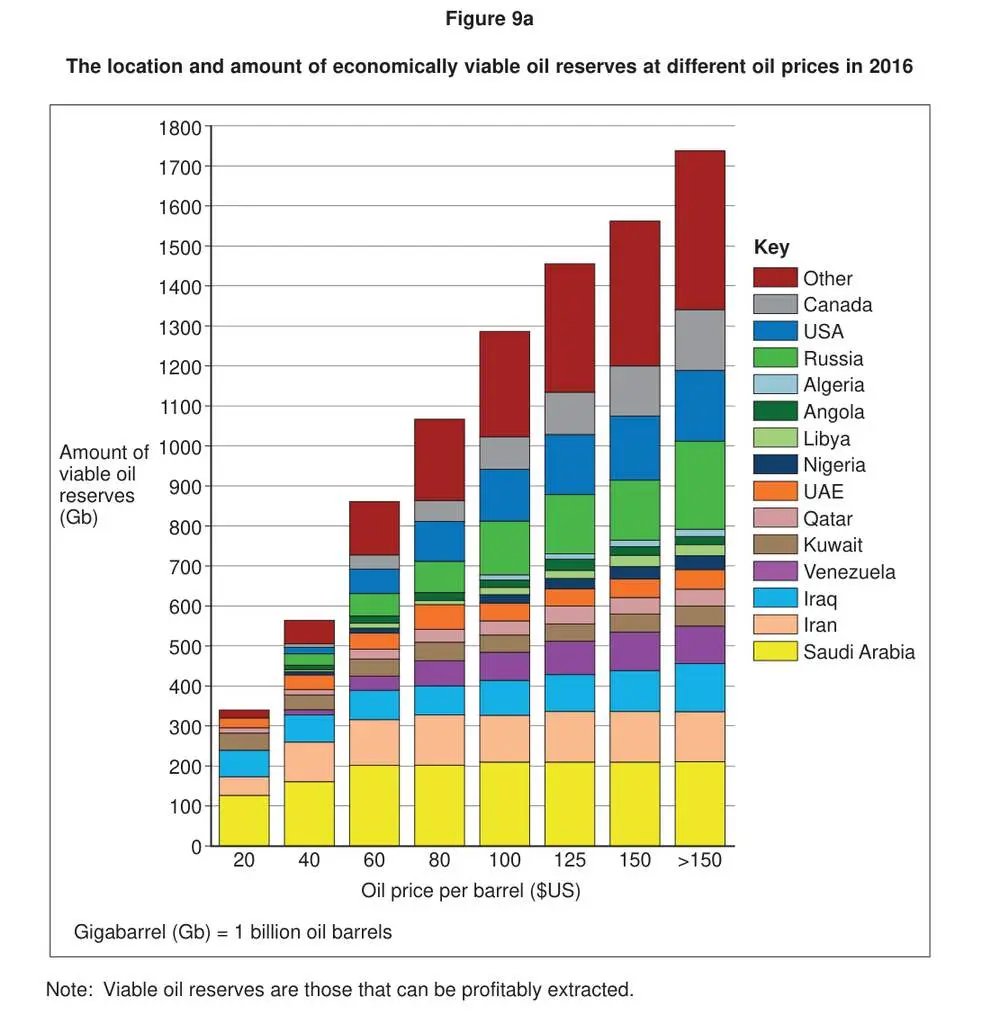
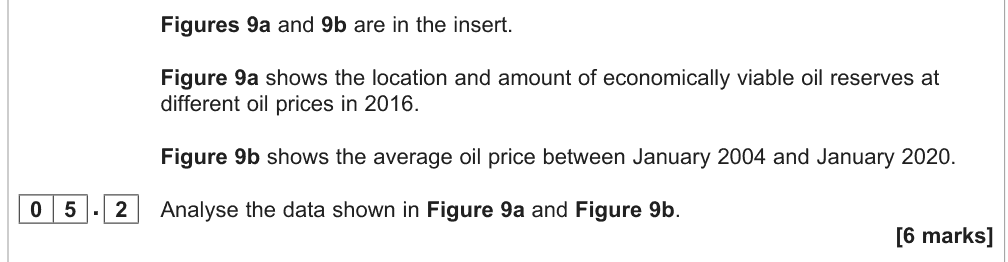
AO3: viable reserves rise with price (about 350 Gb at $20 to nearly four times that at $100) and more countries become viable
Saudi Arabia dominates at low prices (over a third) but only about 12% above $150
link to the 2004–20 price fluctuations
Figure 9b not reproduced in the published insert
November 2021 · Paper 2 · Q5.49 marksmark scheme9-mark essay
Mark scheme, including the levels and indicative content
Notes from the mark scheme and report
links consumption patterns of ores (e.g. Chinese demand for copper/iron) to geopolitics, weighed against the location of reserves, TNCs and resource nationalism
November 2020 · Paper 2 · Q5.14 marksmark schemePoint-marked
November 2020 · Paper 2 · Q5.39 marksmark schemeStimulus
Figures 10a, 10b
A figure for this question was removed from AQA's published paper for copyright reasons.
Mark scheme, including the levels and indicative content
Notes from the mark scheme and report
apply geopolitics to pipelines from Russia, transit via Ukraine, Eastern Europe dependence, UK LNG terminals
Figure 10b not reproduced in the published paper
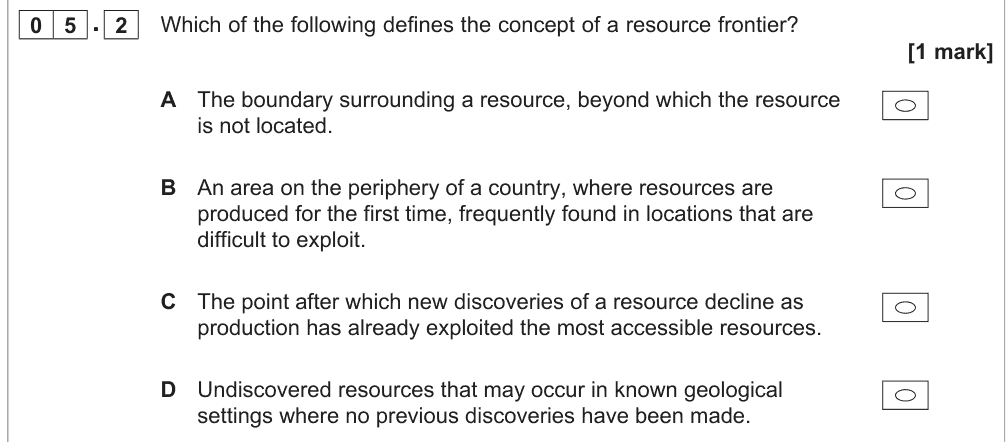
June 2019 · Paper 2 · Q5.21 markmark schemeMultiple choice
Answer
B
Mark scheme
Examiner's comment
Just over half of the students identified B as the correct answer. The importance of students learning key terms was clear in relation to knowledge focused AO1 questions such as these.
Notes from the mark scheme and report
Answer: B
June 2019 · Paper 2 · Q5.56 marksmark schemeData analysis
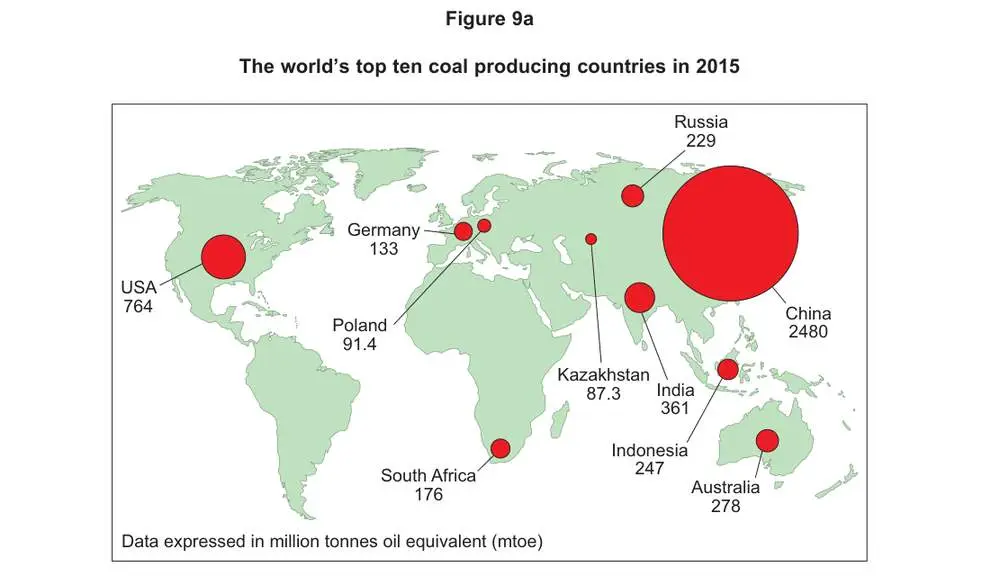
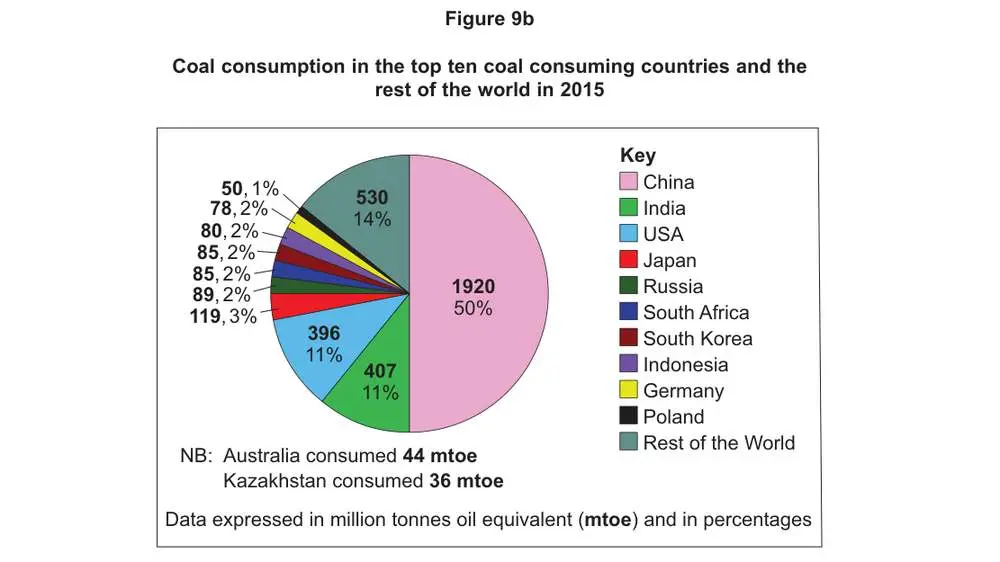
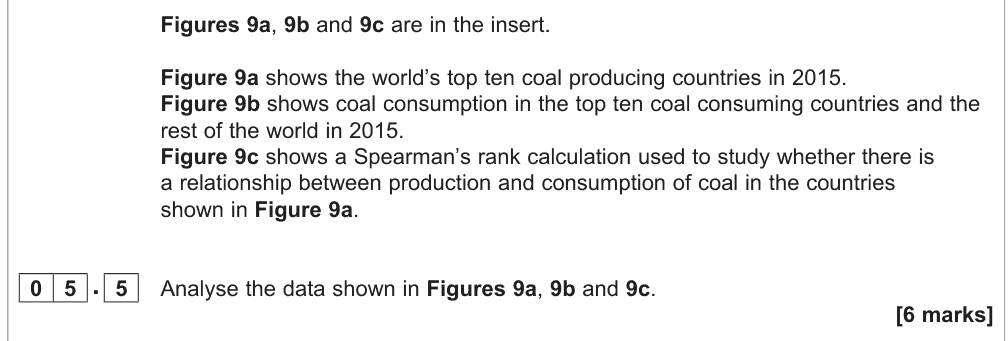
Figures 9a, 9b, 9c
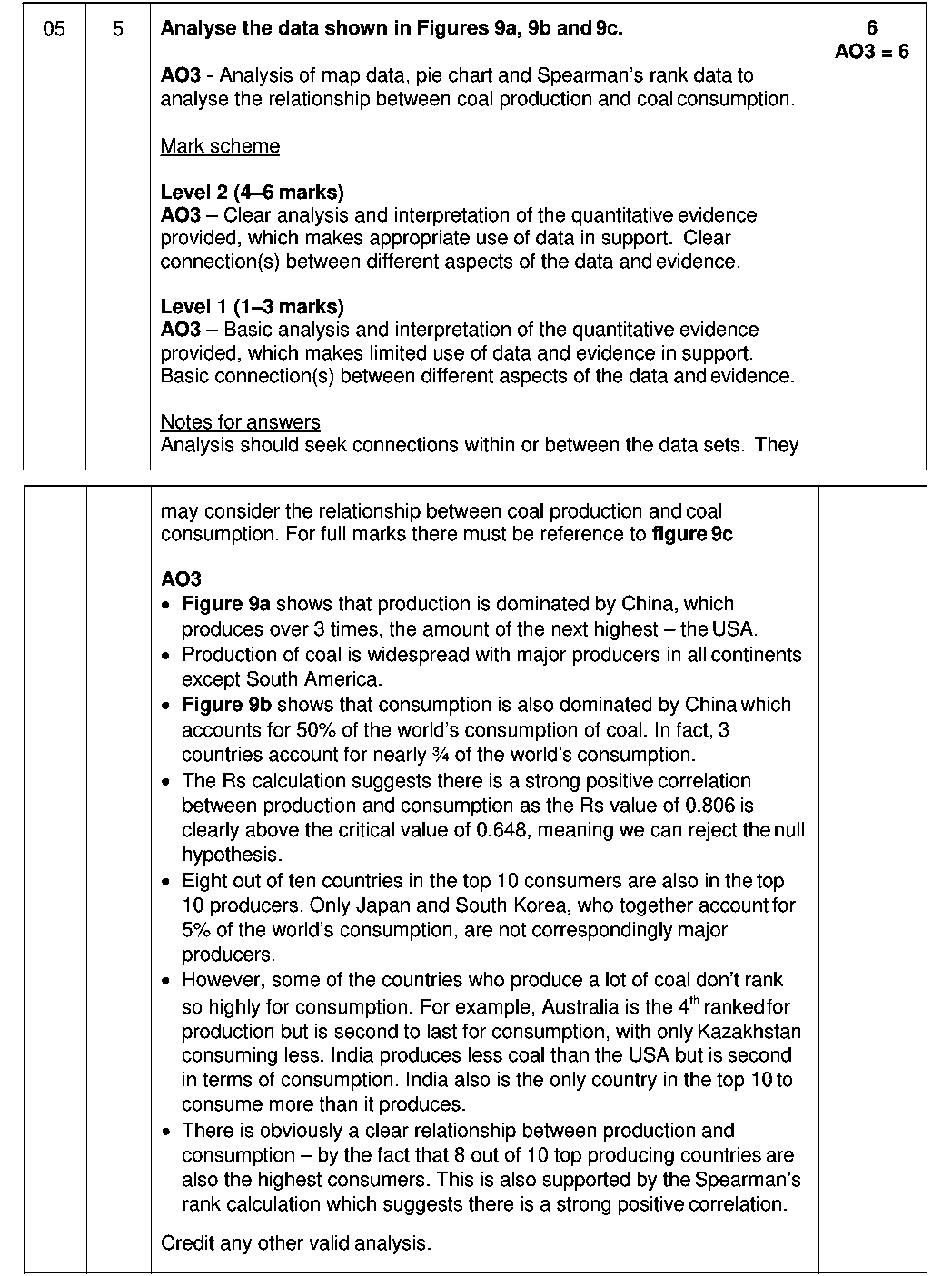
Mark scheme, including the levels and indicative content
Examiner's comment
AO3 skills were tested in this examination paper on the first 6 mark question in each unit, for example 1.2, 2.2, 3.5, 4.5 and 5.5. In this series the command ‘analyse’ was used on these questions. The command ‘analyse’ in this context simply required students to interface with the data and deconstruct the information. They needed to look for patterns and trends and analyse the connections both within the figure and between Figures where applicable. Students need to be encouraged to manipulate data rather than simply describing it, as this does not constitute analysis. As with 3.5 and 4.5, more effective responses on this question looked for the connections between Figures 9a and 9b and then stated whether the Spearman Rank Co-efficient calculation in 9c supported them. These more effective responses examined the relationship between coal producing countries in 9a and coal consumption in 9b. For example, many noted that China produces more than three times its nearest rival, the USA. It is also the world’s largest consumer, consuming nearly five times than the second biggest consumer, India. Responses also noted that eight of the top 10 countries in 9a are in the top 10 consuming countries in 9b. 9c suggests that there is a positive correlation and that the null hypothesis can be rejected. Some students misinterpreted the Rs calculation and then sought to explain this by looking at anomalies in 9a and 9b. Whilst they scored credit for seeking connections, such responses often lacked precision and featured only basic analysis. Some students failed to use the Rs calculation at all. Whilst they could not score maximum marks, with clear analysis of Figures 9a and 9b they were still able to achieve level 2.
Notes from the mark scheme and report
AO3: link coal production (proportional symbols) and consumption (pie chart)
Rs 0.806 above critical value 0.648 so reject the null hypothesis
must use Figure 9c for full marks
anomalies Australia (high production, low use) and India (consumes more than it produces)
June 2019 · Paper 2 · Q5.820 marksmark scheme20-mark essay
Mark scheme, including the levels and indicative content
Examiner's comment
This question differentiated well. Where it was well answered, students used their knowledge of geopolitics to good effect and were able to link it to knowledge of increased energy and/or mineral ore demands and evaluate the extent to which geopolitics will be needed to ensure a sustainable supply. Some very effective responses extended into considering how recycling of metals and/or increasing development of renewable sources may increase a country’s self-reliance and reduce its exposure to geopolitical aspects. The most effective responses were also topical, demonstrating independent reading beyond taught content. Less effective responses tended to only answer parts of the question, for example, only describing the reasons for increasing demand or existing geopolitical involvement. A few students had a very poor understanding of the concept of geopolitics, with some thinking it is synonymous with trade. They also offered little in the way of evidence in support. Students should be encouraged to use specific examples even when not asked for them. It is important that students plan these 20 mark questions and ensure they identify all parts of the question.
Notes from the mark scheme and report
energy or minerals alone can reach full marks
link rising demand to geopolitics and judge how far it is inevitable (recycling, renewables and self-sufficiency may reduce it)
some confused geopolitics with trade
June 2018 · Paper 2 · Q5.21 markmark schemeMultiple choice
Answer
B
Mark scheme
Examiner's comment
Most students identified that B as the correct answer. Students must learn key terms if they are to perform successfully in AO1 questions.
Notes from the mark scheme and report
Answer: B
learn resource-classification terms
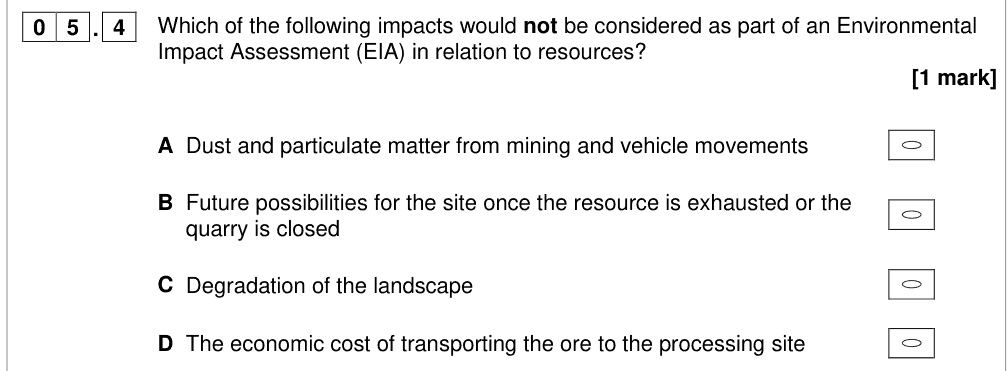
June 2018 · Paper 2 · Q5.41 markmark schemeMultiple choice
Answer
D
Mark scheme
Examiner's comment
Nearly all students correctly identified D.
Notes from the mark scheme and report
Answer: D
nearly all correct
June 2018 · Paper 2 · Q5.820 marksmark scheme20-mark essay
Mark scheme, including the levels and indicative content
Examiner's comment
This question differentiated very well. Where it was well answered, students used their case study of a specific place to good effect and were able to link it to knowledge of future technologies and evaluate the extent to which these might overcome the physical challenges. Popular choices were water resources in Iran, oil in Alaska and tar sands in Canada. Weaker responses tended to only answer parts of the question, for example, only describing the physical challenges in the specific place. They often failed to refer to technological advances. Some students self-penalised by choosing more than one place or more than one resource. This meant that they couldn’t cover one place in sufficient depth in the time available. Where this happened the best place and / or resource was credited. It is important that students plan their answers to these 20 mark questions and ensure they identify all parts of the question.
Notes from the mark scheme and report
one specific place and resource (e.g. Alaska oil, Iran water, Canadian tar sands)
link physical challenges to future technology and economics
more than one place self-penalised (best credited)
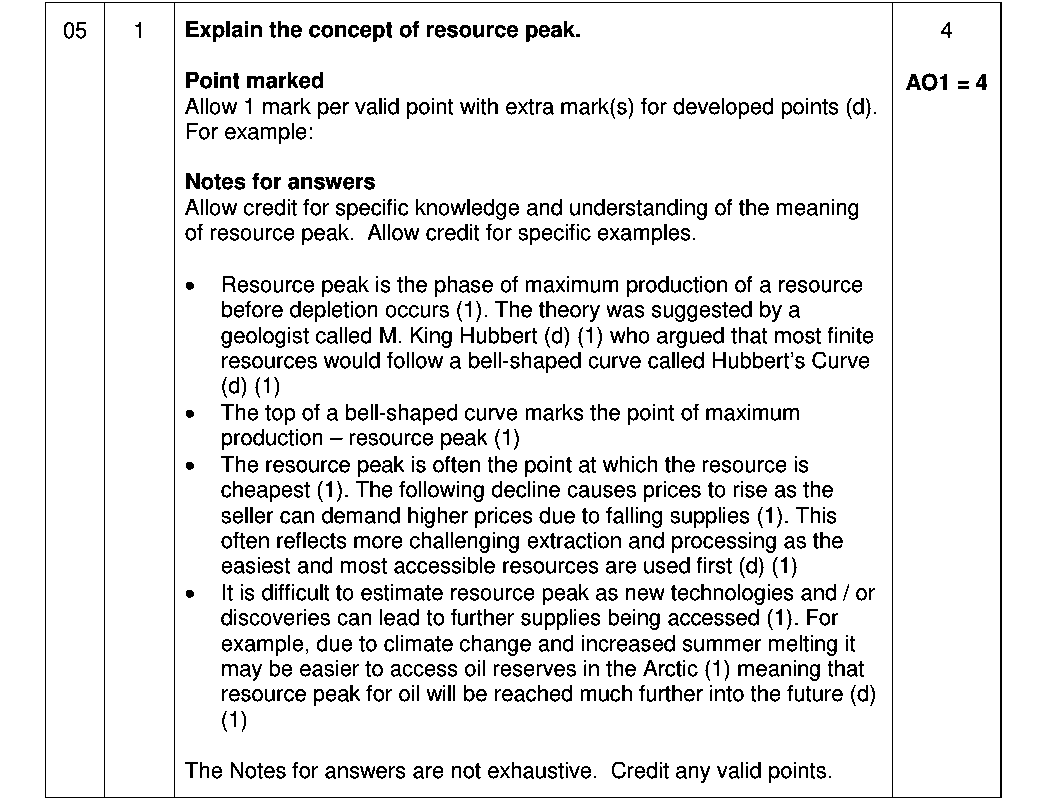
Specimen set 1 · Paper 2 · Q5.14 marksmark schemePoint-marked
Mark scheme
Notes from the mark scheme and report
point marked: point of maximum production before decline (Hubbert curve), price rises after peak as extraction harder, new technology or discoveries can delay peak (e.g. Arctic oil)
Work with an AQA Geography tutor
Essays stuck in the middle levels, or losing marks on the data questions? Book a trial lesson with a specialist AQA Geography tutor.