A-level Paper 2 Section C (option); AS Paper 1 Section B (option)
Level
AS and A level
Specification
3.2.3.8, 3.2.3.9, 4 content points
Since 2017
15 question parts, 10 of them essays
Specification
3.2.3.8-01 Impact of urban areas on local and global environments. Ecological footprint of major urban areas. Dimensions of sustainability: natural, physical, social and economic. Nature and features of sustainable cities. Concept of liveability.
3.2.3.8-02 Contemporary opportunities and challenges in developing more sustainable cities.
3.2.3.8-03 Strategies for developing more sustainable cities.
3.2.3.9-01 Case studies of two contrasting urban areas to illustrate and analyse key themes set out above, to include: • patterns of economic and social well-being • the nature and impact of physical environmental conditions with particular reference to the implications for environmental sustainability, the character of the study areas and the experience and attitudes of their populations.
‘It is clear that the ecological footprint of major urban areas will only increase in the future.’ With reference to an urban area you have studied, how far do you agree with this statement?
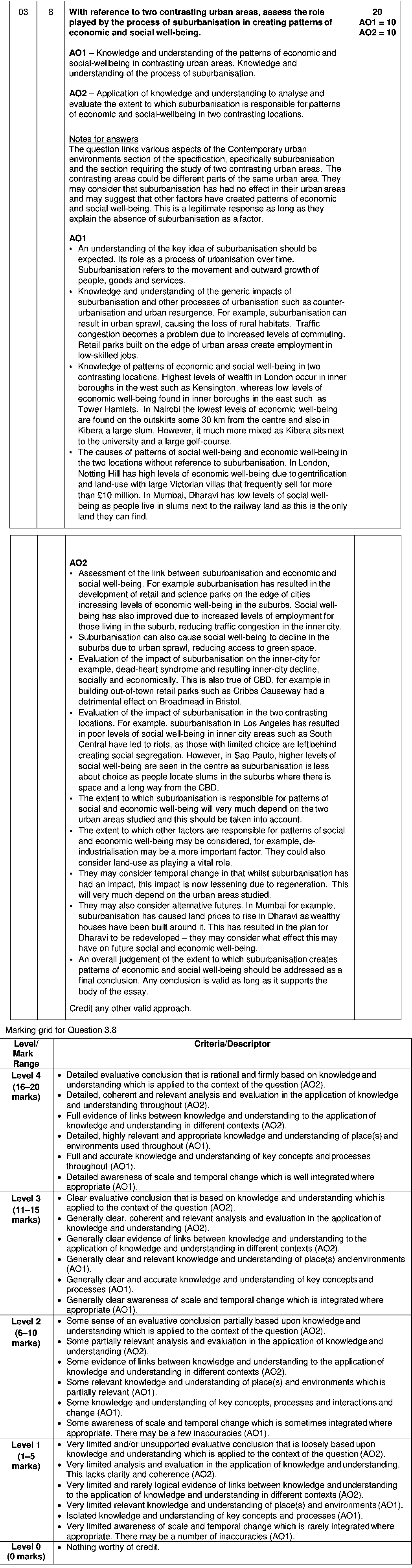
With reference to two contrasting urban areas, assess the role played by the process of suburbanisation in creating patterns of economic and social wellbeing.
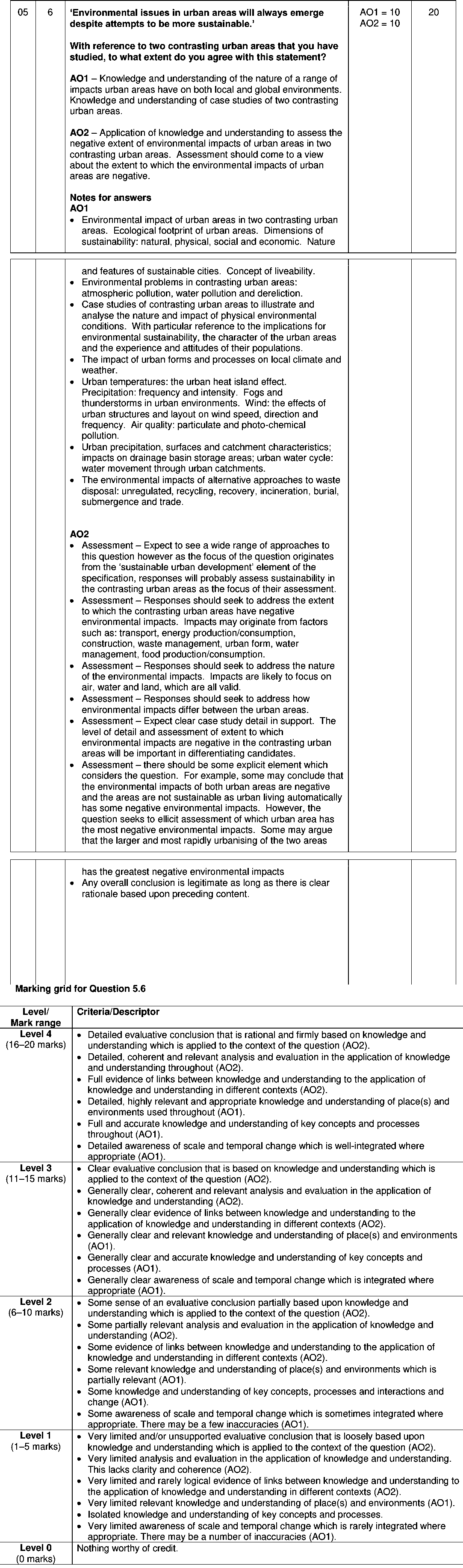
‘Environmental issues in urban areas will always emerge despite attempts to be more sustainable.’ With reference to two contrasting urban areas that you have studied, to what extent do you agree with this statement?
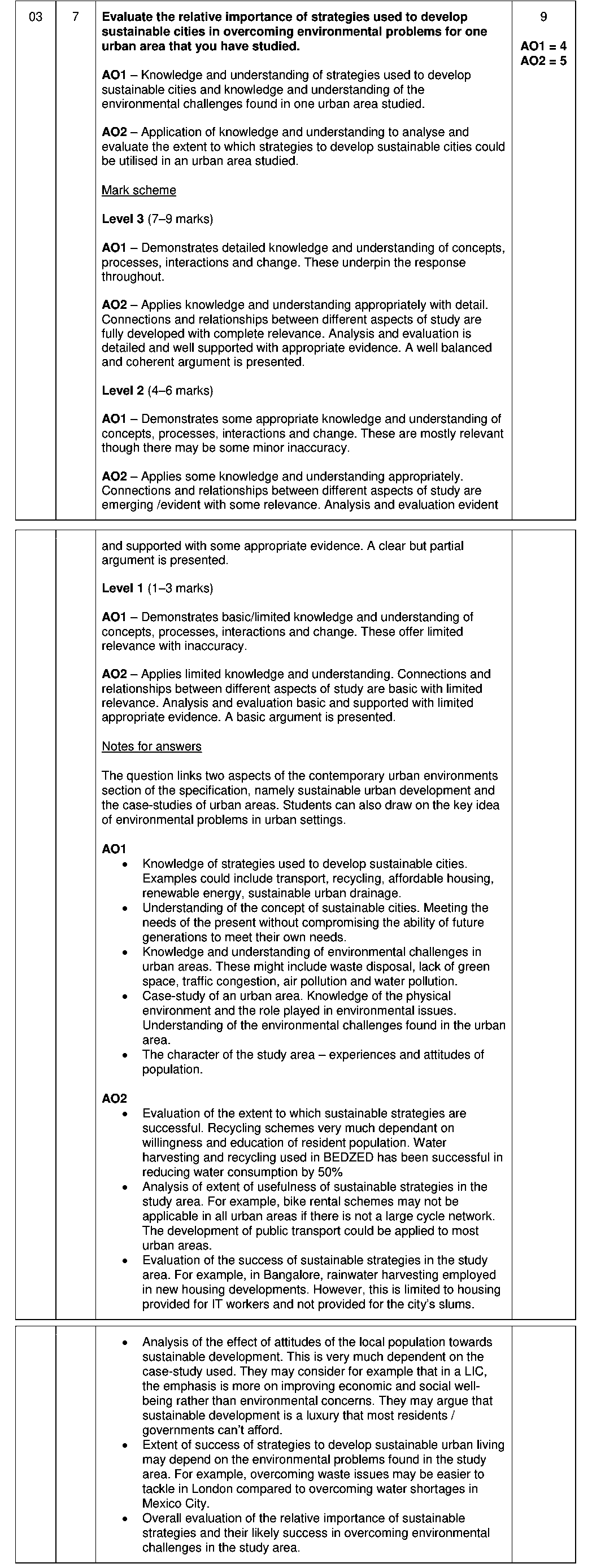
Evaluate the relative importance of strategies used to develop sustainable cities in overcoming environmental problems for one urban area you have studied.
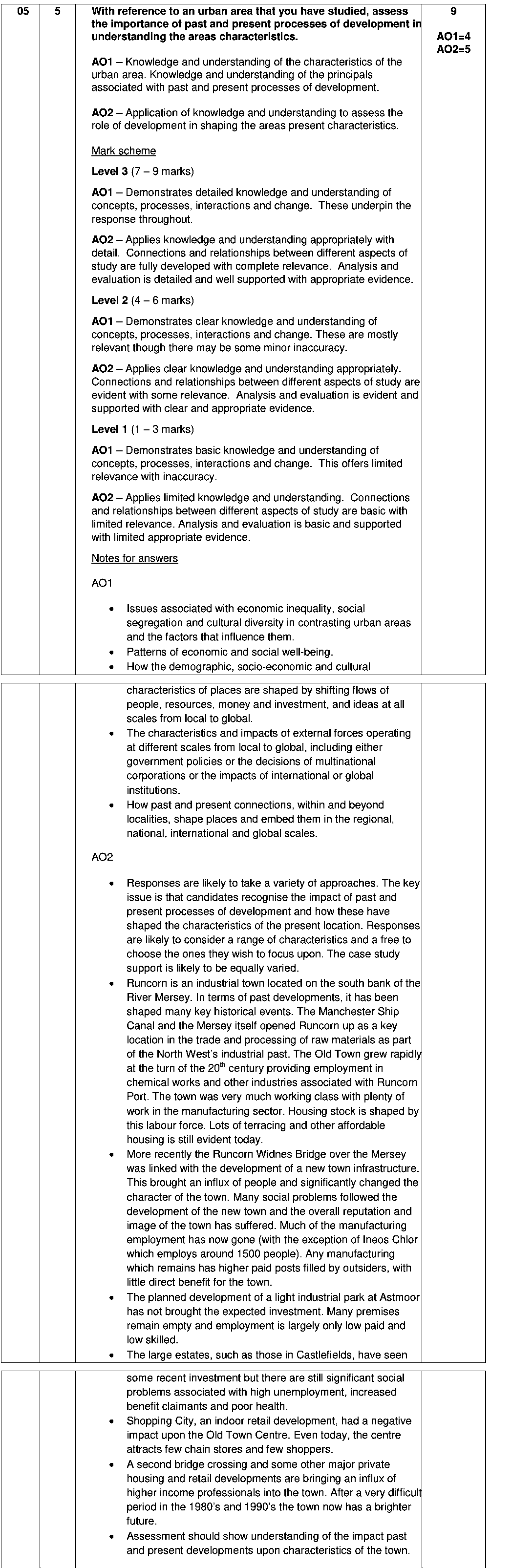
With reference to an urban area that you have studied, assess the importance of past and present processes of development in understanding the area’s characteristics.
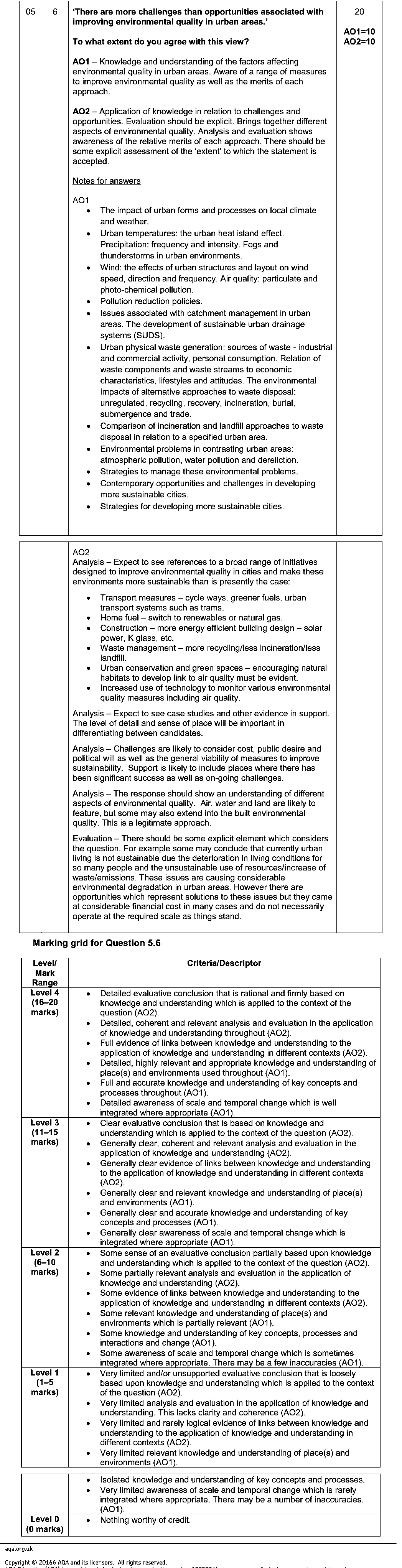
‘There are more challenges than opportunities associated with improving environmental quality in urban areas.’ To what extent do you agree with this view?
Tap a question to zoom it. The figures open above it; the mark scheme (with its levels and indicative content) and the examiner's comment open underneath.
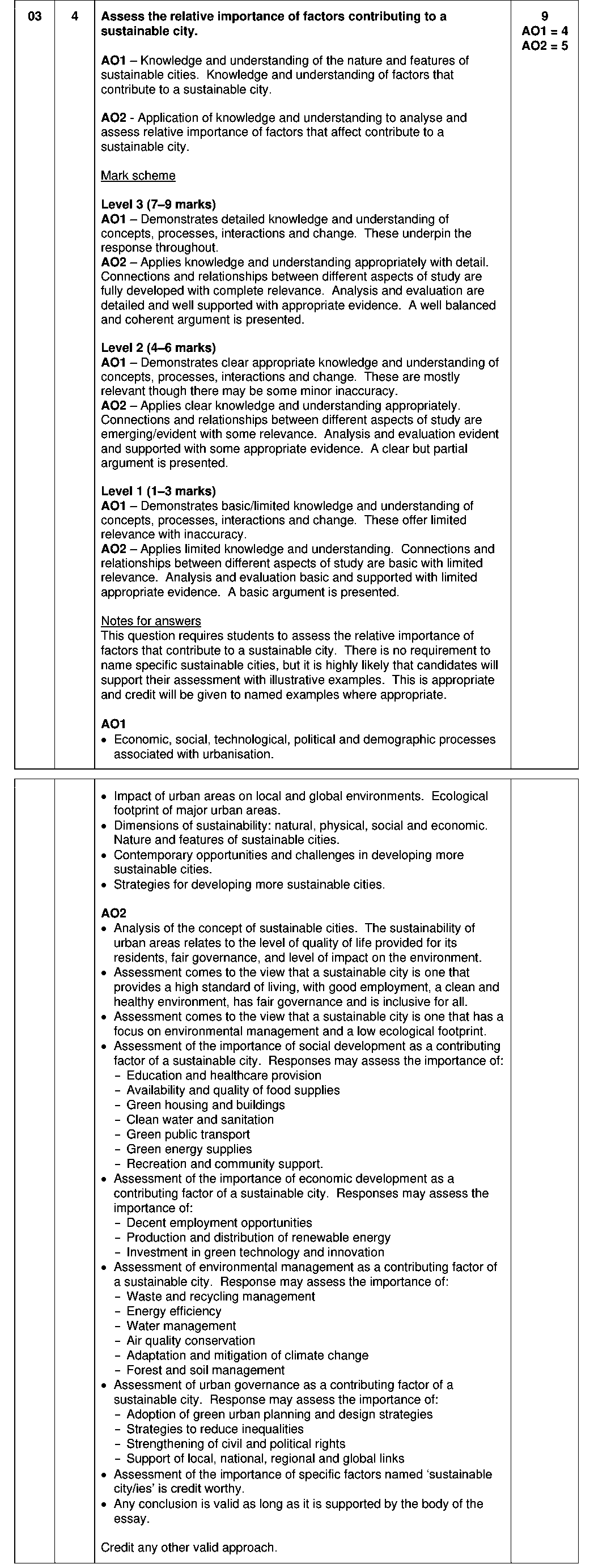
June 2025 · Paper 2 · Q3.49 marksmark scheme9-mark essay
Mark scheme, including the levels and indicative content
Examiner's comment
Most of the 6- and 9-mark questions evidenced some good subject knowledge and application. However, students could achieve higher marks within Level 2 or 3 by making their assessments and evaluations more explicit. The 9-mark questions, without the use of resources, test students’ subject knowledge and application in the optional themes. Responses should balance knowledge (AO1) with evaluation and assessment (AO2) to answer the question posed. Level 3 answers demonstrate detailed knowledge and understanding, make clear connections and views are well supported with evidence and examples. Responses that did not score well either lacked knowledge and understanding of the area of the specification being assessed, for example - sustainable cities, health factors at a local scale or mineral resource security - or a failed to really address the commands of the question (e.g. assess, to what extent). In Section C, each of the 9-mark questions showed mean scores of over 5.0, indicating mid-level 2 performance. Students showed knowledge and evaluation of sustainable cities, local-scale factors negatively impacting health, and the geopolitics of mineral resources. In this example, assessing Contemporary Urban Environments, the question ‘assess the relative importance of factors contributing to a sustainable city’ required students to identify key factors—economic, social, environmental, and technological—and evaluate their significance and interrelationships. Level 3 responses show knowledge of a range of factors, assess their importance and do so with respect to examples. This response begins by identifying some key factors for sustainable cities (sustainable urban drainage, waste management and energy production). These factors are described with links to examples for support (AO1) and their importance and relative importance are considered (AO2). The answer is succinct and shows both detailed subject knowledge and good exam technique. The response shows detailed AO1 knowledge. This was clearly a Level 3 response – it was assessed as being in the middle of Level 3 and awarded 8 marks. With a little more clarity in the introductory section on the concept of sustainable cities it would have received full marks.
Notes from the mark scheme and report
judge relative importance of social, economic, environmental and technological factors (SuDS, waste, energy, transport) with examples
a clear definition of a sustainable city helps
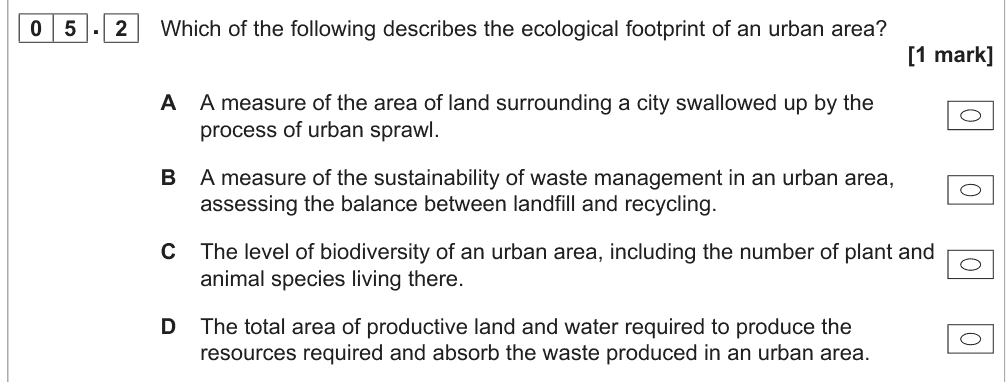
June 2024 · AS Paper 1 · Q5.21 markmark schemeMultiple choice
Answer
D
Mark scheme
Examiner's comment
This question differentiated better than 5.1, with 49% of students accurately choosing option D.
Notes from the mark scheme and report
Answer: D
productive land and water needed to supply resources and absorb waste
49% correct
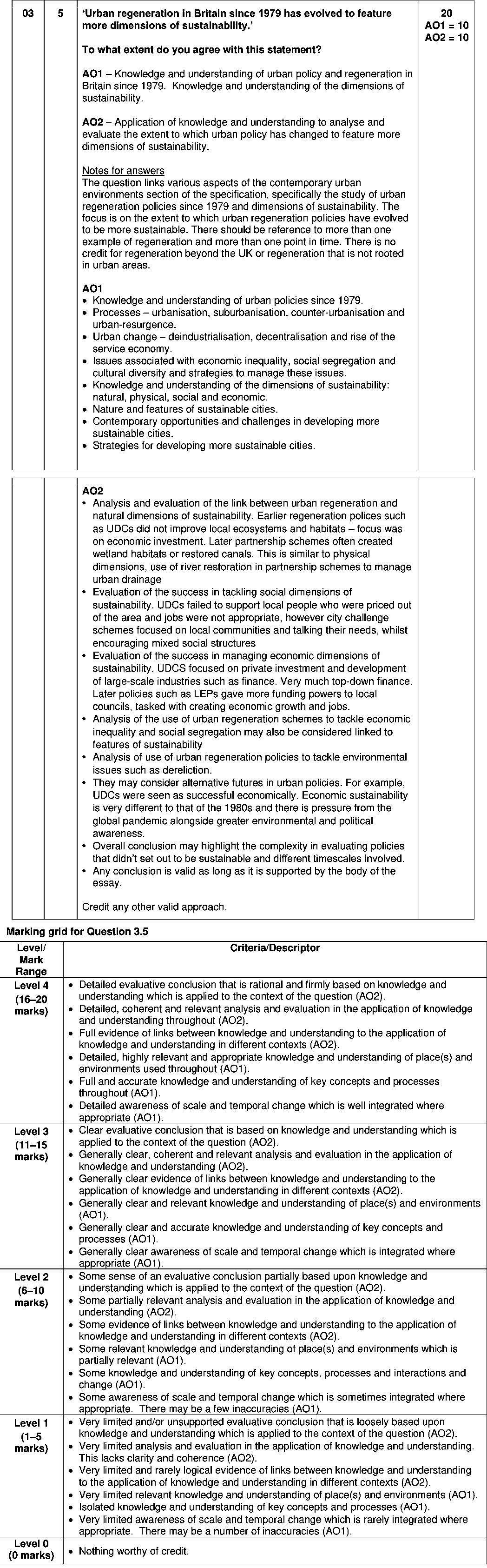
June 2024 · Paper 2 · Q3.520 marksmark scheme20-mark essay
Mark scheme, including the levels and indicative content
Examiner's comment
The 20-mark essay questions continue to illustrate the strong subject knowledge, evaluative skills and preparation of many students. These questions differentiate well, and the increasing confidence shown in these was demonstrated with over 60% of entries attaining at least Level 3. The key is always to demonstrably address the question and to ensure that the application of knowledge and understanding (AO2) is evident with AO1 knowledge used in support. The best responses are clearly organised, follow a logical structure and take a clear and sustained line of reasoning before reaching a conclusion based on the evidence provided. At the other end of the scale, less successful responses can be attributed to a number of reasons – maybe the student misreads the question, sometimes they start out with good intent but then drift away from the question focus – a brief plan is often a precursor to a good response. Some students just do not know the relevant subject content – either they did not learn it or failed to effectively revise it. Sometimes responses can include examples that are over-simplified, out-dated or clichéd and there is limited evidence of deep knowledge and understanding. Q3.5 also highlighted a lack of knowledge regarding urban regeneration policies from 1979. Whilst the specification does not list any particular policies, a number of responses only referred to contemporary (post 2012) urban strategies. In the response to 3.5 below, the student doesn’t really get to grips with the question and does not engage with the approaches to urban regeneration since 1979 perhaps this was not learned or revised well?. However they do attempt to discuss aspects of environmental sustainability within urban areas and there is some evaluation as well as reaching a conclusion. The response is partial, assessed as Level 2, 7 marks.
Notes from the mark scheme and report
evolution of regeneration since 1979 (UDCs/LDDC to community-led and sustainable communities) against natural, physical, social and economic sustainability
needs more than one example and time point
many knew only post-2012 strategies
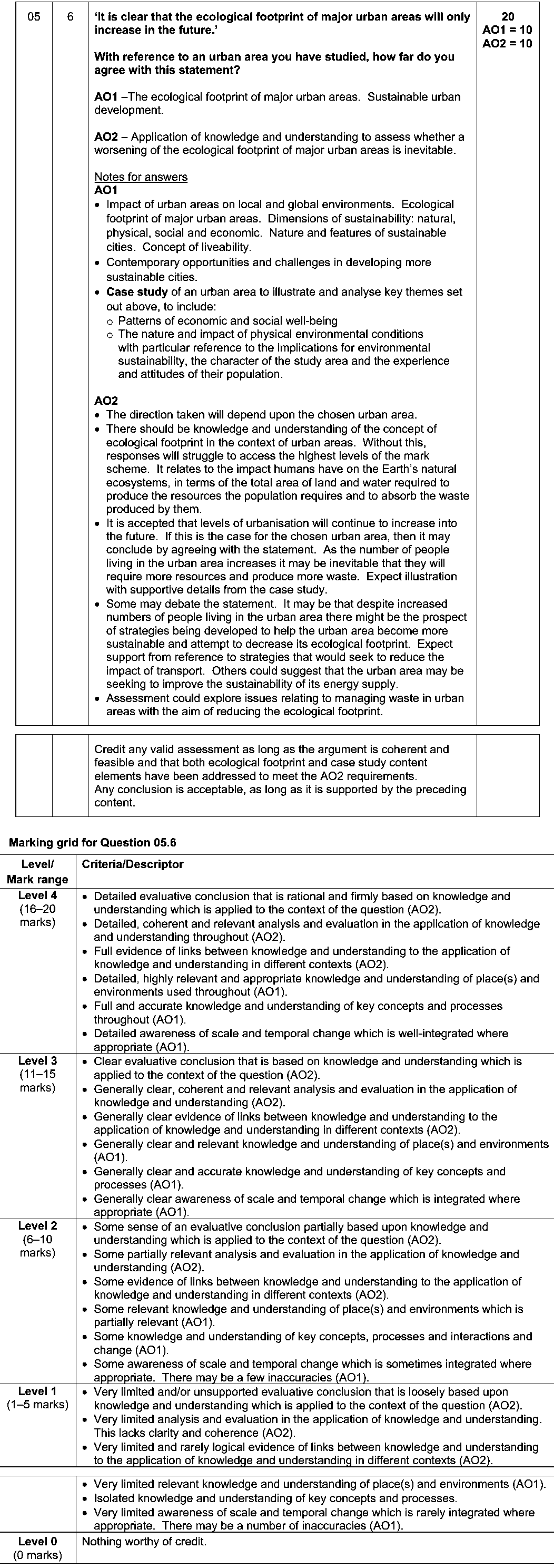
June 2023 · AS Paper 1 · Q5.620 marksmark scheme20-mark essay
Mark scheme, including the levels and indicative content
Examiner's comment
The best responses to this question showed a clear understanding of the concept of ecological footprint. They gave balanced accounts of how levels of consumption of certain commodities will increase in the future, so may increase an urban area’s footprint, whilst efforts may be made to reduce consumption of resources such as fossil fuels and manage waste more effectively, may reduce the footprint. Many of these responses, suggested that the balance between a possible future increase or decrease was dependent on factors such as demographics, current level of economic development, and current and future levels of industrialisation and urbanisation. Such responses highlighted the importance of the need for timely decisions to be made by policy makers sooner rather than later. Many weaker responses indicated that some students were unfamiliar with the concept of ecological footprint. Some concession was allowed and examiners did award credit where they could see assessment of specific environmental issues in the named example.
Notes from the mark scheme and report
must understand ecological footprint (land and water needed to supply resources and absorb waste)
weigh growing consumption against sustainability strategies in a named urban area
some credit for specific environmental issues where the concept was unfamiliar
November 2021 · Paper 2 · Q3.39 marksmark schemeStimulus
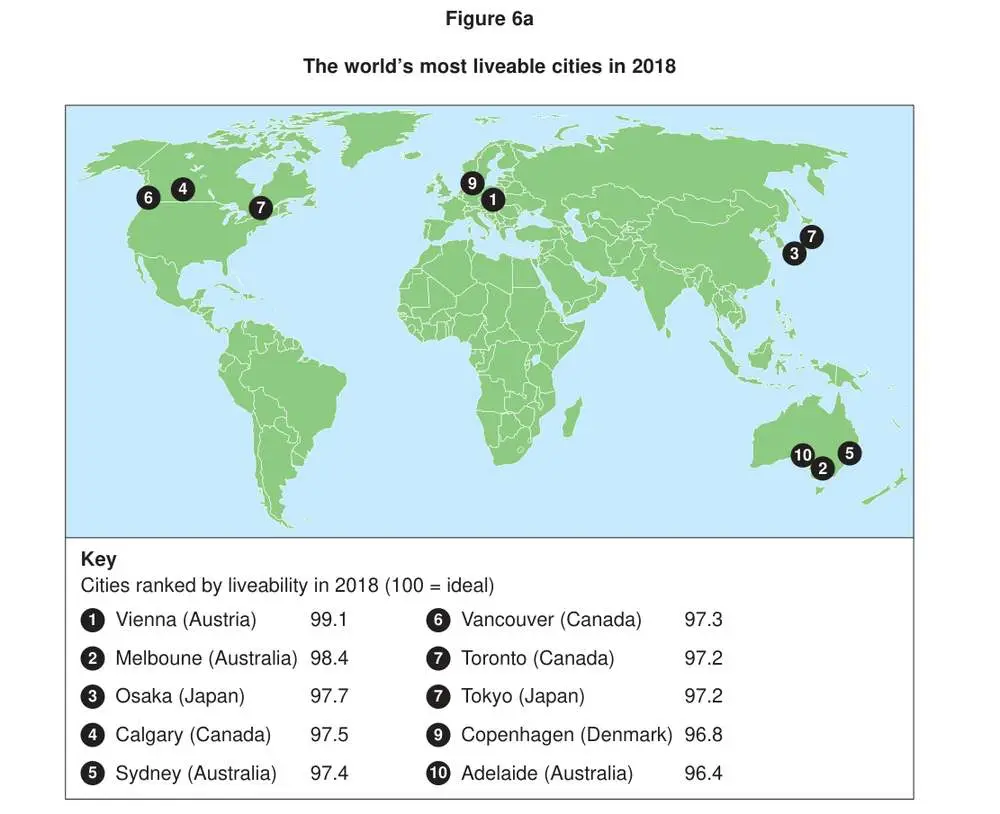
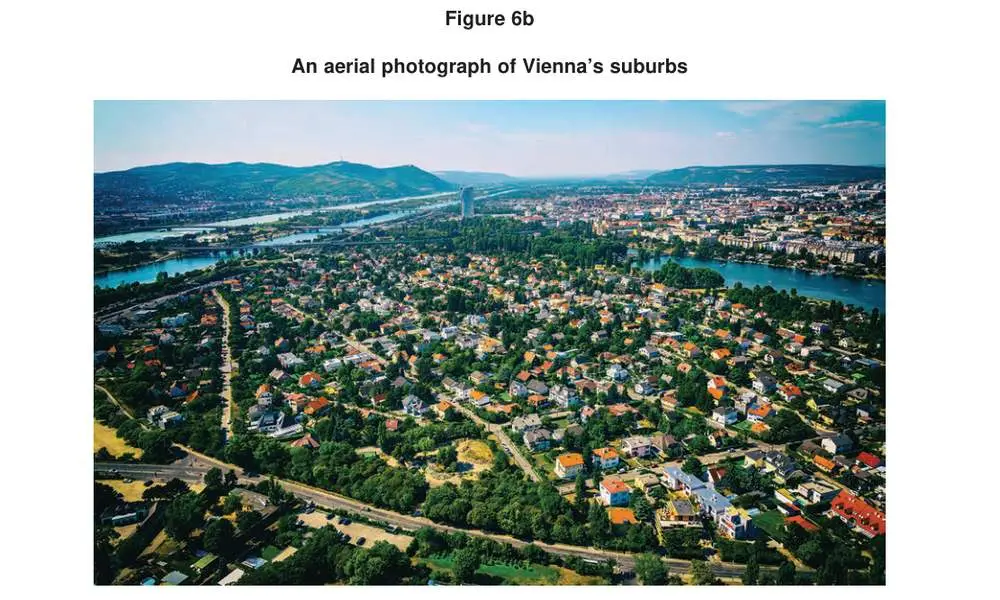
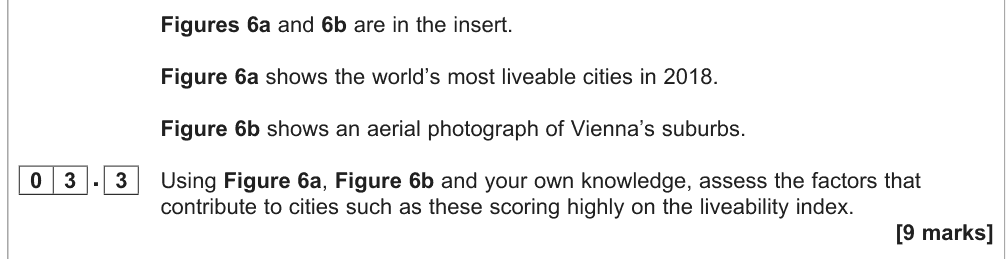
Figures 6a, 6b
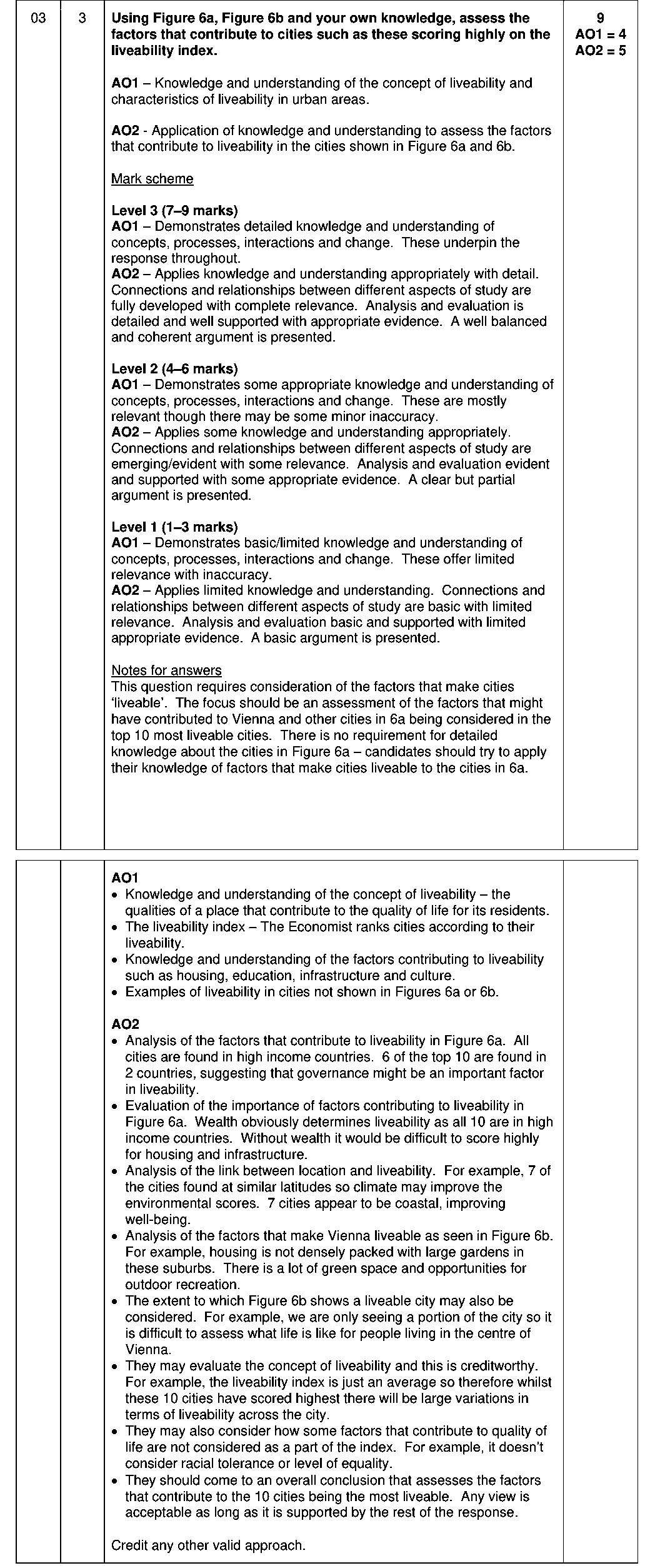
Mark scheme, including the levels and indicative content
Notes from the mark scheme and report
apply the concept of liveability (housing, green space, transport, safety, education, healthcare, culture) to the top-10 cities map and the Vienna suburbs photo
detailed knowledge of the listed cities not required
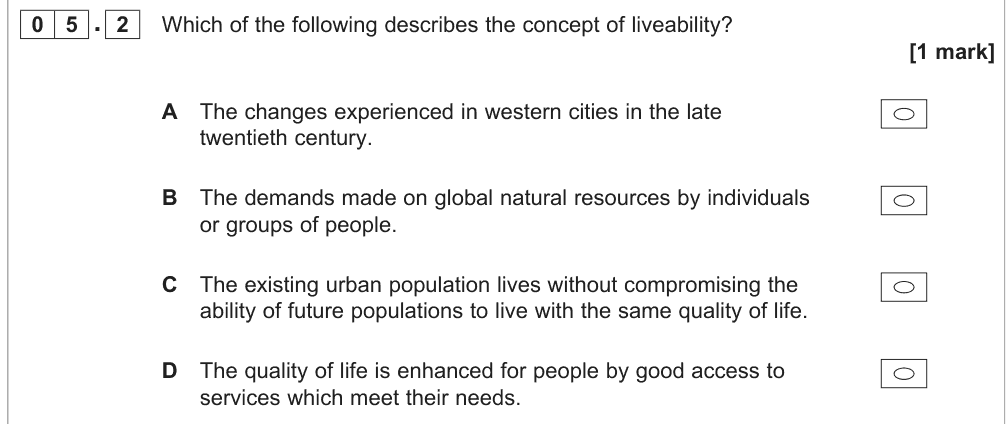
November 2020 · AS Paper 1 · Q5.21 markmark schemeMultiple choice
Answer
D
Mark scheme
Notes from the mark scheme and report
Answer: D (quality of life enhanced by good access to services)
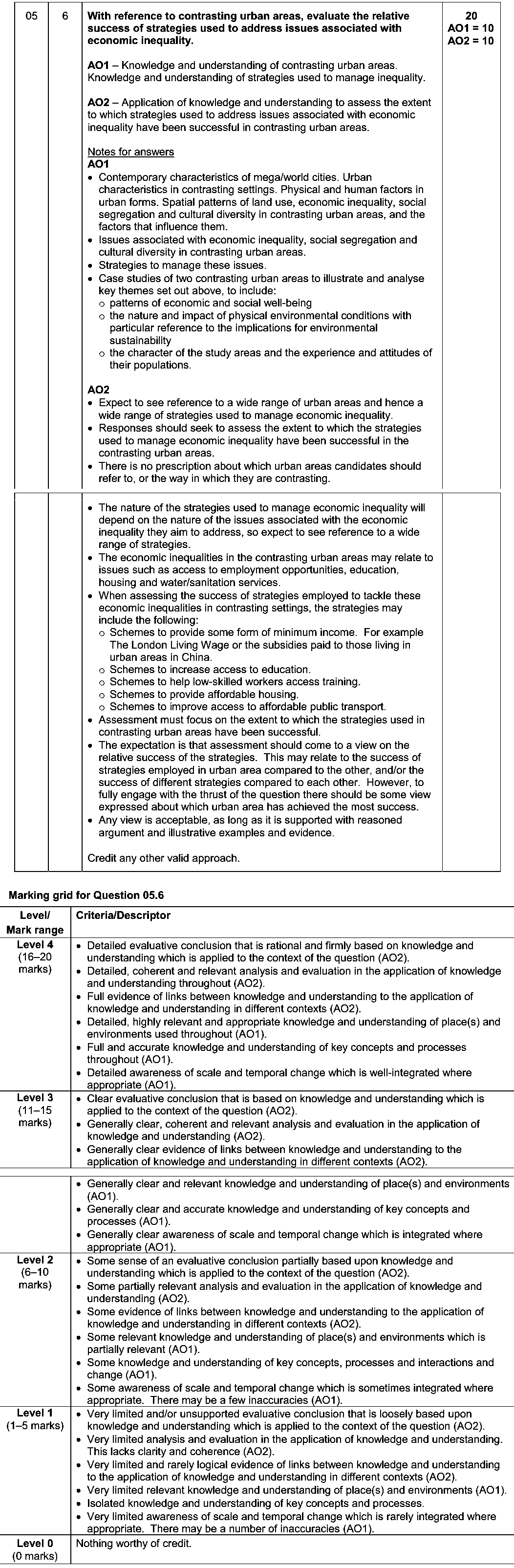
November 2020 · AS Paper 1 · Q5.620 marksmark scheme20-mark essay
Mark scheme, including the levels and indicative content
Notes from the mark scheme and report
contrasting urban areas
evaluate the relative success of strategies for economic inequality (living wage, education, training, affordable housing, transport)
must reach a view on which worked best
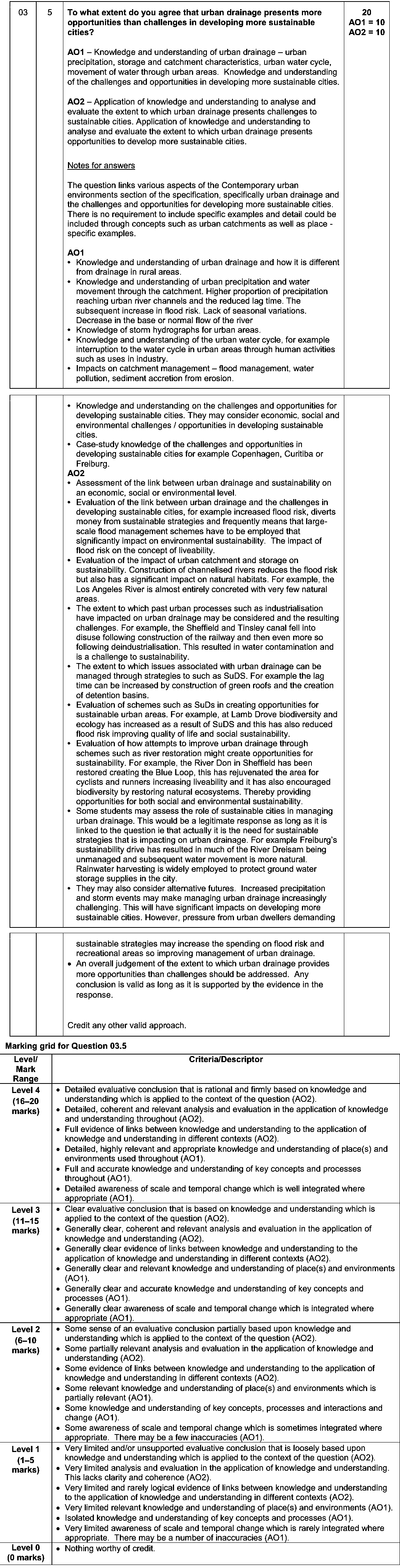
November 2020 · Paper 2 · Q3.520 marksmark scheme20-mark essay
Mark scheme, including the levels and indicative content
Examiner's comment
There were some very good responses to Q3.5. Some of the best responses assessed the opportunities brought about by river restoration projects such as the Cheonggyecheon in Seoul or specific SUDs and then compared this to the challenges of managing flood risk in cities, leading to unsustainable practices. Weaker responses were typified by a lack of specific examples and a reliance on generic knowledge of sustainable cities.
Notes from the mark scheme and report
flood risk and channelisation as challenges v SuDS and river restoration (e.g. Cheonggyecheon) as opportunities
weaker answers lacked examples and relied on generic sustainable-city knowledge
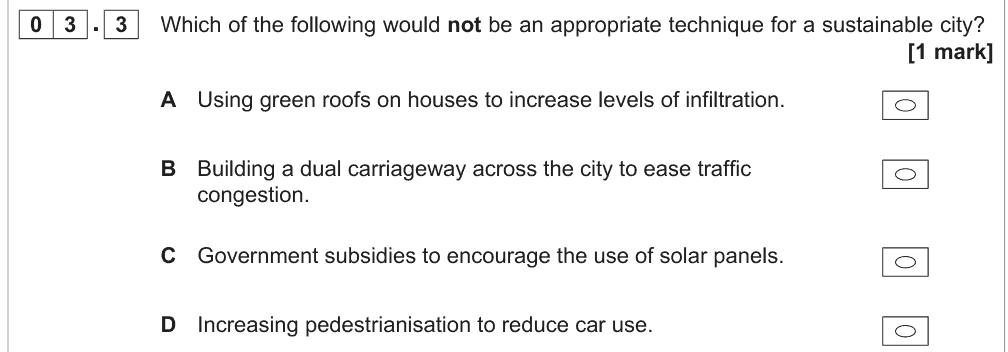
June 2019 · Paper 2 · Q3.31 markmark schemeMultiple choice
Answer
B
Mark scheme
Examiner's comment
Over three-quarters of students identified B as the correct answer. Many who got it wrong had apparently failed to see the word ‘not’ in bold in the question.
Notes from the mark scheme and report
Answer: B (dual carriageway)
some missed the bold 'not'
June 2019 · Paper 2 · Q3.820 marksmark scheme20-mark essay
Mark scheme, including the levels and indicative content
Examiner's comment
Whilst there were some outstanding responses to this question, there were also many less successful responses only accessing level 1 or level 2 credit. Rather than lacking understanding of the concept of suburbanisation, such responses often failed to identify patterns of economic and social wellbeing in their chosen urban areas. In choosing their contrasting urban areas, many students used contrasts in wealth, with London and Mumbai commonly chosen. Contrasts can be seen a variety of ways such as economically, by scale or land-use. Some students used two different areas of a city and this was perfectly legitimate. This often provided a better route as students looked at the contrasts in social and economic wellbeing, linking it to the degree to which suburbanisation was responsible. Selection of urban areas was key, and many students appear to use their changing places case-studies; again, this was often a successful route as they showed very detailed knowledge and applied their understanding of suburbanisation. Students should be encouraged to be synoptic and think about ‘what best fits’ when answering these 20 mark questions. The question also asked about ‘the role played by the process of suburbanisation’, so a perfectly legitimate response was to consider that actually suburbanisation played a limited role and that other processes were far more important, as long as this was evidenced based, showing clear understanding. Less effective responses often confused terminology. For example ‘counter-urbanisation’ and ‘urbanisation’ were often explained as ‘suburbanisation’. This was particularly the case with case-studies such as Mumbai, where students frequently expressed the view that suburbanisation played a huge role in creating slums as people moved from rural areas to outer edges of urban areas. Typically effective responses used clear contrasting urban areas and showed specific knowledge of patterns of wellbeing. They then considered the degree to which suburbanisation had caused these, often bringing in other causes such as regeneration coming to an overall evidence-based conclusion. These students frequently went on to score level 4, with many accessing full marks.
Notes from the mark scheme and report
needs patterns of economic and social wellbeing in two contrasting urban areas (may be two parts of one city) linked to suburbanisation
may argue other processes matter more
confusing suburbanisation with urbanisation/counter-urbanisation was common
June 2018 · AS Paper 1 · Q5.620 marksmark scheme20-mark essay
Mark scheme, including the levels and indicative content
Examiner's comment
Many candidates found this question quite challenging. Whilst 51% did reach Level 3 or higher, only 12% scored in Level 4 and 10% failed to get out of Level 1. Many were confident in their AO1 knowledge and understanding of the characteristics of their two case studies, but often failed to give clear assessment of specific environmental issues or specific attempts at sustainability in these locations. The best answers engaged with the assumption of inevitability suggested in the question. These applied their knowledge and understanding of their case studies to either argue for against this inevitability. Many came to the view that urban areas are inevitably unsustainable and that they will always pose environmental issues. This approach was valid and could score well if the argument was clearly supported with evidence from their chosen urban areas. A limited number of responses self-penalised by only referring to one urban area. Any scale of urban area was accepted. Some focused on whole cities, e.g. Mumbai, whilst others focused on more local scaled examples, e.g. Dharavi in Mumbai. Either approach was valid. As long as there was some clear difference in some aspect of the chosen case studies, examiners were open to most contrasting places offered by candidates. It is worth reminding centres that both 20-mark questions in section B will not have direct links to the identified specification content. Students need to be prepared to use their knowledge and understanding of content, concepts and processes. This should then be applied to the context of questions, rather than a narrative approach of reciting learned materials which some more limited responses showed.
Notes from the mark scheme and report
two contrasting urban areas required (one only self-penalised)
assess specific environmental issues and sustainability attempts and whether issues are inevitable
any scale of urban area accepted
June 2018 · Paper 2 · Q3.79 marksmark scheme9-mark essay
Mark scheme, including the levels and indicative content
Examiner's comment
This question was generally not well-answered. Very few students considered the relative importance of sustainable strategies in dealing with environmental problems. Too many students seemed to have not really moved beyond GCSE case studies such as of Curitiba or BedZED. The best approaches discussed how sustainable strategies might be used to overcome environmental problems in an urban area they had studied. For example, some students discussed the difficulties of implementing a congestion charge in Mumbai and concluded that perhaps strategies used to recycle waste are more important and useful.
Notes from the mark scheme and report
must weigh the relative importance of sustainable strategies for one studied urban area
June 2017 · AS Paper 1 · Q5.59 marksmark schemeSynoptic
Mark scheme, including the levels and indicative content
Examiner's comment
This was the comparable question to 4.5. The requirements of this question crossed specification units. It is important that centres note that every series there will be one question which crosses specification units at both AS and A Level. In this case, the link was to Changing Places. The concept (from that unit) of past and present processes of development, was integrated into this contemporary urban environments question. It is an Ofqual requirement that such questions are set every series so that students can demonstrate understanding and learning from across the breadth of study. Depending upon the choice of urban area, there were a variety of past and present processes of development which students could refer to. In general, this was not particularly well done and opportunities were missed by many. Some chose processes such as urbanisation, counter-urbanisation and gentrification. Others considered deindustrialisation for example. Another approach was to consider urban regeneration strategies as processes of development. The point really is that it was for the student to choose and apply. It was then simply a matter of assessing the impact of the process upon the area’s characteristics. The average mark was 4.33 with 66% accessing Level 2 or better. Only 16% accessed Level 3.
Notes from the mark scheme and report
cross-unit link to Changing Places
processes such as deindustrialisation, gentrification, regeneration applied to the chosen urban area
only 16% Level 3
Specimen set 1 · AS Paper 1 · Q5.620 marksmark scheme20-mark essay
Mark scheme, including the levels and indicative content
Notes from the mark scheme and report
weigh challenges against opportunities in improving urban air, water and waste quality (pollution policies, SUDS, recycling) with examples
explicit view on extent required
Specimen set 1 · Paper 2 · Q3.39 marksmark schemeStimulus
Mark scheme, including the levels and indicative content
Notes from the mark scheme and report
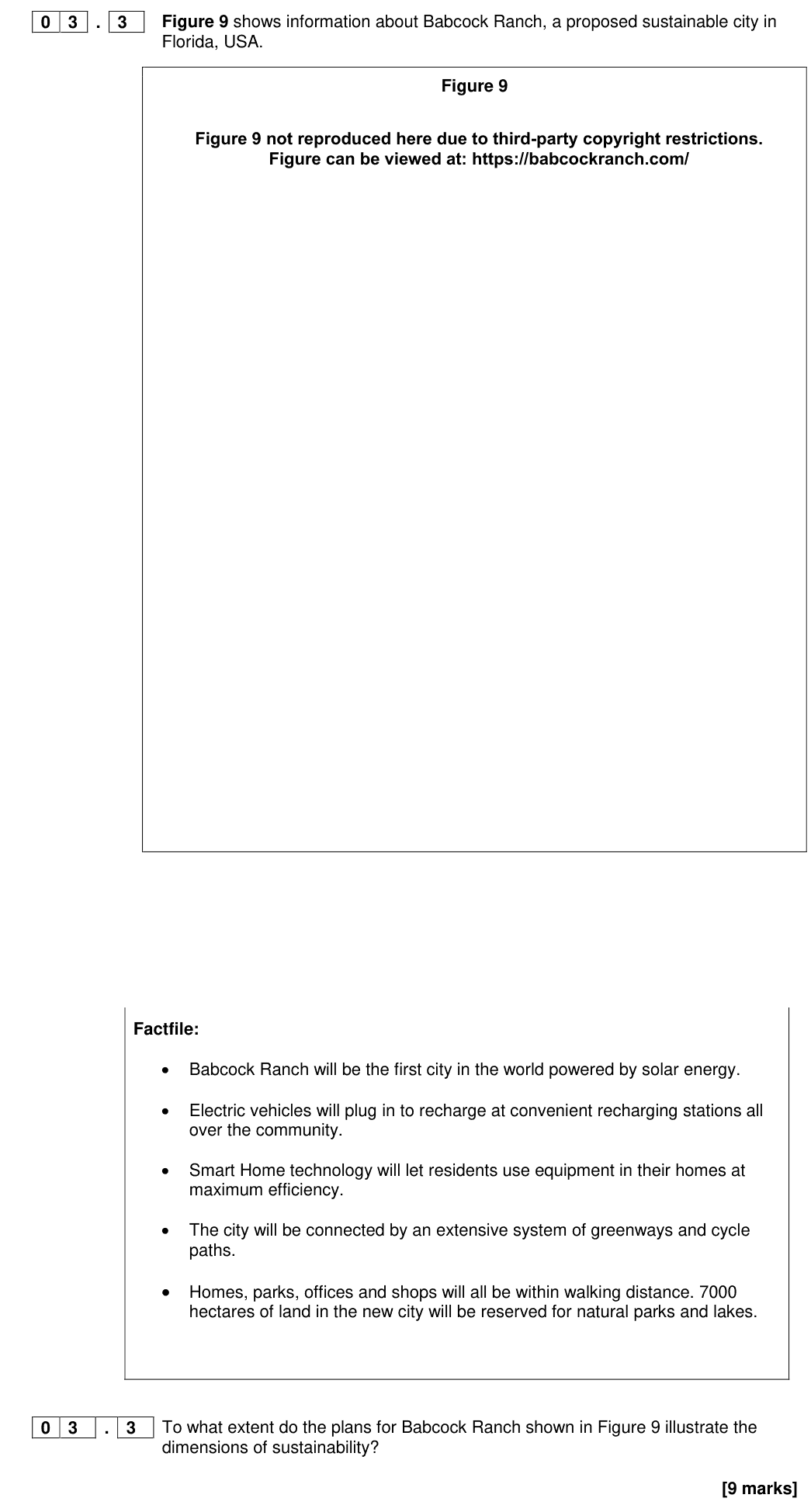
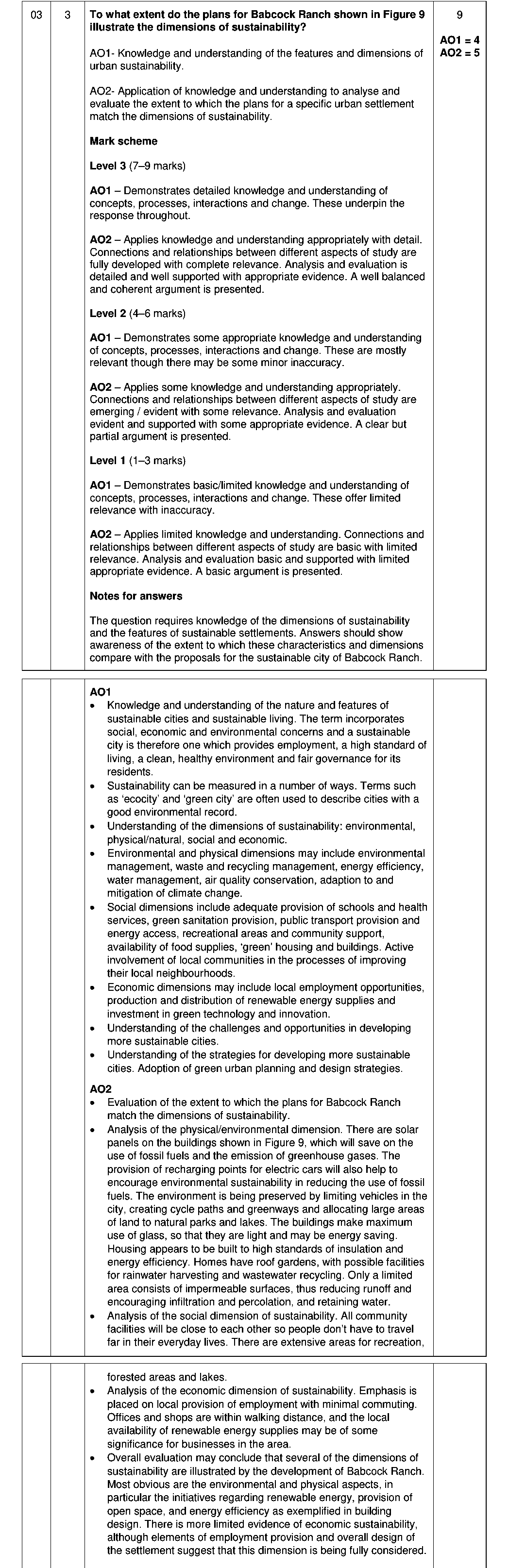
apply the natural, physical, social and economic dimensions of sustainability to the Babcock Ranch factfile (solar power, EVs, walkability, 7000 ha parks) and note gaps (social/economic)
Figure 9 image not reproduced in the published paper
Work with an AQA Geography tutor
Essays stuck in the middle levels, or losing marks on the data questions? Book a trial lesson with a specialist AQA Geography tutor.