A-level Paper 2 Section C (option); AS Paper 1 Section B (option)
Level
AS and A level
Specification
3.2.3.5, 3 content points
Since 2017
12 question parts, 5 of them essays
Specification
3.2.3.5-01 Urban precipitation, surfaces and catchment characteristics; impacts on drainage basin storage areas; urban water cycle: water movement through urban catchments as measured by hydrographs.
3.2.3.5-02 Issues associated with catchment management in urban areas. The development of sustainable urban drainage systems (SUDS).
3.2.3.5-03 River restoration and conservation in damaged urban catchments with reference to a specific project. Reasons for and aims of the project; attitudes and contributions of parties involved; project activities and evaluation of project outcomes.
Tap a question to zoom it. The figures open above it; the mark scheme (with its levels and indicative content) and the examiner's comment open underneath.
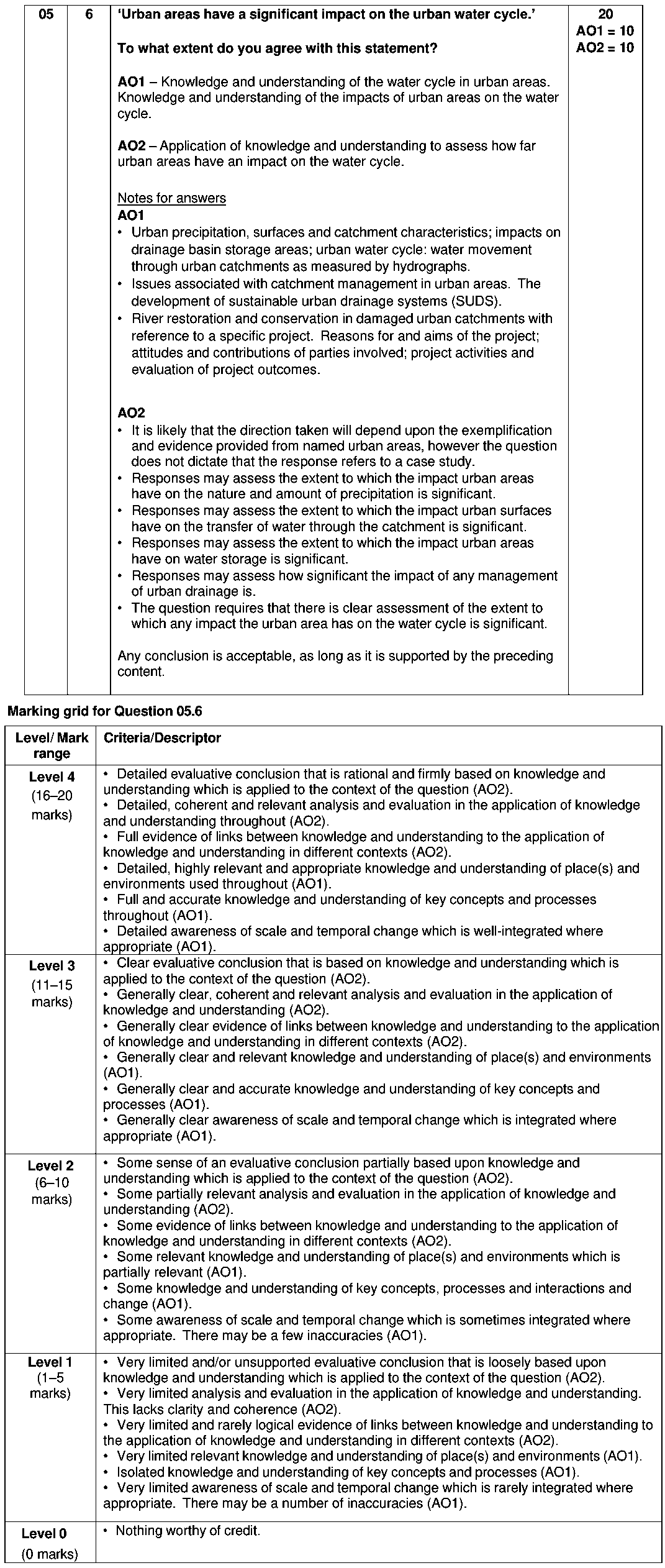
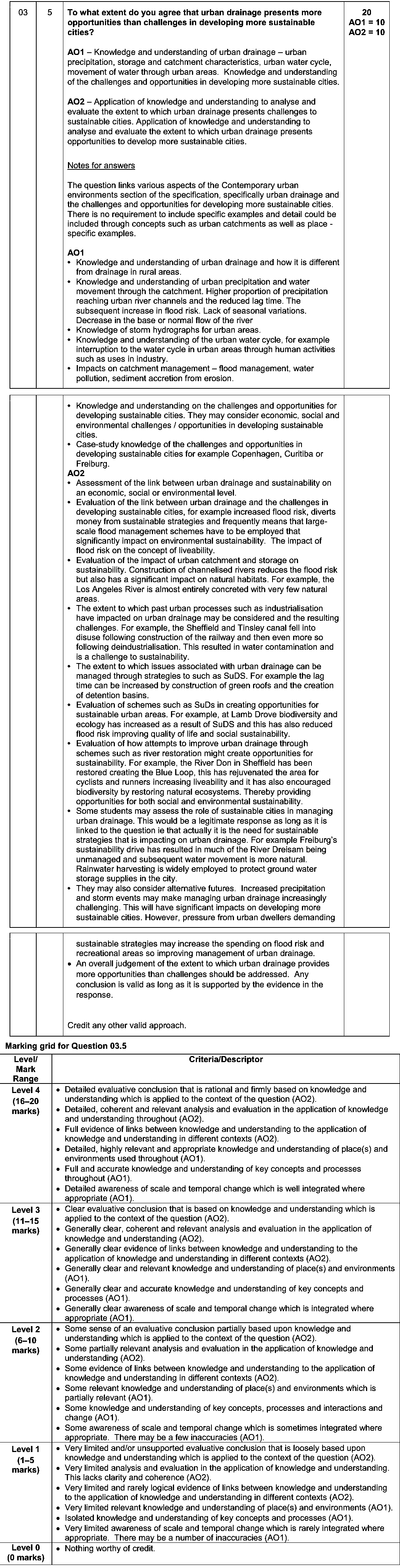
June 2025 · AS Paper 1 · Q5.620 marksmark scheme20-mark essay
Mark scheme, including the levels and indicative content
Examiner's comment
Like other 20-mark questions this differentiated quite well, with a mean of 12.23 and over 70% reached Level 3 or higher. The best answers showed clear and/or detailed knowledge and understanding of the urban water cycle, and explicitly referred to specific inputs, flows, stores, and outputs in the cycle. Many of these responses noted how urban areas influence precipitation, infiltration rates and then levels of overland flow. Others linked aspects of the urban heat island effect to rates of evaporation and then possible links to thunderstorms. There were some responses that looked at the impact of urban areas on different stores of water, for example the impact of abstraction on ground water. These could all score well, as long as there was also clear and detailed assessment. Although, the question did not require a case study, many of the best responses did support their points with reference to named locations. This often added to the quality of the AO1 element of the answer. Some appeared to try to give a rehearsed response about specific examples of SUDs or river restoration.This was credit worthy as long as there was a clear attempt to target aspects of the water cycle.
Notes from the mark scheme and report
precipitation, impermeable surfaces, infiltration and overland flow, stores (abstraction), heat island and thunderstorms
named locations strengthen AO1
SUDS/river restoration credited only if tied to the water cycle
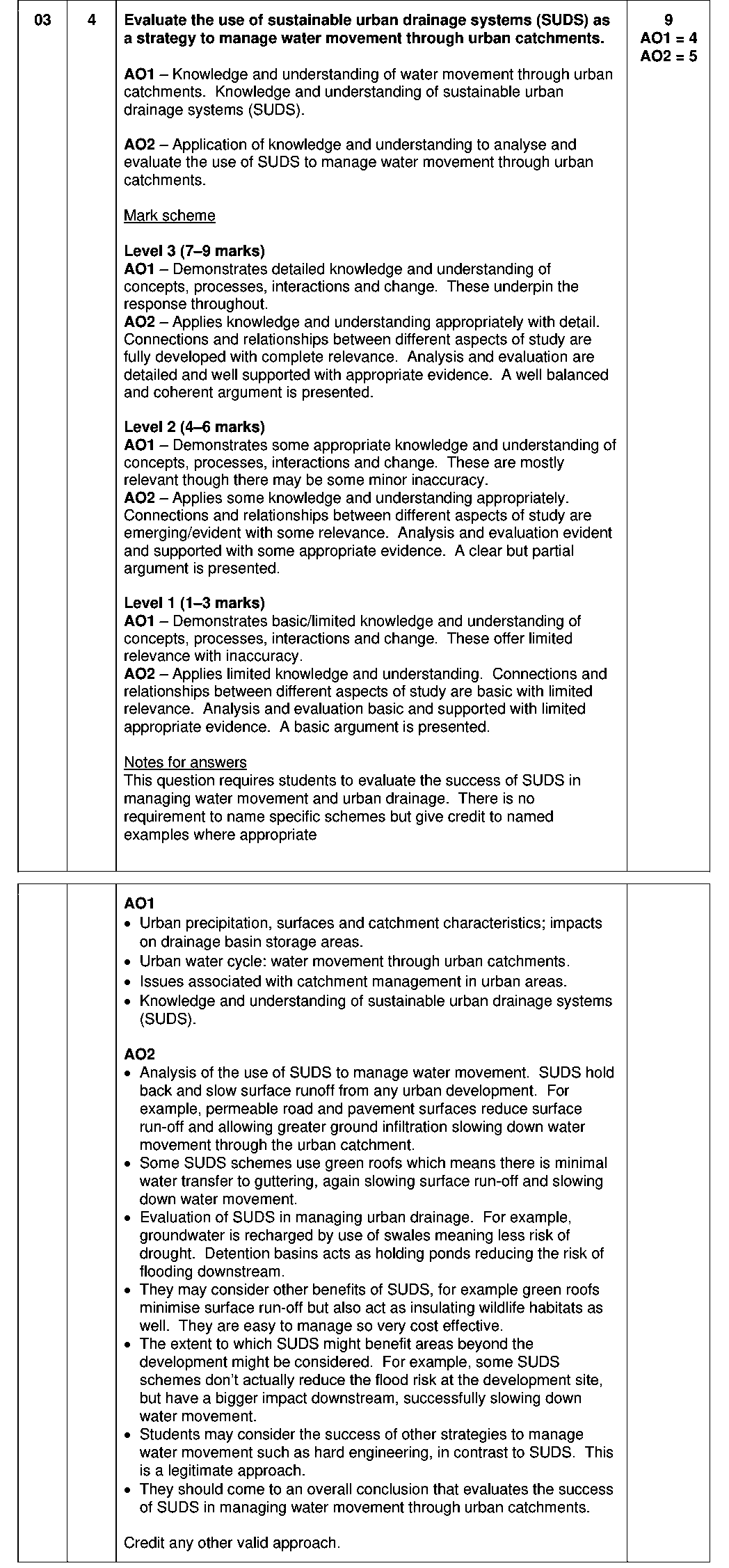
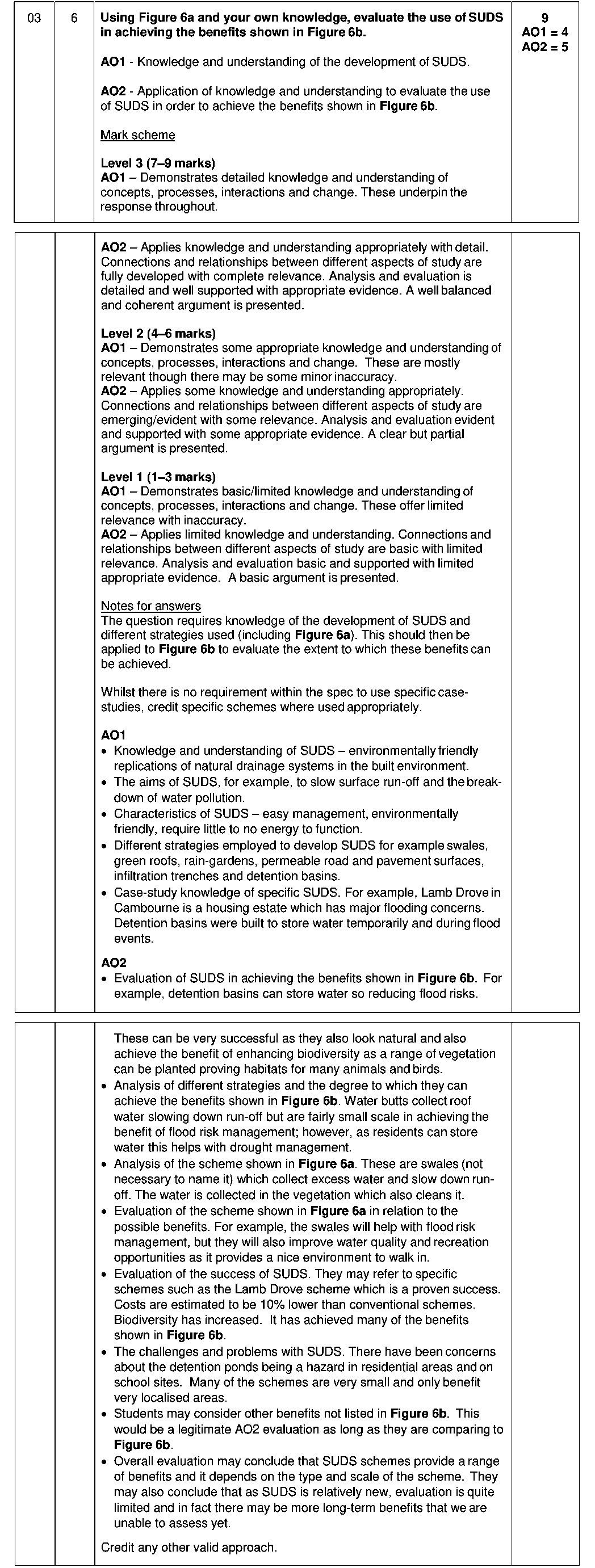
June 2024 · Paper 2 · Q3.49 marksmark scheme9-mark essay
Mark scheme, including the levels and indicative content
Examiner's comment
The 9-mark questions in the options all showed a mean score well into Level 2 with some good knowledge and evaluation of sustainable urban drainage, managing soil problems and the relationship between physical and energy mix. There was good subject specific knowledge evident in the .4 9-mark questions in the options, but students would be advised to include relevant examples of places / situations to add weight to their theoretical knowledge and assessment. These questions assess students’ subject knowledge and application within the specification units. Responses should have a balance of AO1 knowledge and AO2 evaluation / assessment in which the subject knowledge is applied to actually answer the question. Good answers show detailed knowledge and a clear and explicit evaluation / assessment. Less successful responses either did not understand the key concept being tested, so students who did not know about sustainable urban drainage systems, the management of soil problems or the links between energy mix and physical geography would clearly not score well. A lack of depth of knowledge or a failure to fully assess / evaluate the issue would also lead to lower marks. In the example below (from 3.3 Contemporary urban environments) the response shows some basic knowledge of SUDs (they refer to permeable pavements and swales), but limited understanding of how they work and there is little evaluation of their use as ways of managing water movement through urban catchments. It was given some credit at the top of Level 1, 3 marks.
Notes from the mark scheme and report
evaluate SUDS (permeable surfaces, green roofs, swales, retention ponds) for slowing runoff and recharge
named schemes credited
report labels this example 3.3 but it is the SUDS question
weak answers knew SUDS only superficially
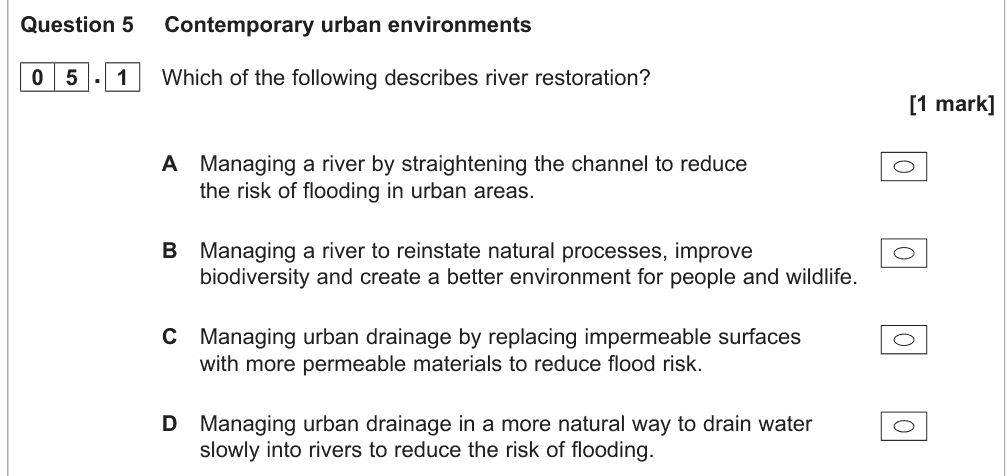
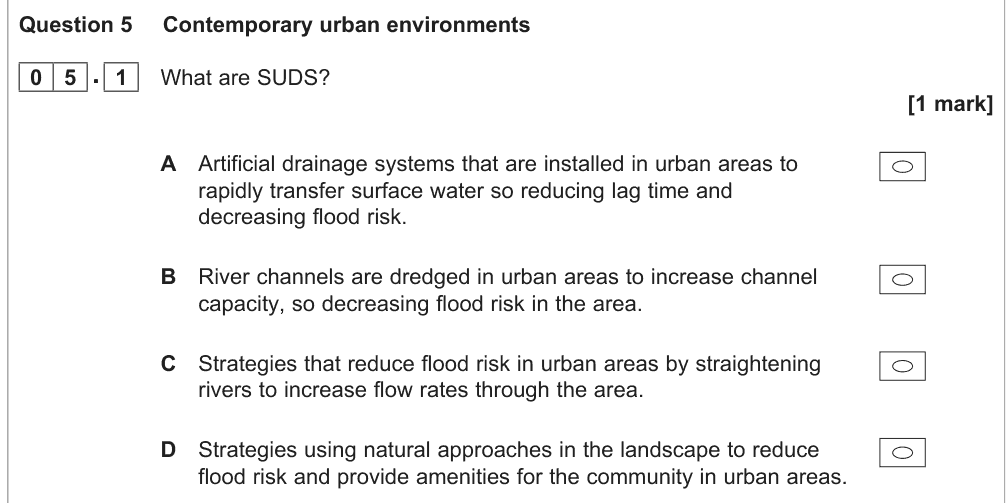
June 2023 · AS Paper 1 · Q5.11 markmark schemeMultiple choice
Answer
B
Mark scheme
Examiner's comment
Both of these multiple-choice questions were answered well by students.
Notes from the mark scheme and report
Answer: B
river restoration reinstates natural processes and improves biodiversity (C and D describe SUDS, A channelisation)
June 2022 · Paper 2 · Q3.26 marksmark schemeData analysis
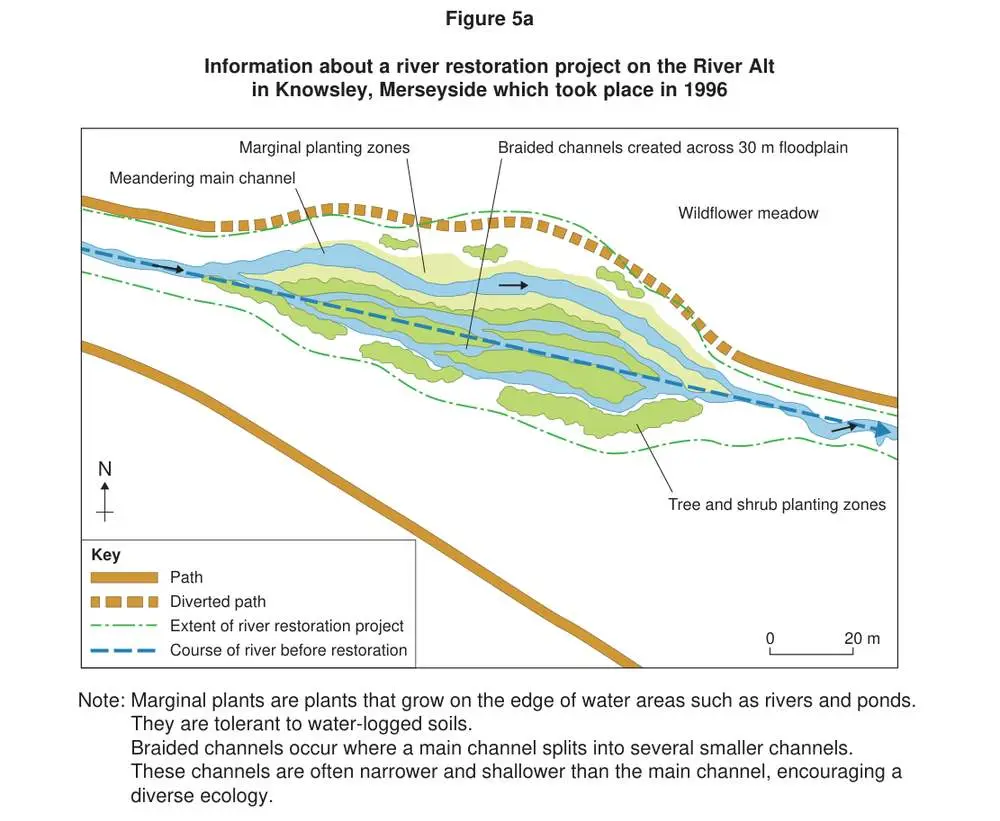
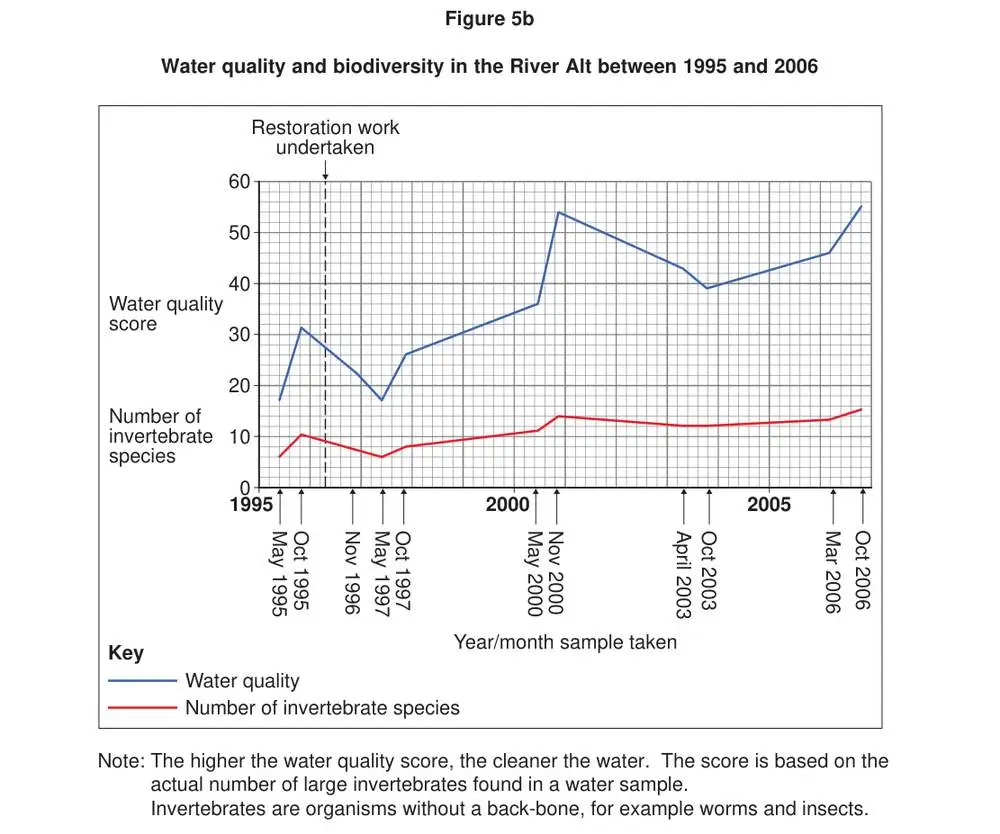
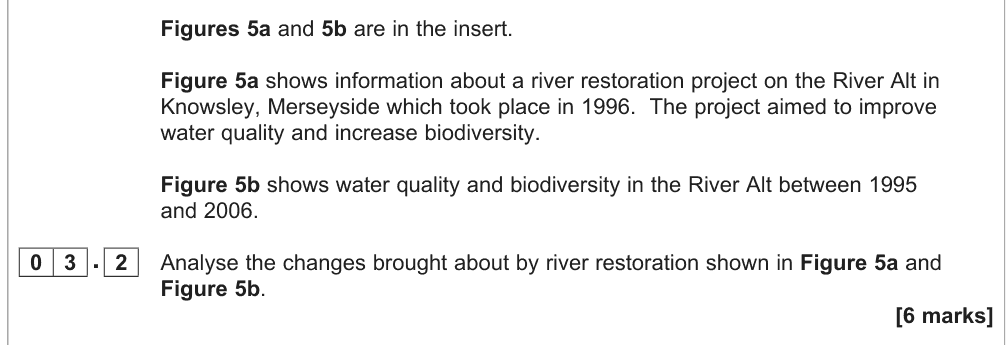
Figures 5a, 5b
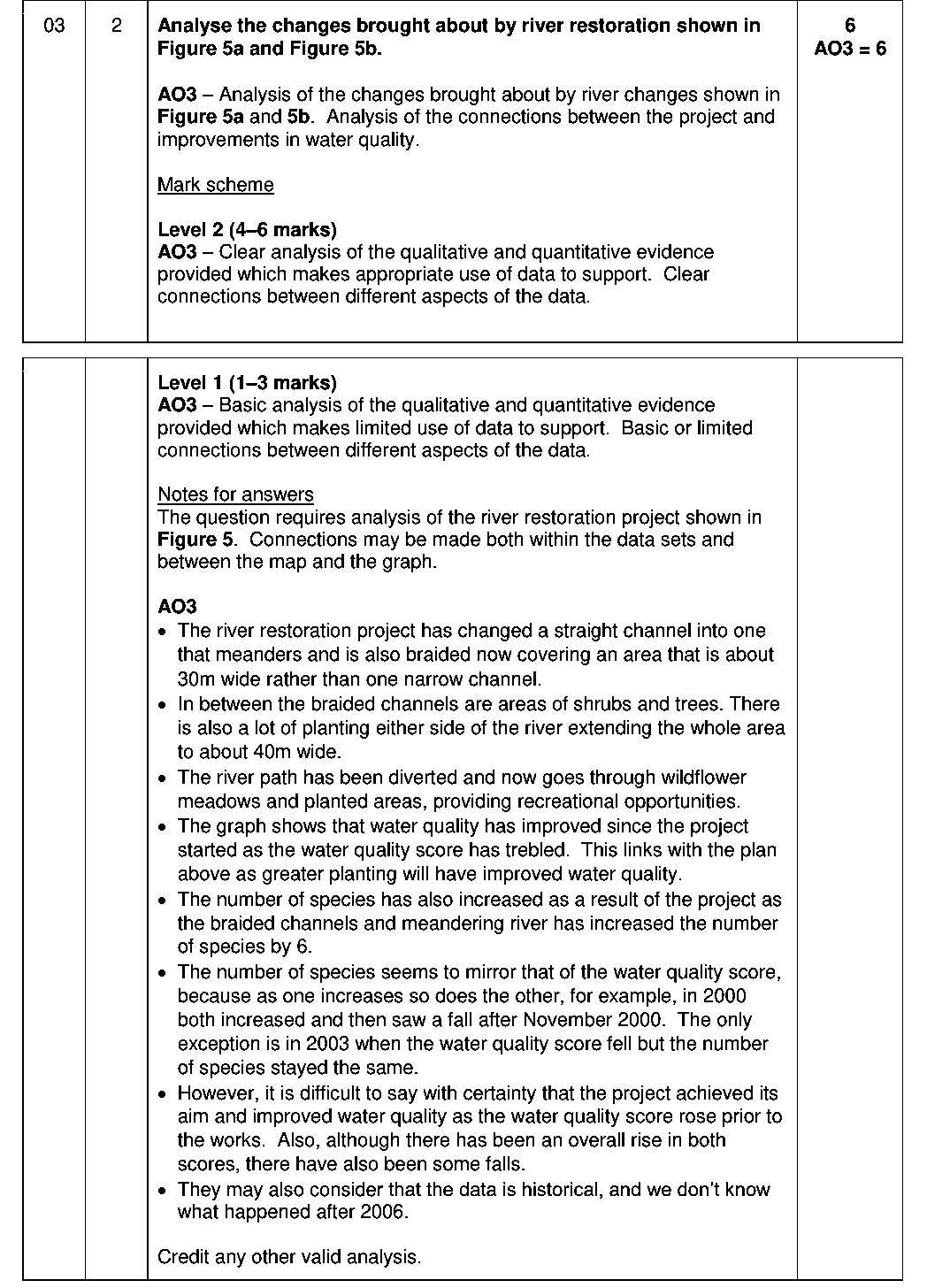
Mark scheme, including the levels and indicative content
Examiner's comment
Over half of all students were able to access L2 on this question. Answers generally focused on Figure 5b, using the data to support analysis of changes in water quality and invertebrate species. The best students were able to use this data to make connections with the changes that had taken place in Figure 5a. Some students only saw an overall improvement in water quality and/or number of invertebrate species. More sophisticated responses acknowledged that there wasn't a consistent improvement over time and thus used the data from Figure 5b more effectively. Some students read data in Figure 5b inaccurately, which impacted the accuracy of their response. This shows the importance of practising all the skills listed in the skills section and ensuring students can read simple graphs as well as more complex ones.
Notes from the mark scheme and report
AO3: plan shows straight channel replaced by meandering/braided channel and planting zones (about 30–40 m wide)
graph shows water-quality score roughly trebles and species up by 6, with the two lines moving together but not steadily
note the score rose before the works
misreading Figure 5b cost marks
November 2021 · Paper 2 · Q3.49 marksmark scheme9-mark essay
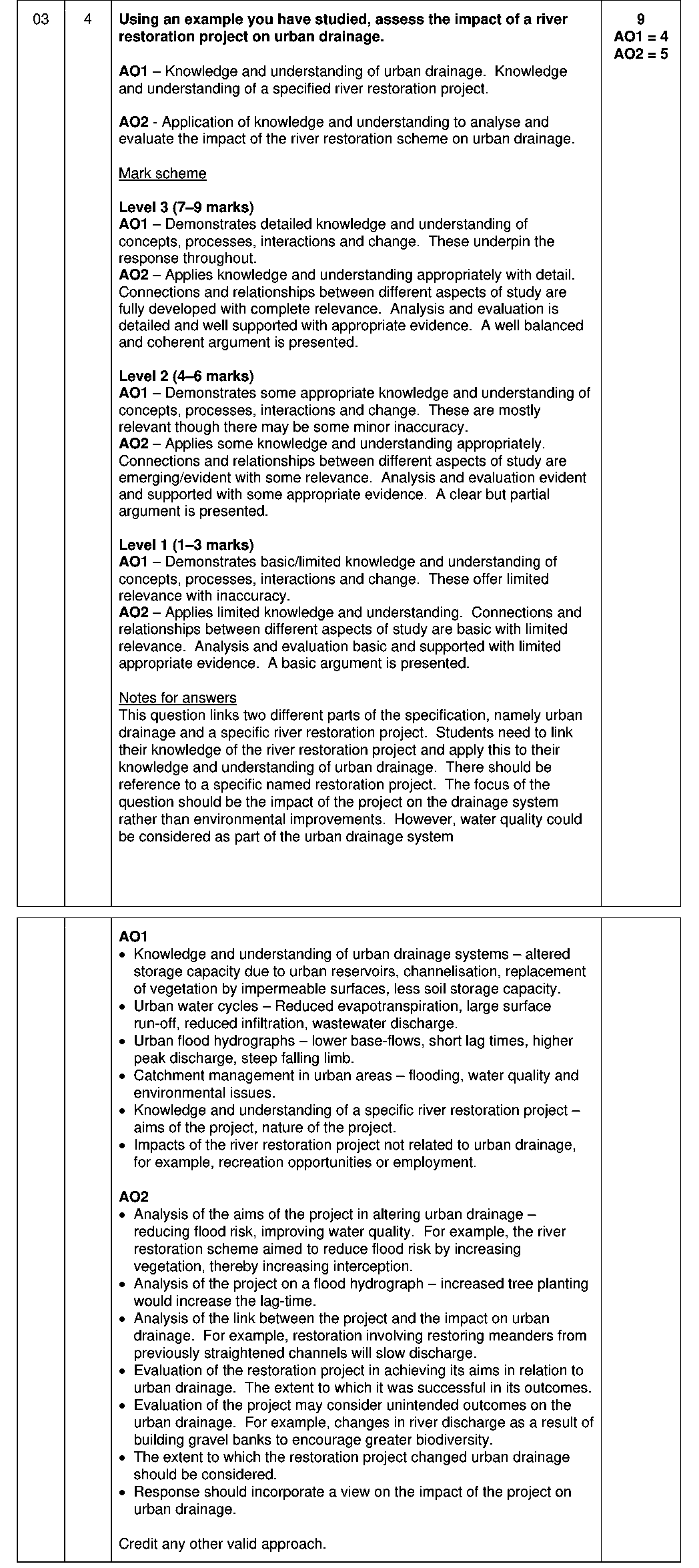
Mark scheme, including the levels and indicative content
Notes from the mark scheme and report
named river restoration project required
judge its effect on urban drainage (storage, infiltration, lag time and peak discharge, flood risk, water quality) rather than general environmental gains
November 2020 · Paper 2 · Q3.520 marksmark scheme20-mark essay
Mark scheme, including the levels and indicative content
Examiner's comment
There were some very good responses to Q3.5. Some of the best responses assessed the opportunities brought about by river restoration projects such as the Cheonggyecheon in Seoul or specific SUDs and then compared this to the challenges of managing flood risk in cities, leading to unsustainable practices. Weaker responses were typified by a lack of specific examples and a reliance on generic knowledge of sustainable cities.
Notes from the mark scheme and report
flood risk and channelisation as challenges v SuDS and river restoration (e.g. Cheonggyecheon) as opportunities
weaker answers lacked examples and relied on generic sustainable-city knowledge
June 2019 · AS Paper 1 · Q5.11 markmark schemeMultiple choice
Answer
D
Mark scheme
Notes from the mark scheme and report
Answer: D
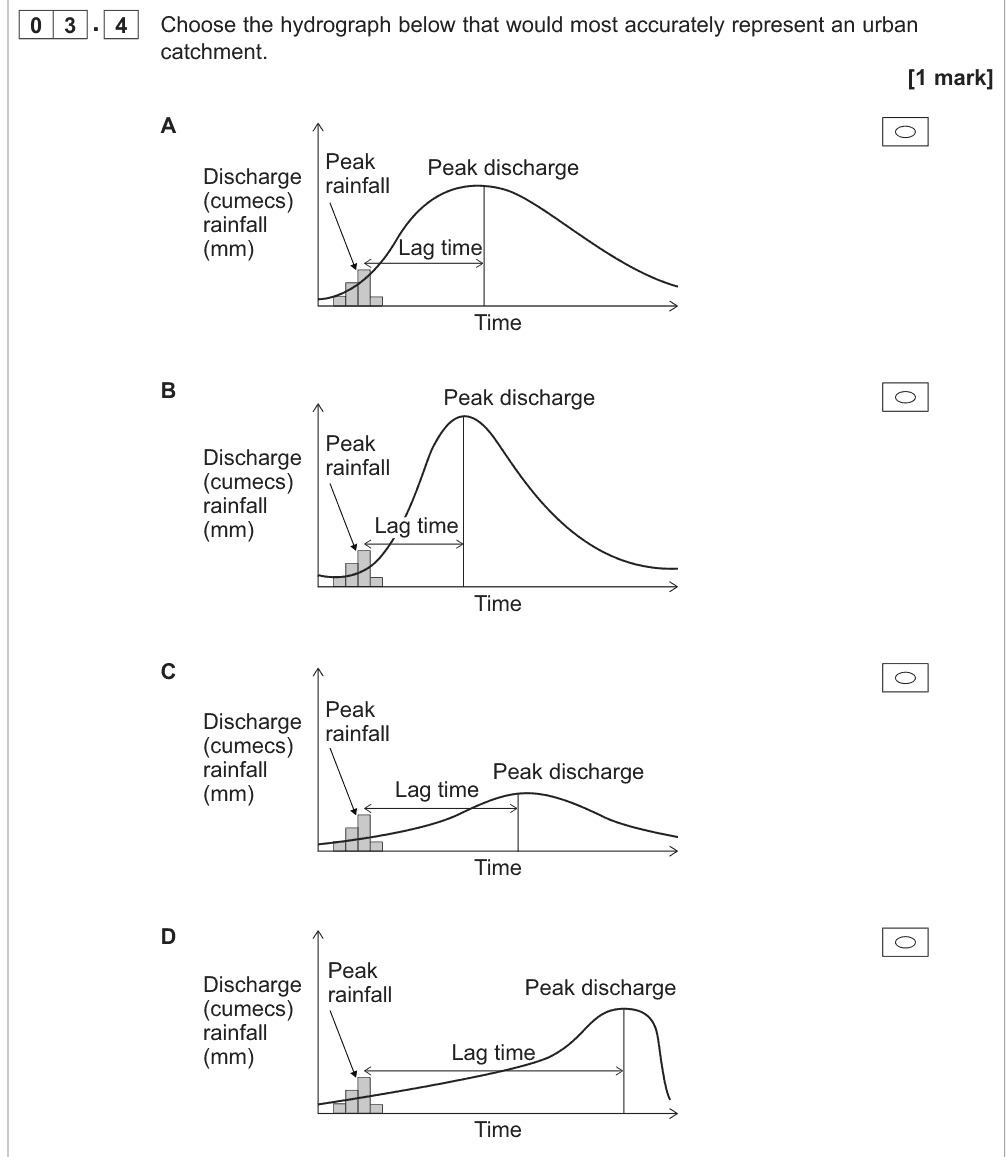
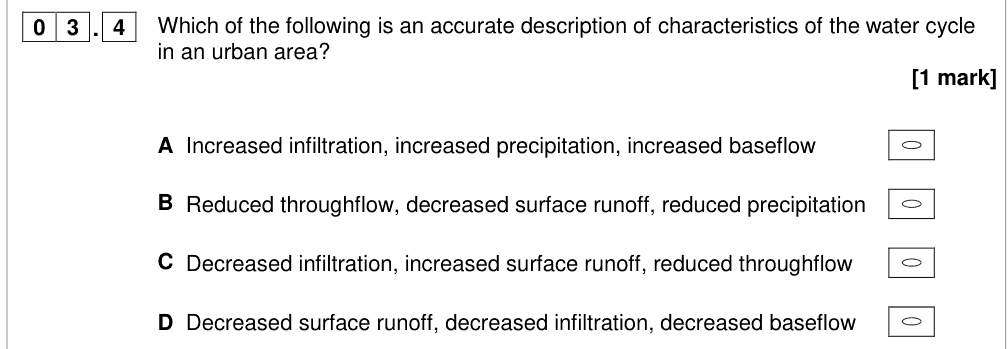
June 2019 · Paper 2 · Q3.41 markmark schemeMultiple choice
Answer
B
Mark scheme
Examiner's comment
Over two-thirds identified B as the correct answer.
Notes from the mark scheme and report
Answer: B (urban hydrograph: short lag time, high peak)
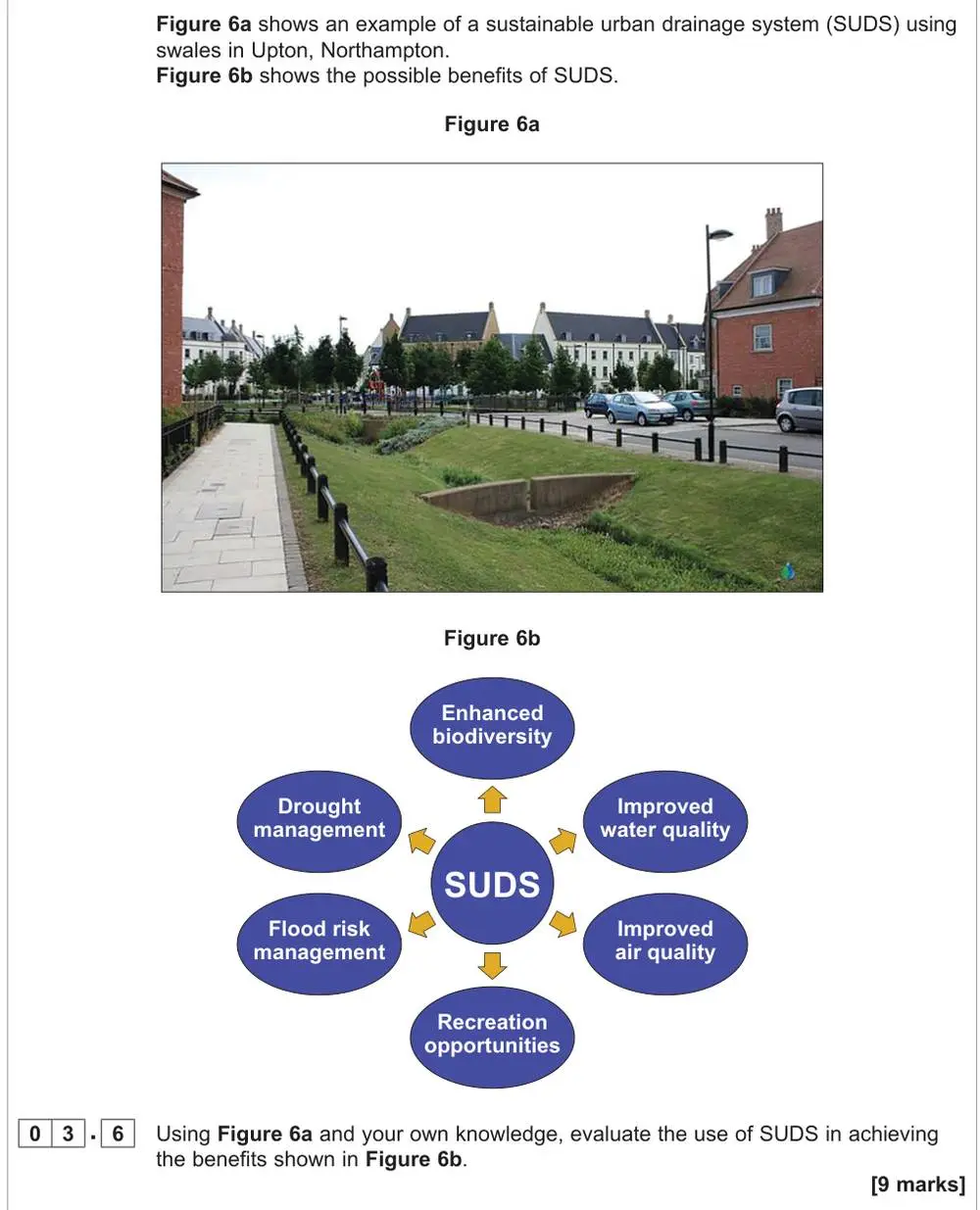
June 2019 · Paper 2 · Q3.69 marksmark schemeStimulus
Mark scheme, including the levels and indicative content
Examiner's comment
A full range of responses was seen on this question which discriminated well. Most students were able to access at least level 2 by having some understanding of the concept of SUDs and applying this to the figures. For example, many were able to explain the benefits of Figure 6a linked to 6b. Students who did not make reference to their own knowledge of SUDs schemes found it difficult to access marks beyond low level 2, relying on simplistic links between phrases in 6b and their supposed presence in 6a. The best answers at level 3 were able to evaluate 6a and other SUDs schemes (Lamb Drove was very popular) in relation to some of the phrases in 6b. At times, there was confusion with river restoration projects showing the need to learn key concepts accurately. Whilst students were able to score credit with generic relevant ideas, inappropriate aspects featured frequently in responses.
Notes from the mark scheme and report
apply knowledge of SUDS (swales, detention basins, green roofs, e.g. Lamb Drove) to each benefit in Figure 6b
answers without own SUDS knowledge stayed low Level 2
do not confuse with river restoration
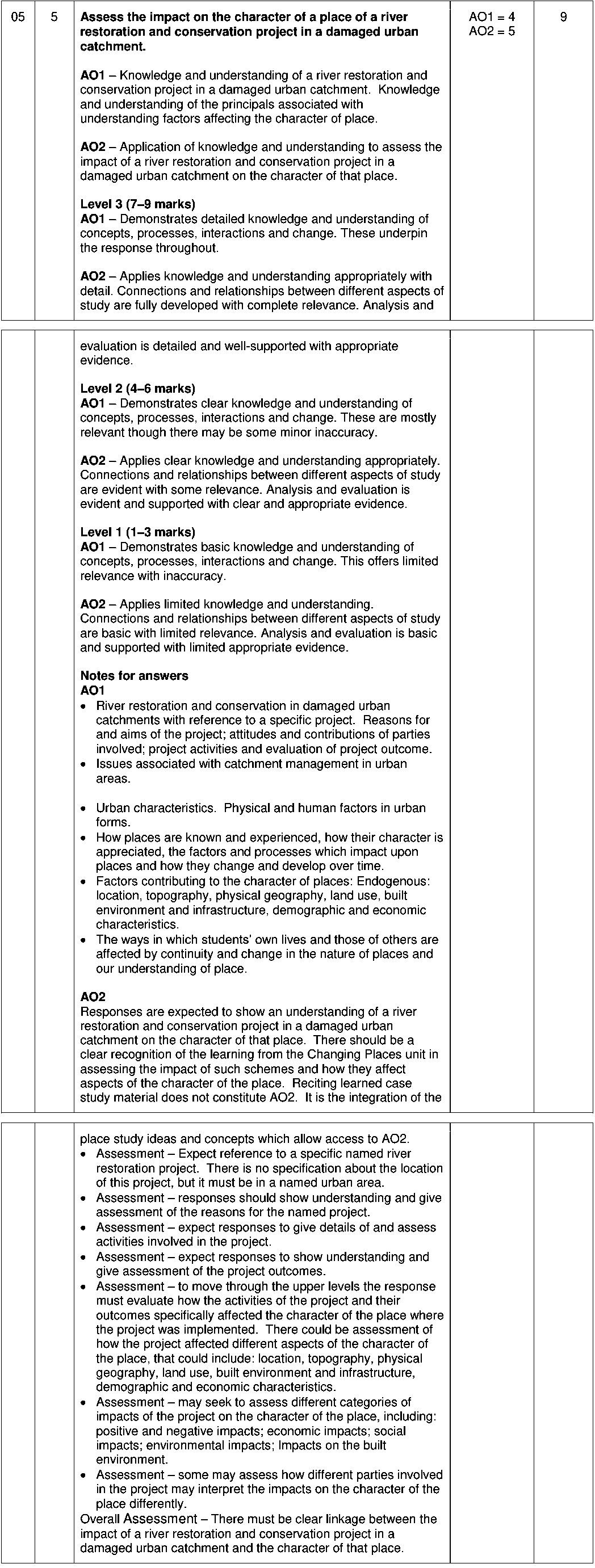
June 2018 · AS Paper 1 · Q5.59 marksmark schemeSynoptic
Mark scheme, including the levels and indicative content
Examiner's comment
This was the comparable question to 4.5. The requirements of this question crossed specification units. It is important to remind centres that every series there will be one question which crosses specification units at both AS and A-level. In this case, the link was to Changing Places. The concept (from that unit) of the character of place, was integrated into this contemporary urban environments question. It is an Ofqual requirement that such questions are set every series so that students can demonstrate understanding and learning from across the breadth of study. The nature of impacts on the character of places depended on the choice of river restoration and conservation project. A significant number of responses did not move beyond outlining the nature of the chosen project, often with little more than a summary of the positive and negative achievements. Better responses needed to clearly engage with how the project impacted on the character of the place. Where this was done well there was reference, not just to the physical character of the place, i.e. aspects of the built environment and land use, but also to other aspects of the character of the place. These could have included the cultural and social character of the place, i.e. how different people engaged with, or felt differently about the place following the project. Others referred to improvements in the economic character of a place, with improved opportunities for tourism or increased property values, and the subsequent impacts on character that these would have had. Some engaged with this cross specification link well, however many struggled. The average mark was for this question was 3.69. 52% of responses reached Level 2 or above, but only 14% achieved Level 3. Surprisingly, of those who answered the other parts of question 5, 4.47% did not attempt this question and 7.75% scored zero.
Notes from the mark scheme and report
cross-specification link to Changing Places (character of place)
must assess how a named urban river restoration project changed the physical, social, cultural and economic character of the place, not just describe the project
only 14% reached Level 3
mean 3.69
June 2018 · Paper 2 · Q3.41 markmark schemeMultiple choice
Answer
C
Mark scheme
Examiner's comment
Nearly all students identified C as the correct answer.
Notes from the mark scheme and report
Answer: C
nearly all correct
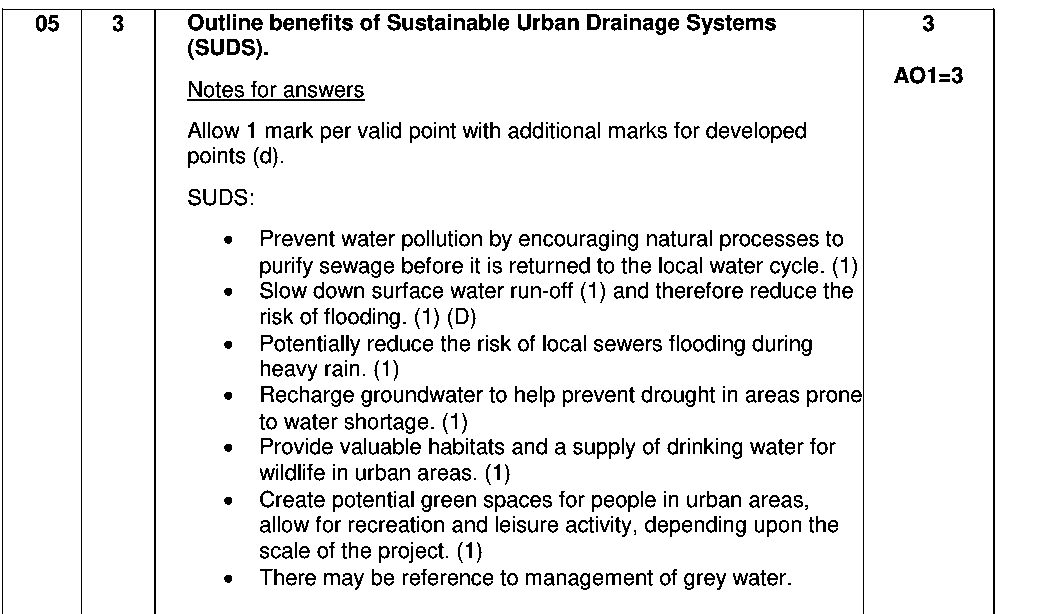
June 2017 · AS Paper 1 · Q5.33 marksmark schemeShort answer
Mark scheme
Examiner's comment
14% failed to secure any credit on this question. There were a number of approaches that students could have taken but many appeared to be guessing. Those that had clearly studied this concept scored three marks. Most made reference to SUDS being used to control flooding. Few went further to consider the reduction in pollution, creation of habitats and leisure opportunities for people.
Notes from the mark scheme and report
reduce flood risk, filter pollution, recharge groundwater, habitats, green space
most only mentioned flooding
14% scored zero
Work with an AQA Geography tutor
Essays stuck in the middle levels, or losing marks on the data questions? Book a trial lesson with a specialist AQA Geography tutor.