3.2.5.3-01 Sources of water; components of demand, water stress.A level only
3.2.5.3-02 Relationship of water supply (volume and quality) to key aspects of physical geography – climate, geology and drainage.A level only
3.2.5.3-03 Strategies to increase water supply to include catchment, diversion, storage and water transfers and desalination.A level only
3.2.5.3-04 Environmental impacts of a major water supply scheme incorporating a major dam and/or barrage and associated distribution networks.A level only
3.2.5.3-05 Strategies to manage water consumption (including reducing demand).A level only
3.2.5.3-06 Sustainability issues associated with water management: virtual water trade, conservation, recycling, ‘greywater’ and groundwater management.A level only
3.2.5.3-07 Water conflicts at a variety of scales – local, national, international.A level only
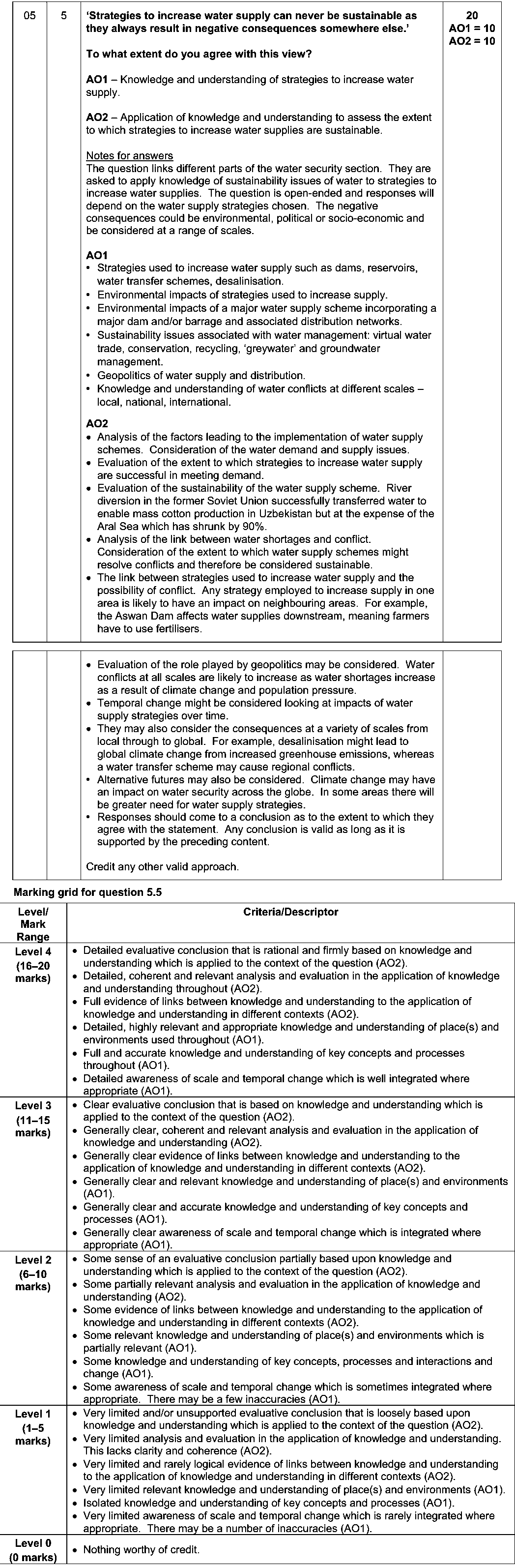
‘Strategies to increase water supply can never be sustainable as they always result in negative consequences somewhere else.’ To what extent do you agree with this view?
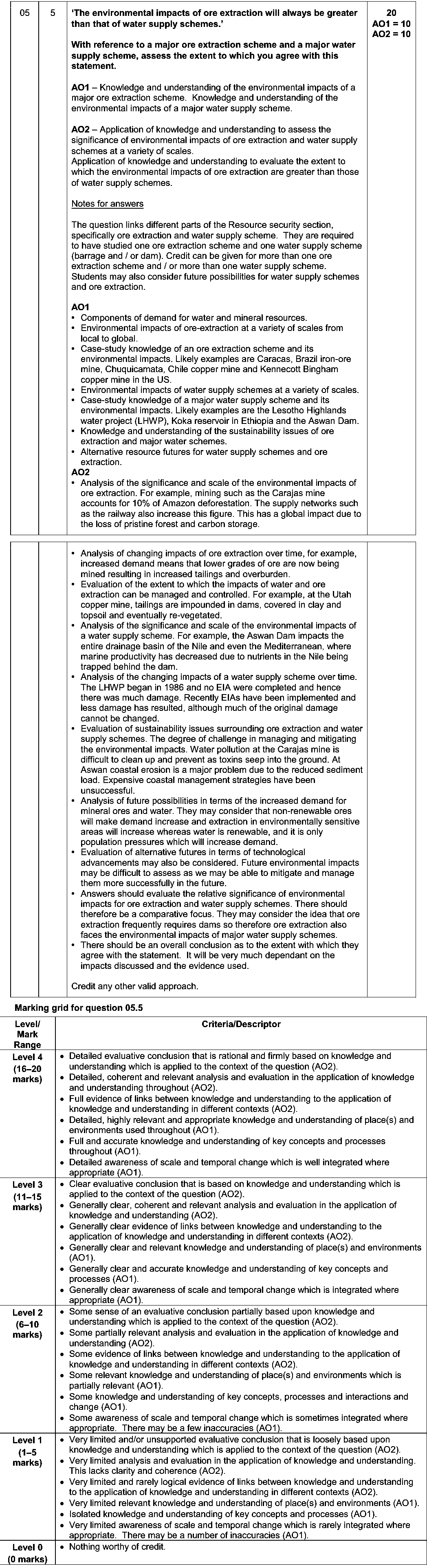
‘The environmental impacts of ore extraction will always be greater than that of water supply schemes.’ With reference to a major ore extraction scheme and a major water supply scheme, assess the extent to which you agree with this statement.
‘Physical factors are more important than human factors in determining strategies for managing water supply, but this may change in the future.’ To what extent do you agree with this view?
Tap a question to zoom it. The figures open above it; the mark scheme (with its levels and indicative content) and the examiner's comment open underneath.
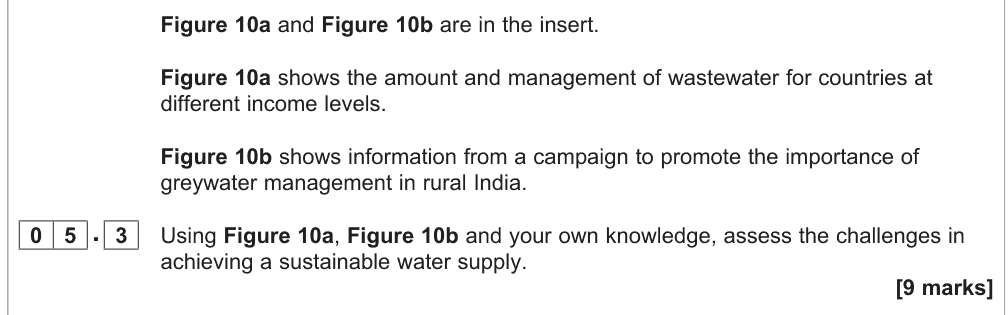
June 2025 · Paper 2 · Q5.39 marksmark schemeStimulus
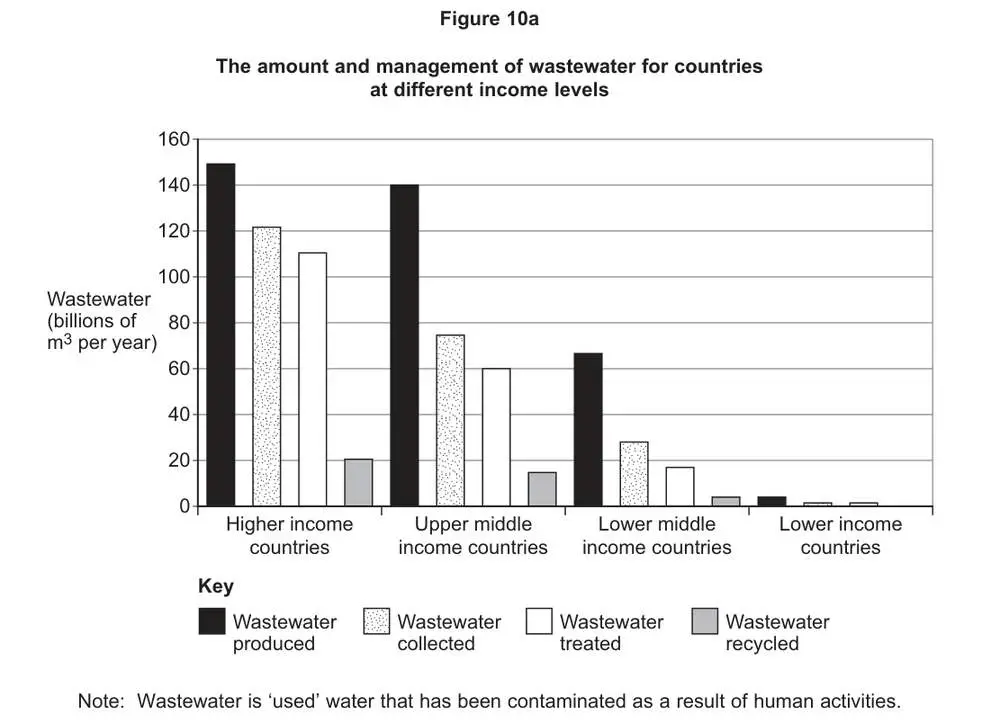
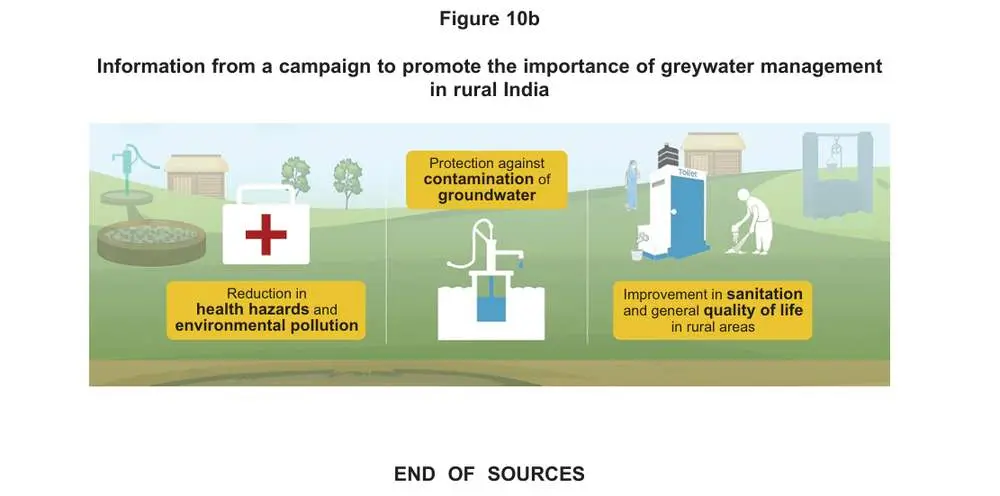
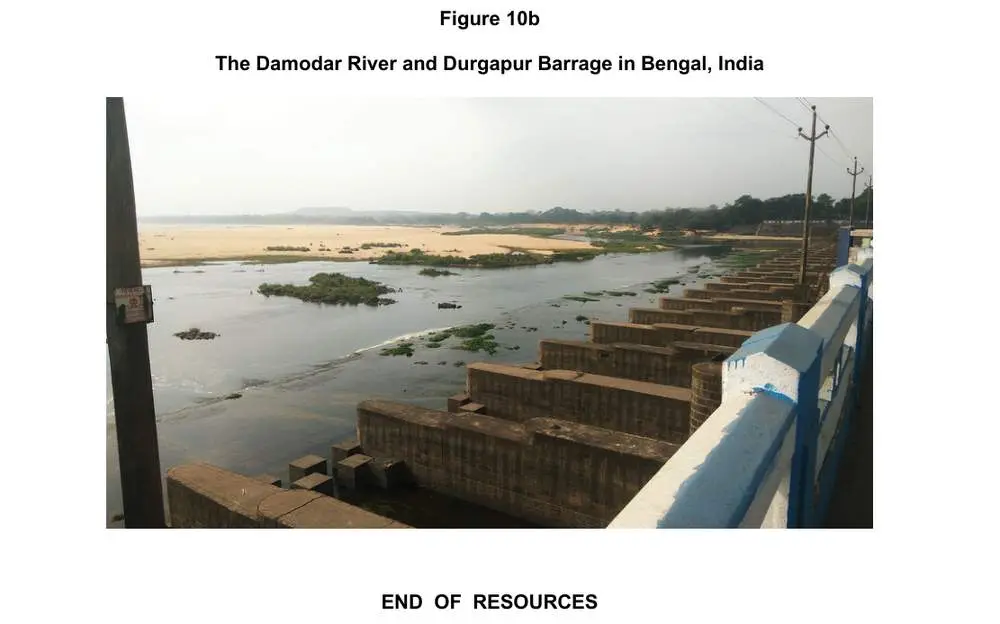
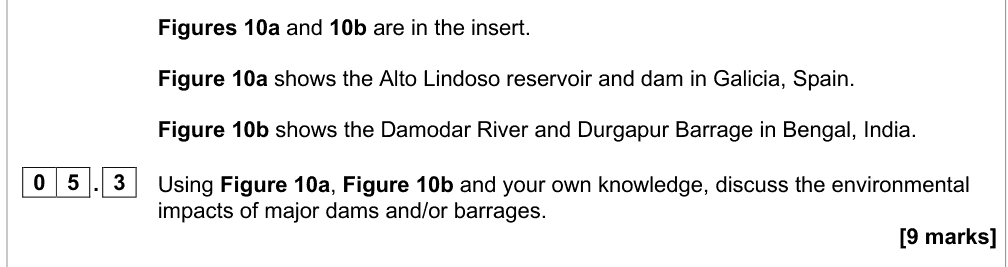
Figures 10a, 10b
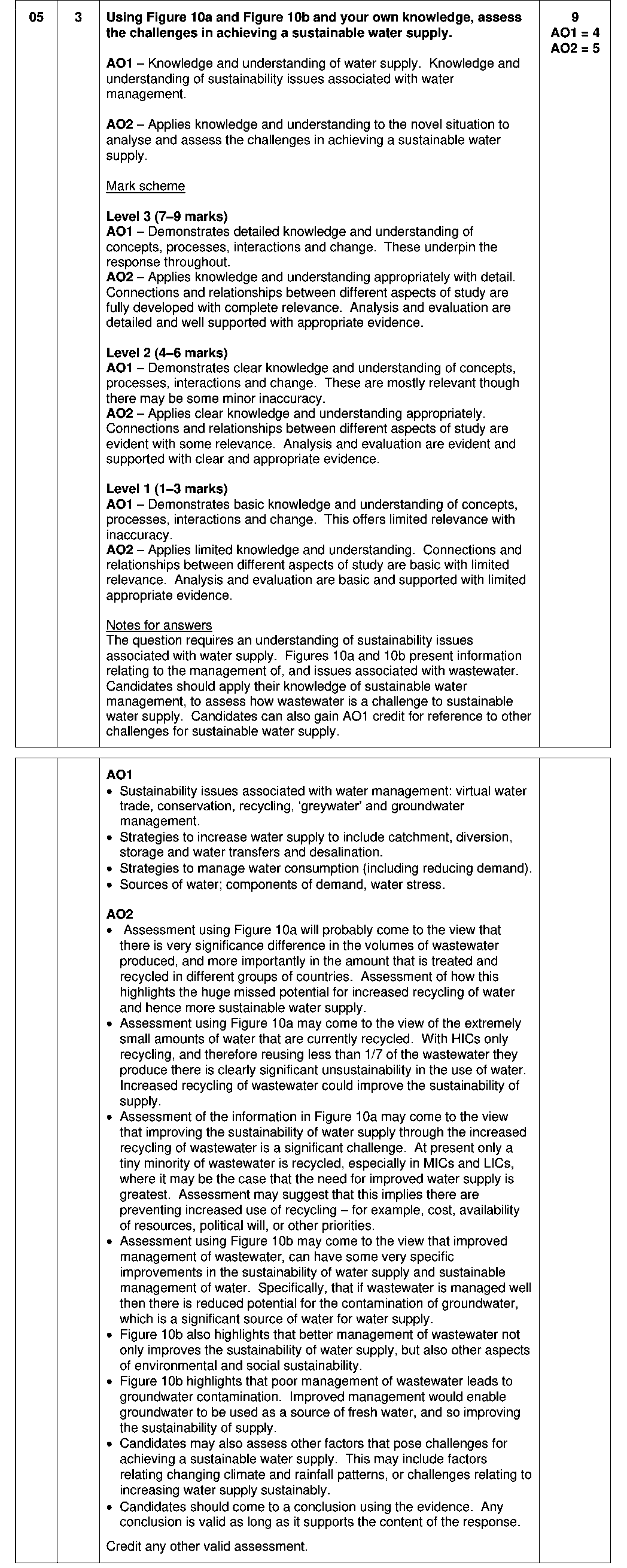
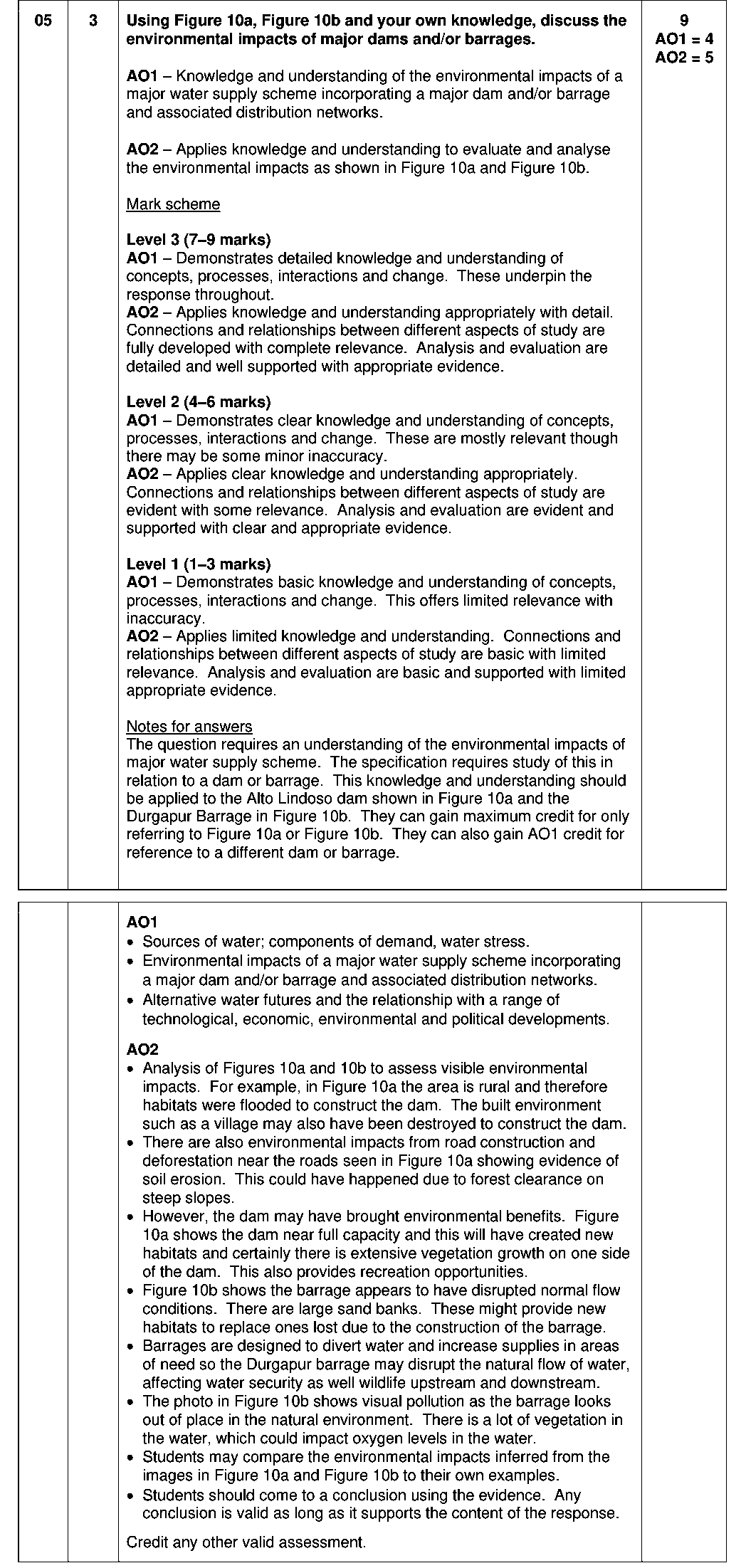
Mark scheme, including the levels and indicative content
Examiner's comment
In the 6- and 9-mark questions (AO1 & AO2) that used novel stimulus material there was evidence of some student confidence and clear application of knowledge and understanding. Most of the 6- and 9-mark questions evidenced some good subject knowledge and application. However, students could achieve higher marks within Level 2 or 3 by making their assessments and evaluations more explicit. These questions are based on the novel resources, designed to assess students’ abilities in how well they can apply their understanding of the specification topic to unfamiliar scenarios. Students should integrate their own knowledge and understanding, with the information presented in the novel material to answer the question. In both of the 6- and 9-mark questions, AO2 has a greater bearing on the distribution of marks, so the assessment or evaluation is more significant. Students should use their ‘own knowledge’ (AO1) to support their reasons. Students obtaining Level 1 in these questions often do not address the question posed or lean towards a description of the novel resources. In Section C, students chose to answer questions from the optional topics they had studied. o On question 03.3 the novel resource focussed on fortress developments o On question 04.3 the novel resource focused on female education and fertility o On question 05.3 the novel resources focused on wastewater and greywater management Students linked the resources to their own knowledge, rather than describing the information presented. In Section C, each of the 9-mark questions showed mean scores of over 5.0, indicating mid-level 2 performance. Students showed knowledge and evaluation of sustainable cities, local-scale factors negatively impacting health, and the geopolitics of mineral resources.
Notes from the mark scheme and report
apply wastewater recycling and greywater management to the figures: tiny share recycled (under 1/7 even in HICs), cost and infrastructure barriers in LICs
other supply challenges credited as AO1
June 2024 · Paper 2 · Q5.39 marksmark schemeStimulus
Figures 10a, 10b
A figure for this question was removed from AQA's published paper for copyright reasons.
Mark scheme, including the levels and indicative content
Examiner's comment
The 6- and 9-mark questions in each section referring to stimulus material (.3) were attempted with some confidence. Students used their own knowledge and understanding alongside the resources to answer the question and this was most effectively done in the options (3.3, 4.3 and 5.3). Each scenario required students to consider an area of the specification (mitigation strategies for non-communicable diseases, edge cities and the environmental impacts of dams / barrages), link the resource and utilise their own knowledge. Students are clearly well prepared for these questions and relatively few gave descriptive or analytical responses based solely on the novel resource. The AO1/AO2 questions using a novel resource, aim to test students’ abilities to apply their knowledge of a key idea to the situation presented and bring in some of their own knowledge to support their argument. In these questions, AO2 is more heavily weighted than AO1 and therefore the argument along with the application from the resource is key but ‘own knowledge’ as well also gains credit. When students do not score so well on these questions it can usually be put down to one of three things. Either, they analyse the resource (doing what they should be doing with the .2 questions), only comment on the resource as a route towards answering the question (so use none of their ‘own knowledge’) or the reverse where they use only their own knowledge (AO1) and do not interface with the resource (AO2). Relatively few students gave solely descriptive accounts of the novel resources provided in the .3 questions. Where this did occur, students only obtained credit in Level 1.
Notes from the mark scheme and report
environmental impacts of dams/barrages (flooded habitats, sediment trapping, flow change, fish migration) applied to the photos
one figure alone can reach full marks
other schemes credited as AO1
Figure 10a not reproduced in the published paper
June 2023 · Paper 2 · Q5.520 marksmark scheme20-mark essay
Mark scheme, including the levels and indicative content
Examiner's comment
The 20 mark responses in all 5 questions produced some interesting and considered responses from many students although some leaned very heavily on some outdated and clichéd views of places or made contrasts between places that were difficult to compare in a meaningful way. As mentioned in the introduction, there were some very clear and focused 20-mark responses and it is apparent that students are well-trained for these questions. Good practice was seen with responses that start with a clear position statement and then developed a clear thread with evidence from valid examples. This balance of AO1 and AO2 is the way to good marks. There should be a final conclusion that clearly links back to the question set. Where students did not perform as well in the essay questions, the opposite characteristics were often evident - namely, no clear position statement, copious AO1 retelling case study knowledge without application and an absent, vague or unsubstantiated conclusion. Q5.5 demonstrated good case study use with some detailed knowledge of water transfer schemes and desalinisation projects employed to illustrate and evaluate the sustainability of water supplies. The biggest issue with responses to Q5.5 was that of recounted case studies of water transfer schemes without discussion of the sustainability aspect that the question was probing.
Notes from the mark scheme and report
judge sustainability of dams, transfers and desalination and whether negative consequences elsewhere are inevitable (Aral Sea, Aswan, conflicts, emissions)
many recounted transfer schemes without discussing sustainability
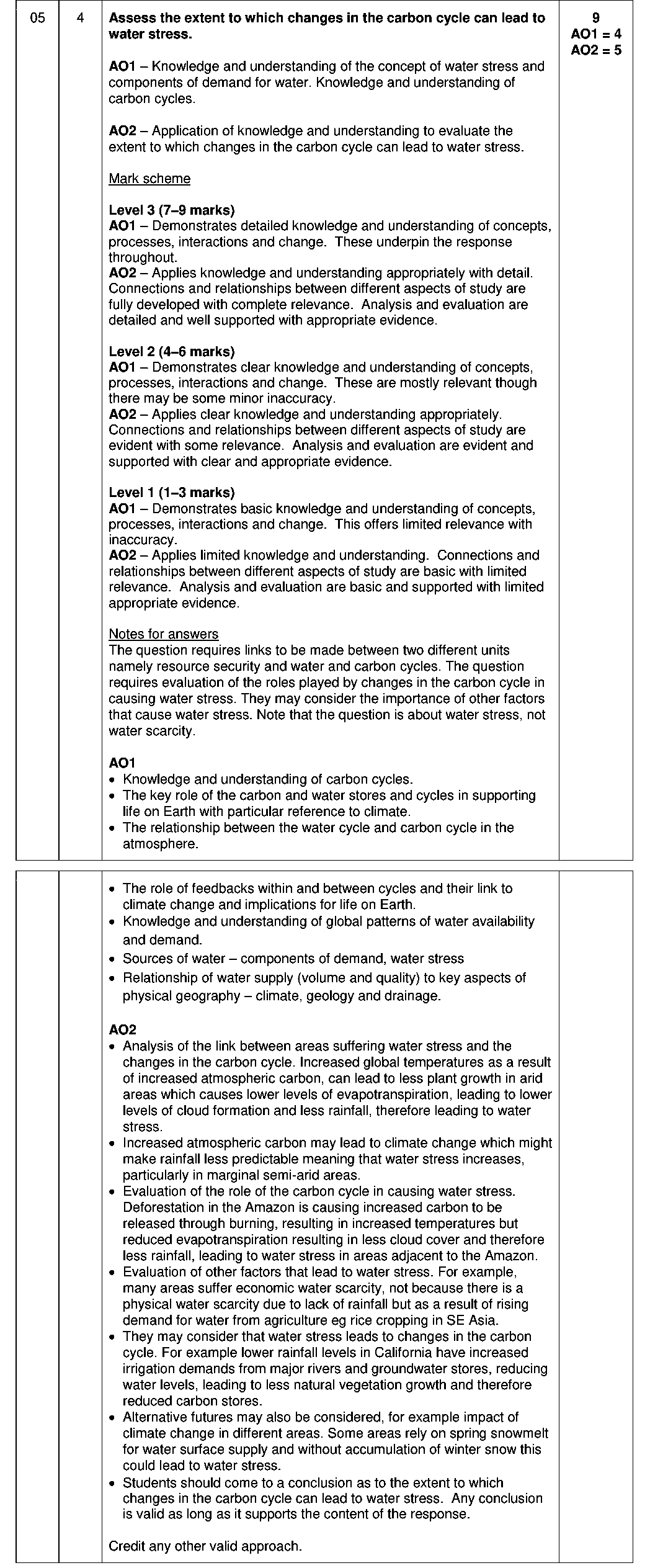
June 2022 · Paper 2 · Q5.49 marksmark schemeSynoptic
Mark scheme, including the levels and indicative content
Examiner's comment
The cross-specification question within the optional sections (3.4, 4.4 and 5.4) was evidence of this and stuents seemedless-well prepared for this type of question. As with 3.4 and 5.4, many students seem unprepared for this cross-specification question. They were asked to apply knowledge of the carbon cycle to causes of water stress. Many students found this very challenging. Many responses were very generic and did not use evidence in support. The best responses used examples of locations suffering water stress and were able to use their knowledge of the location to suggest how changes in the carbon cycle might affect the level of water stress. Teaching concepts through use of examples, certainly provides students more to develop in all exam questions. Weaker responses tended to focus on changes in the carbon cycle with simple links to increased evaporation or more droughts.
Notes from the mark scheme and report
cross-specification link to water and carbon cycles: rising atmospheric carbon, warming and less reliable rainfall in named water-stressed places, weighed against demand-side causes
about water stress not scarcity
generic evaporation/drought links scored low
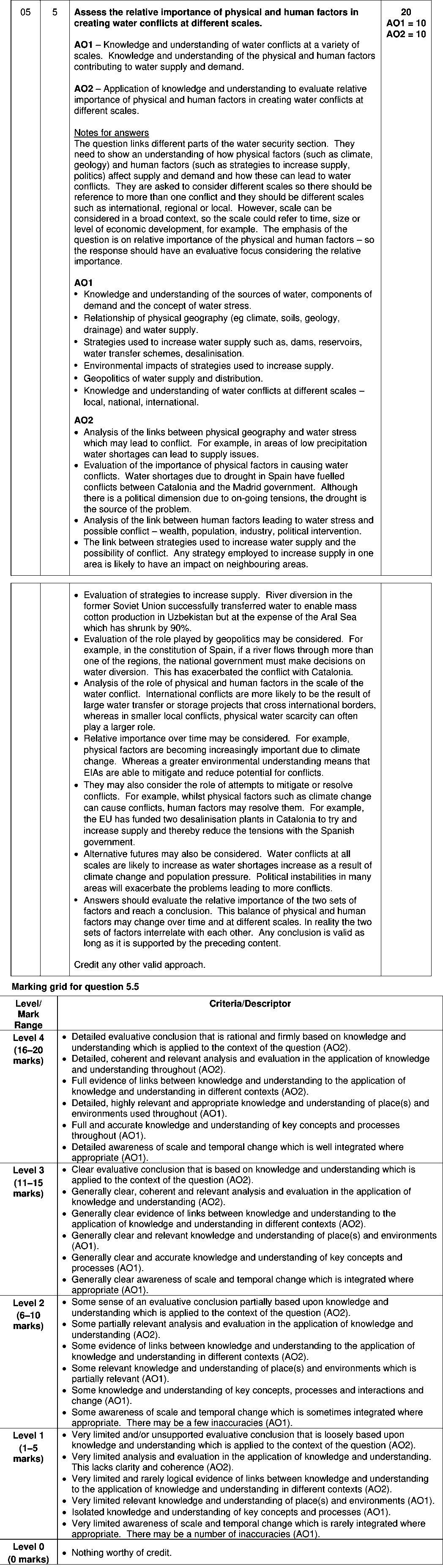
November 2021 · Paper 2 · Q5.520 marksmark scheme20-mark essay
Mark scheme, including the levels and indicative content
Notes from the mark scheme and report
relative importance of physical (climate, drainage, geology) and human (dams, abstraction, politics, demand) factors in water conflicts at more than one scale (local, national, international — e.g. Nile, Mekong)
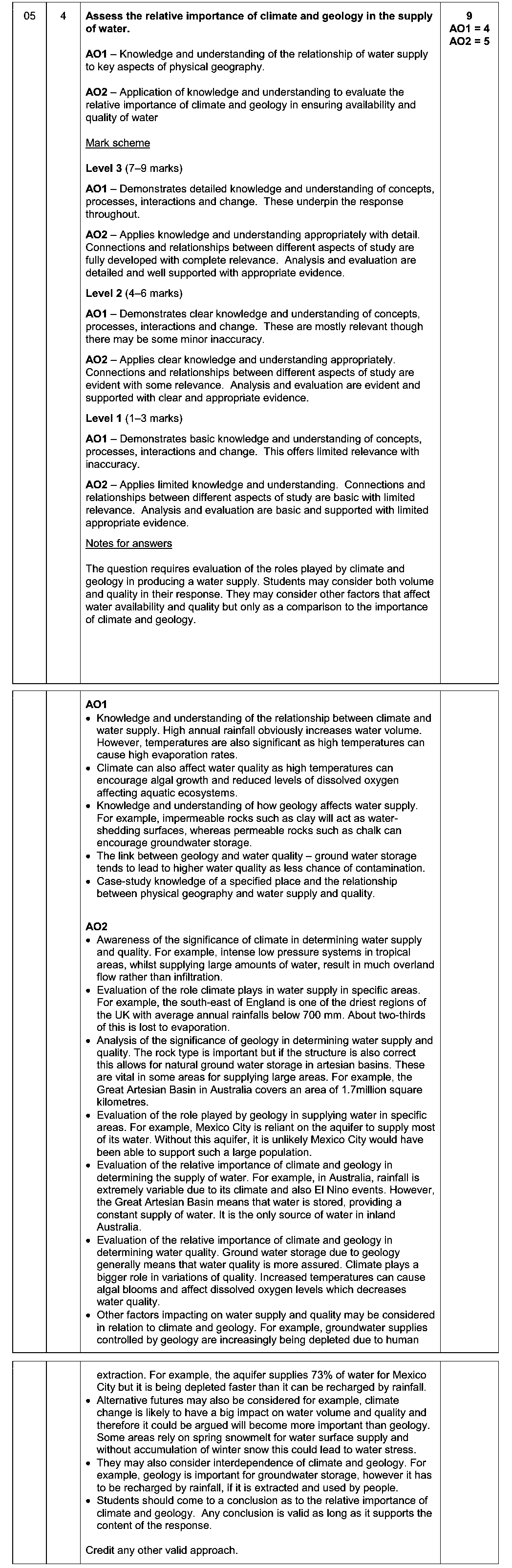
November 2020 · Paper 2 · Q5.49 marksmark scheme9-mark essay
Mark scheme, including the levels and indicative content
Examiner's comment
Q5.4 required students to assess the relative importance of climate and geology in the supply of water. All too frequently, they were only able to refer to climate. This very much limited them to level one marks. Whilst there is no requirement for an even balance, there must be a discussion of both to engage with relative importance. Where students are asked to consider relative importance, they should look at what has a bigger role rather than just simply stating the importance without any comparative element. Whilst there was no requirement to do so, the better responses used a place example to exemplify their points, with Mexico City being a popular choice. This confirms that supervising teachers should encourage students to support answers with specific learnt examples where they can do so.
Notes from the mark scheme and report
must discuss both climate (rainfall, evaporation) and geology (aquifers, artesian basins) and judge relative importance
climate-only answers limited to Level 1
Mexico City a popular example
November 2020 · Paper 2 · Q5.520 marksmark scheme20-mark essay
Mark scheme, including the levels and indicative content
Notes from the mark scheme and report
compare environmental impacts of a named ore scheme (e.g. Carajás, Bingham) and a named dam/water scheme (e.g. Aswan, Lesotho Highlands) at different scales and over time
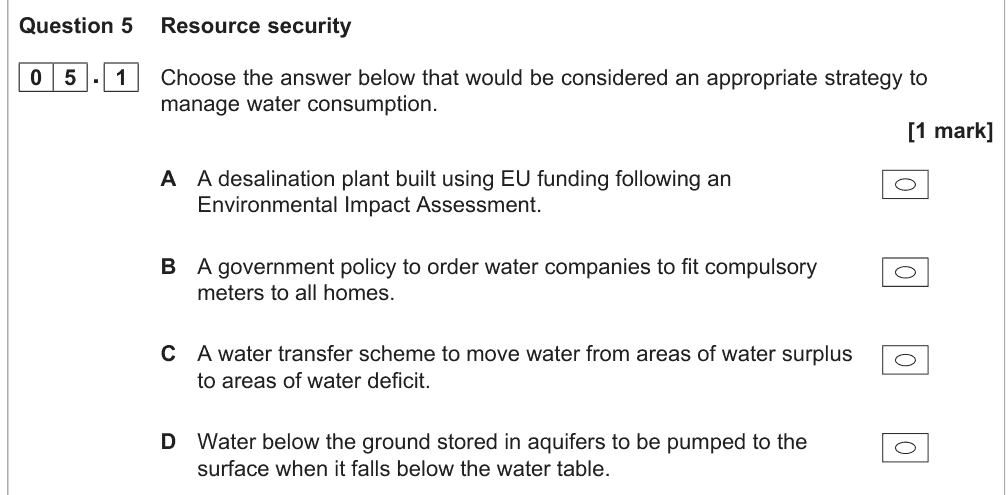
June 2019 · Paper 2 · Q5.11 markmark schemeMultiple choice
Answer
B
Mark scheme
Examiner's comment
Nearly all students correctly identified B as the right answer, showing that they understood the difference between managing consumption and managing supply.
Notes from the mark scheme and report
Answer: B (compulsory water meters manage consumption
others increase supply)
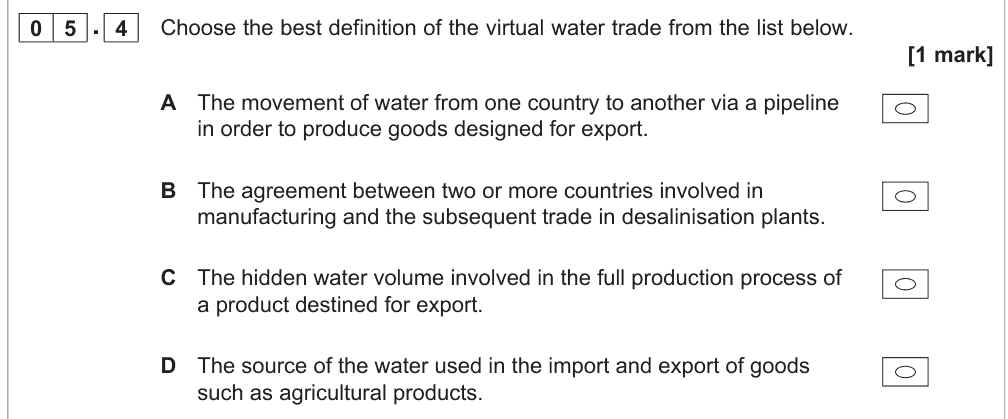
June 2019 · Paper 2 · Q5.41 markmark schemeMultiple choice
Answer
C
Mark scheme
Examiner's comment
Three-quarters of students correctly identified C as defining the virtual water trade.
Notes from the mark scheme and report
Answer: C (hidden water in production of exported goods)
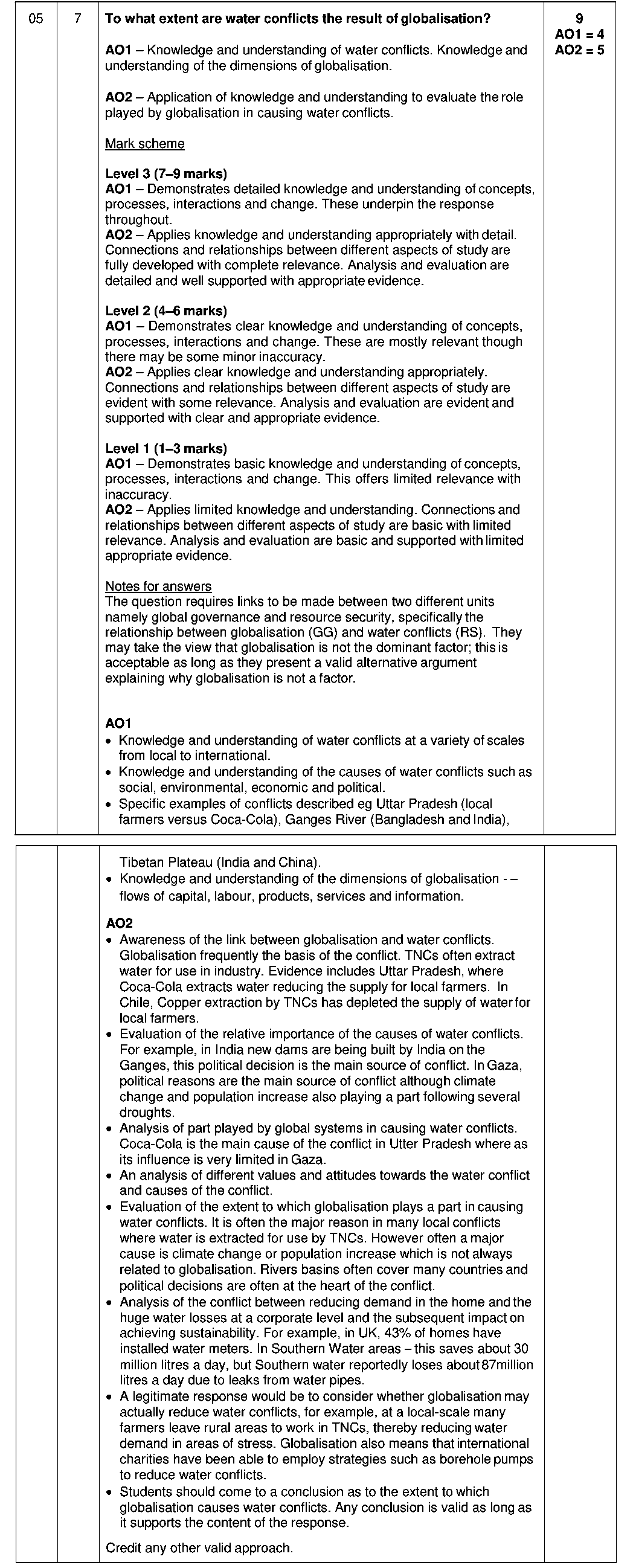
June 2019 · Paper 2 · Q5.79 marksmark schemeSynoptic
Mark scheme, including the levels and indicative content
Examiner's comment
This cross-specification question proved quite challenging, as did comparable questions 3.7 and 4.7, requiring students to link their knowledge of water conflicts or society to the extent to which globalisation was responsible for the conflict. Many students simply set out their AO1 knowledge of water conflicts with only a passing reference to globalisation. The question required students to assess the extent of the contribution made by globalisation, so it would be perfectly legitimate to show why other factors such as climate change made a larger contribution. As with other questions on this paper such as 3.7 and 4.7, clearer geographical thinking would have raised performance on this question, for example by considering important geographical concepts such as scale and temporal change in their responses.
Notes from the mark scheme and report
synoptic (links Resource security with Global systems)
may argue other causes (politics, climate change, population growth) matter more
many only described conflicts with passing reference to globalisation
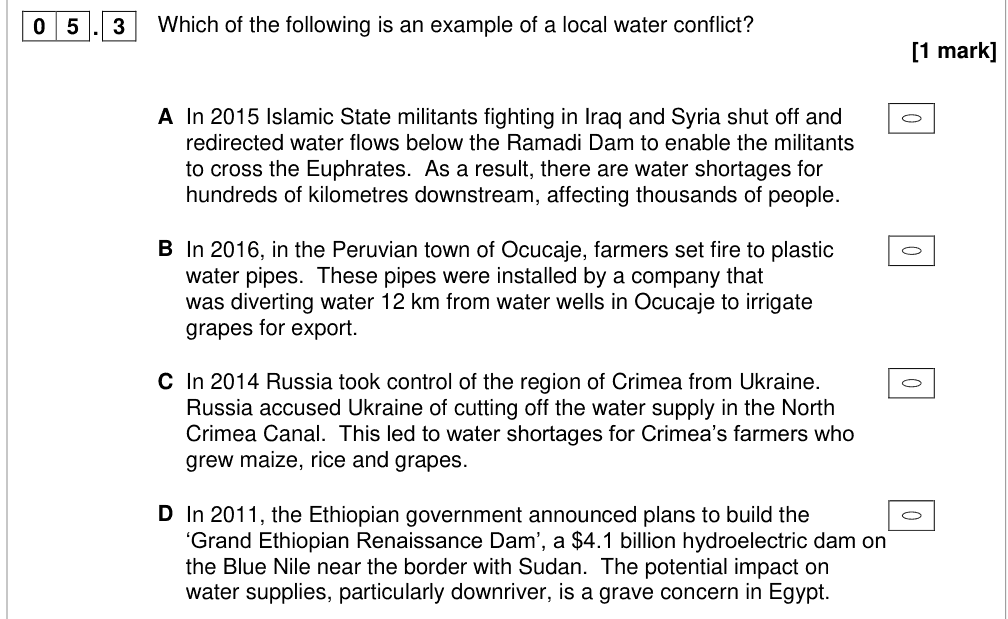
June 2018 · Paper 2 · Q5.31 markmark schemeMultiple choice
Answer
B
Mark scheme
Examiner's comment
The important word in this question was ‘local’ and most students identified B as the correct answer. D was the most commonly chosen incorrect distractor, however this is clearly international, involving Ethiopia and Egypt.
Notes from the mark scheme and report
Answer: B
key word 'local'
D (Ethiopia/Egypt) is international and was the commonest wrong choice
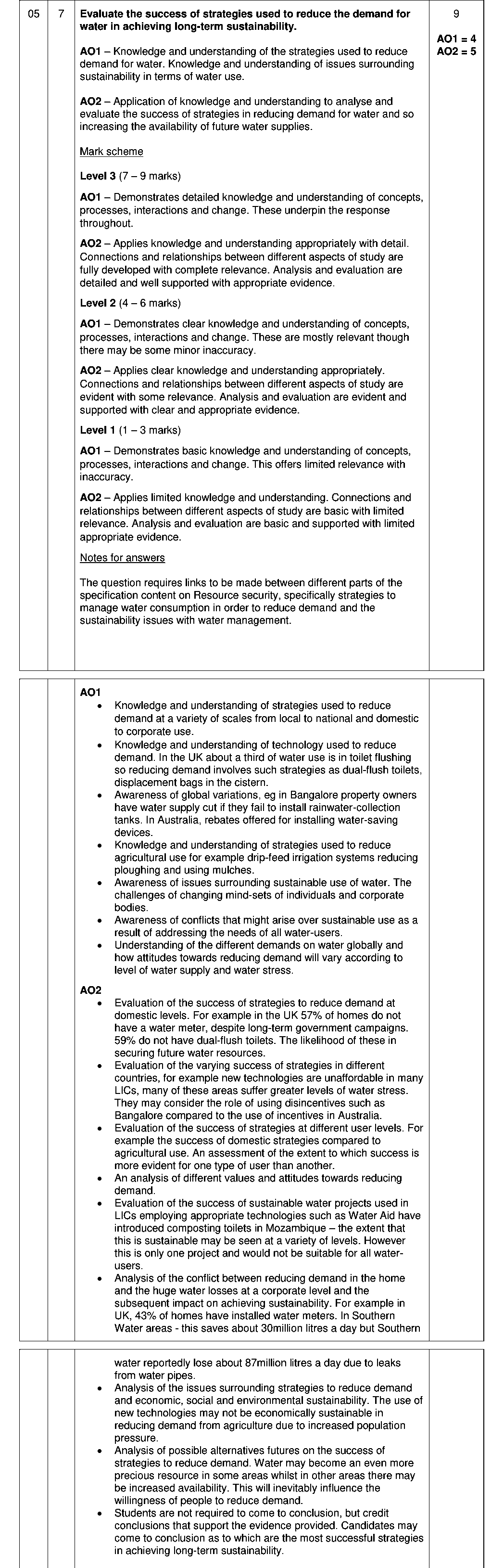
June 2018 · Paper 2 · Q5.79 marksmark scheme9-mark essay
Mark scheme, including the levels and indicative content
Examiner's comment
Some students were evidently well-prepared for this question. They had detailed knowledge of strategies employed to reduce demand and they were able to make the AO2 links to long-term sustainability, evaluating the effectiveness in achieving this. Many included multiple strategies and came to sound conclusions on overall effectiveness. However, there were also many weak responses. These tended to be largely descriptive with little or no evaluation. Some students misunderstood the question and considered strategies used to increase supply, such as irrigation.
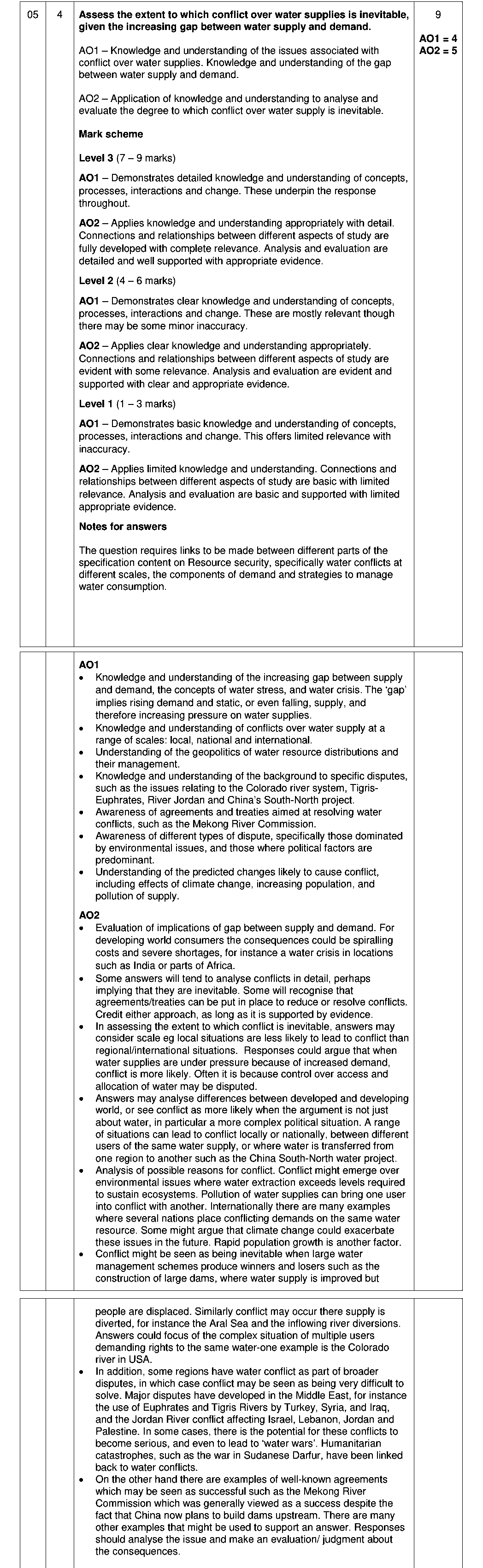
Specimen set 1 · Paper 2 · Q5.49 marksmark scheme9-mark essay
Mark scheme, including the levels and indicative content
Notes from the mark scheme and report
weigh whether supply–demand gap makes water conflict inevitable at local to international scales (Colorado, Nile, Tigris–Euphrates) against cooperation and treaties (Mekong River Commission)
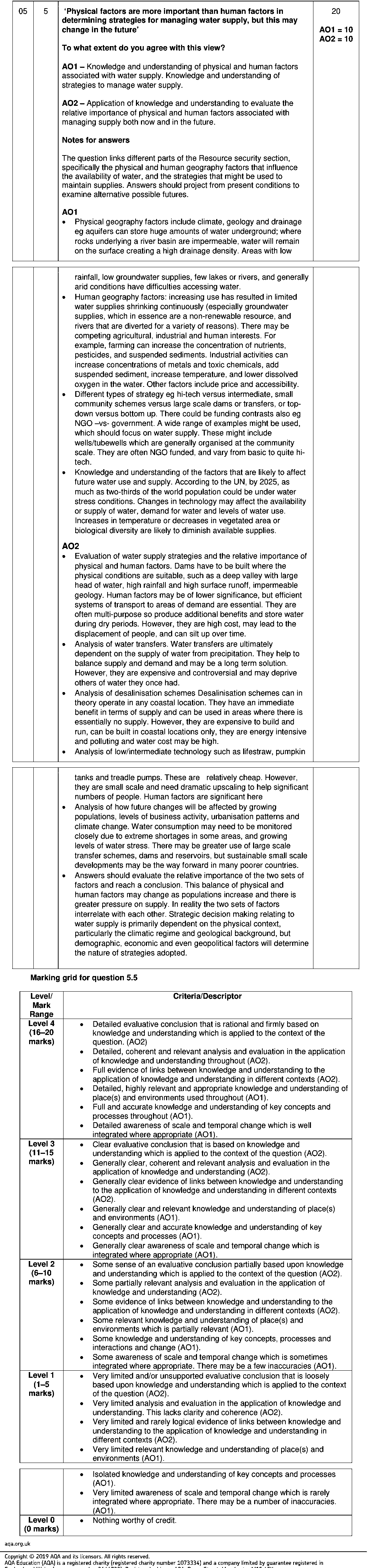
Specimen set 1 · Paper 2 · Q5.520 marksmark scheme20-mark essay
Mark scheme, including the levels and indicative content
Notes from the mark scheme and report
weigh physical factors (climate, geology, drainage) against human factors (demand, politics, technology, finance) in water-supply strategies now and in alternative futures
Work with an AQA Geography tutor
Essays stuck in the middle levels, or losing marks on the data questions? Book a trial lesson with a specialist AQA Geography tutor.