A-level Paper 1 Section C (option); AS Paper 1 Section B (option)
Level
AS and A level
Specification
3.1.5.6, 3.1.5.7, 4 content points
Since 2017
20 question parts, 13 of them essays
Specification
3.1.5.6-01 Nature of wildfires. Conditions favouring intense wild fires: vegetation type, fuel characteristics, climate and recent weather and fire behaviour. Causes of fires: natural and human agency. Impacts: primary/secondary, environmental, social, economic, political. Short and long-term responses; risk management designed to reduce the impacts of the hazard through preparedness, mitigation, prevention and adaptation.
3.1.5.6-02 Impact and human responses as evidenced by a recent wild fire event.
3.1.5.7-01 Case study of a multi-hazardous environment beyond the UK to illustrate and analyse the nature of the hazards and the social, economic and environmental risks presented, and how human qualities and responses such as resilience, adaptation, mitigation and management contribute to its continuing human occupation.
3.1.5.7-02 Case study at a local scale of a specified place in a hazardous setting to illustrate the physical nature of the hazard and analyse how the economic, social and political character of its community reflects the presence and impacts of the hazard and the community’s response to the risk.
‘People live successfully in multi-hazardous environments as they are able to adapt to and mitigate the impact of the hazards they face.’ With reference to a multi-hazardous environment beyond the UK that you have studied, assess the extent to which you agree
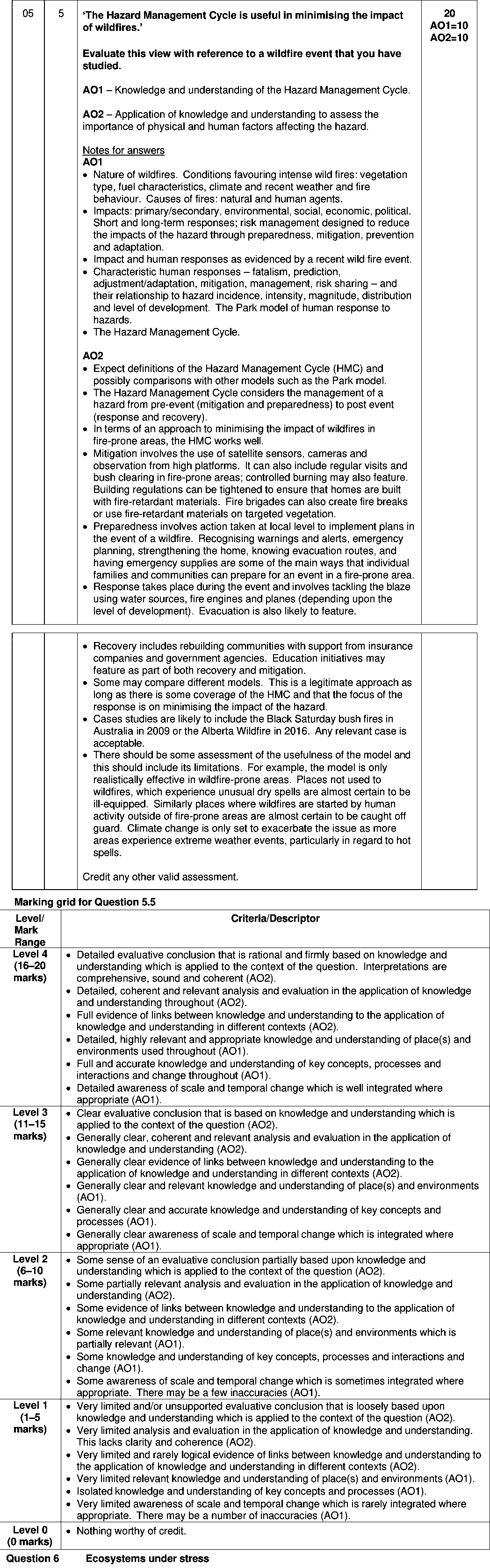
‘The Hazard Management Cycle is useful in minimising the impact of wildfires.’ Evaluate this view with reference to a wildfire event that you have studied.
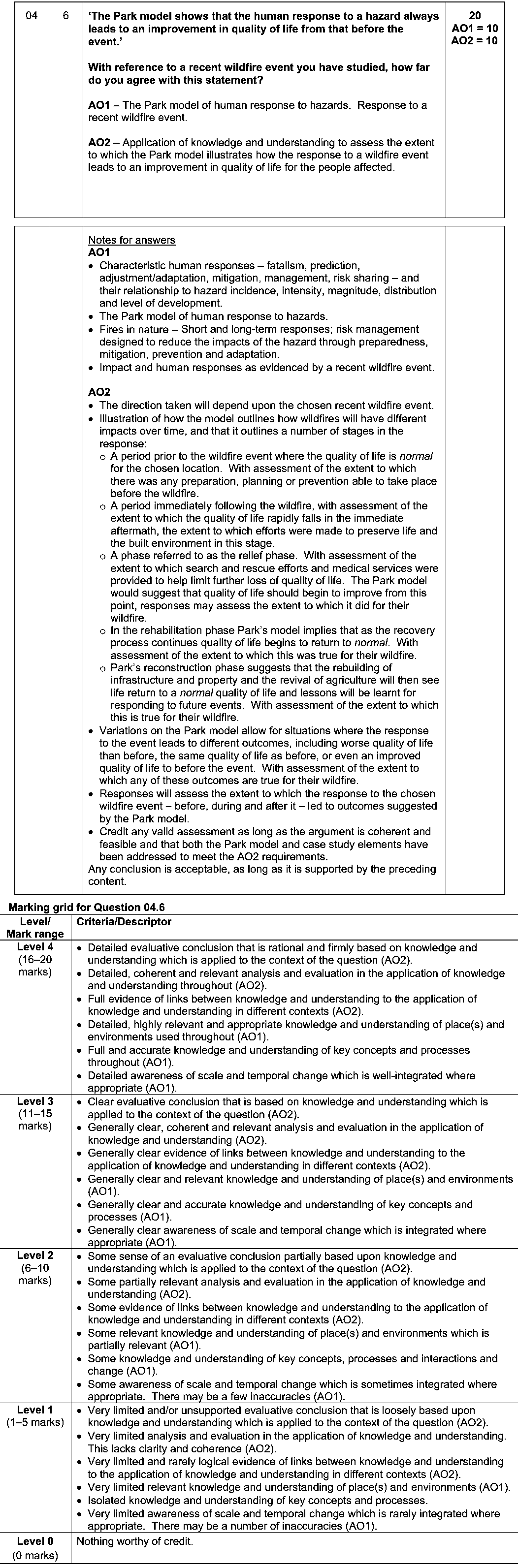
‘The Park model shows that the human response to a hazard always leads to an improvement in quality of life from that before the event.’ With reference to a recent wildfire event you have studied, how far do you agree with this statement?
With reference to a hazardous location at a local scale, assess the importance of the physical processes and factors which have contributed to the scale and nature of the hazard.
‘The impacts experienced in multi-hazardous environments make them uninhabitable.’ With reference to a multi-hazardous environment beyond the UK that you have studied, to what extent do you agree with this view?
With reference to a multi-hazardous environment that you have studied, assess the view that the underlying cause(s) leading to the hazards is human activity rather than physical factors.
Tap a question to zoom it. The figures open above it; the mark scheme (with its levels and indicative content) and the examiner's comment open underneath.
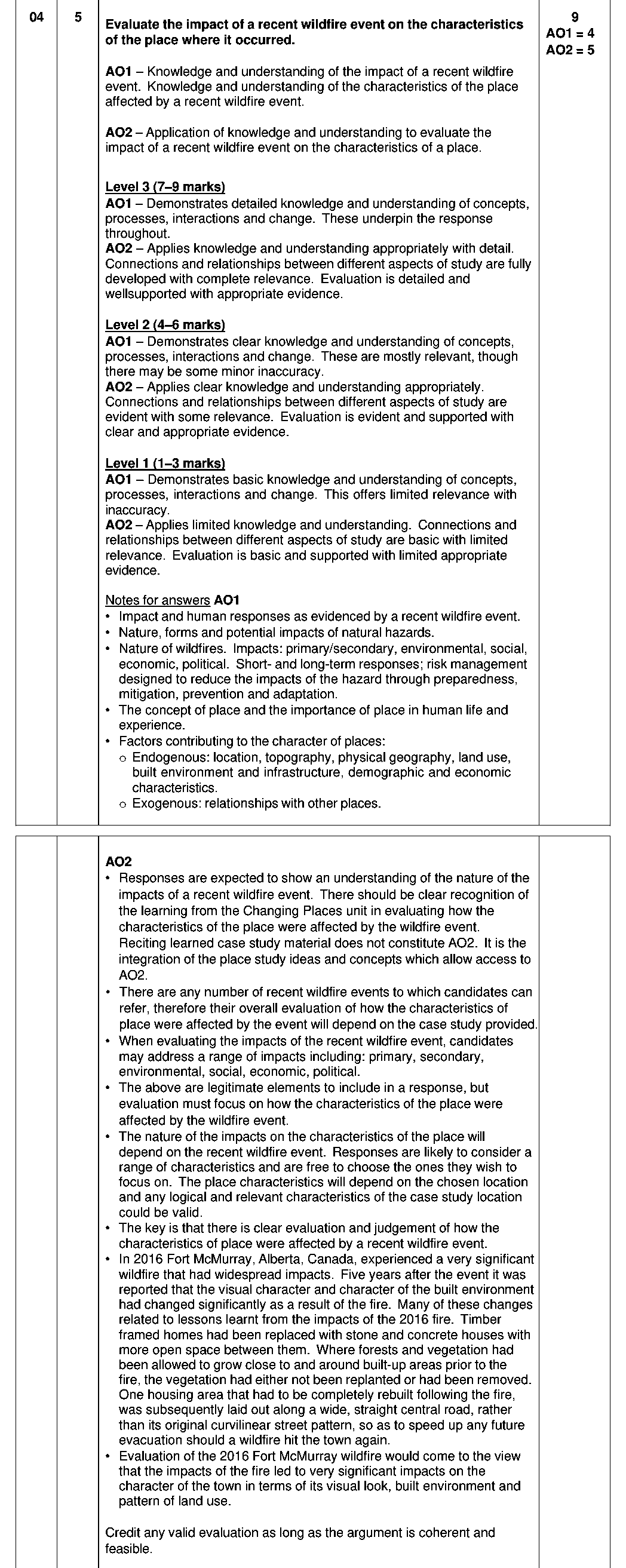
June 2025 · AS Paper 1 · Q4.59 marksmark schemeSynoptic
Mark scheme, including the levels and indicative content
Examiner's comment
This question proved to quite challenging for many and had a mean score of only 4.35.Only 13% is responses achieved Level 3. Only the very best responses had clear and detailed knowledge and understanding of an appropriate wildfire event, whilst identifying that this was across specification question, requiring application of knowledge and understanding from the Changing Places unit. Where the link was identified the best responses identified specific economic, social, demographic, or environmental characteristics of place that had been impacted by the wildfire event. Many responses often did not focus on the impacts at the scale of the local place, i.e. referring to the “Black Saturday Bushfires in Australia,” and whilst most did identify impacts, it was hard to see any link to specific characteristics of place. There were some excellent responses that focused on specific impacts of fires in Fort McMurray or more recently in California, where individual neighbourhoods or areas were given as exemplar material. Other responses sought to compare different wildfires. These often did not score well as depth was often lost with this approach. As with Q4.5 above, many students made comparisons between 2 case studies, which could be creditworthy, however, the specification is clear that only one case study is required.
Notes from the mark scheme and report
synoptic (links Hazards with Changing Places): impacts of a recent wildfire on economic, social, demographic and environmental characteristics of a local place (Fort McMurray, California neighbourhoods)
comparing several fires lost depth
only 13% Level 3
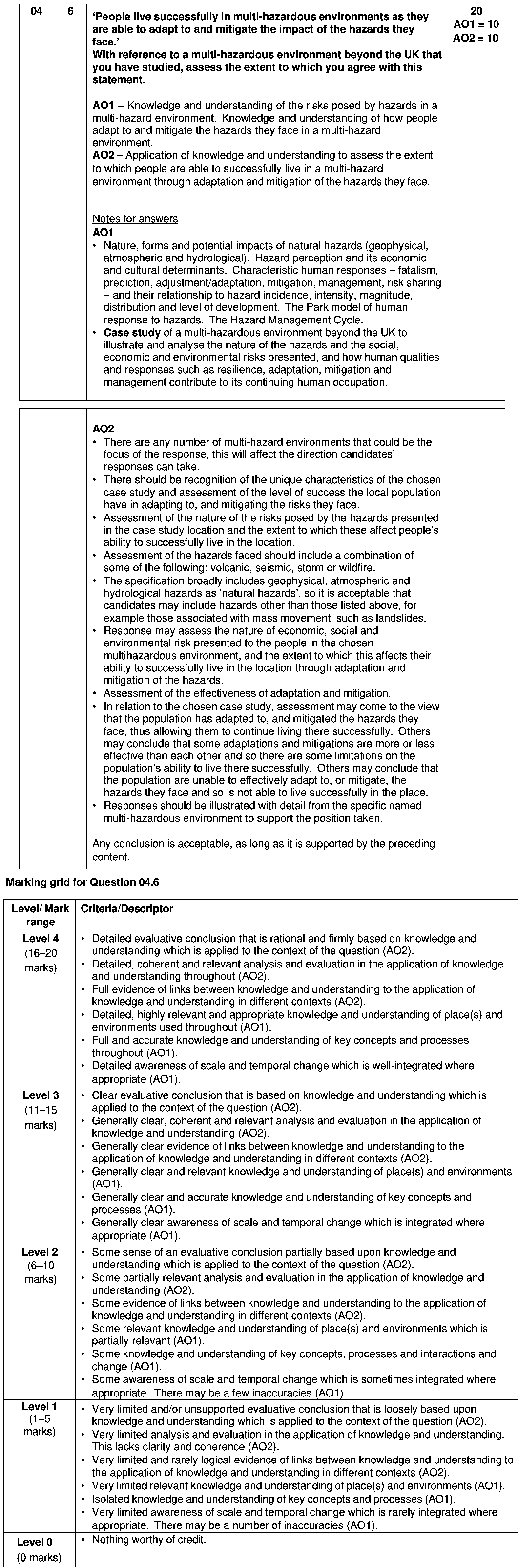
June 2025 · AS Paper 1 · Q4.620 marksmark scheme20-mark essay
Mark scheme, including the levels and indicative content
Examiner's comment
This question proved more accessible and differentiated well, with a mean of 12.74. Nearly 75%of responses reached Level 3 and over 25% scored in Level 4. The best responses showed clear and detailed knowledge and understanding of specific risks in a specific multi-hazard environment and made some attempt to differentiate between attempts to mitigate and adapt. Some weaker responses came from students who did not appear to have a clear case study of a specific multi-hazardous environment. As with Q4.5 above, many students made comparisons between 2 case studies, which could be creditworthy, however, the specification is clear that only one case study is required. Some weaker responses compared the case studies rather than explicitly targeting the question.
Notes from the mark scheme and report
one multi-hazardous environment beyond the UK
assess adaptation v mitigation and success of continued occupation
weaker answers lacked a clear case study or compared two
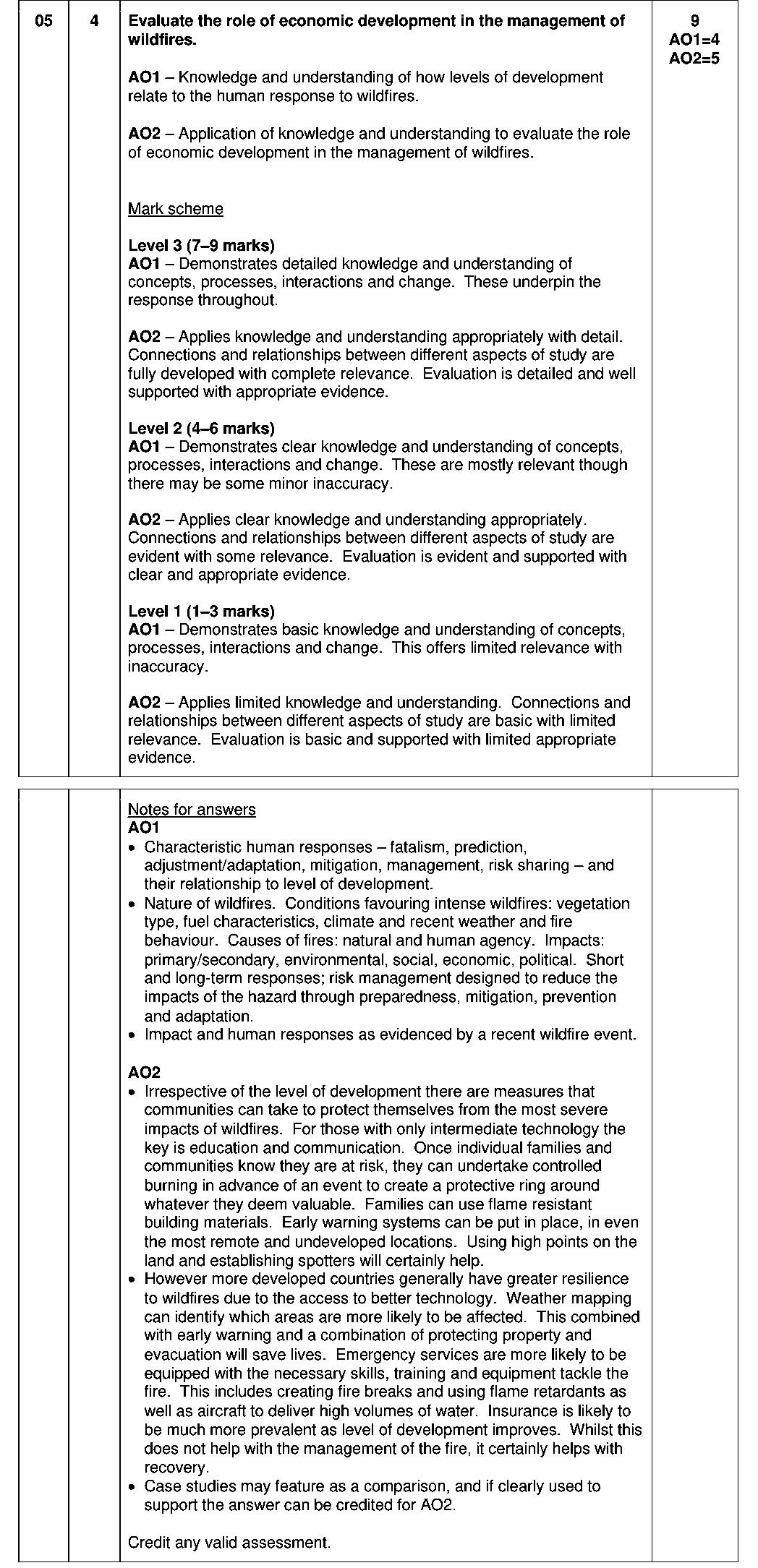
June 2025 · Paper 1 · Q5.49 marksmark schemeSynoptic
Mark scheme, including the levels and indicative content
Examiner's comment
These questions assess knowledge and understanding of links made within or across specification units. The 9-mark AO1/AO2 questions in Section C produced similar outcomes, though question 06.4 was a little stronger more generally. Question 05.4 did not perform quite as well as 06.4 on the 9-mark Section C options. Students need to show understanding that whilst economic development can certainly help and provide advantages in tackling wildfire, there are many other natural and human factors which can affect outcomes from wildfire events. Case study support clearly helped but was not essential. Question 05.4 (AO1 & AO2) (9 mark) should have been more straightforward than many found this to be. A typical answer acknowledged that economic development will usually mean that a higher income country will usually have more tools at its disposal to tackle wildfire both in planning for and responding to it. A combination of education, land use mapping, satellite imagery including weather forecasting can also help to plan for a wildfire. Wide ranging responses are also more readily available in richer parts of the world through deployment of firefighters, using aerial techniques and controlled burning. The nuance of the question really invited students to draw on their own case study support to show how other factors may contribute more substantially. This included consideration of drought, availability of fuel and proximity to built-up areas. Indeed, some of the worst wildfires (in terms of impact on people) have been in some of the richest parts of the world. This response failed to get to the required depth and instead relied on only the most basic ideas. Level 1 (2 marks)
Notes from the mark scheme and report
report groups this as the synoptic 9-mark question, though the mark scheme stays within Hazards
richer countries have more tools (forecasting, firefighting aircraft, controlled burning) but drought, fuel and nearness to settlements matter too - some worst fires are in rich countries
basic answers stayed in Level 1
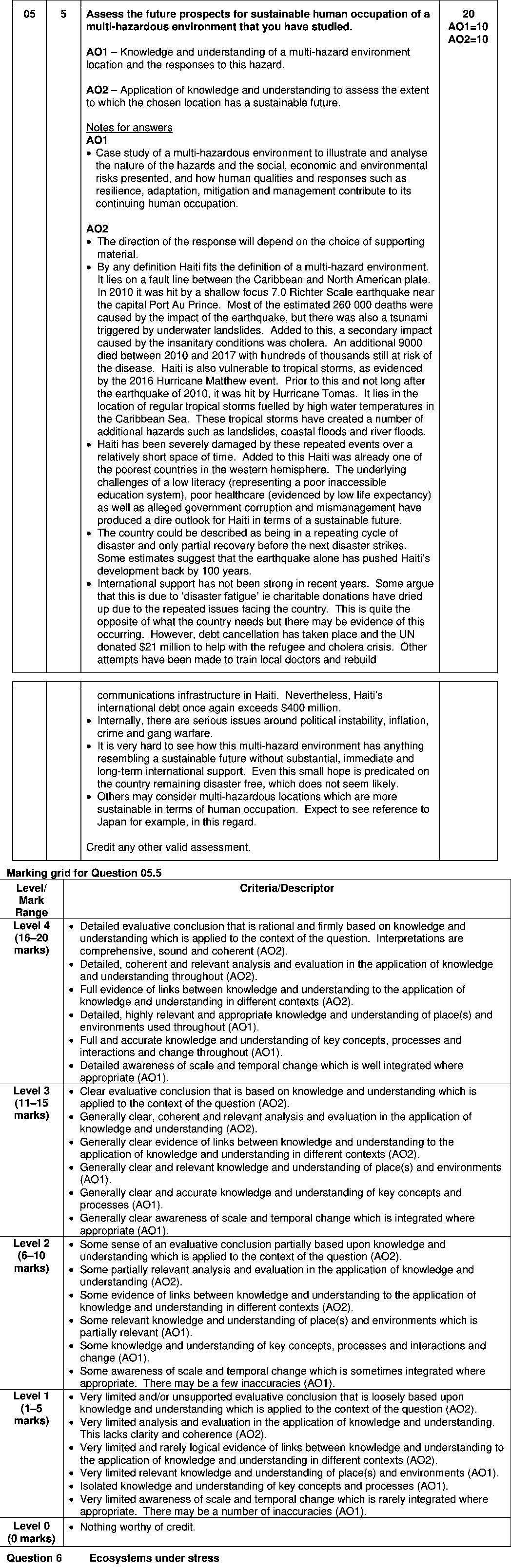
June 2025 · Paper 1 · Q5.520 marksmark scheme20-mark essay
Mark scheme, including the levels and indicative content
Examiner's comment
These questions assess knowledge, understanding and application: constructing arguments and drawing conclusions. These questions are designed to allow students to demonstrate links within different areas of the specification unit. Examiners expect to see secure underpinning knowledge and understanding as well as depth of support including case study material as appropriate. This should then be used to craft a balanced argument with a sustained line of reasoning. Students often look at more than one side of an argument. This is to be encouraged, but examiners would really hope to see a sustained argument which considered these different viewpoints, i.e. that they hold their own, well supported position throughout. Question 05.5 generally performed well once students understood the concept of human occupation and provided this was backed up with an appropriate case study of a multi hazardous environment. For Question 05.5 (AO1 & AO2) (20 marks) provided students had a suitable case study and understood the meaning of the term human occupation, many went on to produce clear, strong responses. This student chose the Philippines and remained focused on ideas around how it might secure sustainable human occupation into the future with the main focus being on challenges in achieving such ambitions. Level 4 (16 marks)
Notes from the mark scheme and report
needs a multi-hazardous environment (e.g. Haiti, Philippines) and the meaning of sustainable human occupation
assess resilience, adaptation, mitigation and management against risks and development challenges
June 2024 · Paper 1 · Q5.520 marksmark scheme20-mark essay
Mark scheme, including the levels and indicative content
Examiner's comment
The 20-mark questions are a major differentiator on this paper. In this series, it was also very evident that those who prepared well gained access to the full range of marks. The best responses evidence a deep and secure knowledge and understanding of the specification area/s being tested. Attention to detail is always strong and case study support is almost always very accurate. Less successful responses tend to fall down for a number of reasons. Students sometimes misread the question or, in the heat of examination, may not fully grasp what is required. In such circumstances they may tend towards knowledge recital and only touch on what is required to actually answer the question. For example, where students knew the basis of the Hazard Management Cycle, we saw really strong evaluation in relation to their chosen wildfire case study. This response shows a strong understanding of the Hazard Management Cycle as a simple model which authorities could potentially use to help mitigate the impact of wildfires. It shows clear evidence of how authorities (in this case the Canadian and Albertan governments) used a variety of management techniques to minimise the impact of the Alberta / Fort McMurray events. There is also a clear understanding of the cyclical nature of management using the model. This one scored L4 - 18 marks.
Notes from the mark scheme and report
define the Hazard Management Cycle (mitigation, preparedness, response, recovery) and evaluate it against a named wildfire
comparison with the Park model credited
strong example used Fort McMurray, Alberta (Level 4, 18 marks)
June 2023 · AS Paper 1 · Q4.620 marksmark scheme20-mark essay
Mark scheme, including the levels and indicative content
Examiner's comment
The best responses on this question showed a clear understanding of the concept of the Park Model. They were able to give balanced accounts of how the quality of life was affected by a named recent wildfire event. Many of these responses gave clear assessment of the extent to which the changes in quality of life that were experienced followed the pattern suggested by the model. The best answers gave perceptive assessment of specific impacts of the wildfire and how they affected the quality of life of the people there. Some did make comparisons between one wildfire and another, and as long as the purpose of this was to explicitly address the statement in the stem of the question this was creditable. Many weaker responses suggested some students were unfamiliar with the Park Model. Where students’ case study knowledge was weak, it was difficult for them to make clear assessment of how specific aspects of quality of life were affected, but some did offer some suggestions of how it might have changed.
Notes from the mark scheme and report
must know the Park model stages (pre-event, relief, rehabilitation, reconstruction) and test whether quality of life ends higher than before for a named recent wildfire
comparison with another fire credited only if it addresses the statement
many unfamiliar with the Park model
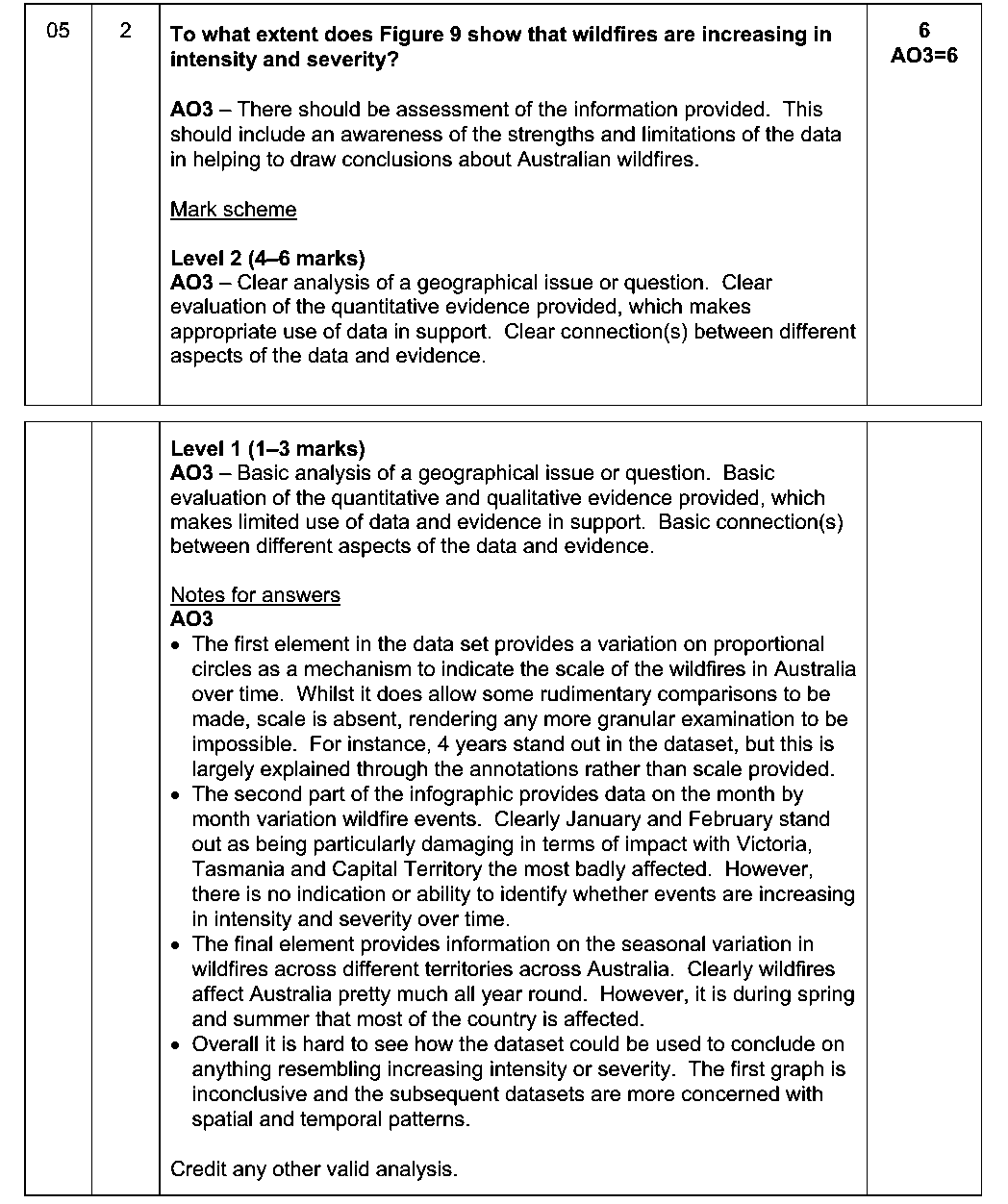
June 2023 · Paper 1 · Q5.26 marksmark schemeData analysis
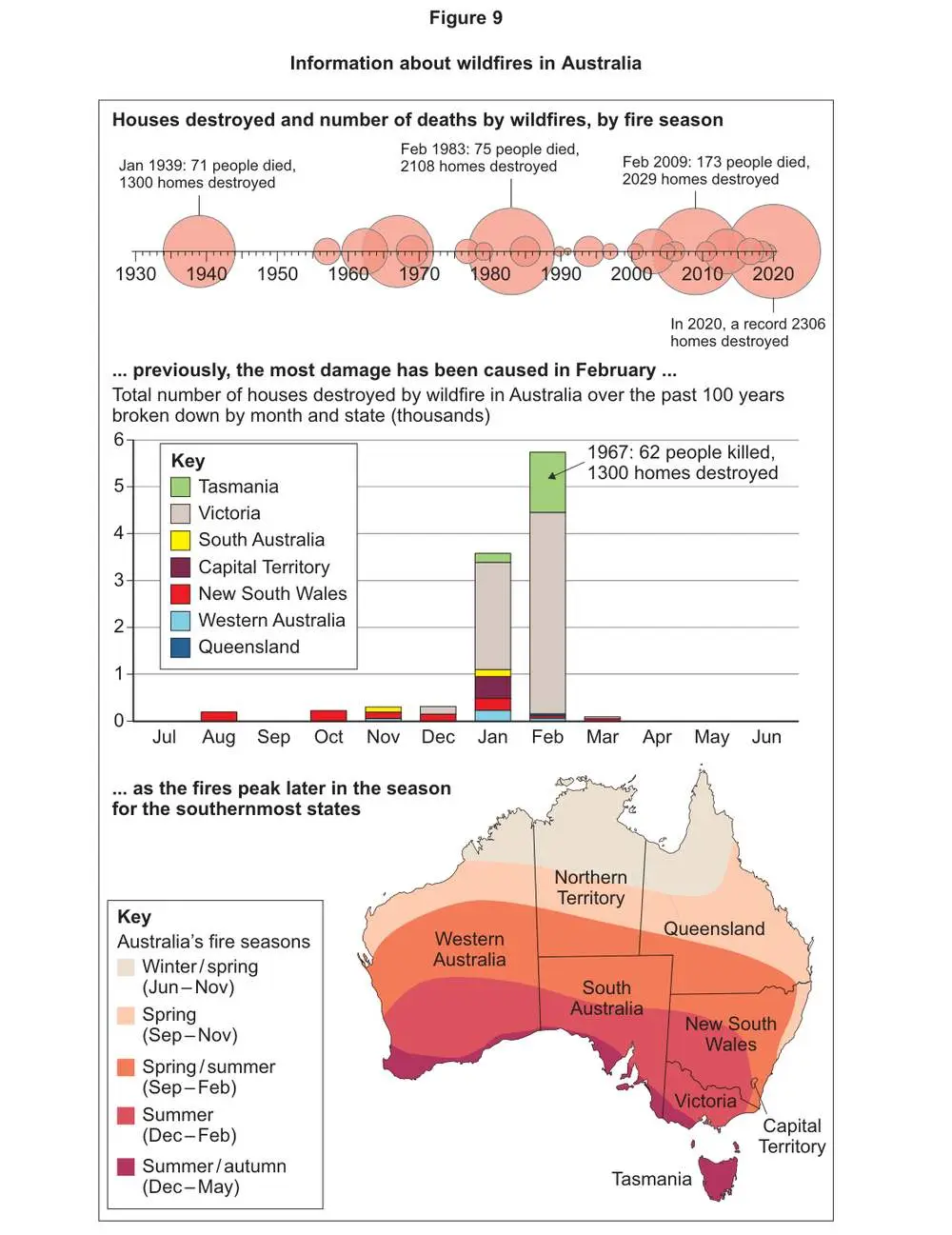
Figure 9
Mark scheme, including the levels and indicative content
Examiner's comment
Sometimes there are multiple stimulus materials, or multiple pieces of information within a single resource. Students score more marks when they are able to make links between these different pieces of information. For evaluation, those that show a critical awareness of the data being presented are invariably operating at a higher level than who do not. Evaluation is an important skill to demonstrate in these questions. However, some still struggled with the skill evaluation questions e.g. Q.2.2, Q.3.2, Q.4.2 and Q.5.2. Students need to be mindful that skills questions can test analysis, evaluation and interpretation of geographical information and skills (AO3). For Q.5.2, careful evaluation would have shown that these resources do very little to show that wildfires are increasing in intensity and severity. This again shows the need for more practice on evaluation of resources and techniques. Q.5.2 required evaluation of the usefulness of the resource. Students are expected to read the question carefully, interface with the resource and then craft their response. Had they clearly engaged with the resource they would have realised that the resource was not in fact very useful.
Notes from the mark scheme and report
AO3 evaluation: the proportional-circle timeline has no scale and the monthly and seasonal maps show patterns, not trends, so the resource shows little about increasing intensity or severity
many failed to evaluate the resource
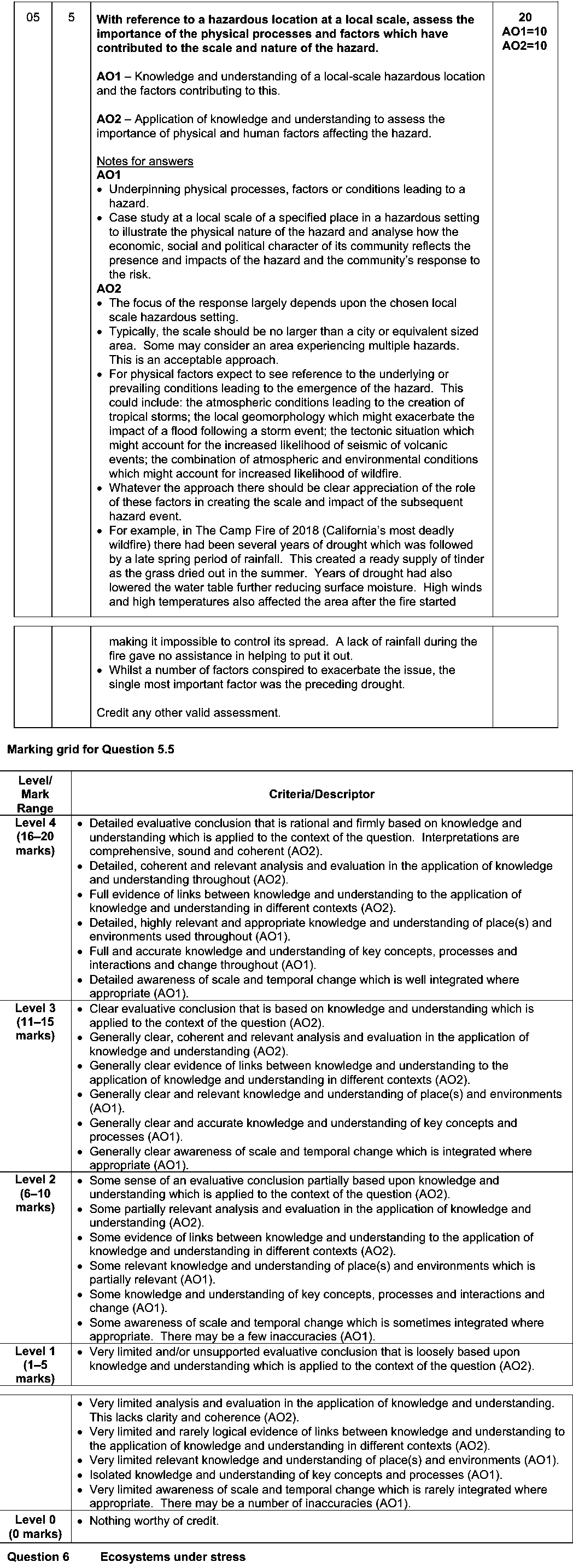
June 2023 · Paper 1 · Q5.520 marksmark scheme20-mark essay
Mark scheme, including the levels and indicative content
Examiner's comment
For the 20-mark questions there was a more physical focus to most of the questions in this series. Those that prepared well (and, crucially, those that read the questions carefully), comfortably scored Level 3/4. It was pleasing to see so many well-constructed essays. Typically many students asserted their own position in relation to the question at the outset (AO2 – argument) before proceeding to argue their points (AO2) and back this up with solid subject knowledge (AO1). Their conclusions then often returned to the theme of the question and pulled together the previously argued points into one closing paragraph. Generally, new content should not be introduced into the conclusion. Also supporting knowledge and understanding should be relevant and be used to help articulate the position in relation to the question. Those who read the questions carefully, answered the question in a clear structure and supported this with detailed knowledge easily accessed Level 3/4. On Q.5.5, physical processes and factors should have been relatively straightforward. This could have included factors such as climate, geographical location, tectonic setting etc. Too many never really engaged with these, but did show some awareness of human factors. Such responses were limited. On Q.5.5 the key limiting factor was in those who could not grasp the physical processes and factors shaping their local-scale location. Whilst examiners necessarily took a fairly relaxed view on what constituted local scale, there did need to be some engagement on the physical processes and factors. Tectonic setting or geographical location offered suitable routes to credit in this regard.
Notes from the mark scheme and report
own local-scale hazardous place: physical processes and factors (tectonic setting, climate, location, drought before the 2018 Camp Fire)
many only discussed human factors and were limited
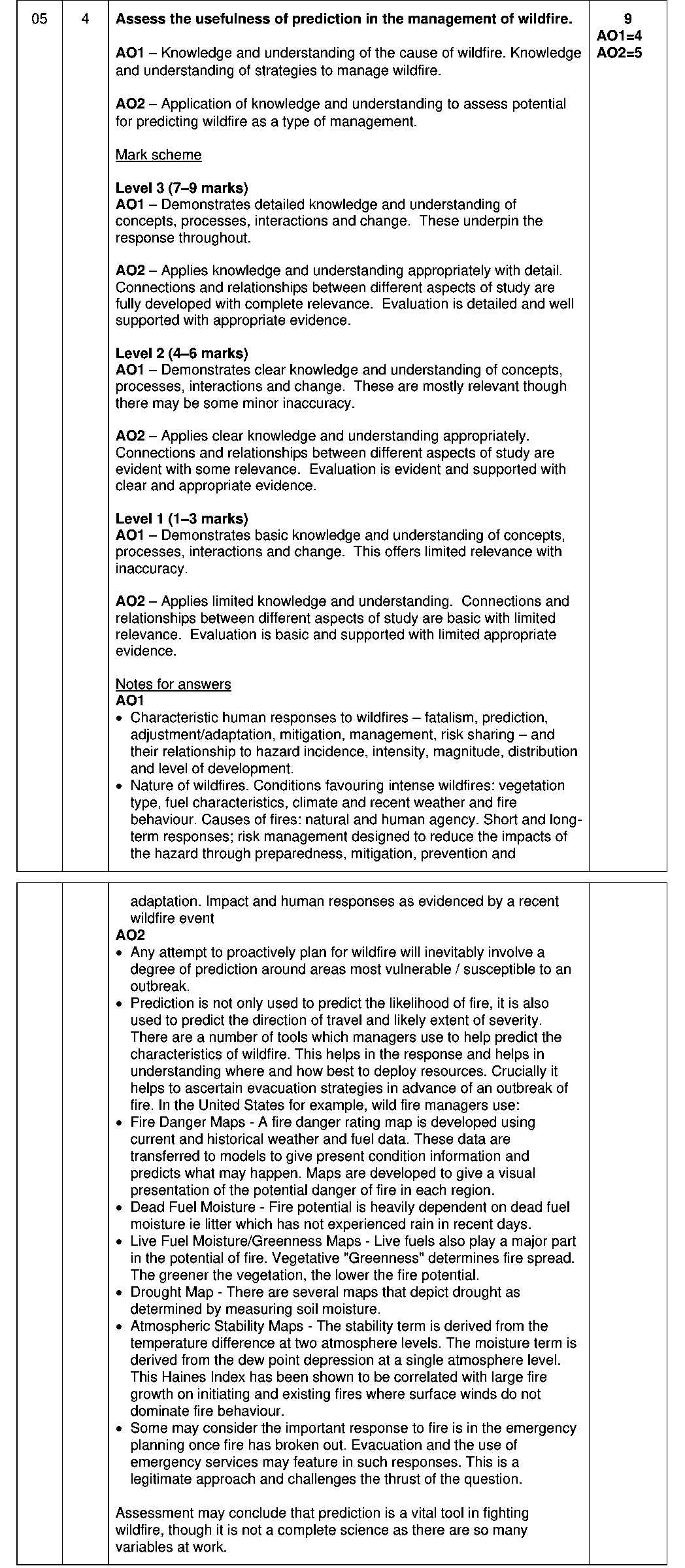
June 2022 · Paper 1 · Q5.49 marksmark scheme9-mark essay
Mark scheme, including the levels and indicative content
Examiner's comment
Students generally found this to be an accessible question. Many had prepared well and wrote confidently about what prediction actually means in the context of wildfire. They also contrasted this with other approaches around planning, preparation and mitigation. Case studies also complimented the responses with content related to Australia (Black Friday) and Canada (Fort McMurray).
Notes from the mark scheme and report
assess prediction (fire danger maps, fuel moisture, spread modelling, evacuation planning) against other responses such as preparation and mitigation
case studies such as Black Saturday Australia or Fort McMurray support
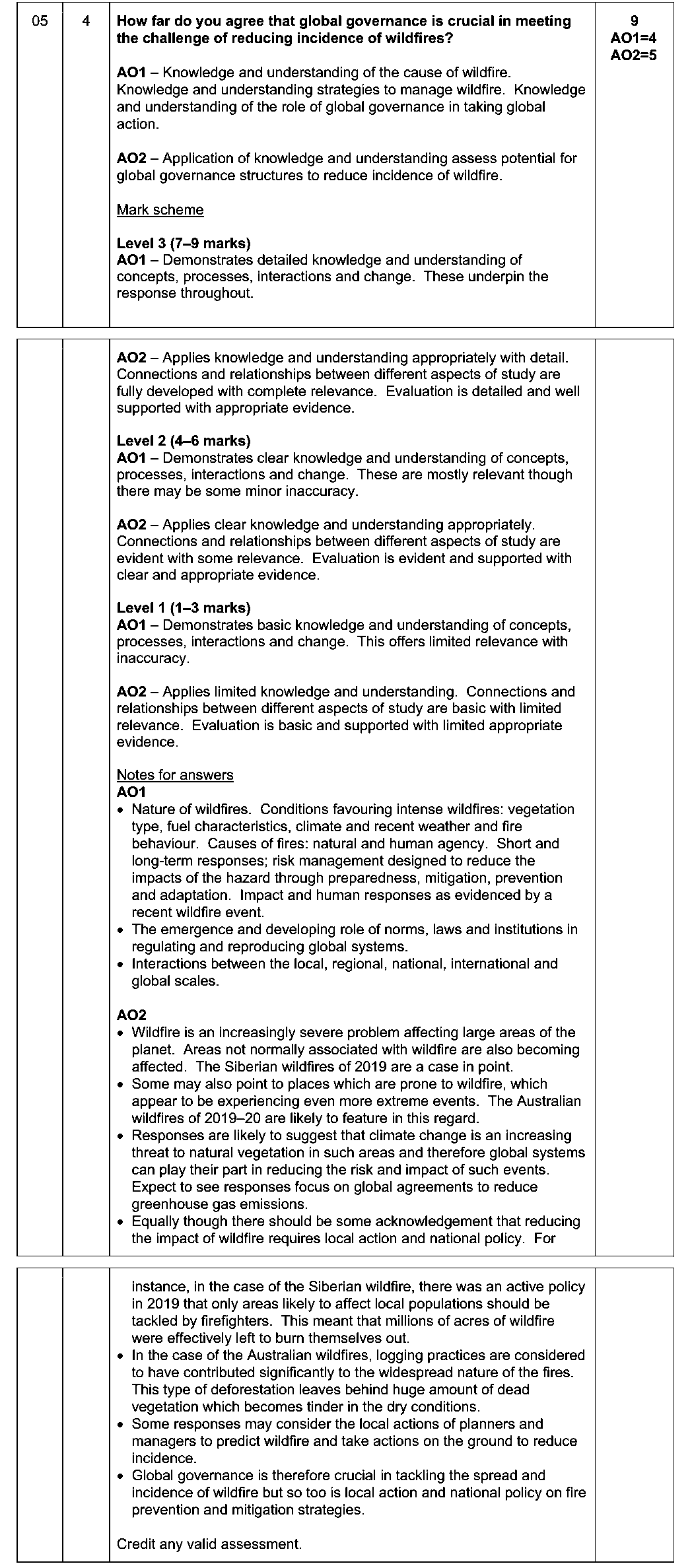
November 2021 · Paper 1 · Q5.49 marksmark schemeSynoptic
Mark scheme, including the levels and indicative content
Notes from the mark scheme and report
links Hazards with Global governance: climate agreements to cut emissions versus local and national action (e.g. Siberia 2019, Australia 2019–20 logging)
November 2020 · AS Paper 1 · Q4.33 marksmark schemeShort answer
Mark scheme
Notes from the mark scheme and report
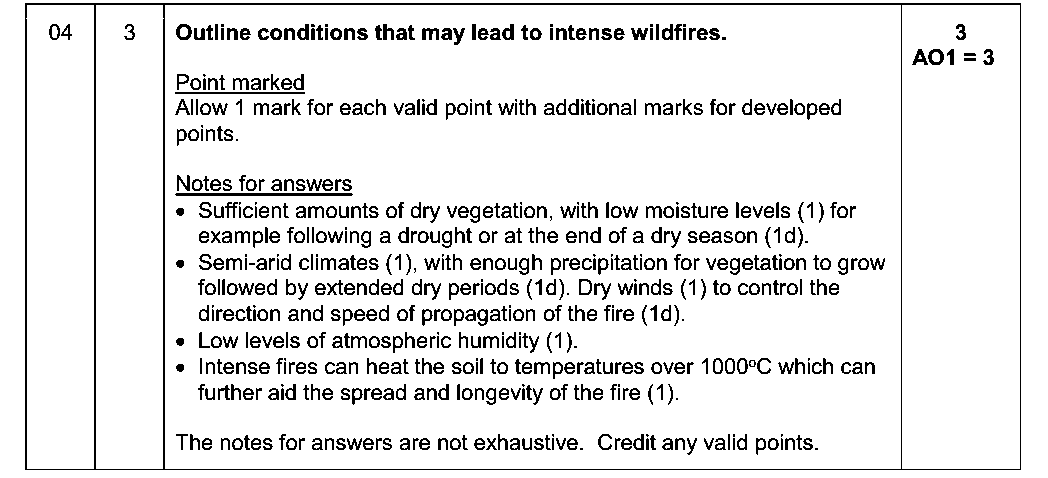
point marked
plenty of dry fuel after drought or dry season, semi-arid climate, dry winds, low humidity, intense heat aiding spread
November 2020 · Paper 1 · Q5.520 marksmark scheme20-mark essay
Mark scheme, including the levels and indicative content
Examiner's comment
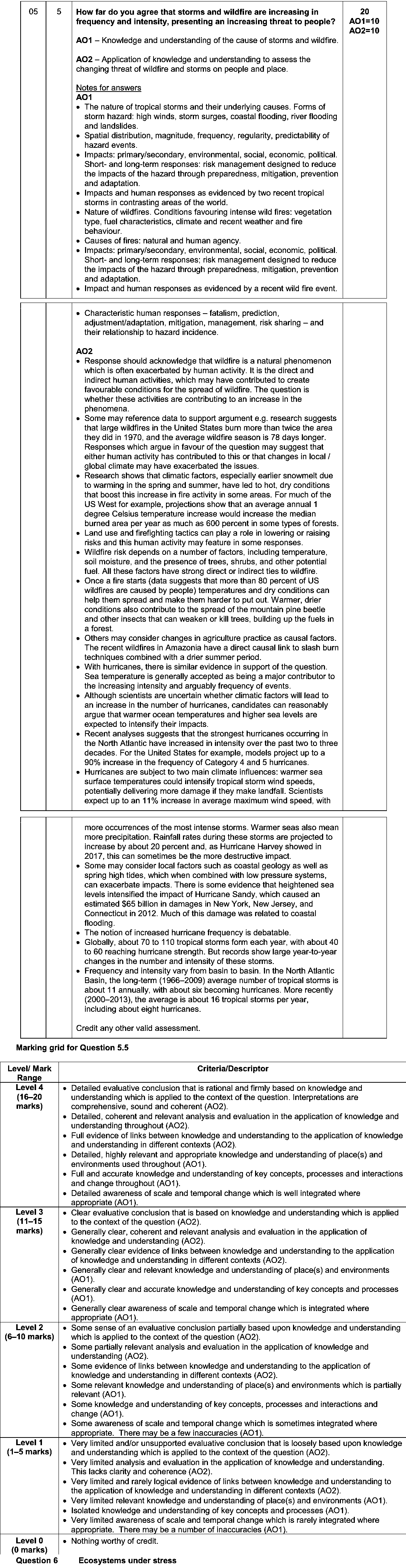
For the extended response most understood the implicit link between climate change and increased impact of tropical storms and wildfire. Most agreed with the direction of the question, but not all responses were well supported.
Notes from the mark scheme and report
link climate change (warmer seas, earlier snowmelt, drought) to storm intensity and wildfire extent
storm frequency is debatable
most agreed but support was often weak
June 2019 · AS Paper 1 · Q4.11 markmark schemeMultiple choice
Answer
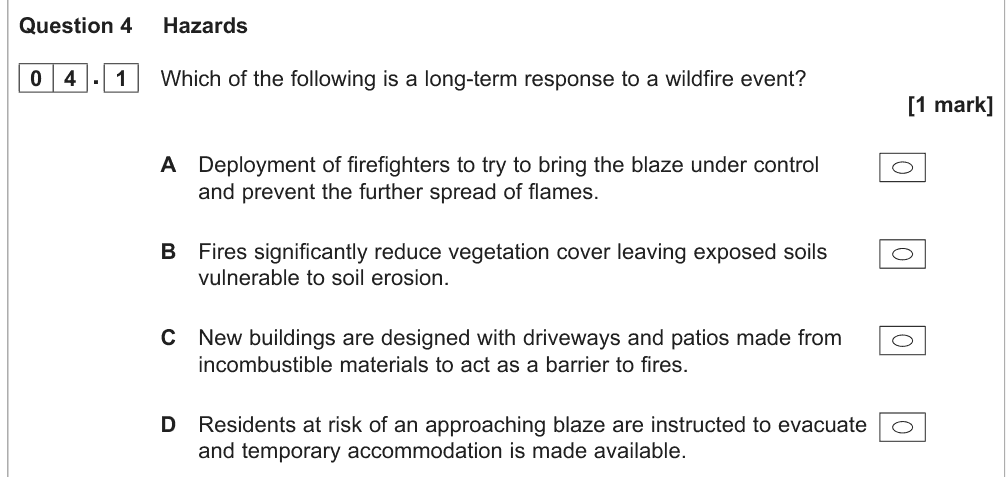
C
Mark scheme
Notes from the mark scheme and report
Answer: C (fire-resistant building design)
June 2019 · AS Paper 1 · Q4.620 marksmark scheme20-mark essay
Mark scheme, including the levels and indicative content
Notes from the mark scheme and report
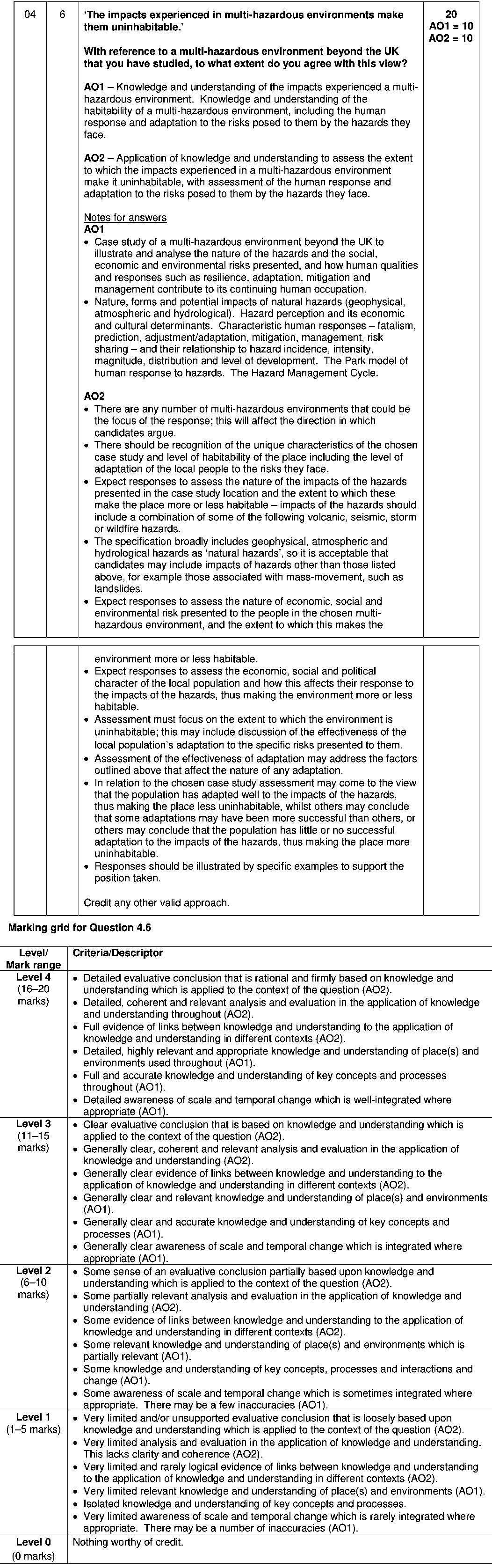
own multi-hazardous environment beyond the UK: impacts vs resilience, adaptation and continued occupation
judge how far it is uninhabitable
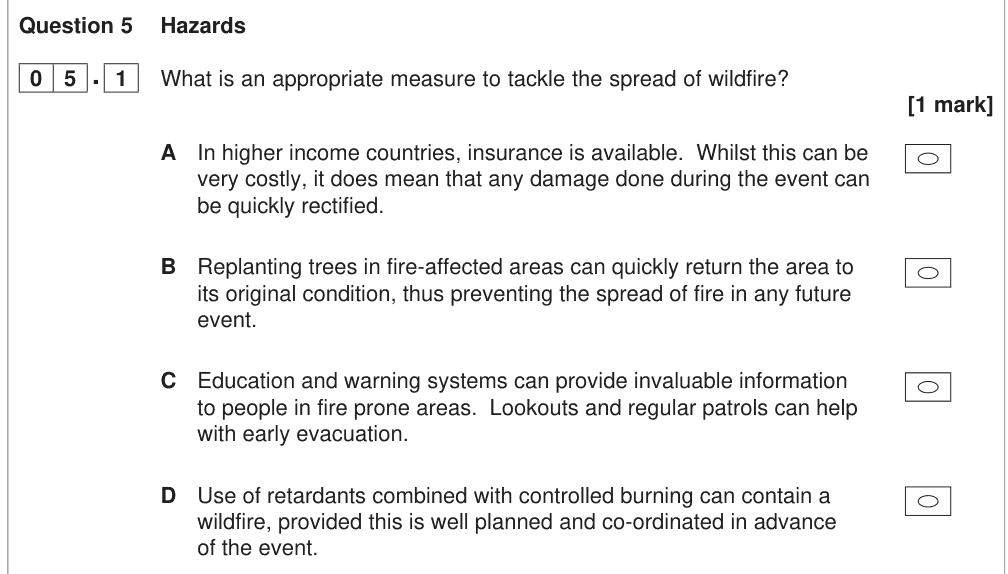
June 2019 · Paper 1 · Q5.11 markmark schemeMultiple choice
Answer
D
Mark scheme
Examiner's comment
The majority of students successfully identified D as the correct answer.
Notes from the mark scheme and report
Answer: D
most chose correctly
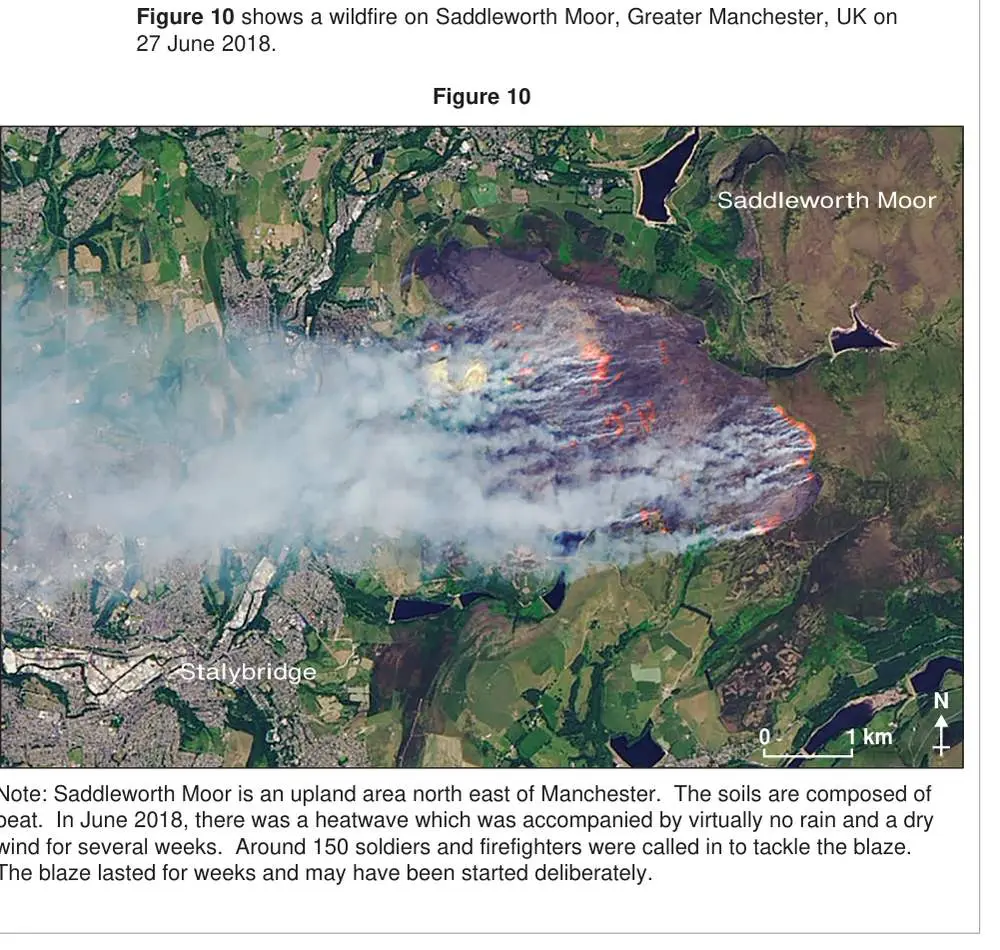
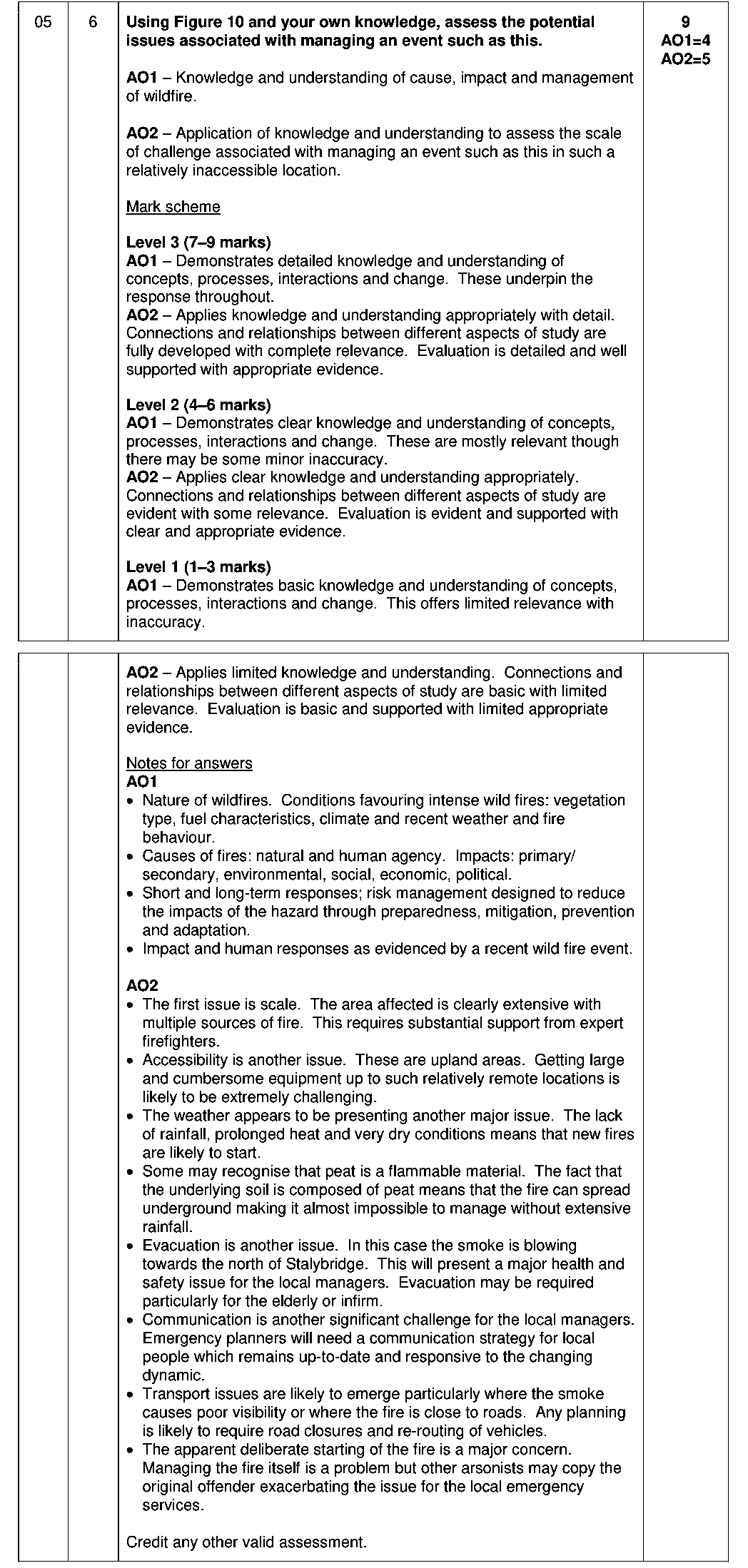
June 2019 · Paper 1 · Q5.69 marksmark schemeStimulus
Figure 10
Mark scheme, including the levels and indicative content
Examiner's comment
It was surprising to see so many fail to identify the potential management issues of scale, potential pollution, minimising habitat loss, minimising risk to life, addressing evacuation issues, managing potential respiratory issues and so on. Some students tried to bring in their own case study which was credited at AO1, but could have been used more effectively to identify the management issues in this resource. There were many issues which could be reasonably derived from the resource and too many over complicated their responses. Application of knowledge in this case did not require a lengthy recital of a learned case study. The application required knowledge of the management issues in a wildfire to be applied to this resource.
Notes from the mark scheme and report
issues from the resource: scale, inaccessible upland, drought, peat burning underground, smoke and evacuation, communication, arson
reciting a learned case study was not needed
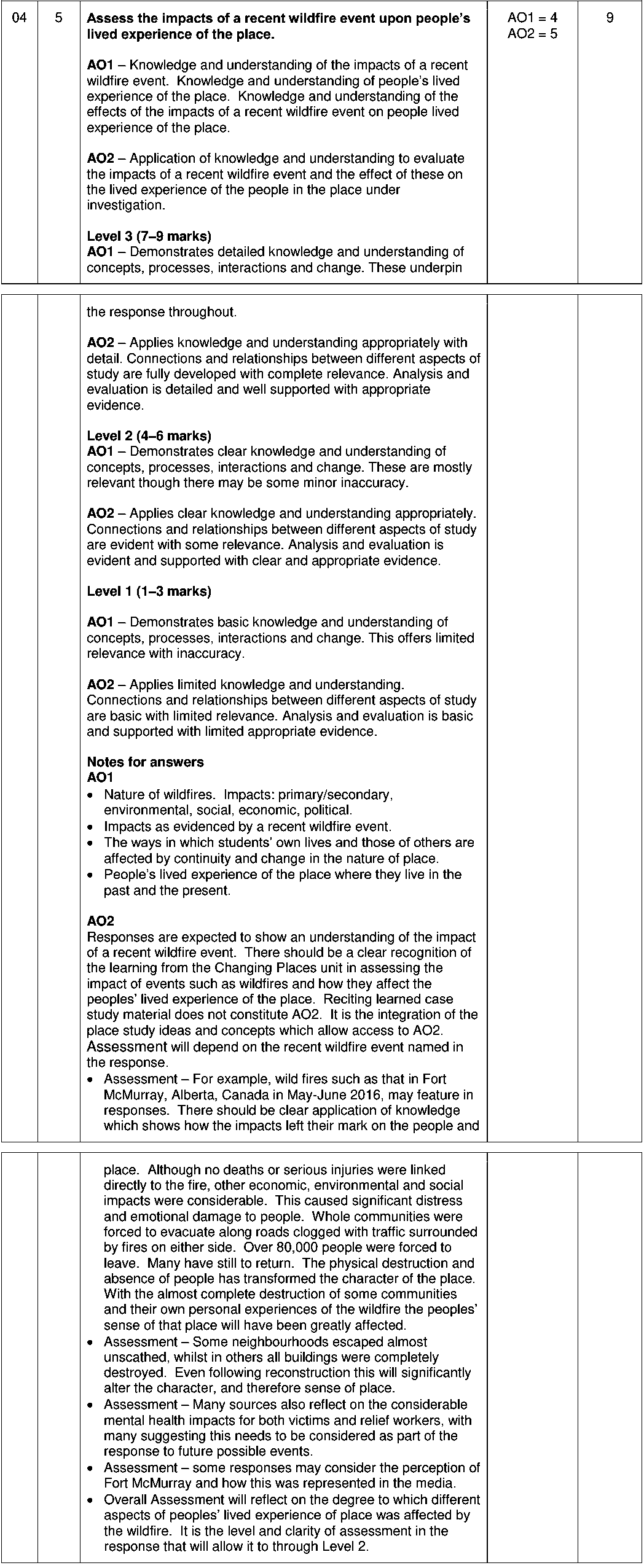
June 2018 · AS Paper 1 · Q4.59 marksmark schemeSynoptic
Mark scheme, including the levels and indicative content
Examiner's comment
This question required students to make a link across specification units. It is clear that many students were well prepared for this. It is important to remind centres that every series there will be one question which crosses specification units at both AS and A Level. In this case, the link was to Changing Places. The concept (from that unit) of people’s lived experience of place, was integrated into this hazards question. It is an Ofqual requirement that such questions are set every series so that students can demonstrate understanding and learning from across the breadth of study. There was a pleasing range and variety in case studies used. Most candidates went beyond a simple list of impacts of their chosen fire and did at least begin to assess how these affected the lives of the people affected. This was shown by 69% of responses reaching Level 2 or higher. However, only 18% reached Level 3, so there was scope for further, or more detailed, links to be made. Those that did not focus on how the fires impacted on people’s lives remained in Level 1.
Notes from the mark scheme and report
cross-specification link to Changing Places (lived experience of place)
must show how a named recent wildfire changed people's lives and feelings about the place, not just list impacts (Level 1)
only 18% reached Level 3
June 2018 · Paper 1 · Q5.31 markmark schemeMultiple choice
Answer
D
Mark scheme
Examiner's comment
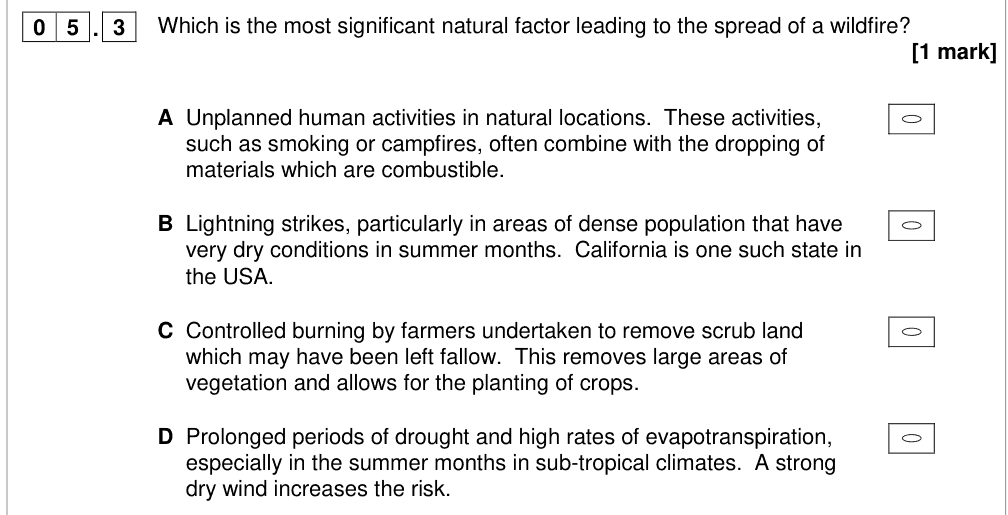
The key word in the question was ‘natural’. Many spotted that D was the correct answer. Some considered B to be correct, but of course built up areas are not places where wildfire is most likely to start.
Notes from the mark scheme and report
Answer: D
key word is 'natural' — drought and high evapotranspiration
B wrong as built-up areas are not where wildfires usually start
June 2018 · Paper 1 · Q5.820 marksmark scheme20-mark essay
Mark scheme, including the levels and indicative content
Examiner's comment
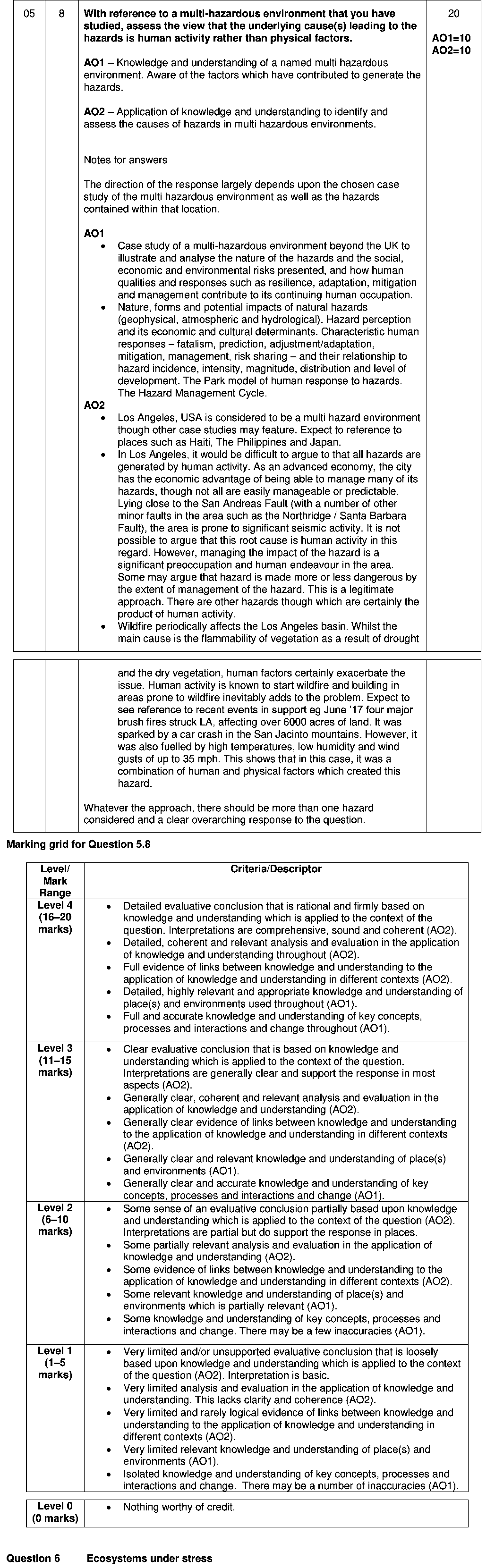
Some students self-penalised here by referring to more than one multi hazard environment. This did not allow such responses to get to the required depth in such a relatively short amount of writing time. In considering the question, the best responses understood that human activity is always the underlying the cause. The fact is that an event only becomes a hazard when it affects people in places. It is the human occupation of the place which creates the hazard. However equally others argued that the underlying cause is often physical, for example referencing tectonic processes in the development of seismic hazards. Either approach was credited. Some students ran out of time and lost marks simply through poor time management.
Notes from the mark scheme and report
one named multi-hazard environment (e.g. Los Angeles, Philippines, Japan, Haiti)
argue whether hazards stem from human activity (occupation, wildfire ignition) or physical processes (tectonics)
referring to several environments limited depth
time management an issue
June 2017 · AS Paper 1 · Q4.46 marksmark schemeData analysis
Mark scheme, including the levels and indicative content
Examiner's comment
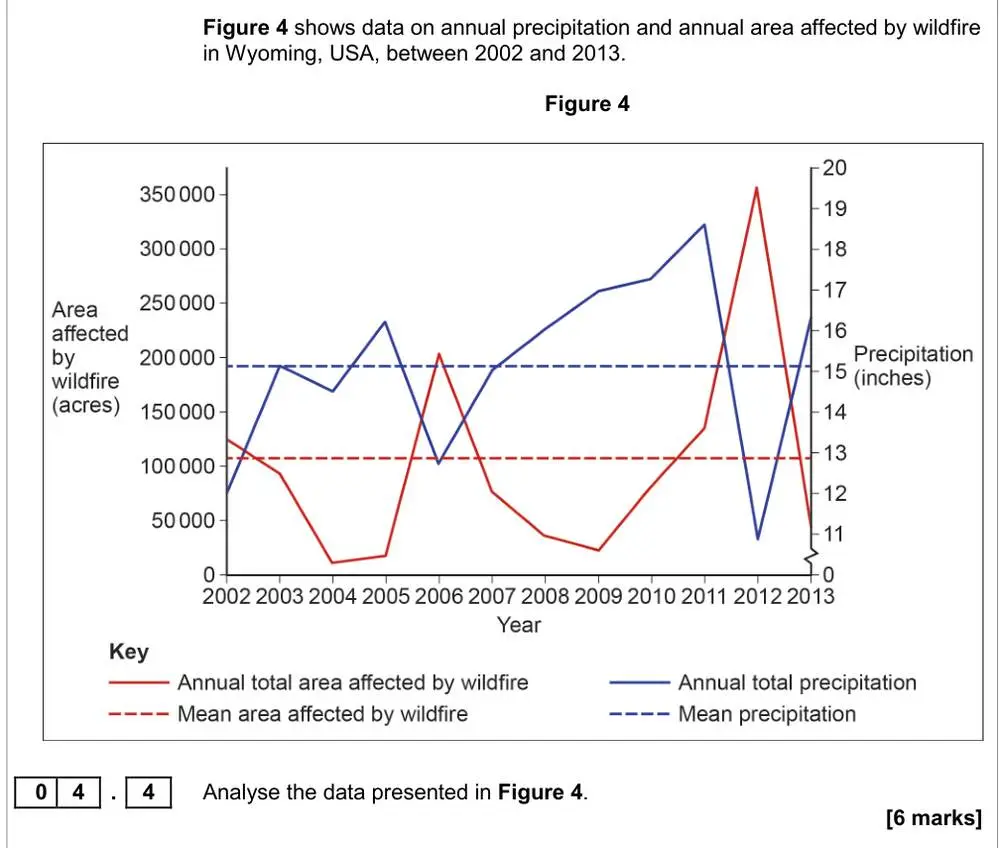
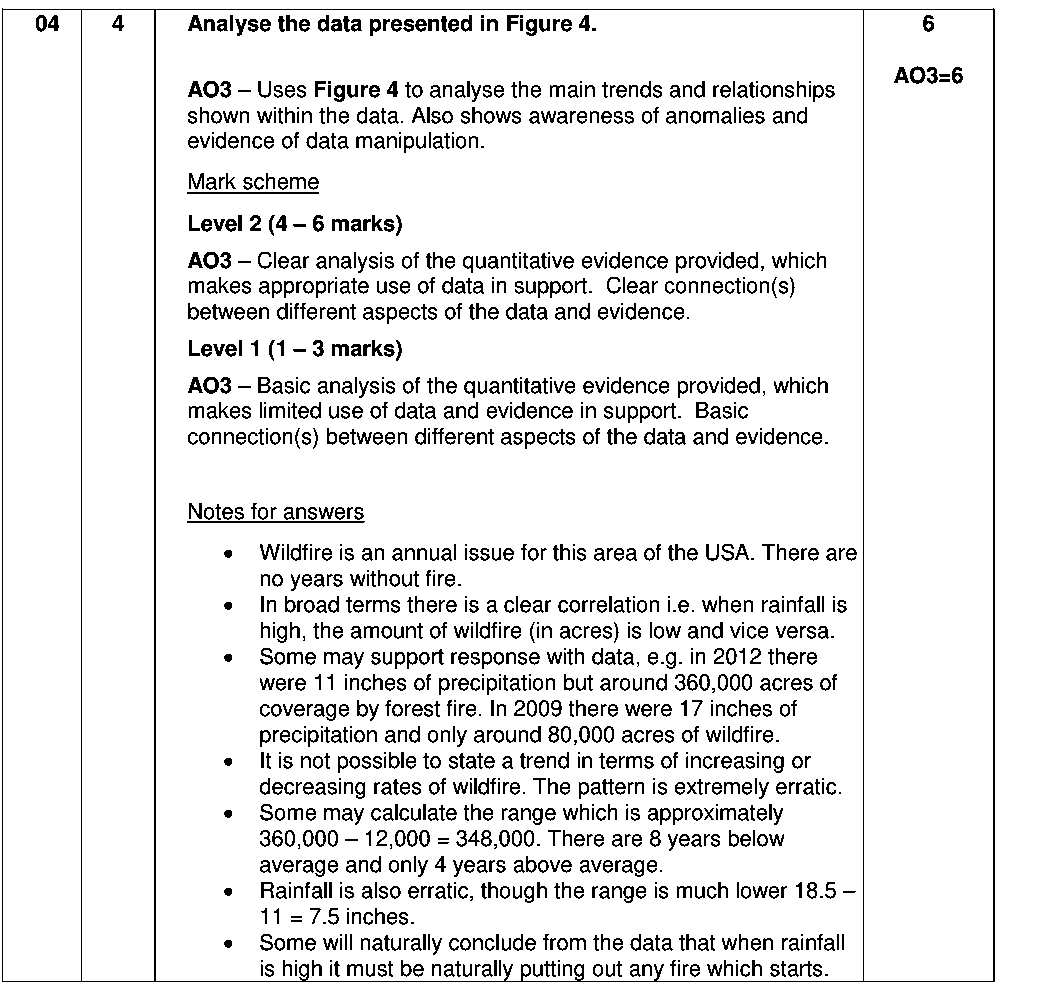
The mean mark for this question was 3.12 with only 39% accessing Level 2. Many failed to spot the inverse relationship evidenced in most years i.e. that when precipitation levels are above the mean, areas affected by wildfire are generally relatively low and vice versa. Data was often lifted to support trends but not used in a more sophisticated way to analyse the relationships. Some responses simply dealt with the lines separately and failed to see the relationship. Others drifted into the cause of forest fire or the reasons why rain reduces incidence. This constitutes AO2 as it is application of knowledge. No credit was available for this approach.
Notes from the mark scheme and report
AO3: inverse relationship between precipitation and wildfire area, erratic pattern, ranges and anomalies
many treated the lines separately
no credit for causes of fire
mean 3.12
Work with an AQA Geography tutor
Essays stuck in the middle levels, or losing marks on the data questions? Book a trial lesson with a specialist AQA Geography tutor.