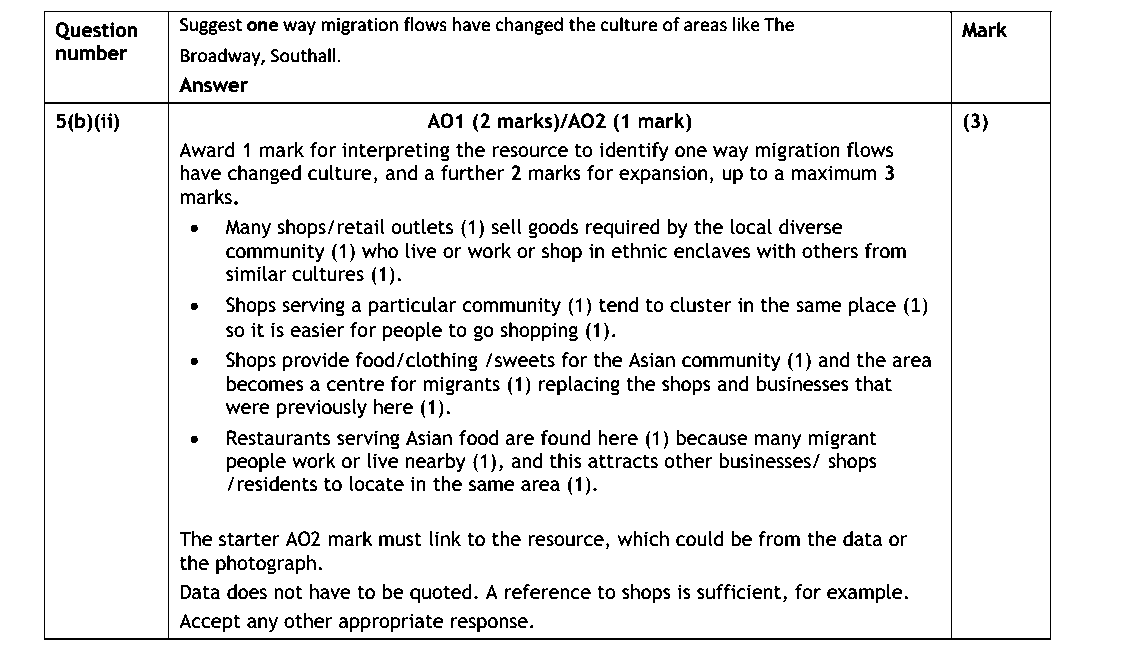
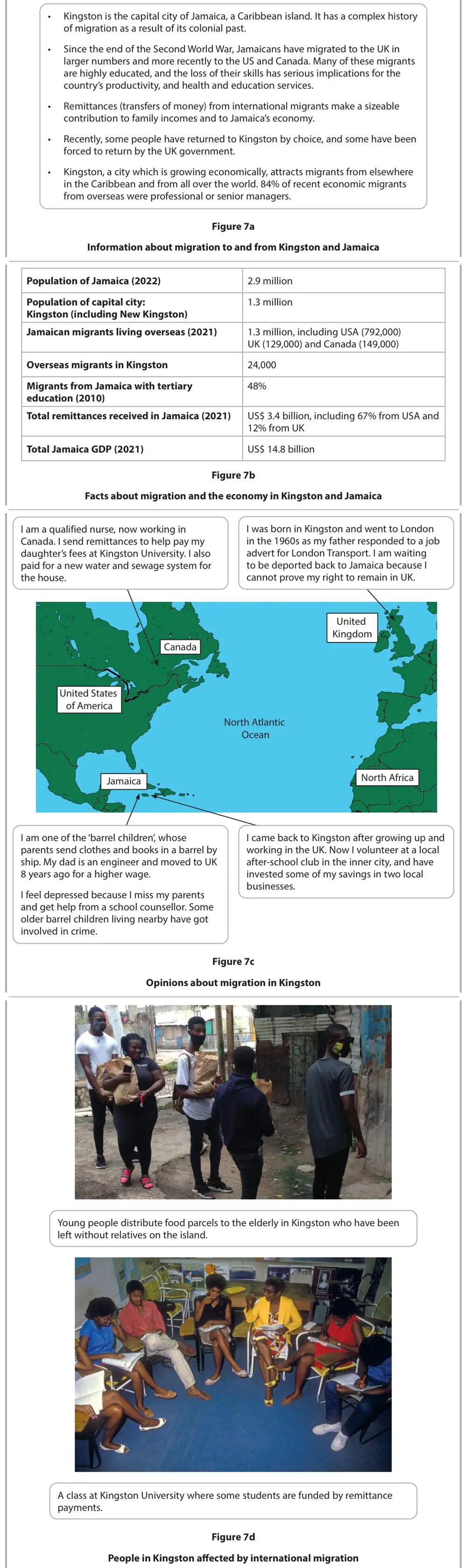
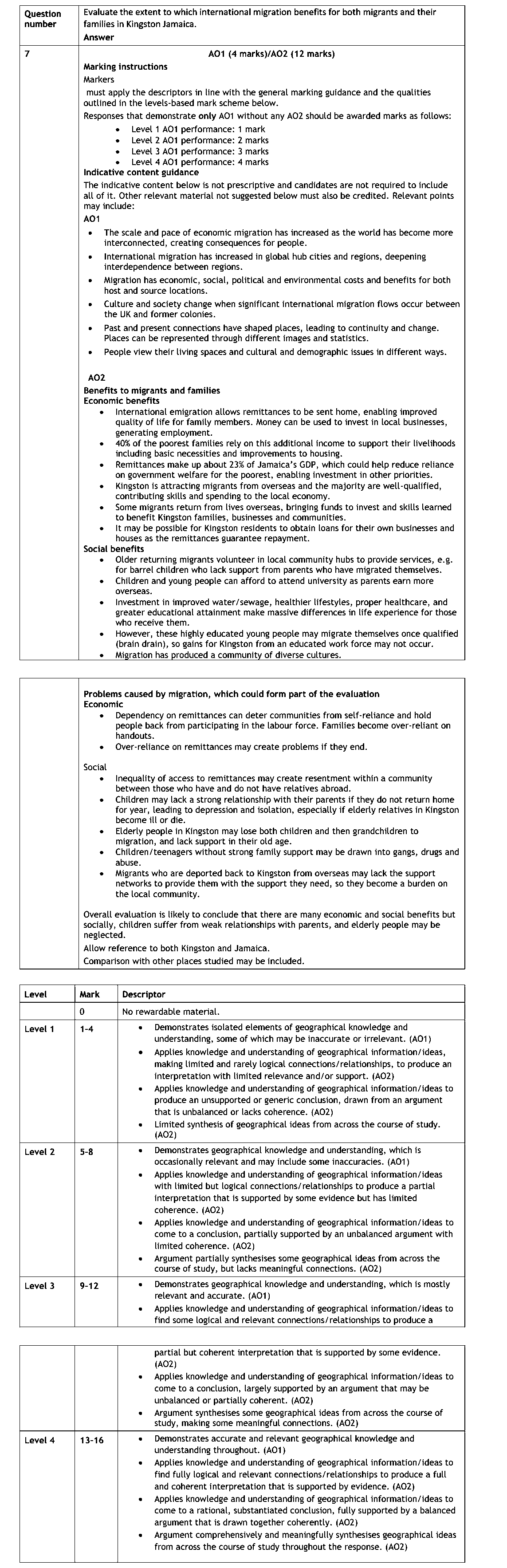
7 Study Figures 7a, 7b, 7c and 7d in the Resource Booklet. Evaluate the extent to which international migration brings benefits for both migrants and their families in Kingston, Jamaica.
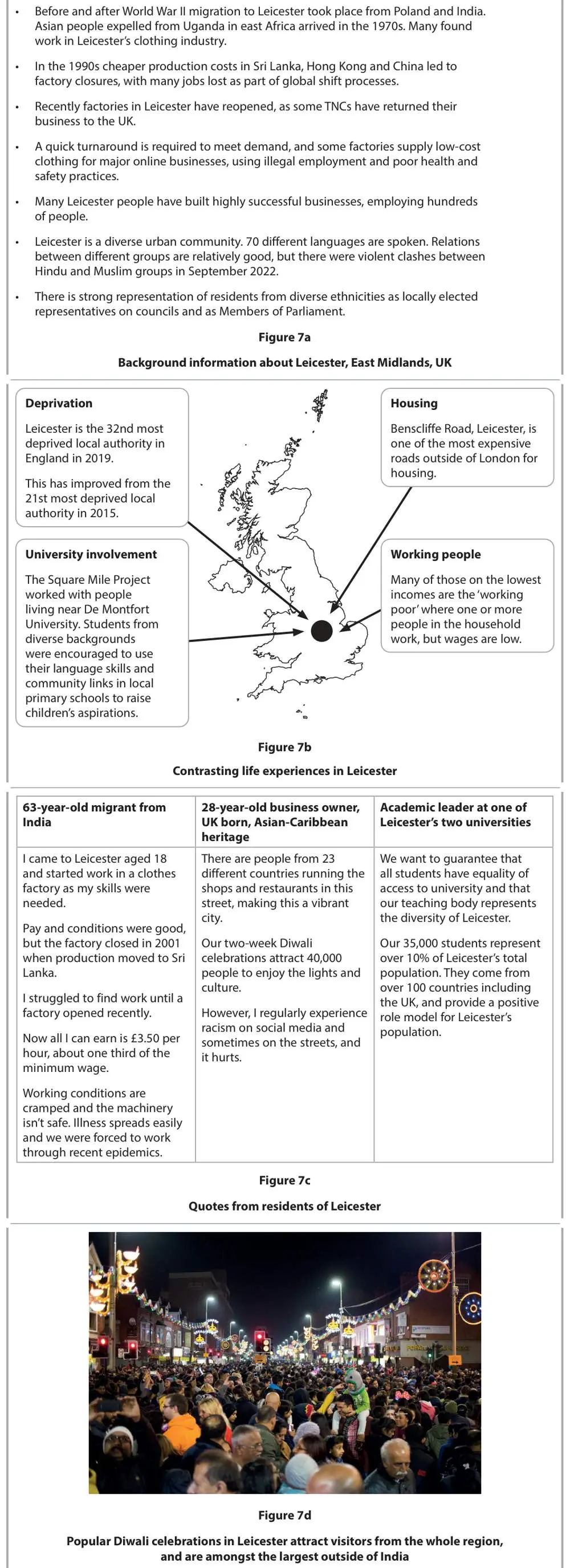
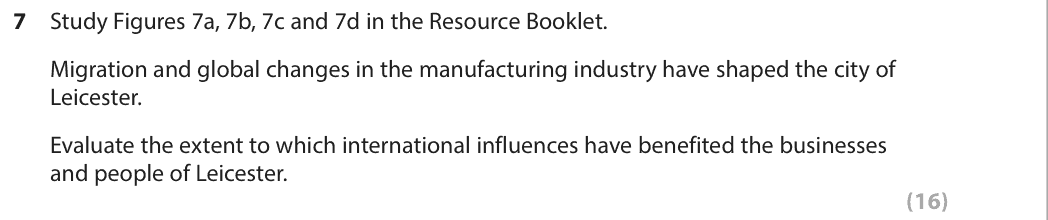
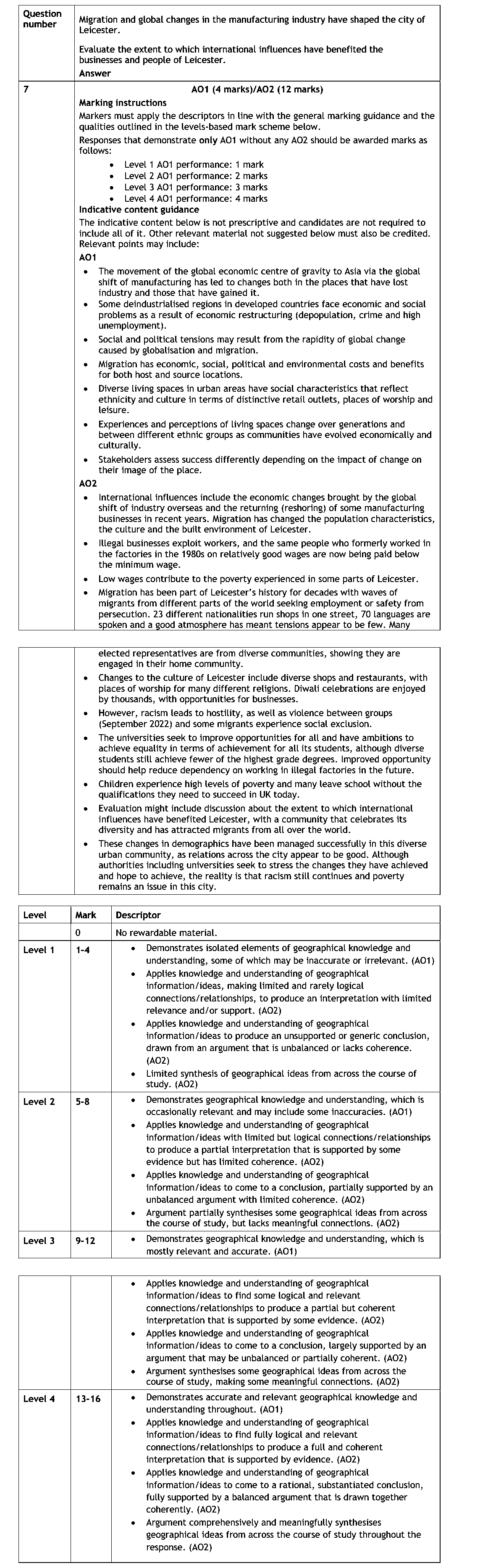
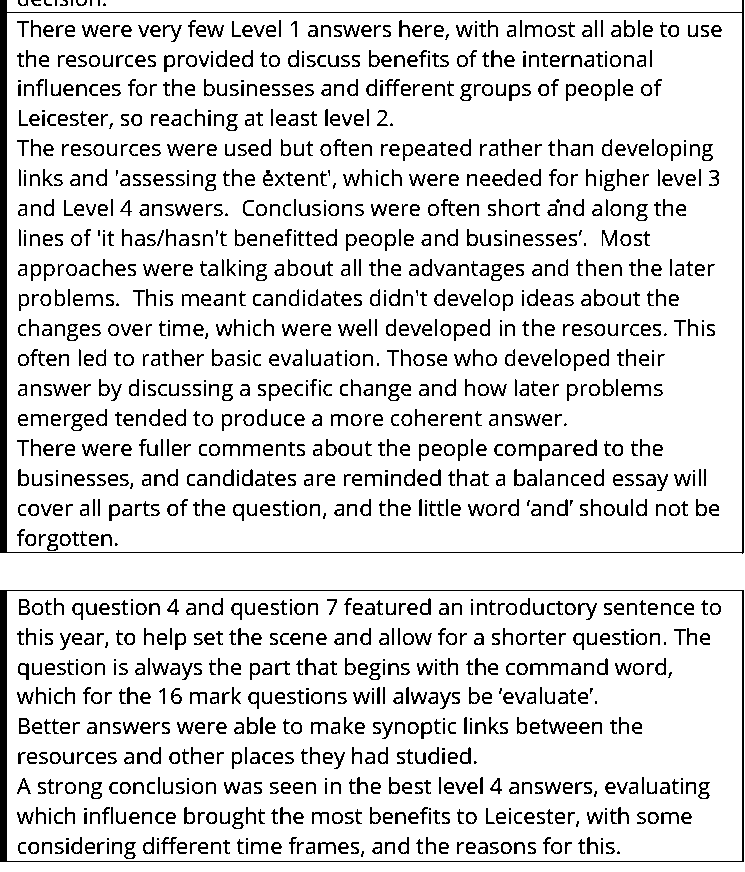
7 Study Figures 7a, 7b, 7c and 7d in the Resource Booklet. Migration and global changes in the manufacturing industry have shaped the city of Leicester. Evaluate the extent to which international influences have benefited the businesses and people of Leicester
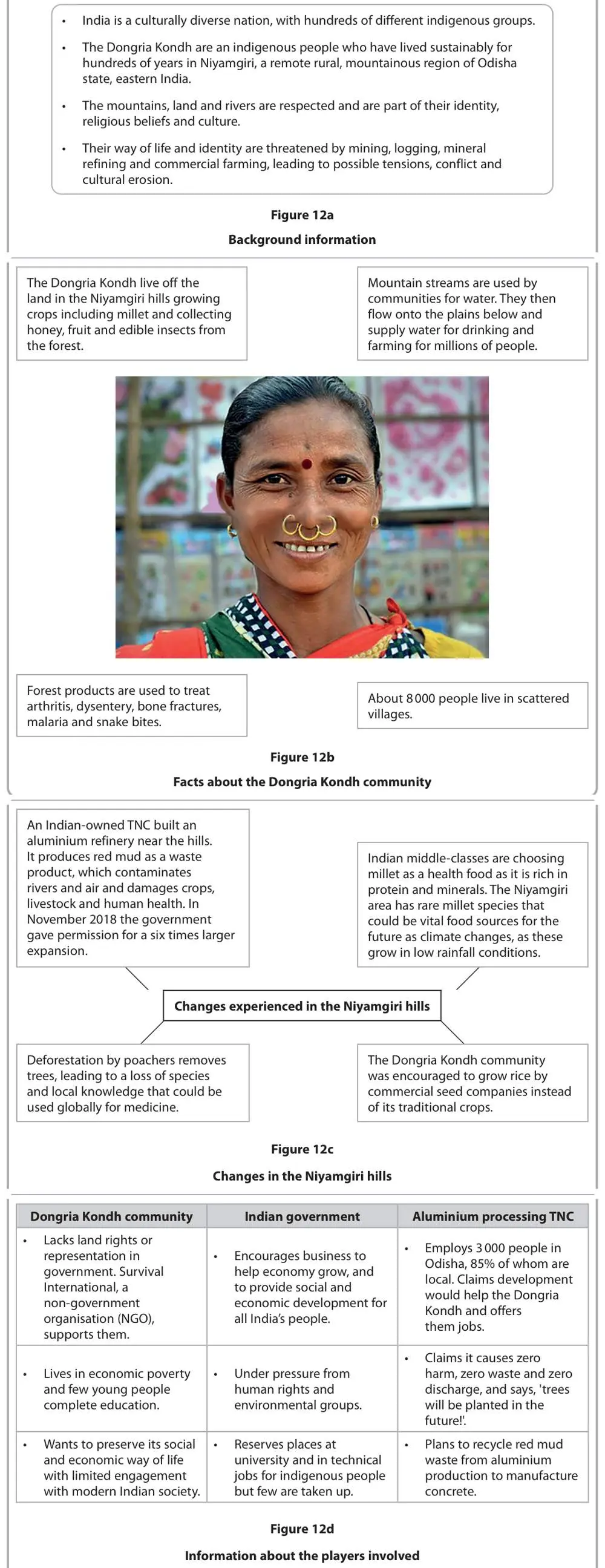
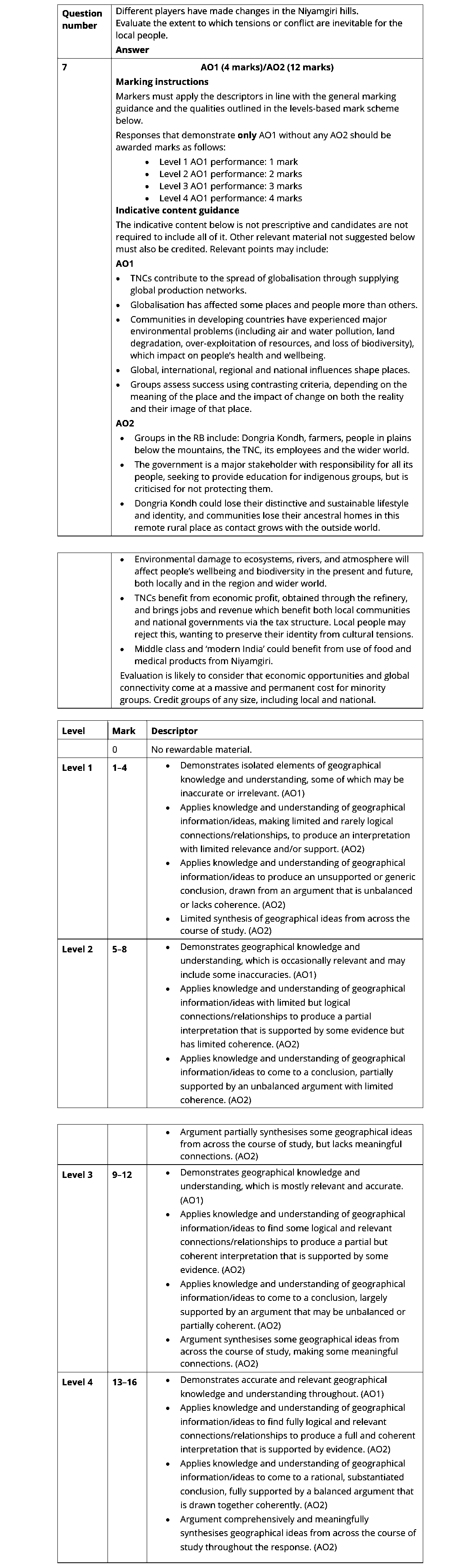
7 Study Figures 12a, 12b, 12c and 12d in the Resource Booklet. Different players have made changes in the Niyamgiri hills. Evaluate the extent to which tensions or conflict are inevitable for the local people.
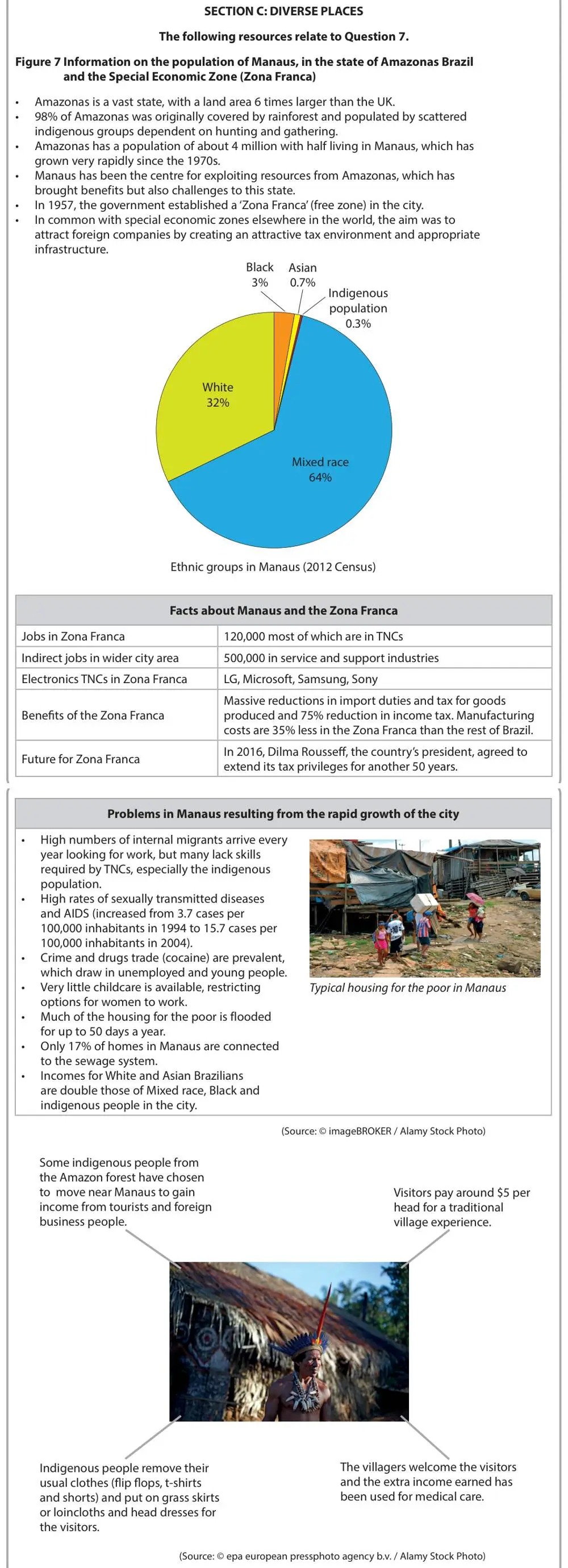
7 Study Figure 7 in the Resource Booklet. The creation of Special Economic Zones produces winners and losers. Evaluate the view that the government decision to extend the Special Economic Zone will be good for all the people of Manaus and Amazonas.
Tap a question to zoom it. The figures open above it; the mark scheme (with its levels and indicative content) and the examiner's comment open underneath.
June 2025 · Paper 2 · Q4(a)(i)3 marksAO1=2, AO2=1Data response
Resources for question 4
Mark scheme
Examiner's comment
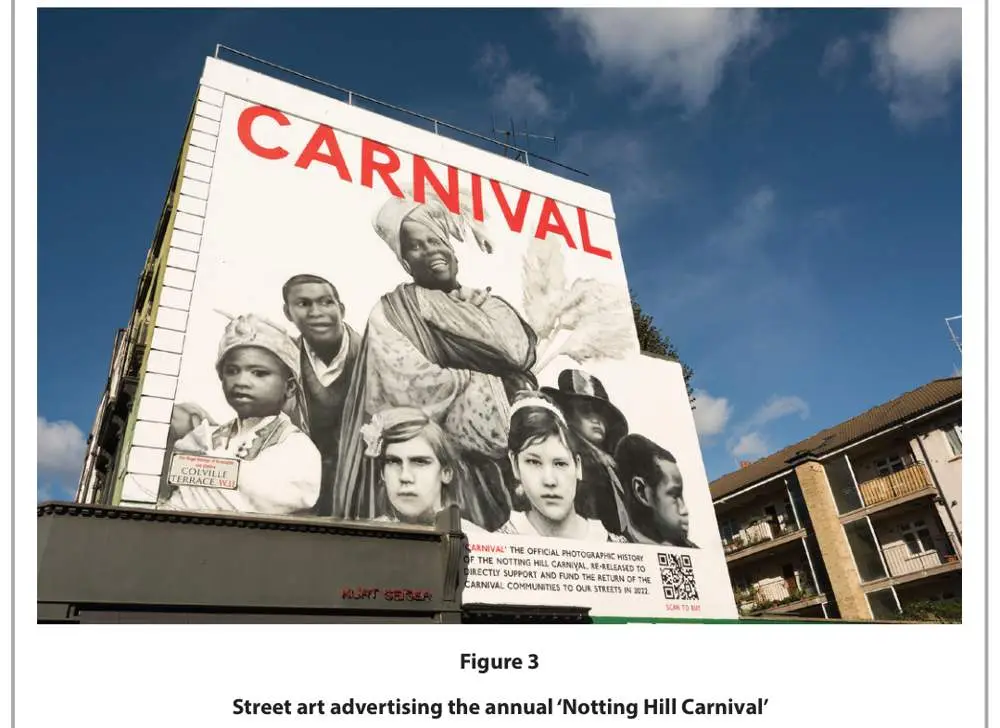
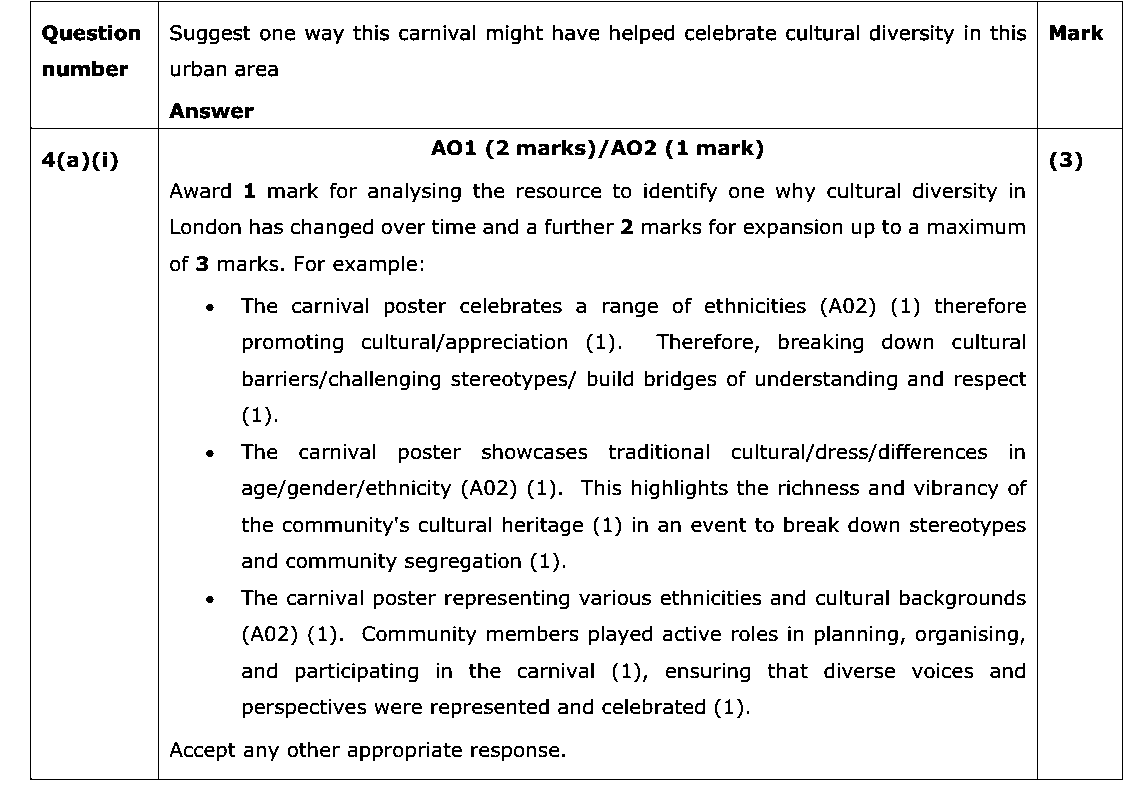
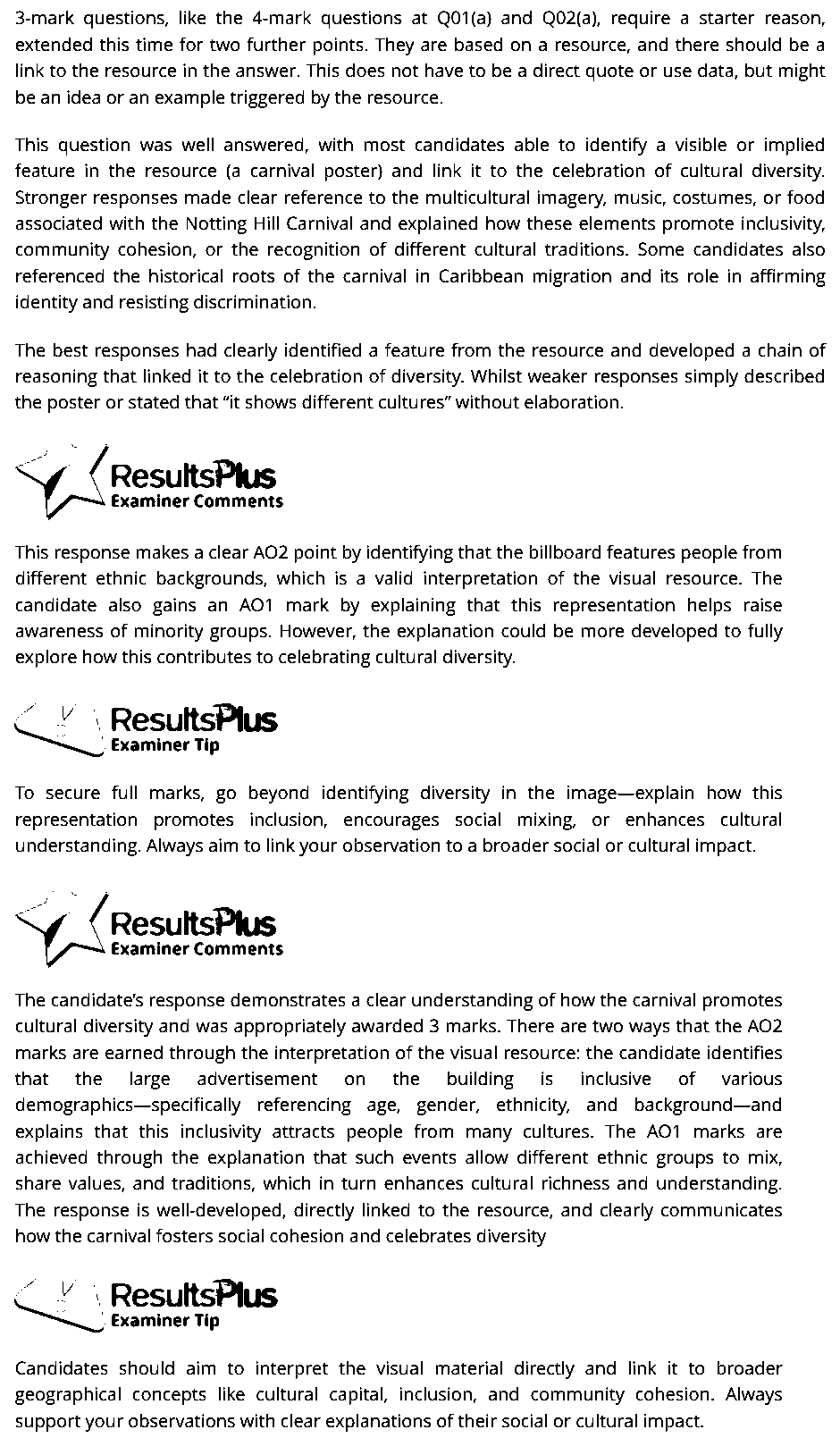
3-mark questions, like the 4-mark questions at Q01(a) and Q02(a), require a starter reason, extended this time for two further points. They are based on a resource, and there should be a link to the resource in the answer. This does not have to be a direct quote or use data, but might be an idea or an example triggered by the resource. This question was well answered, with most candidates able to identify a visible or implied feature in the resource (a carnival poster) and link it to the celebration of cultural diversity. Stronger responses made clear reference to the multicultural imagery, music, costumes, or food associated with the Notting Hill Carnival and explained how these elements promote inclusivity, community cohesion, or the recognition of different cultural traditions. Some candidates also referenced the historical roots of the carnival in Caribbean migration and its role in affirming identity and resisting discrimination. The best responses had clearly identified a feature from the resource and developed a chain of reasoning that linked it to the celebration of diversity. Whilst weaker responses simply described the poster or stated that “it shows different cultures” without elaboration. This response makes a clear AO2 point by identifying that the billboard features people from different ethnic backgrounds, which is a valid interpretation of the visual resource. The candidate also gains an AO1 mark by explaining that this representation helps raise awareness of minority groups. However, the explanation could be more developed to fully explore how this contributes to celebrating cultural diversity. To secure full marks, go beyond identifying diversity in the image—explain how this representation promotes inclusion, encourages social mixing, or enhances cultural understanding. Always aim to link your observation to a broader social or cultural impact. The candidate’s response demonstrates a clear understanding of how the carnival promotes cultural diversity and was appropriately awarded 3 marks. There are two ways that the AO2 marks are earned through the interpretation of the visual resource: the candidate identifies that the large advertisement on the building is inclusive of various demographics—specifically referencing age, gender, ethnicity, and background—and explains that this inclusivity attracts people from many cultures. The AO1 marks are achieved through the explanation that such events allow different ethnic groups to mix, share values, and traditions, which in turn enhances cultural richness and understanding. The response is well-developed, directly linked to the resource, and clearly communicates how the carnival fosters social cohesion and celebrates diversity Candidates should aim to interpret the visual material directly and link it to broader geographical concepts like cultural capital, inclusion, and community cohesion. Always support your observations with clear explanations of their social or cultural impact.
Notes from the mark scheme and report
Starter from Figure 3 then two extensions: poster shows a range of ethnicities, ages and dress, promoting appreciation, challenging stereotypes and community cohesion
Caribbean migration roots of the carnival
well answered
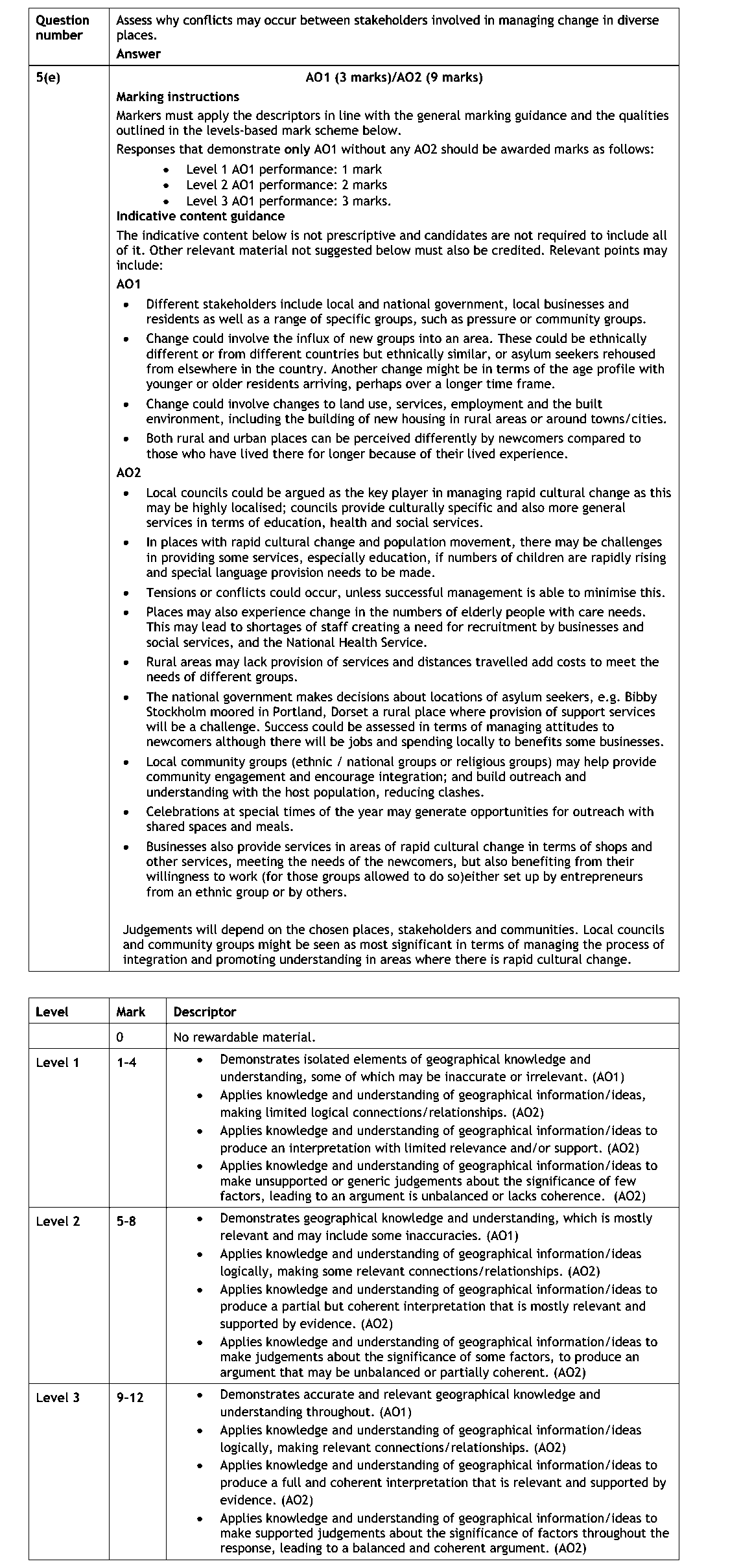
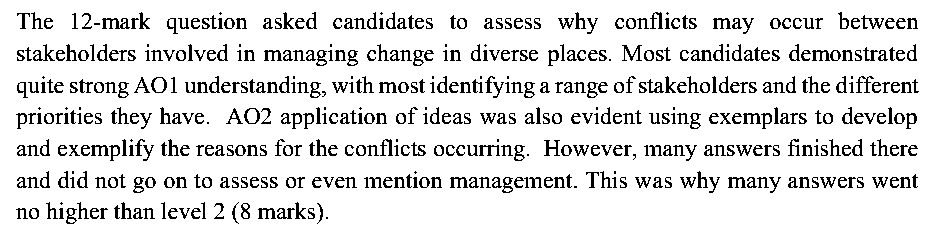
June 2025 · AS Paper 2 · Q5(e)12 marksAO1=3, AO2=912-mark essay
Resources for question 5
Mark scheme, including the levels and indicative content
Examiner's comment
The 12-mark question asked candidates to assess why conflicts may occur between stakeholders involved in managing change in diverse places. Most candidates demonstrated quite strong AO1 understanding, with most identifying a range of stakeholders and the different priorities they have. AO2 application of ideas was also evident using exemplars to develop and exemplify the reasons for the conflicts occurring. However, many answers finished there and did not go on to assess or even mention management. This was why many answers went no higher than level 2 (8 marks).
Notes from the mark scheme and report
Stakeholders (local and national government, businesses, long-term residents, recent migrants, community groups) with contrasting priorities for change
many did not assess or mention management so stayed at Level 2 (8 marks)
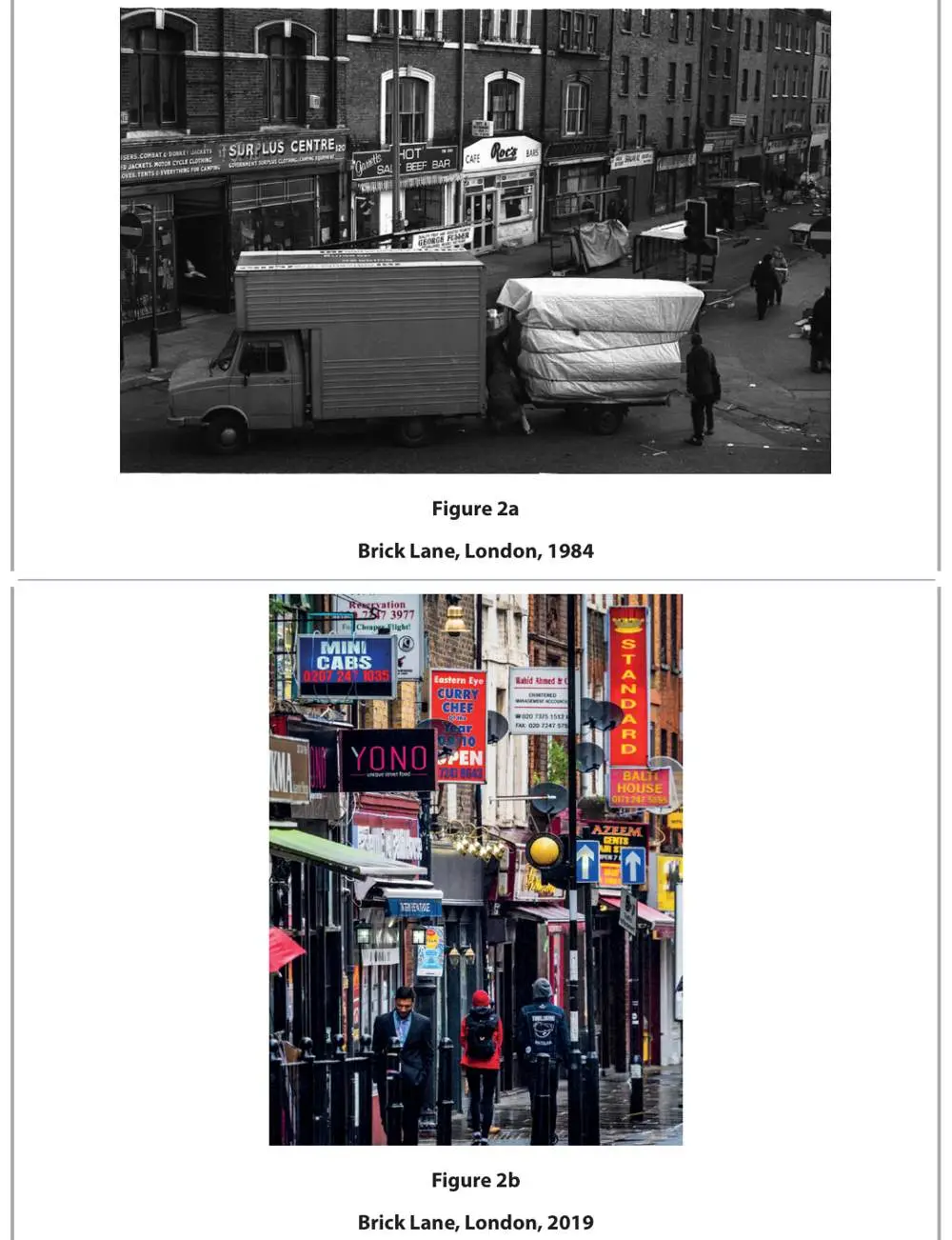
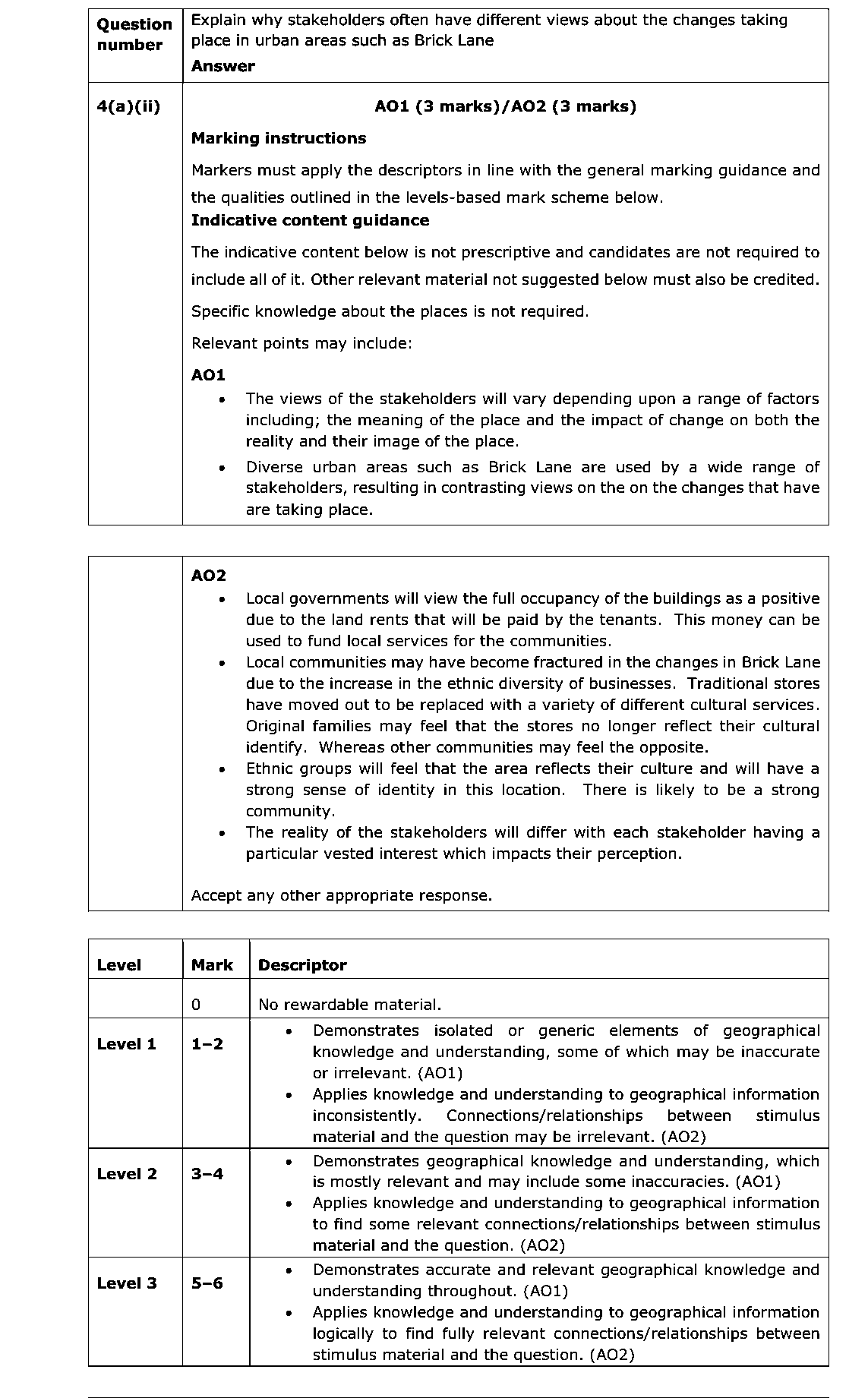
June 2024 · Paper 2 · Q4(a)(ii)6 marksAO1=3, AO2=3Extended response
Resources for question 4
Mark scheme, including the levels and indicative content
Examiner's comment
This is a 6-mark, AO1 and AO2 question based on a resource. The weighting is equal, with AO1 being awarded 3 marks and AO2 also 3 marks. Candidates needed to study the resource and suggest reasons why. Candidates needed to use the resource to gain ideas and then develop these using geographical knowledge and understanding in their answer. These ideas do not need to be specifically lifted from the resource, but there should be a link. A significant number of candidates did not use the figures enough to inspire their answer and/or they focused on vague groups and their attitudes toward perceived changes. These responses tended to end up in level 1. However, across the cohort a wide variety of plausible stakeholders were suggested, including local communities, local media, as well local countries and individuals. Level 2 responses went onto to explain the perspective they held about plausible changes to places. Similarly, to responses in 3aii, stakeholders discussed were mainly local residents – those that had lived in the area a long time and were unhappy with the changes being made as they felt excluded/marginalized. Businesses again were by far the most popular stakeholders who agreed/were pleased with the changes as there was more money to be made by catering to the new customers. Being a 6-mark ‘Explain’ question it was likely candidates performed better when they identified two separate stakeholders each with a very different perspective (which are not the opposite of each other). The most likely approach was to find one who held a positive view and another who held a negative view, but others include the scale (eg Local resident vs Local council) and time scale (long-term resident versus new arrival). There was no one approach that worked best; the best responses scored level 3 for the detail of their explanation. 5 marks were awarded here. The response covers 2 different stakeholders: older, white British locals and younger migrant stakeholders. For each stakeholder the reasons for their different perspectives is well explained. Although the reasons are distinct and well explained in each paragraph, there is quite a bit of overlap between the two paragraphs hence why the response was not given full marks. Overall, the response applies knowledge and understanding to geographical information logically to find fully relevant connections/relationships between stimulus material and the question. The majority of responses focused solely on the negative connotations of the changes and very few discussed the positives of multiculturalism in these contexts. Centres should look to explore a range of perspectives on this topic to ensure a more balanced view. 2 marks were awarded. The response is largely generic with limited knowledge and understanding linked to the resource. The response mentions one stakeholder, ie shoppers, but this is not explored. The response demonstrates isolated elements of geographical knowledge and understanding, some of which may be inaccurate or irrelevant. This means this is a Level 1 response, with generic elements of geographical knowledge and understanding. Remember that the 6-mark questions with a resource require candidates to find connections between the stimulus material and the question. You are then able to use your own knowledge and understanding to answer the question.
Notes from the mark scheme and report
Long-term residents seeking continuity v recent in-migrants, businesses, developers and council seeking change
gentrification, rising rents, loss of identity v economic opportunities
vague groups and attitudes stayed in Level 1
June 2024 · AS Paper 2 · Q5(b)(i)2 marksAO3=2Calculation
Resources for question 5
Mark scheme
Examiner's comment
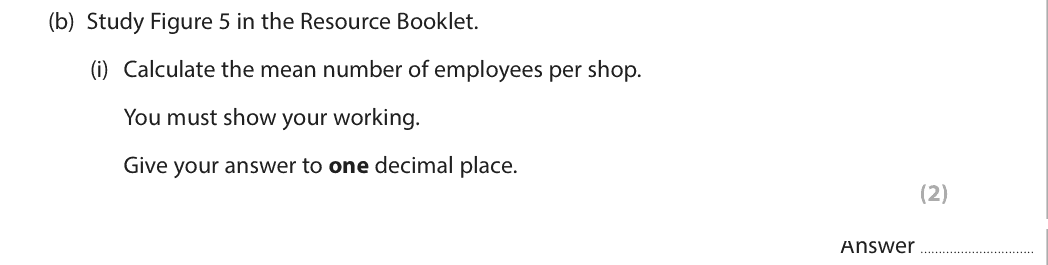
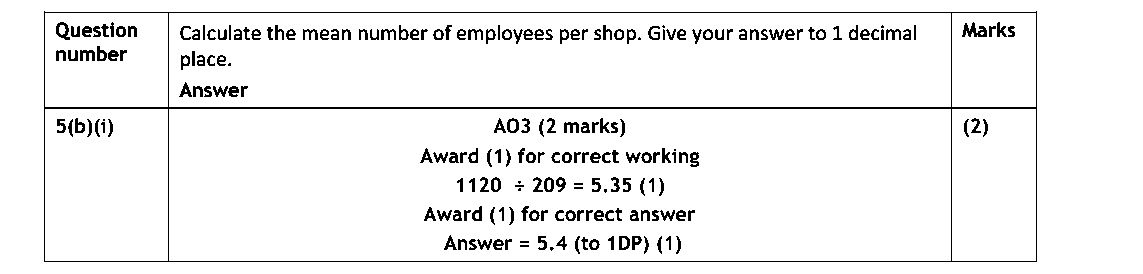
The majority were able to select the appropriate data and calculate the mean correctly. Candidates are reminded to follow instructions about giving the answer to one decimal place, as stated in this question.
Notes from the mark scheme and report
Answer: 5.4 (1120 ÷ 209 = 5.35)
1 mark working, 1 mark answer to 1 d.p.
June 2024 · AS Paper 2 · Q5(b)(ii)3 marksAO1=2, AO2=1Data response
Resources for question 5
Mark scheme
Examiner's comment
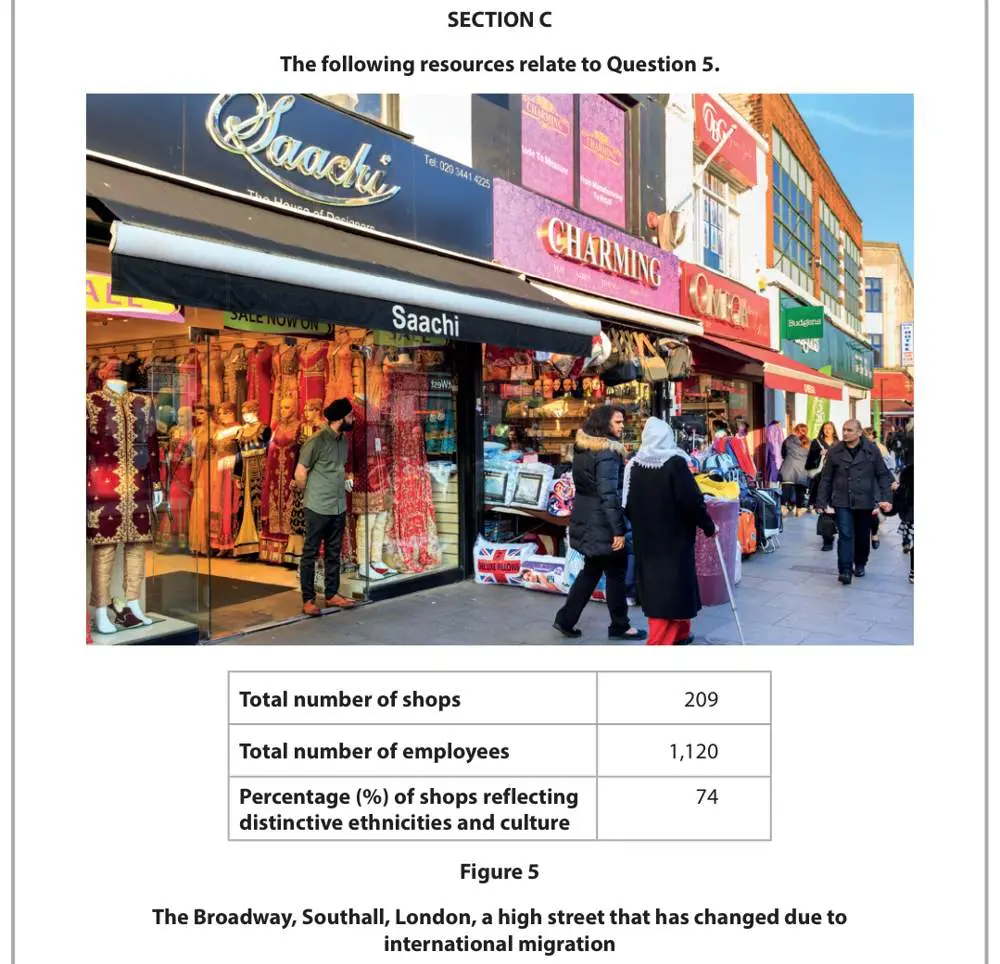
Most used the resource to identify a change in culture shown in the photograph, and successfully developed the reasoning for a second mark, but candidates did not always manage to get the third mark as the further extension was too vague.
Notes from the mark scheme and report
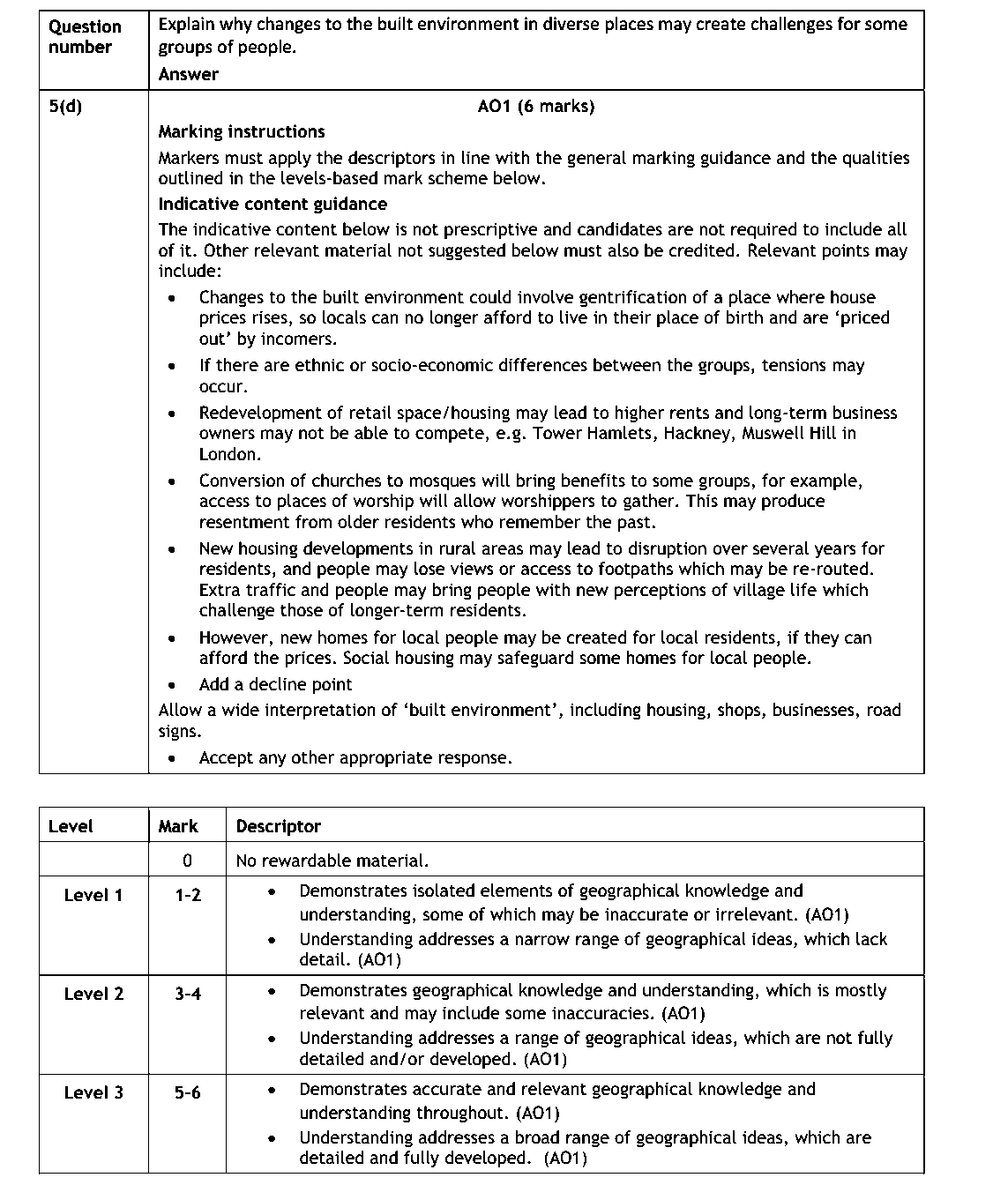
1 mark for a change shown in Figure 5 (Southall shops), 2 for development: shops selling goods for the South Asian community cluster in an ethnic enclave and replace earlier businesses
the third mark was often too vague
June 2024 · AS Paper 2 · Q5(d)6 marksAO1=6Extended response
Resources for question 5
Mark scheme, including the levels and indicative content
Examiner's comment
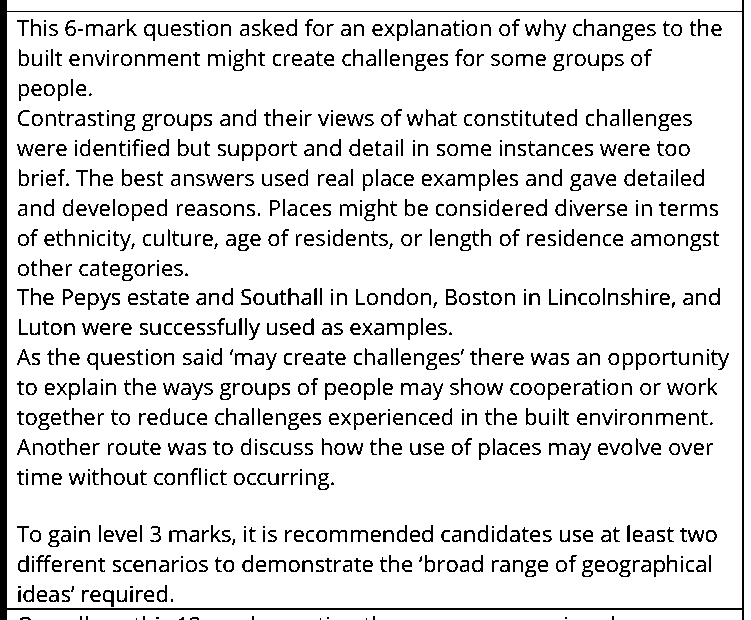
This 6-mark question asked for an explanation of why changes to the built environment might create challenges for some groups of people. Contrasting groups and their views of what constituted challenges were identified but support and detail in some instances were too brief. The best answers used real place examples and gave detailed and developed reasons. Places might be considered diverse in terms of ethnicity, culture, age of residents, or length of residence amongst other categories. The Pepys estate and Southall in London, Boston in Lincolnshire, and Luton were successfully used as examples. As the question said ‘may create challenges’ there was an opportunity to explain the ways groups of people may show cooperation or work together to reduce challenges experienced in the built environment. Another route was to discuss how the use of places may evolve over time without conflict occurring. To gain level 3 marks, it is recommended candidates use at least two different scenarios to demonstrate the ‘broad range of geographical ideas’ required.
Notes from the mark scheme and report
Gentrification prices out locals, redevelopment of retail and social housing, conversion of buildings to places of worship, new housing changing village life
named places (Pepys estate, Southall, Boston, Luton) helped
detail was often too brief
June 2024 · AS Paper 2 · Q716 marksAO1=4, AO2=1216-mark essay
Resources for question 7
Mark scheme, including the levels and indicative content
Notes from the mark scheme and report
Figures 7a-7d (Kingston, Jamaica): remittances (US$3.4bn, about 23% of GDP) fund education, housing and businesses, returning migrants bring skills v brain drain (48% of emigrants tertiary educated), 'barrel children' without parents, isolated elderly, forced deportation
judge for migrants and families separately
June 2023 · Paper 2 · Q4(a)(ii)6 marksAO1=3, AO2=3Extended response
Resources for question 4
Mark scheme, including the levels and indicative content
Examiner's comment
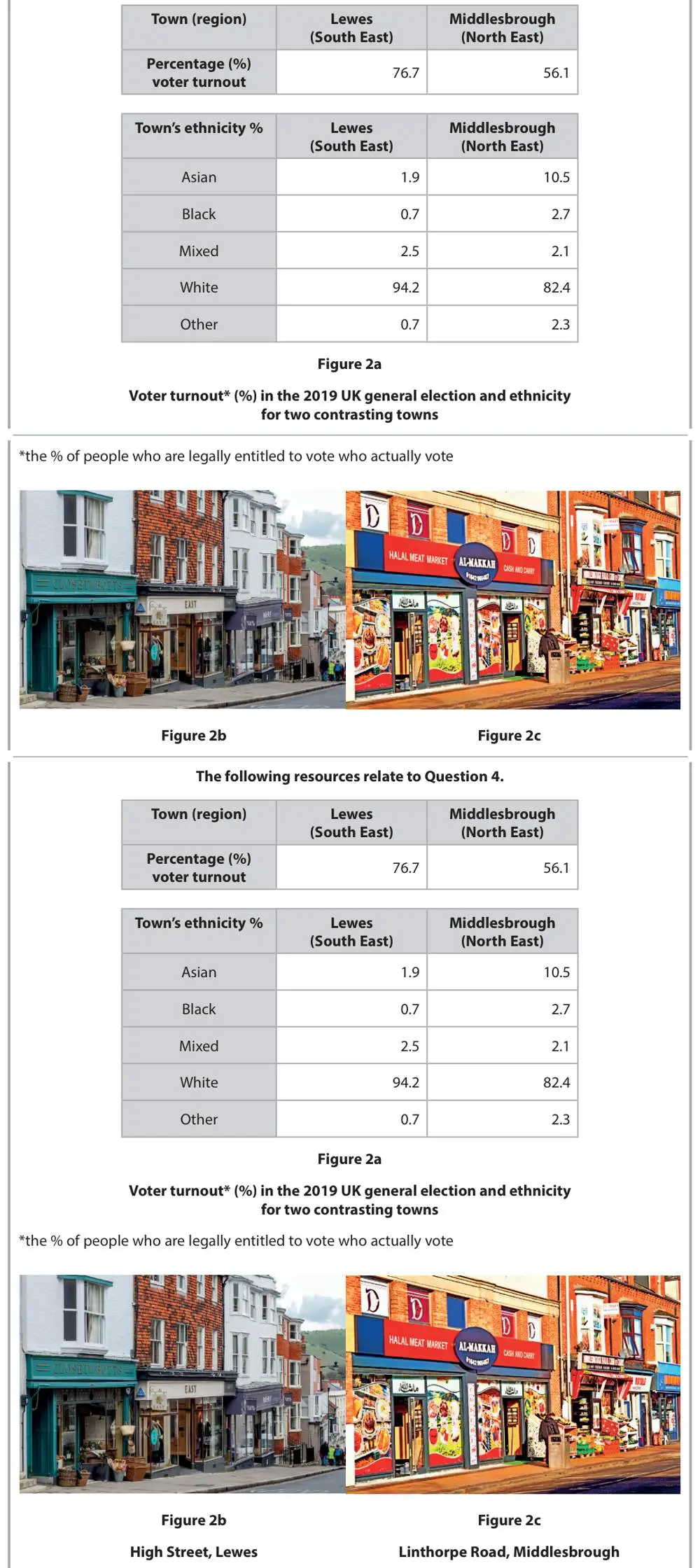
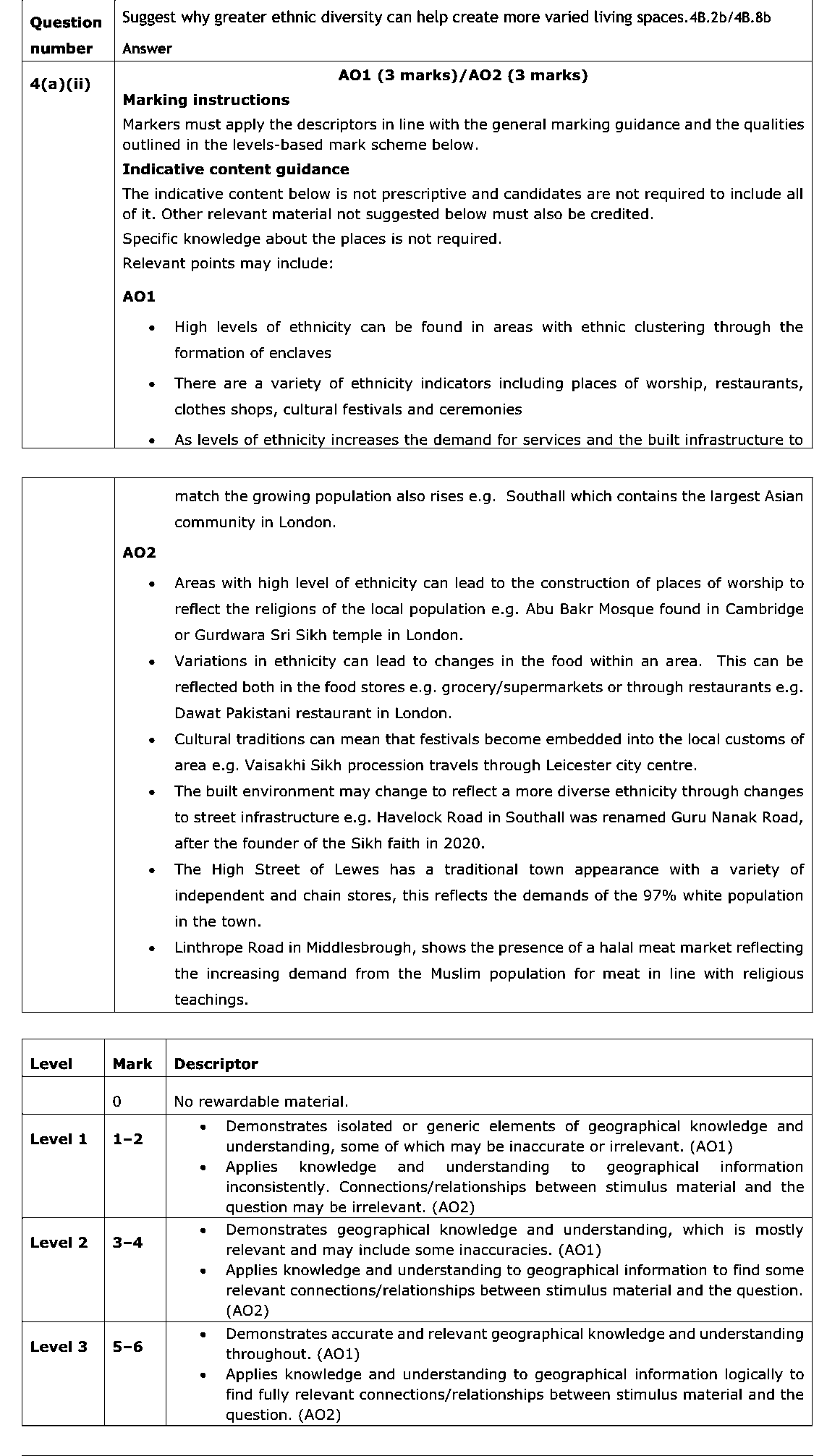
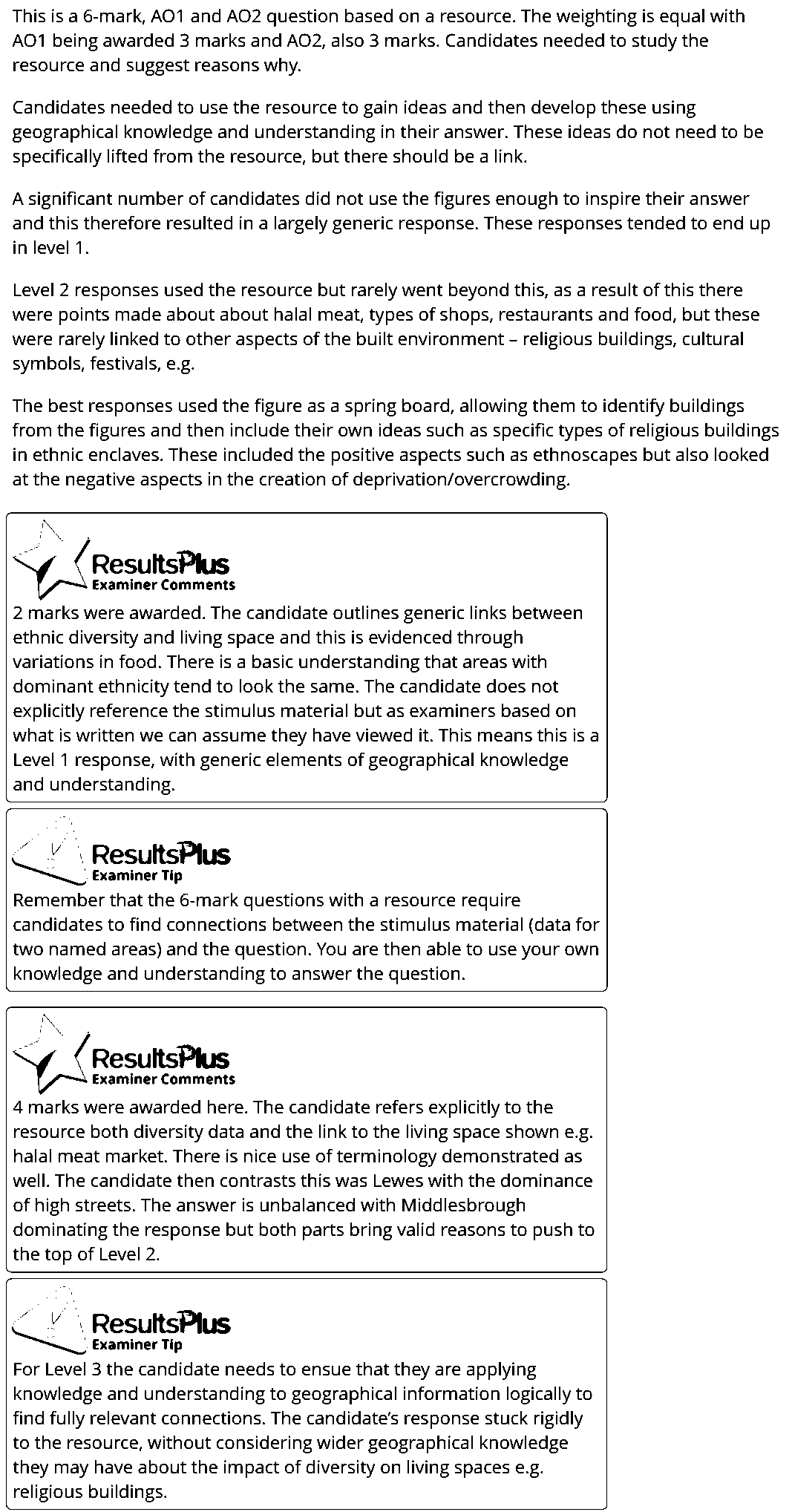
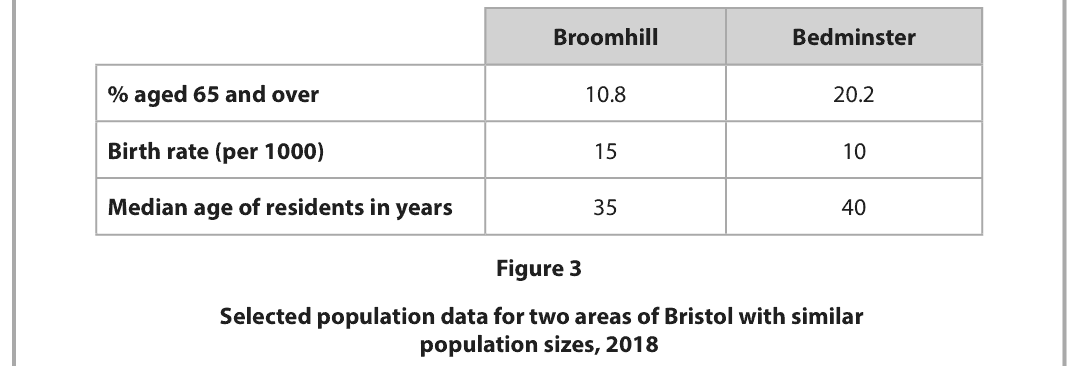
This is a 6-mark, AO1 and AO2 question based on a resource. The weighting is equal with AO1 being awarded 3 marks and AO2, also 3 marks. Candidates needed to study the resource and suggest reasons why. Candidates needed to use the resource to gain ideas and then develop these using geographical knowledge and understanding in their answer. These ideas do not need to be specifically lifted from the resource, but there should be a link. A significant number of candidates did not use the figures enough to inspire their answer and this therefore resulted in a largely generic response. These responses tended to end up in level 1. Level 2 responses used the resource but rarely went beyond this, as a result of this there were points made about about halal meat, types of shops, restaurants and food, but these were rarely linked to other aspects of the built environment – religious buildings, cultural symbols, festivals, e.g. The best responses used the figure as a spring board, allowing them to identify buildings from the figures and then include their own ideas such as specific types of religious buildings in ethnic enclaves. These included the positive aspects such as ethnoscapes but also looked at the negative aspects in the creation of deprivation/overcrowding. 2 marks were awarded. The candidate outlines generic links between ethnic diversity and living space and this is evidenced through variations in food. There is a basic understanding that areas with dominant ethnicity tend to look the same. The candidate does not explicitly reference the stimulus material but as examiners based on what is written we can assume they have viewed it. This means this is a Level 1 response, with generic elements of geographical knowledge and understanding. Remember that the 6-mark questions with a resource require candidates to find connections between the stimulus material (data for two named areas) and the question. You are then able to use your own knowledge and understanding to answer the question. 4 marks were awarded here. The candidate refers explicitly to the resource both diversity data and the link to the living space shown e.g. halal meat market. There is nice use of terminology demonstrated as well. The candidate then contrasts this was Lewes with the dominance of high streets. The answer is unbalanced with Middlesbrough dominating the response but both parts bring valid reasons to push to the top of Level 2. For Level 3 the candidate needs to ensue that they are applying knowledge and understanding to geographical information logically to find fully relevant connections. The candidate’s response stuck rigidly to the resource, without considering wider geographical knowledge they may have about the impact of diversity on living spaces e.g. religious buildings.
Notes from the mark scheme and report
Use Figures 2a-2c: diverse communities create distinctive retail (halal butchers, food shops), places of worship, restaurants, festivals and leisure (e.g. Southall)
generic answers that did not use the photos stayed in Level 1
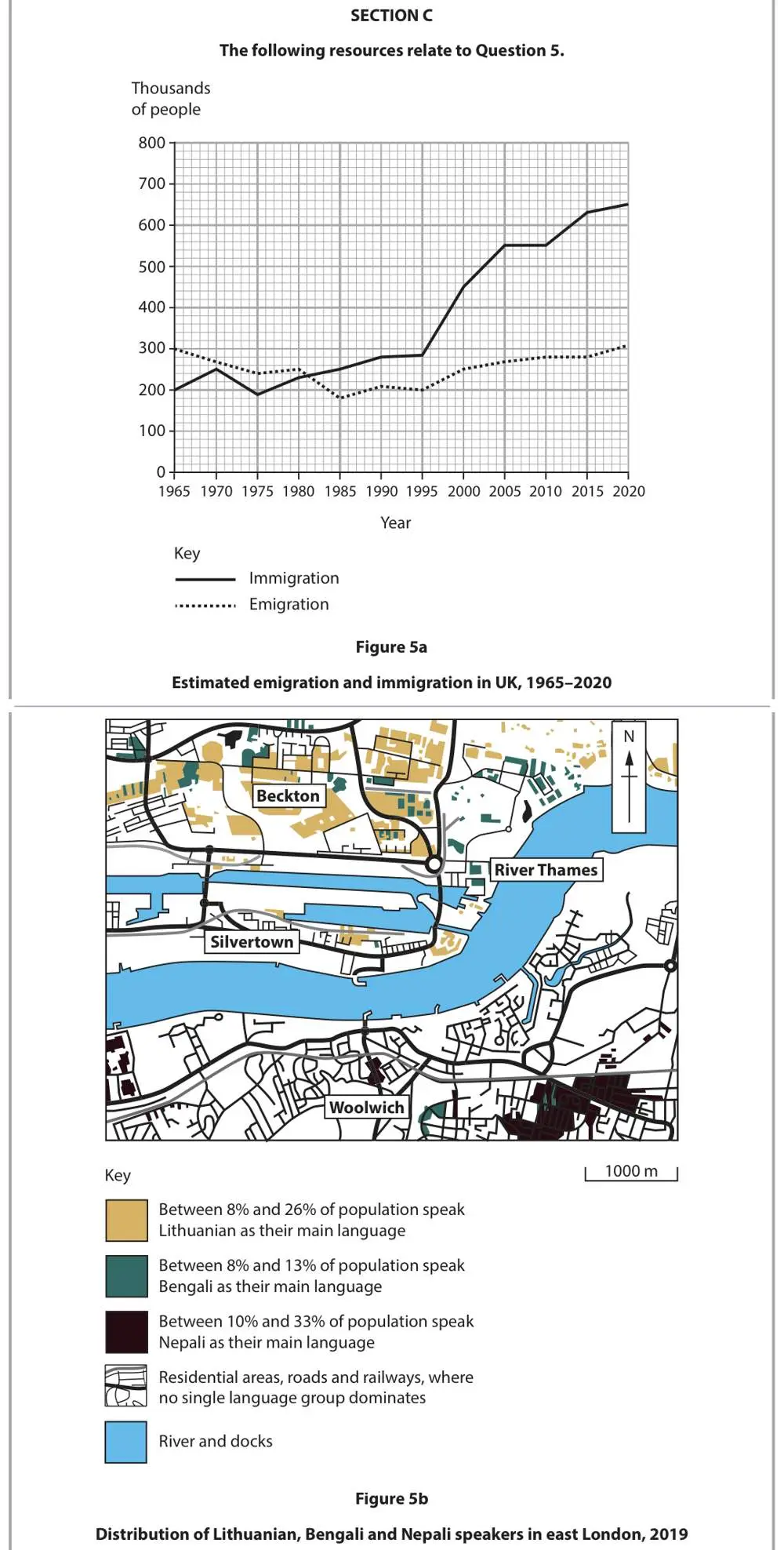
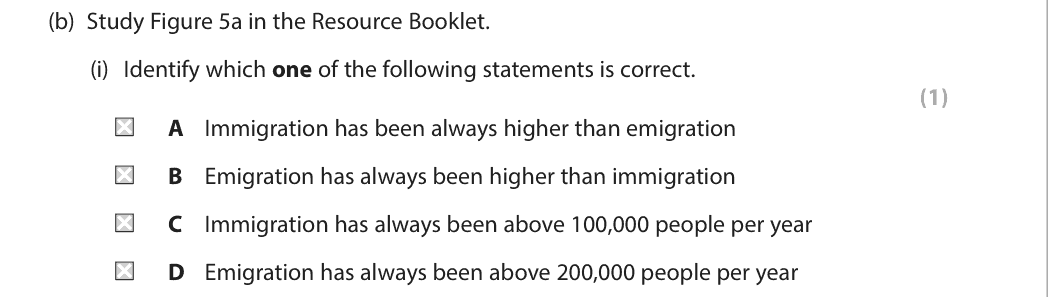
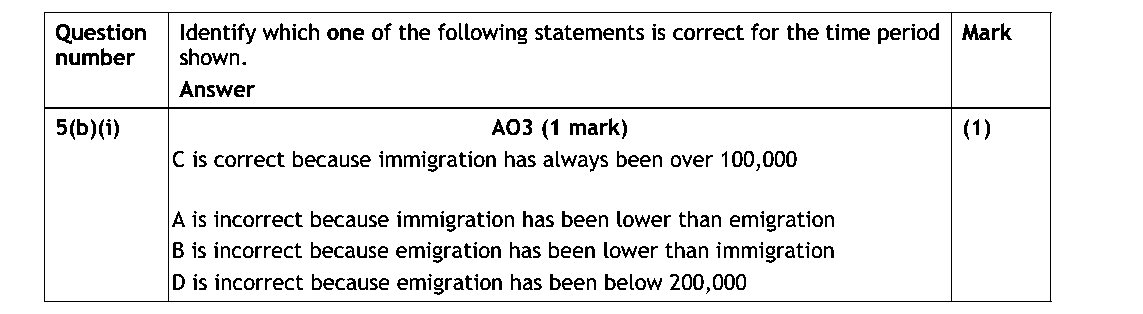
June 2023 · AS Paper 2 · Q5(b)(i)1 markAO3=1Multiple choice
Resources for question 5
Answer
C
Mark scheme
Examiner's comment
The majority successfully identified C as the correct answer.
Notes from the mark scheme and report
Answer C: immigration always above 100,000 per year
A and B wrong as the lines cross
D wrong as emigration fell below 200,000
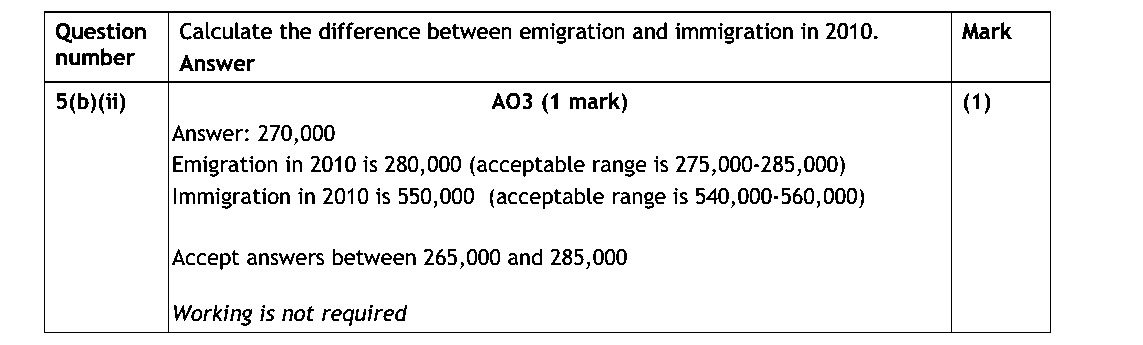
June 2023 · AS Paper 2 · Q5(b)(ii)1 markAO3=1Calculation
Resources for question 5
Mark scheme
Examiner's comment
The majority gave an answer within the range on the mark scheme, though some left off the thousands so gave an unacceptable answer.
Notes from the mark scheme and report
Answer: 270,000 (immigration 550,000 minus emigration 280,000 in 2010)
accept 265,000-285,000
some left off the thousands
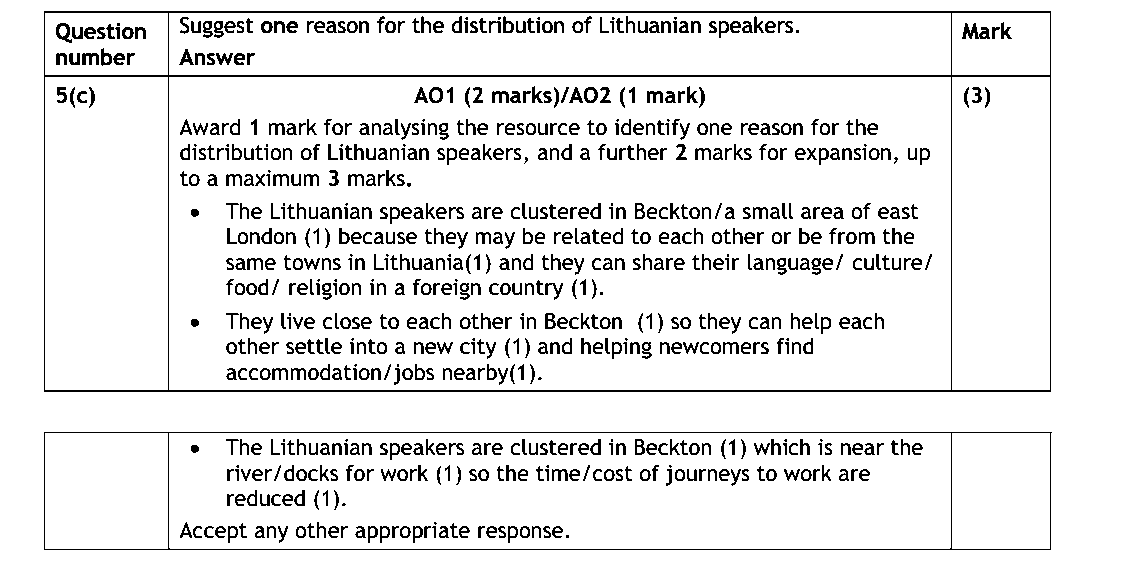
June 2023 · AS Paper 2 · Q5(c)3 marksAO1=2, AO2=1Data response
Resources for question 5
Mark scheme
Examiner's comment
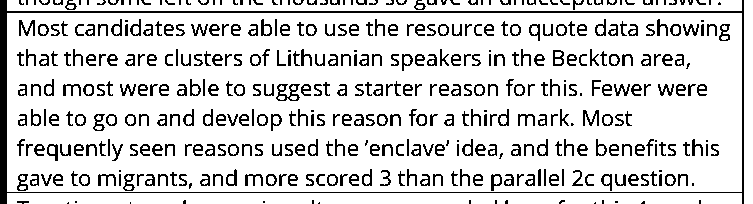
Most candidates were able to use the resource to quote data showing that there are clusters of Lithuanian speakers in the Beckton area, and most were able to suggest a starter reason for this. Fewer were able to go on and develop this reason for a third mark. Most frequently seen reasons used the ’enclave’ idea, and the benefits this gave to migrants, and more scored 3 than the parallel 2c question.
Notes from the mark scheme and report
Lithuanian speakers cluster in Beckton (Figure 5b): enclave with family, shared language and culture, support for newcomers
or near docks and jobs
most suggested a reason but fewer developed it for 3
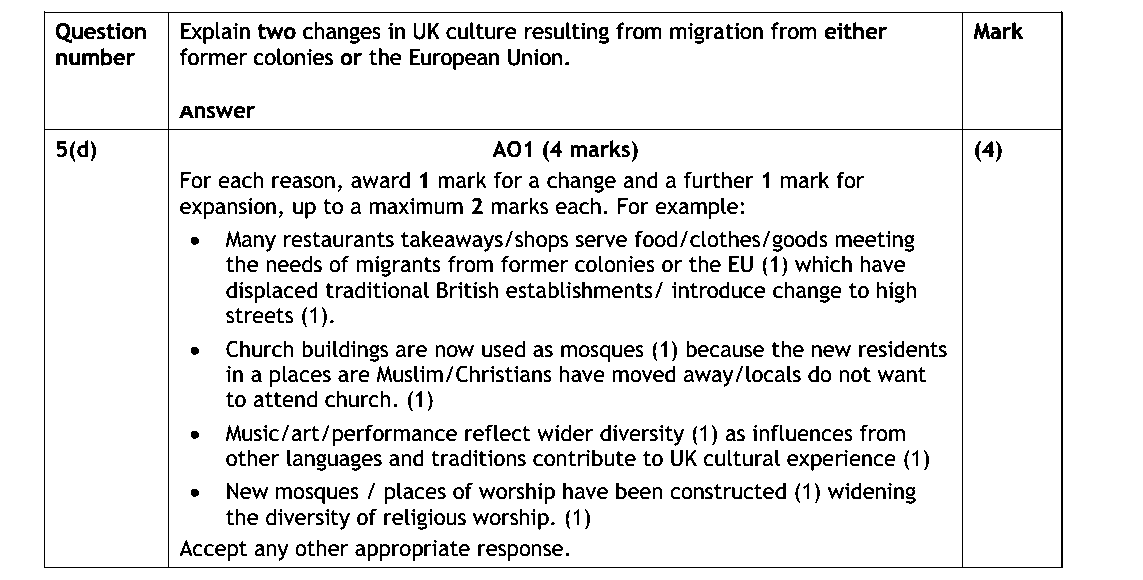
June 2023 · AS Paper 2 · Q5(d)4 marksAO1=4Short answer
Resources for question 5
Mark scheme
Examiner's comment
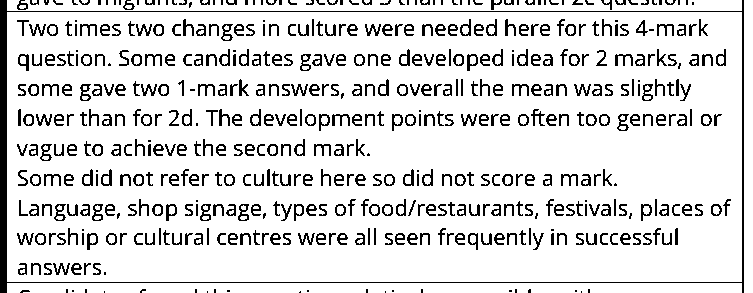
Two times two changes in culture were needed here for this 4-mark question. Some candidates gave one developed idea for 2 marks, and some gave two 1-mark answers, and overall the mean was slightly lower than for 2d. The development points were often too general or vague to achieve the second mark. Some did not refer to culture here so did not score a mark. Language, shop signage, types of food/restaurants, festivals, places of worship or cultural centres were all seen frequently in successful answers.
Notes from the mark scheme and report
Restaurants, shops and food
places of worship
language and signage
music and festivals (e.g. Notting Hill Carnival)
the change must be cultural
development points were often too vague
June 2023 · AS Paper 2 · Q716 marksAO1=4, AO2=1216-mark essay
Resources for question 7
Mark scheme, including the levels and indicative content
Examiner's comment
There were very few Level 1 answers here, with almost all able to use the resources provided to discuss benefits of the international influences for the businesses and different groups of people of Leicester, so reaching at least level 2. The resources were used but often repeated rather than developing links and 'assessing the extent', which were needed for higher level 3 and Level 4 answers. Conclusions were often short and along the lines of 'it has/hasn't benefitted people and businesses’. Most approaches were talking about all the advantages and then the later problems. This meant candidates didn't develop ideas about the changes over time, which were well developed in the resources. This often led to rather basic evaluation. Those who developed their answer by discussing a specific change and how later problems emerged tended to produce a more coherent answer. There were fuller comments about the people compared to the businesses, and candidates are reminded that a balanced essay will cover all parts of the question, and the little word ‘and’ should not be forgotten. Both question 4 and question 7 featured an introductory sentence to this year, to help set the scene and allow for a shorter question. The question is always the part that begins with the command word, which for the 16 mark questions will always be ‘evaluate’. Better answers were able to make synoptic links between the resources and other places they had studied. A strong conclusion was seen in the best level 4 answers, evaluating which influence brought the most benefits to Leicester, with some considering different time frames, and the reasons for this.
Notes from the mark scheme and report
Use Figures 7a-7d (Leicester): migration and global shift closed then reshored clothing factories with illegal low pay
diverse businesses, Diwali, university role v racism and 2022 clashes
develop change over time and judge the extent, not just repeat the resources
June 2022 · Paper 2 · Q4(c)20 marksAO1=5, AO2=1520-mark essay
Resources for question 4
Mark scheme, including the levels and indicative content
Examiner's comment
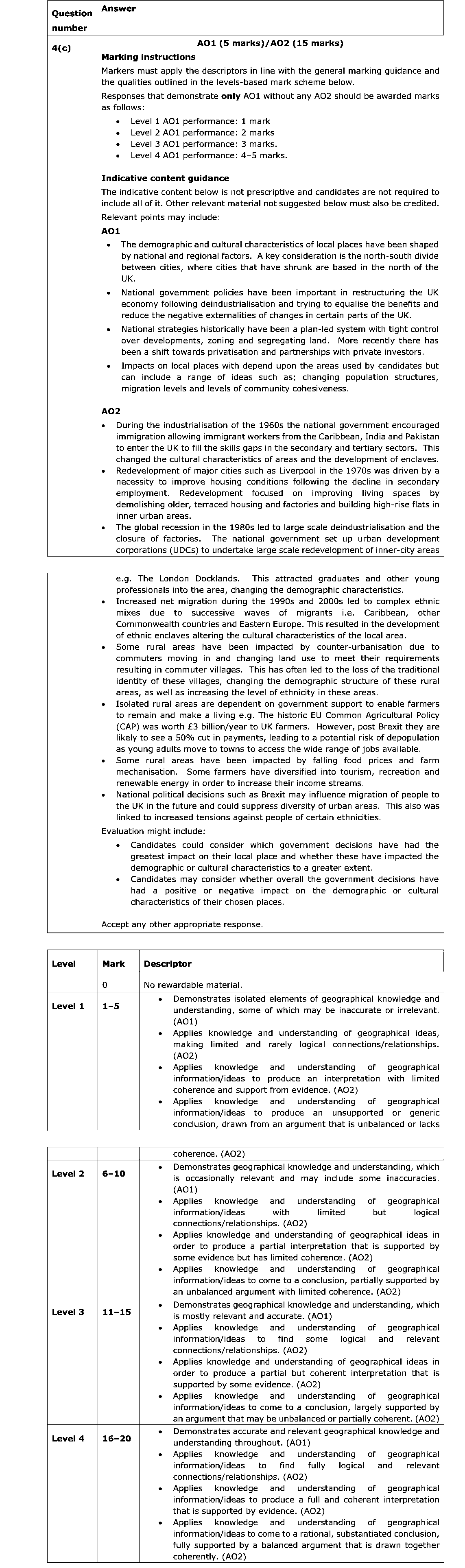
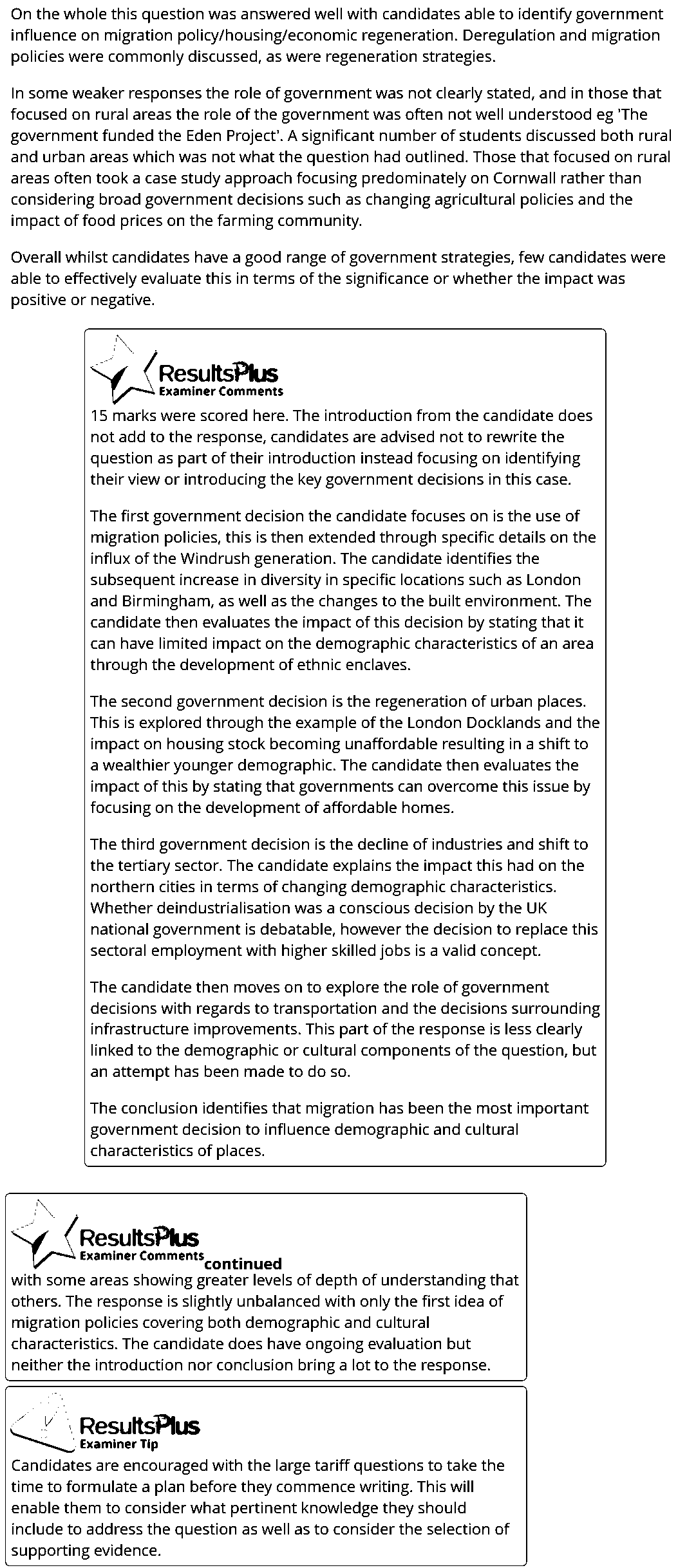
On the whole this question was answered well with candidates able to identify government influence on migration policy/housing/economic regeneration. Deregulation and migration policies were commonly discussed, as were regeneration strategies. In some weaker responses the role of government was not clearly stated, and in those that focused on rural areas the role of the government was often not well understood eg 'The government funded the Eden Project'. A significant number of students discussed both rural and urban areas which was not what the question had outlined. Those that focused on rural areas often took a case study approach focusing predominately on Cornwall rather than considering broad government decisions such as changing agricultural policies and the impact of food prices on the farming community. Overall whilst candidates have a good range of government strategies, few candidates were able to effectively evaluate this in terms of the significance or whether the impact was positive or negative. 15 marks were scored here. The introduction from the candidate does not add to the response, candidates are advised not to rewrite the question as part of their introduction instead focusing on identifying their view or introducing the key government decisions in this case. The first government decision the candidate focuses on is the use of migration policies, this is then extended through specific details on the influx of the Windrush generation. The candidate identifies the subsequent increase in diversity in specific locations such as London and Birmingham, as well as the changes to the built environment. The candidate then evaluates the impact of this decision by stating that it can have limited impact on the demographic characteristics of an area through the development of ethnic enclaves. The second government decision is the regeneration of urban places. This is explored through the example of the London Docklands and the impact on housing stock becoming unaffordable resulting in a shift to a wealthier younger demographic. The candidate then evaluates the impact of this by stating that governments can overcome this issue by focusing on the development of affordable homes. The third government decision is the decline of industries and shift to the tertiary sector. The candidate explains the impact this had on the northern cities in terms of changing demographic characteristics. Whether deindustrialisation was a conscious decision by the UK national government is debatable, however the decision to replace this sectoral employment with higher skilled jobs is a valid concept. The candidate then moves on to explore the role of government decisions with regards to transportation and the decisions surrounding infrastructure improvements. This part of the response is less clearly linked to the demographic or cultural components of the question, but an attempt has been made to do so. The conclusion identifies that migration has been the most important government decision to influence demographic and cultural characteristics of places. . continued with some areas showing greater levels of depth of understanding that others. The response is slightly unbalanced with only the first idea of migration policies covering both demographic and cultural characteristics. The candidate does have ongoing evaluation but neither the introduction nor conclusion bring a lot to the response. Candidates are encouraged with the large tariff questions to take the time to formulate a plan before they commence writing. This will enable them to consider what pertinent knowledge they should include to address the question as well as to consider the selection of supporting evidence.
Notes from the mark scheme and report
Government migration policy, housing and regeneration and planning shaping demographic and cultural characteristics in either urban or rural places
rural answers often misread government's role (e.g. Eden Project)
few evaluated significance or whether impacts were positive or negative
November 2021 · Paper 2 · Q4(c)20 marksAO1=5, AO2=1520-mark essay
Resources for question 4
Mark scheme, including the levels and indicative content
Examiner's comment
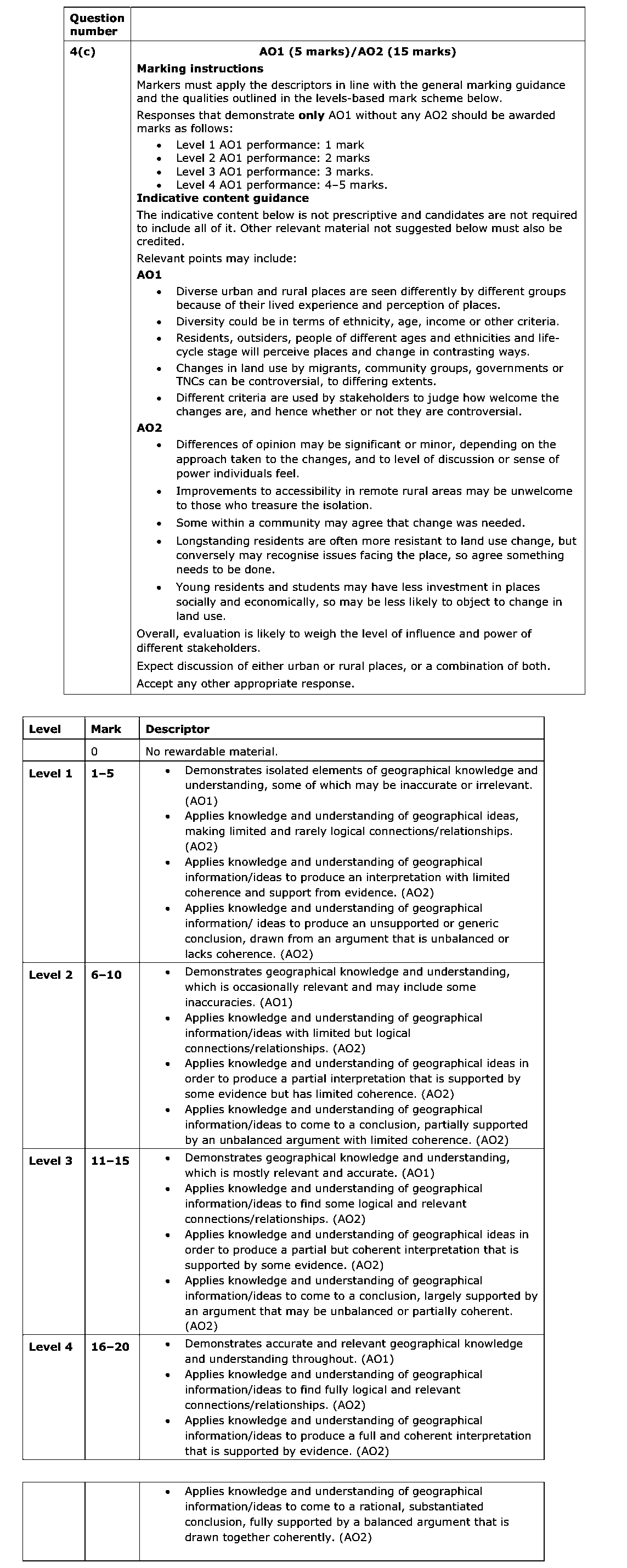
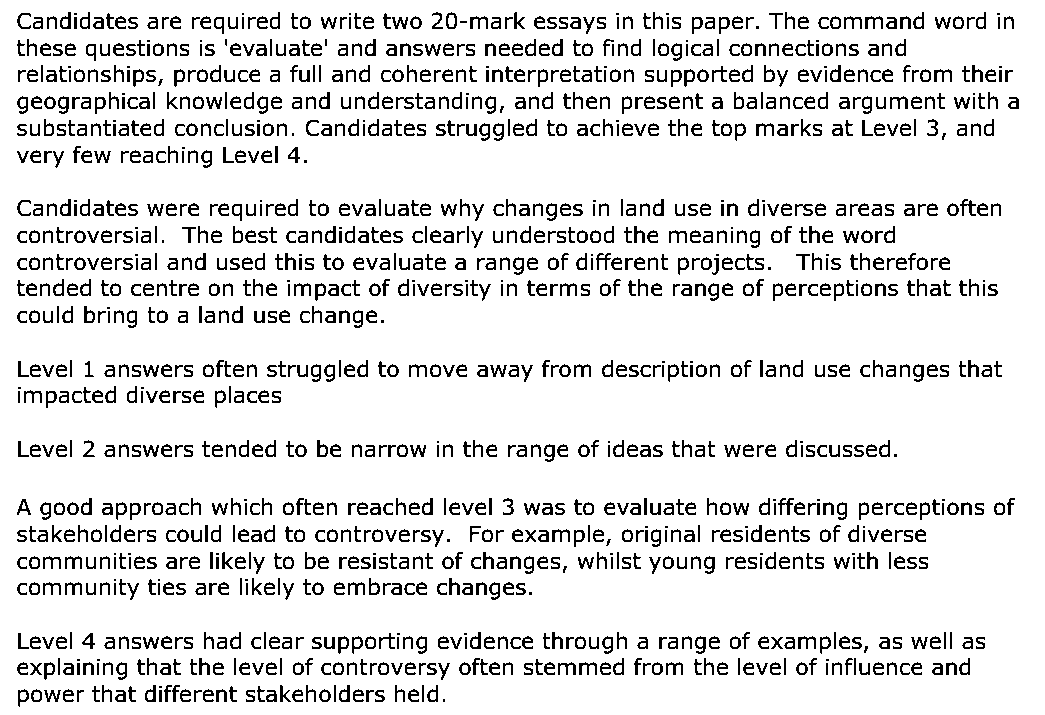
Candidates are required to write two 20-mark essays in this paper. The command word in these questions is 'evaluate' and answers needed to find logical connections and relationships, produce a full and coherent interpretation supported by evidence from their geographical knowledge and understanding, and then present a balanced argument with a substantiated conclusion. Candidates struggled to achieve the top marks at Level 3, and very few reaching Level 4. Candidates were required to evaluate why changes in land use in diverse areas are often controversial. The best candidates clearly understood the meaning of the word controversial and used this to evaluate a range of different projects. This therefore tended to centre on the impact of diversity in terms of the range of perceptions that this could bring to a land use change. Level 1 answers often struggled to move away from description of land use changes that impacted diverse places Level 2 answers tended to be narrow in the range of ideas that were discussed. A good approach which often reached level 3 was to evaluate how differing perceptions of stakeholders could lead to controversy. For example, original residents of diverse communities are likely to be resistant of changes, whilst young residents with less community ties are likely to embrace changes. Level 4 answers had clear supporting evidence through a range of examples, as well as explaining that the level of controversy often stemmed from the level of influence and power that different stakeholders held.
Notes from the mark scheme and report
Land-use changes by migrants, community groups, governments and TNCs perceived differently by age, ethnicity and length of residence
long-term residents seeking continuity v in-migrants
Level 4 linked controversy to stakeholders' influence and power, with a range of examples
October 2020 · AS Paper 2 · Q716 marksAO1=4, AO2=1216-mark essay
Resources for question 7
Mark scheme, including the levels and indicative content
Notes from the mark scheme and report
Use Figures 12a-12d: refinery red mud pollution, poaching and deforestation, commercial seeds replacing traditional crops threaten identity
NGO support, millet demand and TNC recycling offer opportunities
judge whether tension is inevitable or can be managed
June 2019 · Paper 2 · Q4(a)(i)3 marksAO1=2, AO2=1Data response
Resources for question 4
Mark scheme
Examiner's comment
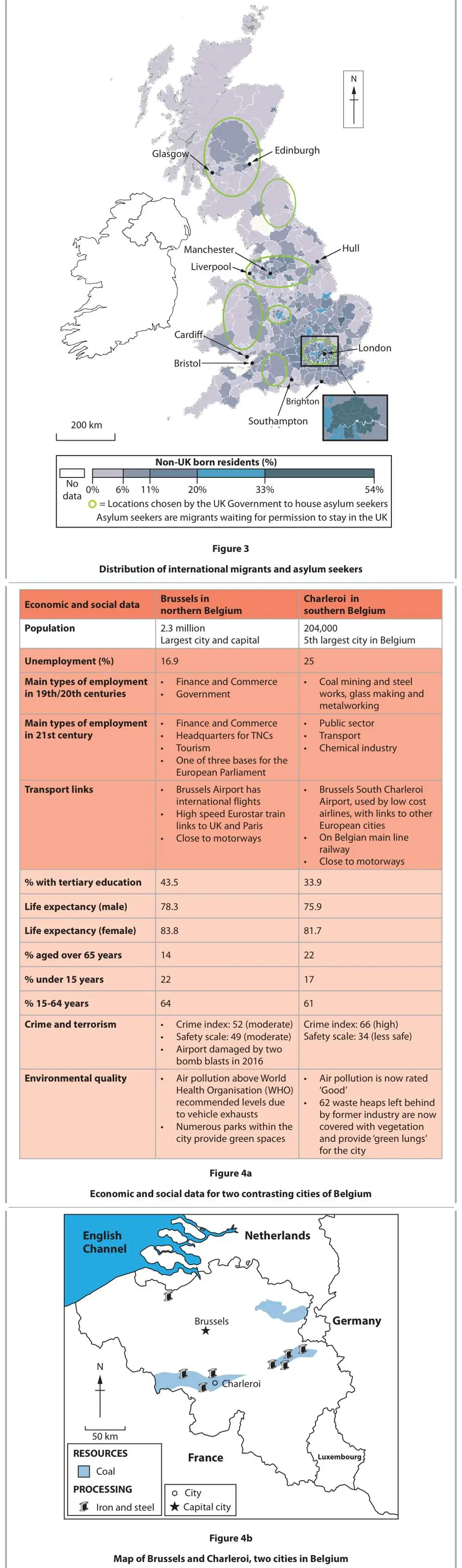
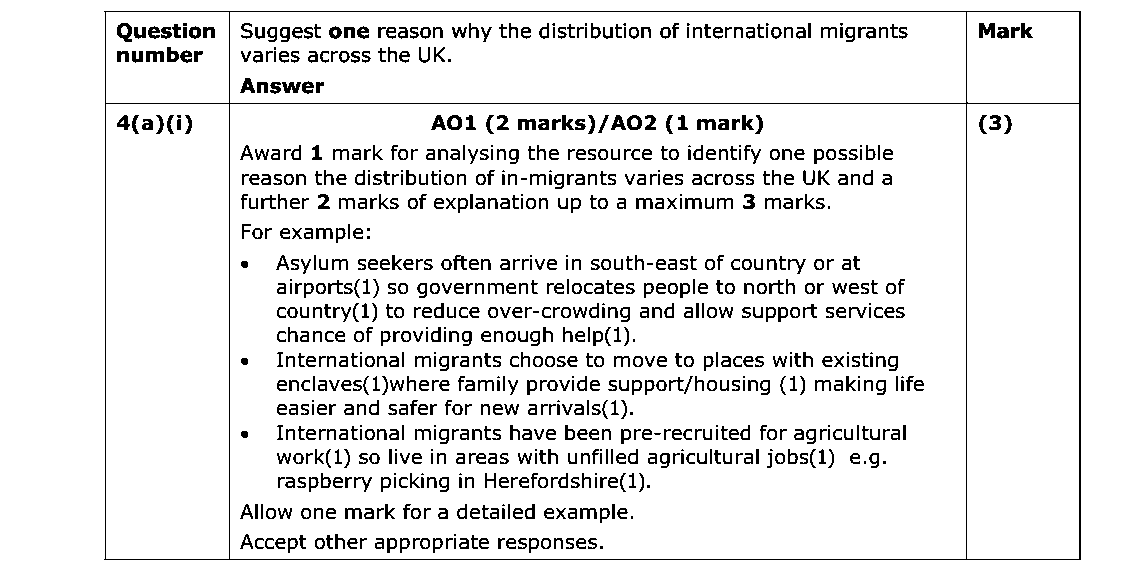
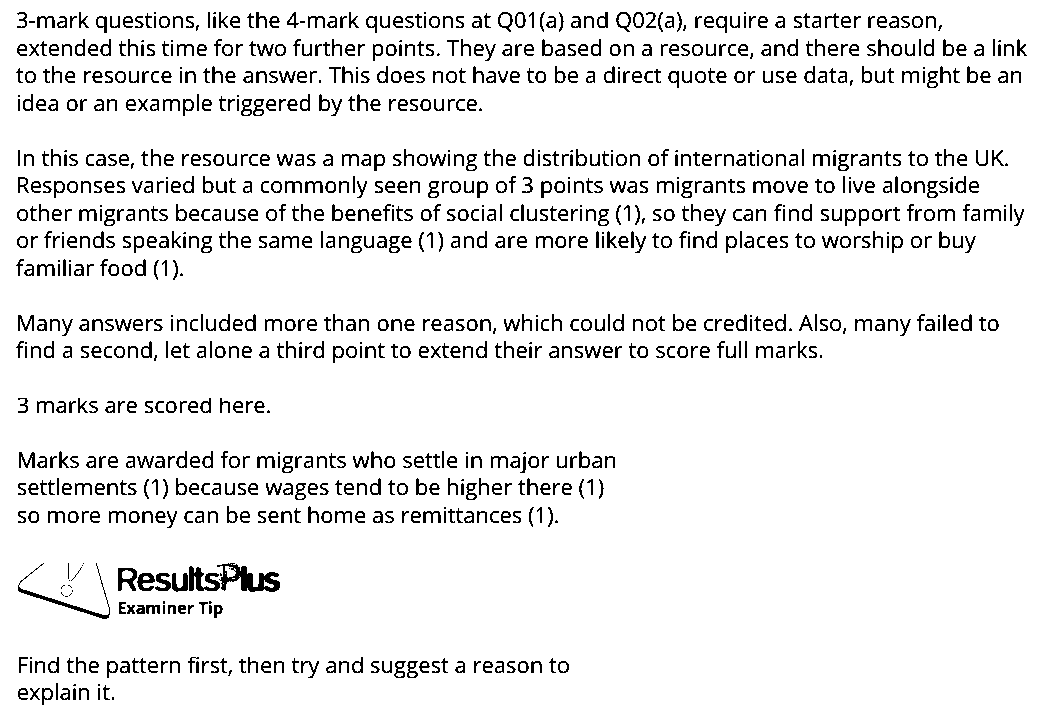
3-mark questions, like the 4-mark questions at Q01(a) and Q02(a), require a starter reason, extended this time for two further points. They are based on a resource, and there should be a link to the resource in the answer. This does not have to be a direct quote or use data, but might be an idea or an example triggered by the resource. In this case, the resource was a map showing the distribution of international migrants to the UK. Responses varied but a commonly seen group of 3 points was migrants move to live alongside other migrants because of the benefits of social clustering (1), so they can find support from family or friends speaking the same language (1) and are more likely to find places to worship or buy familiar food (1). Many answers included more than one reason, which could not be credited. Also, many failed to find a second, let alone a third point to extend their answer to score full marks. 3 marks are scored here. Marks are awarded for migrants who settle in major urban settlements (1) because wages tend to be higher there (1) so more money can be sent home as remittances (1). Find the pattern first, then try and suggest a reason to explain it.
Notes from the mark scheme and report
Figure 3: migrants cluster in large cities for jobs and social clustering (family, language, worship, food)
asylum seekers dispersed by government
many gave more than one reason or failed to extend
June 2019 · Paper 2 · Q4(a)(ii)6 marksAO1=3, AO2=3Extended response
Resources for question 4
Mark scheme, including the levels and indicative content
Examiner's comment
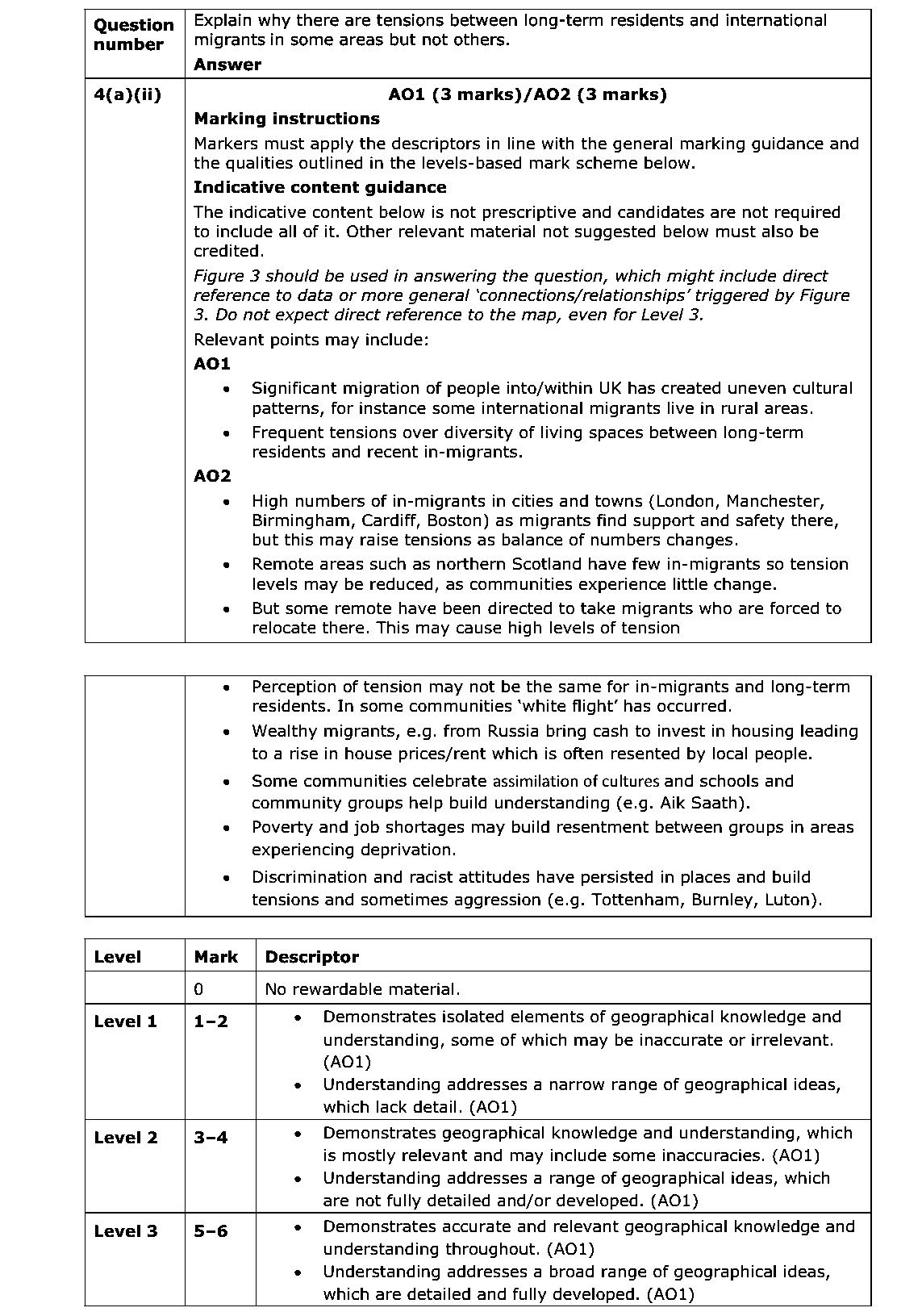
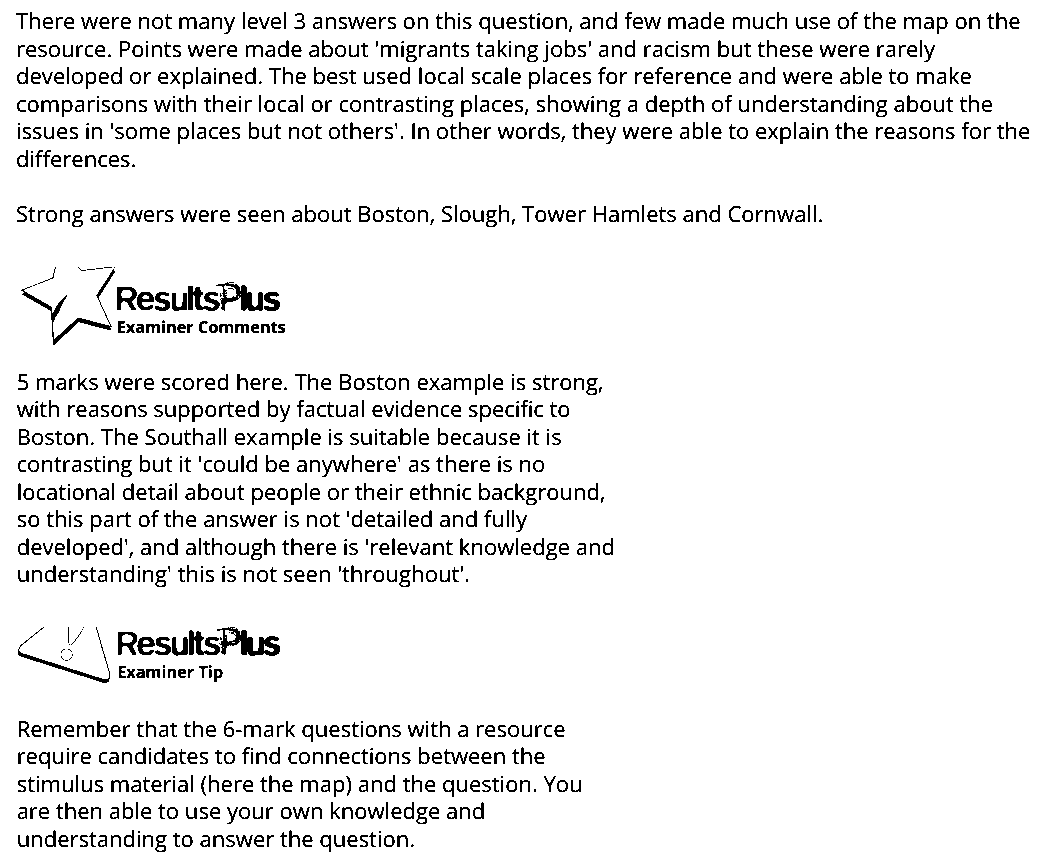
There were not many level 3 answers on this question, and few made much use of the map on the resource. Points were made about 'migrants taking jobs' and racism but these were rarely developed or explained. The best used local scale places for reference and were able to make comparisons with their local or contrasting places, showing a depth of understanding about the issues in 'some places but not others'. In other words, they were able to explain the reasons for the differences. Strong answers were seen about Boston, Slough, Tower Hamlets and Cornwall. 5 marks were scored here. The Boston example is strong, with reasons supported by factual evidence specific to Boston. The Southall example is suitable because it is contrasting but it 'could be anywhere' as there is no locational detail about people or their ethnic background, so this part of the answer is not 'detailed and fully developed', and although there is 'relevant knowledge and understanding' this is not seen 'throughout'. Remember that the 6-mark questions with a resource require candidates to find connections between the stimulus material (here the map) and the question. You are then able to use your own knowledge and understanding to answer the question.
Notes from the mark scheme and report
Rapid change in places with few previous migrants (e.g. Boston) v long-established diversity (Southall, Tower Hamlets)
competition for housing and services, media, social exclusion
few L3 answers and little use of the map
June 2019 · Paper 2 · Q4(b)6 marksAO1=6Extended response
Resources for question 4
Mark scheme, including the levels and indicative content
Examiner's comment
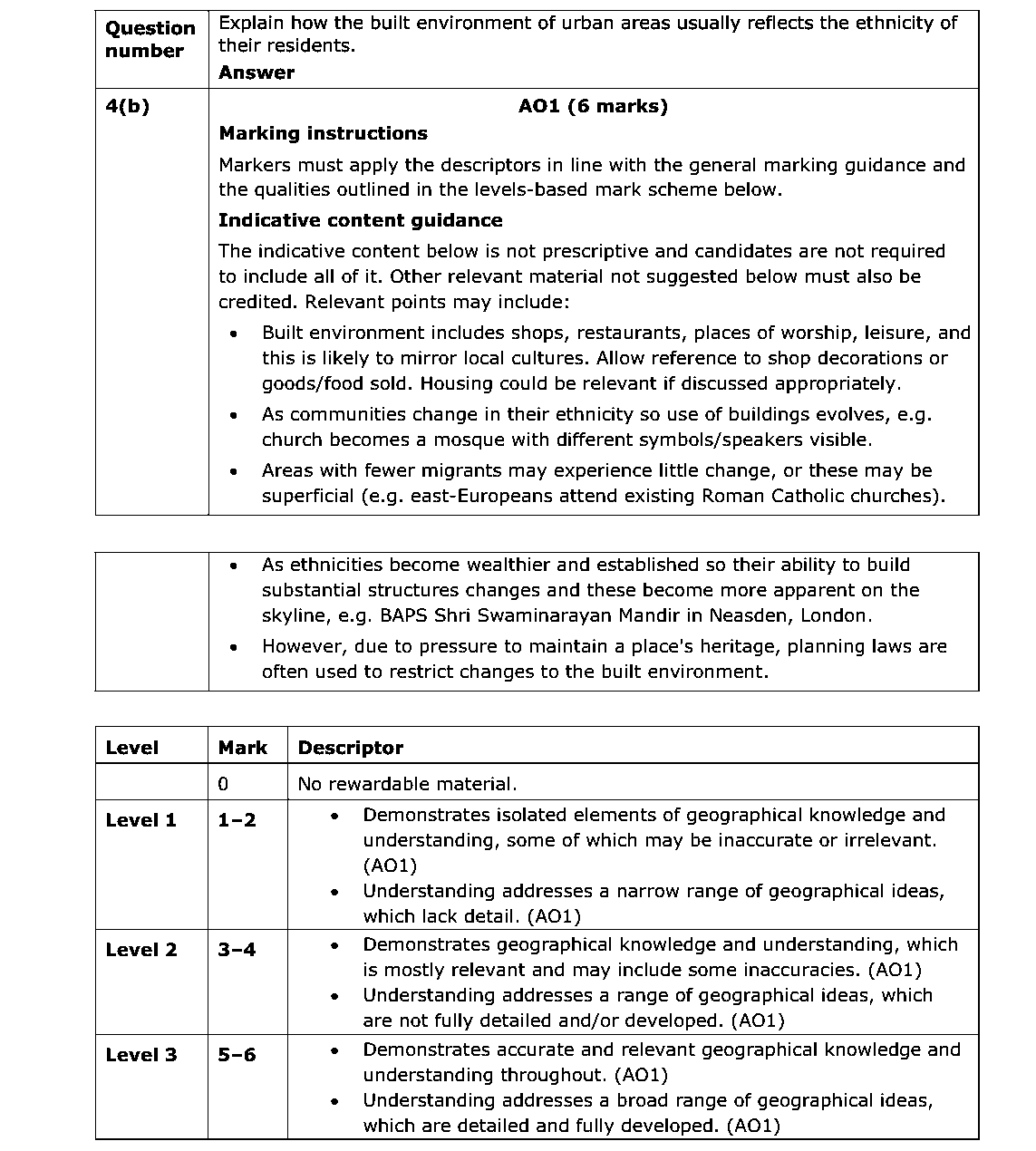
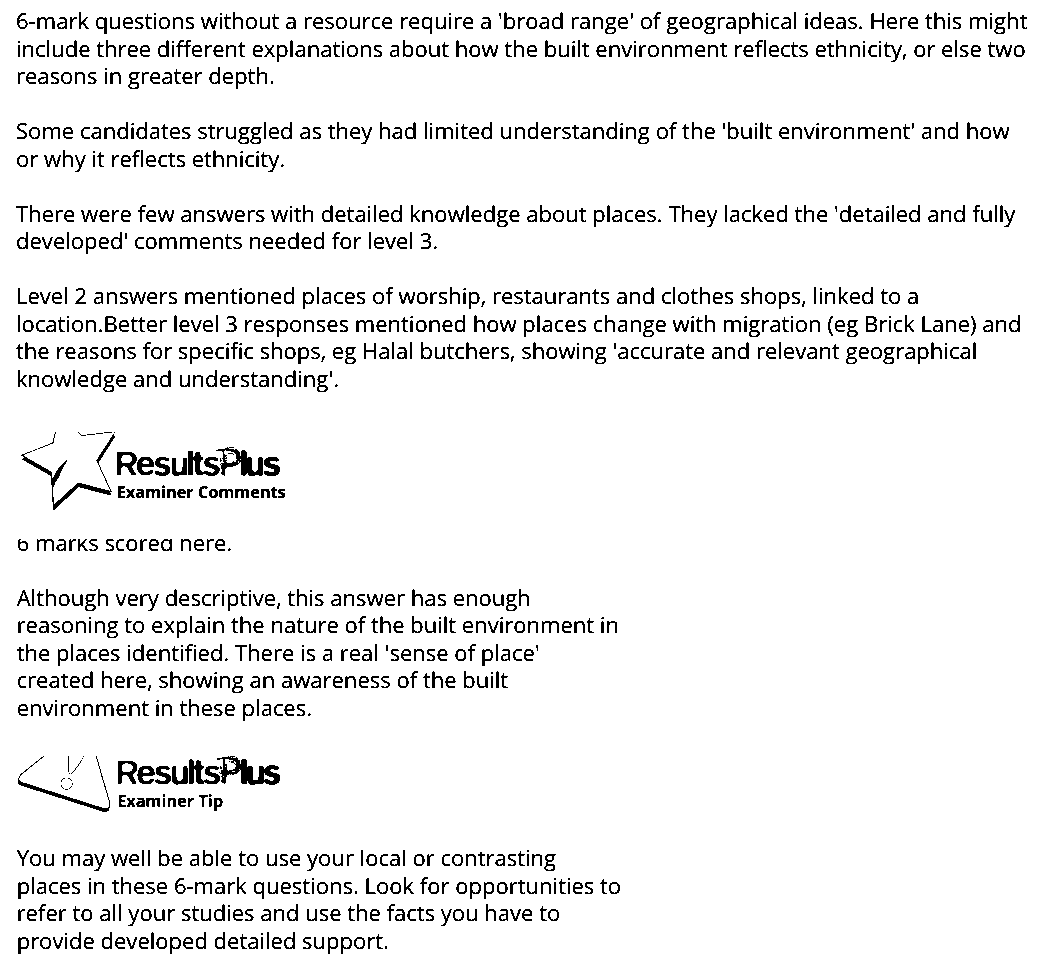
6-mark questions without a resource require a 'broad range' of geographical ideas. Here this might include three different explanations about how the built environment reflects ethnicity, or else two reasons in greater depth. Some candidates struggled as they had limited understanding of the 'built environment' and how or why it reflects ethnicity. There were few answers with detailed knowledge about places. They lacked the 'detailed and fully developed' comments needed for level 3. Level 2 answers mentioned places of worship, restaurants and clothes shops, linked to a location.Better level 3 responses mentioned how places change with migration (eg Brick Lane) and the reasons for specific shops, eg Halal butchers, showing 'accurate and relevant geographical knowledge and understanding'. 6 marks scored here. Although very descriptive, this answer has enough reasoning to explain the nature of the built environment in the places identified. There is a real 'sense of place' created here, showing an awareness of the built environment in these places. You may well be able to use your local or contrasting places in these 6-mark questions. Look for opportunities to refer to all your studies and use the facts you have to provide developed detailed support.
Notes from the mark scheme and report
Places of worship, ethnic shops and restaurants (halal butchers), signage, festivals, adapted housing (e.g. Brick Lane, Southall)
many did not understand 'built environment'
few detailed place examples
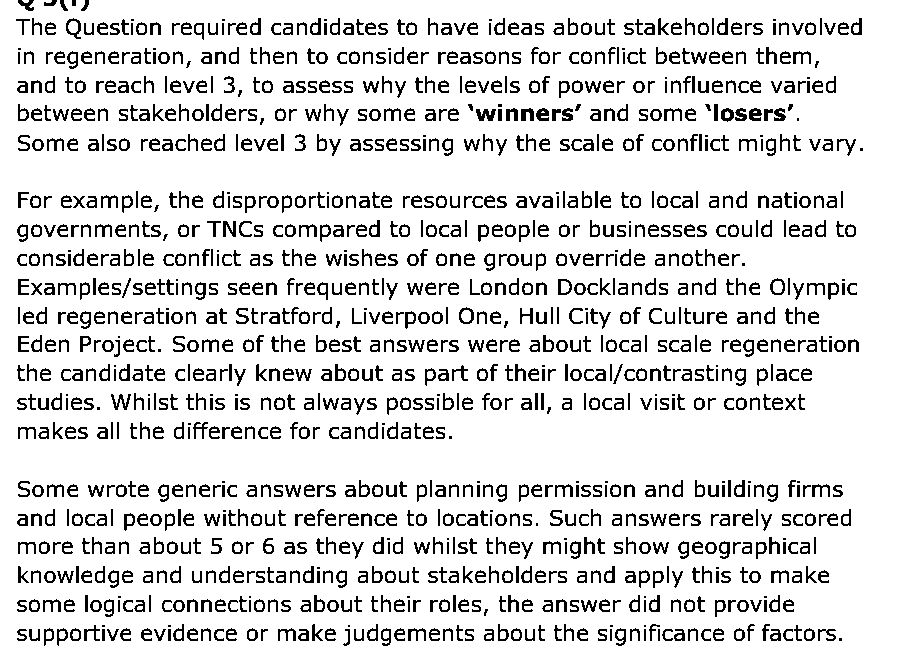
June 2019 · AS Paper 2 · Q5(f)12 marksAO1=3, AO2=912-mark essay
Resources for question 5
Mark scheme, including the levels and indicative content
Examiner's comment
The Question required candidates to have ideas about stakeholders involved in regeneration, and then to consider reasons for conflict between them, and to reach level 3, to assess why the levels of power or influence varied between stakeholders, or why some are ‘winners’ and some ‘losers’. Some also reached level 3 by assessing why the scale of conflict might vary. For example, the disproportionate resources available to local and national governments, or TNCs compared to local people or businesses could lead to considerable conflict as the wishes of one group override another. Examples/settings seen frequently were London Docklands and the Olympic led regeneration at Stratford, Liverpool One, Hull City of Culture and the Eden Project. Some of the best answers were about local scale regeneration the candidate clearly knew about as part of their local/contrasting place studies. Whilst this is not always possible for all, a local visit or context makes all the difference for candidates. Some wrote generic answers about planning permission and building firms and local people without reference to locations. Such answers rarely scored more than about 5 or 6 as they did whilst they might show geographical knowledge and understanding about stakeholders and apply this to make some logical connections about their roles, the answer did not provide supportive evidence or make judgements about the significance of factors.
Notes from the mark scheme and report
Long-term residents seeking continuity v in-migrants seeking change
government, TNCs, NGOs and community groups with unequal power
Level 3 assesses why power varies and who wins or loses
generic answers rarely passed 5 or 6
June 2018 · AS Paper 2 · Q5(b)(i)1 markAO3=1Calculation
Resources for question 5
Mark scheme
Examiner's comment
5a Most, but not all, knew that higher fertility rate than mortality rate was the correct answer. 5bi and 5bii Most, but not all, were able to use scale to calculate the railway length, but one third of candidates could not select the correct area. These, along with the OS skills questions in Q3, are basic geographical skills that should be practised in the course of study when relevant.
Notes from the mark scheme and report
Answer: 840 m (accept 830-850 m) using the scale
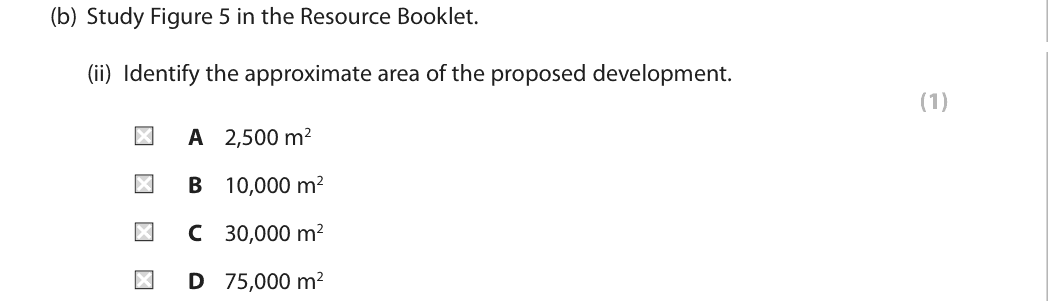
June 2018 · AS Paper 2 · Q5(b)(ii)1 markAO3=1Multiple choice
Resources for question 5
Answer
D
Mark scheme
Notes from the mark scheme and report
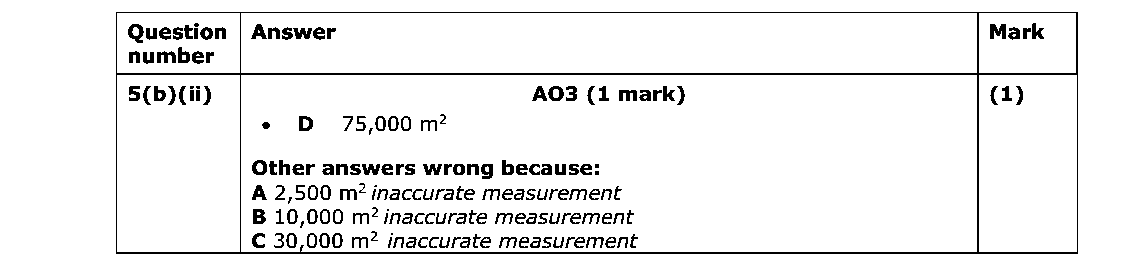
Answer D: about 75,000 m²
one third of candidates could not select the correct area
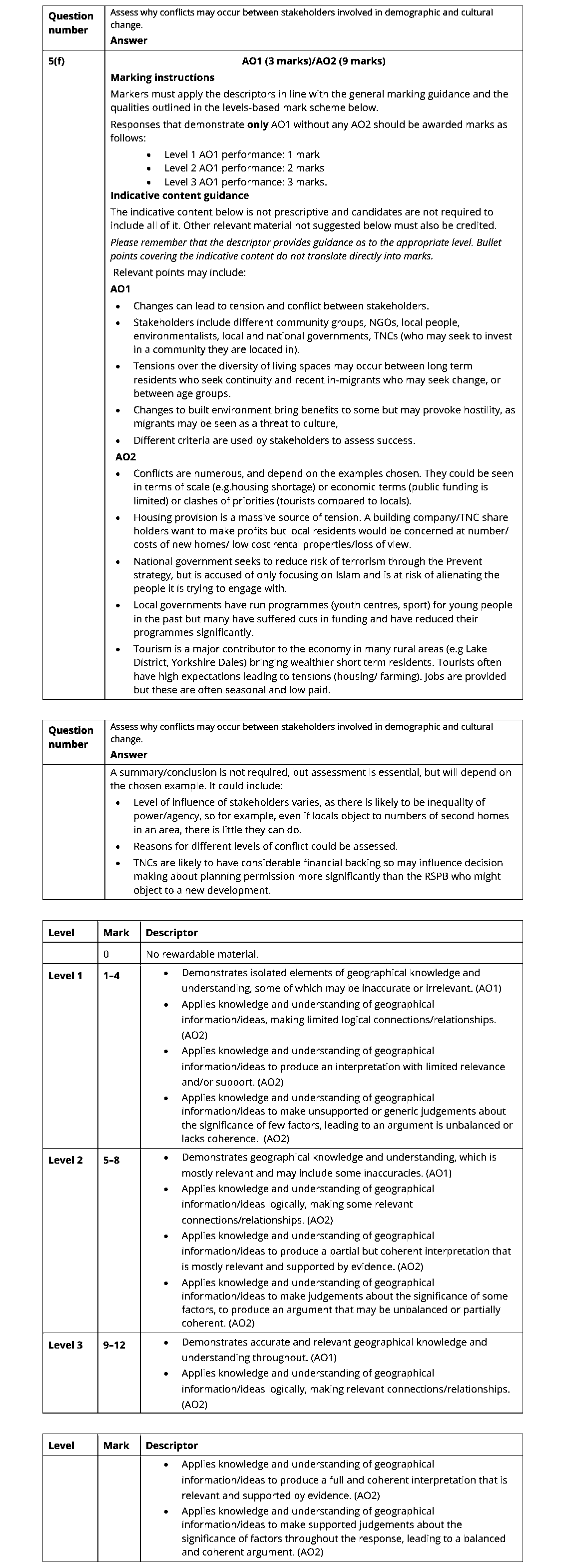
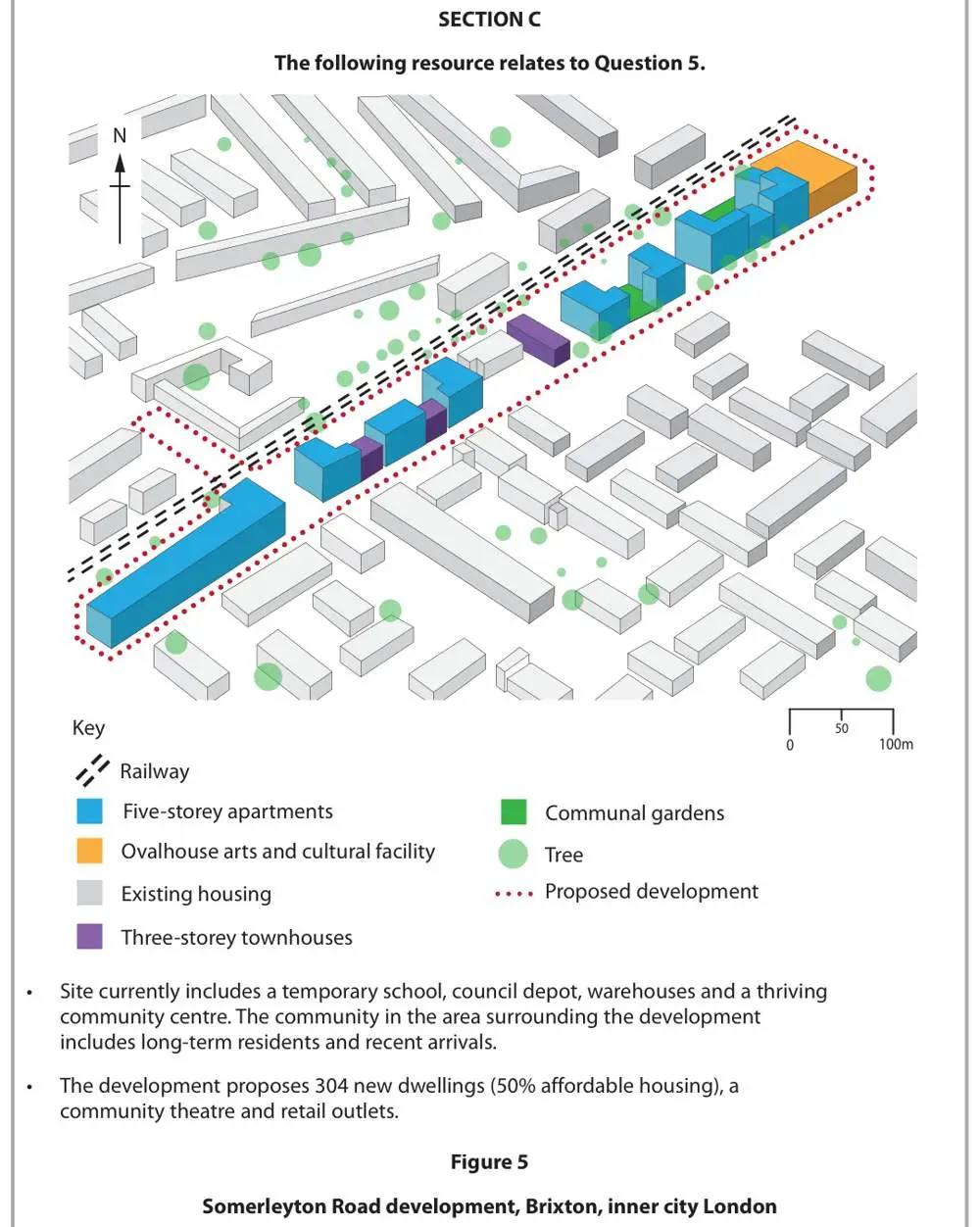
June 2018 · AS Paper 2 · Q5(b)(iii)3 marksAO1=2, AO2=1Data response
Resources for question 5
Mark scheme
Examiner's comment
Not applicable.
Notes from the mark scheme and report
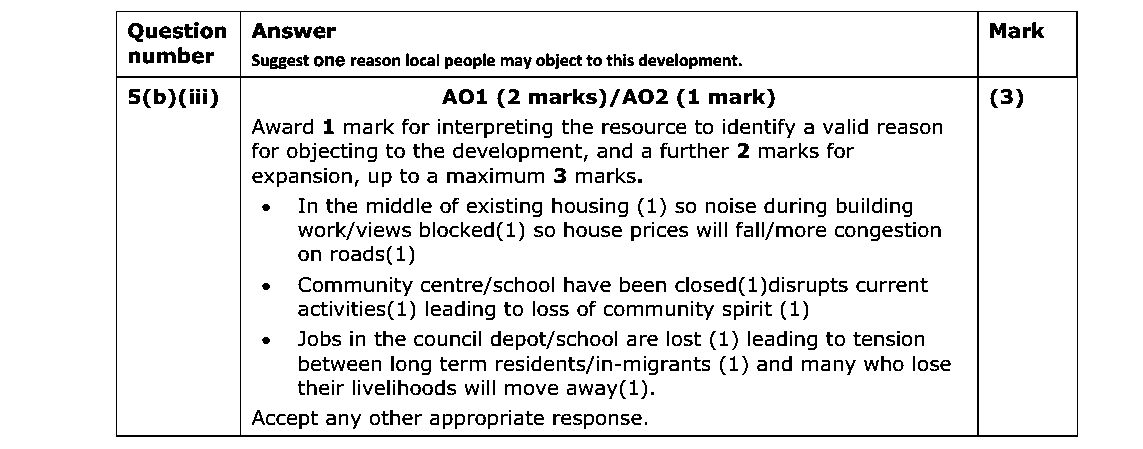
One reason from Figure 5 developed twice: construction noise among existing housing, five-storey blocks block light and views, loss of the community centre, school and depot jobs, tension between long-term residents and in-migrants, gentrification
June 2018 · AS Paper 2 · Q5(c)4 marksAO1=4Short answer
Resources for question 5
Mark scheme
Examiner's comment
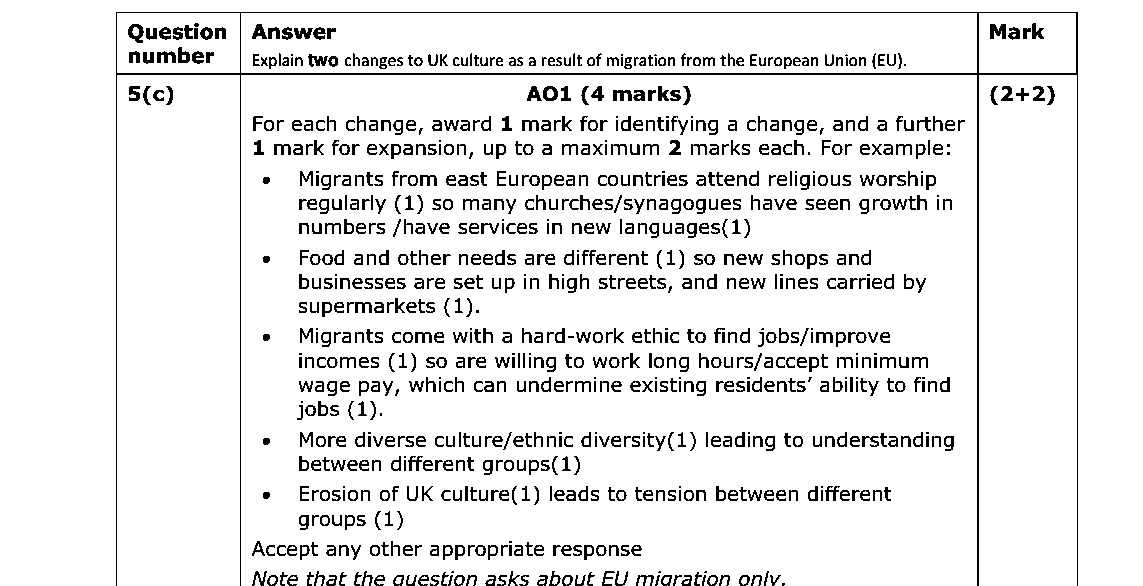
As on the 4 mark questions on Q1, two pairs of developed answers are needed. A broad interpretation of UK culture was taken. Most were able to identify two changes, but not all were able to develop these ideas for a second mark in each case. Some used examples of migration from places outside the EU which were not acceptable. The majority of answers focused on food or music, or shops and religious buildings.
Notes from the mark scheme and report
EU migration only: religious worship (e.g. Polish Catholic churches), shops and food, music, language, workforce in low-wage jobs
extend each change once
examples from outside the EU not accepted
June 2018 · AS Paper 2 · Q5(d)6 marksAO1=6Extended response
Resources for question 5
Mark scheme, including the levels and indicative content
Examiner's comment
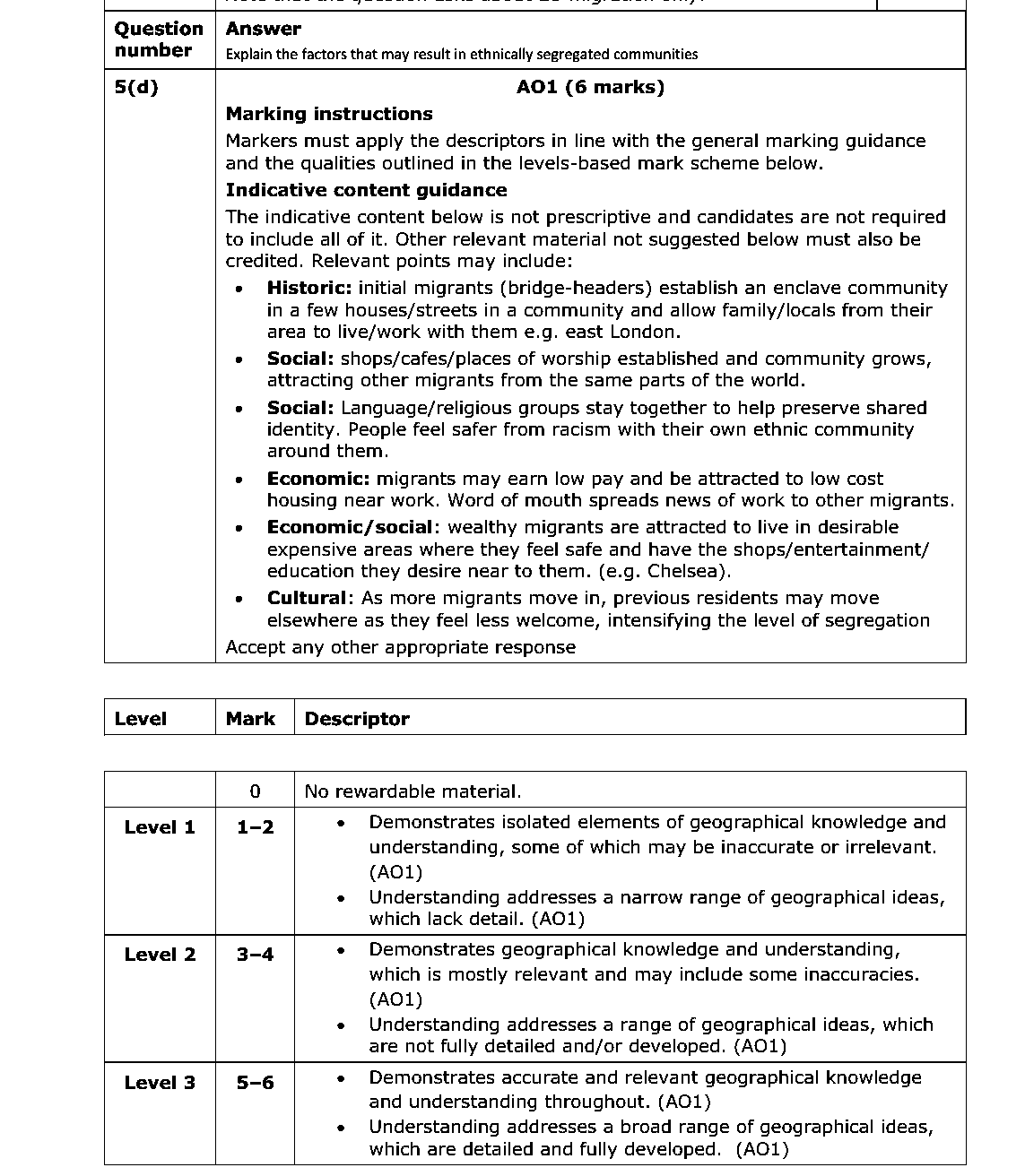
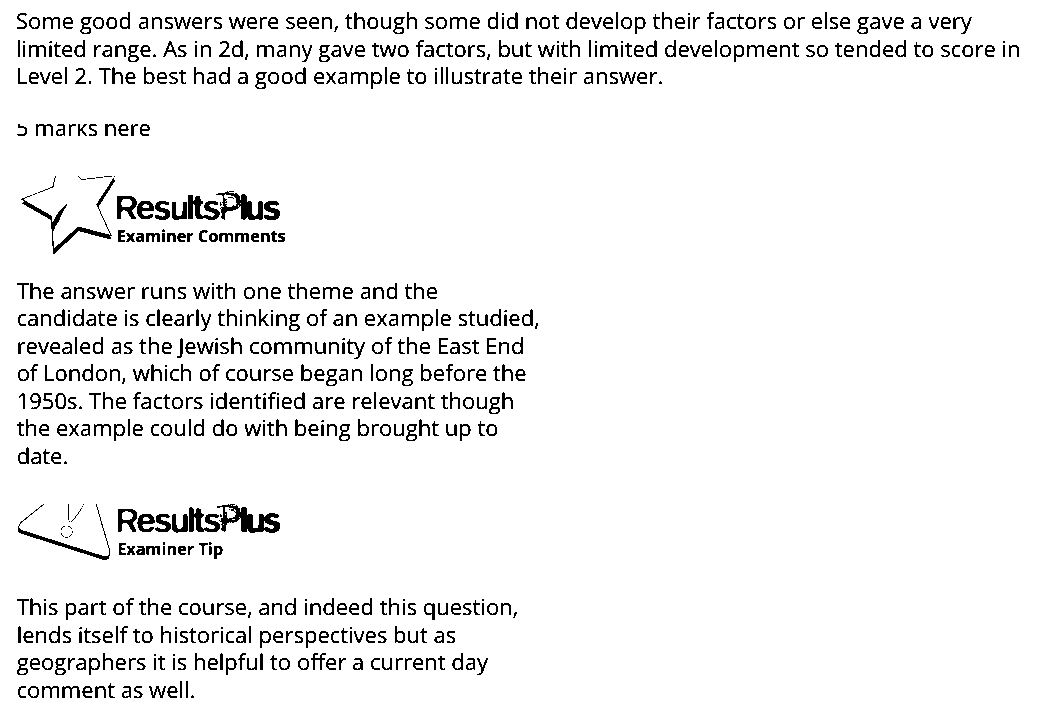
Some good answers were seen, though some did not develop their factors or else gave a very limited range. As in 2d, many gave two factors, but with limited development so tended to score in Level 2. The best had a good example to illustrate their answer. 5 marks here The answer runs with one theme and the candidate is clearly thinking of an example studied, revealed as the Jewish community of the East End of London, which of course began long before the 1950s. The factors identified are relevant though the example could do with being brought up to date. This part of the course, and indeed this question, lends itself to historical perspectives but as geographers it is helpful to offer a current day comment as well.
Notes from the mark scheme and report
Chain migration and family/social clustering, cheap housing near arrival points, discrimination, services (places of worship, shops), language, income
best used a current example
two undeveloped factors stayed in Level 2
June 2017 · AS Paper 2 · Q5(c)4 marksAO1=4Short answer
Mark scheme
Examiner's comment
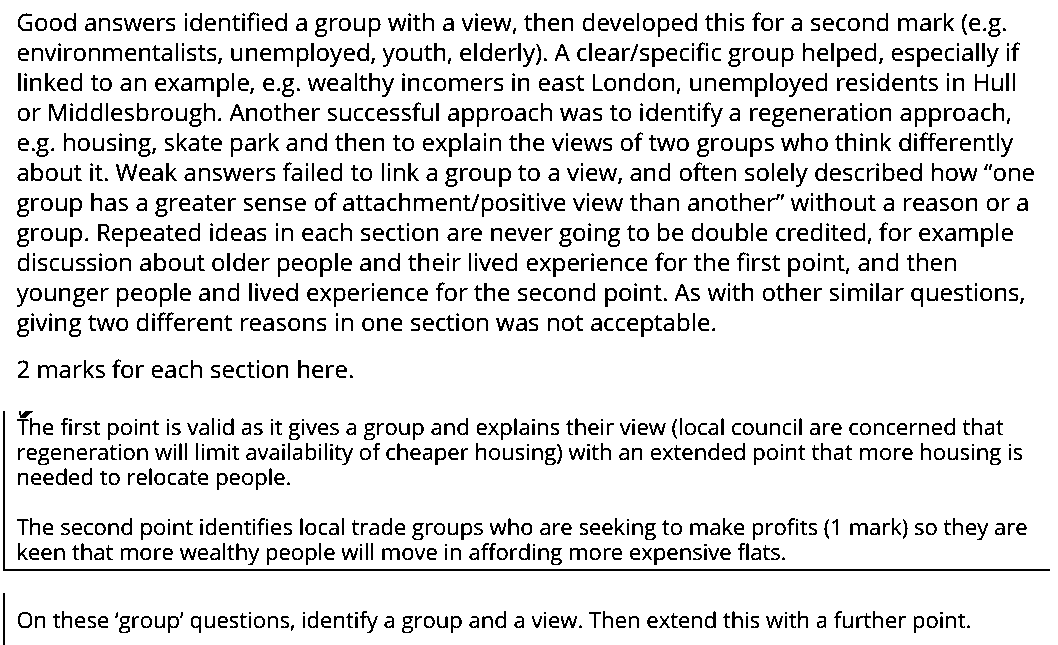
Good answers identified a group with a view, then developed this for a second mark (e.g. environmentalists, unemployed, youth, elderly). A clear/specific group helped, especially if linked to an example, e.g. wealthy incomers in east London, unemployed residents in Hull or Middlesbrough. Another successful approach was to identify a regeneration approach, e.g. housing, skate park and then to explain the views of two groups who think differently about it. Weak answers failed to link a group to a view, and often solely described how “one group has a greater sense of attachment/positive view than another” without a reason or a group. Repeated ideas in each section are never going to be double credited, for example discussion about older people and their lived experience for the first point, and then younger people and lived experience for the second point. As with other similar questions, giving two different reasons in one section was not acceptable. 2 marks for each section here. The first point is valid as it gives a group and explains their view (local council are concerned that regeneration will limit availability of cheaper housing) with an extended point that more housing is needed to relocate people. The second point identifies local trade groups who are seeking to make profits (1 mark) so they are keen that more wealthy people will move in affording more expensive flats. On these ‘group’ questions, identify a group and a view. Then extend this with a further point.
Notes from the mark scheme and report
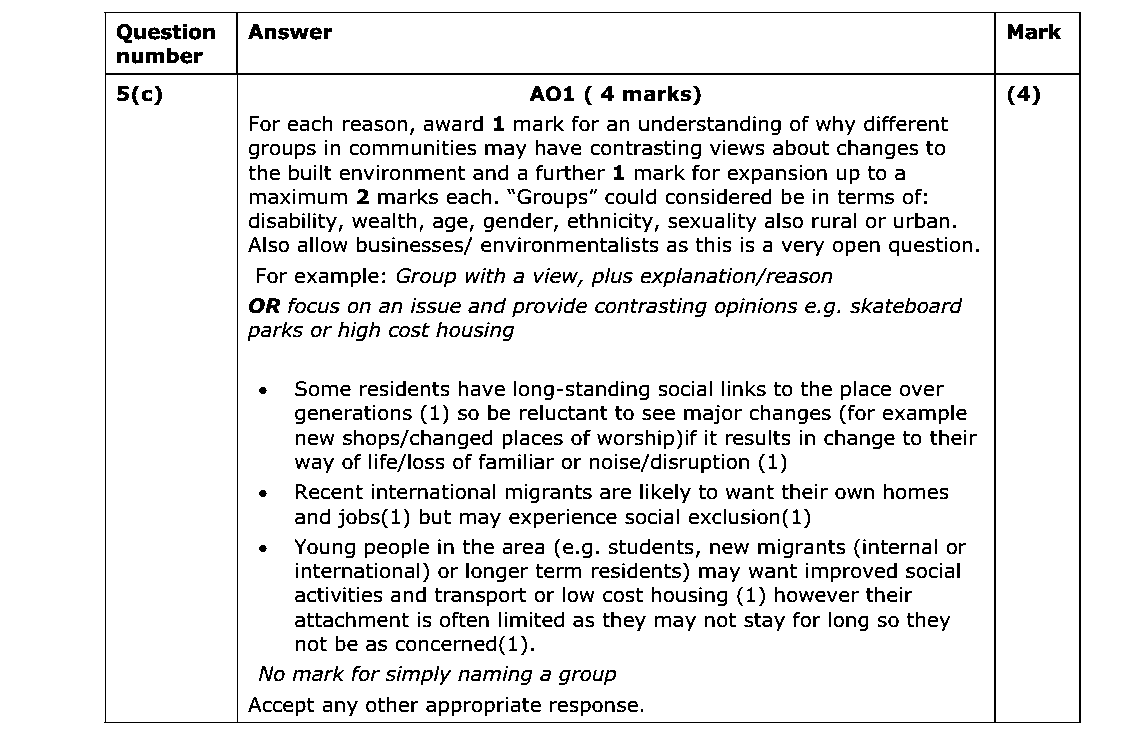
Name a group and its view of the built-environment change then extend (long-term residents, recent migrants, young people, businesses)
simply naming a group gains nothing
June 2017 · AS Paper 2 · Q5(e)12 marksAO1=3, AO2=912-mark essay
Mark scheme, including the levels and indicative content
Examiner's comment
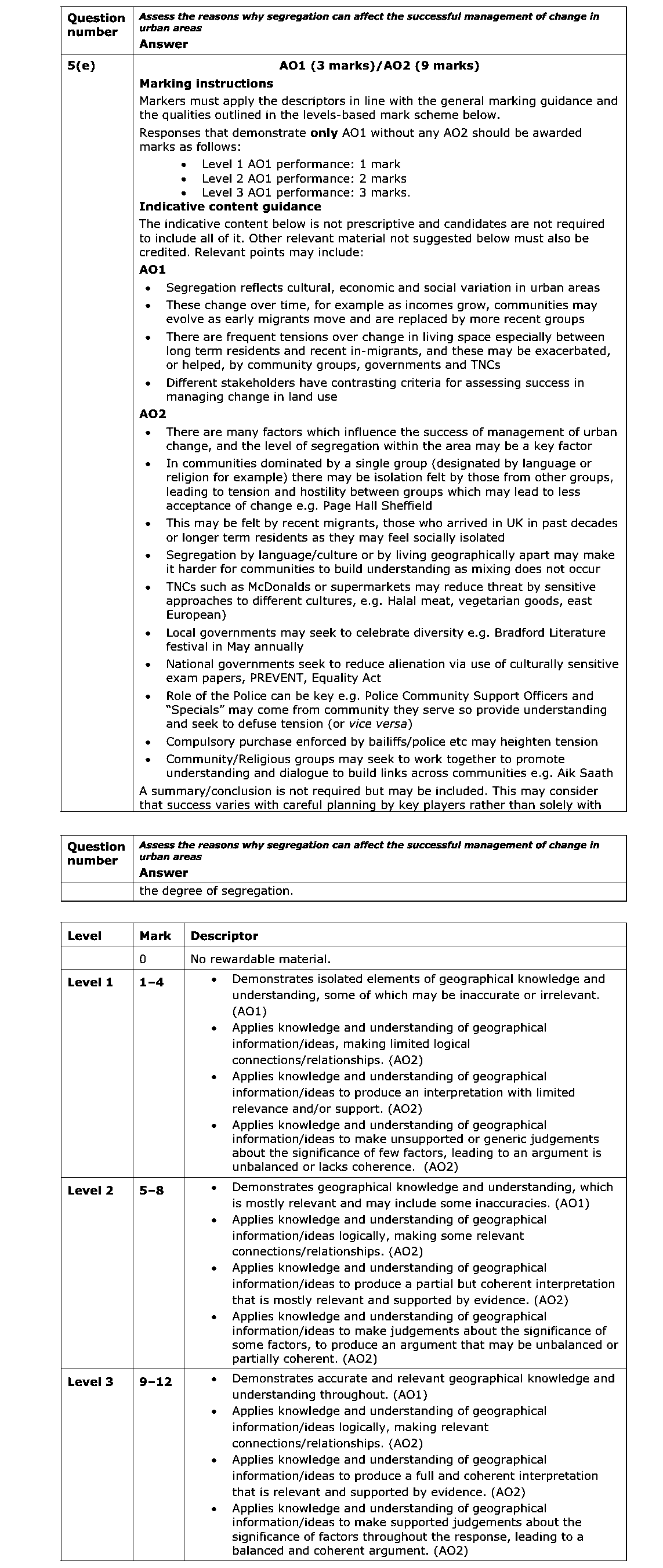
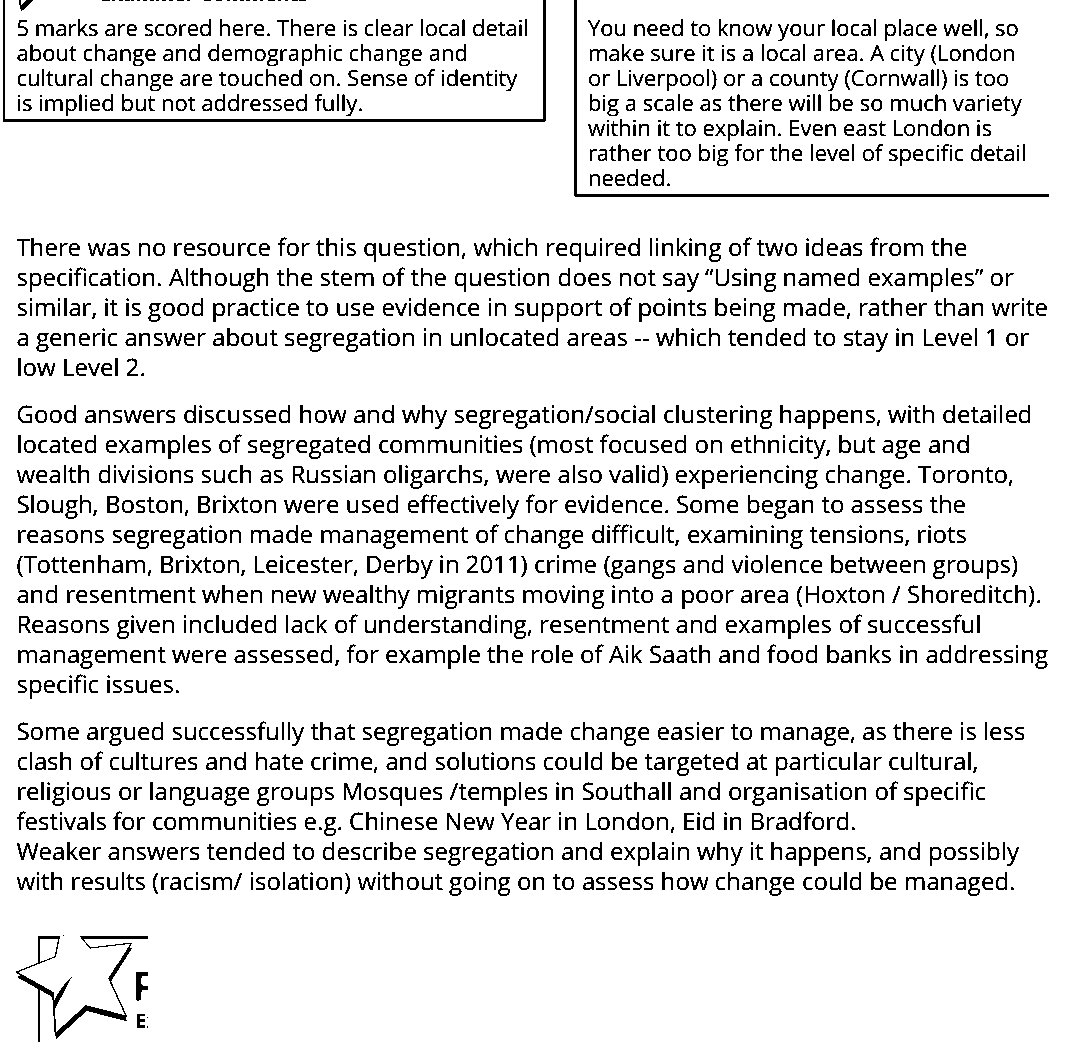
There was no resource for this question, which required linking of two ideas from the specification. Although the stem of the question does not say “Using named examples” or similar, it is good practice to use evidence in support of points being made, rather than write a generic answer about segregation in unlocated areas -- which tended to stay in Level 1 or low Level 2. Good answers discussed how and why segregation/social clustering happens, with detailed located examples of segregated communities (most focused on ethnicity, but age and wealth divisions such as Russian oligarchs, were also valid) experiencing change. Toronto, Slough, Boston, Brixton were used effectively for evidence. Some began to assess the reasons segregation made management of change difficult, examining tensions, riots (Tottenham, Brixton, Leicester, Derby in 2011) crime (gangs and violence between groups) and resentment when new wealthy migrants moving into a poor area (Hoxton / Shoreditch). Reasons given included lack of understanding, resentment and examples of successful management were assessed, for example the role of Aik Saath and food banks in addressing specific issues. Some argued successfully that segregation made change easier to manage, as there is less clash of cultures and hate crime, and solutions could be targeted at particular cultural, religious or language groups Mosques /temples in Southall and organisation of specific festivals for communities e.g. Chinese New Year in London, Eid in Bradford. Weaker answers tended to describe segregation and explain why it happens, and possibly with results (racism/ isolation) without going on to assess how change could be managed. 5 marks are scored here. There is clear local detail about change and demographic change and cultural change are touched on. Sense of identity is implied but not addressed fully. You need to know your local place well, so make sure it is a local area. A city (London or Liverpool) or a county (Cornwall) is too big a scale as there will be so much variety within it to explain. Even east London is rather too big for the level of specific detail needed.
Notes from the mark scheme and report
Explain why clustering happens then assess its effect on managing change: tensions, riots, gentrification v targeted solutions (Aik Saath, community festivals)
some argued segregation made change easier
generic answers stayed in Level 1 or low Level 2
June 2017 · AS Paper 2 · Q716 marksAO1=4, AO2=1216-mark essay
Resources for question 7
Mark scheme, including the levels and indicative content
Examiner's comment
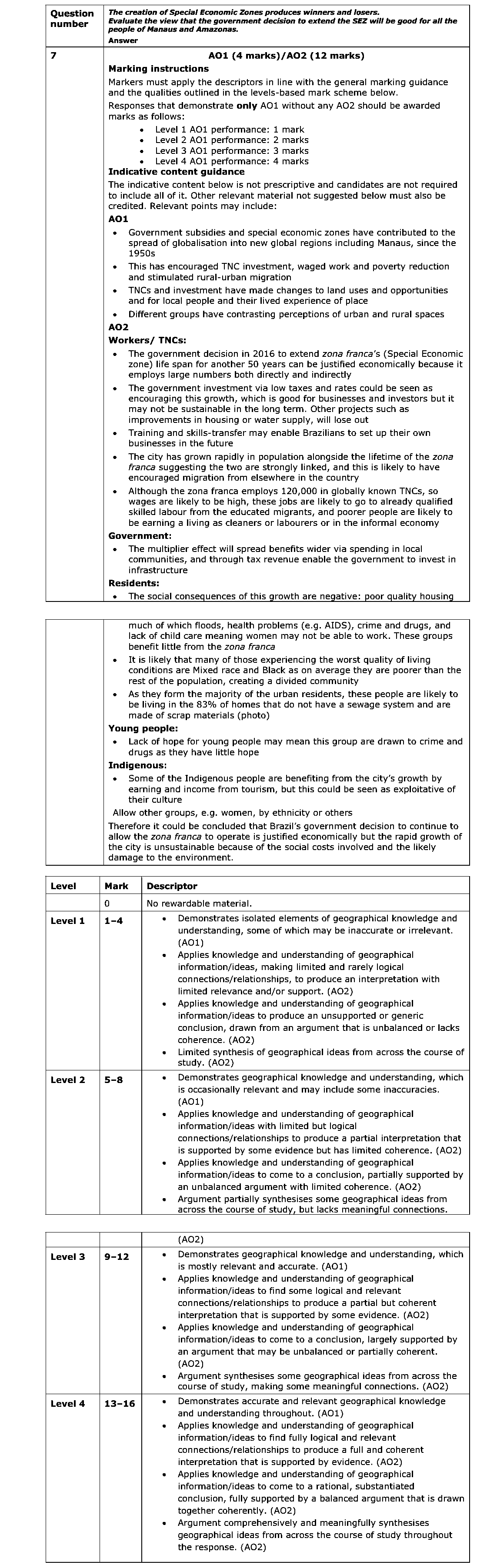
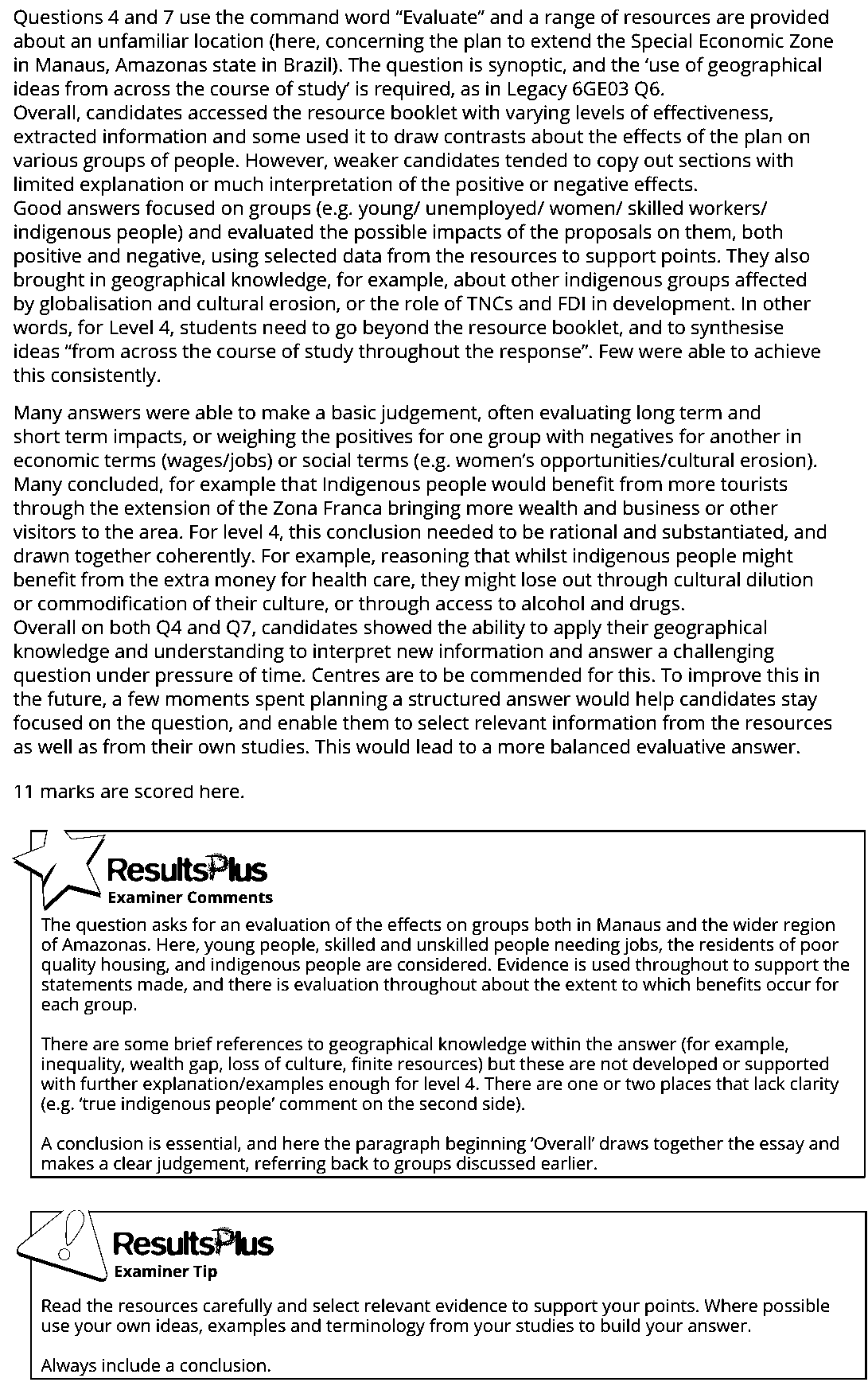
Questions 4 and 7 use the command word “Evaluate” and a range of resources are provided about an unfamiliar location (here, concerning the plan to extend the Special Economic Zone in Manaus, Amazonas state in Brazil). The question is synoptic, and the ‘use of geographical ideas from across the course of study’ is required, as in Legacy 6GE03 Q6. Overall, candidates accessed the resource booklet with varying levels of effectiveness, extracted information and some used it to draw contrasts about the effects of the plan on various groups of people. However, weaker candidates tended to copy out sections with limited explanation or much interpretation of the positive or negative effects. Good answers focused on groups (e.g. young/ unemployed/ women/ skilled workers/ indigenous people) and evaluated the possible impacts of the proposals on them, both positive and negative, using selected data from the resources to support points. They also brought in geographical knowledge, for example, about other indigenous groups affected by globalisation and cultural erosion, or the role of TNCs and FDI in development. In other words, for Level 4, students need to go beyond the resource booklet, and to synthesise ideas “from across the course of study throughout the response”. Few were able to achieve this consistently. Many answers were able to make a basic judgement, often evaluating long term and short term impacts, or weighing the positives for one group with negatives for another in economic terms (wages/jobs) or social terms (e.g. women’s opportunities/cultural erosion). Many concluded, for example that Indigenous people would benefit from more tourists through the extension of the Zona Franca bringing more wealth and business or other visitors to the area. For level 4, this conclusion needed to be rational and substantiated, and drawn together coherently. For example, reasoning that whilst indigenous people might benefit from the extra money for health care, they might lose out through cultural dilution or commodification of their culture, or through access to alcohol and drugs. Overall on both Q4 and Q7, candidates showed the ability to apply their geographical knowledge and understanding to interpret new information and answer a challenging question under pressure of time. Centres are to be commended for this. To improve this in the future, a few moments spent planning a structured answer would help candidates stay focused on the question, and enable them to select relevant information from the resources as well as from their own studies. This would lead to a more balanced evaluative answer. 11 marks are scored here. The question asks for an evaluation of the effects on groups both in Manaus and the wider region of Amazonas. Here, young people, skilled and unskilled people needing jobs, the residents of poor quality housing, and indigenous people are considered. Evidence is used throughout to support the statements made, and there is evaluation throughout about the extent to which benefits occur for each group. There are some brief references to geographical knowledge within the answer (for example, inequality, wealth gap, loss of culture, finite resources) but these are not developed or supported with further explanation/examples enough for level 4. There are one or two places that lack clarity (e.g. ‘true indigenous people’ comment on the second side). A conclusion is essential, and here the paragraph beginning ‘Overall’ draws together the essay and makes a clear judgement, referring back to groups discussed earlier. Read the resources carefully and select relevant evidence to support your points. Where possible use your own ideas, examples and terminology from your studies to build your answer. Always include a conclusion.
Notes from the mark scheme and report
Figure 7: Zona Franca jobs and TNC investment v poor housing, flooding, crime, AIDS, income gaps by ethnicity, indigenous cultural commodification
weigh winners and losers by group
Level 4 needs ideas from across the course, which few achieved consistently
Work with an Edexcel Geography tutor
Essays stuck in the middle levels, or losing marks on the data questions? Book a trial lesson with a specialist Edexcel Geography tutor.