5 Study the resources in Section B of the Resource Booklet. Evaluate the view that the exploitation of resources in the Arctic and Antarctica will create more costs than benefits.
Tap a question to zoom it. The figures open above it; the mark scheme (with its levels and indicative content) and the examiner's comment open underneath.
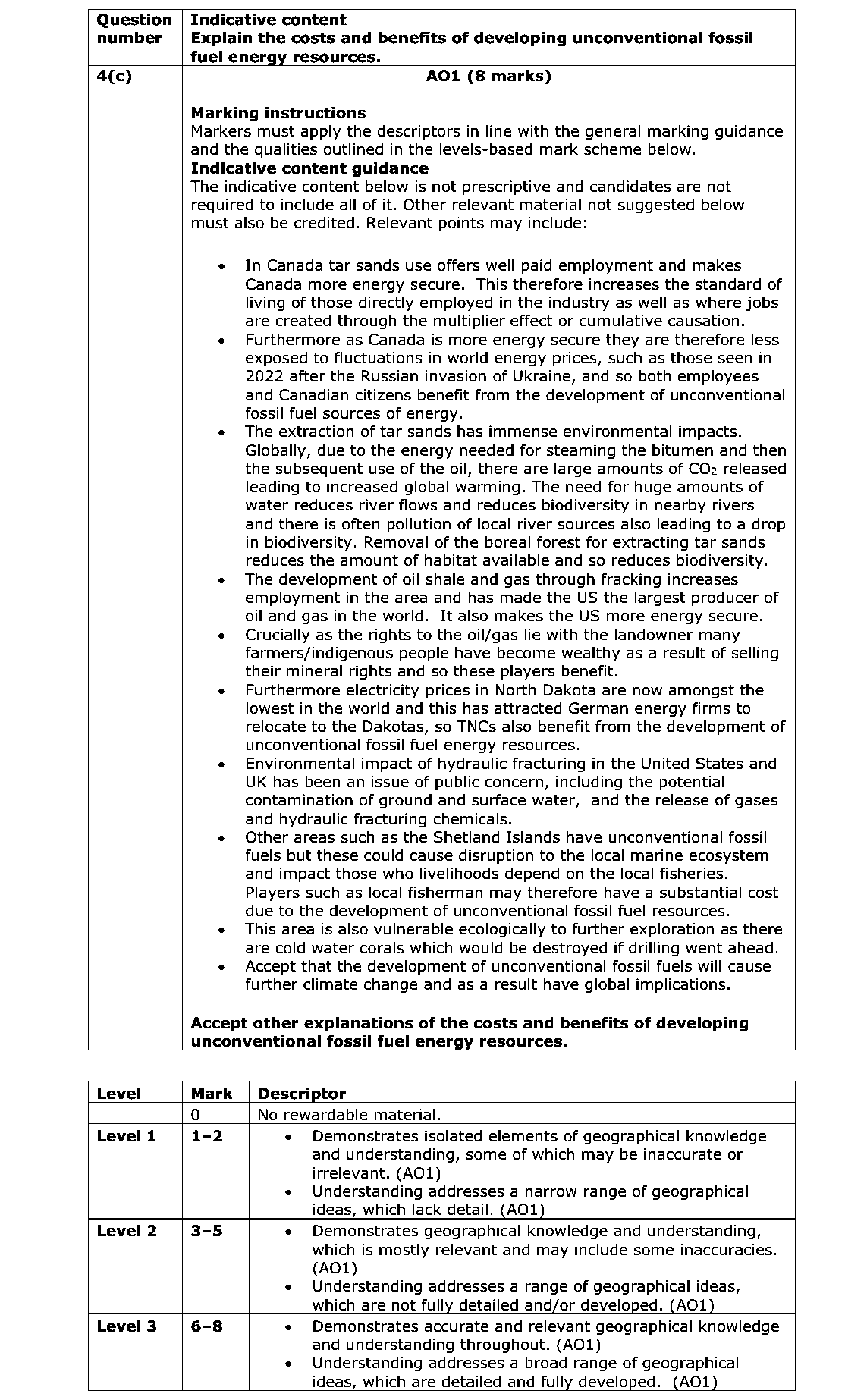
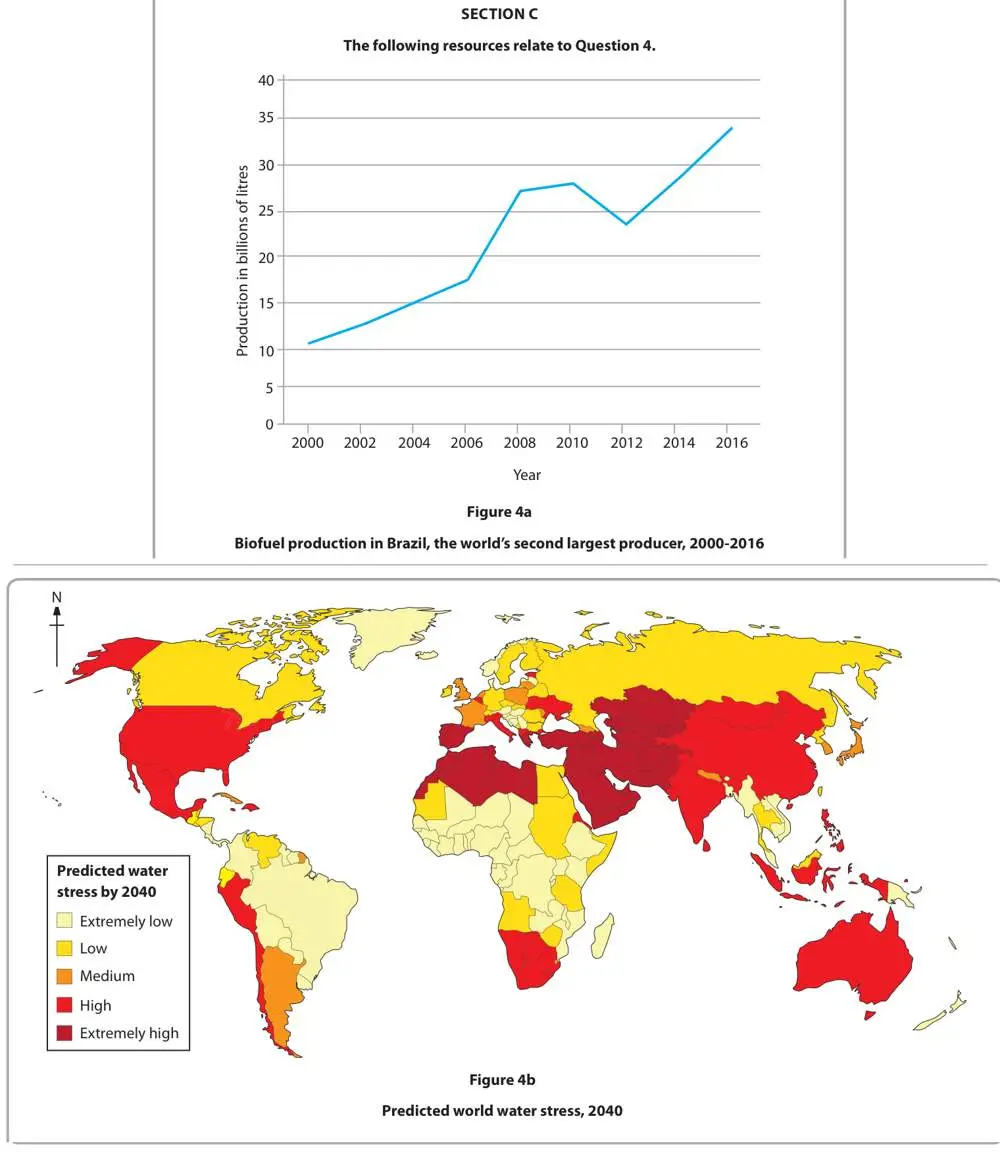
June 2025 · Paper 1 · Q4(c)8 marksAO1=8Extended response
Resources for question 4
Mark scheme, including the levels and indicative content
Examiner's comment
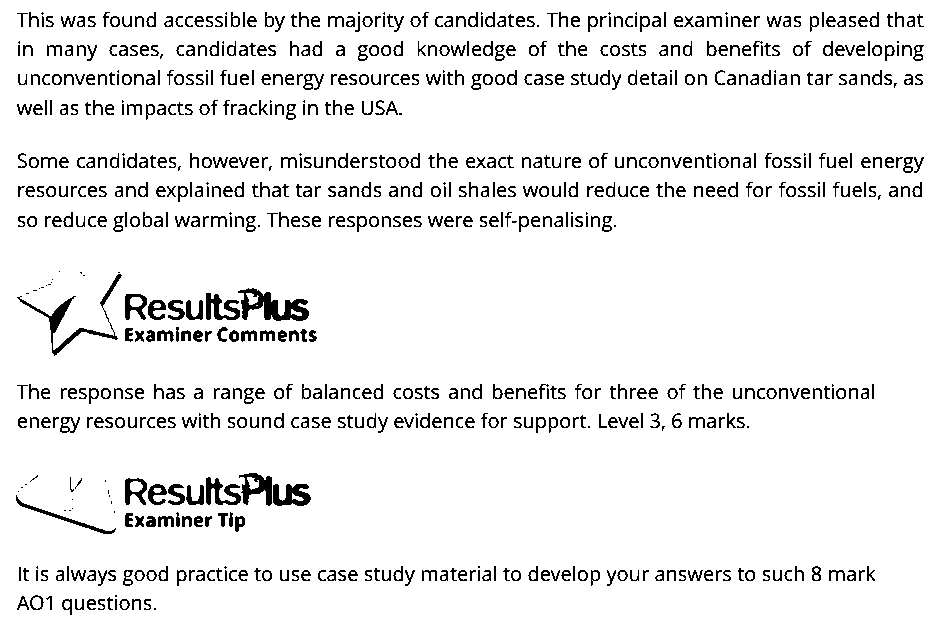
This was found accessible by the majority of candidates. The principal examiner was pleased that in many cases, candidates had a good knowledge of the costs and benefits of developing unconventional fossil fuel energy resources with good case study detail on Canadian tar sands, as well as the impacts of fracking in the USA. Some candidates, however, misunderstood the exact nature of unconventional fossil fuel energy resources and explained that tar sands and oil shales would reduce the need for fossil fuels, and so reduce global warming. These responses were self-penalising. The response has a range of balanced costs and benefits for three of the unconventional energy resources with sound case study evidence for support. Level 3, 6 marks. It is always good practice to use case study material to develop your answers to such 8 mark AO1 questions.
Notes from the mark scheme and report
Benefits: energy security, jobs, tax revenue (Canadian tar sands, US fracking, Brazil deep-water oil)
costs: emissions, water use and pollution, habitat loss, earthquakes, Indigenous land
they are fossil fuels and do not cut warming
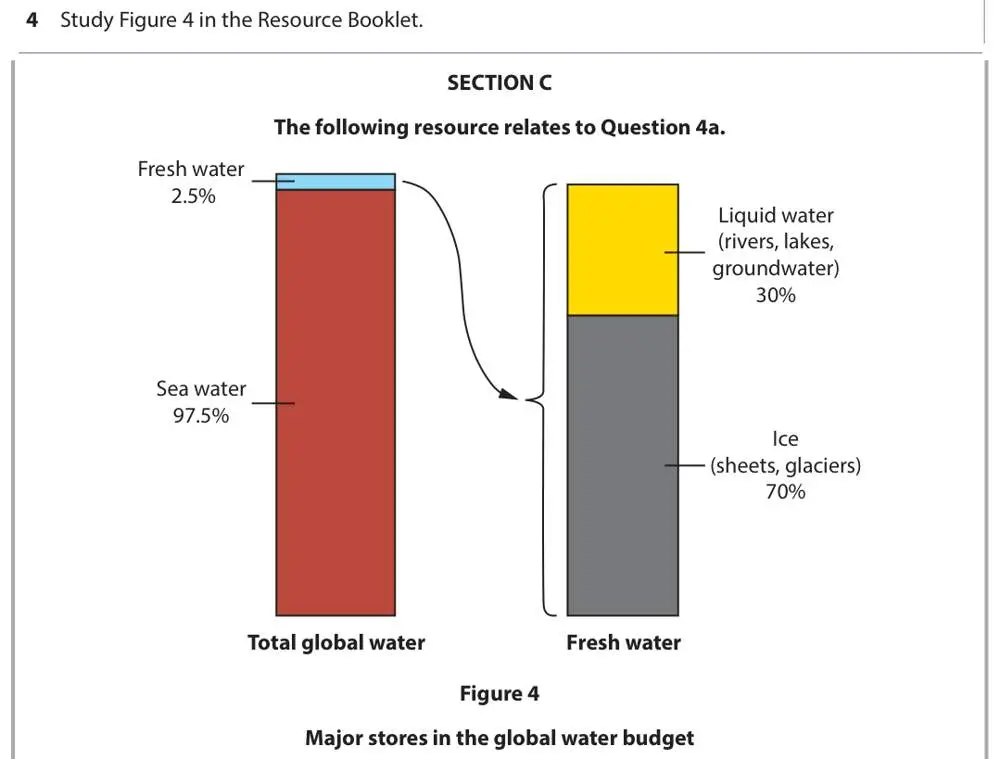
June 2023 · Paper 1 · Q4(a)3 marksAO1=2, AO2=1Data response
Resources for question 4
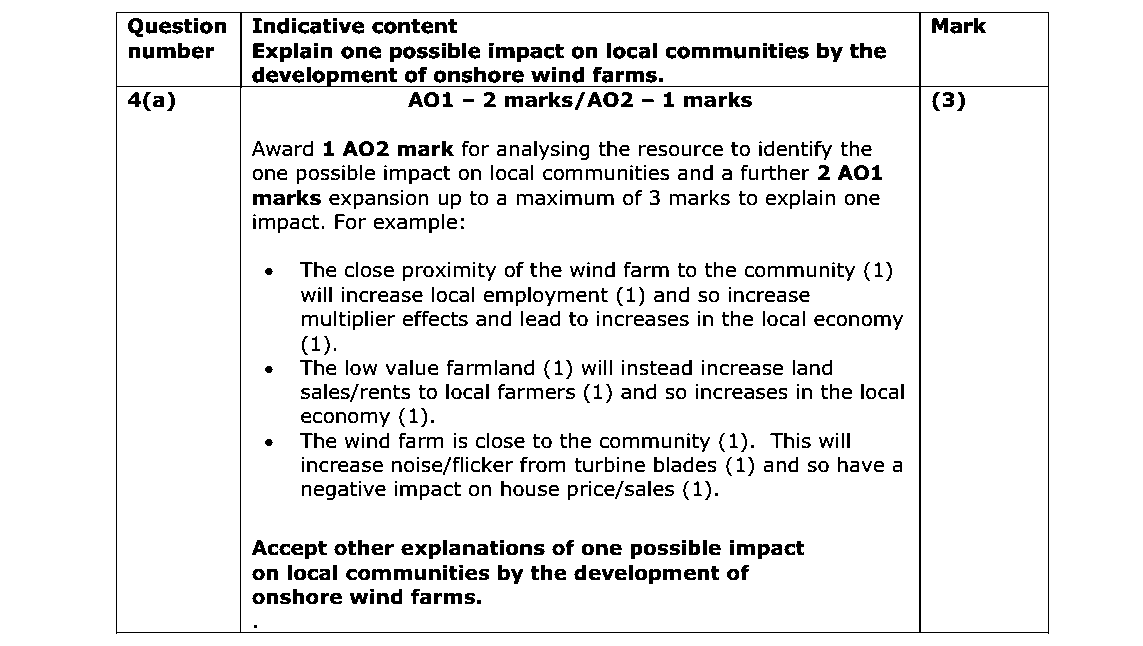
Mark scheme
Examiner's comment
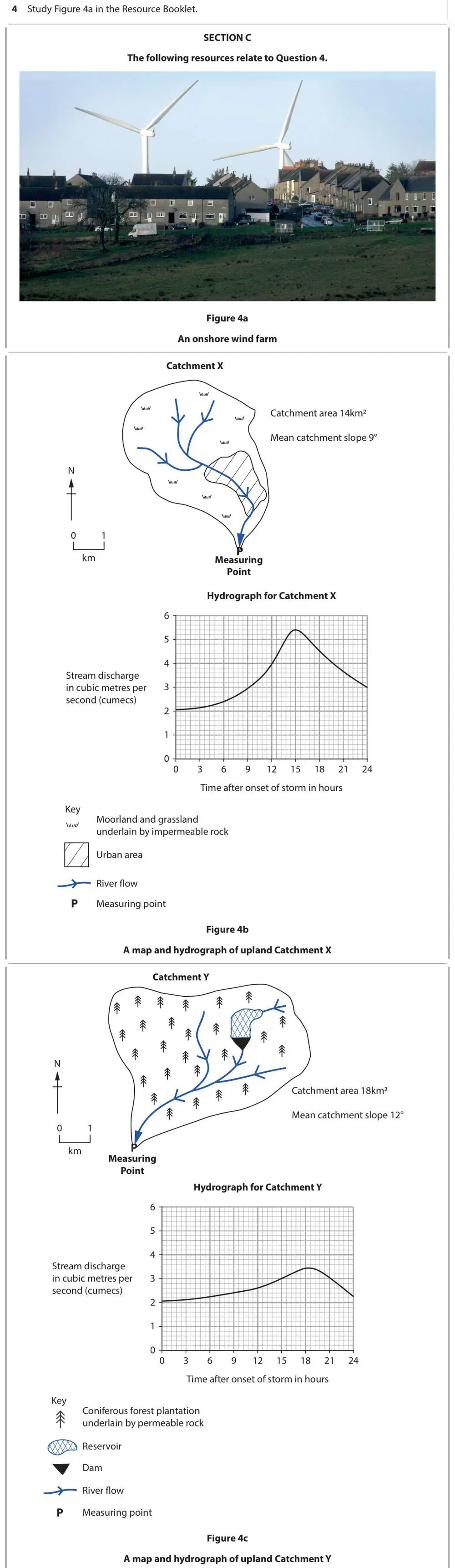
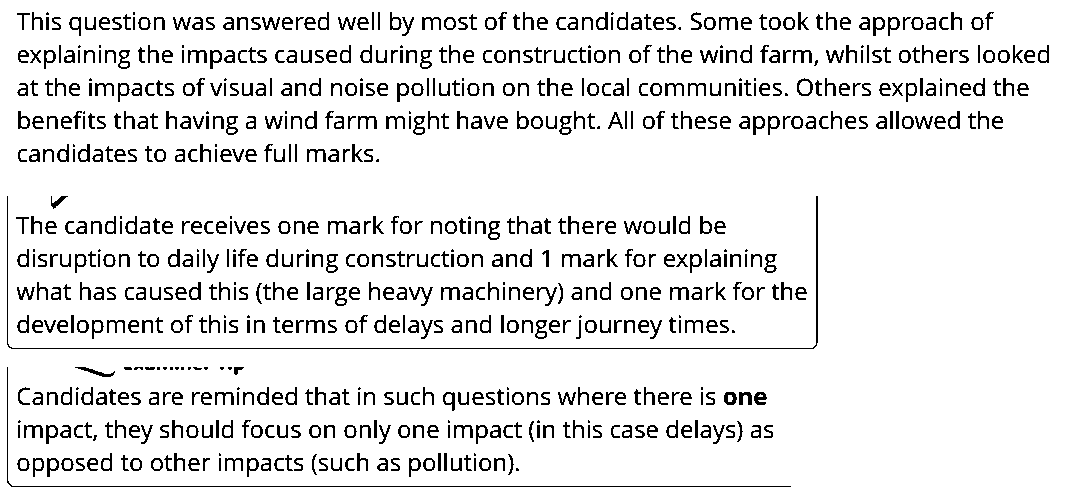
This question was answered well by most of the candidates. Some took the approach of explaining the impacts caused during the construction of the wind farm, whilst others looked at the impacts of visual and noise pollution on the local communities. Others explained the benefits that having a wind farm might have bought. All of these approaches allowed the candidates to achieve full marks. The candidate receives one mark for noting that there would be disruption to daily life during construction and 1 mark for explaining what has caused this (the large heavy machinery) and one mark for the development of this in terms of delays and longer journey times. Candidates are reminded that in such questions where there is one impact, they should focus on only one impact (in this case delays) as opposed to other impacts (such as pollution).
Notes from the mark scheme and report
1 AO2 mark for an impact from the Figure 4a photo (turbines next to housing), 2 AO1 for development: construction disruption, noise, shadow flicker and visual intrusion lowering house prices, or local jobs, rents to farmers and multiplier effects
June 2023 · Paper 3 · Q14 marksAO1=4Short answer
Mark scheme
Examiner's comment
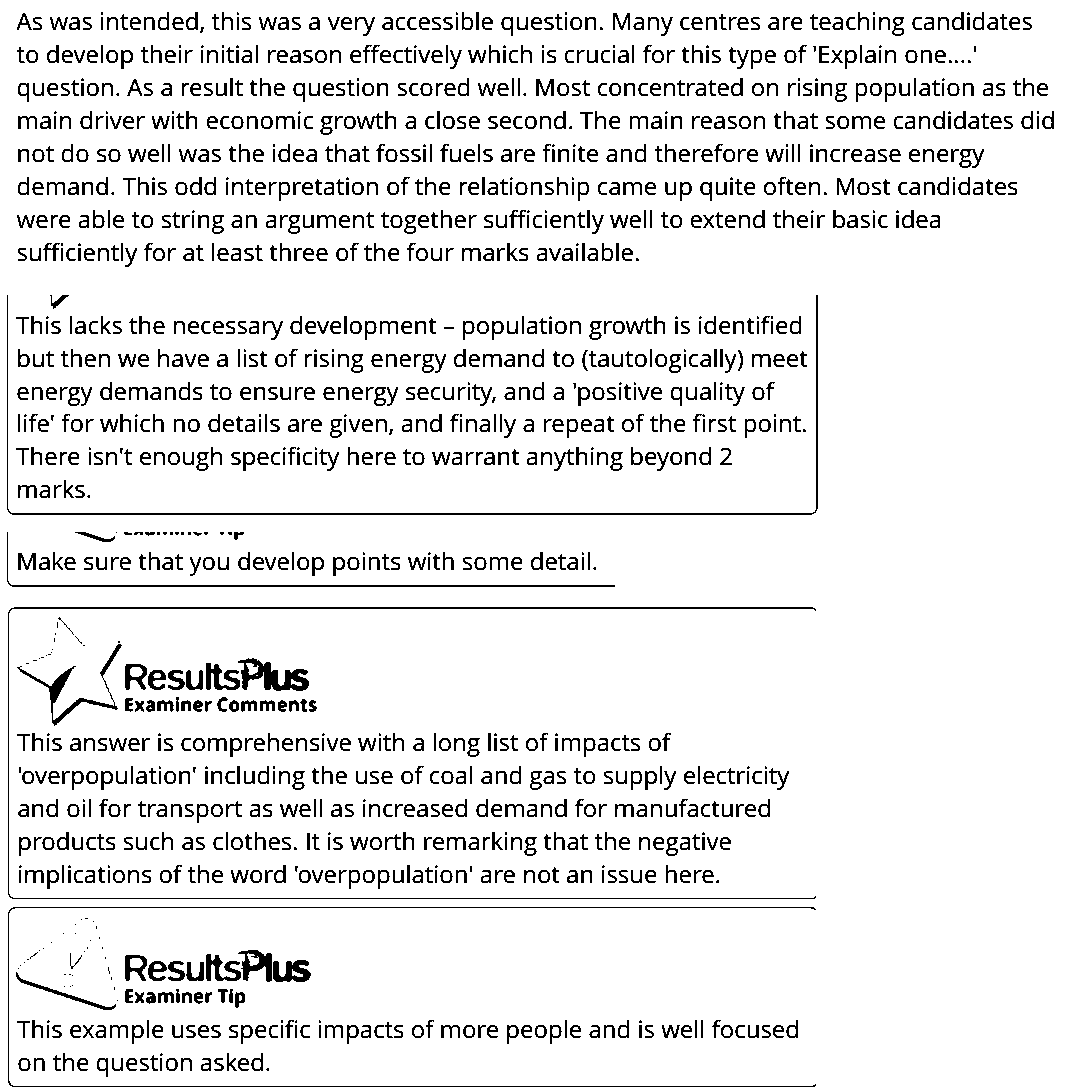
As was intended, this was a very accessible question. Many centres are teaching candidates to develop their initial reason effectively which is crucial for this type of 'Explain one....' question. As a result the question scored well. Most concentrated on rising population as the main driver with economic growth a close second. The main reason that some candidates did not do so well was the idea that fossil fuels are finite and therefore will increase energy demand. This odd interpretation of the relationship came up quite often. Most candidates were able to string an argument together sufficiently well to extend their basic idea sufficiently for at least three of the four marks available. This lacks the necessary development – population growth is identified but then we have a list of rising energy demand to (tautologically) meet energy demands to ensure energy security, and a 'positive quality of life' for which no details are given, and finally a repeat of the first point. There isn't enough specificity here to warrant anything beyond 2 marks. Make sure that you develop points with some detail. This answer is comprehensive with a long list of impacts of 'overpopulation' including the use of coal and gas to supply electricity and oil for transport as well as increased demand for manufactured products such as clothes. It is worth remarking that the negative implications of the word 'overpopulation' are not an issue here. This example uses specific impacts of more people and is well focused on the question asked.
Notes from the mark scheme and report
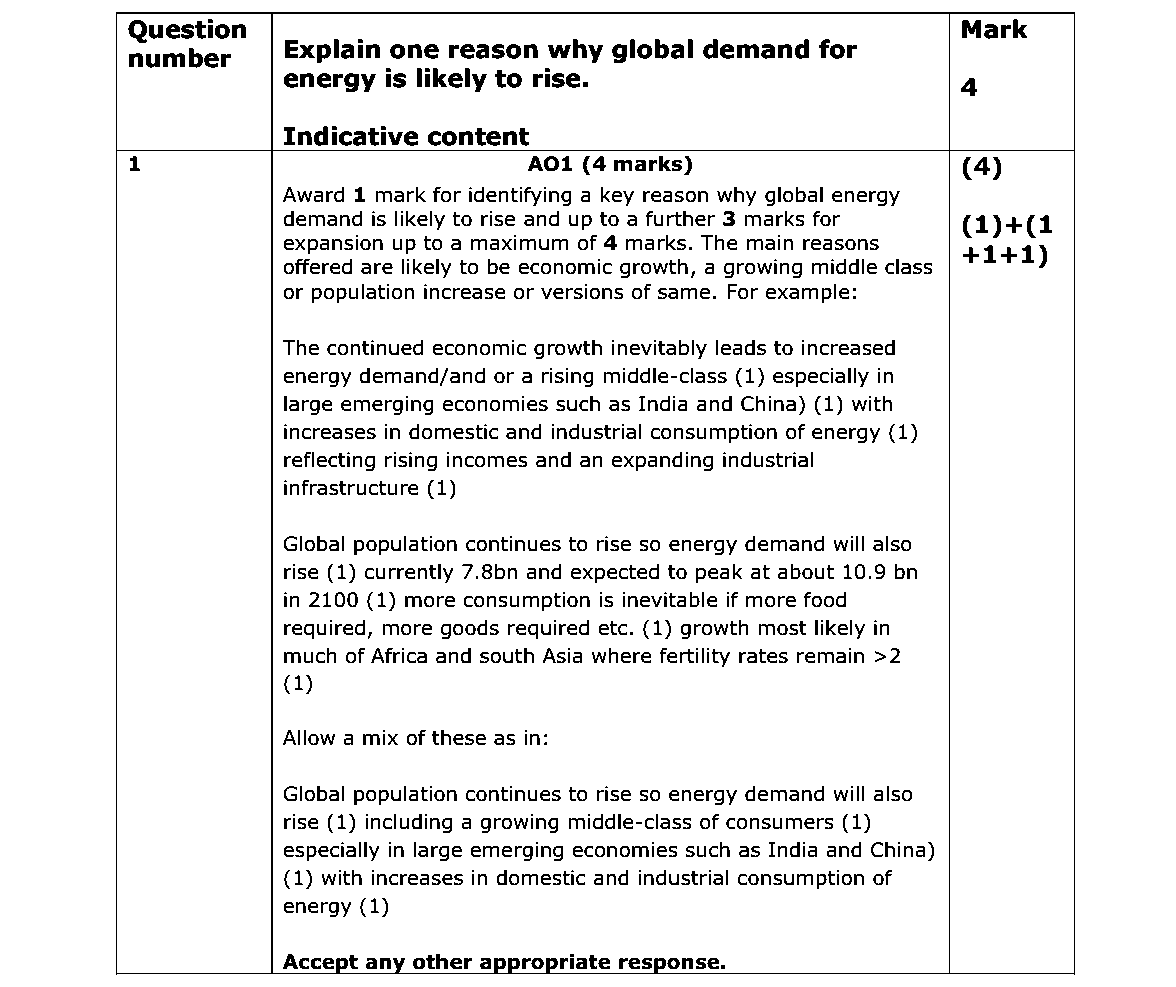
One reason developed in a chain: population growth (7.8bn towards about 10.9bn by 2100) or economic growth and a rising middle class in emerging economies (China, India) raising domestic and industrial consumption
the idea that finite fossil fuels raise demand is a common misconception
June 2022 · Paper 1 · Q4(a)3 marksAO1=2, AO2=1Data response
Resources for question 4
Mark scheme
Examiner's comment
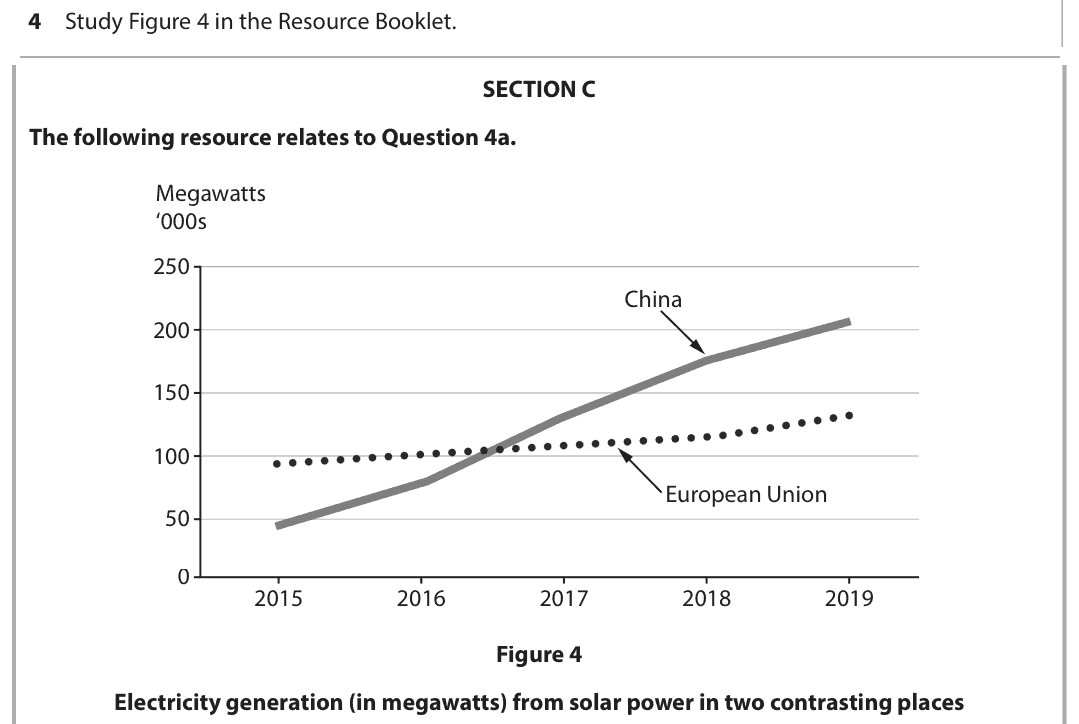
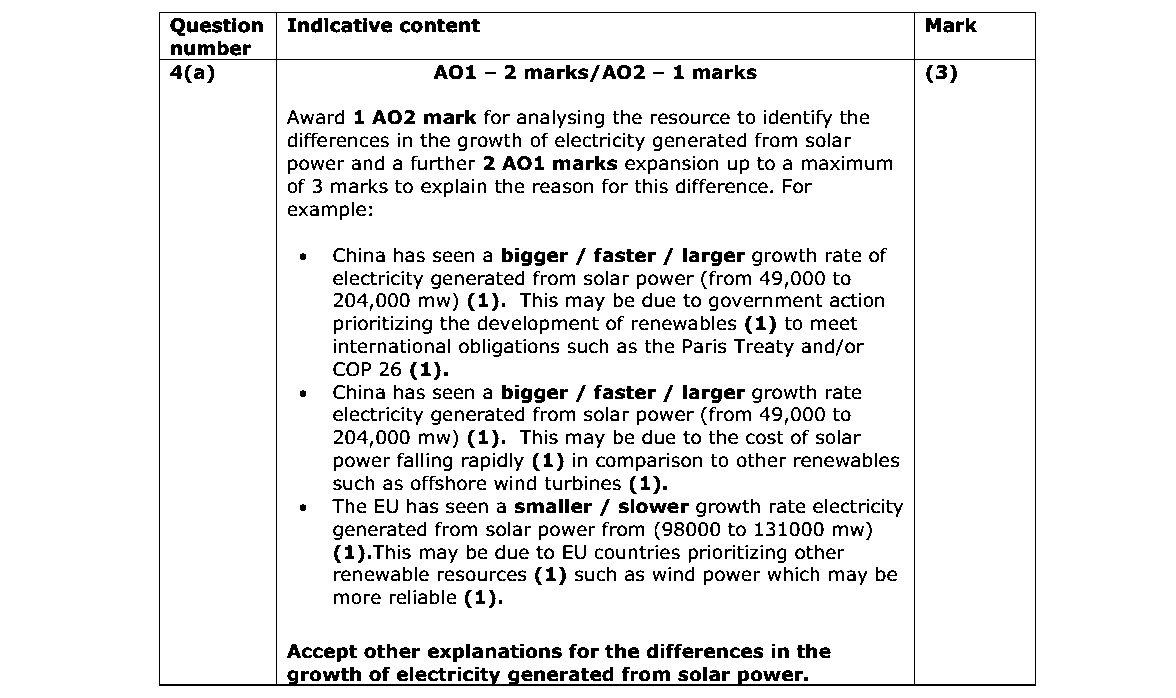
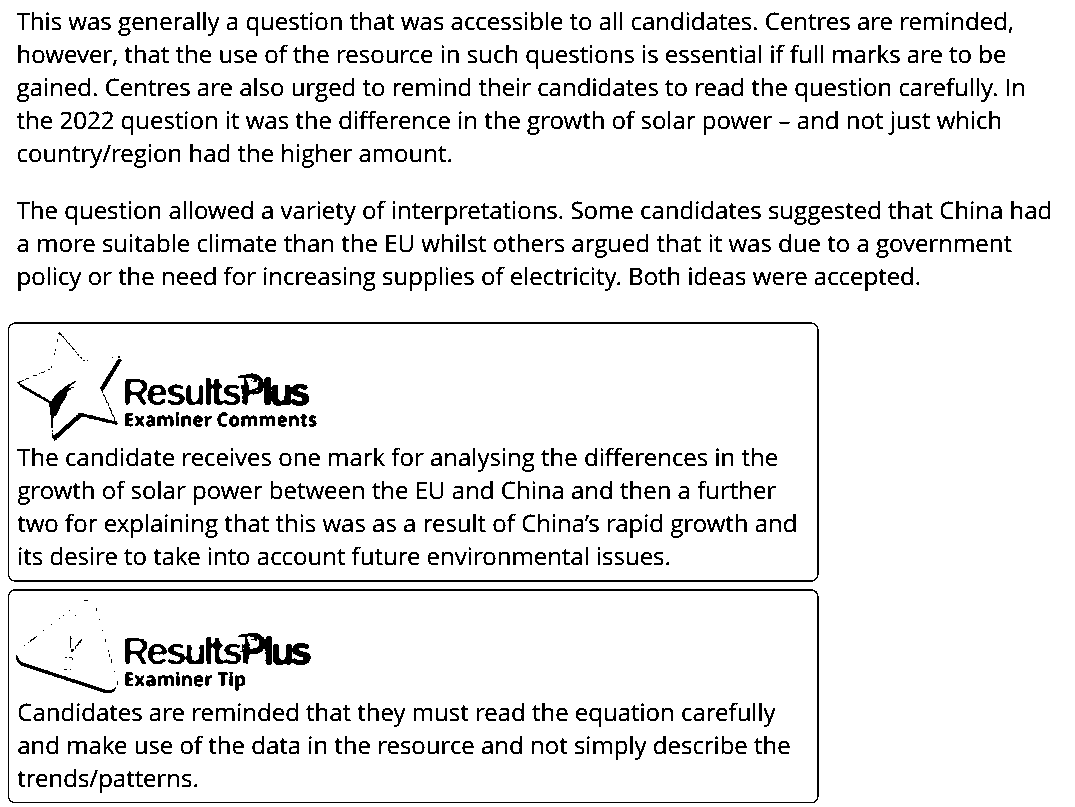
This was generally a question that was accessible to all candidates. Centres are reminded, however, that the use of the resource in such questions is essential if full marks are to be gained. Centres are also urged to remind their candidates to read the question carefully. In the 2022 question it was the difference in the growth of solar power – and not just which country/region had the higher amount. The question allowed a variety of interpretations. Some candidates suggested that China had a more suitable climate than the EU whilst others argued that it was due to a government policy or the need for increasing supplies of electricity. Both ideas were accepted. The candidate receives one mark for analysing the differences in the growth of solar power between the EU and China and then a further two for explaining that this was as a result of China’s rapid growth and its desire to take into account future environmental issues. Candidates are reminded that they must read the equation carefully and make use of the data in the resource and not simply describe the trends/patterns.
Notes from the mark scheme and report
Use Figure 4: China's solar output grew much faster (from about 49,000 to 204,000 MW) than the EU's
government policy, Paris commitments or rising demand
focus on the difference in growth, not just which is higher
June 2022 · Paper 1 · Q4(d)12 marksAO1=3, AO2=912-mark essay
Resources for question 4
Mark scheme, including the levels and indicative content
Examiner's comment
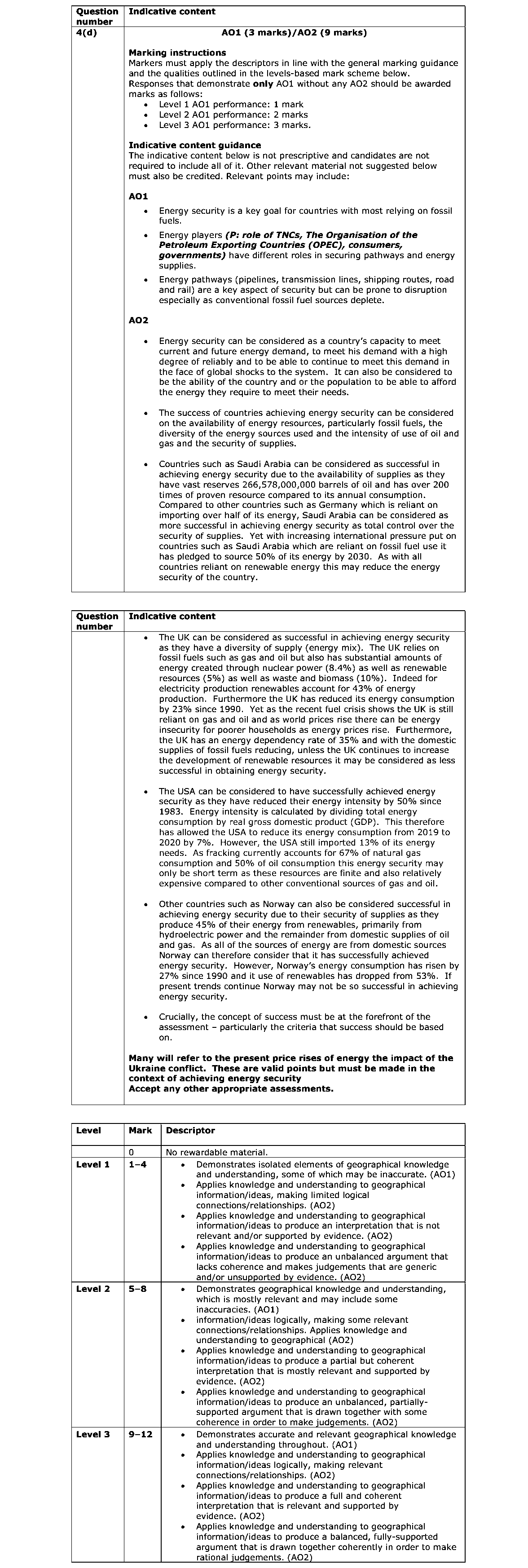
The Ukraine conflict and the subsequent rise in fuel prices alongside the banning of Russian oil and gas made this a very accessible question. Centres are reminded, however, that when teaching this subject they should be clear on what they mean by energy mix. There is a clear difference on the total energy mix for a country and the way in which a country produces electricity. In some cases there was inaccurate information presented when candidates confused these two key ideas. Despite this there were some excellent responses which assessed the role of natural resources, government policy, geopolitics and the use of renewable resources in determining energy security. This demonstrates accurate and relevant geographical knowledge and understanding throughout of how successful different countries have been in achieving energy security. It applies knowledge and understanding to geographical information/ideas logically, making relevant connections/relationships to produce a full and coherent interpretation that is relevant and supported by evidence that is drawn together coherently in order to make rational judgements. Level 3 9 marks. This has sound understanding of how successful two countries are in achieving energy security but could have been improved by having better locational detail, particularly for the UK.
Notes from the mark scheme and report
Compare countries' energy mixes, domestic resources, pathways and policy (e.g. Russia-Ukraine gas disruption, France nuclear, USA fracking)
do not confuse total energy mix with electricity generation
November 2021 · Paper 1 · Q4(a)3 marksAO1=2, AO2=1Data response
Resources for question 4
Mark scheme
Examiner's comment
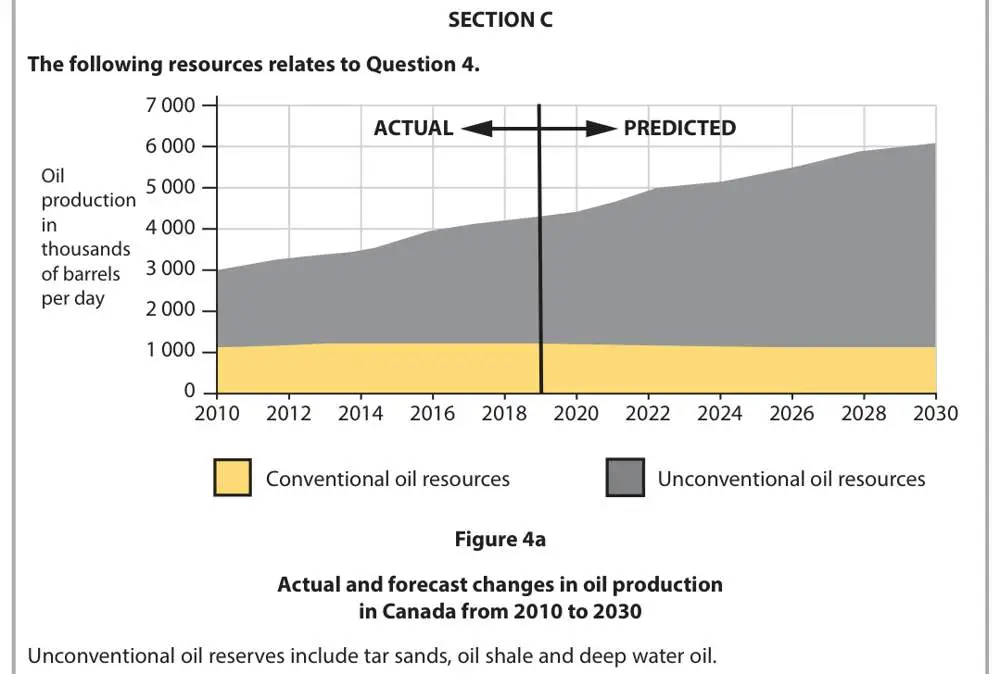
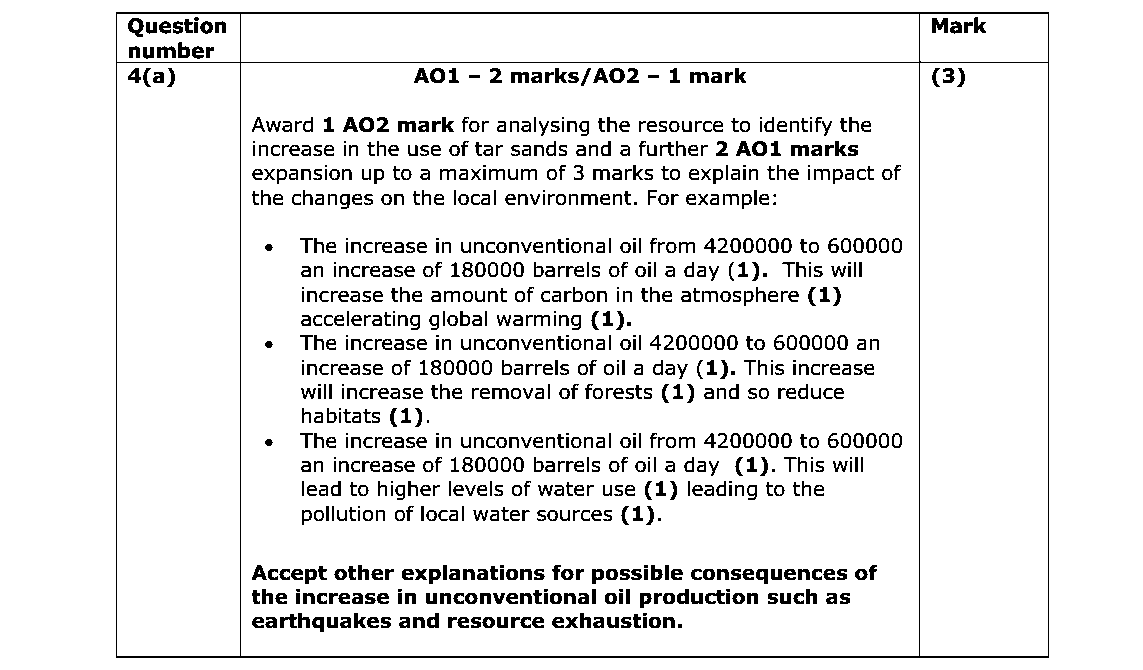
This was found accessible by many of the candidates who were able to explain the possible consequences of an increase in the production of unconventional oil. There were a wide range of answers accepted and many candidates were able to explain the consequences of deep water drilling on marine ecosystems as well as the impact on the forest and aquatic ecosystems caused by an increase in tar sands.
Notes from the mark scheme and report
Figure 4a: unconventional output rises sharply to about 6 million barrels/day by 2030
consequence explained with two links: more carbon emissions, deforestation and habitat loss from tar sands, water use and pollution
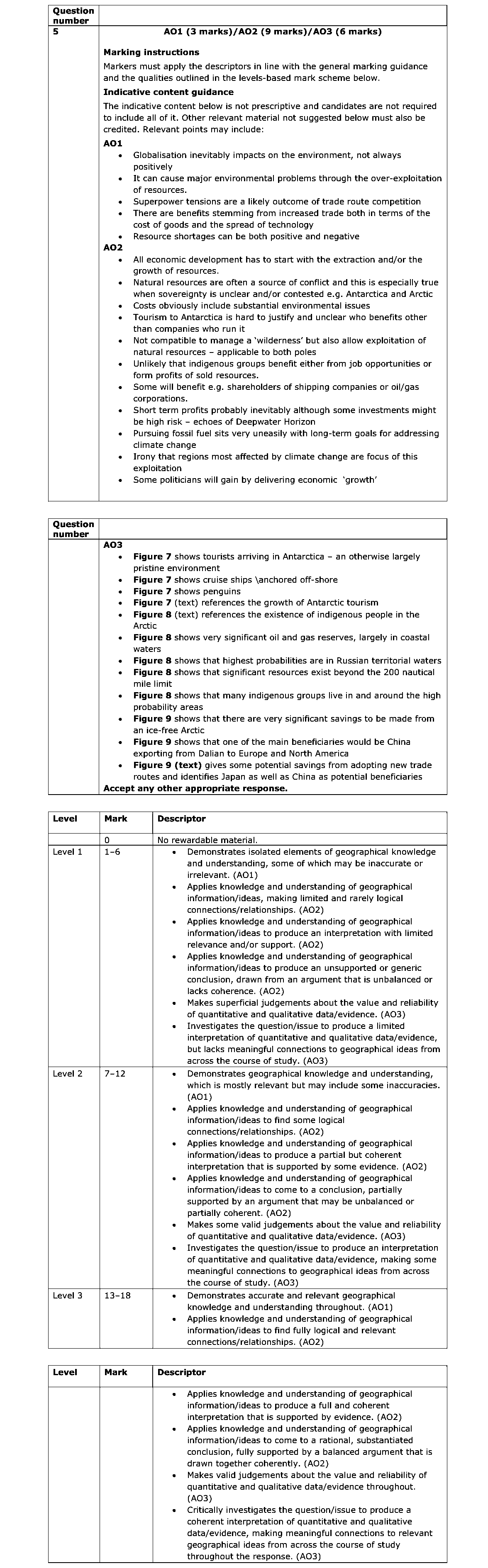
November 2021 · Paper 3 · Q518 marksAO1=3, AO2=9, AO3=618-mark essay
Resources for question 5
Mark scheme, including the levels and indicative content
Examiner's comment
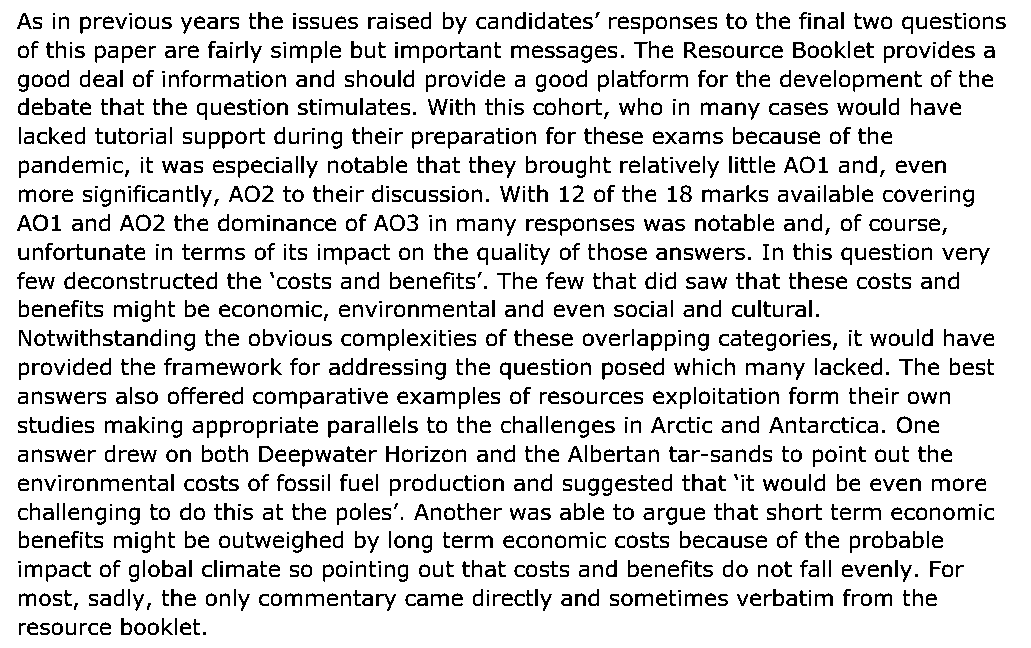
As in previous years the issues raised by candidates’ responses to the final two questions of this paper are fairly simple but important messages. The Resource Booklet provides a good deal of information and should provide a good platform for the development of the debate that the question stimulates. With this cohort, who in many cases would have lacked tutorial support during their preparation for these exams because of the pandemic, it was especially notable that they brought relatively little AO1 and, even more significantly, AO2 to their discussion. With 12 of the 18 marks available covering AO1 and AO2 the dominance of AO3 in many responses was notable and, of course, unfortunate in terms of its impact on the quality of those answers. In this question very few deconstructed the ‘costs and benefits’. The few that did saw that these costs and benefits might be economic, environmental and even social and cultural. Notwithstanding the obvious complexities of these overlapping categories, it would have provided the framework for addressing the question posed which many lacked. The best answers also offered comparative examples of resources exploitation form their own studies making appropriate parallels to the challenges in Arctic and Antarctica. One answer drew on both Deepwater Horizon and the Albertan tar-sands to point out the environmental costs of fossil fuel production and suggested that ‘it would be even more challenging to do this at the poles’. Another was able to argue that short term economic benefits might be outweighed by long term economic costs because of the probable impact of global climate so pointing out that costs and benefits do not fall evenly. For most, sadly, the only commentary came directly and sometimes verbatim from the resource booklet.
Notes from the mark scheme and report
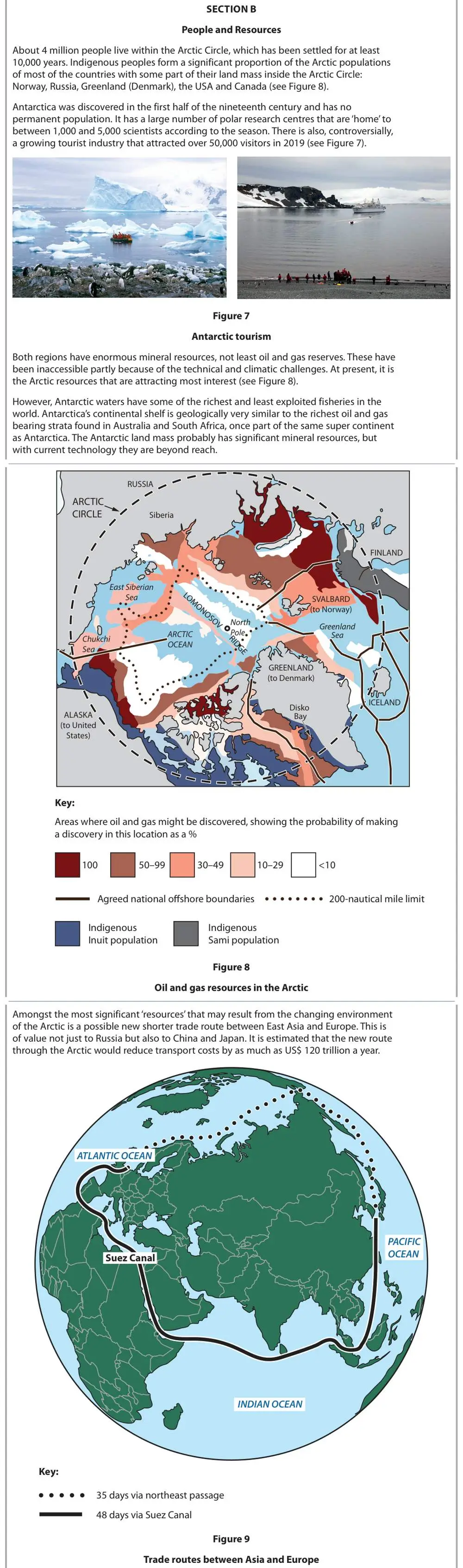
Figures 7-9: Arctic oil and gas, Antarctic fisheries and tourism, a northeast passage cutting Asia-Europe shipping from 48 to 35 days v environmental damage, indigenous Inuit and Sami losing out, contested sovereignty
deconstruct economic, environmental and social costs and benefits
most relied on the resources with little AO1 or AO2
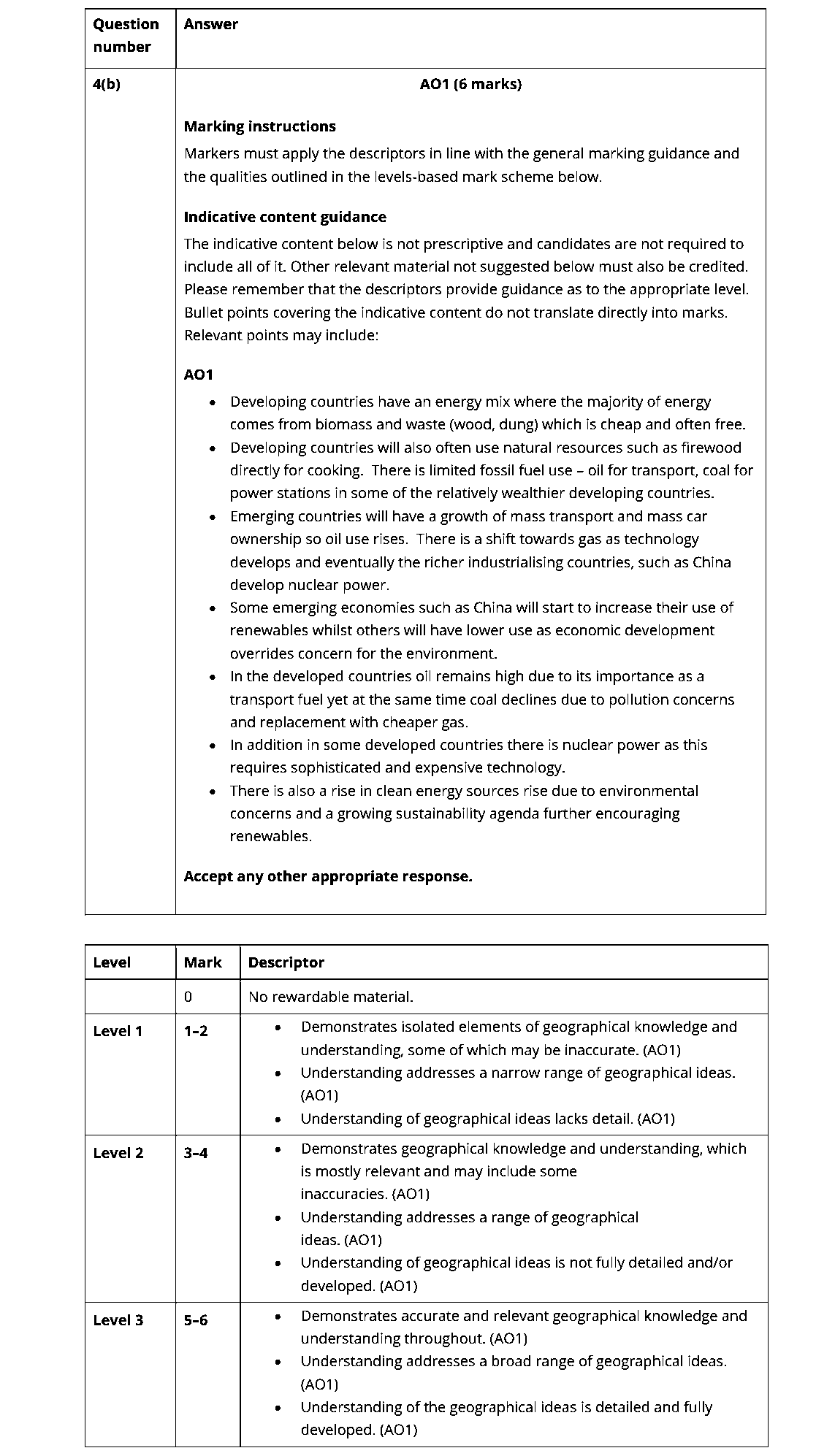
June 2019 · Paper 1 · Q4(b)6 marksAO1=6Extended response
Resources for question 4
Mark scheme, including the levels and indicative content
Examiner's comment
Although the vast majority of candidates found this an accessible question, some candidates mistook energy mix for energy consumption and as a result found it difficult to gain much credit. The best candidates compared the energy mix of a range of countries at different levels of development and gave good explanations based on the ability of richer countries to be able to use a wider variety of primary and secondary energy sources. Many used the Kuznets curve model to show how as a country’s economy develops the energy mix would change. This demonstrates accurate and relevant geographical knowledge and understanding of why the level of economic development affects the energy mix of countries. The candidate’s understanding addresses a broad range of geographical ideas which are detailed and fully developed. Level 3: 5 marks. The answer could have been improved by using a different example for the candidate´s last point. Although the candidate is correct that countries with a low level of development often have to rely on domestic energy sources the examples they use are clearly incorrect.
Notes from the mark scheme and report
Developing countries rely on biomass and wood
emerging economies add oil for transport, coal and gas and later nuclear and renewables (China)
developed countries diversify
Kuznets curve
some confused energy mix with consumption
Work with an Edexcel Geography tutor
Essays stuck in the middle levels, or losing marks on the data questions? Book a trial lesson with a specialist Edexcel Geography tutor.