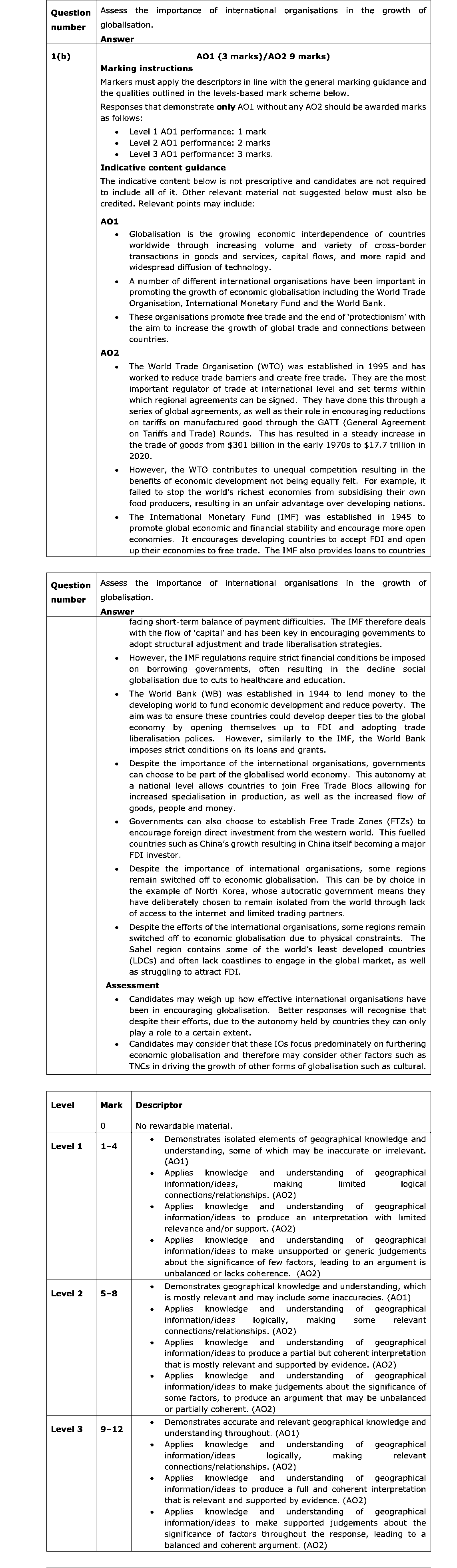
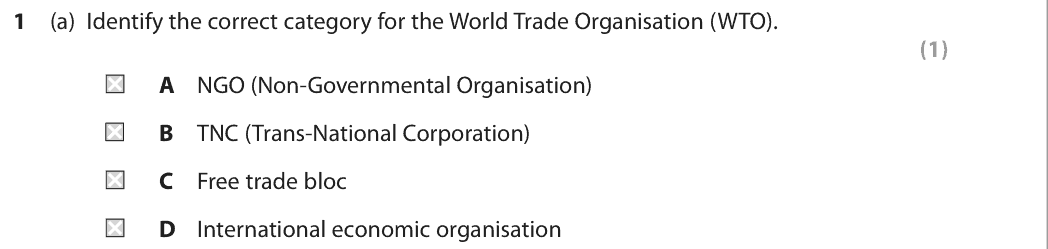
International Organisations include the World Trade Organisation (WTO), International Monetary Fund (IMF) and the World Bank. (b) Assess the importance of international organisations in the growth of globalisation.
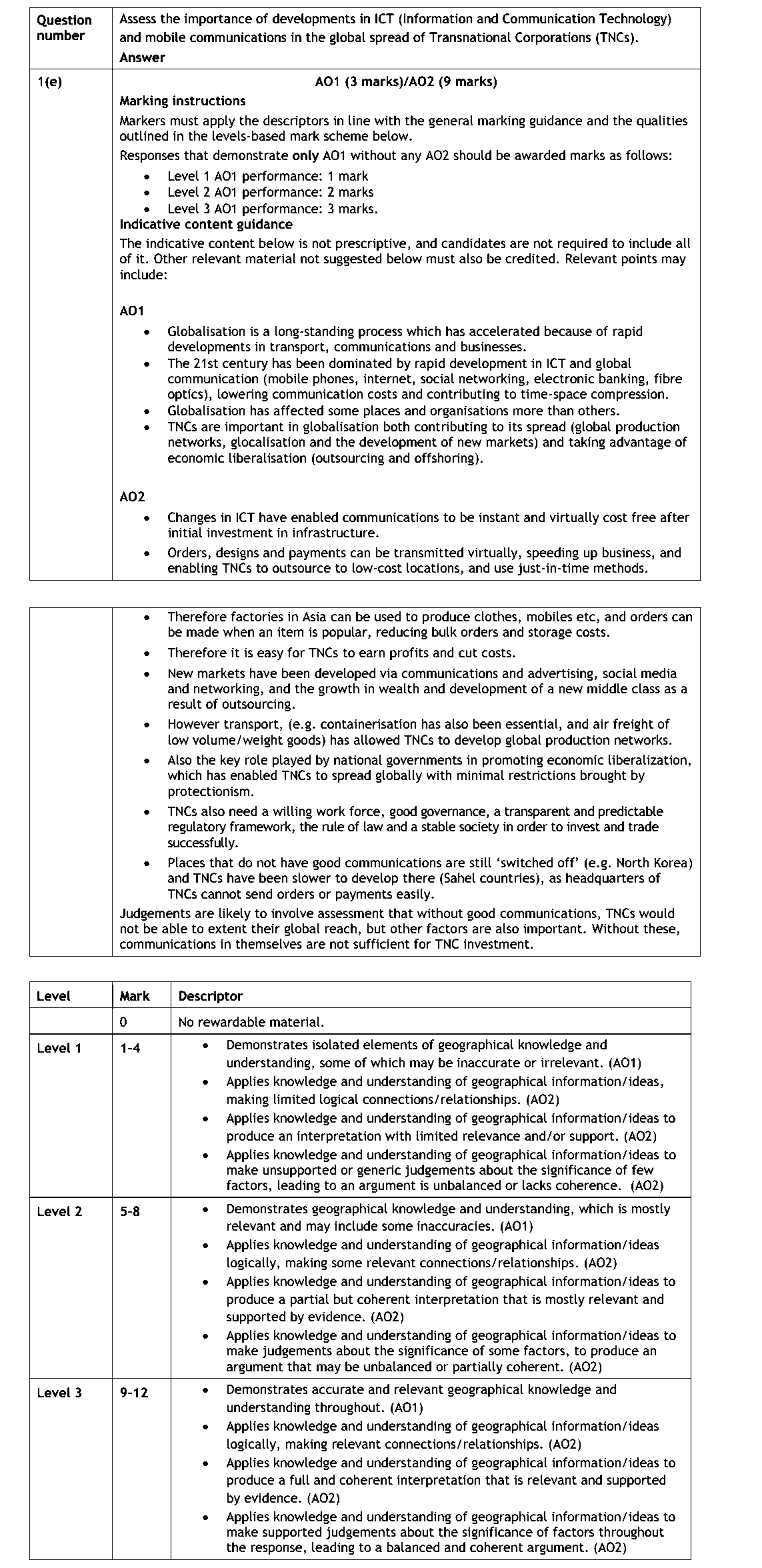
Assess the importance of developments in ICT (Information and Communication Technology) and mobile communication in the global spread of TNCs (Transnational Corporations).
5 Study the resources in Section B of the Resource Booklet. Evaluate the view that geographical isolation has been the main barrier to the sustainable development of SIDS.
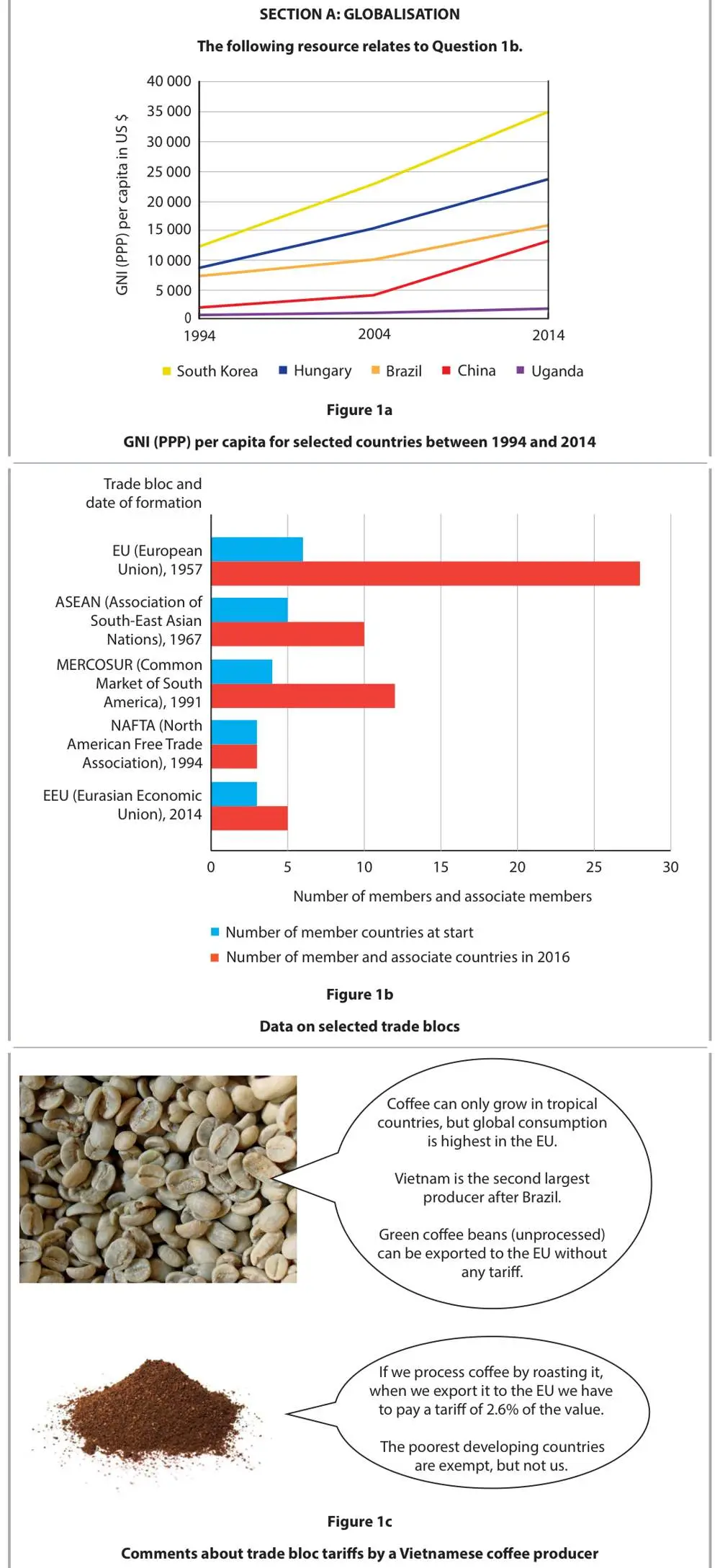
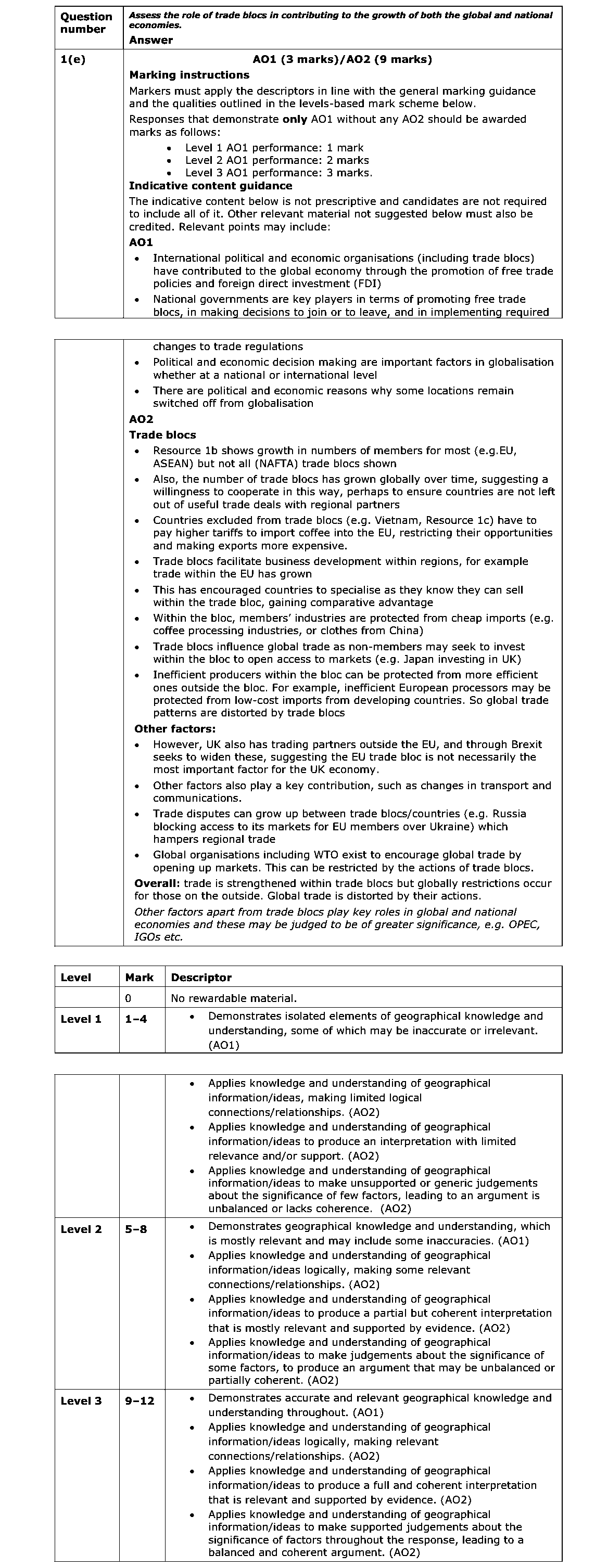
Study Figures 1b and 1c in the Resource Booklet. Assess the role of trade blocs in contributing to the growth of both the global economy and national economies.
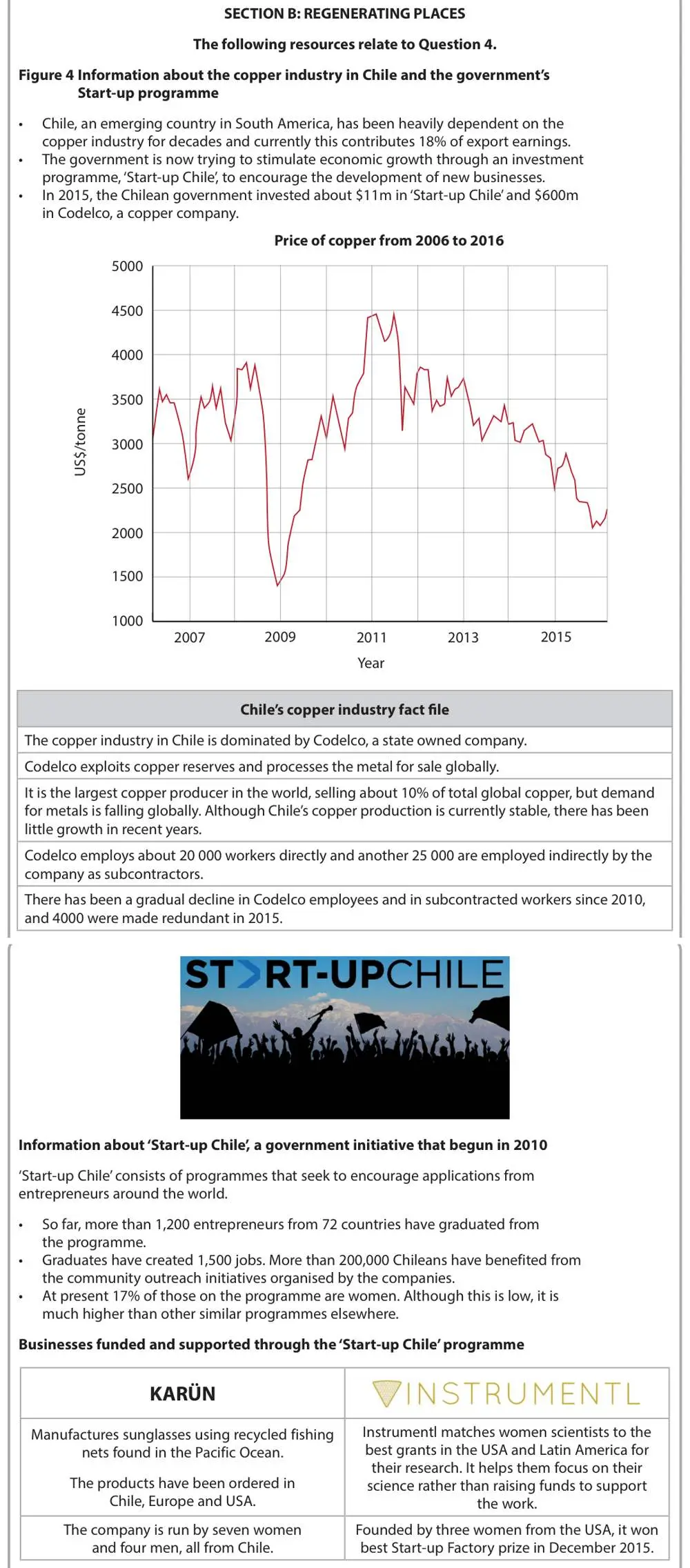
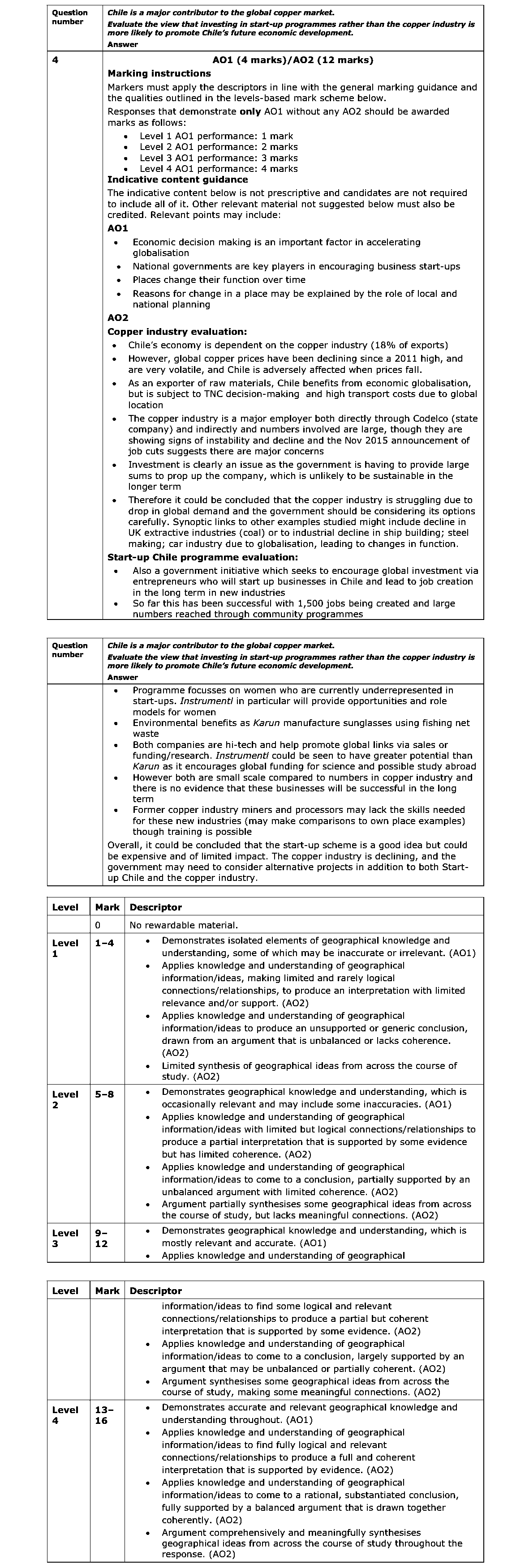
4 Study Figure 4 in the Resource Booklet. Chile is the major contributor to the global copper market. Evaluate the view that investing in start-up programmes rather than the copper industry is more likely to promote Chile’s future economic development.
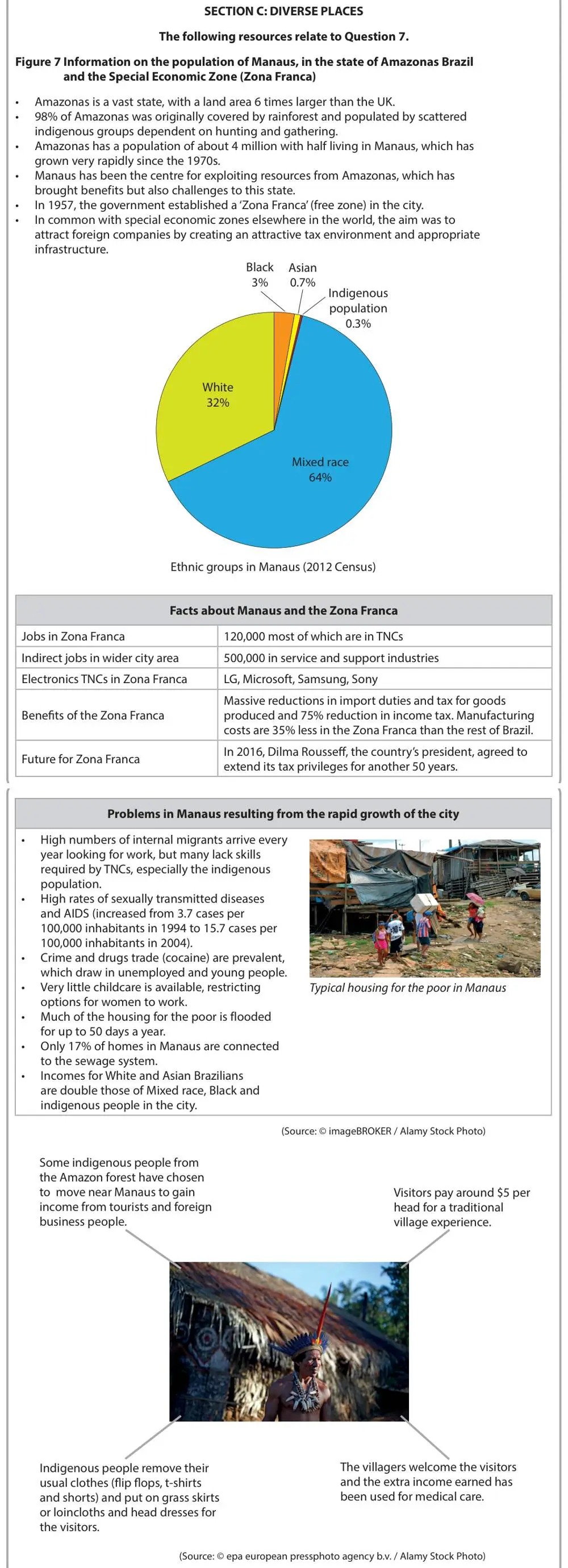
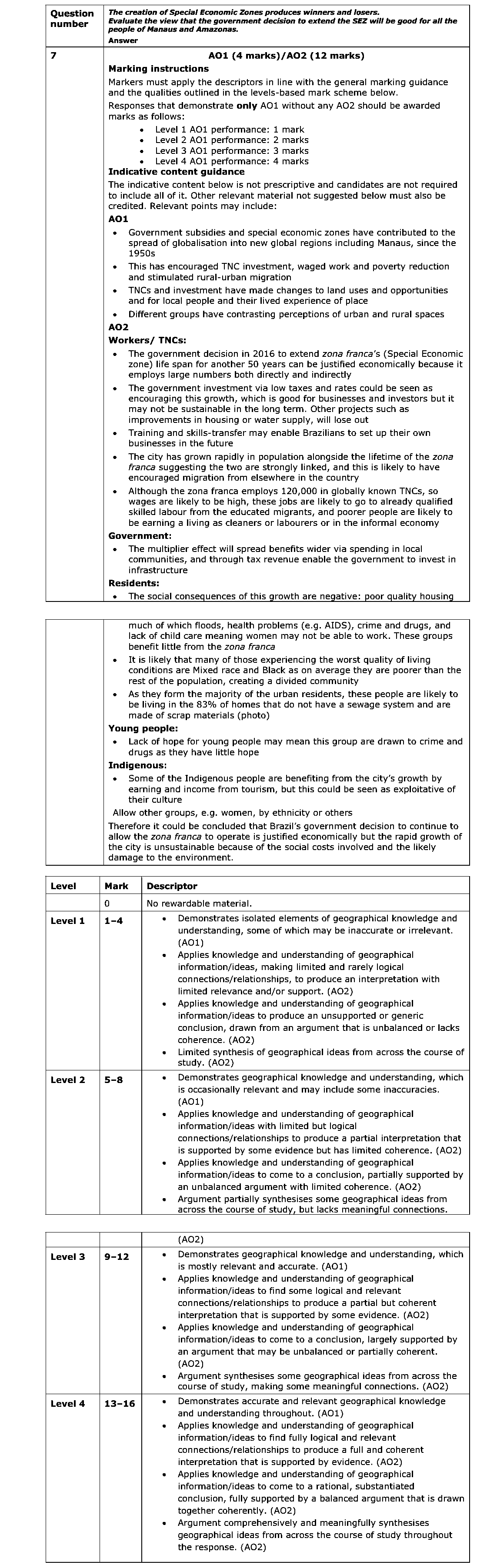
7 Study Figure 7 in the Resource Booklet. The creation of Special Economic Zones produces winners and losers. Evaluate the view that the government decision to extend the Special Economic Zone will be good for all the people of Manaus and Amazonas.
Tap a question to zoom it. The figures open above it; the mark scheme (with its levels and indicative content) and the examiner's comment open underneath.
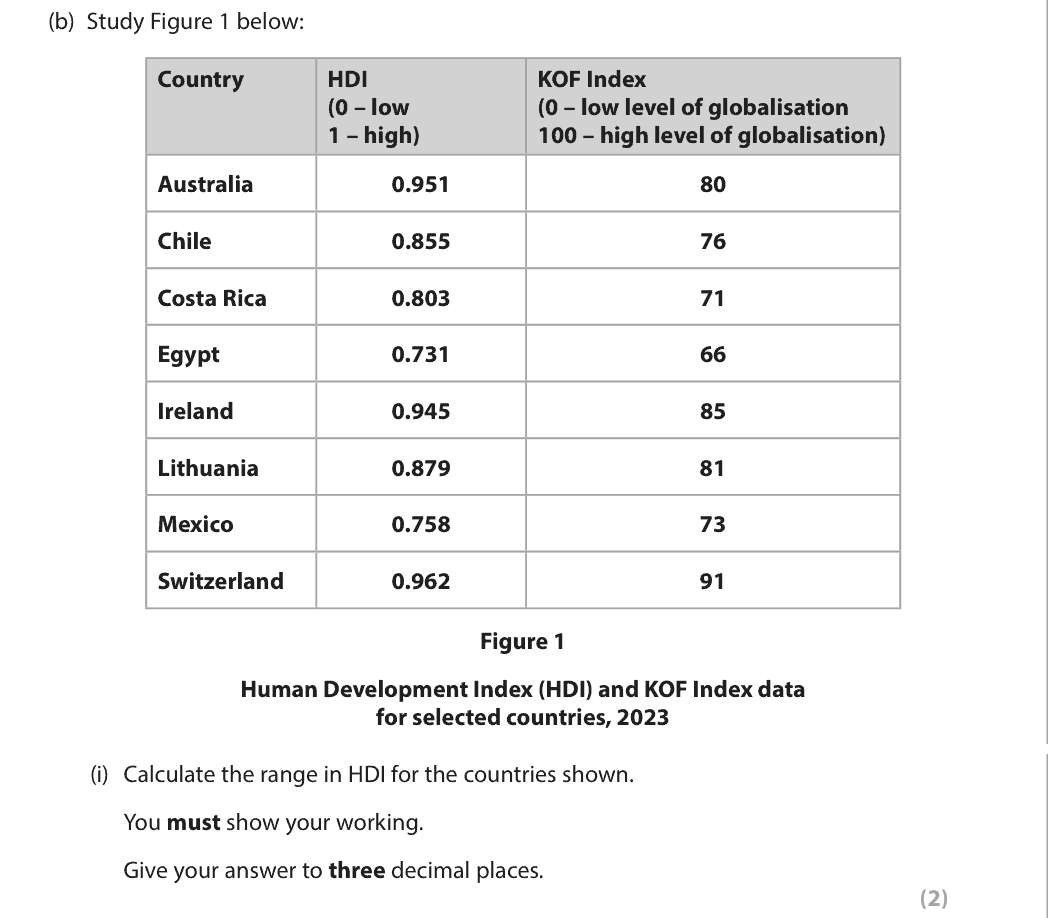
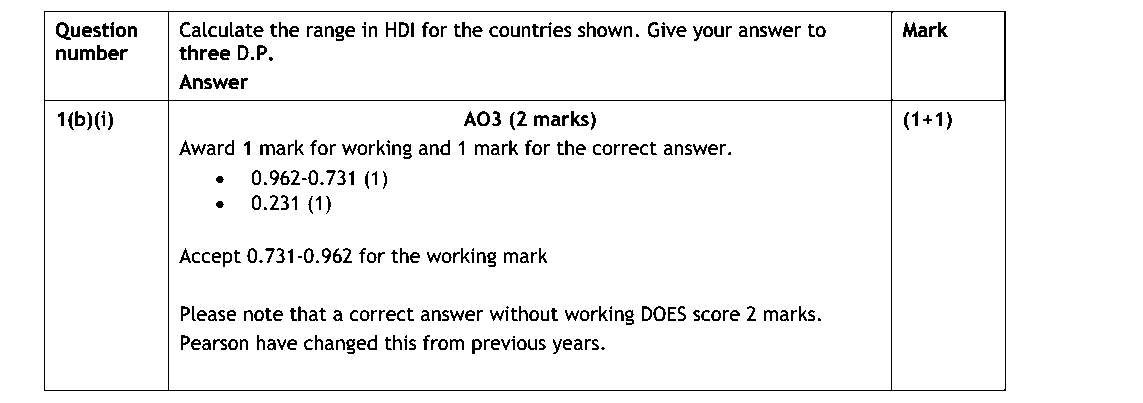
June 2025 · AS Paper 2 · Q1(b)(i)2 marksAO3=2Calculation
Mark scheme
Examiner's comment
This 2-mark maths question to calculate a range was answered very effectively. Most gave their working, but centres may like to note this is no longer required. If the correct answer if given, working is not required. However, it is good practice to give working, and if a mistake is made, the working may nevertheless score a mark, depending on the data used.
Notes from the mark scheme and report
Answer: 0.231 (0.962 − 0.731, Switzerland minus Egypt)
a correct answer without working now scores both marks
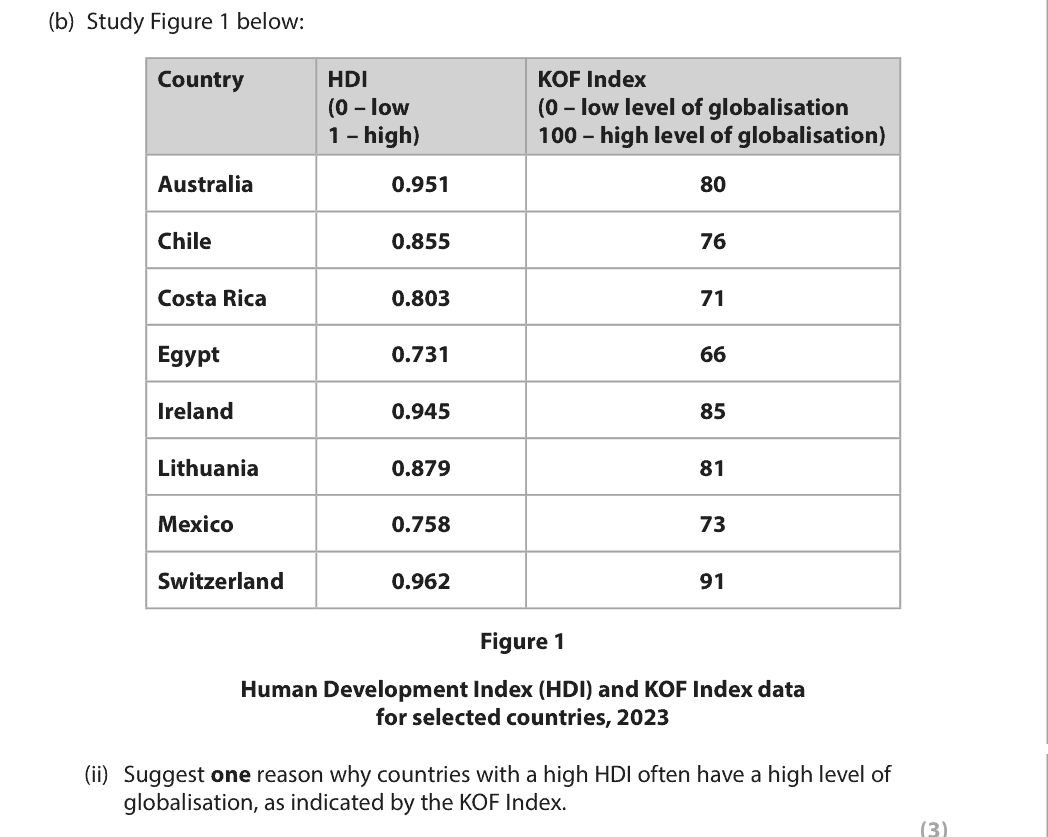
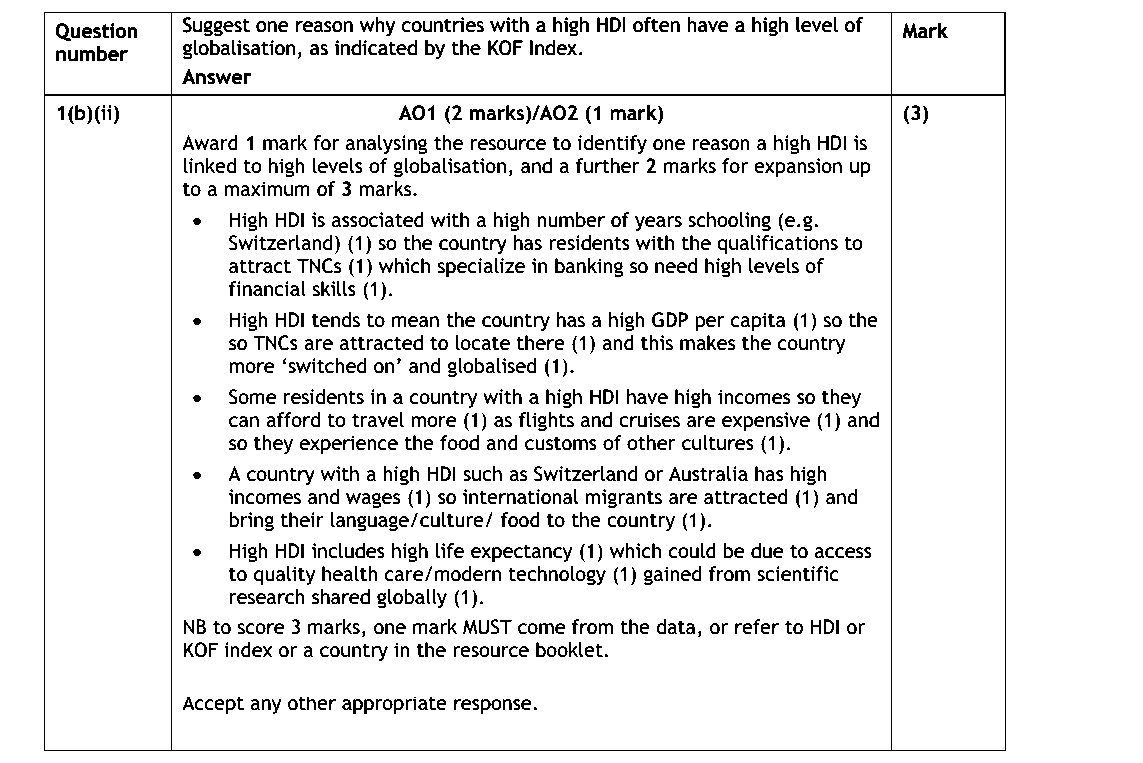
June 2025 · AS Paper 2 · Q1(b)(ii)3 marksAO1=2, AO2=1Data response
Mark scheme
Examiner's comment
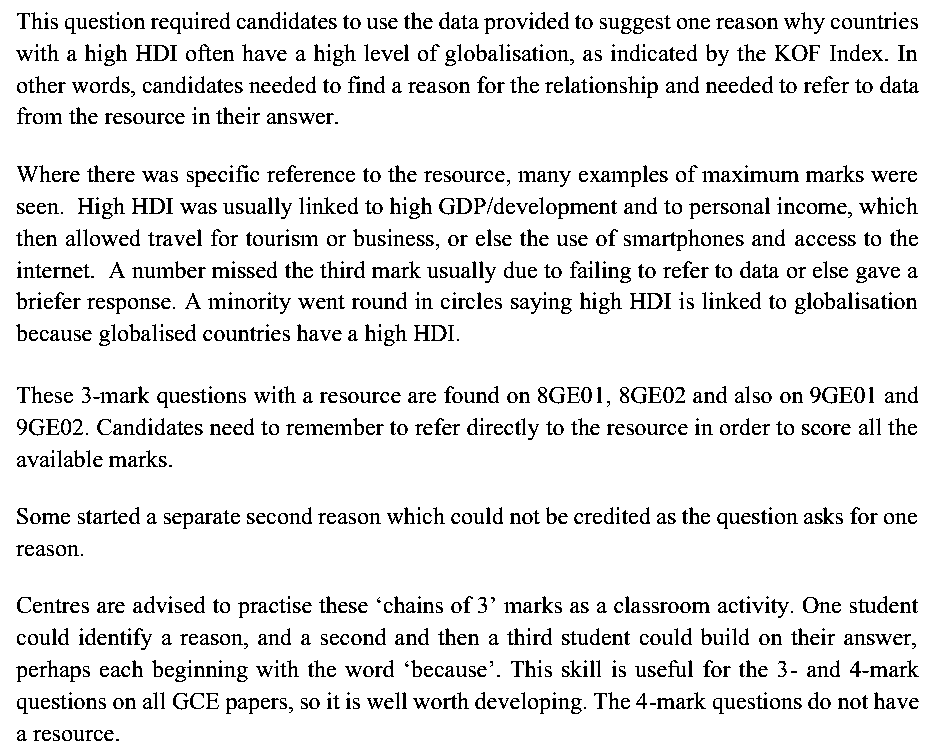
This question required candidates to use the data provided to suggest one reason why countries with a high HDI often have a high level of globalisation, as indicated by the KOF Index. In other words, candidates needed to find a reason for the relationship and needed to refer to data from the resource in their answer. Where there was specific reference to the resource, many examples of maximum marks were seen. High HDI was usually linked to high GDP/development and to personal income, which then allowed travel for tourism or business, or else the use of smartphones and access to the internet. A number missed the third mark usually due to failing to refer to data or else gave a briefer response. A minority went round in circles saying high HDI is linked to globalisation because globalised countries have a high HDI. These 3-mark questions with a resource are found on 8GE01, 8GE02 and also on 9GE01 and 9GE02. Candidates need to remember to refer directly to the resource in order to score all the available marks. Some started a separate second reason which could not be credited as the question asks for one reason. Centres are advised to practise these ‘chains of 3’ marks as a classroom activity. One student could identify a reason, and a second and then a third student could build on their answer, perhaps each beginning with the word ‘because’. This skill is useful for the 3- and 4-mark questions on all GCE papers, so it is well worth developing. The 4-mark questions do not have a resource.
Notes from the mark scheme and report
High HDI means high GDP per capita, education and incomes, attracting TNCs and enabling travel and internet use, so higher KOF scores (e.g. Switzerland 0.962 and 91)
quote data from Figure 1 for the third mark
avoid circular reasoning and a second reason
June 2025 · AS Paper 2 · Q1(c)4 marksAO1=4Short answer
Mark scheme
Examiner's comment
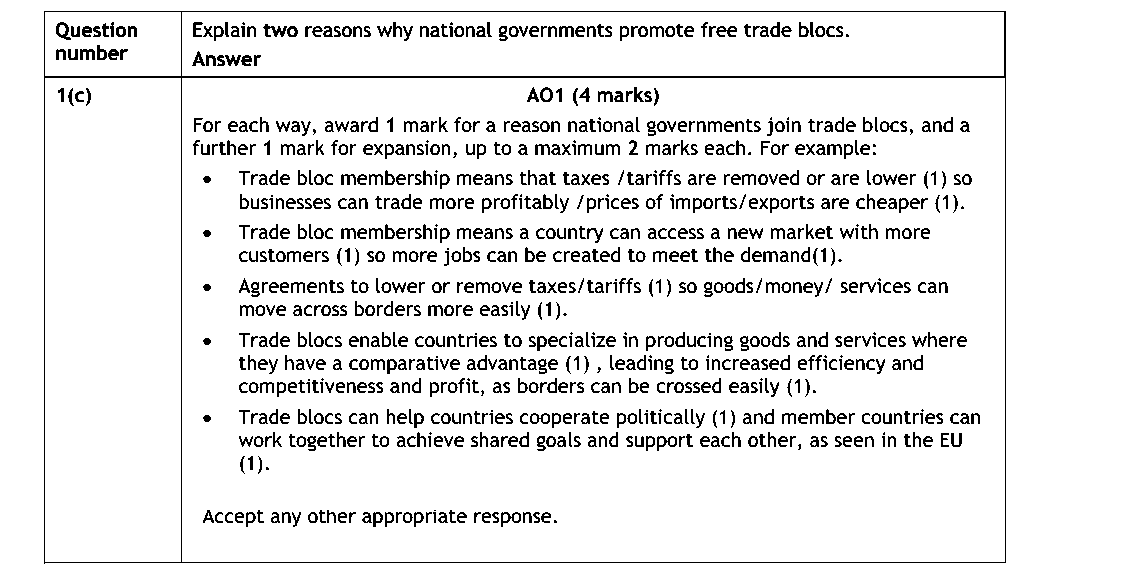
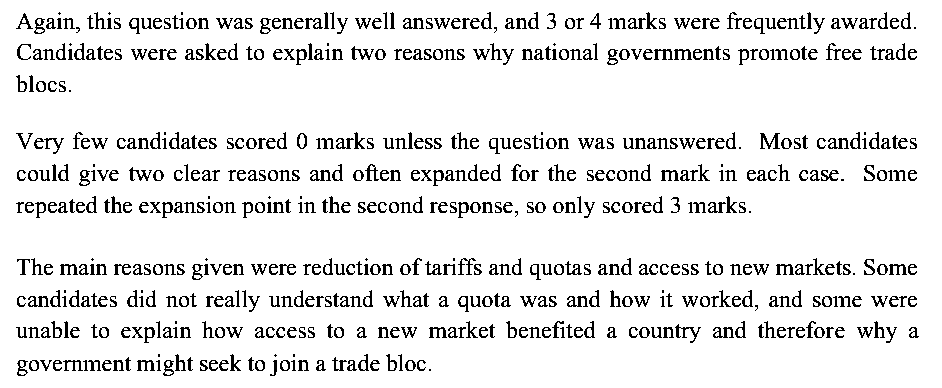
Again, this question was generally well answered, and 3 or 4 marks were frequently awarded. Candidates were asked to explain two reasons why national governments promote free trade blocs. Very few candidates scored 0 marks unless the question was unanswered. Most candidates could give two clear reasons and often expanded for the second mark in each case. Some repeated the expansion point in the second response, so only scored 3 marks. The main reasons given were reduction of tariffs and quotas and access to new markets. Some candidates did not really understand what a quota was and how it worked, and some were unable to explain how access to a new market benefited a country and therefore why a government might seek to join a trade bloc.
Notes from the mark scheme and report
Lower or removed tariffs and quotas make trade cheaper
access to larger markets creates jobs
specialisation by comparative advantage
repeating the same expansion twice capped answers at 3 marks
June 2025 · AS Paper 2 · Q1(e)12 marksAO1=3, AO2=912-mark essay
Mark scheme, including the levels and indicative content
Examiner's comment
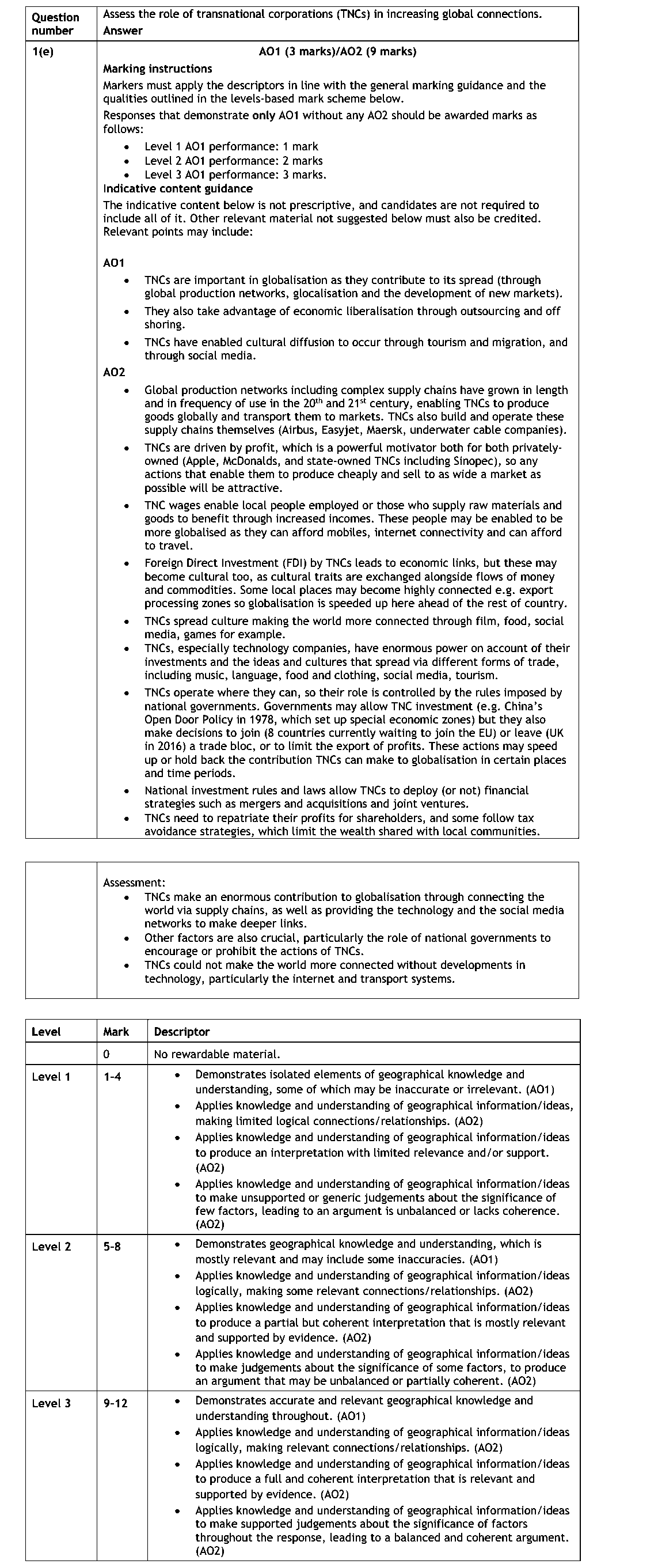
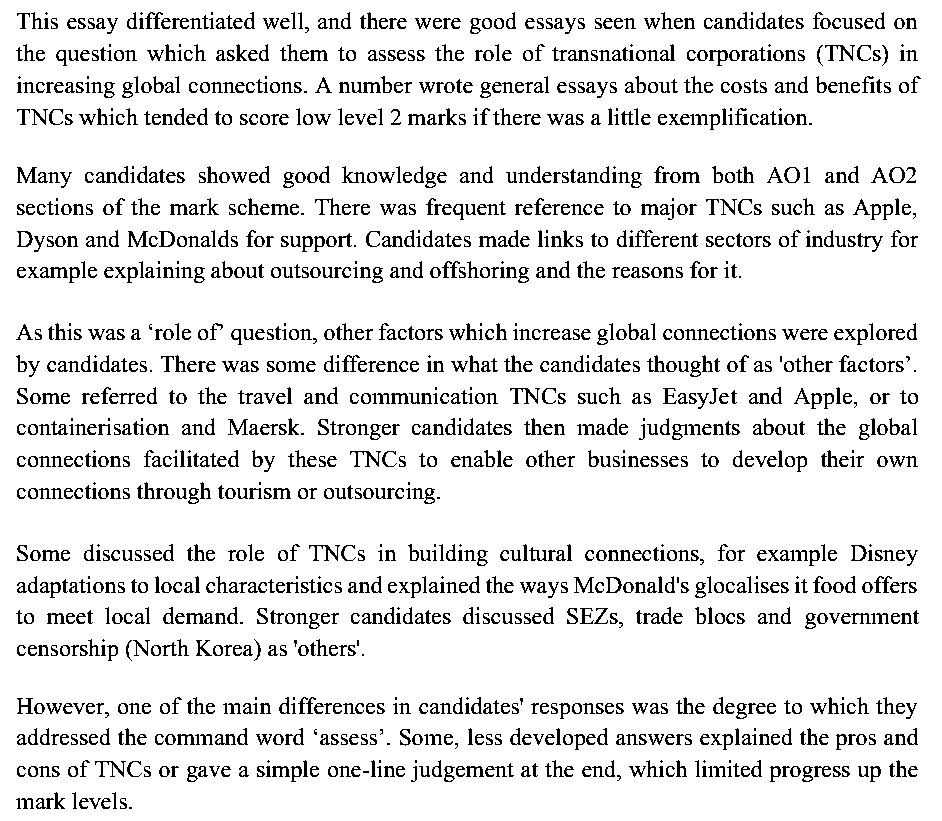
This essay differentiated well, and there were good essays seen when candidates focused on the question which asked them to assess the role of transnational corporations (TNCs) in increasing global connections. A number wrote general essays about the costs and benefits of TNCs which tended to score low level 2 marks if there was a little exemplification. Many candidates showed good knowledge and understanding from both AO1 and AO2 sections of the mark scheme. There was frequent reference to major TNCs such as Apple, Dyson and McDonalds for support. Candidates made links to different sectors of industry for example explaining about outsourcing and offshoring and the reasons for it. As this was a ‘role of’ question, other factors which increase global connections were explored by candidates. There was some difference in what the candidates thought of as 'other factors’. Some referred to the travel and communication TNCs such as EasyJet and Apple, or to containerisation and Maersk. Stronger candidates then made judgments about the global connections facilitated by these TNCs to enable other businesses to develop their own connections through tourism or outsourcing. Some discussed the role of TNCs in building cultural connections, for example Disney adaptations to local characteristics and explained the ways McDonald's glocalises it food offers to meet local demand. Stronger candidates discussed SEZs, trade blocs and government censorship (North Korea) as 'others'. However, one of the main differences in candidates' responses was the degree to which they addressed the command word ‘assess’. Some, less developed answers explained the pros and cons of TNCs or gave a simple one-line judgement at the end, which limited progress up the mark levels.
Notes from the mark scheme and report
TNCs spread globalisation via global production networks, outsourcing, offshoring and glocalisation (Apple, McDonald's, Disney)
weigh against transport and ICT (containerisation, Maersk, EasyJet), governments and IGOs
general cost-benefit essays on TNCs stayed in low Level 2
June 2024 · Paper 2 · Q1(a)4 marksAO1=4Short answer
Mark scheme
Examiner's comment
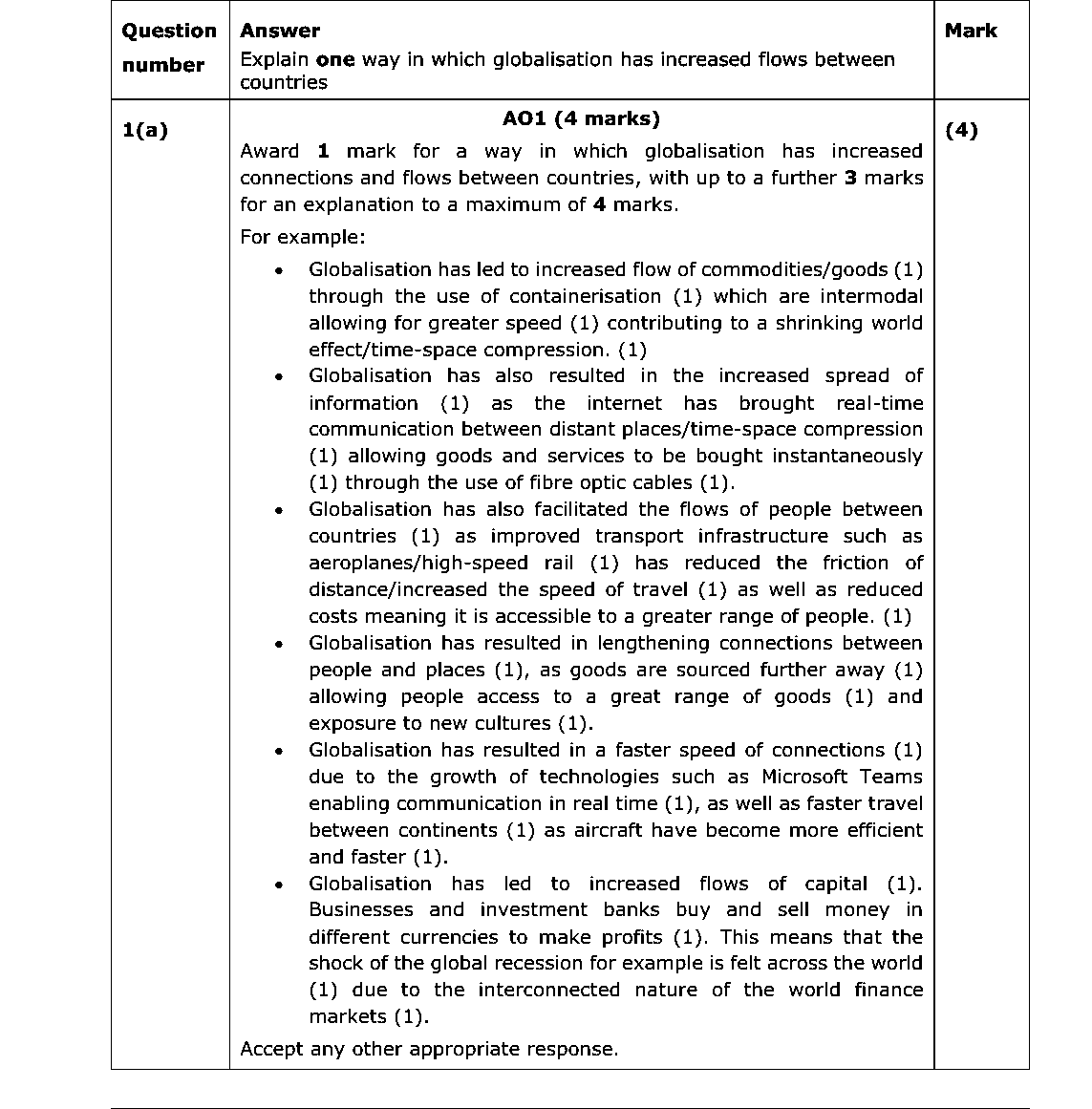
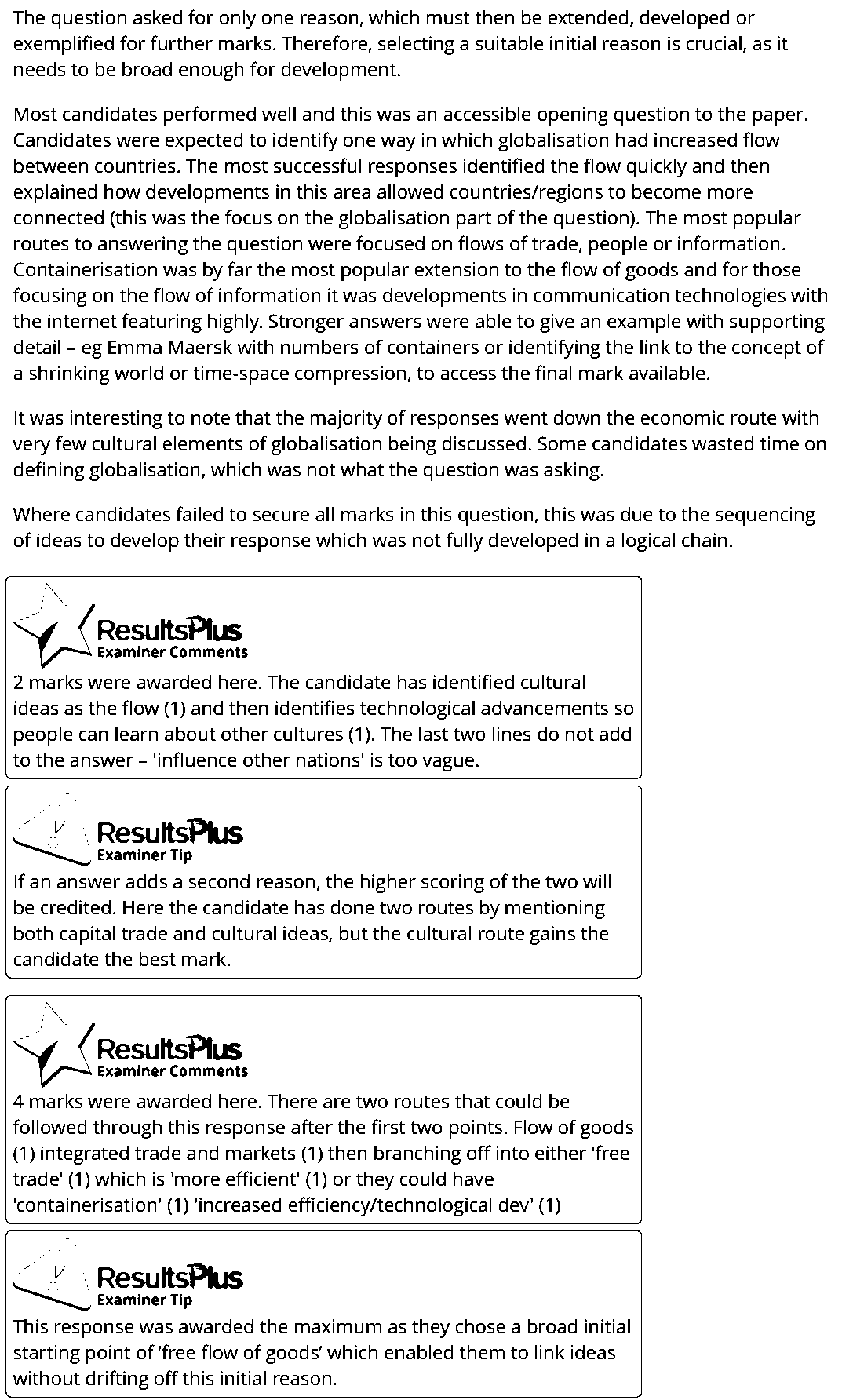
The question asked for only one reason, which must then be extended, developed or exemplified for further marks. Therefore, selecting a suitable initial reason is crucial, as it needs to be broad enough for development. Most candidates performed well and this was an accessible opening question to the paper. Candidates were expected to identify one way in which globalisation had increased flow between countries. The most successful responses identified the flow quickly and then explained how developments in this area allowed countries/regions to become more connected (this was the focus on the globalisation part of the question). The most popular routes to answering the question were focused on flows of trade, people or information. Containerisation was by far the most popular extension to the flow of goods and for those focusing on the flow of information it was developments in communication technologies with the internet featuring highly. Stronger answers were able to give an example with supporting detail – eg Emma Maersk with numbers of containers or identifying the link to the concept of a shrinking world or time-space compression, to access the final mark available. It was interesting to note that the majority of responses went down the economic route with very few cultural elements of globalisation being discussed. Some candidates wasted time on defining globalisation, which was not what the question was asking. Where candidates failed to secure all marks in this question, this was due to the sequencing of ideas to develop their response which was not fully developed in a logical chain. 2 marks were awarded here. The candidate has identified cultural ideas as the flow (1) and then identifies technological advancements so people can learn about other cultures (1). The last two lines do not add to the answer – 'influence other nations' is too vague. If an answer adds a second reason, the higher scoring of the two will be credited. Here the candidate has done two routes by mentioning both capital trade and cultural ideas, but the cultural route gains the candidate the best mark. 4 marks were awarded here. There are two routes that could be followed through this response after the first two points. Flow of goods (1) integrated trade and markets (1) then branching off into either 'free trade' (1) which is 'more efficient' (1) or they could have 'containerisation' (1) 'increased efficiency/technological dev' (1) This response was awarded the maximum as they chose a broad initial starting point of ‘free flow of goods’ which enabled them to link ideas without drifting off this initial reason.
Notes from the mark scheme and report
One flow (goods, people, capital or information) developed three times: containerisation (e.g. Emma Maersk) lowers costs, internet and ICT give time-space compression, linked global finance markets
pick a reason broad enough to develop
accessible opening question
June 2024 · Paper 2 · Q1(b)12 marksAO1=3, AO2=912-mark essay
Mark scheme, including the levels and indicative content
Examiner's comment
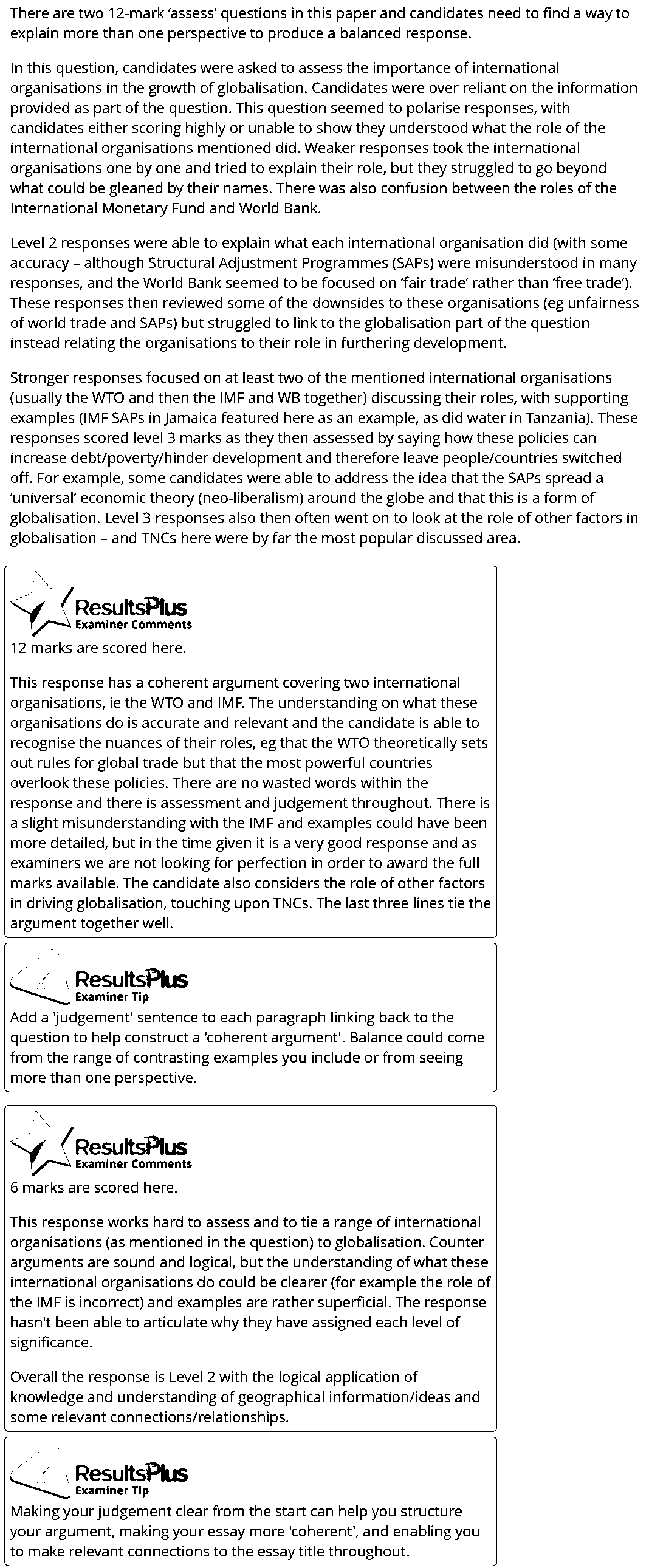
There are two 12-mark ‘assess’ questions in this paper and candidates need to find a way to explain more than one perspective to produce a balanced response. In this question, candidates were asked to assess the importance of international organisations in the growth of globalisation. Candidates were over reliant on the information provided as part of the question. This question seemed to polarise responses, with candidates either scoring highly or unable to show they understood what the role of the international organisations mentioned did. Weaker responses took the international organisations one by one and tried to explain their role, but they struggled to go beyond what could be gleaned by their names. There was also confusion between the roles of the International Monetary Fund and World Bank. Level 2 responses were able to explain what each international organisation did (with some accuracy – although Structural Adjustment Programmes (SAPs) were misunderstood in many responses, and the World Bank seemed to be focused on ‘fair trade’ rather than ‘free trade’). These responses then reviewed some of the downsides to these organisations (eg unfairness of world trade and SAPs) but struggled to link to the globalisation part of the question instead relating the organisations to their role in furthering development. Stronger responses focused on at least two of the mentioned international organisations (usually the WTO and then the IMF and WB together) discussing their roles, with supporting examples (IMF SAPs in Jamaica featured here as an example, as did water in Tanzania). These responses scored level 3 marks as they then assessed by saying how these policies can increase debt/poverty/hinder development and therefore leave people/countries switched off. For example, some candidates were able to address the idea that the SAPs spread a ‘universal’ economic theory (neo-liberalism) around the globe and that this is a form of globalisation. Level 3 responses also then often went on to look at the role of other factors in globalisation – and TNCs here were by far the most popular discussed area. 12 marks are scored here. This response has a coherent argument covering two international organisations, ie the WTO and IMF. The understanding on what these organisations do is accurate and relevant and the candidate is able to recognise the nuances of their roles, eg that the WTO theoretically sets out rules for global trade but that the most powerful countries overlook these policies. There are no wasted words within the response and there is assessment and judgement throughout. There is a slight misunderstanding with the IMF and examples could have been more detailed, but in the time given it is a very good response and as examiners we are not looking for perfection in order to award the full marks available. The candidate also considers the role of other factors in driving globalisation, touching upon TNCs. The last three lines tie the argument together well. Add a 'judgement' sentence to each paragraph linking back to the question to help construct a 'coherent argument'. Balance could come from the range of contrasting examples you include or from seeing more than one perspective. 6 marks are scored here. This response works hard to assess and to tie a range of international organisations (as mentioned in the question) to globalisation. Counter arguments are sound and logical, but the understanding of what these international organisations do could be clearer (for example the role of the IMF is incorrect) and examples are rather superficial. The response hasn't been able to articulate why they have assigned each level of significance. Overall the response is Level 2 with the logical application of knowledge and understanding of geographical information/ideas and some relevant connections/relationships. Making your judgement clear from the start can help you structure your argument, making your essay more 'coherent', and enabling you to make relevant connections to the essay title throughout.
Notes from the mark scheme and report
WTO cuts trade barriers, IMF loans and SAPs, World Bank development lending promote free trade and FDI
weigh against TNCs, technology (ICT, containerisation) and national governments
many confused IMF and World Bank, misunderstood SAPs or thought the World Bank promotes 'fair trade'
over-reliance on the names in the question
June 2024 · AS Paper 2 · Q1(e)12 marksAO1=3, AO2=912-mark essay
Resources for question 1
Mark scheme, including the levels and indicative content
Examiner's comment
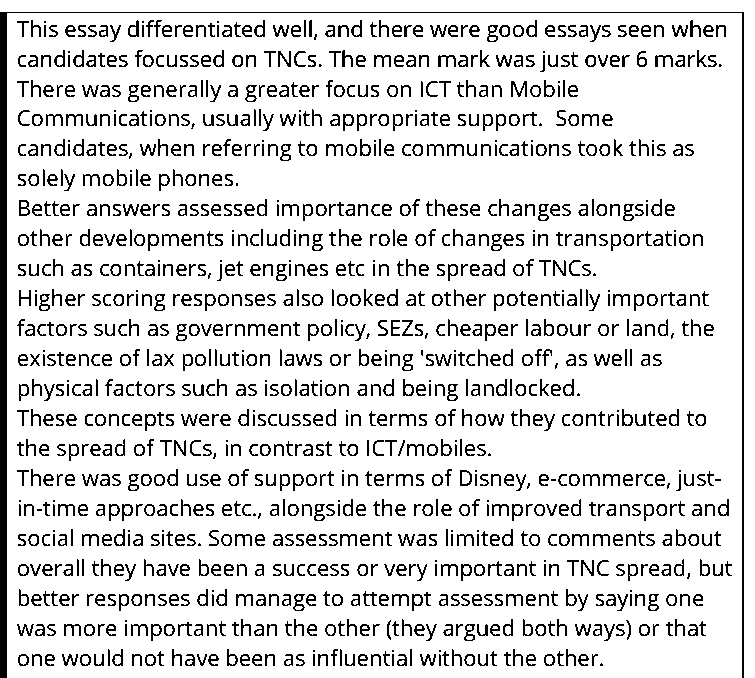
This essay differentiated well, and there were good essays seen when candidates focussed on TNCs. The mean mark was just over 6 marks. There was generally a greater focus on ICT than Mobile Communications, usually with appropriate support. Some candidates, when referring to mobile communications took this as solely mobile phones. Better answers assessed importance of these changes alongside other developments including the role of changes in transportation such as containers, jet engines etc in the spread of TNCs. Higher scoring responses also looked at other potentially important factors such as government policy, SEZs, cheaper labour or land, the existence of lax pollution laws or being 'switched off', as well as physical factors such as isolation and being landlocked. These concepts were discussed in terms of how they contributed to the spread of TNCs, in contrast to ICT/mobiles. There was good use of support in terms of Disney, e-commerce, just- in-time approaches etc., alongside the role of improved transport and social media sites. Some assessment was limited to comments about overall they have been a success or very important in TNC spread, but better responses did manage to attempt assessment by saying one was more important than the other (they argued both ways) or that one would not have been as influential without the other.
Notes from the mark scheme and report
ICT, internet and mobile communication let TNCs coordinate global production networks, offshore and outsource, reach new markets
weigh against containerisation and jet transport, government policy and SEZs, cheap labour, lax laws and switched-off places
better answers focused on TNCs and assessed other factors
June 2024 · Paper 3 · Q14 marksAO1=4Short answer
Mark scheme
Examiner's comment
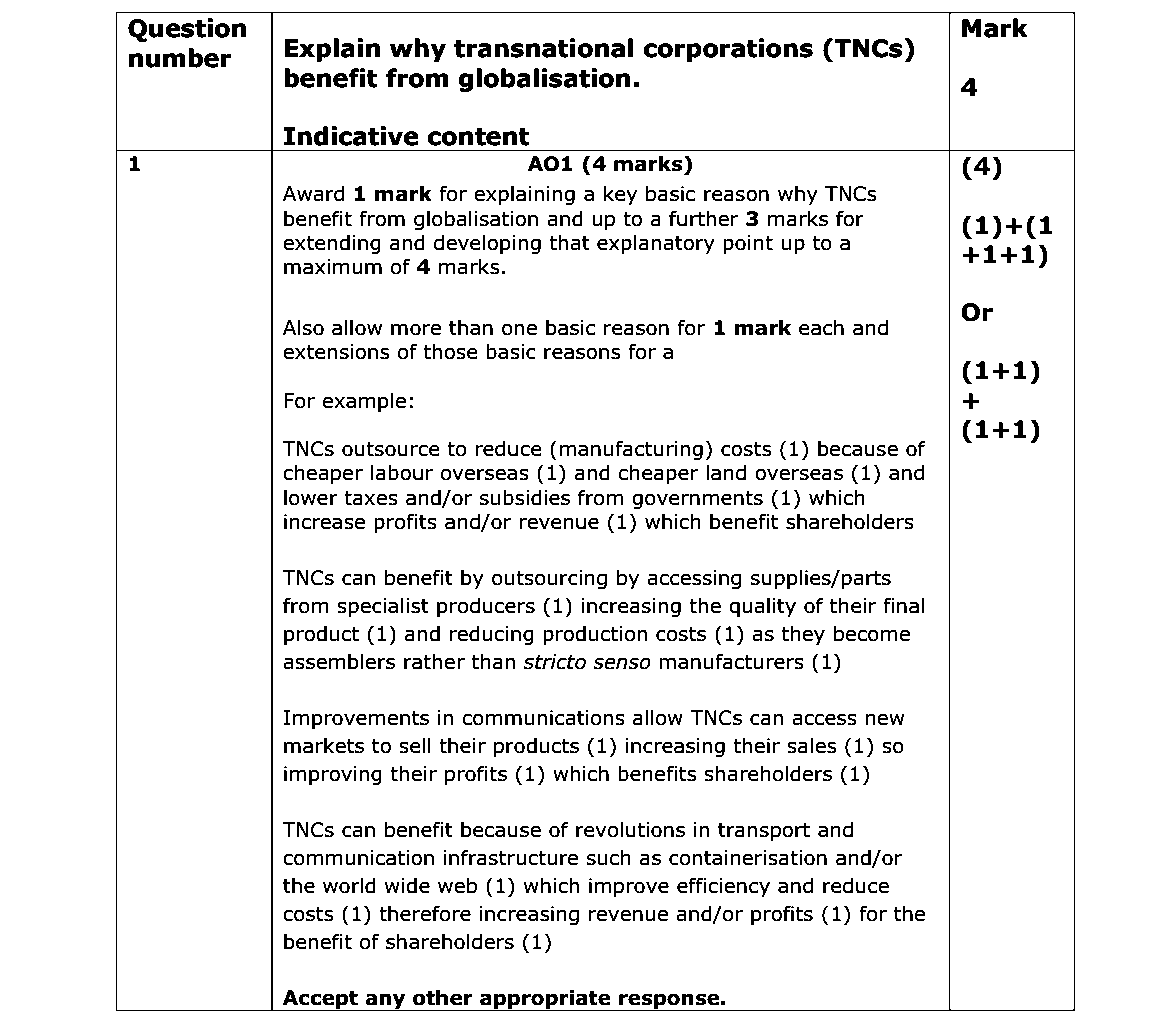
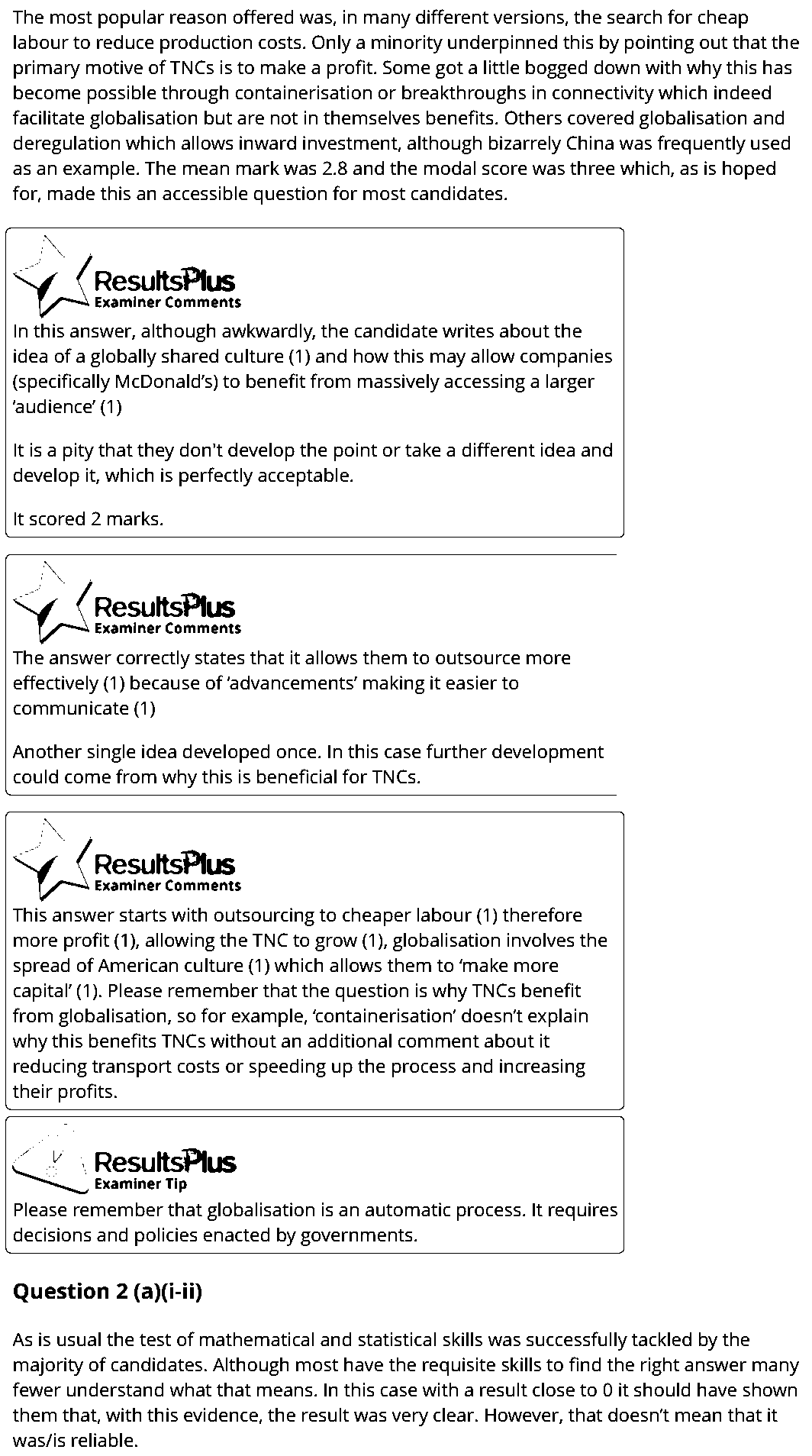
The most popular reason offered was, in many different versions, the search for cheap labour to reduce production costs. Only a minority underpinned this by pointing out that the primary motive of TNCs is to make a profit. Some got a little bogged down with why this has become possible through containerisation or breakthroughs in connectivity which indeed facilitate globalisation but are not in themselves benefits. Others covered globalisation and deregulation which allows inward investment, although bizarrely China was frequently used as an example. The mean mark was 2.8 and the modal score was three which, as is hoped for, made this an accessible question for most candidates. In this answer, although awkwardly, the candidate writes about the idea of a globally shared culture (1) and how this may allow companies (specifically McDonald’s) to benefit from massively accessing a larger ‘audience’ (1) It is a pity that they don't develop the point or take a different idea and develop it, which is perfectly acceptable. It scored 2 marks. The answer correctly states that it allows them to outsource more effectively (1) because of ‘advancements’ making it easier to communicate (1) Another single idea developed once. In this case further development could come from why this is beneficial for TNCs. This answer starts with outsourcing to cheaper labour (1) therefore more profit (1), allowing the TNC to grow (1), globalisation involves the spread of American culture (1) which allows them to ‘make more capital’ (1). Please remember that the question is why TNCs benefit from globalisation, so for example, ‘containerisation’ doesn’t explain why this benefits TNCs without an additional comment about it reducing transport costs or speeding up the process and increasing their profits. Please remember that globalisation is an automatic process. It requires decisions and policies enacted by governments. Question 2 (a)(i-ii) As is usual the test of mathematical and statistical skills was successfully tackled by the majority of candidates. Although most have the requisite skills to find the right answer many fewer understand what that means. In this case with a result close to 0 it should have shown them that, with this evidence, the result was very clear. However, that doesn’t mean that it was/is reliable.
Notes from the mark scheme and report
TNCs outsource and offshore to cheaper labour and land, lower taxes and subsidies, access specialist suppliers and new markets, all raising profits for shareholders
containerisation or the internet only count when linked to lower costs or higher profit
mean 2.8, mode 3
June 2023 · Paper 2 · Q1(a)4 marksAO1=4Short answer
Mark scheme
Examiner's comment
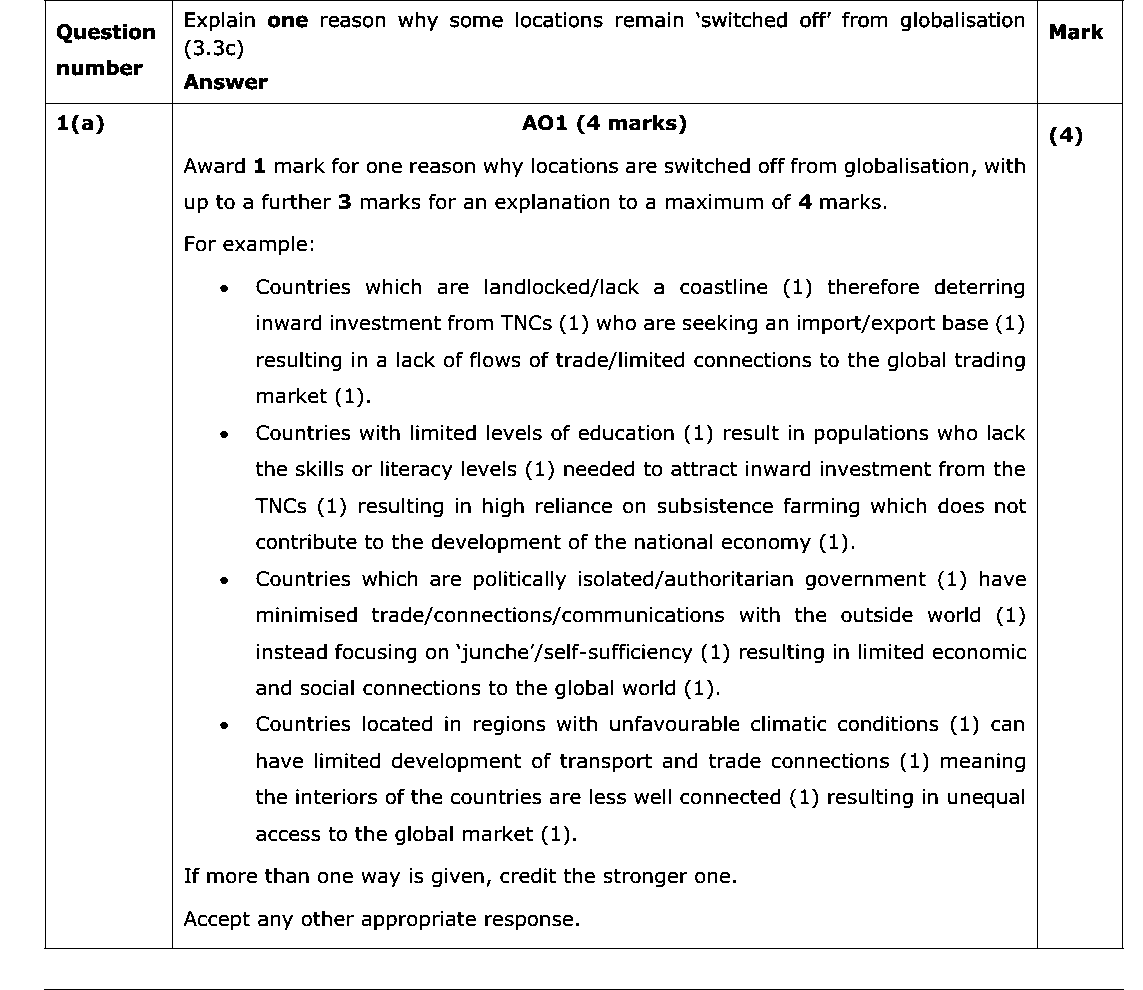
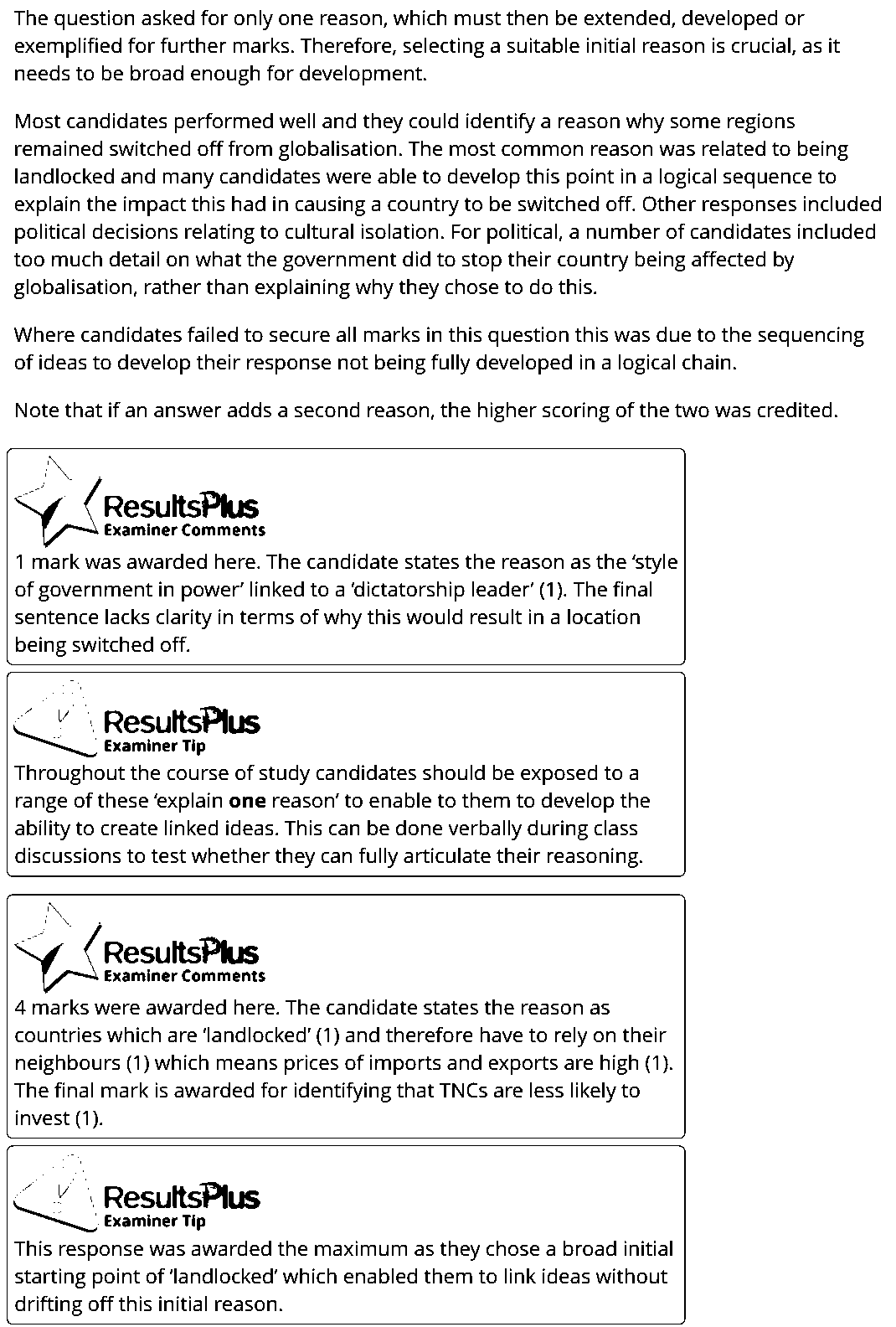
The question asked for only one reason, which must then be extended, developed or exemplified for further marks. Therefore, selecting a suitable initial reason is crucial, as it needs to be broad enough for development. Most candidates performed well and they could identify a reason why some regions remained switched off from globalisation. The most common reason was related to being landlocked and many candidates were able to develop this point in a logical sequence to explain the impact this had in causing a country to be switched off. Other responses included political decisions relating to cultural isolation. For political, a number of candidates included too much detail on what the government did to stop their country being affected by globalisation, rather than explaining why they chose to do this. Where candidates failed to secure all marks in this question this was due to the sequencing of ideas to develop their response not being fully developed in a logical chain. Note that if an answer adds a second reason, the higher scoring of the two was credited. 1 mark was awarded here. The candidate states the reason as the ‘style of government in power’ linked to a ‘dictatorship leader’ (1). The final sentence lacks clarity in terms of why this would result in a location being switched off. Throughout the course of study candidates should be exposed to a range of these ‘explain one reason’ to enable to them to develop the ability to create linked ideas. This can be done verbally during class discussions to test whether they can fully articulate their reasoning. 4 marks were awarded here. The candidate states the reason as countries which are ‘landlocked’ (1) and therefore have to rely on their neighbours (1) which means prices of imports and exports are high (1). The final mark is awarded for identifying that TNCs are less likely to invest (1). This response was awarded the maximum as they chose a broad initial starting point of ‘landlocked’ which enabled them to link ideas without drifting off this initial reason.
Notes from the mark scheme and report
One reason developed three times: landlocked/remote location deters TNC investment, political isolation (North Korea), conflict, poor infrastructure and ICT access
explain why governments isolate rather than describe what they do
June 2023 · AS Paper 2 · Q1(c)4 marksAO1=4Short answer
Resources for question 1
Mark scheme
Examiner's comment
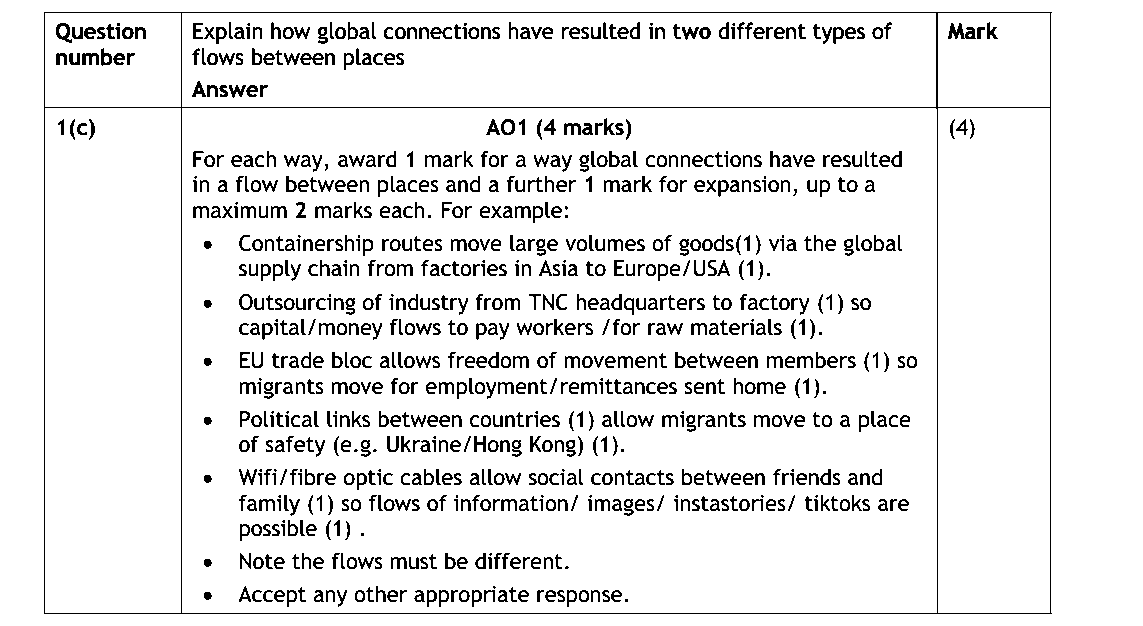
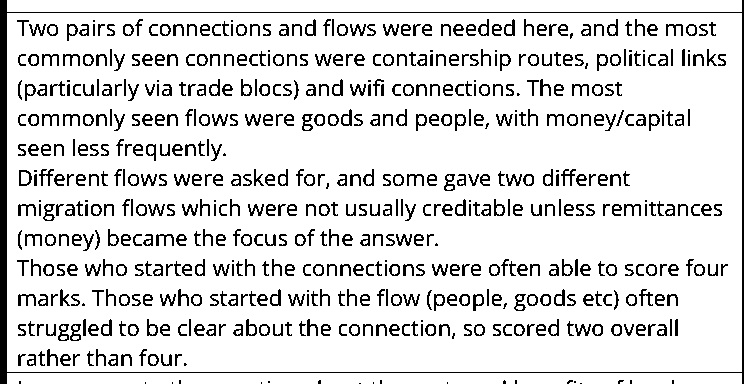
Two pairs of connections and flows were needed here, and the most commonly seen connections were containership routes, political links (particularly via trade blocs) and wifi connections. The most commonly seen flows were goods and people, with money/capital seen less frequently. Different flows were asked for, and some gave two different migration flows which were not usually creditable unless remittances (money) became the focus of the answer. Those who started with the connections were often able to score four marks. Those who started with the flow (people, goods etc) often struggled to be clear about the connection, so scored two overall rather than four.
Notes from the mark scheme and report
Pair a connection with a flow: container routes and goods, trade blocs and migrants, TNC networks and capital, wifi/fibre and information
two migration flows not different flows unless remittances
starting from the connection scored better
June 2022 · Paper 2 · Q1(a)4 marksAO1=4Short answer
Mark scheme
Examiner's comment
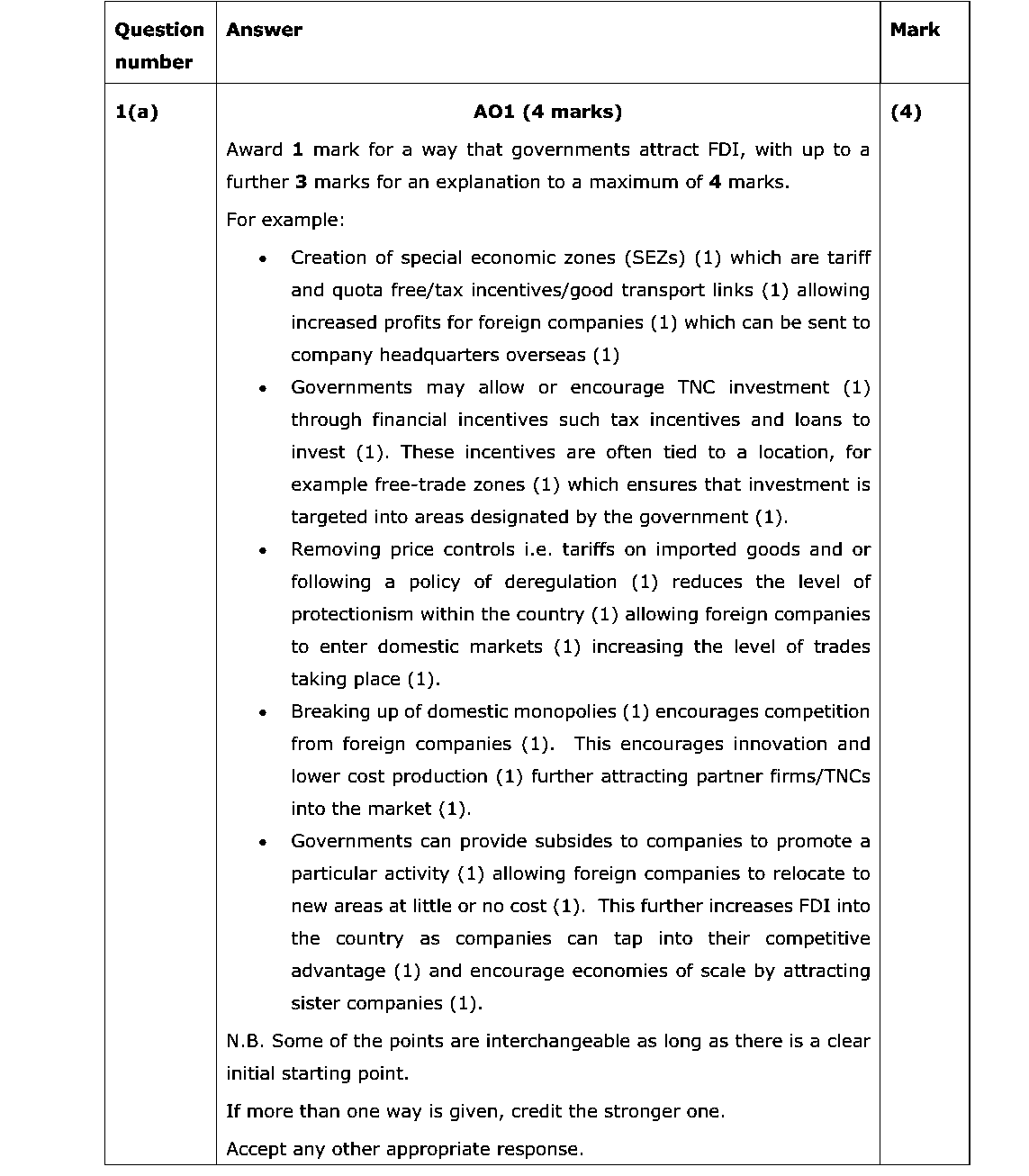
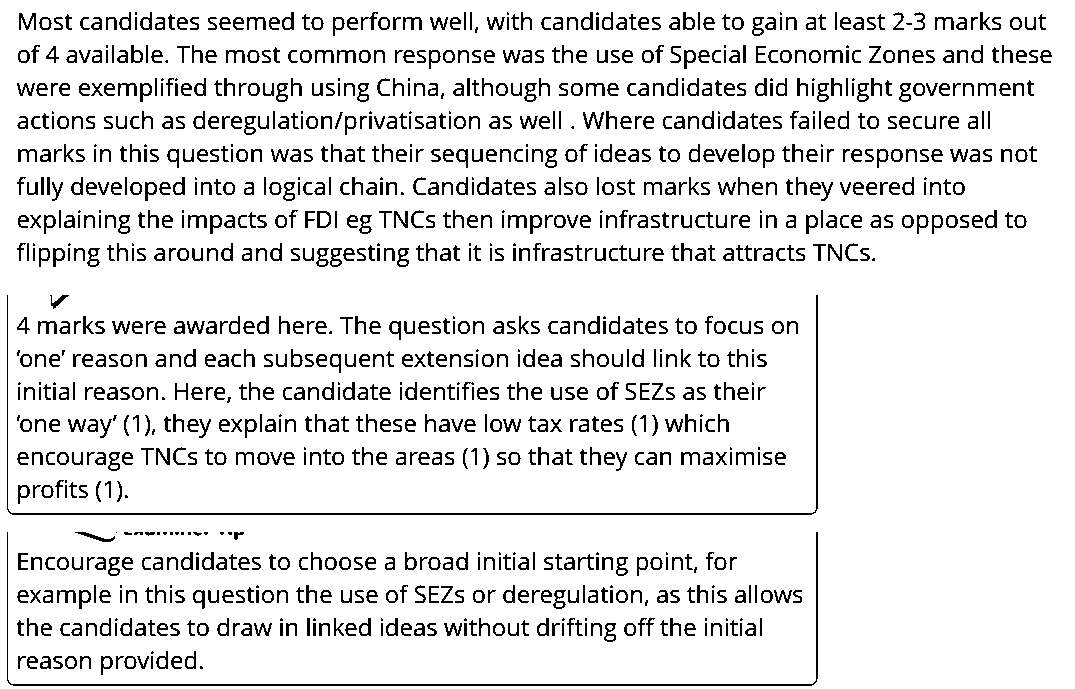
Most candidates seemed to perform well, with candidates able to gain at least 2-3 marks out of 4 available. The most common response was the use of Special Economic Zones and these were exemplified through using China, although some candidates did highlight government actions such as deregulation/privatisation as well . Where candidates failed to secure all marks in this question was that their sequencing of ideas to develop their response was not fully developed into a logical chain. Candidates also lost marks when they veered into explaining the impacts of FDI eg TNCs then improve infrastructure in a place as opposed to flipping this around and suggesting that it is infrastructure that attracts TNCs. 4 marks were awarded here. The question asks candidates to focus on ‘one’ reason and each subsequent extension idea should link to this initial reason. Here, the candidate identifies the use of SEZs as their ‘one way’ (1), they explain that these have low tax rates (1) which encourage TNCs to move into the areas (1) so that they can maximise profits (1). Encourage candidates to choose a broad initial starting point, for example in this question the use of SEZs or deregulation, as this allows the candidates to draw in linked ideas without drifting off the initial reason provided.
Notes from the mark scheme and report
One way developed into a chain: special economic zones with low tax, tariff-free trade and good transport (e.g. China's Open Door Policy), deregulation or privatisation
writing about the impacts of FDI rather than how it is attracted lost marks
June 2022 · Paper 2 · Q1(b)12 marksAO1=3, AO2=912-mark essay
Mark scheme, including the levels and indicative content
Examiner's comment
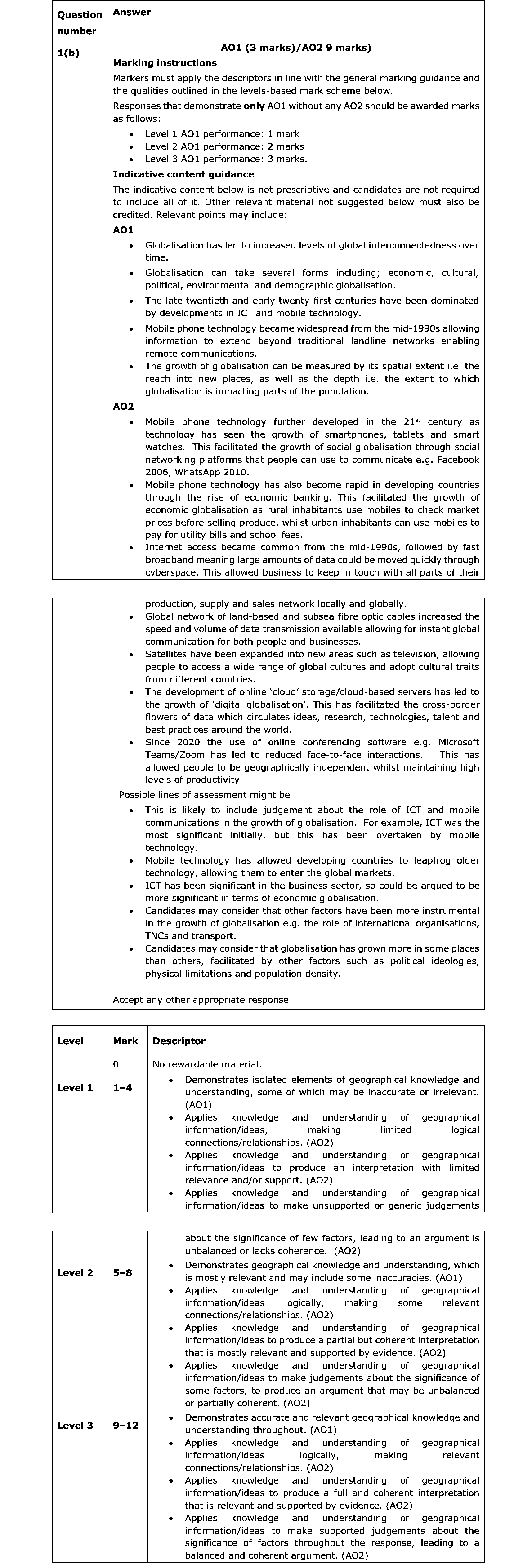
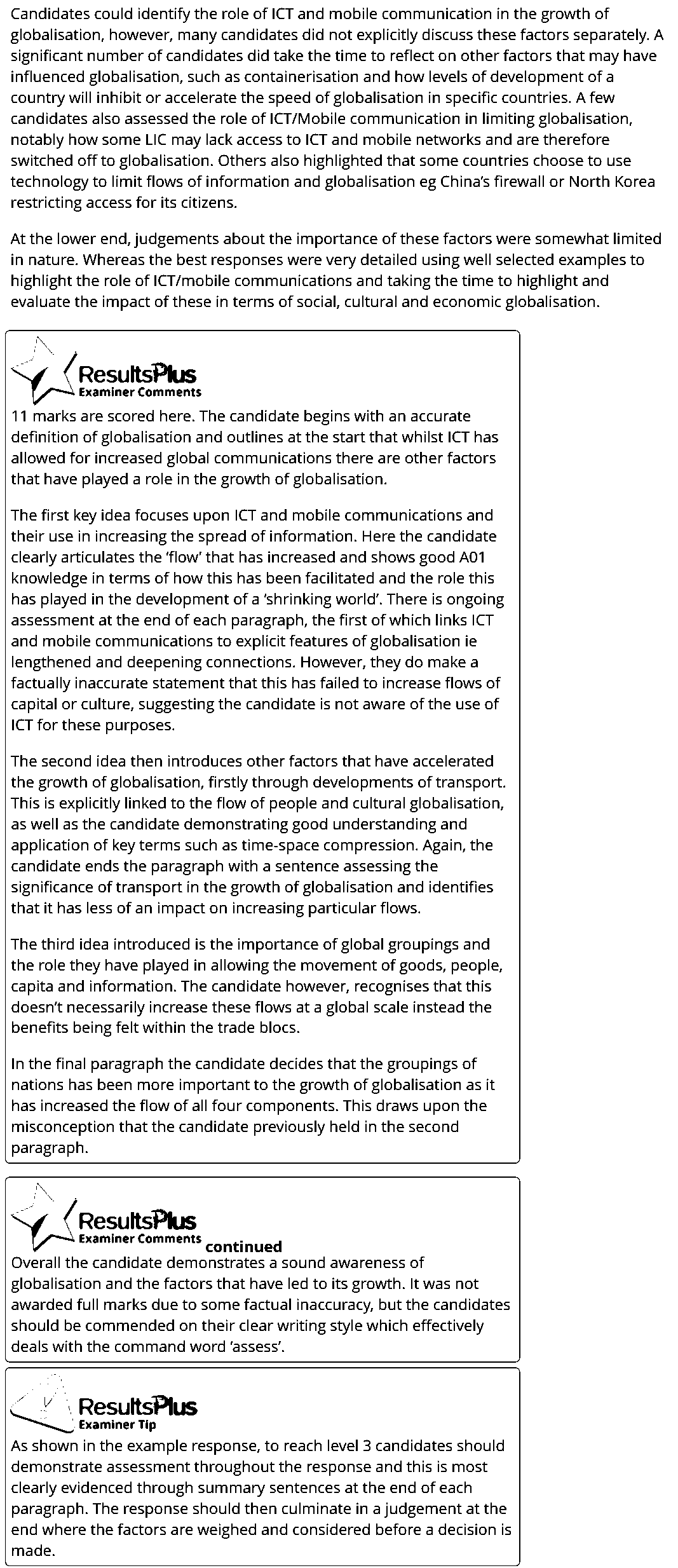
Candidates could identify the role of ICT and mobile communication in the growth of globalisation, however, many candidates did not explicitly discuss these factors separately. A significant number of candidates did take the time to reflect on other factors that may have influenced globalisation, such as containerisation and how levels of development of a country will inhibit or accelerate the speed of globalisation in specific countries. A few candidates also assessed the role of ICT/Mobile communication in limiting globalisation, notably how some LIC may lack access to ICT and mobile networks and are therefore switched off to globalisation. Others also highlighted that some countries choose to use technology to limit flows of information and globalisation eg China’s firewall or North Korea restricting access for its citizens. At the lower end, judgements about the importance of these factors were somewhat limited in nature. Whereas the best responses were very detailed using well selected examples to highlight the role of ICT/mobile communications and taking the time to highlight and evaluate the impact of these in terms of social, cultural and economic globalisation. 11 marks are scored here. The candidate begins with an accurate definition of globalisation and outlines at the start that whilst ICT has allowed for increased global communications there are other factors that have played a role in the growth of globalisation. The first key idea focuses upon ICT and mobile communications and their use in increasing the spread of information. Here the candidate clearly articulates the ‘flow’ that has increased and shows good A01 knowledge in terms of how this has been facilitated and the role this has played in the development of a ‘shrinking world’. There is ongoing assessment at the end of each paragraph, the first of which links ICT and mobile communications to explicit features of globalisation ie lengthened and deepening connections. However, they do make a factually inaccurate statement that this has failed to increase flows of capital or culture, suggesting the candidate is not aware of the use of ICT for these purposes. The second idea then introduces other factors that have accelerated the growth of globalisation, firstly through developments of transport. This is explicitly linked to the flow of people and cultural globalisation, as well as the candidate demonstrating good understanding and application of key terms such as time-space compression. Again, the candidate ends the paragraph with a sentence assessing the significance of transport in the growth of globalisation and identifies that it has less of an impact on increasing particular flows. The third idea introduced is the importance of global groupings and the role they have played in allowing the movement of goods, people, capita and information. The candidate however, recognises that this doesn’t necessarily increase these flows at a global scale instead the benefits being felt within the trade blocs. In the final paragraph the candidate decides that the groupings of nations has been more important to the growth of globalisation as it has increased the flow of all four components. This draws upon the misconception that the candidate previously held in the second paragraph. continued Overall the candidate demonstrates a sound awareness of globalisation and the factors that have led to its growth. It was not awarded full marks due to some factual inaccuracy, but the candidates should be commended on their clear writing style which effectively deals with the command word ‘assess’. As shown in the example response, to reach level 3 candidates should demonstrate assessment throughout the response and this is most clearly evidenced through summary sentences at the end of each paragraph. The response should then culminate in a judgement at the end where the factors are weighed and considered before a decision is made.
Notes from the mark scheme and report
ICT, internet, mobile phones and fibre optics drive time-space compression and economic, social and cultural flows
weigh against containerisation, transport, IGOs and government policy
switched-off places (LICs, China's firewall, North Korea) limit its role
treat ICT and mobile communications separately
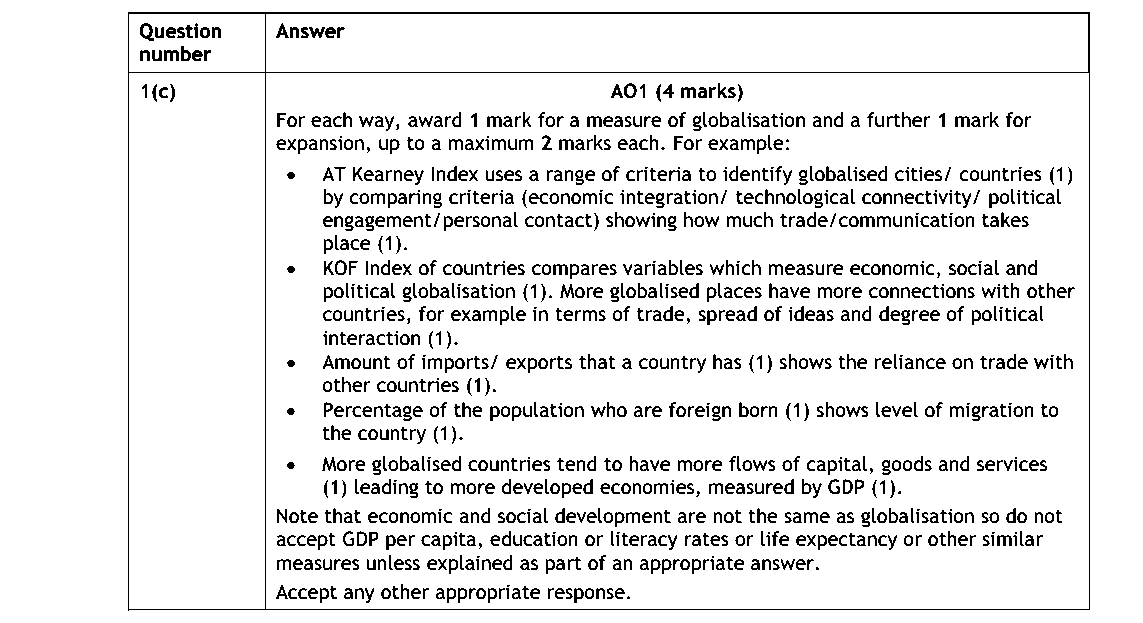
June 2022 · AS Paper 2 · Q1(c)4 marksAO1=4Short answer
Resources for question 1
Mark scheme
Examiner's comment
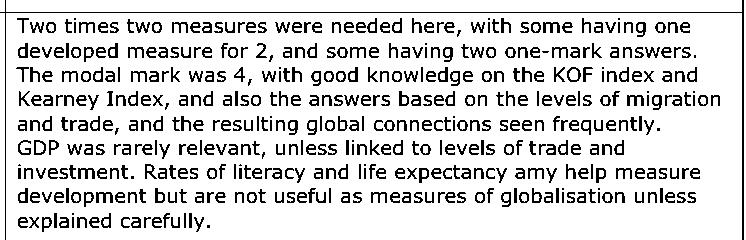
Two times two measures were needed here, with some having one developed measure for 2, and some having two one-mark answers. The modal mark was 4, with good knowledge on the KOF index and Kearney Index, and also the answers based on the levels of migration and trade, and the resulting global connections seen frequently. GDP was rarely relevant, unless linked to levels of trade and investment. Rates of literacy and life expectancy amy help measure development but are not useful as measures of globalisation unless explained carefully.
Notes from the mark scheme and report
KOF index and AT Kearney index (economic, social/technological, political criteria), trade as % of GDP, migrant share, flows of capital
GDP, literacy or life expectancy measure development not globalisation unless linked
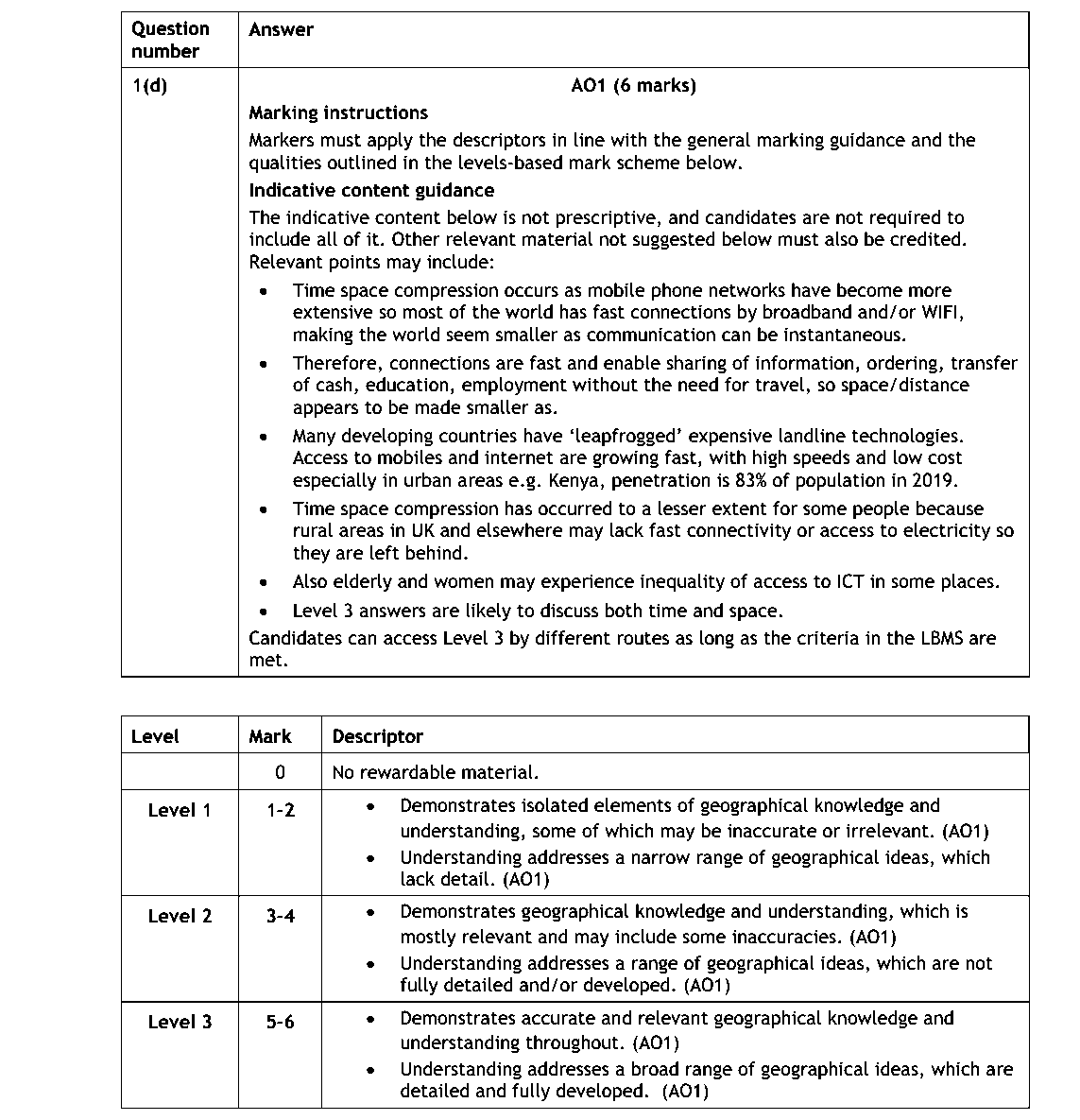
June 2022 · AS Paper 2 · Q1(d)6 marksAO1=6Extended response
Resources for question 1
Mark scheme, including the levels and indicative content
Examiner's comment
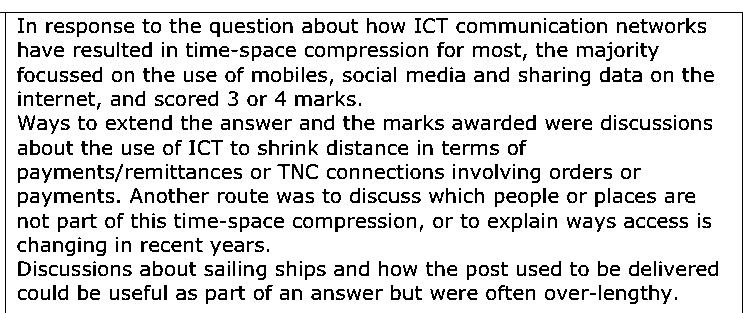
In response to the question about how ICT communication networks have resulted in time-space compression for most, the majority focussed on the use of mobiles, social media and sharing data on the internet, and scored 3 or 4 marks. Ways to extend the answer and the marks awarded were discussions about the use of ICT to shrink distance in terms of payments/remittances or TNC connections involving orders or payments. Another route was to discuss which people or places are not part of this time-space compression, or to explain ways access is changing in recent years. Discussions about sailing ships and how the post used to be delivered could be useful as part of an answer but were often over-lengthy.
Notes from the mark scheme and report
Mobile networks, internet, fibre optics make communication instant and cheap
leapfrogging in developing countries (e.g. Kenya mobile payments)
best answers note those left out (rural, elderly)
long histories of sailing ships wasted time
June 2022 · Paper 3 · Q38 marksAO1=4, AO3=4Extended response
Resources for question 3
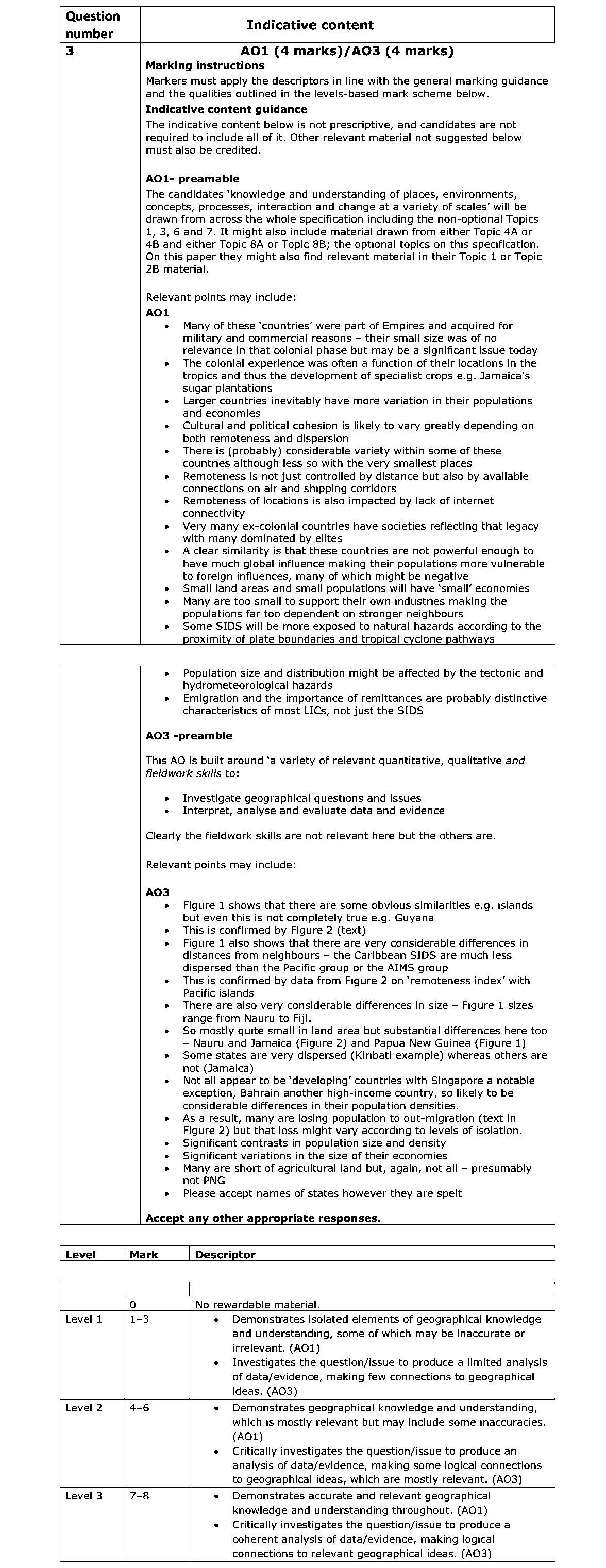
Mark scheme, including the levels and indicative content
Examiner's comment
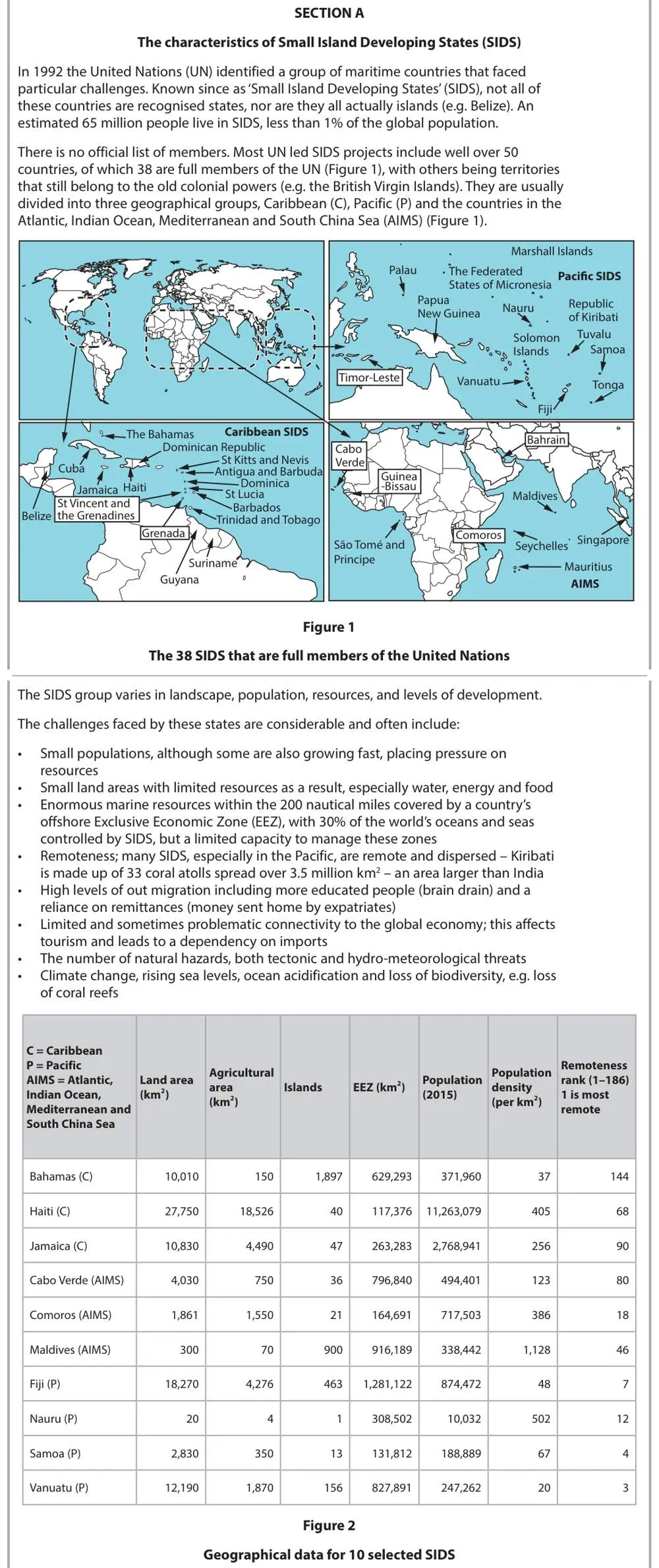
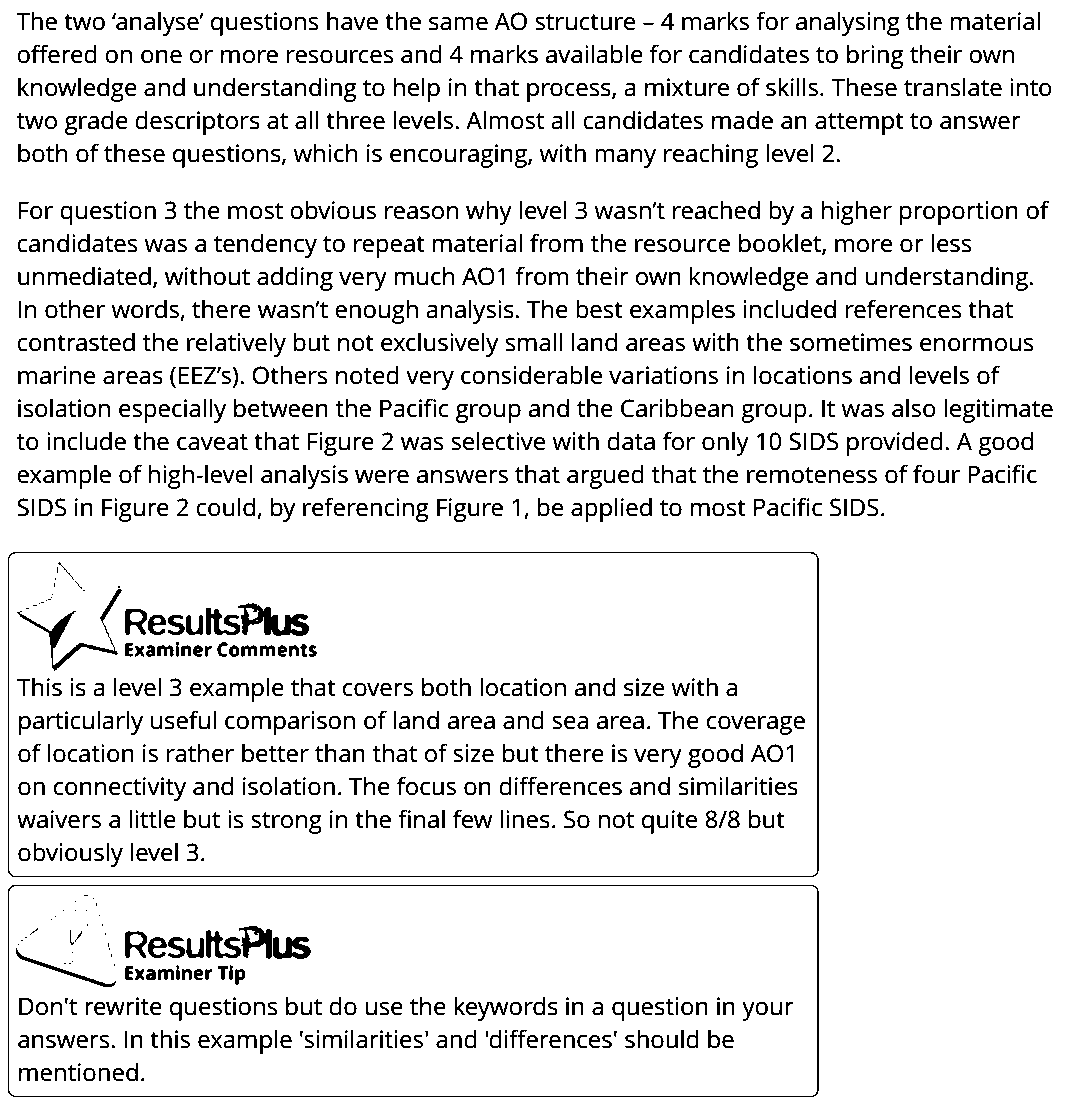
The two ‘analyse’ questions have the same AO structure – 4 marks for analysing the material offered on one or more resources and 4 marks available for candidates to bring their own knowledge and understanding to help in that process, a mixture of skills. These translate into two grade descriptors at all three levels. Almost all candidates made an attempt to answer both of these questions, which is encouraging, with many reaching level 2. For question 3 the most obvious reason why level 3 wasn’t reached by a higher proportion of candidates was a tendency to repeat material from the resource booklet, more or less unmediated, without adding very much AO1 from their own knowledge and understanding. In other words, there wasn’t enough analysis. The best examples included references that contrasted the relatively but not exclusively small land areas with the sometimes enormous marine areas (EEZ’s). Others noted very considerable variations in locations and levels of isolation especially between the Pacific group and the Caribbean group. It was also legitimate to include the caveat that Figure 2 was selective with data for only 10 SIDS provided. A good example of high-level analysis were answers that argued that the remoteness of four Pacific SIDS in Figure 2 could, by referencing Figure 1, be applied to most Pacific SIDS. This is a level 3 example that covers both location and size with a particularly useful comparison of land area and sea area. The coverage of location is rather better than that of size but there is very good AO1 on connectivity and isolation. The focus on differences and similarities waivers a little but is strong in the final few lines. So not quite 8/8 but obviously level 3. Don't rewrite questions but do use the keywords in a question in your answers. In this example 'similarities' and 'differences' should be mentioned.
Notes from the mark scheme and report
Figures 1-2: three regional groups (Caribbean, Pacific, AIMS), small land areas but huge EEZs, Pacific SIDS most remote and dispersed, colonial origins
note Figure 2 covers only 10 SIDS
repeating the resource without own knowledge kept many below Level 3
June 2022 · Paper 3 · Q518 marksAO1=3, AO2=9, AO3=618-mark essay
Resources for question 5
Mark scheme, including the levels and indicative content
Examiner's comment
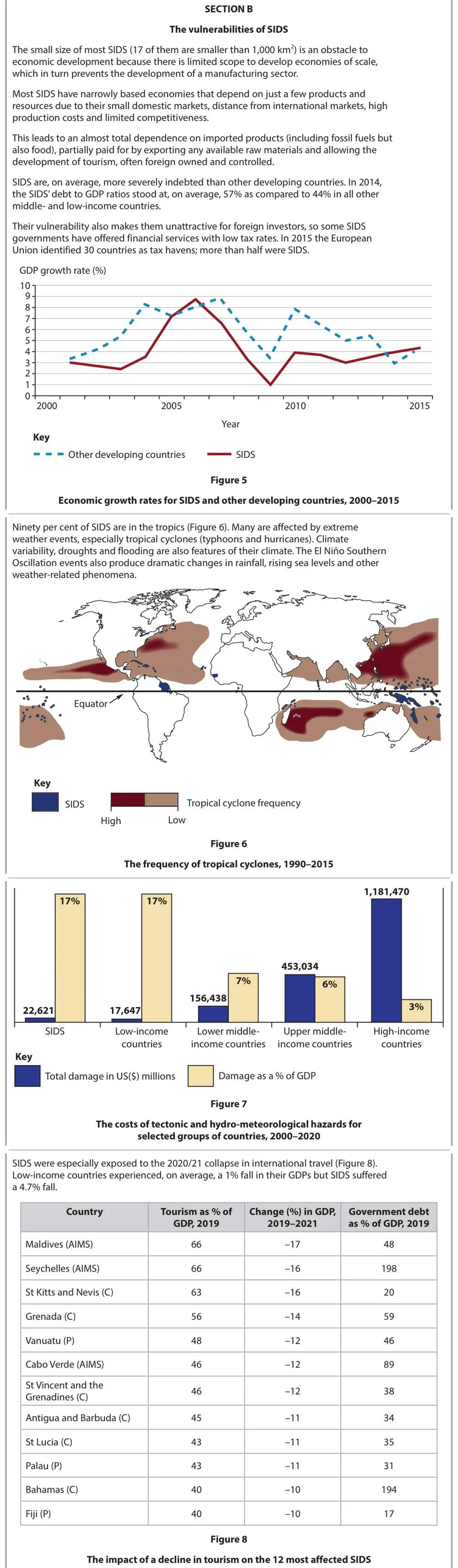
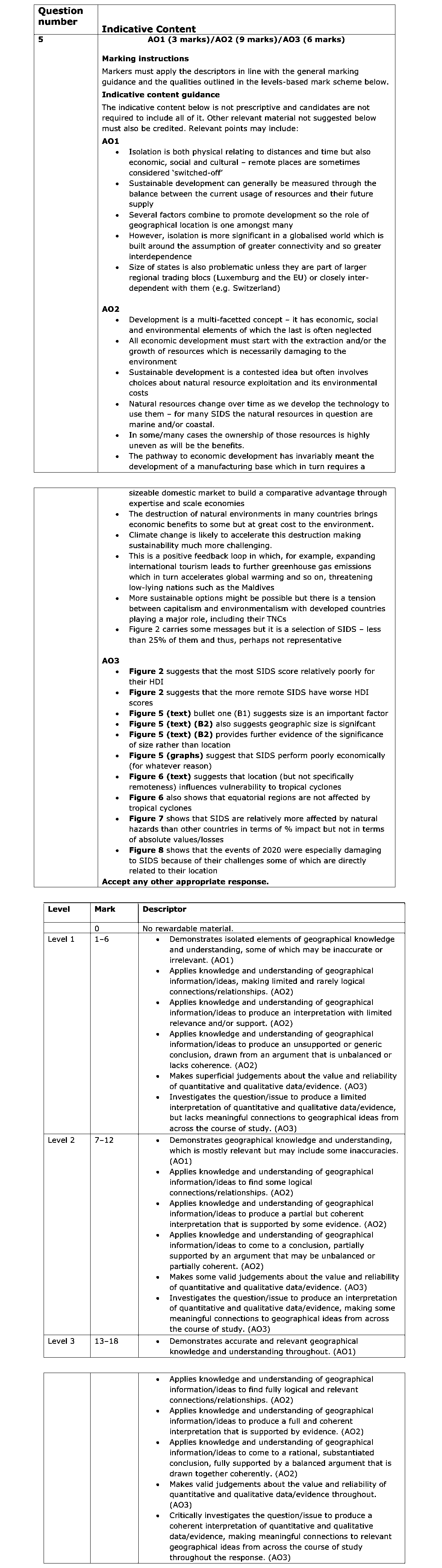
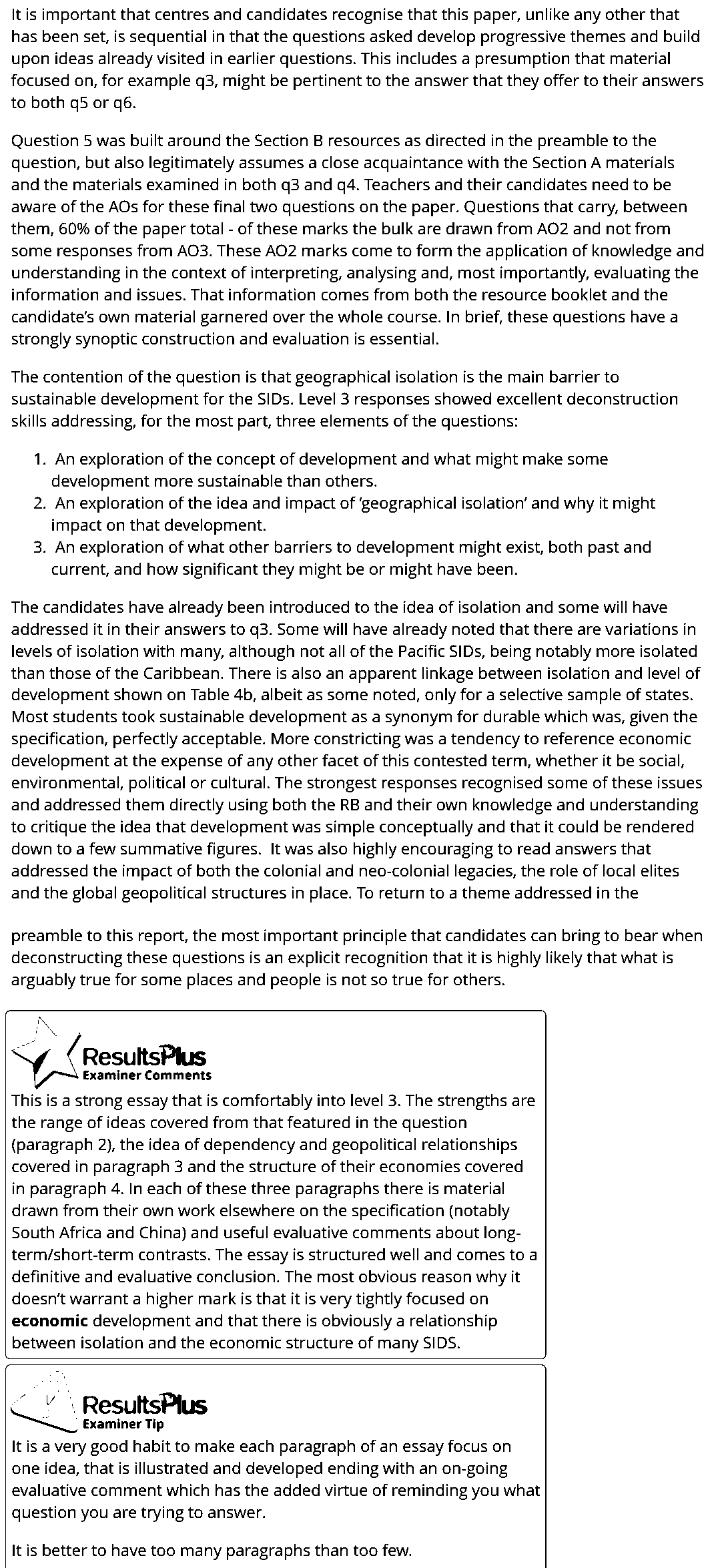
It is important that centres and candidates recognise that this paper, unlike any other that has been set, is sequential in that the questions asked develop progressive themes and build upon ideas already visited in earlier questions. This includes a presumption that material focused on, for example q3, might be pertinent to the answer that they offer to their answers to both q5 or q6. Question 5 was built around the Section B resources as directed in the preamble to the question, but also legitimately assumes a close acquaintance with the Section A materials and the materials examined in both q3 and q4. Teachers and their candidates need to be aware of the AOs for these final two questions on the paper. Questions that carry, between them, 60% of the paper total - of these marks the bulk are drawn from AO2 and not from some responses from AO3. These AO2 marks come to form the application of knowledge and understanding in the context of interpreting, analysing and, most importantly, evaluating the information and issues. That information comes from both the resource booklet and the candidate’s own material garnered over the whole course. In brief, these questions have a strongly synoptic construction and evaluation is essential. The contention of the question is that geographical isolation is the main barrier to sustainable development for the SIDs. Level 3 responses showed excellent deconstruction skills addressing, for the most part, three elements of the questions: 1. An exploration of the concept of development and what might make some development more sustainable than others. 2. An exploration of the idea and impact of ‘geographical isolation’ and why it might impact on that development. 3. An exploration of what other barriers to development might exist, both past and current, and how significant they might be or might have been. The candidates have already been introduced to the idea of isolation and some will have addressed it in their answers to q3. Some will have already noted that there are variations in levels of isolation with many, although not all of the Pacific SIDs, being notably more isolated than those of the Caribbean. There is also an apparent linkage between isolation and level of development shown on Table 4b, albeit as some noted, only for a selective sample of states. Most students took sustainable development as a synonym for durable which was, given the specification, perfectly acceptable. More constricting was a tendency to reference economic development at the expense of any other facet of this contested term, whether it be social, environmental, political or cultural. The strongest responses recognised some of these issues and addressed them directly using both the RB and their own knowledge and understanding to critique the idea that development was simple conceptually and that it could be rendered down to a few summative figures. It was also highly encouraging to read answers that addressed the impact of both the colonial and neo-colonial legacies, the role of local elites and the global geopolitical structures in place. To return to a theme addressed in the preamble to this report, the most important principle that candidates can bring to bear when deconstructing these questions is an explicit recognition that it is highly likely that what is arguably true for some places and people is not so true for others. This is a strong essay that is comfortably into level 3. The strengths are the range of ideas covered from that featured in the question (paragraph 2), the idea of dependency and geopolitical relationships covered in paragraph 3 and the structure of their economies covered in paragraph 4. In each of these three paragraphs there is material drawn from their own work elsewhere on the specification (notably South Africa and China) and useful evaluative comments about long- term/short-term contrasts. The essay is structured well and comes to a definitive and evaluative conclusion. The most obvious reason why it doesn’t warrant a higher mark is that it is very tightly focused on economic development and that there is obviously a relationship between isolation and the economic structure of many SIDS. It is a very good habit to make each paragraph of an essay focus on one idea, that is illustrated and developed ending with an on-going evaluative comment which has the added virtue of reminding you what question you are trying to answer. It is better to have too many paragraphs than too few.
Notes from the mark scheme and report
Section B: isolation, small markets, import dependence and debt (57% of GDP) v tropical cyclone exposure, hazard costs (damage as % of GDP), tourism collapse 2020-21 and colonial history
define sustainable development
judge whether isolation is the main barrier
November 2021 · Paper 2 · Q1(a)4 marksAO1=4Short answer
Mark scheme
Examiner's comment
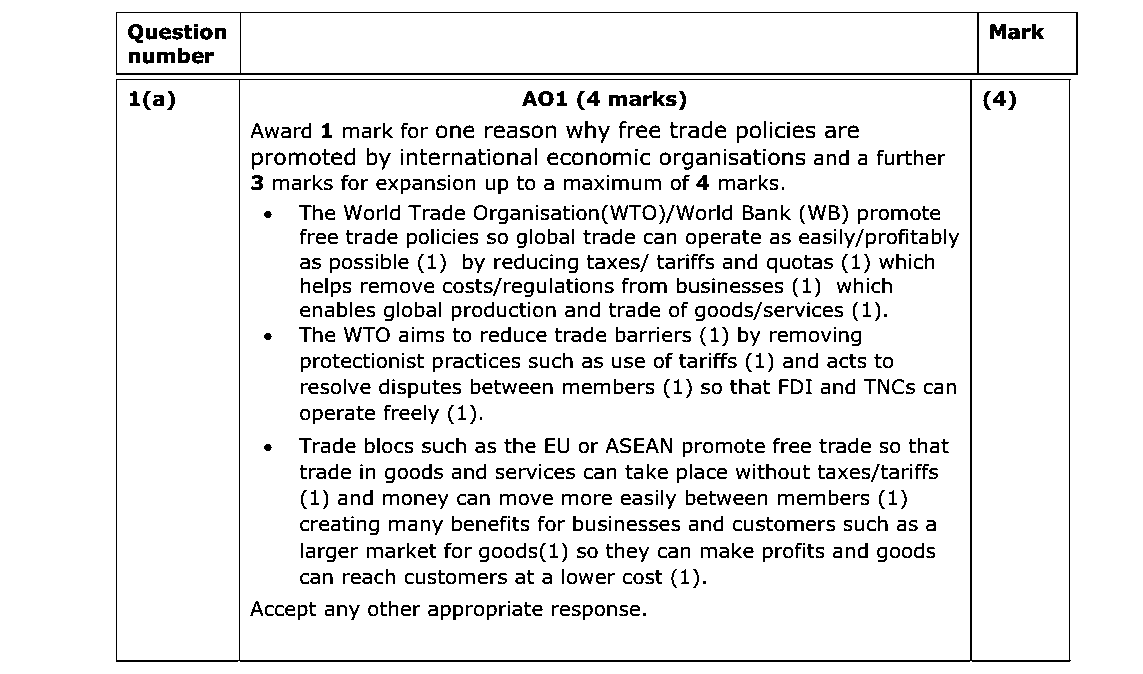
Candidates were to explain one reason why free trade policies are promoted by international economic organisations. Those candidates which explicitly referenced an International economic organisation found it easier to articulate why they promoted free trade policies, whilst those who discussed the adoption of free trade policies in a more generic manner struggled to move past two marks.
Notes from the mark scheme and report
One reason + 3 marks of expansion: WTO and World Bank cut tariffs and quotas so trade is cheaper and more profitable, enabling global production networks, FDI and TNC growth
naming a specific organisation helped, generic answers stuck at two marks
October 2020 · AS Paper 2 · Q1(a)1 markAO1=1Multiple choice
Resources for question 1
Answer
D
Mark scheme
Notes from the mark scheme and report
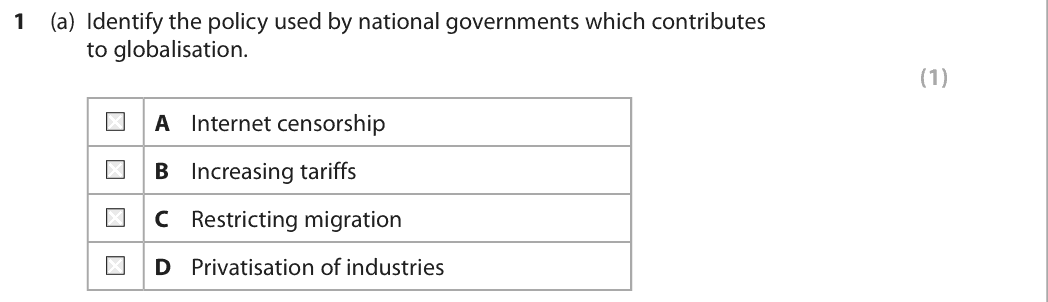
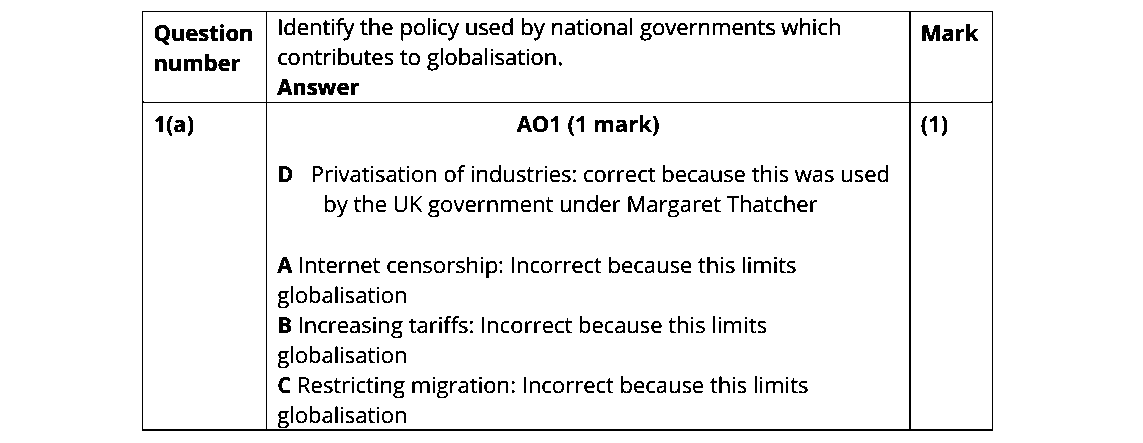
Answer D (privatisation of industries), a liberalisation policy that opens markets to investment
A, B and C all restrict globalisation
October 2020 · AS Paper 2 · Q1(b)(i)1 markAO3=1Calculation
Resources for question 1
Mark scheme
Notes from the mark scheme and report
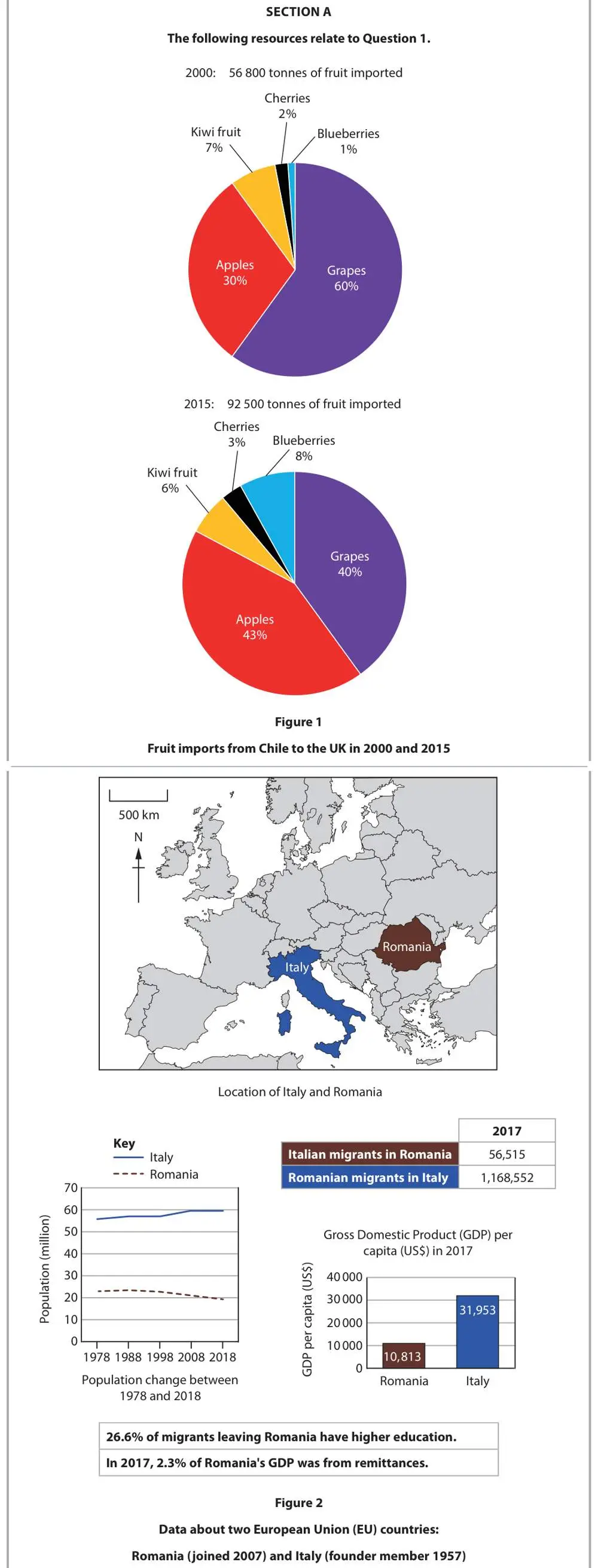
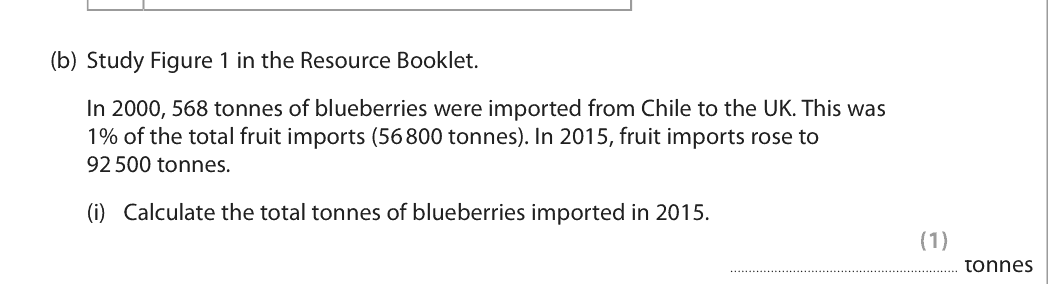
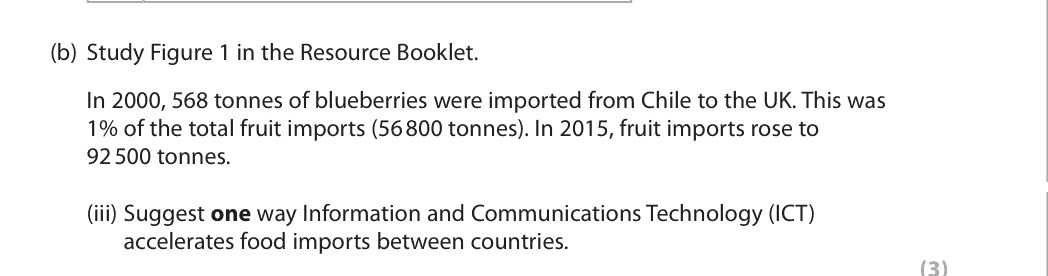
Answer: 7400 tonnes (8% of 92 500 from the 2015 pie chart in Figure 1)
no other answer accepted
October 2020 · AS Paper 2 · Q1(b)(ii)1 markAO3=1Calculation
Resources for question 1
Mark scheme
Notes from the mark scheme and report
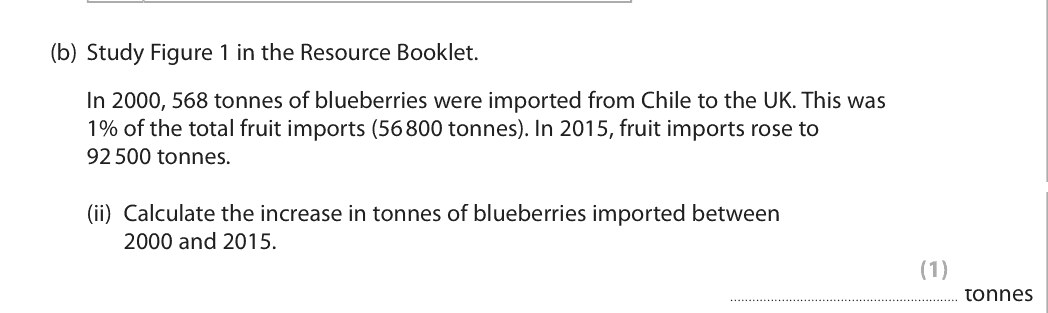
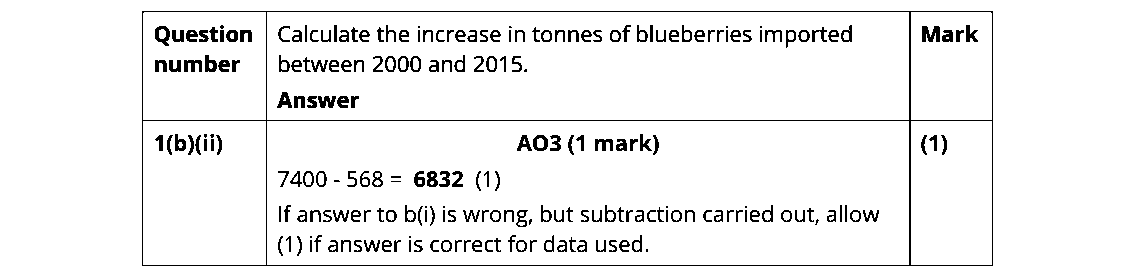
Answer: 6832 tonnes (7400 - 568)
own-figure rule applies if (b)(i) was wrong but the subtraction is correct
October 2020 · AS Paper 2 · Q1(b)(iii)3 marksAO1=2, AO2=1Short answer
Resources for question 1
Mark scheme
Notes from the mark scheme and report
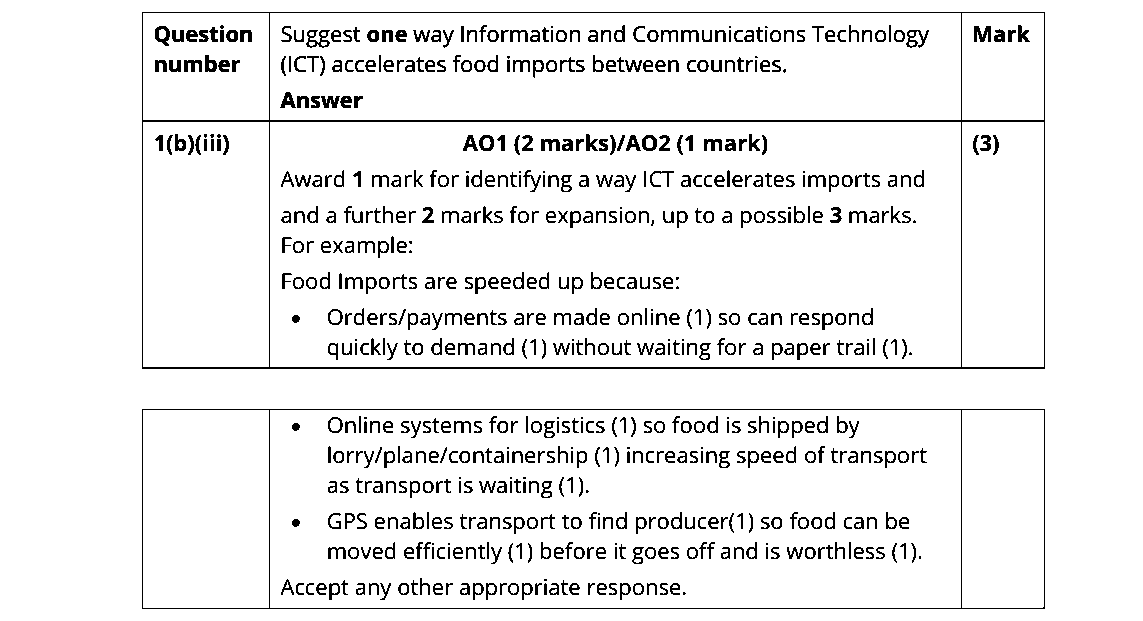
One way plus 2 marks of expansion: online ordering and payment respond quickly to demand
online logistics systems speed shipping
GPS tracking moves perishable food before it spoils
October 2020 · AS Paper 2 · Q1(d)6 marksAO1=6Extended response
Resources for question 1
Mark scheme, including the levels and indicative content
Notes from the mark scheme and report
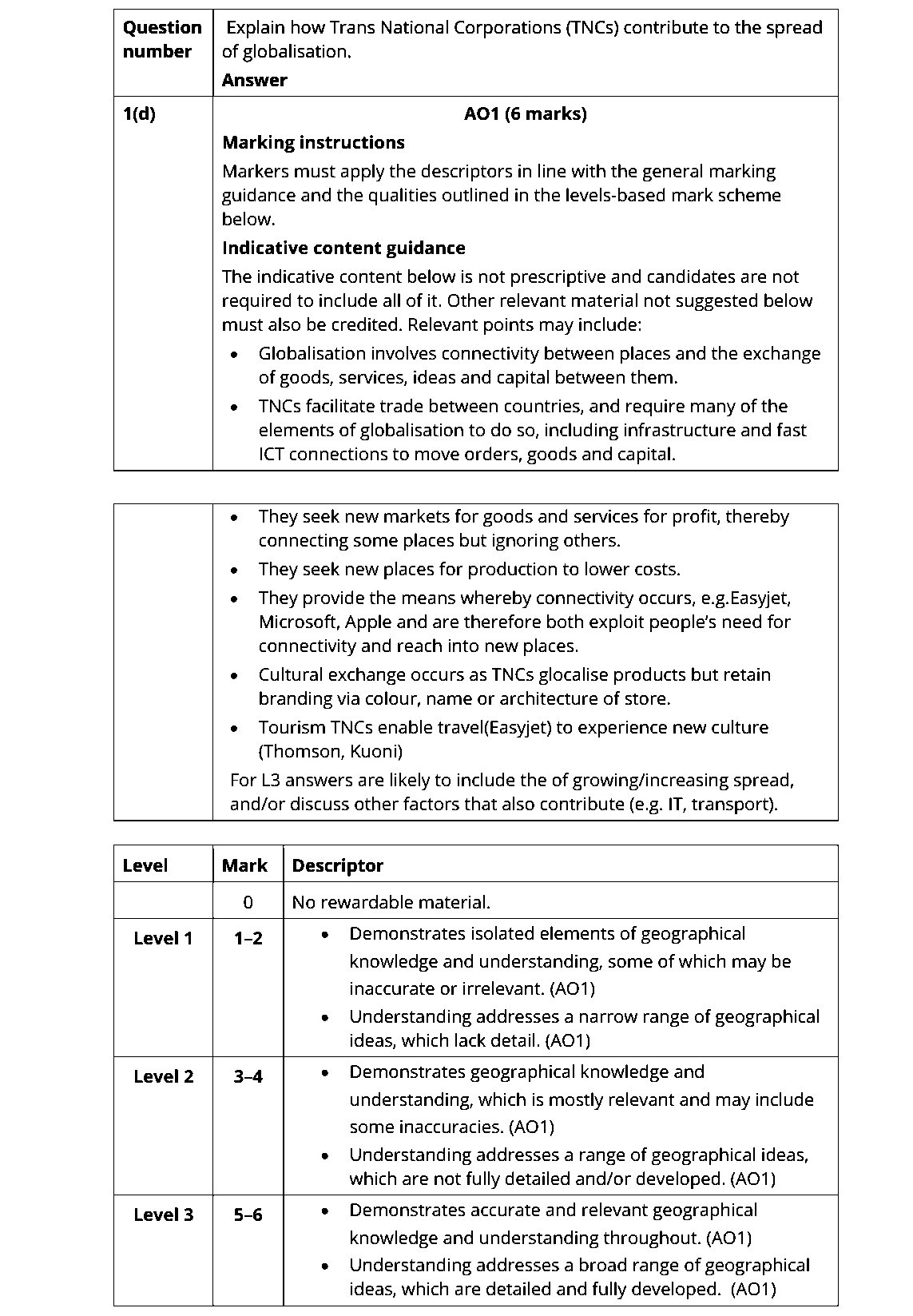
TNCs need and drive connectivity (ICT, infrastructure)
seek new markets and cheaper production sites (global production networks, offshoring)
glocalisation spreads culture while keeping branding
June 2019 · AS Paper 2 · Q1(a)(i)1 markAO1=1Multiple choice
Resources for question 1
Answer
B
Mark scheme
Examiner's comment
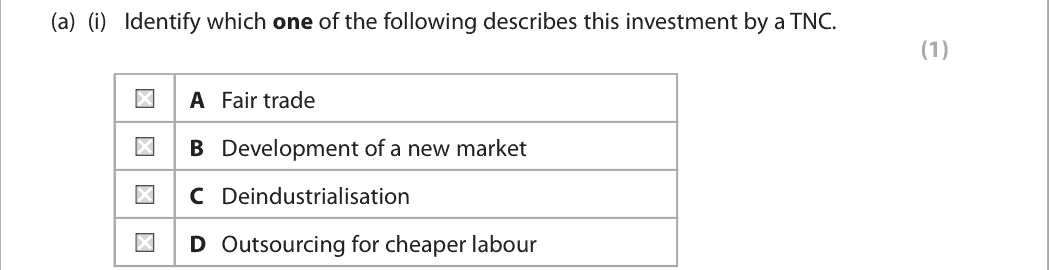
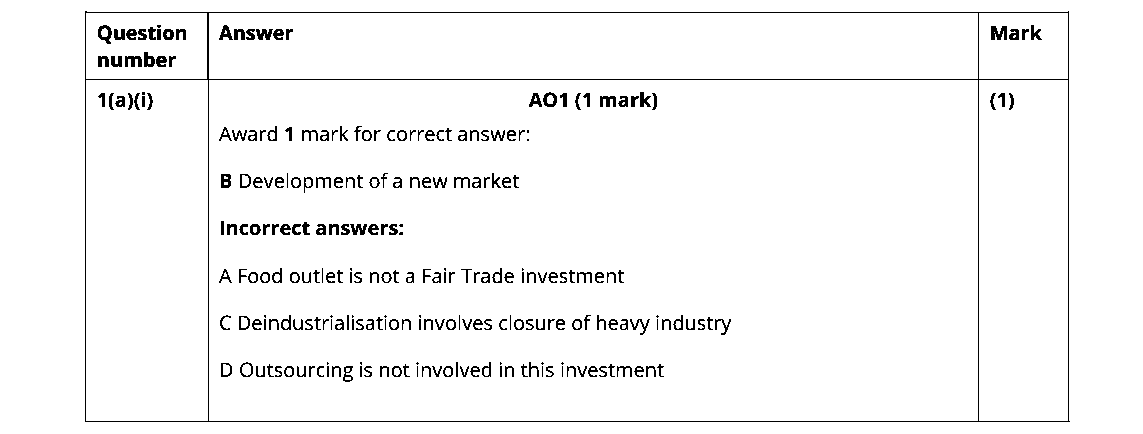
Most were able to identify B Development of new market as the correct answer, though a few selected each of the other options. This Question tested knowledge of the basic globalisation terminology candidates are likely to be using in their studies.
Notes from the mark scheme and report
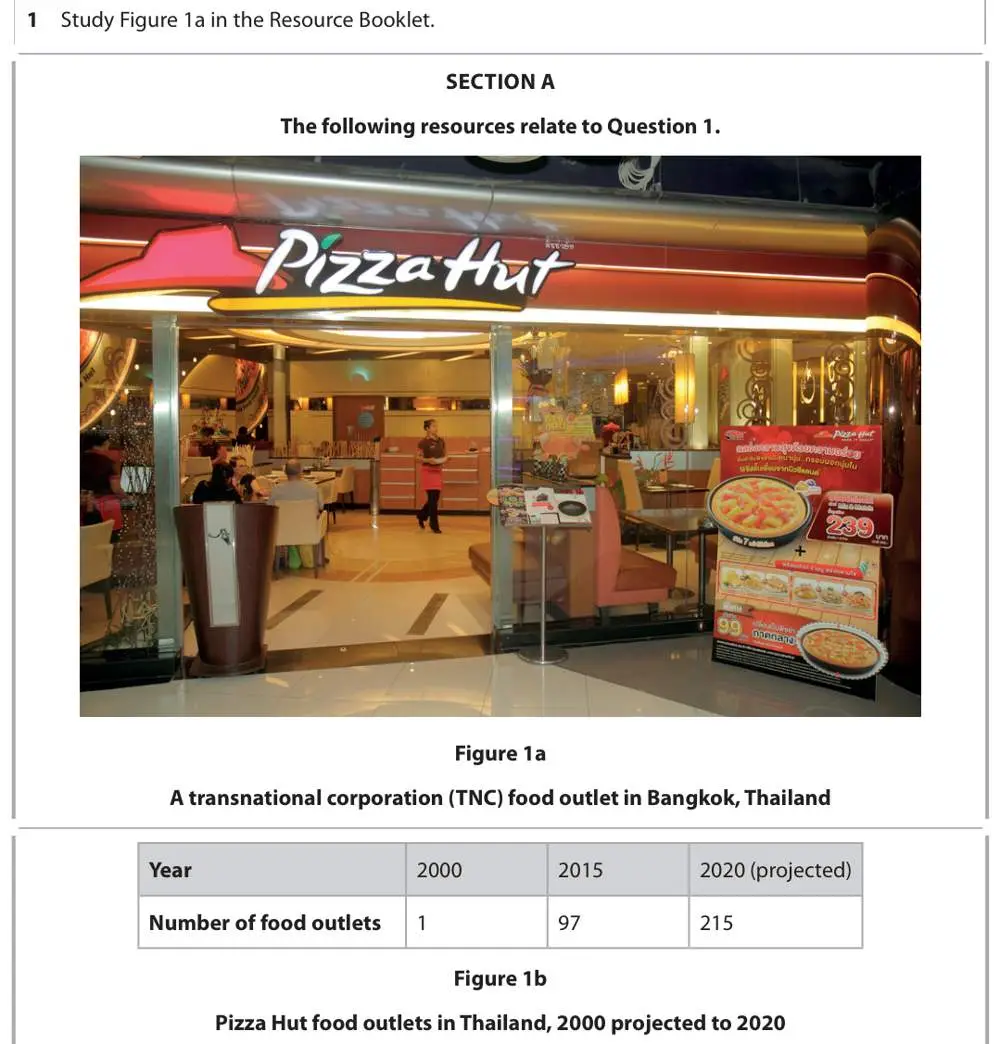
Answer B (development of a new market): a TNC outlet in Bangkok extends its market
A not fair trade, C is closure of heavy industry, D outsourcing not involved
most answered correctly
June 2019 · AS Paper 2 · Q1(b)2 marksAO3=2Calculation
Resources for question 1
Mark scheme
Examiner's comment
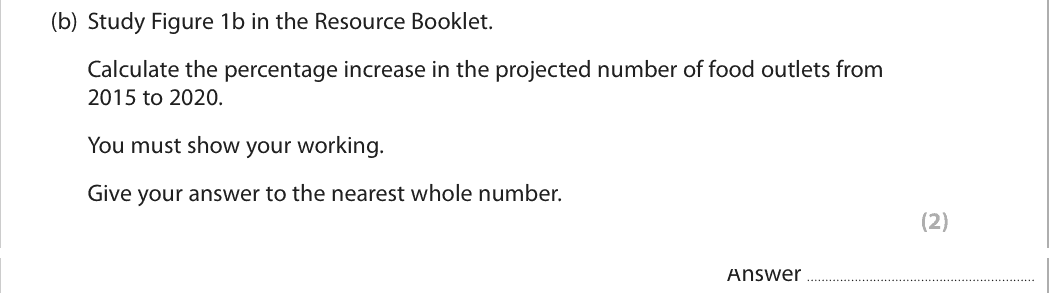
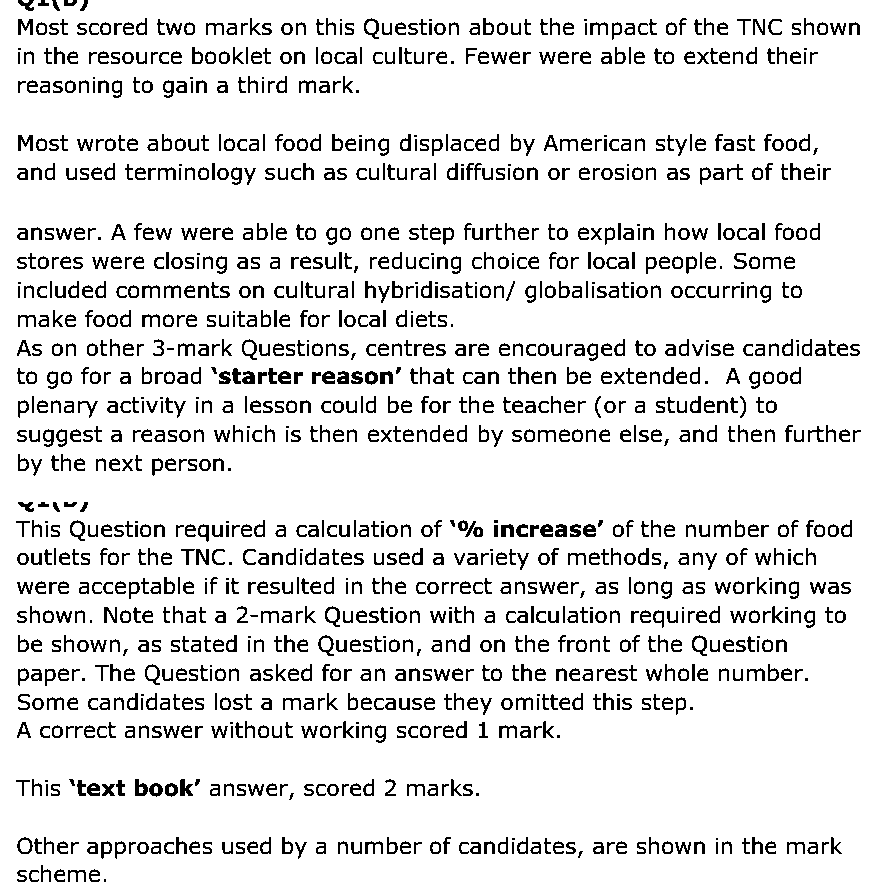
Most scored two marks on this Question about the impact of the TNC shown in the resource booklet on local culture. Fewer were able to extend their reasoning to gain a third mark. Most wrote about local food being displaced by American style fast food, and used terminology such as cultural diffusion or erosion as part of their answer. A few were able to go one step further to explain how local food stores were closing as a result, reducing choice for local people. Some included comments on cultural hybridisation/ globalisation occurring to make food more suitable for local diets. As on other 3-mark Questions, centres are encouraged to advise candidates to go for a broad ‘starter reason’ that can then be extended. A good plenary activity in a lesson could be for the teacher (or a student) to suggest a reason which is then extended by someone else, and then further by the next person. This Question required a calculation of ‘% increase’ of the number of food outlets for the TNC. Candidates used a variety of methods, any of which were acceptable if it resulted in the correct answer, as long as working was shown. Note that a 2-mark Question with a calculation required working to be shown, as stated in the Question, and on the front of the Question paper. The Question asked for an answer to the nearest whole number. Some candidates lost a mark because they omitted this step. A correct answer without working scored 1 mark. This ‘text book’ answer, scored 2 marks. Other approaches used by a number of candidates, are shown in the mark scheme.
Notes from the mark scheme and report
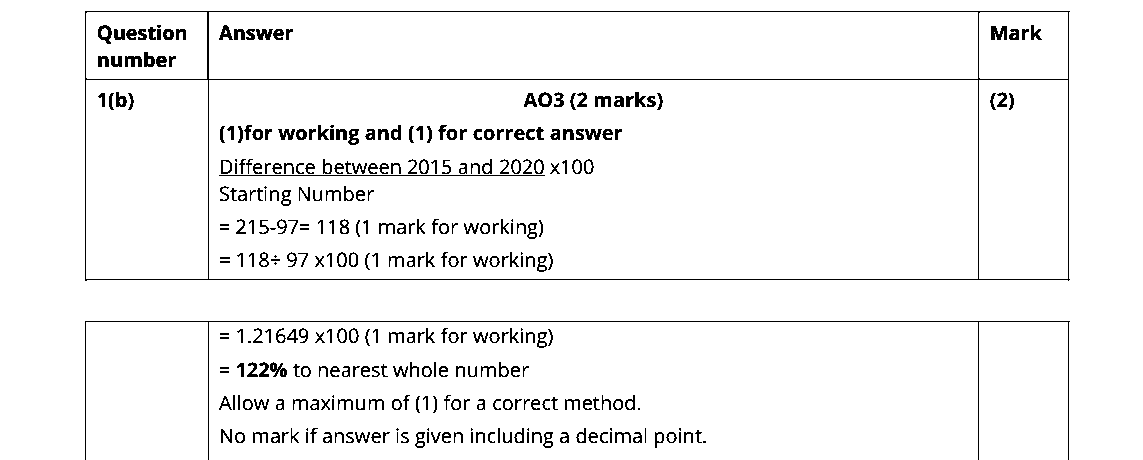
Answer: 122% ((215 - 97) ÷ 97 x 100 = 121.6)
1 mark working, 1 mark answer
no mark if given with a decimal
report: some lost a mark by omitting working
June 2019 · Paper 3 · Q518 marksAO1=3, AO2=9, AO3=618-mark essay
Resources for question 5
Mark scheme, including the levels and indicative content
Examiner's comment
Obviously, it is important for students to review all the material in the booklet but for the final two essay questions it is especially important. It is worthwhile for centres to remind their candidates that all resources have a purpose and they are not chosen lightly. An example of that is the information offered regarding Japan’s energy mix (figure 7). No question directly focused on the country’s energy mix but using this information alongside the trade data (figures 6a and 6b) would have been very useful for this question, and indeed for Q06. One perspective would have been to discuss the role of nuclear power in reducing Japan’s fossil fuel consumption which of course, would reduce its imports. To develop this some candidates pointed out that the impact of Fukushima was to increase imports and thus increase international trade. In other words an increase in the volume of international trade is not necessarily positive. Similarly, those candidates that recognised that Japan had moved from import substitution to free trade had a much better understanding of the debate in the question given that import substitution reduces trade. The best answers understood the importance of Japan’s positive terms of trade and its trade surplus as opposed to trade in general. They also recognised that exposure to global competition was a factor driving Japan’s R&D and innovation - which is very important to understand their economic success (and ongoing positive terms of trade). There were many opportunities to illustrate these points with evidence from the booklet. It was less good to quote evidence of Japan’s economic success but not link it to the role of free trade. On that same topic the best responses made an effort to establish what might be the appropriate measures of ‘success’. As referenced in the opening preamble it was surprising that relatively few candidates used AO2 case study information here. Given that the outsourcing/reshoring debate is both highly topical and on the specification it was significant for its absence. A final issue to address was the lack of reflection on what exactly constitutes ‘Japan’. Given that the synoptic links specifically identify ‘players’ as well as actions, futures and uncertainties, it was surprising that so few identified any variations across Japanese society. From this perspective it seems reasonable to expect candidates to suggest that some parts of the Japanese economy have done better than others and thus some people have had more success than others. Many candidates evaluated other factors that might explain Japan’s economic success such as working culture, investments in nuclear and renewable energy and demographic change. This was best done when clearly making judgements about their importance relative to trade. A common weakness was to evaluate these other factors, but not link them back to the question. A summary conclusion that captured their evaluative judgements on the importance of these factors was a characteristic of the highest marks. Candidates needed to come to a view and justify their view. What is especially interesting about this essay is the candidate's persistent attempts to make connections and links both between different resource booklet material and that material and their own AO2 understanding. Sometimes that does not work in terms of objective reality (trade helping out after Fukushima) but the key point here is that it is plausibility rather than real histories that matter in this case. Obviously, there is no expectation that students know anything much at all about Japan but if their attempts to explain are coherent that is the sole criteria by which they are judged; that is the essence of the 'geographical skills' that this paper explores. This response was awarded 17 marks. Try to make links between different resources in the booklet wherever you can. This is an essay that could be edited quite quickly to improve it. What it does well is the provision of an overview of the several aspects of Japanese society and its economic system but what it does not do quite so effectively is relate these observations to the question in a truly evaluative fashion. A good example can be found with the paragraph that ends at the top of page 10. Having discussed Japan's energy mix and made a point about the development of renewables reducing the need to import fossil fuels the relationship to trade is left unstated. The very brief conclusion does not add very much to the evaluation. This response was awarded 14 marks. Don't lose sight of the question by keeping the focus clear.
Notes from the mark scheme and report
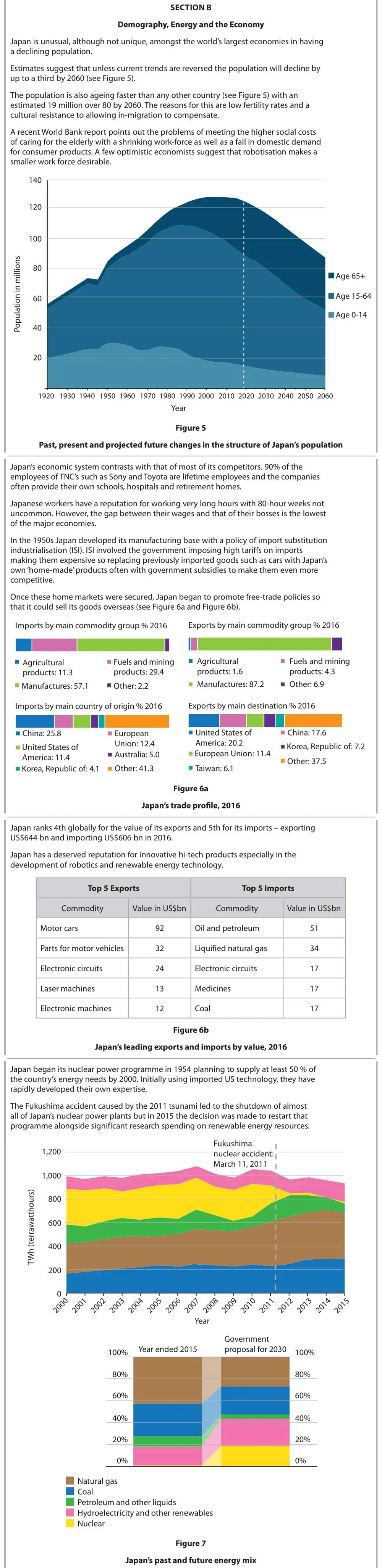
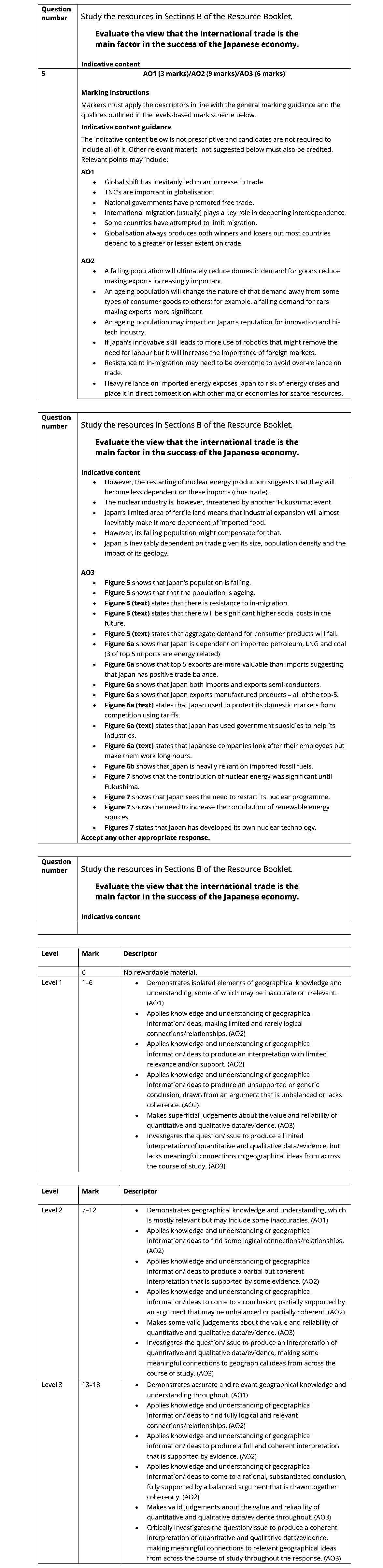
Section B (Figures 5-7): shift from import substitution to free trade, trade surplus and hi-tech exports (cars, electronics) v ageing, shrinking population and lifetime employment, innovation and robotics, heavy energy imports (post-Fukushima)
best answers saw terms of trade and surplus mattered more than trade volume
use the energy-mix figure
June 2018 · AS Paper 2 · Q1(a)1 markAO1=1Multiple choice
Resources for question 1
Answer
D
Mark scheme
Notes from the mark scheme and report
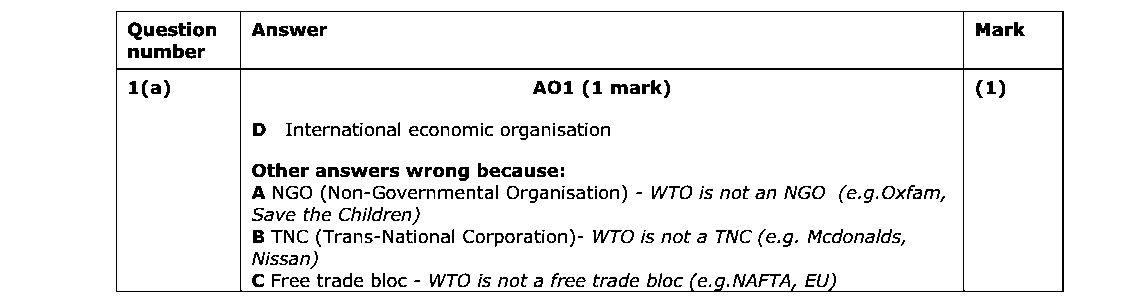
Answer D: the WTO is an international economic organisation
not an NGO (e.g. Oxfam), a TNC or a free trade bloc (e.g. EU, NAFTA)
June 2018 · AS Paper 2 · Q1(b)1 markAO3=1Multiple choice
Resources for question 1
Answer
B
Mark scheme
Notes from the mark scheme and report
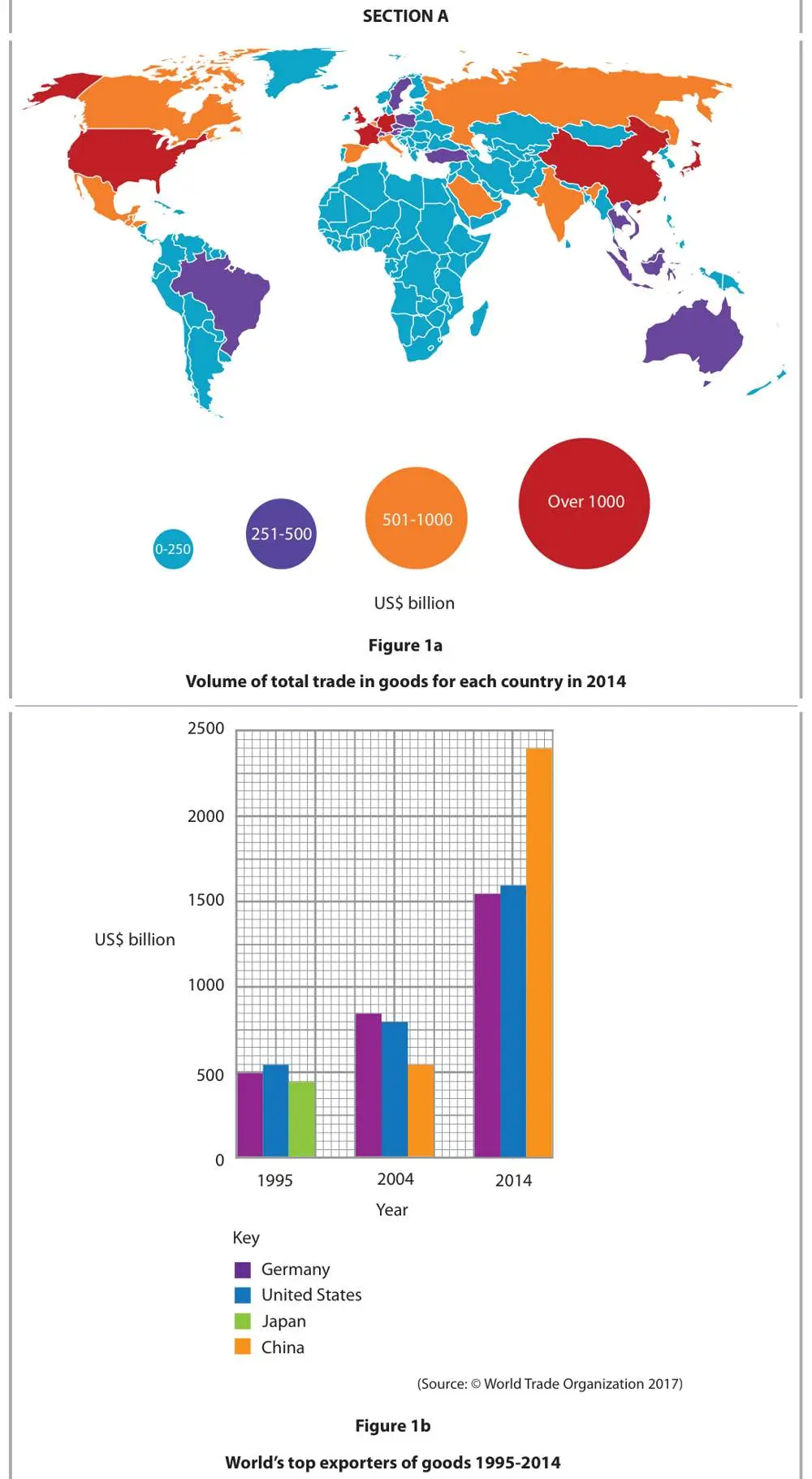
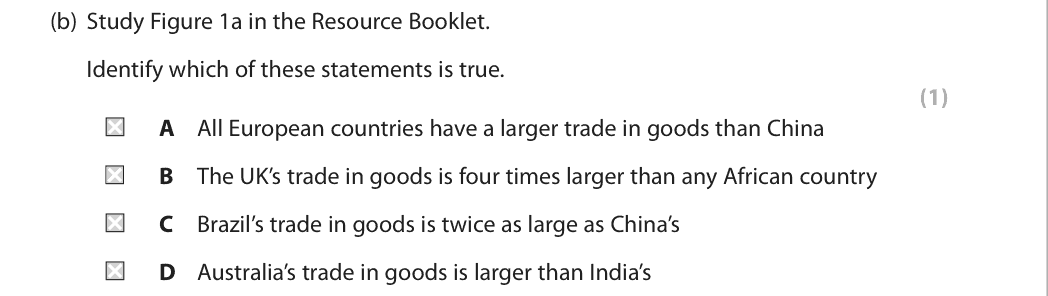
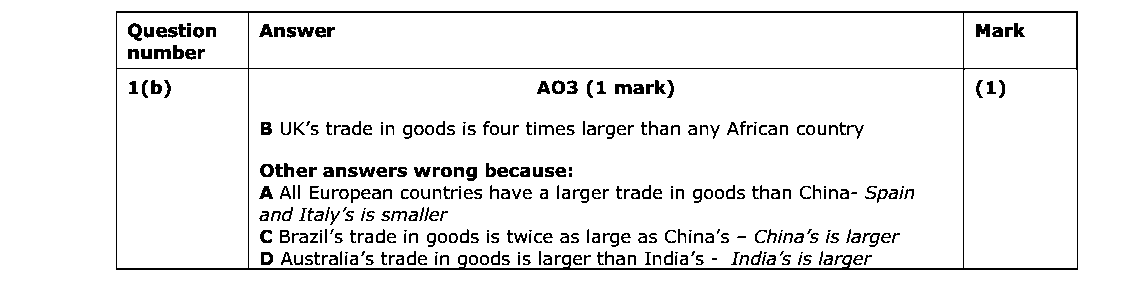
Answer B: UK trade in goods is four times larger than any African country (Figure 1a)
A wrong as Spain and Italy trade less than China
C wrong as China's is larger
D wrong as India's is larger
June 2018 · AS Paper 2 · Q1(c)(ii)3 marksAO1=2, AO2=1Data response
Resources for question 1
Mark scheme
Examiner's comment
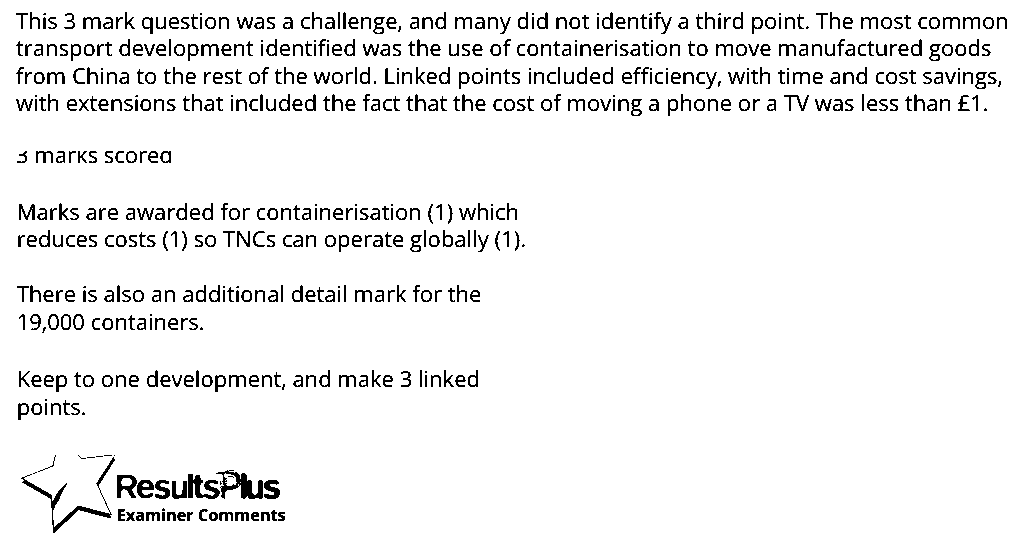
This 3 mark question was a challenge, and many did not identify a third point. The most common transport development identified was the use of containerisation to move manufactured goods from China to the rest of the world. Linked points included efficiency, with time and cost savings, with extensions that included the fact that the cost of moving a phone or a TV was less than £1. 3 marks scored Marks are awarded for containerisation (1) which reduces costs (1) so TNCs can operate globally (1). There is also an additional detail mark for the 19,000 containers. Keep to one development, and make 3 linked points.
Notes from the mark scheme and report
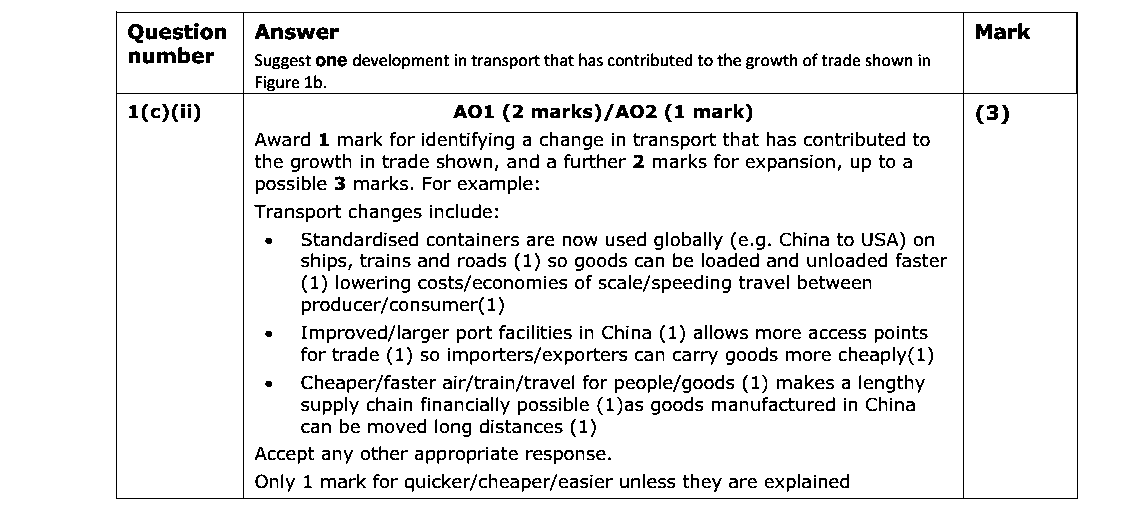
One transport development (e.g. containerisation, larger container ships, air freight) developed twice: lower unit costs, global supply chains from China
'quicker/cheaper' alone gets 1 mark unless explained
many did not reach a third linked point
June 2018 · AS Paper 2 · Q1(d)4 marksAO1=4Short answer
Resources for question 1
Mark scheme
Examiner's comment
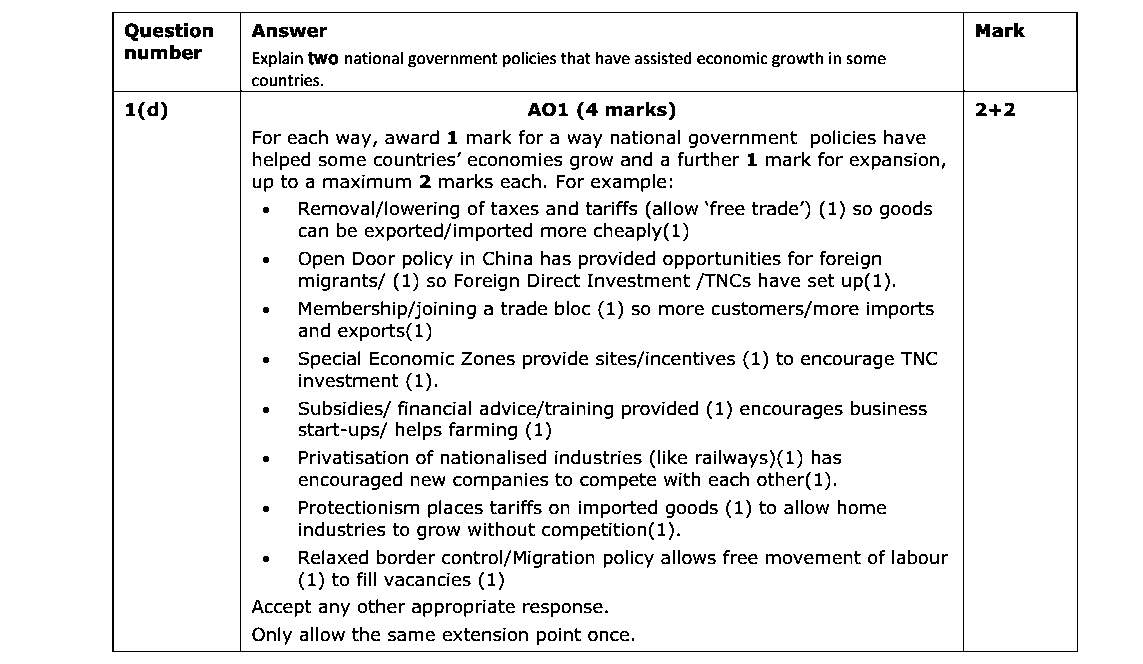
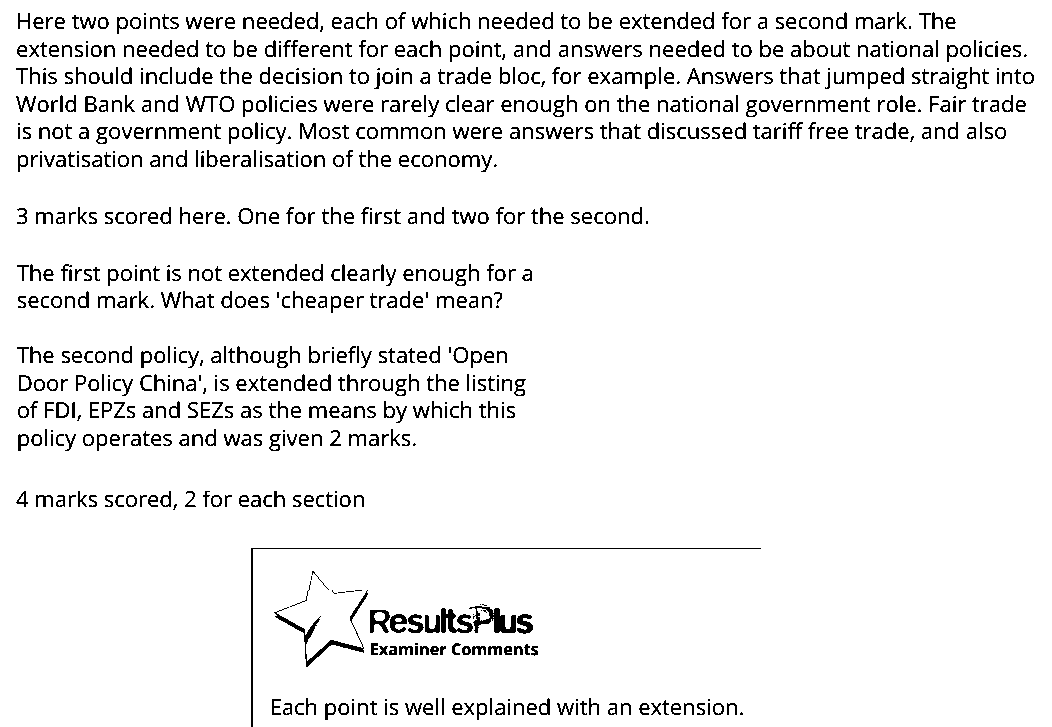
Here two points were needed, each of which needed to be extended for a second mark. The extension needed to be different for each point, and answers needed to be about national policies. This should include the decision to join a trade bloc, for example. Answers that jumped straight into World Bank and WTO policies were rarely clear enough on the national government role. Fair trade is not a government policy. Most common were answers that discussed tariff free trade, and also privatisation and liberalisation of the economy. 3 marks scored here. One for the first and two for the second. The first point is not extended clearly enough for a second mark. What does 'cheaper trade' mean? The second policy, although briefly stated 'Open Door Policy China', is extended through the listing of FDI, EPZs and SEZs as the means by which this policy operates and was given 2 marks. 4 marks scored, 2 for each section Each point is well explained with an extension.
Notes from the mark scheme and report
National policies: lowering tariffs/joining a trade bloc, privatisation, liberalisation/deregulation, SEZs and FDI incentives, migration policy
each extended once with different extensions
WTO/World Bank policies and fair trade are not national policies
June 2018 · Paper 3 · Q14 marksAO1=4Short answer
Mark scheme
Examiner's comment
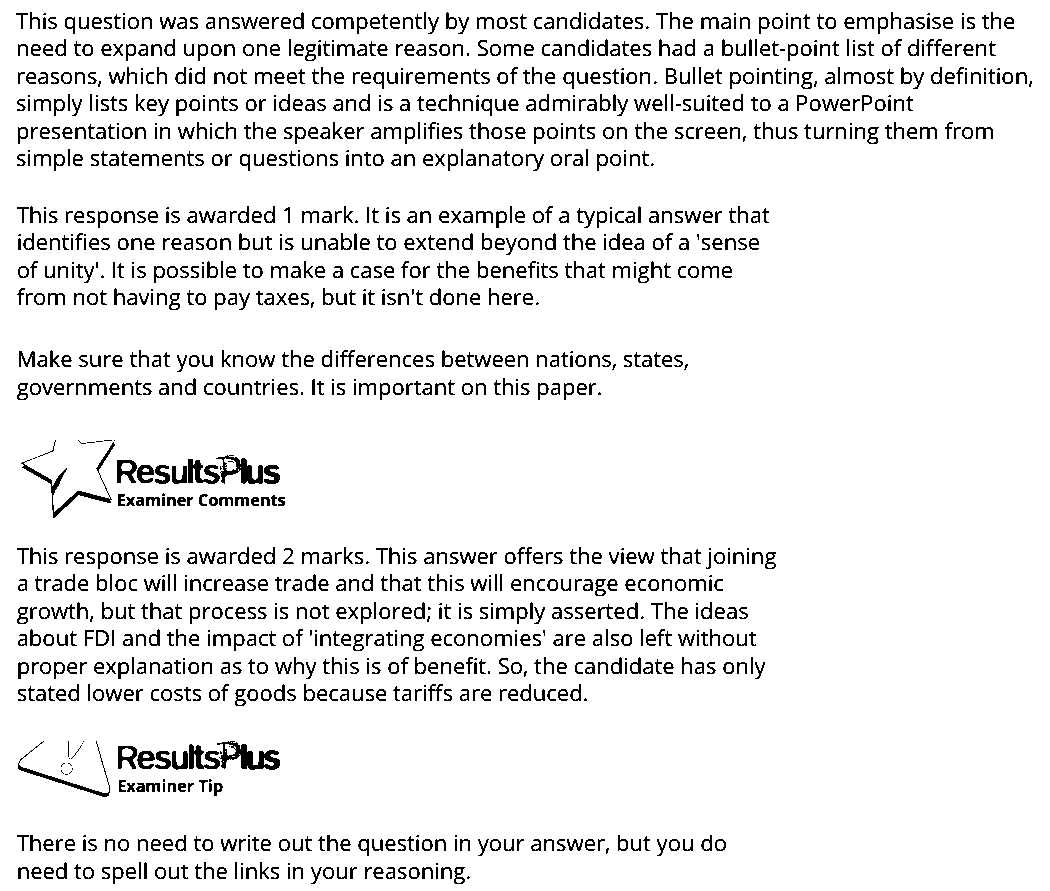
This question was answered competently by most candidates. The main point to emphasise is the need to expand upon one legitimate reason. Some candidates had a bullet-point list of different reasons, which did not meet the requirements of the question. Bullet pointing, almost by definition, simply lists key points or ideas and is a technique admirably well-suited to a PowerPoint presentation in which the speaker amplifies those points on the screen, thus turning them from simple statements or questions into an explanatory oral point. This response is awarded 1 mark. It is an example of a typical answer that identifies one reason but is unable to extend beyond the idea of a 'sense of unity'. It is possible to make a case for the benefits that might come from not having to pay taxes, but it isn't done here. Make sure that you know the differences between nations, states, governments and countries. It is important on this paper. This response is awarded 2 marks. This answer offers the view that joining a trade bloc will increase trade and that this will encourage economic growth, but that process is not explored; it is simply asserted. The ideas about FDI and the impact of 'integrating economies' are also left without proper explanation as to why this is of benefit. So, the candidate has only stated lower costs of goods because tariffs are reduced. There is no need to write out the question in your answer, but you do need to spell out the links in your reasoning.
Notes from the mark scheme and report
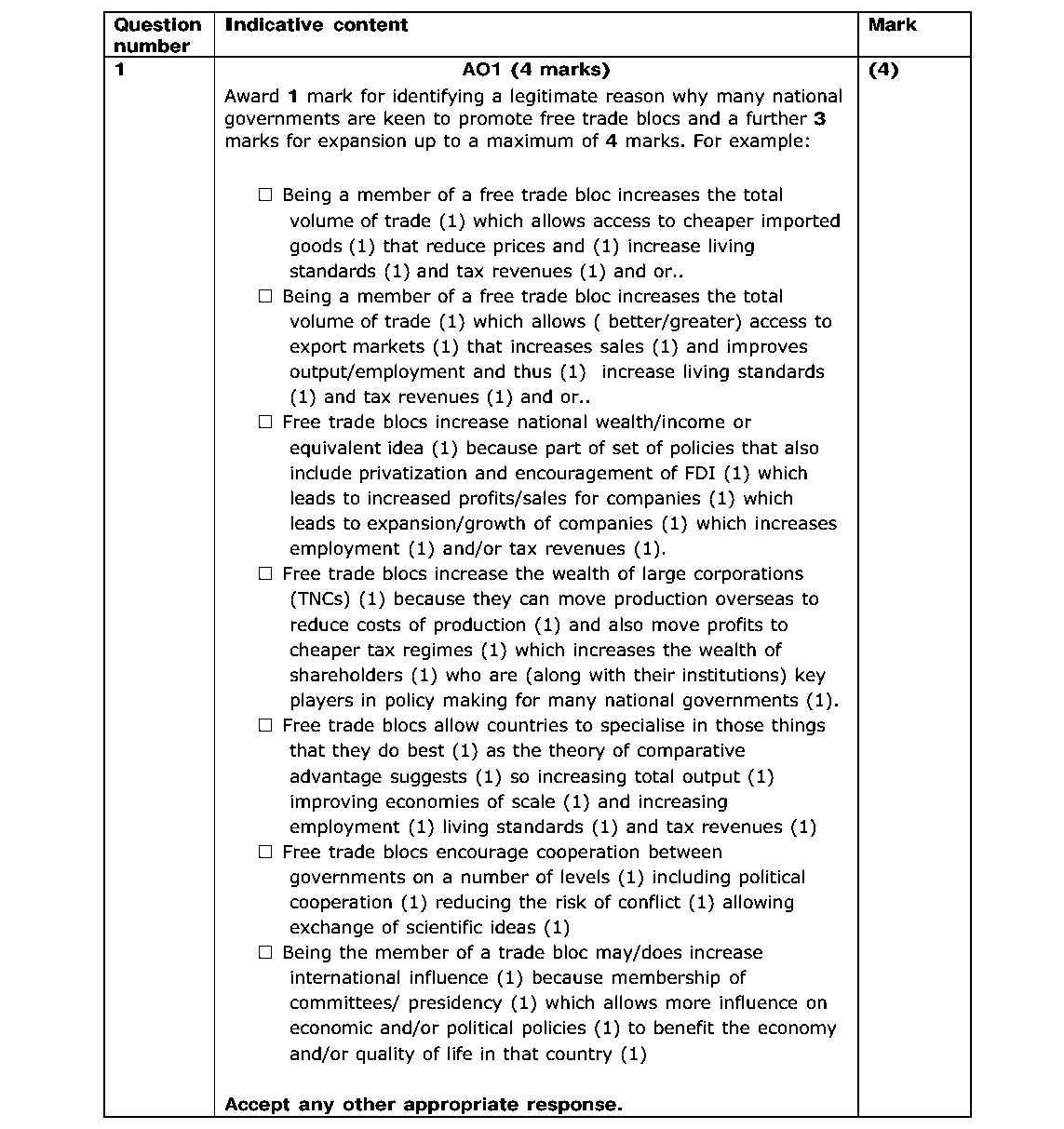
One reason developed three times: more trade gives access to export markets and cheaper imports, raising output, jobs, living standards and tax revenue
or comparative advantage and economies of scale
or political cooperation
bullet lists of reasons did not meet the demand
know nations v states v governments
June 2018 · Paper 3 · Q48 marksAO1=4, AO3=4Extended responseHard
Resources for question 4
Mark scheme, including the levels and indicative content
Examiner's comment
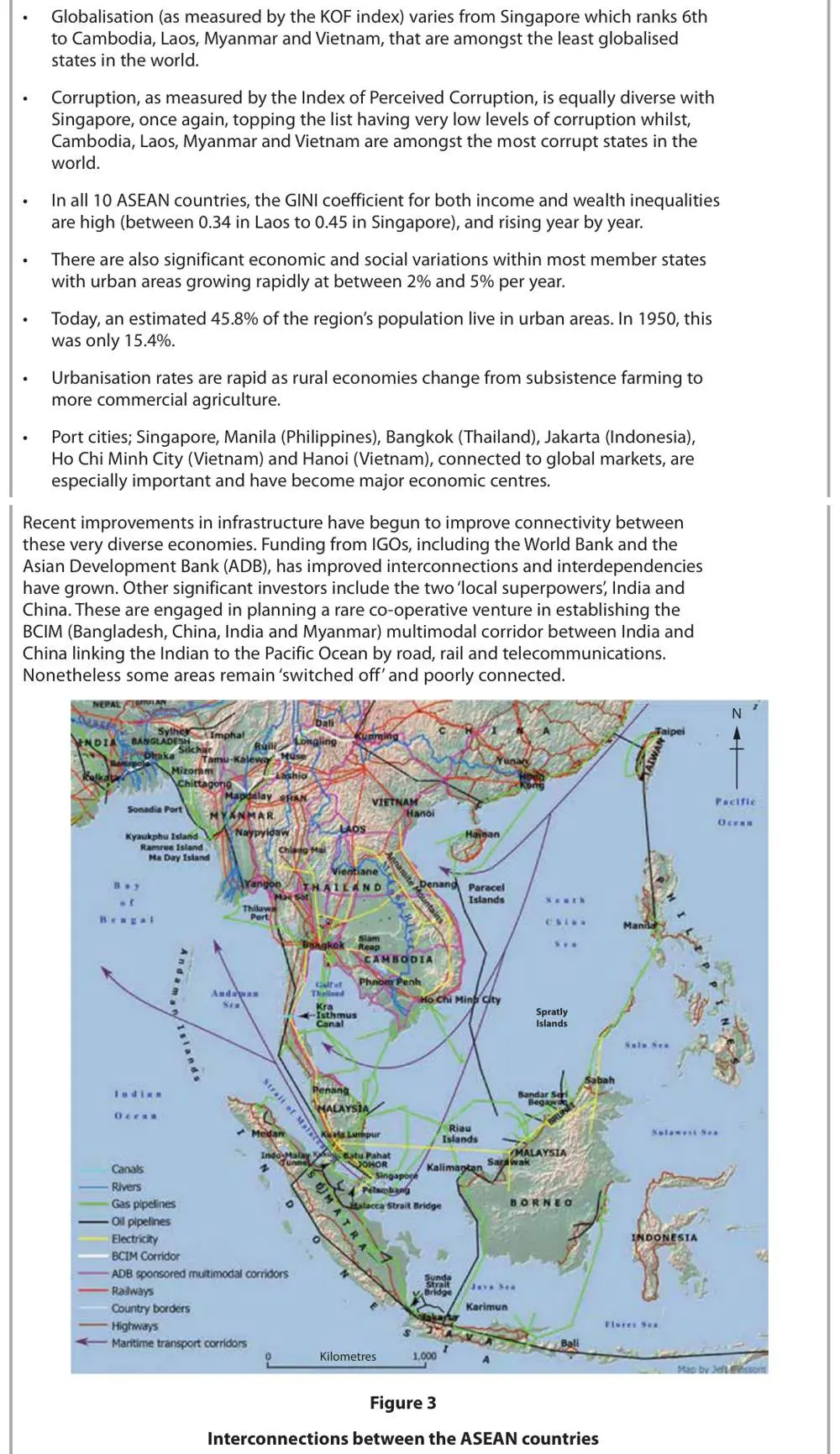
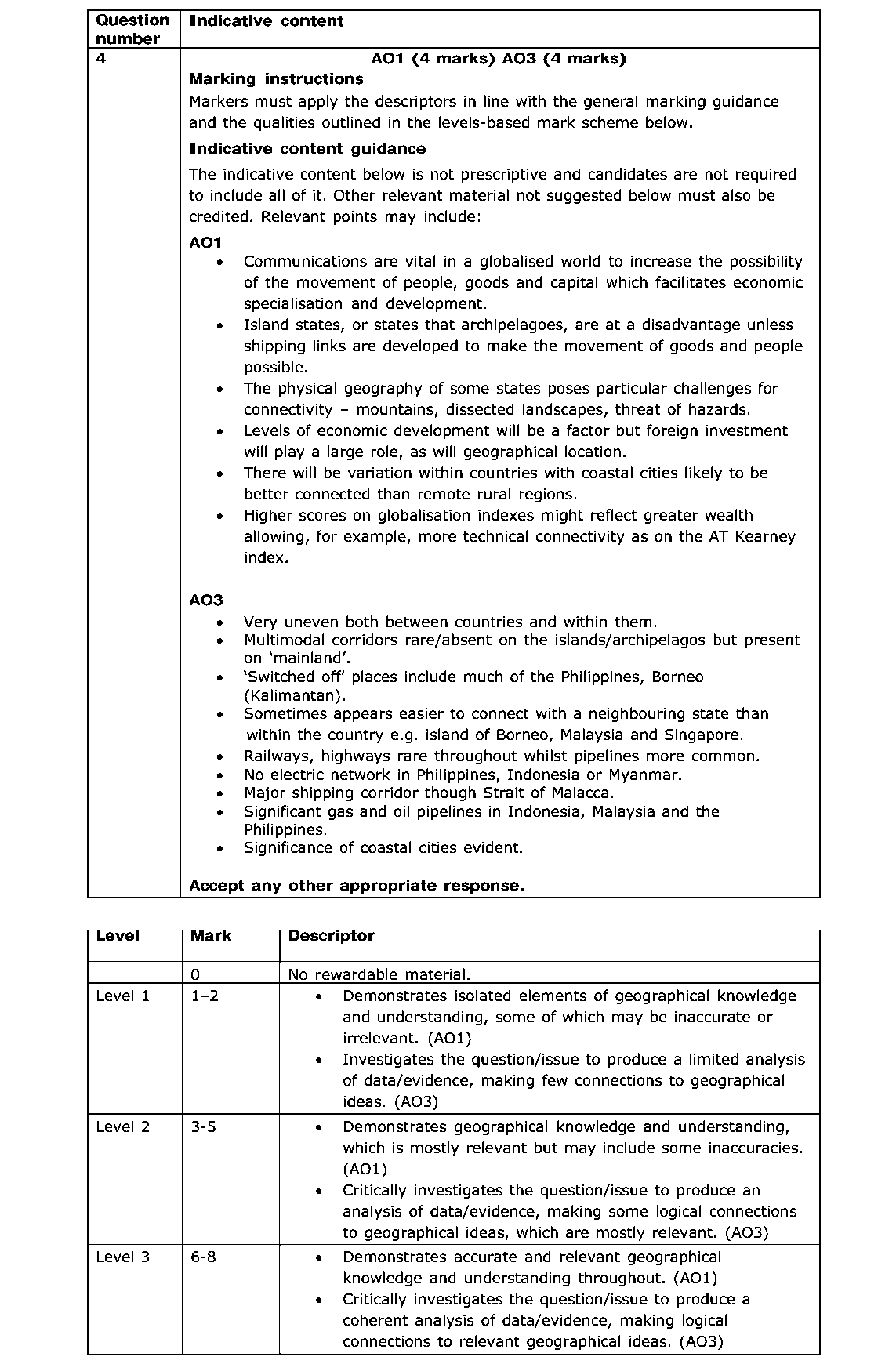
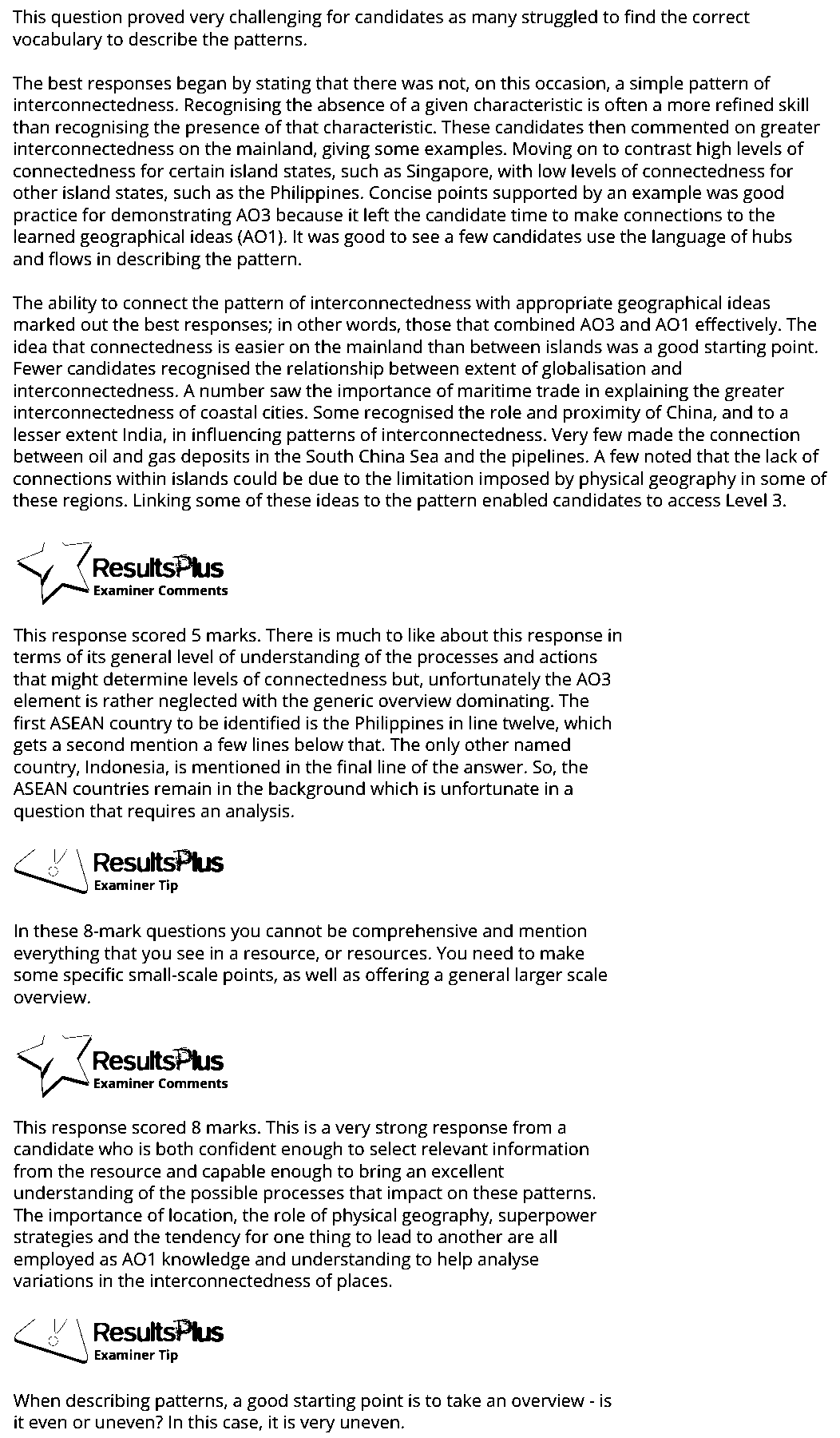
This question proved very challenging for candidates as many struggled to find the correct vocabulary to describe the patterns. The best responses began by stating that there was not, on this occasion, a simple pattern of interconnectedness. Recognising the absence of a given characteristic is often a more refined skill than recognising the presence of that characteristic. These candidates then commented on greater interconnectedness on the mainland, giving some examples. Moving on to contrast high levels of connectedness for certain island states, such as Singapore, with low levels of connectedness for other island states, such as the Philippines. Concise points supported by an example was good practice for demonstrating AO3 because it left the candidate time to make connections to the learned geographical ideas (AO1). It was good to see a few candidates use the language of hubs and flows in describing the pattern. The ability to connect the pattern of interconnectedness with appropriate geographical ideas marked out the best responses; in other words, those that combined AO3 and AO1 effectively. The idea that connectedness is easier on the mainland than between islands was a good starting point. Fewer candidates recognised the relationship between extent of globalisation and interconnectedness. A number saw the importance of maritime trade in explaining the greater interconnectedness of coastal cities. Some recognised the role and proximity of China, and to a lesser extent India, in influencing patterns of interconnectedness. Very few made the connection between oil and gas deposits in the South China Sea and the pipelines. A few noted that the lack of connections within islands could be due to the limitation imposed by physical geography in some of these regions. Linking some of these ideas to the pattern enabled candidates to access Level 3. This response scored 5 marks. There is much to like about this response in terms of its general level of understanding of the processes and actions that might determine levels of connectedness but, unfortunately the AO3 element is rather neglected with the generic overview dominating. The first ASEAN country to be identified is the Philippines in line twelve, which gets a second mention a few lines below that. The only other named country, Indonesia, is mentioned in the final line of the answer. So, the ASEAN countries remain in the background which is unfortunate in a question that requires an analysis. In these 8-mark questions you cannot be comprehensive and mention everything that you see in a resource, or resources. You need to make some specific small-scale points, as well as offering a general larger scale overview. This response scored 8 marks. This is a very strong response from a candidate who is both confident enough to select relevant information from the resource and capable enough to bring an excellent understanding of the possible processes that impact on these patterns. The importance of location, the role of physical geography, superpower strategies and the tendency for one thing to lead to another are all employed as AO1 knowledge and understanding to help analyse variations in the interconnectedness of places. When describing patterns, a good starting point is to take an overview - is it even or uneven? In this case, it is very uneven.
Notes from the mark scheme and report
Use Figure 3: very uneven
multimodal corridors and pipelines on the mainland (BCIM corridor), Singapore and the Malacca Strait a hub, Philippines and Borneo 'switched off'
island geography, mountains and hazards hinder links
IGO and ADB funding
report: 'This question proved very challenging for candidates', many lacked vocabulary to describe the pattern
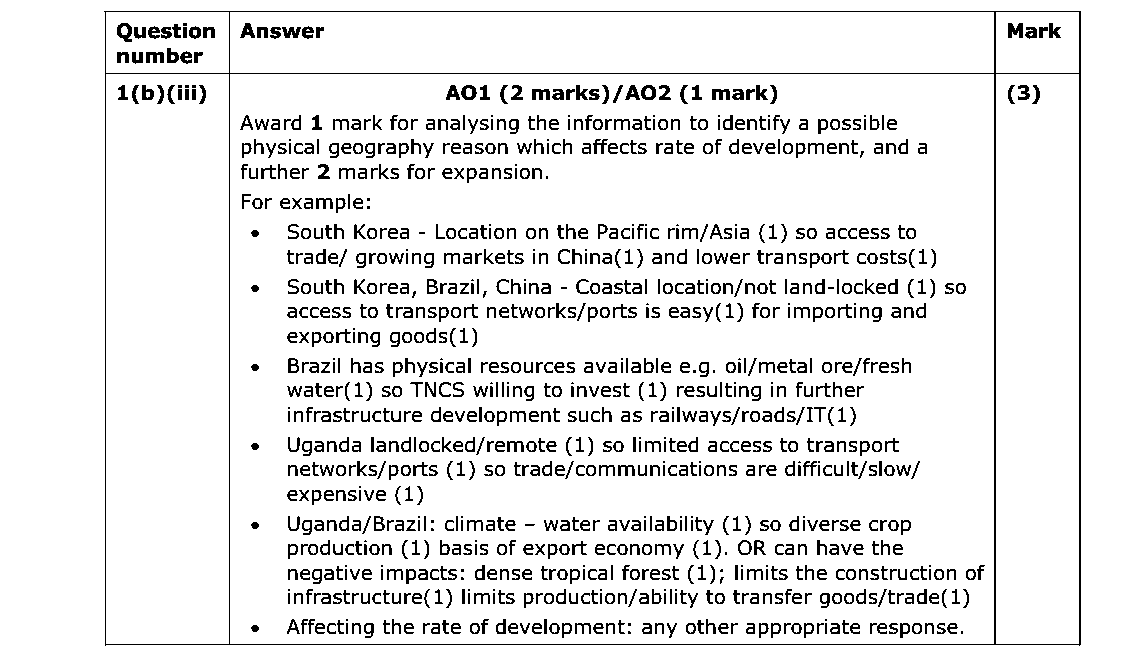
June 2017 · AS Paper 2 · Q1(b)(iii)3 marksAO1=2, AO2=1Data response
Resources for question 1
Mark scheme
Examiner's comment
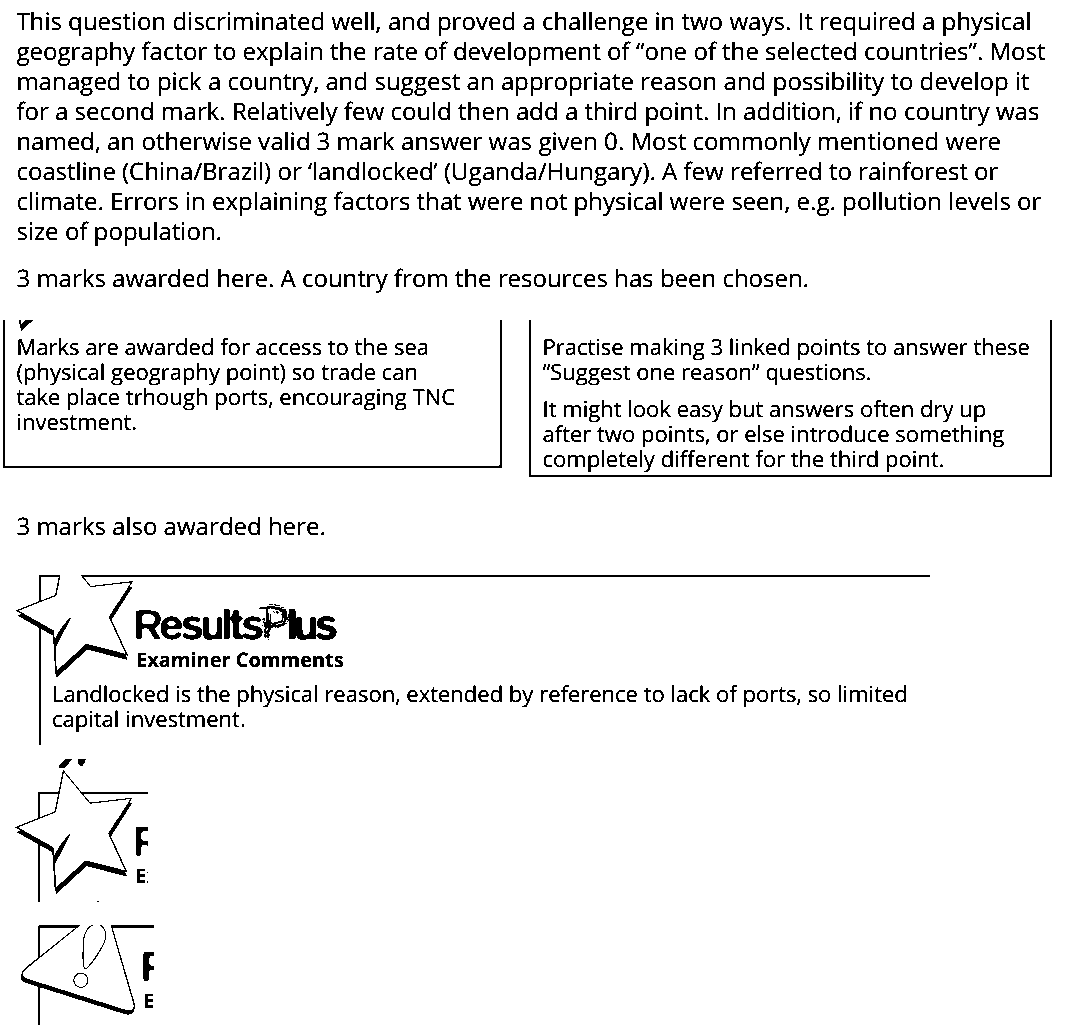
This question discriminated well, and proved a challenge in two ways. It required a physical geography factor to explain the rate of development of “one of the selected countries”. Most managed to pick a country, and suggest an appropriate reason and possibility to develop it for a second mark. Relatively few could then add a third point. In addition, if no country was named, an otherwise valid 3 mark answer was given 0. Most commonly mentioned were coastline (China/Brazil) or ‘landlocked’ (Uganda/Hungary). A few referred to rainforest or climate. Errors in explaining factors that were not physical were seen, e.g. pollution levels or size of population. 3 marks awarded here. A country from the resources has been chosen. Marks are awarded for access to the sea (physical geography point) so trade can take place trhough ports, encouraging TNC investment. Practise making 3 linked points to answer these “Suggest one reason” questions. It might look easy but answers often dry up after two points, or else introduce something completely different for the third point. 3 marks also awarded here. Landlocked is the physical reason, extended by reference to lack of ports, so limited capital investment.
Notes from the mark scheme and report
Name a Figure 1a country and a physical factor (coastline and ports v landlocked Uganda/Hungary, resources, climate) then two linked developments
no country named scored 0
non-physical factors (pollution, population) not credited
June 2017 · AS Paper 2 · Q1(c)4 marksAO1=4Short answer
Resources for question 1
Mark scheme
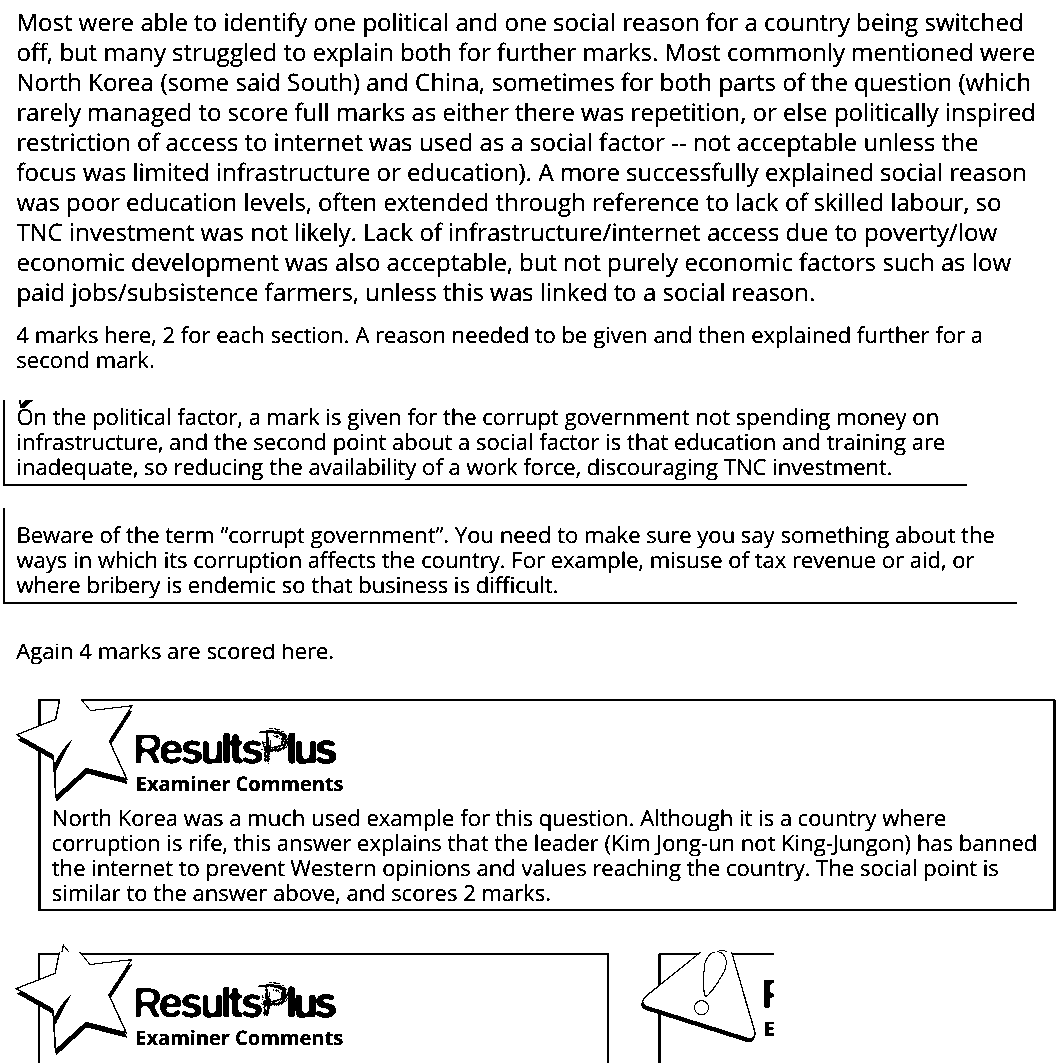
Examiner's comment
Most were able to identify one political and one social reason for a country being switched off, but many struggled to explain both for further marks. Most commonly mentioned were North Korea (some said South) and China, sometimes for both parts of the question (which rarely managed to score full marks as either there was repetition, or else politically inspired restriction of access to internet was used as a social factor -- not acceptable unless the focus was limited infrastructure or education). A more successfully explained social reason was poor education levels, often extended through reference to lack of skilled labour, so TNC investment was not likely. Lack of infrastructure/internet access due to poverty/low economic development was also acceptable, but not purely economic factors such as low paid jobs/subsistence farmers, unless this was linked to a social reason. 4 marks here, 2 for each section. A reason needed to be given and then explained further for a second mark. On the political factor, a mark is given for the corrupt government not spending money on infrastructure, and the second point about a social factor is that education and training are inadequate, so reducing the availability of a work force, discouraging TNC investment. Beware of the term “corrupt government”. You need to make sure you say something about the ways in which its corruption affects the country. For example, misuse of tax revenue or aid, or where bribery is endemic so that business is difficult. Again 4 marks are scored here. North Korea was a much used example for this question. Although it is a country where corruption is rife, this answer explains that the leader (Kim Jong-un not King-Jungon) has banned the internet to prevent Western opinions and values reaching the country. The social point is similar to the answer above, and scores 2 marks.
Notes from the mark scheme and report
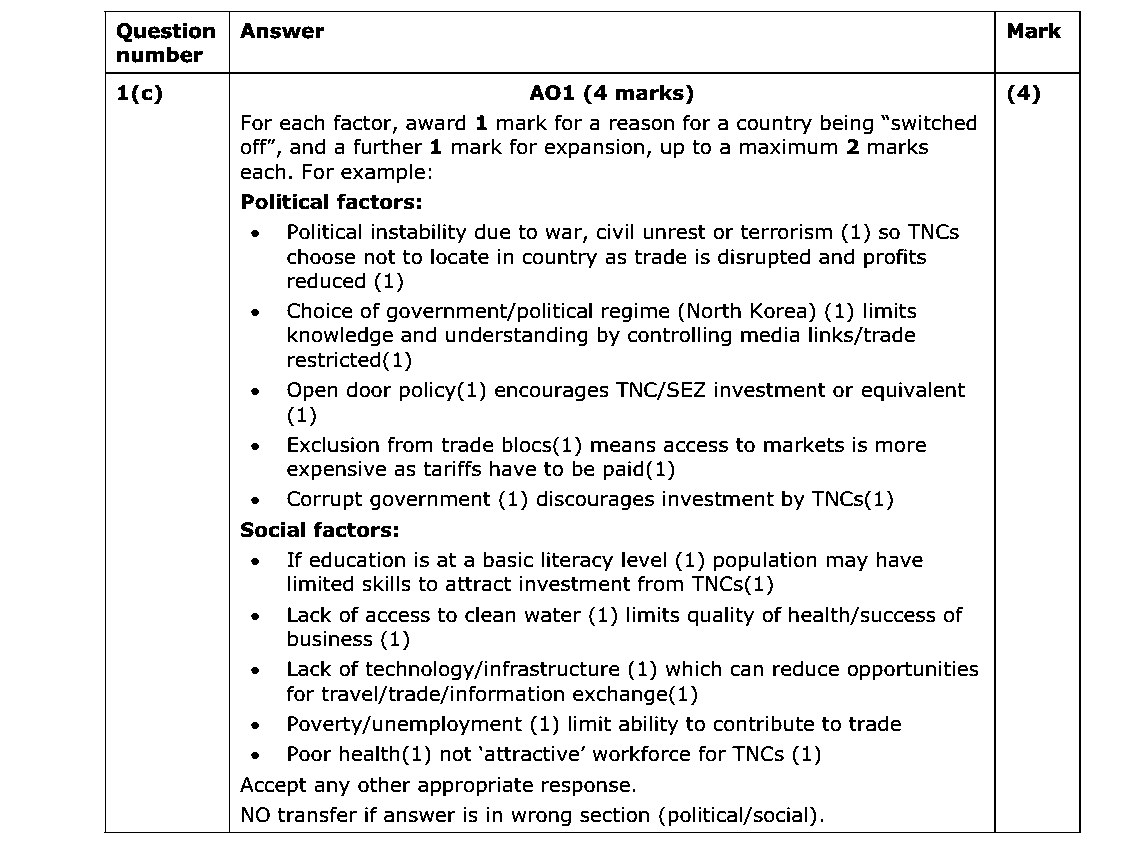
One political (conflict, regime such as North Korea, corruption, exclusion from trade blocs) and one social reason (low literacy/skills, poor health, no infrastructure) each extended
internet censorship is political not social
no transfer between sections
June 2017 · AS Paper 2 · Q1(d)6 marksAO1=6Extended response
Resources for question 1
Mark scheme, including the levels and indicative content
Examiner's comment
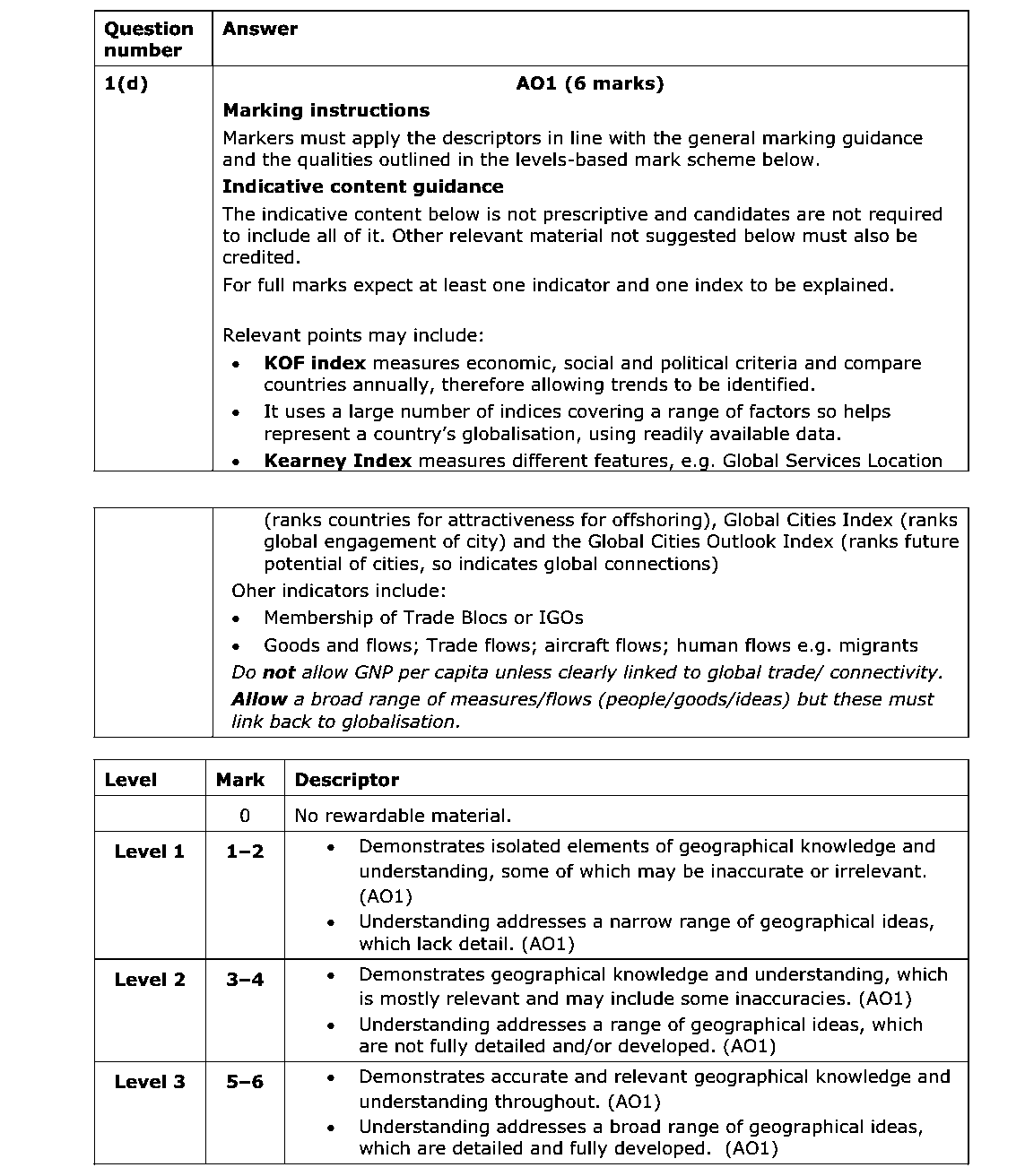
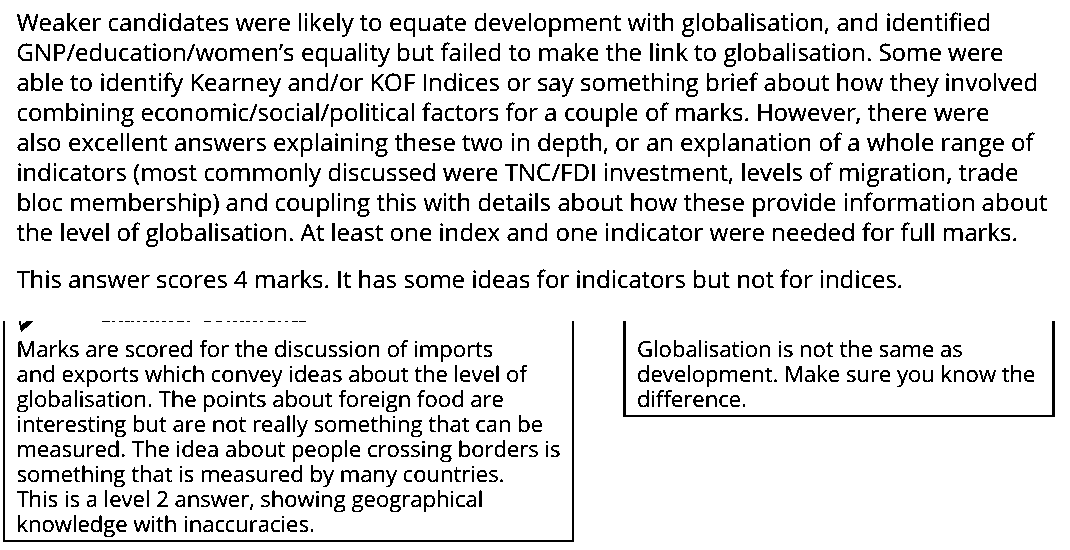
Weaker candidates were likely to equate development with globalisation, and identified GNP/education/women’s equality but failed to make the link to globalisation. Some were able to identify Kearney and/or KOF Indices or say something brief about how they involved combining economic/social/political factors for a couple of marks. However, there were also excellent answers explaining these two in depth, or an explanation of a whole range of indicators (most commonly discussed were TNC/FDI investment, levels of migration, trade bloc membership) and coupling this with details about how these provide information about the level of globalisation. At least one index and one indicator were needed for full marks. This answer scores 4 marks. It has some ideas for indicators but not for indices. Marks are scored for the discussion of imports and exports which convey ideas about the level of globalisation. The points about foreign food are interesting but are not really something that can be measured. The idea about people crossing borders is something that is measured by many countries. This is a level 2 answer, showing geographical knowledge with inaccuracies. Globalisation is not the same as development. Make sure you know the difference.
Notes from the mark scheme and report
Full marks need at least one index (KOF, AT Kearney) and one indicator (trade, FDI, migration flows, trade bloc membership)
weaker answers confused development measures (GNP) with globalisation
June 2017 · AS Paper 2 · Q1(e)12 marksAO1=3, AO2=912-mark essay
Resources for question 1
Mark scheme, including the levels and indicative content
Examiner's comment
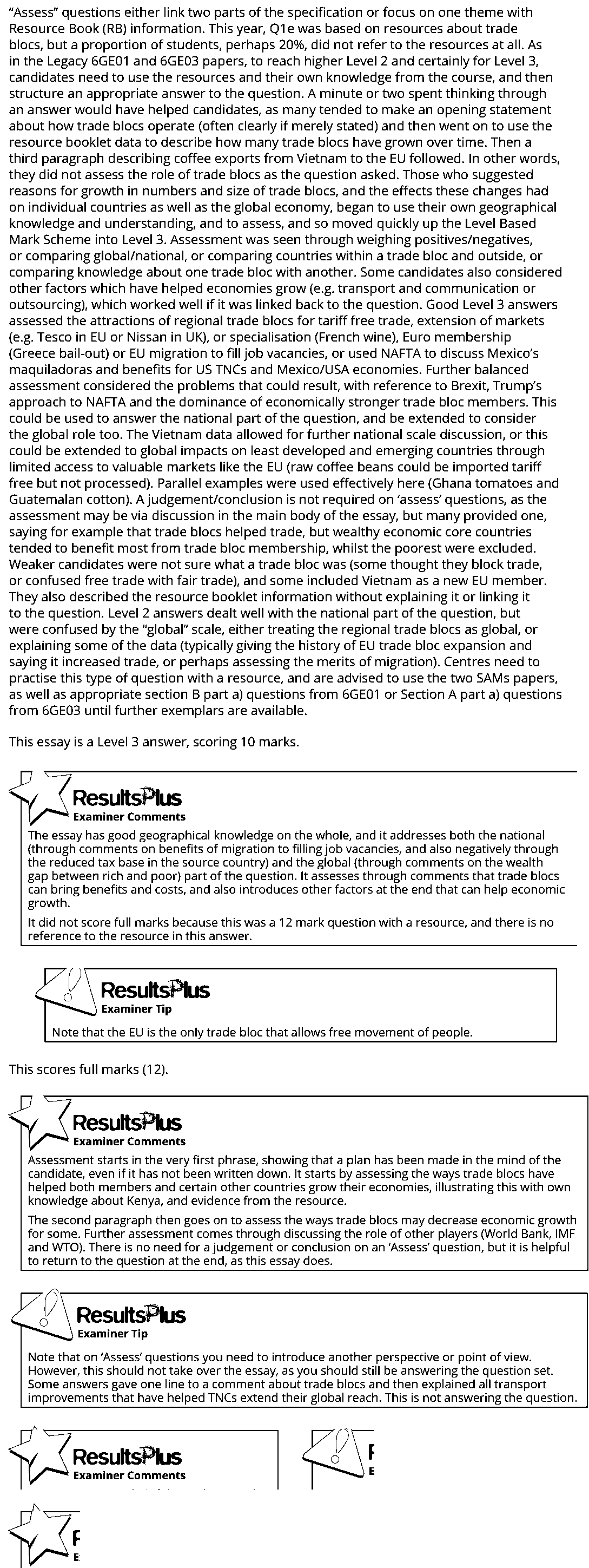
“Assess” questions either link two parts of the specification or focus on one theme with Resource Book (RB) information. This year, Q1e was based on resources about trade blocs, but a proportion of students, perhaps 20%, did not refer to the resources at all. As in the Legacy 6GE01 and 6GE03 papers, to reach higher Level 2 and certainly for Level 3, candidates need to use the resources and their own knowledge from the course, and then structure an appropriate answer to the question. A minute or two spent thinking through an answer would have helped candidates, as many tended to make an opening statement about how trade blocs operate (often clearly if merely stated) and then went on to use the resource booklet data to describe how many trade blocs have grown over time. Then a third paragraph describing coffee exports from Vietnam to the EU followed. In other words, they did not assess the role of trade blocs as the question asked. Those who suggested reasons for growth in numbers and size of trade blocs, and the effects these changes had on individual countries as well as the global economy, began to use their own geographical knowledge and understanding, and to assess, and so moved quickly up the Level Based Mark Scheme into Level 3. Assessment was seen through weighing positives/negatives, or comparing global/national, or comparing countries within a trade bloc and outside, or comparing knowledge about one trade bloc with another. Some candidates also considered other factors which have helped economies grow (e.g. transport and communication or outsourcing), which worked well if it was linked back to the question. Good Level 3 answers assessed the attractions of regional trade blocs for tariff free trade, extension of markets (e.g. Tesco in EU or Nissan in UK), or specialisation (French wine), Euro membership (Greece bail-out) or EU migration to fill job vacancies, or used NAFTA to discuss Mexico’s maquiladoras and benefits for US TNCs and Mexico/USA economies. Further balanced assessment considered the problems that could result, with reference to Brexit, Trump’s approach to NAFTA and the dominance of economically stronger trade bloc members. This could be used to answer the national part of the question, and be extended to consider the global role too. The Vietnam data allowed for further national scale discussion, or this could be extended to global impacts on least developed and emerging countries through limited access to valuable markets like the EU (raw coffee beans could be imported tariff free but not processed). Parallel examples were used effectively here (Ghana tomatoes and Guatemalan cotton). A judgement/conclusion is not required on ‘assess’ questions, as the assessment may be via discussion in the main body of the essay, but many provided one, saying for example that trade blocs helped trade, but wealthy economic core countries tended to benefit most from trade bloc membership, whilst the poorest were excluded. Weaker candidates were not sure what a trade bloc was (some thought they block trade, or confused free trade with fair trade), and some included Vietnam as a new EU member. They also described the resource booklet information without explaining it or linking it to the question. Level 2 answers dealt well with the national part of the question, but were confused by the “global” scale, either treating the regional trade blocs as global, or explaining some of the data (typically giving the history of EU trade bloc expansion and saying it increased trade, or perhaps assessing the merits of migration). Centres need to practise this type of question with a resource, and are advised to use the two SAMs papers, as well as appropriate section B part a) questions from 6GE01 or Section A part a) questions from 6GE03 until further exemplars are available. This essay is a Level 3 answer, scoring 10 marks. Note that the EU is the only trade bloc that allows free movement of people. The essay has good geographical knowledge on the whole, and it addresses both the national (through comments on benefits of migration to filling job vacancies, and also negatively through the reduced tax base in the source country) and the global (through comments on the wealth gap between rich and poor) part of the question. It assesses through comments that trade blocs can bring benefits and costs, and also introduces other factors at the end that can help economic growth. It did not score full marks because this was a 12 mark question with a resource, and there is no reference to the resource in this answer. This scores full marks (12). Assessment starts in the very first phrase, showing that a plan has been made in the mind of the candidate, even if it has not been written down. It starts by assessing the ways trade blocs have helped both members and certain other countries grow their economies, illustrating this with own knowledge about Kenya, and evidence from the resource. The second paragraph then goes on to assess the ways trade blocs may decrease economic growth for some. Further assessment comes through discussing the role of other players (World Bank, IMF and WTO). There is no need for a judgement or conclusion on an ‘Assess’ question, but it is helpful to return to the question at the end, as this essay does. Note that on ‘Assess’ questions you need to introduce another perspective or point of view. However, this should not take over the essay, as you should still be answering the question set. Some answers gave one line to a comment about trade blocs and then explained all transport improvements that have helped TNCs extend their global reach. This is not answering the question.
Notes from the mark scheme and report
Use Figures 1b and 1c: growth in bloc membership, tariffs on processed Vietnamese coffee entering the EU
weigh free trade within blocs against protectionism and distorted global trade
about 20% ignored the resources
describing the data is not assessing
June 2017 · AS Paper 2 · Q416 marksAO1=4, AO2=1216-mark essay
Resources for question 4
Mark scheme, including the levels and indicative content
Examiner's comment
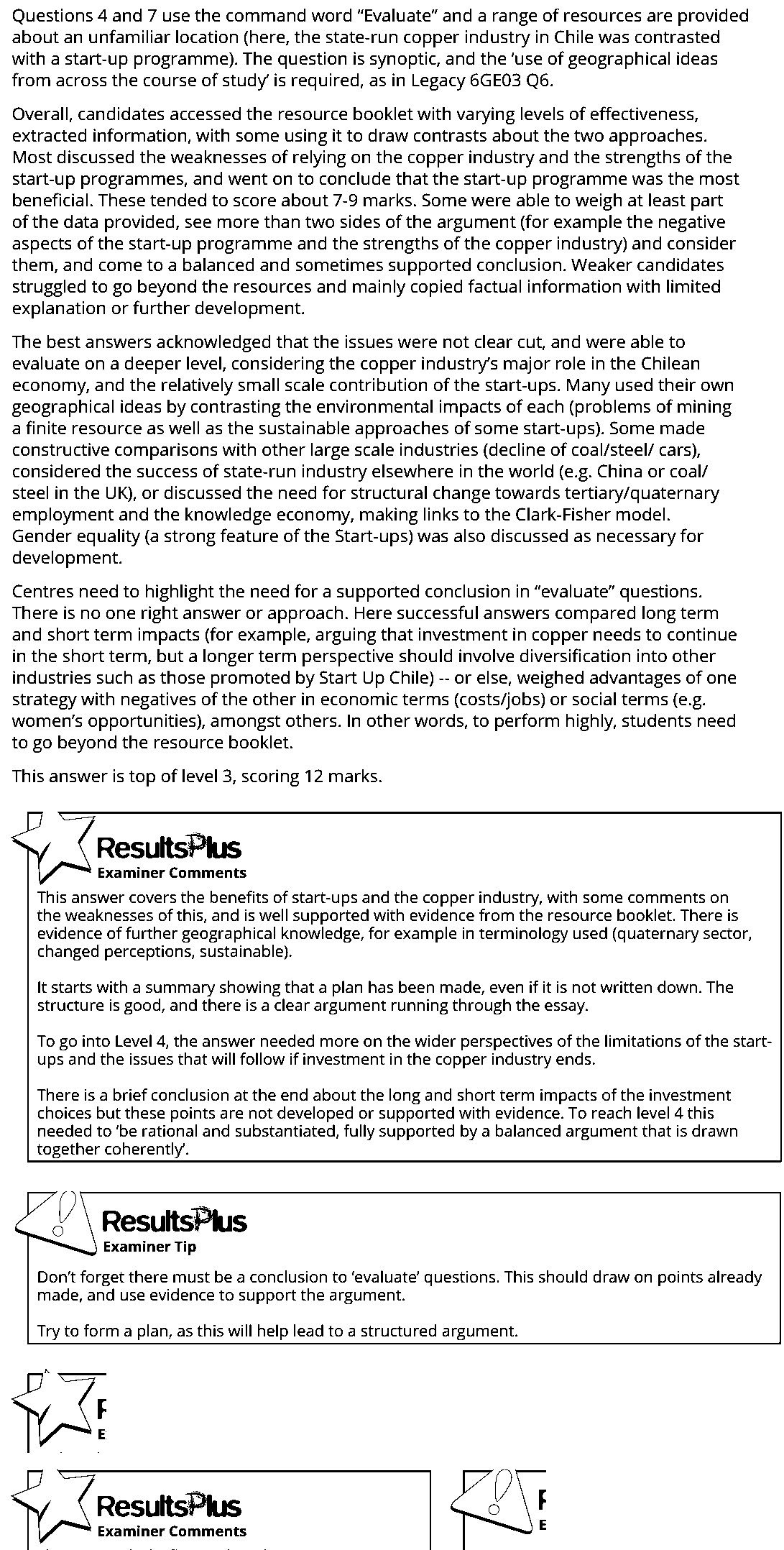
Questions 4 and 7 use the command word “Evaluate” and a range of resources are provided about an unfamiliar location (here, the state-run copper industry in Chile was contrasted with a start-up programme). The question is synoptic, and the ‘use of geographical ideas from across the course of study’ is required, as in Legacy 6GE03 Q6. Overall, candidates accessed the resource booklet with varying levels of effectiveness, extracted information, with some using it to draw contrasts about the two approaches. Most discussed the weaknesses of relying on the copper industry and the strengths of the start-up programmes, and went on to conclude that the start-up programme was the most beneficial. These tended to score about 7-9 marks. Some were able to weigh at least part of the data provided, see more than two sides of the argument (for example the negative aspects of the start-up programme and the strengths of the copper industry) and consider them, and come to a balanced and sometimes supported conclusion. Weaker candidates struggled to go beyond the resources and mainly copied factual information with limited explanation or further development. The best answers acknowledged that the issues were not clear cut, and were able to evaluate on a deeper level, considering the copper industry’s major role in the Chilean economy, and the relatively small scale contribution of the start-ups. Many used their own geographical ideas by contrasting the environmental impacts of each (problems of mining a finite resource as well as the sustainable approaches of some start-ups). Some made constructive comparisons with other large scale industries (decline of coal/steel/ cars), considered the success of state-run industry elsewhere in the world (e.g. China or coal/ steel in the UK), or discussed the need for structural change towards tertiary/quaternary employment and the knowledge economy, making links to the Clark-Fisher model. Gender equality (a strong feature of the Start-ups) was also discussed as necessary for development. Centres need to highlight the need for a supported conclusion in “evaluate” questions. There is no one right answer or approach. Here successful answers compared long term and short term impacts (for example, arguing that investment in copper needs to continue in the short term, but a longer term perspective should involve diversification into other industries such as those promoted by Start Up Chile) -- or else, weighed advantages of one strategy with negatives of the other in economic terms (costs/jobs) or social terms (e.g. women’s opportunities), amongst others. In other words, to perform highly, students need to go beyond the resource booklet. This answer is top of level 3, scoring 12 marks. This answer covers the benefits of start-ups and the copper industry, with some comments on the weaknesses of this, and is well supported with evidence from the resource booklet. There is evidence of further geographical knowledge, for example in terminology used (quaternary sector, changed perceptions, sustainable). It starts with a summary showing that a plan has been made, even if it is not written down. The structure is good, and there is a clear argument running through the essay. To go into Level 4, the answer needed more on the wider perspectives of the limitations of the start- ups and the issues that will follow if investment in the copper industry ends. There is a brief conclusion at the end about the long and short term impacts of the investment choices but these points are not developed or supported with evidence. To reach level 4 this needed to ‘be rational and substantiated, fully supported by a balanced argument that is drawn together coherently’. Don’t forget there must be a conclusion to ‘evaluate’ questions. This should draw on points already made, and use evidence to support the argument. Try to form a plan, as this will help lead to a structured argument.
Notes from the mark scheme and report
Figure 4: copper 18% of exports, volatile falling prices, Codelco job losses v small-scale Start-up Chile (1,500 jobs, women-led firms)
best answers saw it was not clear-cut and used ideas from across the course
typical answers 7-9 marks
June 2017 · AS Paper 2 · Q716 marksAO1=4, AO2=1216-mark essay
Resources for question 7
Mark scheme, including the levels and indicative content
Examiner's comment
Questions 4 and 7 use the command word “Evaluate” and a range of resources are provided about an unfamiliar location (here, concerning the plan to extend the Special Economic Zone in Manaus, Amazonas state in Brazil). The question is synoptic, and the ‘use of geographical ideas from across the course of study’ is required, as in Legacy 6GE03 Q6. Overall, candidates accessed the resource booklet with varying levels of effectiveness, extracted information and some used it to draw contrasts about the effects of the plan on various groups of people. However, weaker candidates tended to copy out sections with limited explanation or much interpretation of the positive or negative effects. Good answers focused on groups (e.g. young/ unemployed/ women/ skilled workers/ indigenous people) and evaluated the possible impacts of the proposals on them, both positive and negative, using selected data from the resources to support points. They also brought in geographical knowledge, for example, about other indigenous groups affected by globalisation and cultural erosion, or the role of TNCs and FDI in development. In other words, for Level 4, students need to go beyond the resource booklet, and to synthesise ideas “from across the course of study throughout the response”. Few were able to achieve this consistently. Many answers were able to make a basic judgement, often evaluating long term and short term impacts, or weighing the positives for one group with negatives for another in economic terms (wages/jobs) or social terms (e.g. women’s opportunities/cultural erosion). Many concluded, for example that Indigenous people would benefit from more tourists through the extension of the Zona Franca bringing more wealth and business or other visitors to the area. For level 4, this conclusion needed to be rational and substantiated, and drawn together coherently. For example, reasoning that whilst indigenous people might benefit from the extra money for health care, they might lose out through cultural dilution or commodification of their culture, or through access to alcohol and drugs. Overall on both Q4 and Q7, candidates showed the ability to apply their geographical knowledge and understanding to interpret new information and answer a challenging question under pressure of time. Centres are to be commended for this. To improve this in the future, a few moments spent planning a structured answer would help candidates stay focused on the question, and enable them to select relevant information from the resources as well as from their own studies. This would lead to a more balanced evaluative answer. 11 marks are scored here. The question asks for an evaluation of the effects on groups both in Manaus and the wider region of Amazonas. Here, young people, skilled and unskilled people needing jobs, the residents of poor quality housing, and indigenous people are considered. Evidence is used throughout to support the statements made, and there is evaluation throughout about the extent to which benefits occur for each group. There are some brief references to geographical knowledge within the answer (for example, inequality, wealth gap, loss of culture, finite resources) but these are not developed or supported with further explanation/examples enough for level 4. There are one or two places that lack clarity (e.g. ‘true indigenous people’ comment on the second side). A conclusion is essential, and here the paragraph beginning ‘Overall’ draws together the essay and makes a clear judgement, referring back to groups discussed earlier. Read the resources carefully and select relevant evidence to support your points. Where possible use your own ideas, examples and terminology from your studies to build your answer. Always include a conclusion.
Notes from the mark scheme and report
Figure 7: Zona Franca jobs and TNC investment v poor housing, flooding, crime, AIDS, income gaps by ethnicity, indigenous cultural commodification
weigh winners and losers by group
Level 4 needs ideas from across the course, which few achieved consistently
Work with an Edexcel Geography tutor
Essays stuck in the middle levels, or losing marks on the data questions? Book a trial lesson with a specialist Edexcel Geography tutor.