Impacts of globalisation: TNCs, culture and the environment 3
Part of
Topic 3: Globalisation
Where it is examined
A-level Paper 2 Q1 (compulsory); AS Paper 2 Q1 (compulsory)
Level
AS and A level
Specification
3 EQ2, 3 key ideas
Since 2017
25 question parts, 8 of them essays
Specification
3.4 The global shift has created winners and losers for people and the physical environment.
3.5 The scale and pace of economic migration has increased as the world has become more interconnected, creating consequences for people and the physical environment.
3.6 The emergence of a global culture, based on western ideas, consumption, and attitudes towards the physical environment, is one outcome of globalisation.
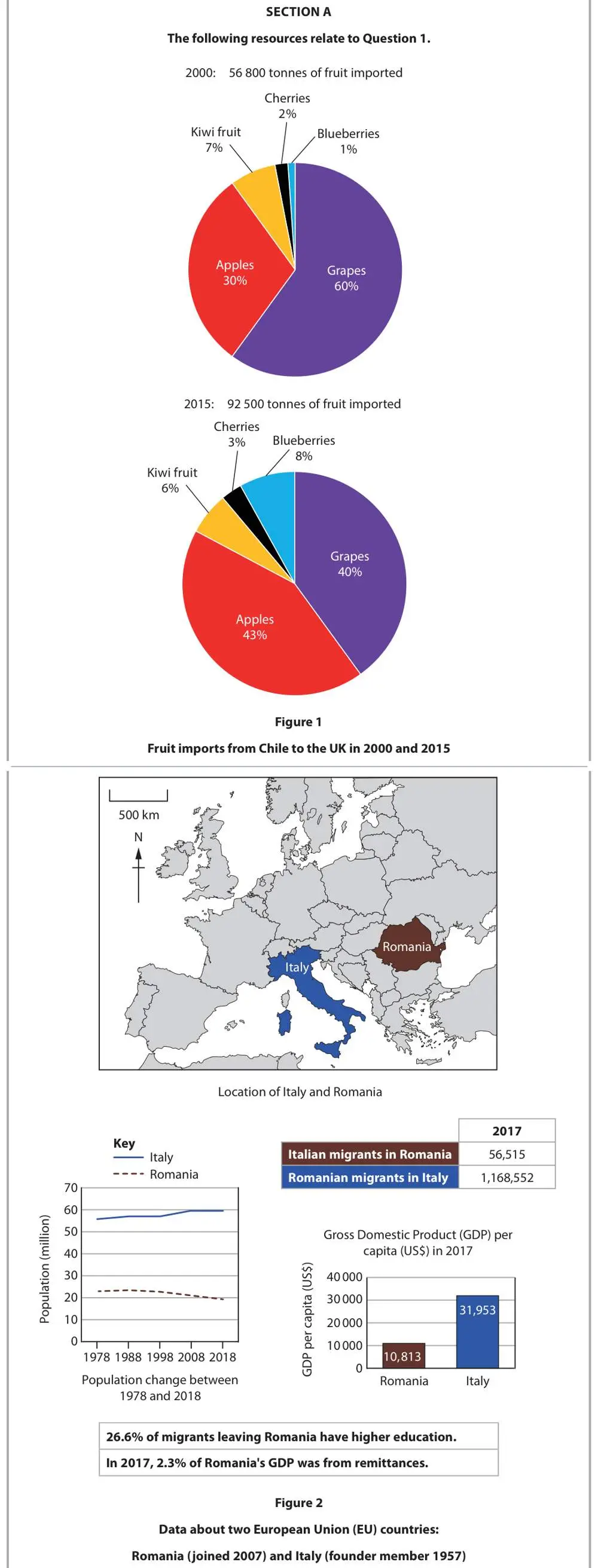
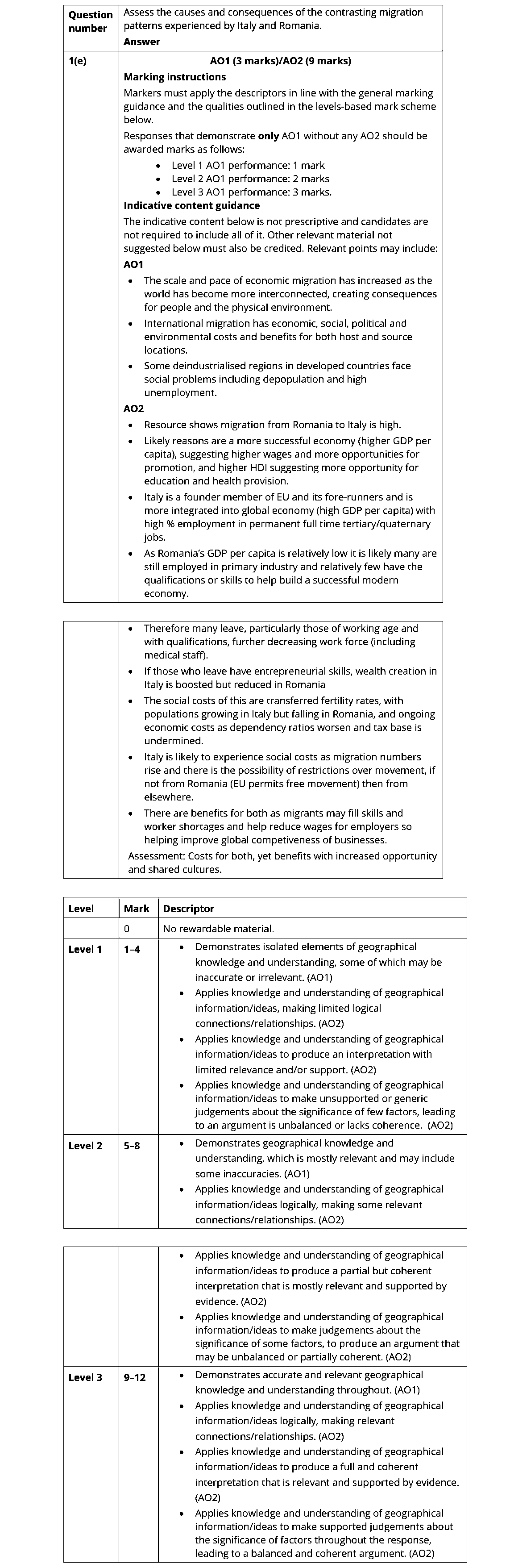
Study Figure 2 in the Resource Booklet. Assess the possible causes and consequences of the contrasting migration patterns experienced by Italy and Romania.
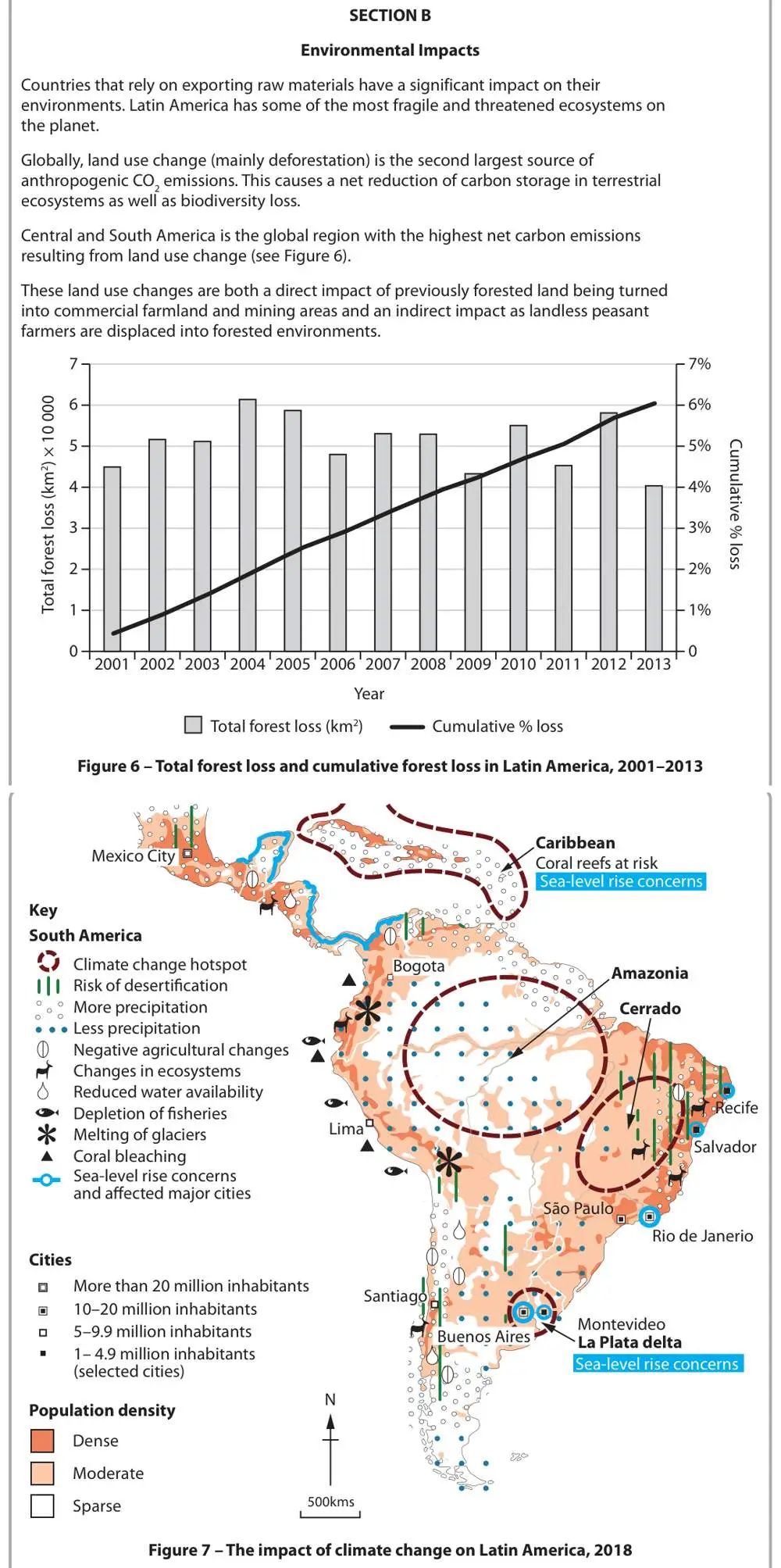
5 Study the resources in Section B of the Resource Booklet. Evaluate the view that economic development based on natural resources inevitably leads to environmental degradation (destruction).
Tap a question to zoom it. The figures open above it; the mark scheme (with its levels and indicative content) and the examiner's comment open underneath.
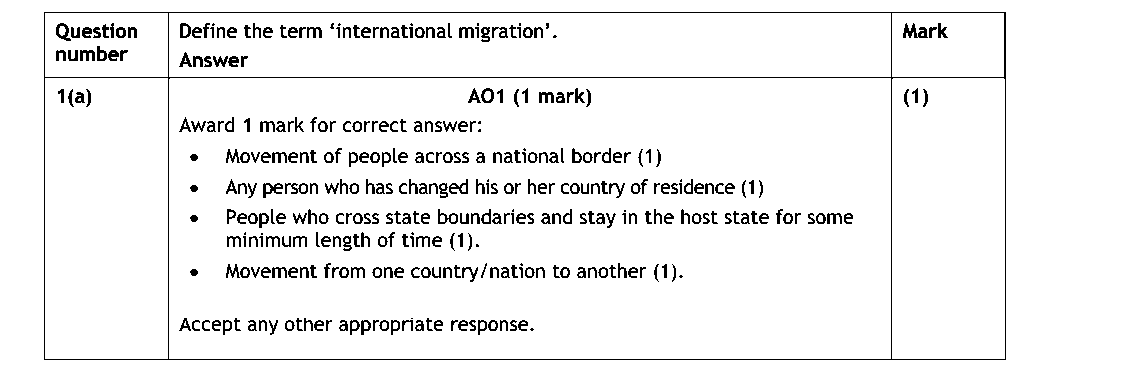
June 2025 · AS Paper 2 · Q1(a)1 markAO1=1Definition
Mark scheme
Examiner's comment
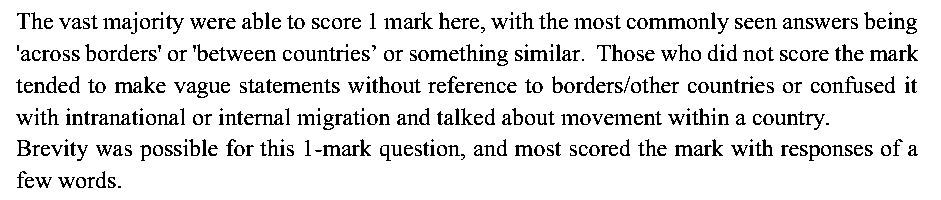
The vast majority were able to score 1 mark here, with the most commonly seen answers being 'across borders' or 'between countries’ or something similar. Those who did not score the mark tended to make vague statements without reference to borders/other countries or confused it with intranational or internal migration and talked about movement within a country. Brevity was possible for this 1-mark question, and most scored the mark with responses of a few words.
Notes from the mark scheme and report
Movement of people across a national border to live in another country
vague answers or confusing it with internal migration within a country scored nothing
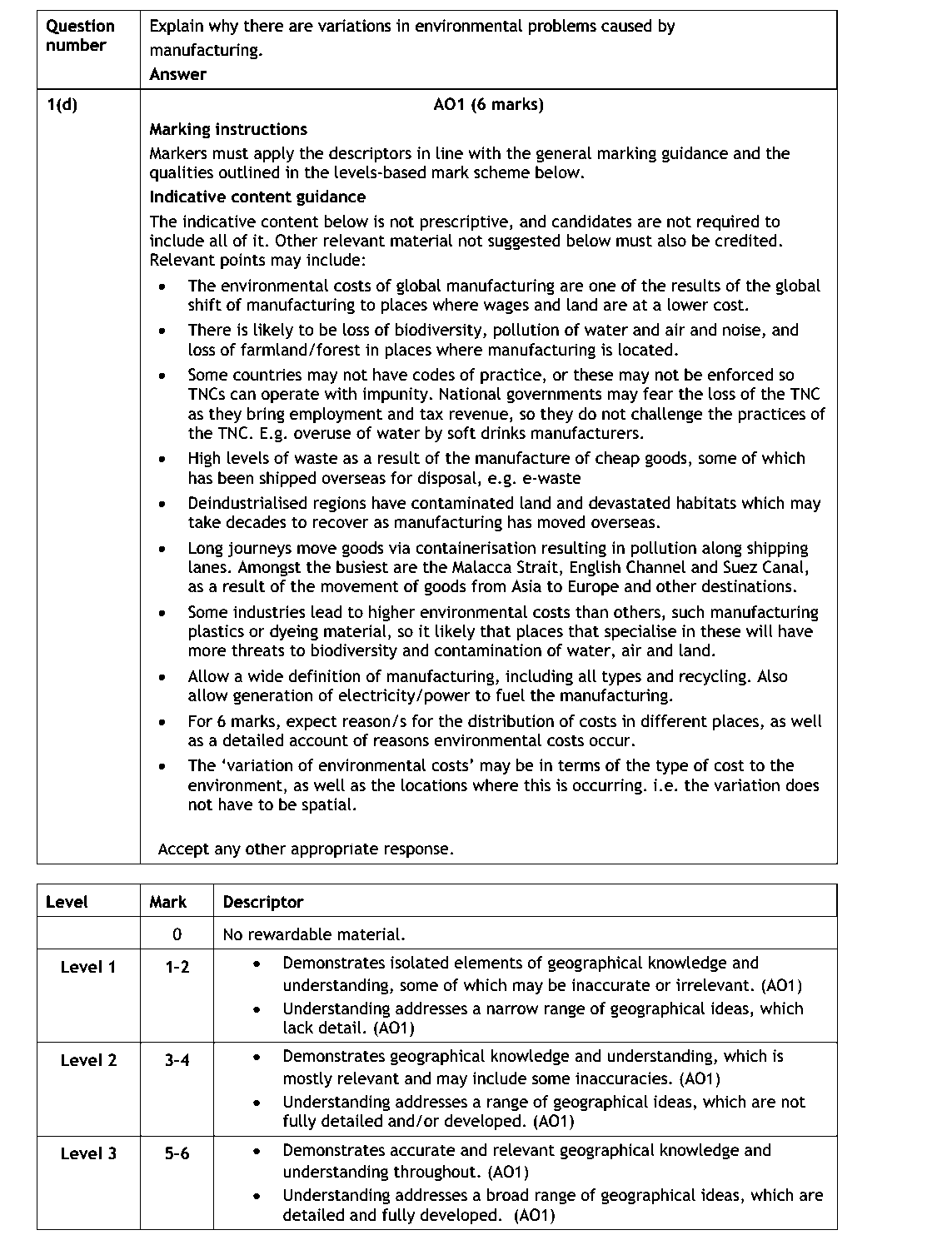
June 2025 · AS Paper 2 · Q1(d)6 marksAO1=6Extended response
Mark scheme, including the levels and indicative content
Examiner's comment
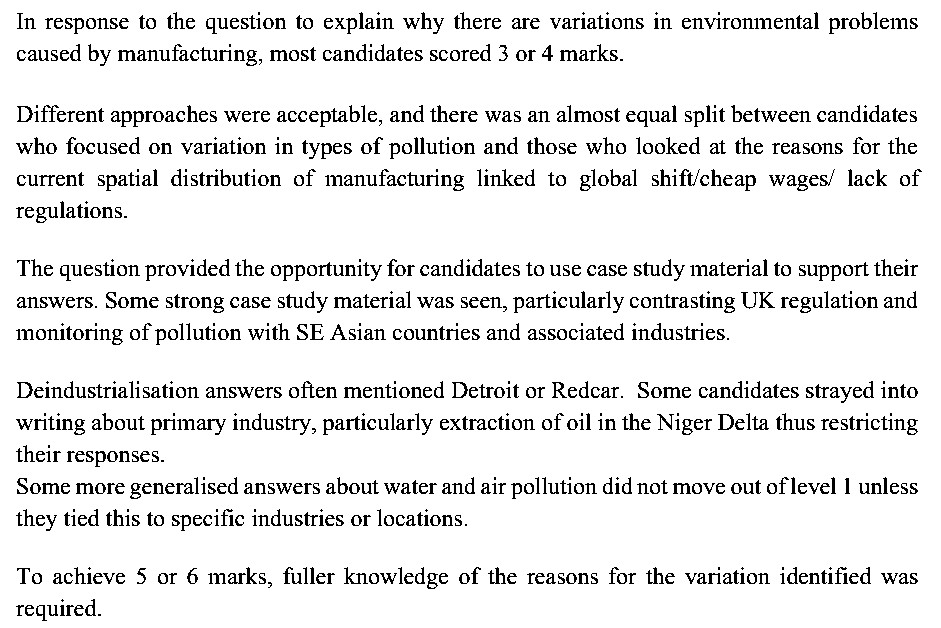
In response to the question to explain why there are variations in environmental problems caused by manufacturing, most candidates scored 3 or 4 marks. Different approaches were acceptable, and there was an almost equal split between candidates who focused on variation in types of pollution and those who looked at the reasons for the current spatial distribution of manufacturing linked to global shift/cheap wages/ lack of regulations. The question provided the opportunity for candidates to use case study material to support their answers. Some strong case study material was seen, particularly contrasting UK regulation and monitoring of pollution with SE Asian countries and associated industries. Deindustrialisation answers often mentioned Detroit or Redcar. Some candidates strayed into writing about primary industry, particularly extraction of oil in the Niger Delta thus restricting their responses. Some more generalised answers about water and air pollution did not move out of level 1 unless they tied this to specific industries or locations. To achieve 5 or 6 marks, fuller knowledge of the reasons for the variation identified was required.
Notes from the mark scheme and report
Global shift moves manufacturing to places with cheap labour and weak environmental regulation (air and water pollution, biodiversity loss) v strict regulation in developed countries
deindustrialised places (Detroit, Redcar) have legacy problems
primary industry (Niger Delta oil) is off-topic
June 2024 · AS Paper 2 · Q1(a)1 markAO1=1Short answer
Resources for question 1
Mark scheme
Examiner's comment
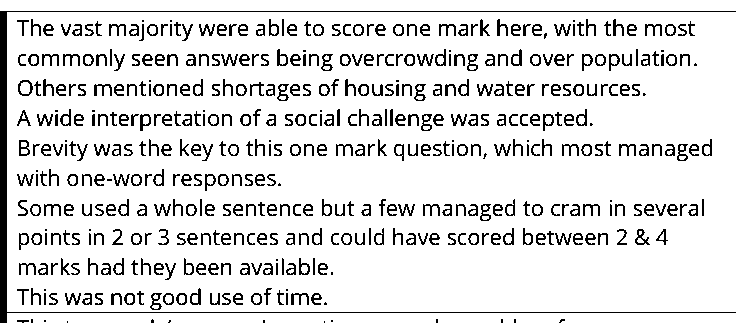
The vast majority were able to score one mark here, with the most commonly seen answers being overcrowding and over population. Others mentioned shortages of housing and water resources. A wide interpretation of a social challenge was accepted. Brevity was the key to this one mark question, which most managed with one-word responses. Some used a whole sentence but a few managed to cram in several points in 2 or 3 sentences and could have scored between 2 & 4 marks had they been available. This was not good use of time.
Notes from the mark scheme and report
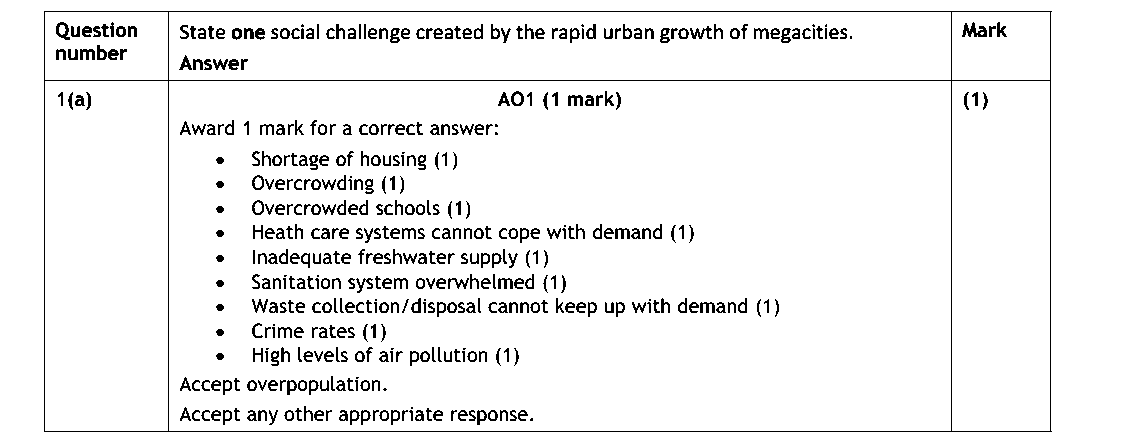
Any social challenge of rapid megacity growth: housing shortage, overcrowding, overloaded schools, health care, water and sanitation, waste, crime, air pollution
a one-word answer is enough
June 2024 · AS Paper 2 · Q1(b)(i)2 marksAO3=2Data response
Resources for question 1
Mark scheme
Examiner's comment
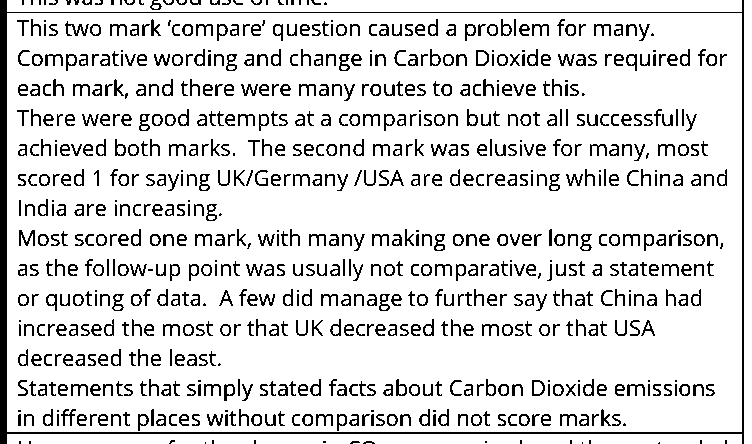
This two mark ‘compare’ question caused a problem for many. Comparative wording and change in Carbon Dioxide was required for each mark, and there were many routes to achieve this. There were good attempts at a comparison but not all successfully achieved both marks. The second mark was elusive for many, most scored 1 for saying UK/Germany /USA are decreasing while China and India are increasing. Most scored one mark, with many making one over long comparison, as the follow-up point was usually not comparative, just a statement or quoting of data. A few did manage to further say that China had increased the most or that UK decreased the most or that USA decreased the least. Statements that simply stated facts about Carbon Dioxide emissions in different places without comparison did not score marks.
Notes from the mark scheme and report
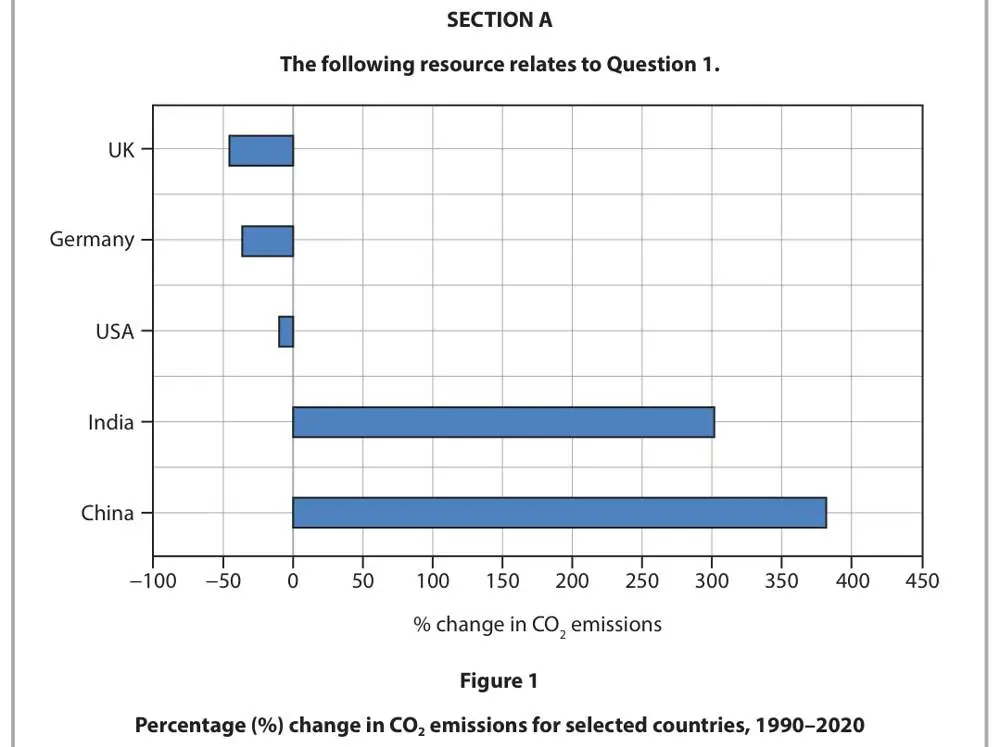
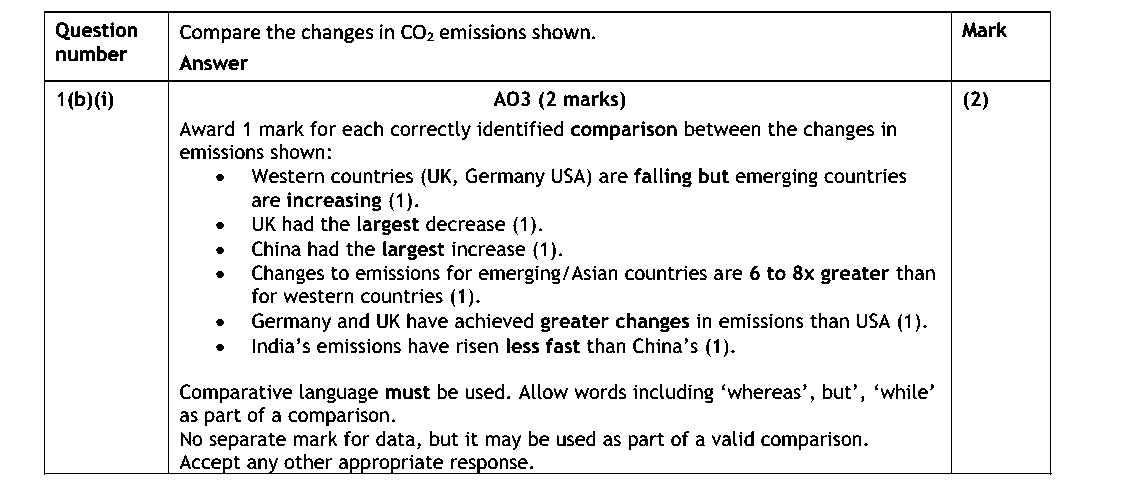
Use Figure 1 (% change in CO2 1990-2020): UK, Germany and USA fell while China and India rose
UK largest fall, China largest rise (about 380%), USA smallest fall
each mark needs comparative language about change
report: 'caused a problem for many', most scored only 1
June 2024 · AS Paper 2 · Q1(b)(ii)3 marksAO1=2, AO2=1Data response
Resources for question 1
Mark scheme
Examiner's comment
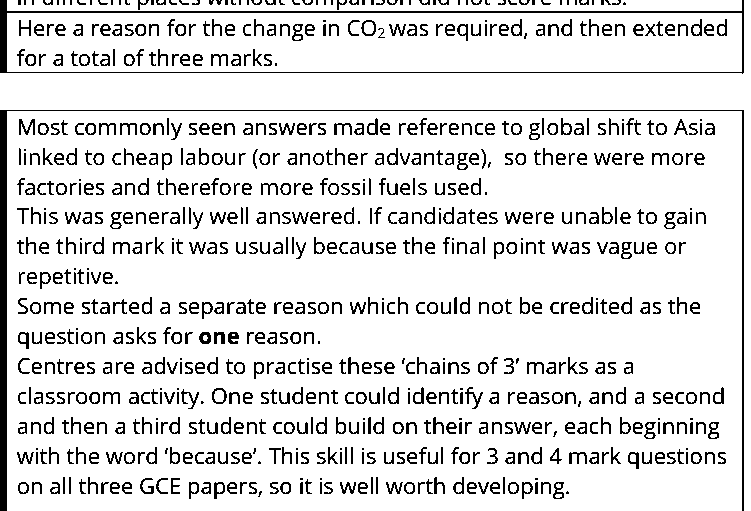
Here a reason for the change in CO2 was required, and then extended for a total of three marks. Most commonly seen answers made reference to global shift to Asia linked to cheap labour (or another advantage), so there were more factories and therefore more fossil fuels used. This was generally well answered. If candidates were unable to gain the third mark it was usually because the final point was vague or repetitive. Some started a separate reason which could not be credited as the question asks for one reason. Centres are advised to practise these ‘chains of 3’ marks as a classroom activity. One student could identify a reason, and a second and then a third student could build on their answer, each beginning with the word ‘because’. This skill is useful for 3 and 4 mark questions on all three GCE papers, so it is well worth developing.
Notes from the mark scheme and report
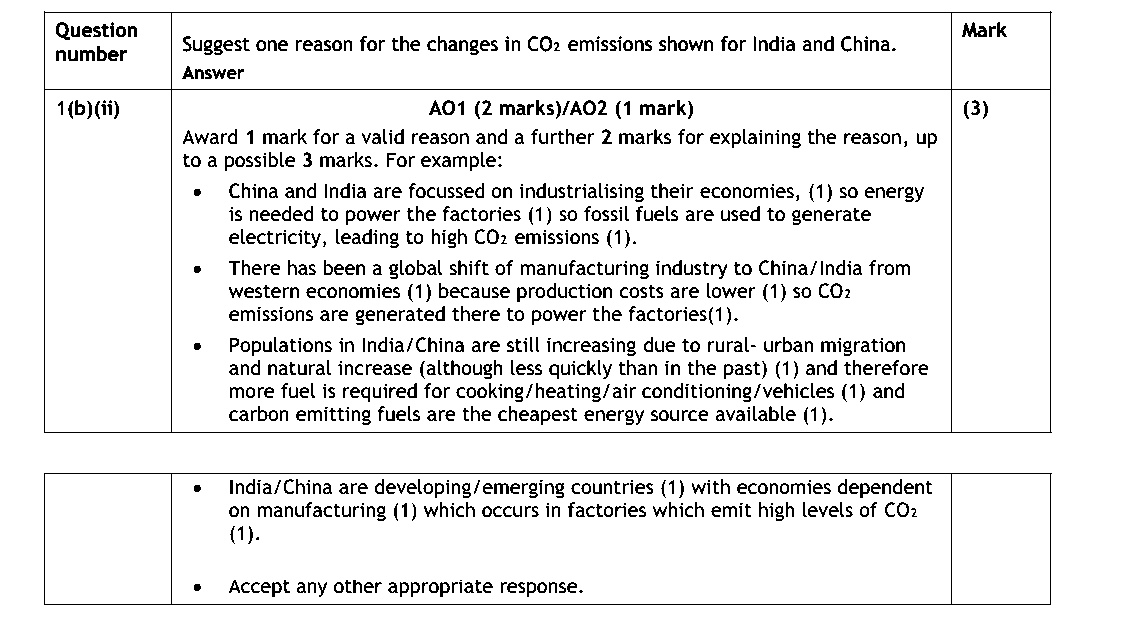
One reason developed in a chain of three: global shift of manufacturing to China/India for cheap labour, so more factories powered by fossil fuels, so rising CO2
also industrialisation, population growth and rising consumption
a second separate reason is not credited
June 2024 · AS Paper 2 · Q1(c)4 marksAO1=4Short answer
Resources for question 1
Mark scheme
Examiner's comment
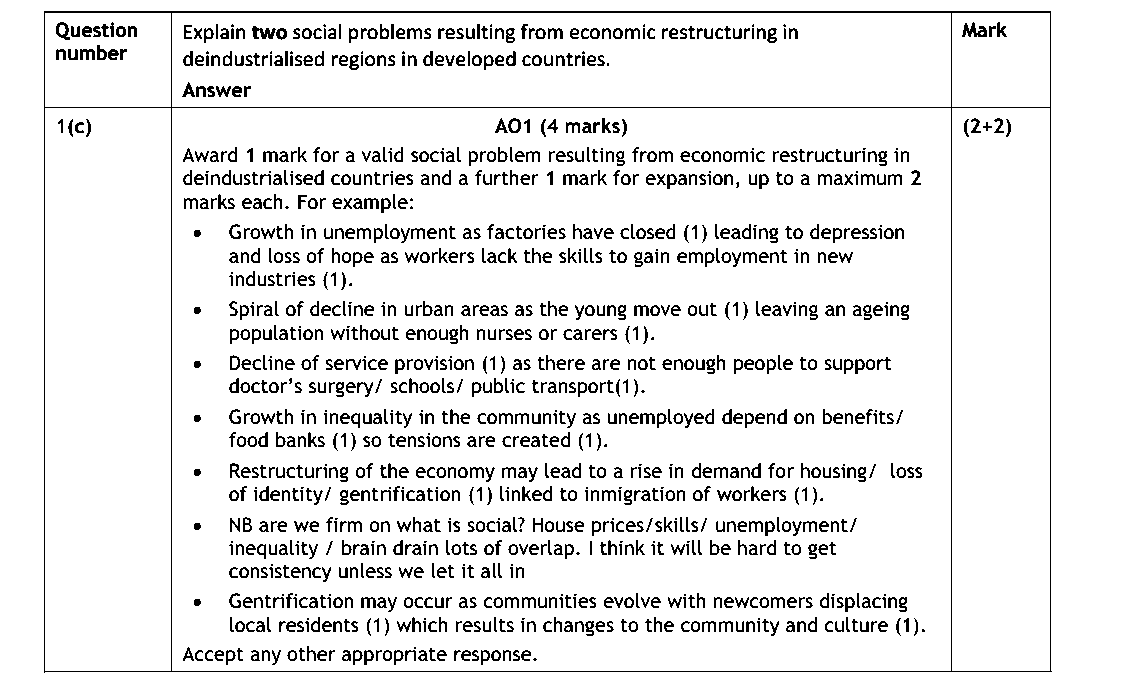
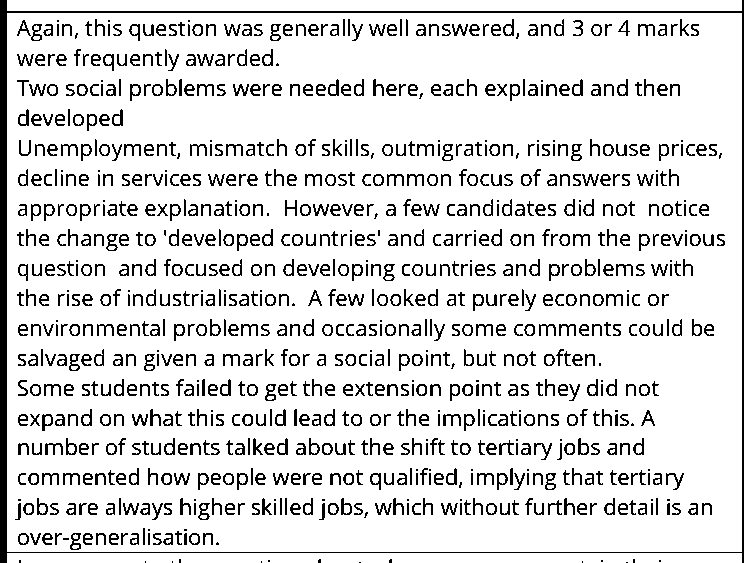
Again, this question was generally well answered, and 3 or 4 marks were frequently awarded. Two social problems were needed here, each explained and then developed Unemployment, mismatch of skills, outmigration, rising house prices, decline in services were the most common focus of answers with appropriate explanation. However, a few candidates did not notice the change to 'developed countries' and carried on from the previous question and focused on developing countries and problems with the rise of industrialisation. A few looked at purely economic or environmental problems and occasionally some comments could be salvaged an given a mark for a social point, but not often. Some students failed to get the extension point as they did not expand on what this could lead to or the implications of this. A number of students talked about the shift to tertiary jobs and commented how people were not qualified, implying that tertiary jobs are always higher skilled jobs, which without further detail is an over-generalisation.
Notes from the mark scheme and report
Deindustrialised regions in developed countries: unemployment and skills mismatch, out-migration of the young leaving an ageing population, decline of services, deprivation and crime
some wrongly wrote about developing countries or economic/environmental problems
June 2023 · AS Paper 2 · Q1(a)1 markAO1=1Short answer
Resources for question 1
Mark scheme
Examiner's comment
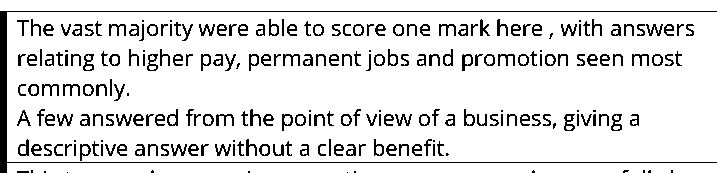
The vast majority were able to score one mark here , with answers relating to higher pay, permanent jobs and promotion seen most commonly. A few answered from the point of view of a business, giving a descriptive answer without a clear benefit.
Notes from the mark scheme and report
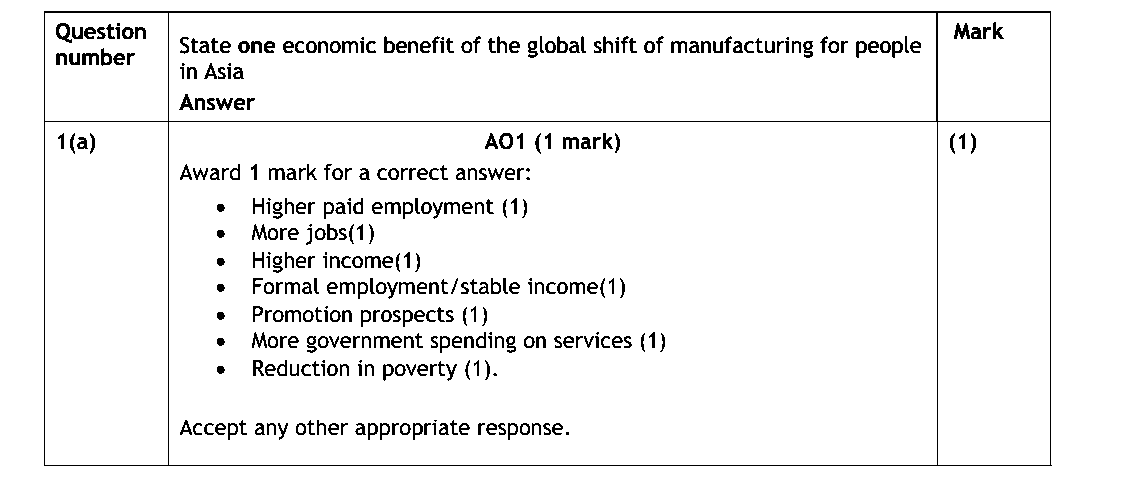
Higher pay, more and more formal jobs, stable income, promotion, poverty reduction, more government spending on services
answers from the business point of view gave no benefit to people
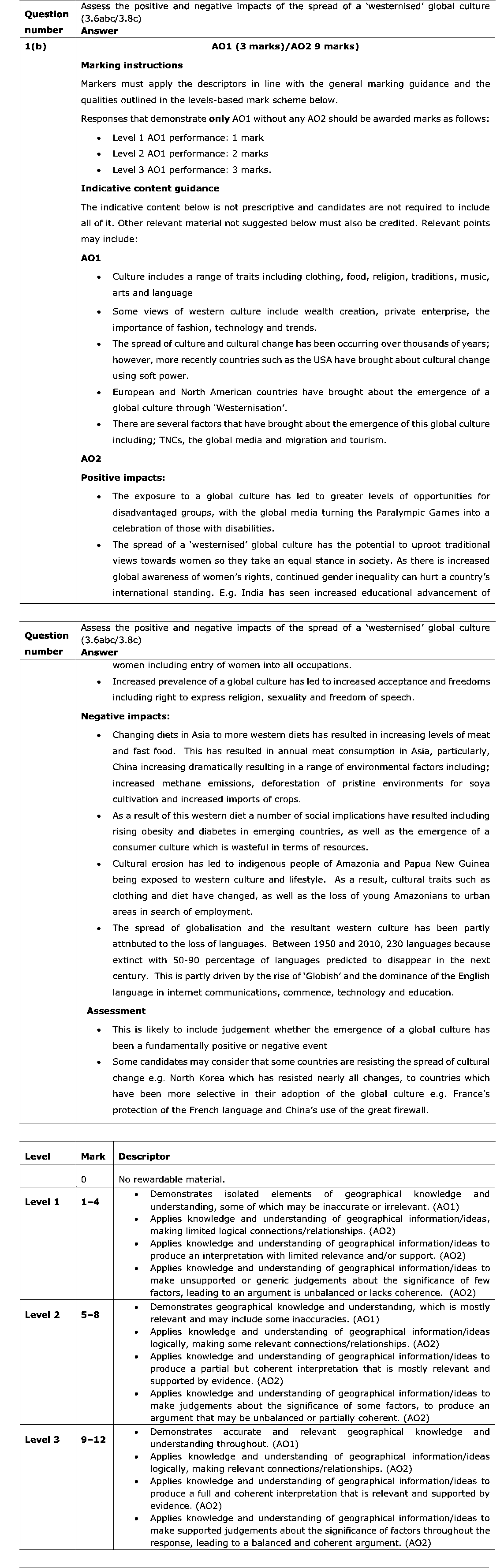
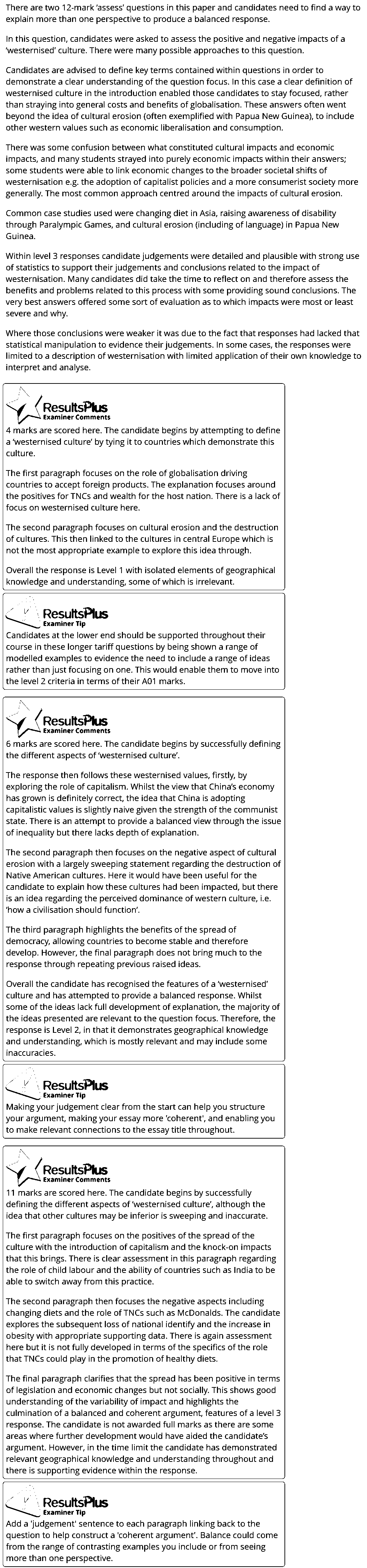
June 2023 · Paper 2 · Q1(b)12 marksAO1=3, AO2=912-mark essay
Mark scheme, including the levels and indicative content
Examiner's comment
There are two 12-mark ‘assess’ questions in this paper and candidates need to find a way to explain more than one perspective to produce a balanced response. In this question, candidates were asked to assess the positive and negative impacts of a ‘westernised’ culture. There were many possible approaches to this question. Candidates are advised to define key terms contained within questions in order to demonstrate a clear understanding of the question focus. In this case a clear definition of westernised culture in the introduction enabled those candidates to stay focused, rather than straying into general costs and benefits of globalisation. These answers often went beyond the idea of cultural erosion (often exemplified with Papua New Guinea), to include other western values such as economic liberalisation and consumption. There was some confusion between what constituted cultural impacts and economic impacts, and many students strayed into purely economic impacts within their answers; some students were able to link economic changes to the broader societal shifts of westernisation e.g. the adoption of capitalist policies and a more consumerist society more generally. The most common approach centred around the impacts of cultural erosion. Common case studies used were changing diet in Asia, raising awareness of disability through Paralympic Games, and cultural erosion (including of language) in Papua New Guinea. Within level 3 responses candidate judgements were detailed and plausible with strong use of statistics to support their judgements and conclusions related to the impact of westernisation. Many candidates did take the time to reflect on and therefore assess the benefits and problems related to this process with some providing sound conclusions. The very best answers offered some sort of evaluation as to which impacts were most or least severe and why. Where those conclusions were weaker it was due to the fact that responses had lacked that statistical manipulation to evidence their judgements. In some cases, the responses were limited to a description of westernisation with limited application of their own knowledge to interpret and analyse. 4 marks are scored here. The candidate begins by attempting to define a ‘westernised culture’ by tying it to countries which demonstrate this culture. The first paragraph focuses on the role of globalisation driving countries to accept foreign products. The explanation focuses around the positives for TNCs and wealth for the host nation. There is a lack of focus on westernised culture here. The second paragraph focuses on cultural erosion and the destruction of cultures. This then linked to the cultures in central Europe which is not the most appropriate example to explore this idea through. Overall the response is Level 1 with isolated elements of geographical knowledge and understanding, some of which is irrelevant. Candidates at the lower end should be supported throughout their course in these longer tariff questions by being shown a range of modelled examples to evidence the need to include a range of ideas rather than just focusing on one. This would enable them to move into the level 2 criteria in terms of their A01 marks. 6 marks are scored here. The candidate begins by successfully defining the different aspects of ‘westernised culture’. The response then follows these westernised values, firstly, by exploring the role of capitalism. Whilst the view that China’s economy has grown is definitely correct, the idea that China is adopting capitalistic values is slightly naive given the strength of the communist state. There is an attempt to provide a balanced view through the issue of inequality but there lacks depth of explanation. The second paragraph then focuses on the negative aspect of cultural erosion with a largely sweeping statement regarding the destruction of Native American cultures. Here it would have been useful for the candidate to explain how these cultures had been impacted, but there is an idea regarding the perceived dominance of western culture, i.e. ‘how a civilisation should function’. The third paragraph highlights the benefits of the spread of democracy, allowing countries to become stable and therefore develop. However, the final paragraph does not bring much to the response through repeating previous raised ideas. Overall the candidate has recognised the features of a ‘westernised’ culture and has attempted to provide a balanced response. Whilst some of the ideas lack full development of explanation, the majority of the ideas presented are relevant to the question focus. Therefore, the response is Level 2, in that it demonstrates geographical knowledge and understanding, which is mostly relevant and may include some inaccuracies. Making your judgement clear from the start can help you structure your argument, making your essay more 'coherent', and enabling you to make relevant connections to the essay title throughout. 11 marks are scored here. The candidate begins by successfully defining the different aspects of ‘westernised culture’, although the idea that other cultures may be inferior is sweeping and inaccurate. The first paragraph focuses on the positives of the spread of the culture with the introduction of capitalism and the knock-on impacts that this brings. There is clear assessment in this paragraph regarding the role of child labour and the ability of countries such as India to be able to switch away from this practice. The second paragraph then focuses the negative aspects including changing diets and the role of TNCs such as McDonalds. The candidate explores the subsequent loss of national identify and the increase in obesity with appropriate supporting data. There is again assessment here but it is not fully developed in terms of the specifics of the role that TNCs could play in the promotion of healthy diets. The final paragraph clarifies that the spread has been positive in terms of legislation and economic changes but not socially. This shows good understanding of the variability of impact and highlights the culmination of a balanced and coherent argument, features of a level 3 response. The candidate is not awarded full marks as there are some areas where further development would have aided the candidate’s argument. However, in the time limit the candidate has demonstrated relevant geographical knowledge and understanding throughout and there is supporting evidence within the response. Add a 'judgement' sentence to each paragraph linking back to the question to help construct a 'coherent argument'. Balance could come from the range of contrasting examples you include or from seeing more than one perspective.
Notes from the mark scheme and report
Define westernised culture first
positives (opportunities for disadvantaged groups, awareness, consumer choice, economic growth) v negatives (cultural erosion e.g. Papua New Guinea, loss of language and diet, environmental impacts, opposition and tension)
avoid drifting into general costs and benefits of globalisation
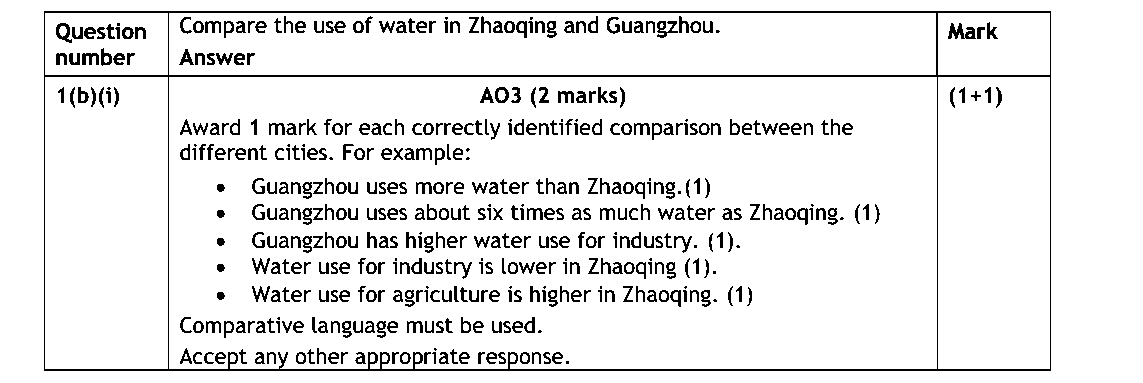
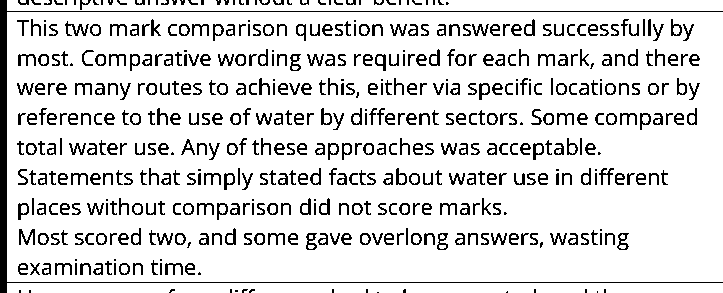
June 2023 · AS Paper 2 · Q1(b)(i)2 marksAO3=2Data response
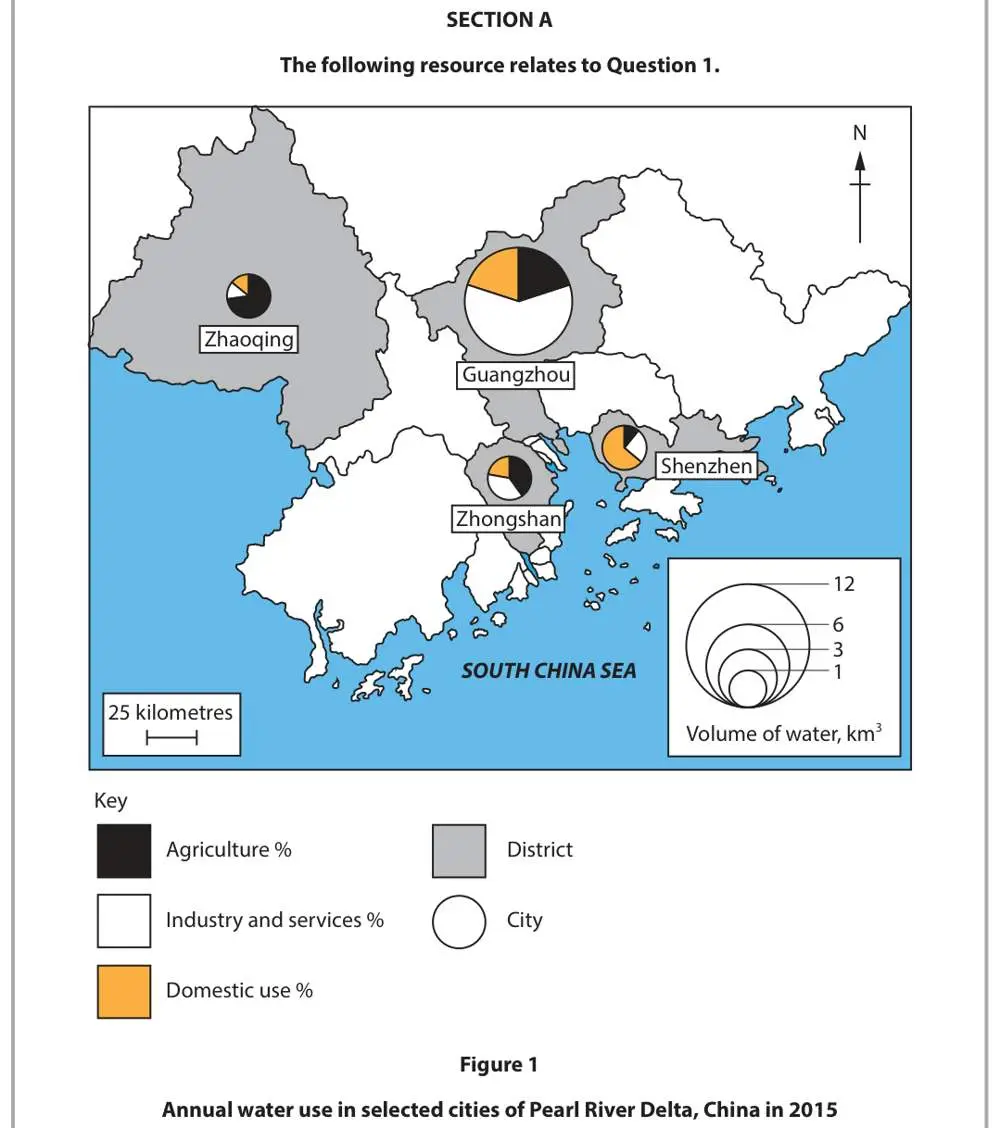
Resources for question 1
Mark scheme
Examiner's comment
This two mark comparison question was answered successfully by most. Comparative wording was required for each mark, and there were many routes to achieve this, either via specific locations or by reference to the use of water by different sectors. Some compared total water use. Any of these approaches was acceptable. Statements that simply stated facts about water use in different places without comparison did not score marks. Most scored two, and some gave overlong answers, wasting examination time.
Notes from the mark scheme and report
Guangzhou uses far more water (about six times Zhaoqing)
Guangzhou mostly industry and services, Zhaoqing mostly agriculture
comparative wording needed for each mark
separate facts not credited
June 2023 · AS Paper 2 · Q1(b)(ii)3 marksAO1=2, AO2=1Data response
Resources for question 1
Mark scheme
Examiner's comment
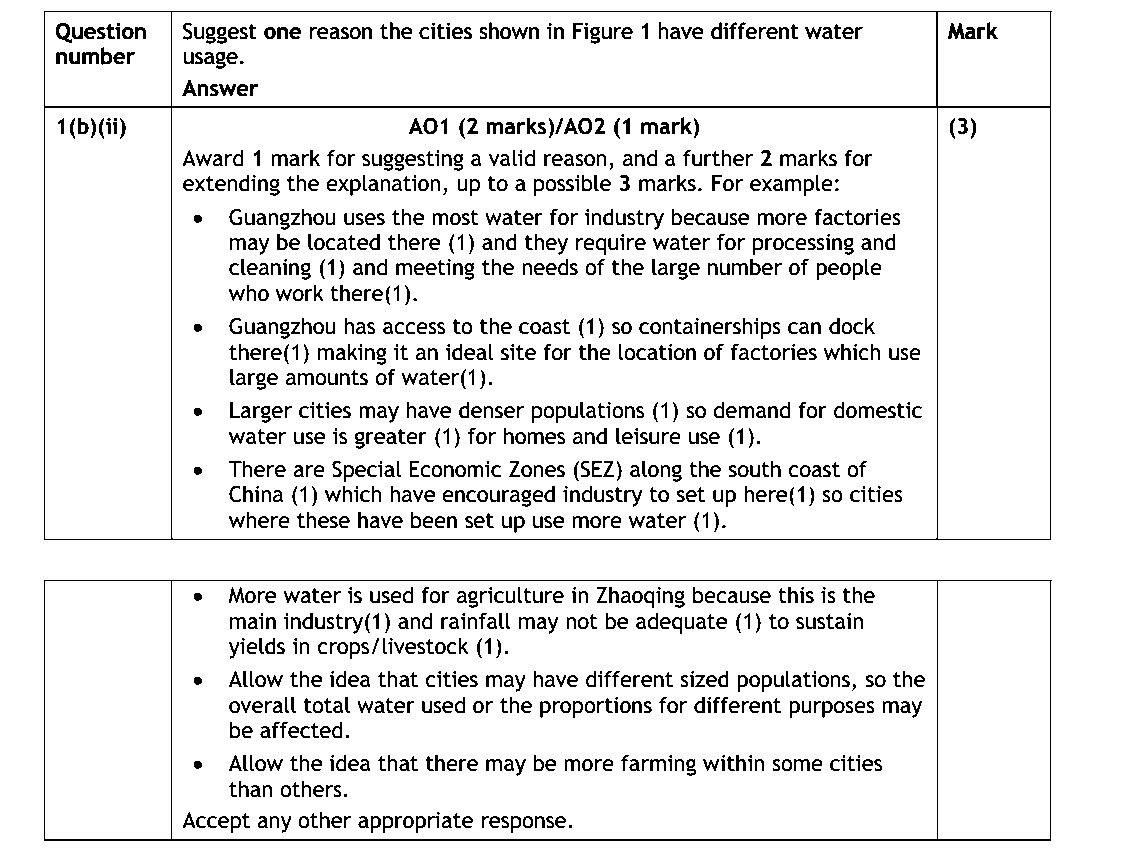
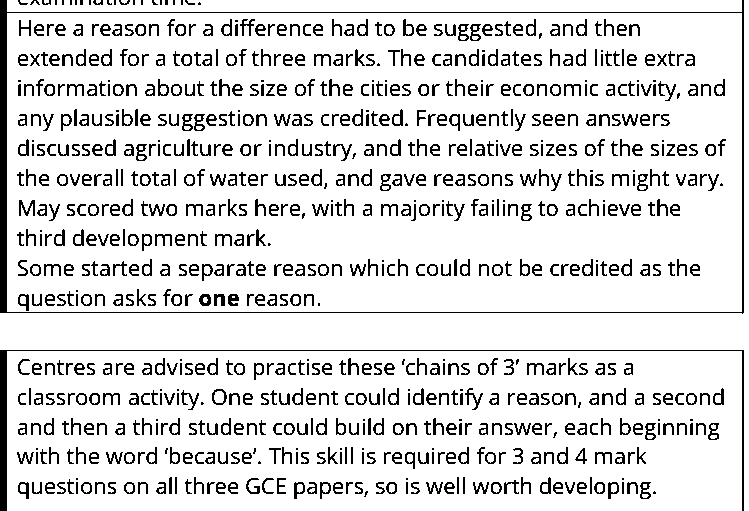
Here a reason for a difference had to be suggested, and then extended for a total of three marks. The candidates had little extra information about the size of the cities or their economic activity, and any plausible suggestion was credited. Frequently seen answers discussed agriculture or industry, and the relative sizes of the sizes of the overall total of water used, and gave reasons why this might vary. May scored two marks here, with a majority failing to achieve the third development mark. Some started a separate reason which could not be credited as the question asks for one reason. Centres are advised to practise these ‘chains of 3’ marks as a classroom activity. One student could identify a reason, and a second and then a third student could build on their answer, each beginning with the word ‘because’. This skill is required for 3 and 4 mark questions on all three GCE papers, so is well worth developing.
Notes from the mark scheme and report
One reason developed: Guangzhou has more factories and a larger population (industrial and domestic demand), Zhaoqing more farming and irrigation
most scored 2 without the third development
a second separate reason is not credited
June 2023 · AS Paper 2 · Q1(e)12 marksAO1=3, AO2=912-mark essay
Resources for question 1
Mark scheme, including the levels and indicative content
Examiner's comment
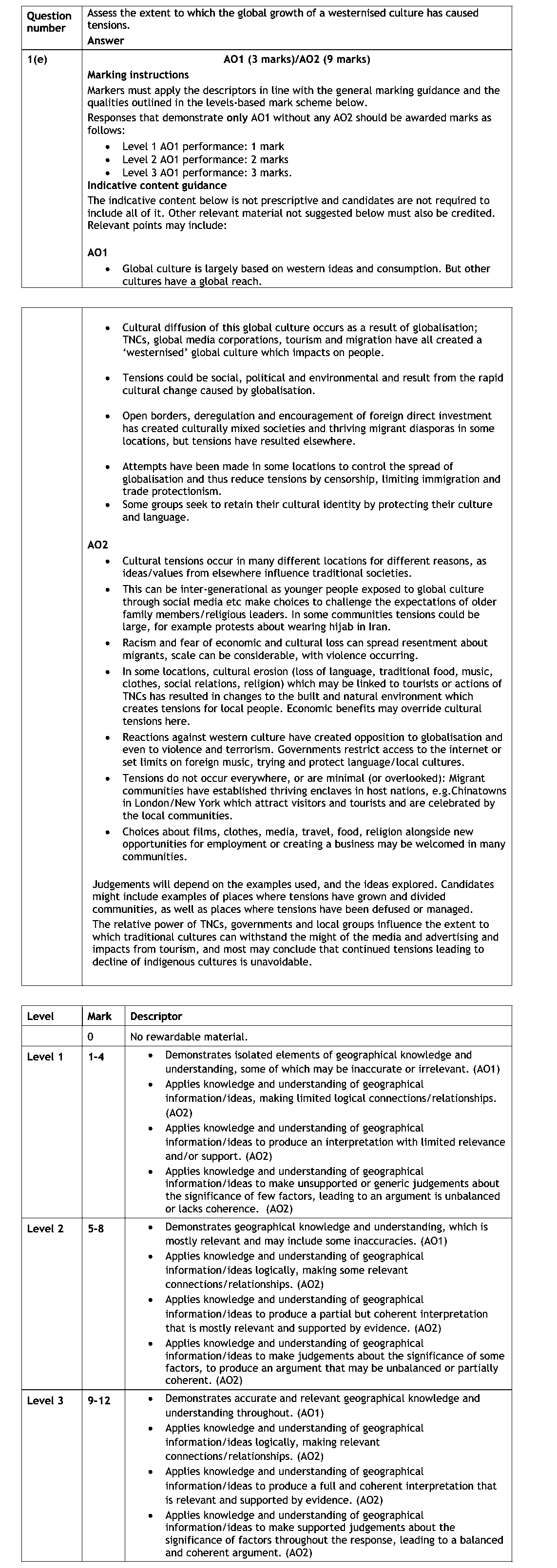
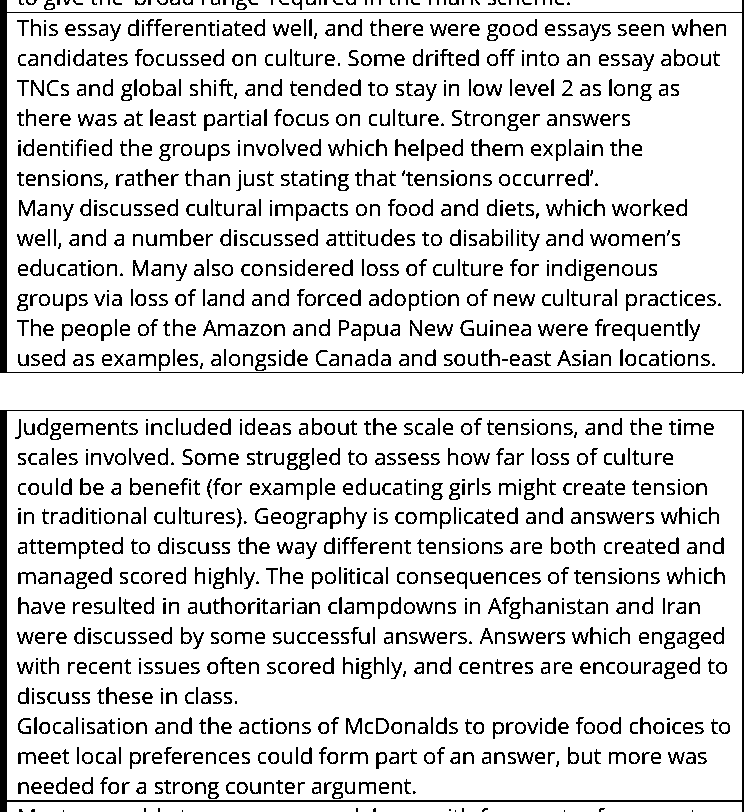
This essay differentiated well, and there were good essays seen when candidates focussed on culture. Some drifted off into an essay about TNCs and global shift, and tended to stay in low level 2 as long as there was at least partial focus on culture. Stronger answers identified the groups involved which helped them explain the tensions, rather than just stating that ‘tensions occurred’. Many discussed cultural impacts on food and diets, which worked well, and a number discussed attitudes to disability and women’s education. Many also considered loss of culture for indigenous groups via loss of land and forced adoption of new cultural practices. The people of the Amazon and Papua New Guinea were frequently used as examples, alongside Canada and south-east Asian locations. Judgements included ideas about the scale of tensions, and the time scales involved. Some struggled to assess how far loss of culture could be a benefit (for example educating girls might create tension in traditional cultures). Geography is complicated and answers which attempted to discuss the way different tensions are both created and managed scored highly. The political consequences of tensions which have resulted in authoritarian clampdowns in Afghanistan and Iran were discussed by some successful answers. Answers which engaged with recent issues often scored highly, and centres are encouraged to discuss these in class. Glocalisation and the actions of McDonalds to provide food choices to meet local preferences could form part of an answer, but more was needed for a strong counter argument.
Notes from the mark scheme and report
Focus on culture: diets, dress, language, Indigenous groups (Amazon, Papua New Guinea), anti-globalisation groups, censorship
identify the groups in tension
drifting into TNCs and global shift held answers in low L2
June 2022 · Paper 3 · Q48 marksAO1=4, AO3=4Extended response
Resources for question 4
Mark scheme, including the levels and indicative content
Examiner's comment
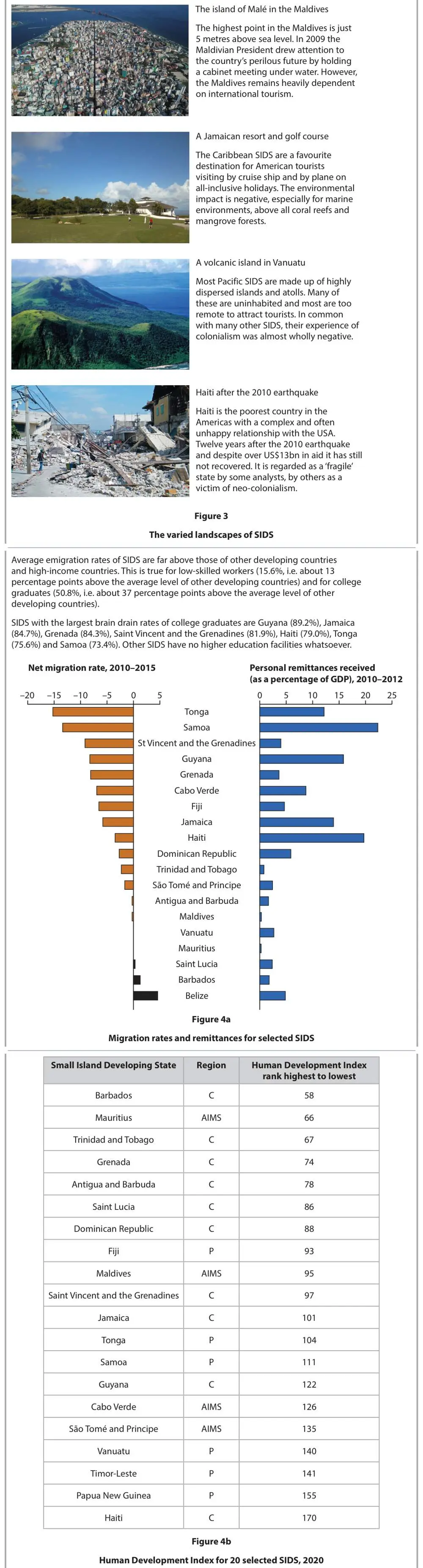
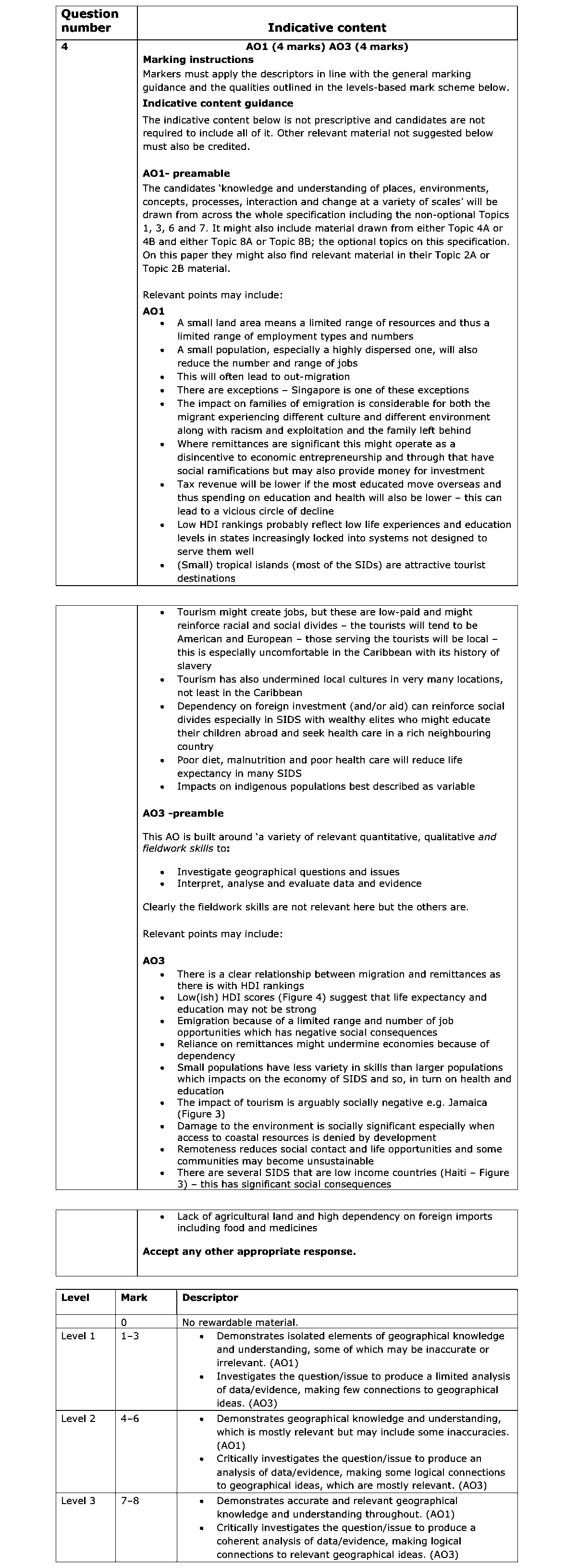
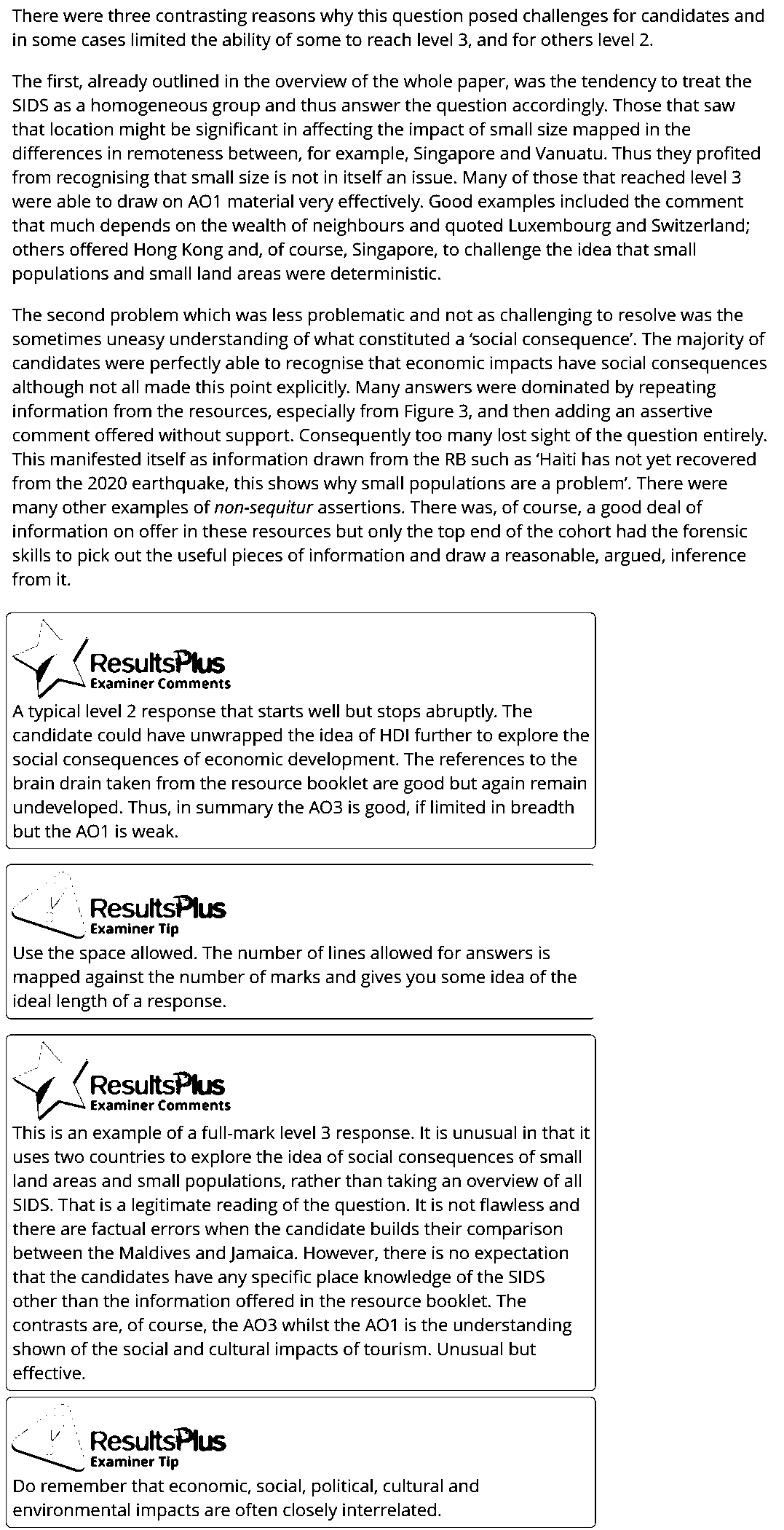
There were three contrasting reasons why this question posed challenges for candidates and in some cases limited the ability of some to reach level 3, and for others level 2. The first, already outlined in the overview of the whole paper, was the tendency to treat the SIDS as a homogeneous group and thus answer the question accordingly. Those that saw that location might be significant in affecting the impact of small size mapped in the differences in remoteness between, for example, Singapore and Vanuatu. Thus they profited from recognising that small size is not in itself an issue. Many of those that reached level 3 were able to draw on AO1 material very effectively. Good examples included the comment that much depends on the wealth of neighbours and quoted Luxembourg and Switzerland; others offered Hong Kong and, of course, Singapore, to challenge the idea that small populations and small land areas were deterministic. The second problem which was less problematic and not as challenging to resolve was the sometimes uneasy understanding of what constituted a ‘social consequence’. The majority of candidates were perfectly able to recognise that economic impacts have social consequences although not all made this point explicitly. Many answers were dominated by repeating information from the resources, especially from Figure 3, and then adding an assertive comment offered without support. Consequently too many lost sight of the question entirely. This manifested itself as information drawn from the RB such as ‘Haiti has not yet recovered from the 2020 earthquake, this shows why small populations are a problem’. There were many other examples of non-sequitur assertions. There was, of course, a good deal of information on offer in these resources but only the top end of the cohort had the forensic skills to pick out the useful pieces of information and draw a reasonable, argued, inference from it. A typical level 2 response that starts well but stops abruptly. The candidate could have unwrapped the idea of HDI further to explore the social consequences of economic development. The references to the brain drain taken from the resource booklet are good but again remain undeveloped. Thus, in summary the AO3 is good, if limited in breadth but the AO1 is weak. Use the space allowed. The number of lines allowed for answers is mapped against the number of marks and gives you some idea of the ideal length of a response. This is an example of a full-mark level 3 response. It is unusual in that it uses two countries to explore the idea of social consequences of small land areas and small populations, rather than taking an overview of all SIDS. That is a legitimate reading of the question. It is not flawless and there are factual errors when the candidate builds their comparison between the Maldives and Jamaica. However, there is no expectation that the candidates have any specific place knowledge of the SIDS other than the information offered in the resource booklet. The contrasts are, of course, the AO3 whilst the AO1 is the understanding shown of the social and cultural impacts of tourism. Unusual but effective. Do remember that economic, social, political, cultural and environmental impacts are often closely interrelated.
Notes from the mark scheme and report
Figures 3-4b: limited jobs drive out-migration and brain drain (Guyana 89% of graduates), dependence on remittances (Haiti, Samoa), low HDI
small size not deterministic (Singapore, Luxembourg)
avoid treating SIDS as one homogeneous group
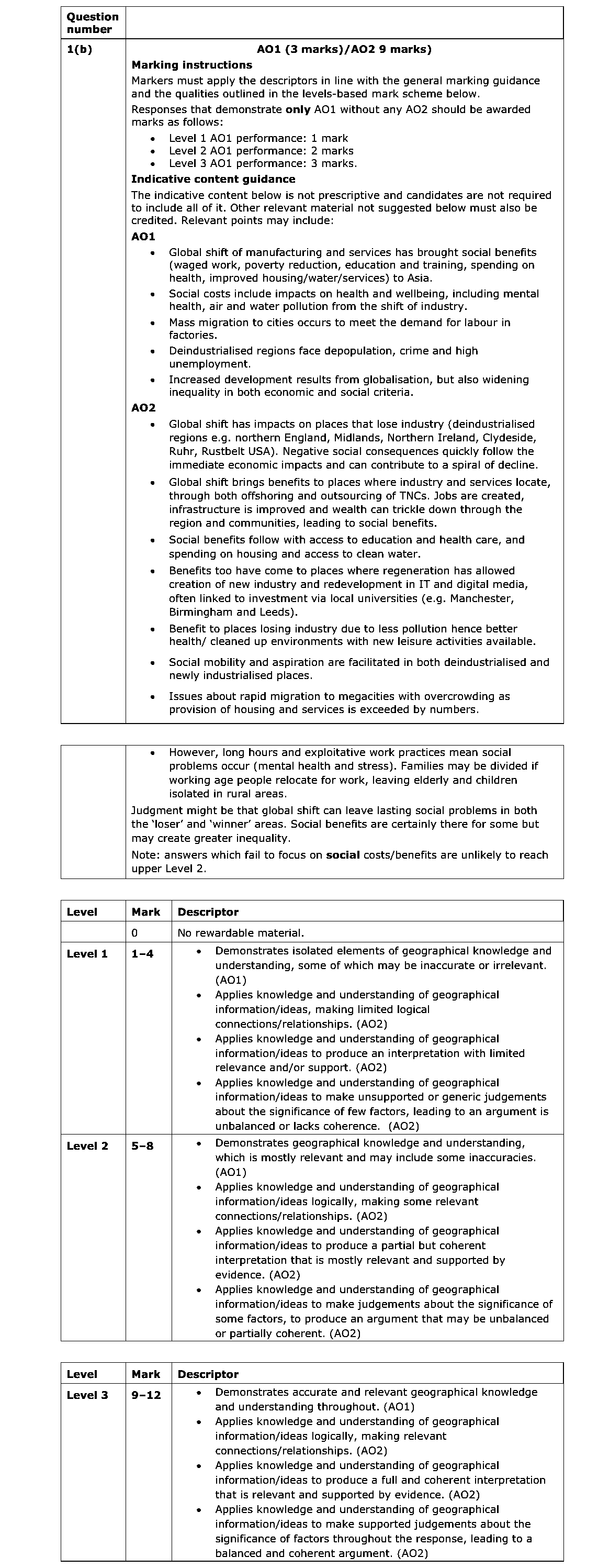
November 2021 · Paper 2 · Q1(b)12 marksAO1=3, AO2=912-mark essay
Mark scheme, including the levels and indicative content
Examiner's comment
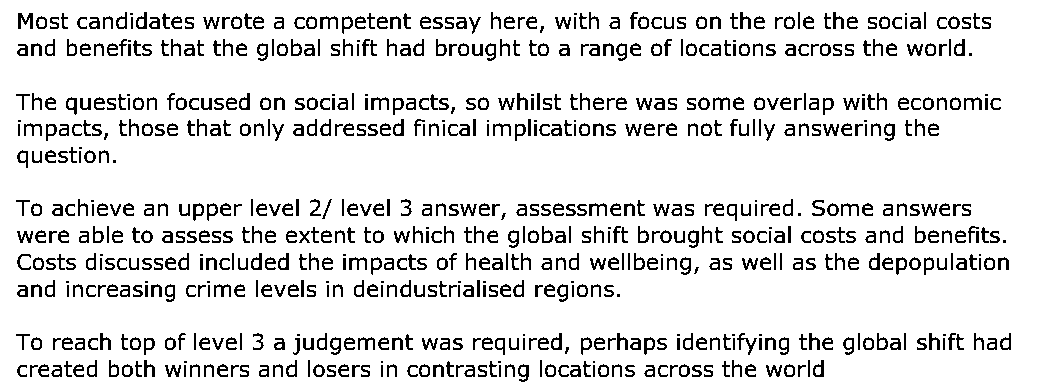
Most candidates wrote a competent essay here, with a focus on the role the social costs and benefits that the global shift had brought to a range of locations across the world. The question focused on social impacts, so whilst there was some overlap with economic impacts, those that only addressed finical implications were not fully answering the question. To achieve an upper level 2/ level 3 answer, assessment was required. Some answers were able to assess the extent to which the global shift brought social costs and benefits. Costs discussed included the impacts of health and wellbeing, as well as the depopulation and increasing crime levels in deindustrialised regions. To reach top of level 3 a judgement was required, perhaps identifying the global shift had created both winners and losers in contrasting locations across the world
Notes from the mark scheme and report
Benefits in Asia (waged work, poverty reduction, education, health, services) v costs (pollution, poor conditions, mental health, unplanned urban growth) and deindustrialised regions (depopulation, crime, unemployment)
must focus on social not just economic impacts
Level 3 judgement on winners and losers
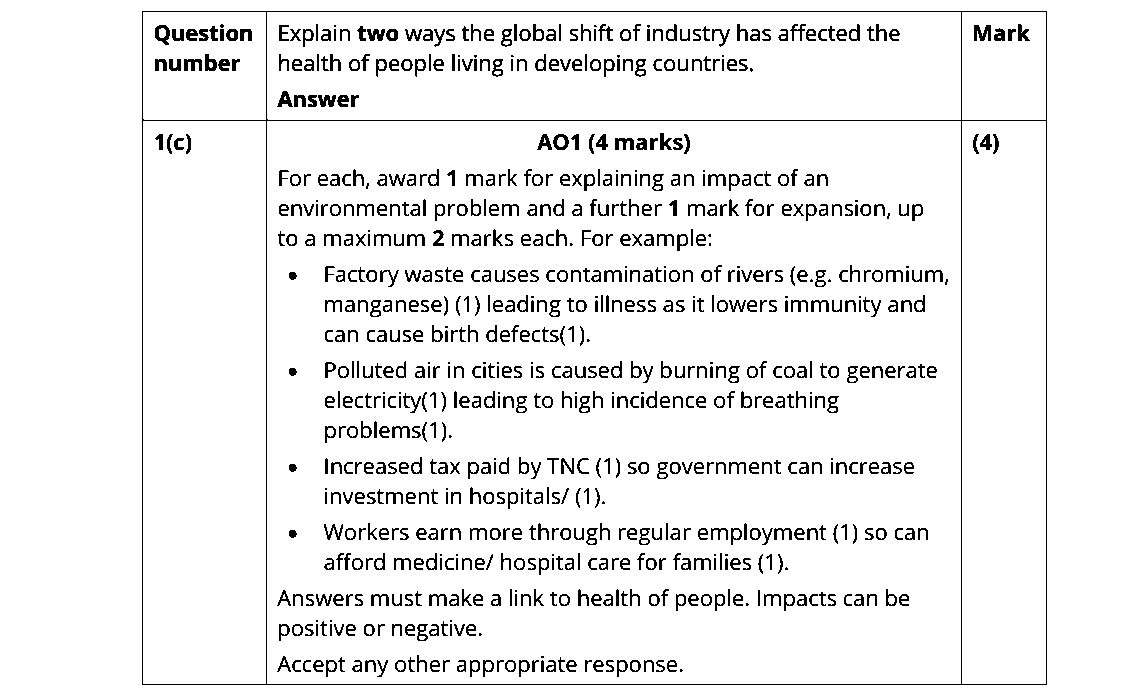
October 2020 · AS Paper 2 · Q1(c)4 marksAO1=4Short answer
Resources for question 1
Mark scheme
Notes from the mark scheme and report
Two ways x (1+1)
must link to health
factory waste contaminates rivers causing illness
coal-burning air pollution and breathing problems
positives accepted (TNC taxes fund hospitals, wages buy medicine)
October 2020 · AS Paper 2 · Q1(e)12 marksAO1=3, AO2=912-mark essay
Resources for question 1
Mark scheme, including the levels and indicative content
Notes from the mark scheme and report
Use Figure 2: GDP per capita gap (10 813 v 31 953 US$), 1.17 million Romanians in Italy v 56 515 Italians in Romania, Romania's falling population, 26.6% of emigrants with higher education, remittances 2.3% of GDP
weigh brain drain and ageing in Romania against labour supply and tensions in Italy
EU free movement since 2007
October 2020 · Paper 3 · Q518 marksAO1=3, AO2=9, AO3=618-mark essay
Resources for question 5
Mark scheme, including the levels and indicative content
Examiner's comment
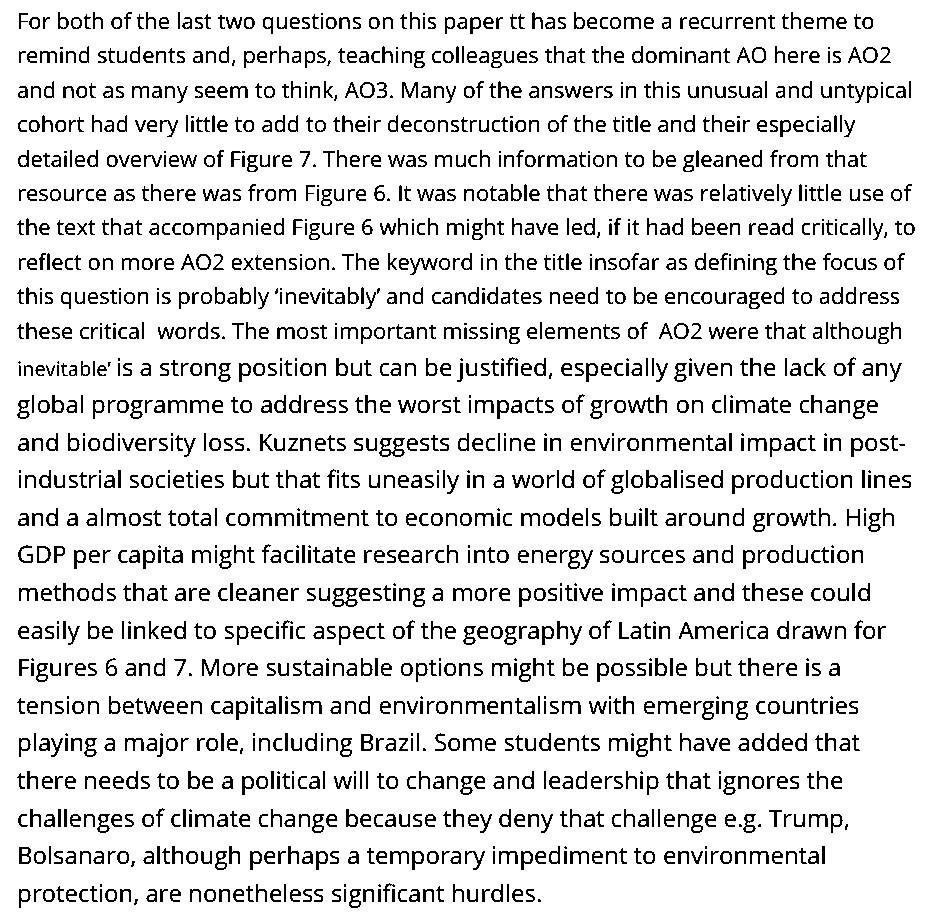
For both of the last two questions on this paper tt has become a recurrent theme to remind students and, perhaps, teaching colleagues that the dominant AO here is AO2 and not as many seem to think, AO3. Many of the answers in this unusual and untypical cohort had very little to add to their deconstruction of the title and their especially detailed overview of Figure 7. There was much information to be gleaned from that resource as there was from Figure 6. It was notable that there was relatively little use of the text that accompanied Figure 6 which might have led, if it had been read critically, to reflect on more AO2 extension. The keyword in the title insofar as defining the focus of this question is probably ‘inevitably’ and candidates need to be encouraged to address these critical words. The most important missing elements of AO2 were that although inevitable’ is a strong position but can be justified, especially given the lack of any global programme to address the worst impacts of growth on climate change and biodiversity loss. Kuznets suggests decline in environmental impact in post- industrial societies but that fits uneasily in a world of globalised production lines and a almost total commitment to economic models built around growth. High GDP per capita might facilitate research into energy sources and production methods that are cleaner suggesting a more positive impact and these could easily be linked to specific aspect of the geography of Latin America drawn for Figures 6 and 7. More sustainable options might be possible but there is a tension between capitalism and environmentalism with emerging countries playing a major role, including Brazil. Some students might have added that there needs to be a political will to change and leadership that ignores the challenges of climate change because they deny that challenge e.g. Trump, Bolsanaro, although perhaps a temporary impediment to environmental protection, are nonetheless significant hurdles.
Notes from the mark scheme and report
Use Figures 6-7: forest loss and climate-change impacts (Amazonia, Cerrado, glaciers, coral reefs)
resource extraction and soya/cattle drive degradation and carbon-water feedbacks v Kuznets curve, cleaner technology and conservation
'inevitably' must be addressed
AO2 dominates, answers over-described Figure 7
June 2019 · Paper 2 · Q1(a)4 marksAO1=4Short answer
Mark scheme
Examiner's comment
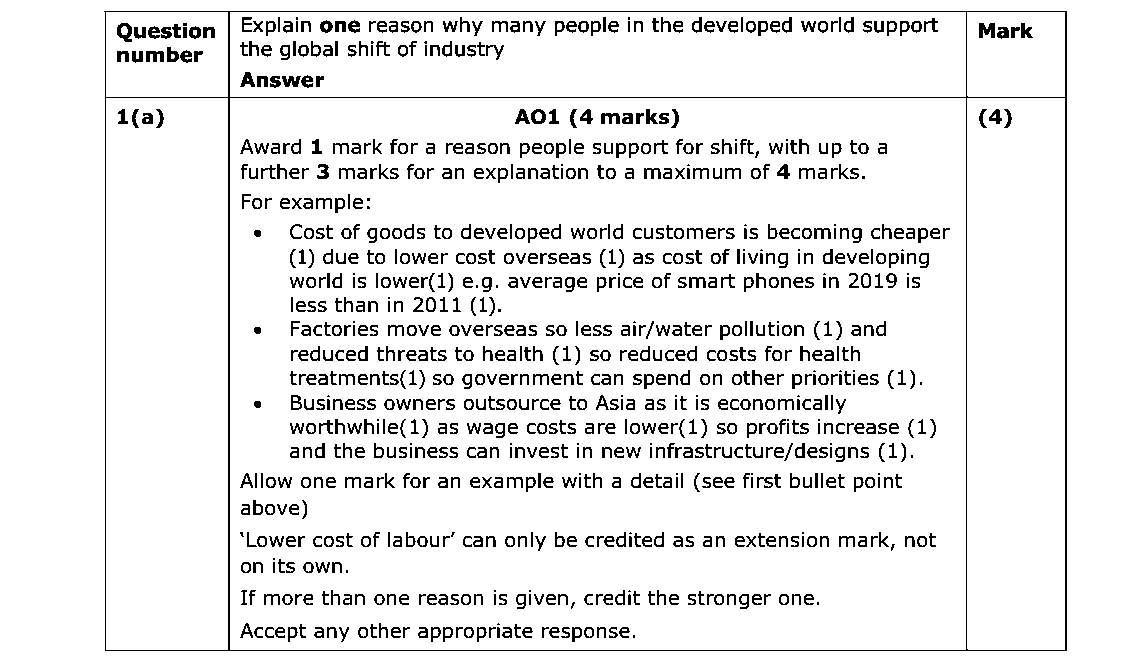
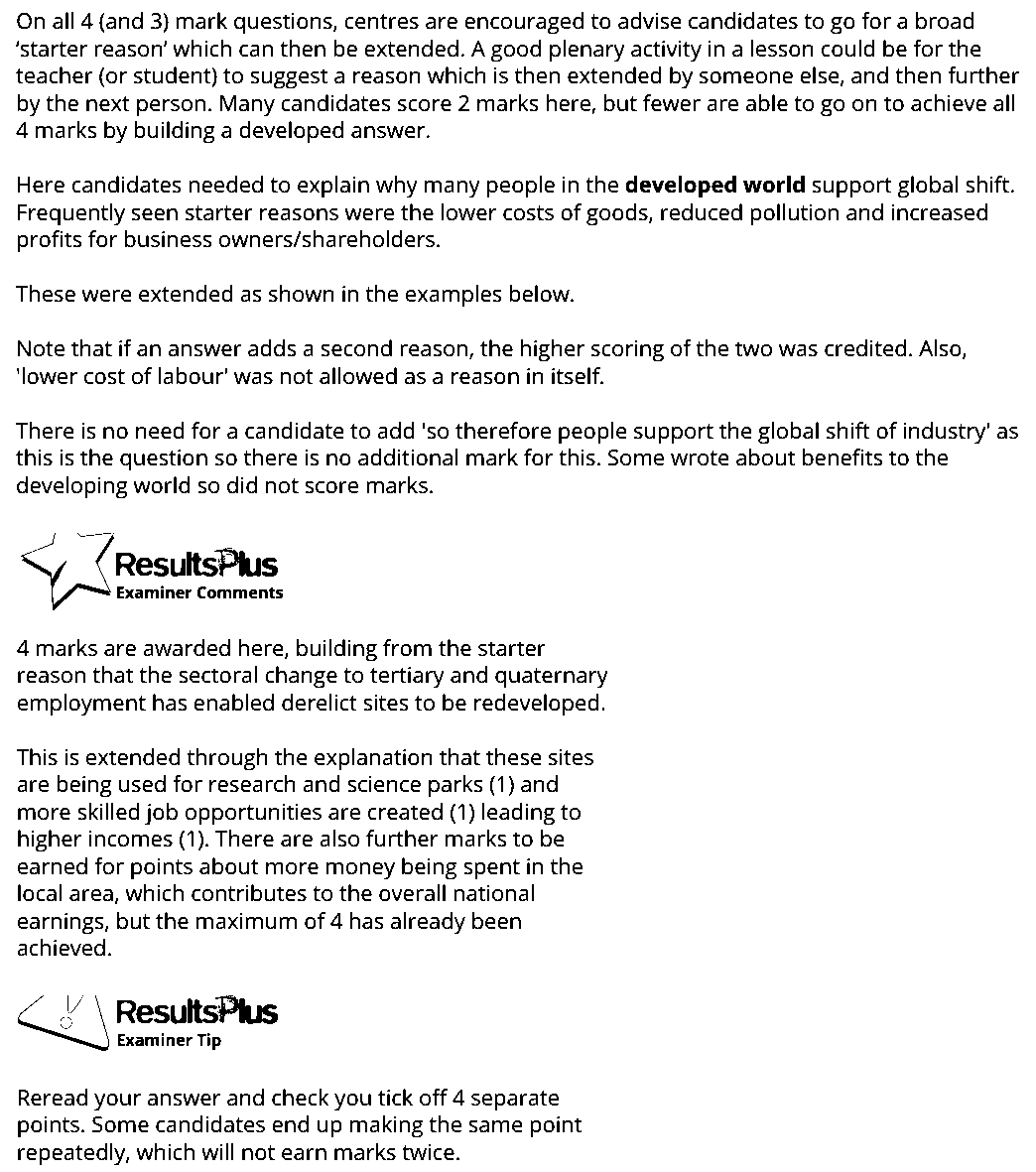
On all 4 (and 3) mark questions, centres are encouraged to advise candidates to go for a broad ‘starter reason’ which can then be extended. A good plenary activity in a lesson could be for the teacher (or student) to suggest a reason which is then extended by someone else, and then further by the next person. Many candidates score 2 marks here, but fewer are able to go on to achieve all 4 marks by building a developed answer. Here candidates needed to explain why many people in the developed world support global shift. Frequently seen starter reasons were the lower costs of goods, reduced pollution and increased profits for business owners/shareholders. These were extended as shown in the examples below. Note that if an answer adds a second reason, the higher scoring of the two was credited. Also, 'lower cost of labour' was not allowed as a reason in itself. There is no need for a candidate to add 'so therefore people support the global shift of industry' as this is the question so there is no additional mark for this. Some wrote about benefits to the developing world so did not score marks. 4 marks are awarded here, building from the starter reason that the sectoral change to tertiary and quaternary employment has enabled derelict sites to be redeveloped. This is extended through the explanation that these sites are being used for research and science parks (1) and more skilled job opportunities are created (1) leading to higher incomes (1). There are also further marks to be earned for points about more money being spent in the local area, which contributes to the overall national earnings, but the maximum of 4 has already been achieved. Reread your answer and check you tick off 4 separate points. Some candidates end up making the same point repeatedly, which will not earn marks twice.
Notes from the mark scheme and report
One reason developed over 4 marks: cheaper goods for consumers (e.g. smartphones), less local pollution and better health, higher profits for owners and shareholders
'lower cost of labour' only as an extension
if two reasons given the better is credited
many scored only 2
June 2019 · AS Paper 2 · Q1(a)(ii)3 marksAO1=2, AO2=1Data response
Resources for question 1
Mark scheme
Notes from the mark scheme and report
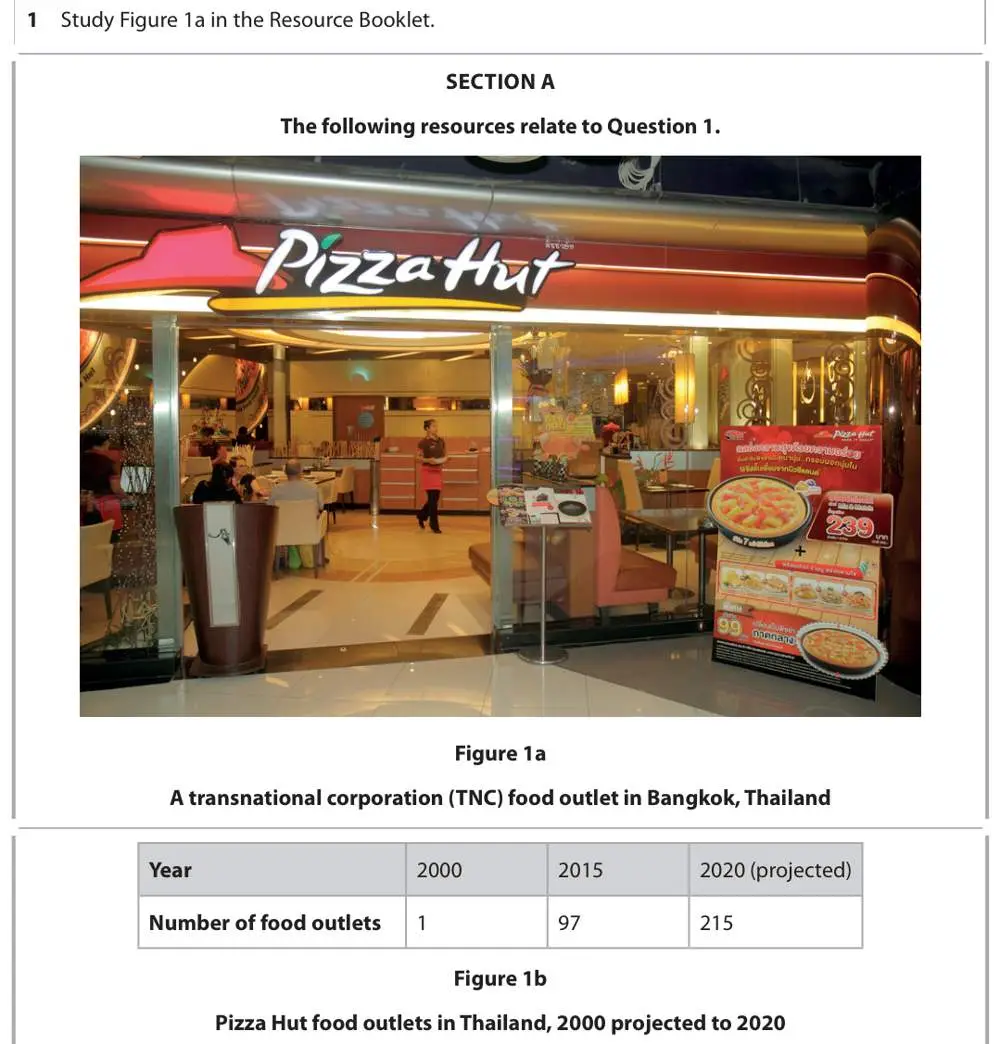
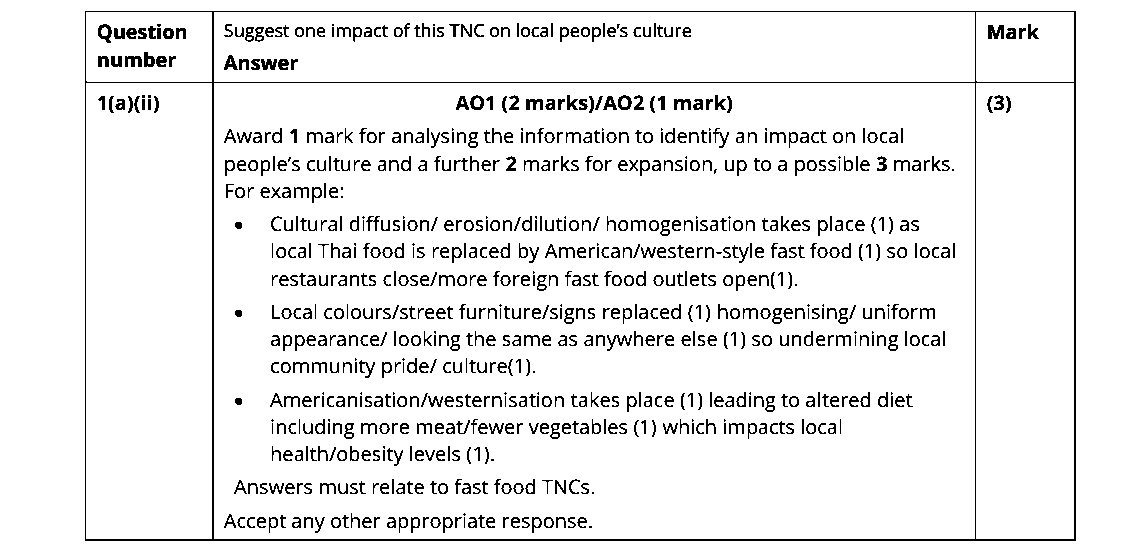
1 mark for an impact from Figure 1a plus 2 for expansion: cultural diffusion or erosion as Thai food is replaced by western fast food and local restaurants close
homogenised appearance
westernised diet and obesity
must relate to fast-food TNCs
report: most scored 2, fewer extended to a third mark
June 2019 · AS Paper 2 · Q1(c)4 marksAO1=4Short answerHard
Resources for question 1
Mark scheme
Examiner's comment
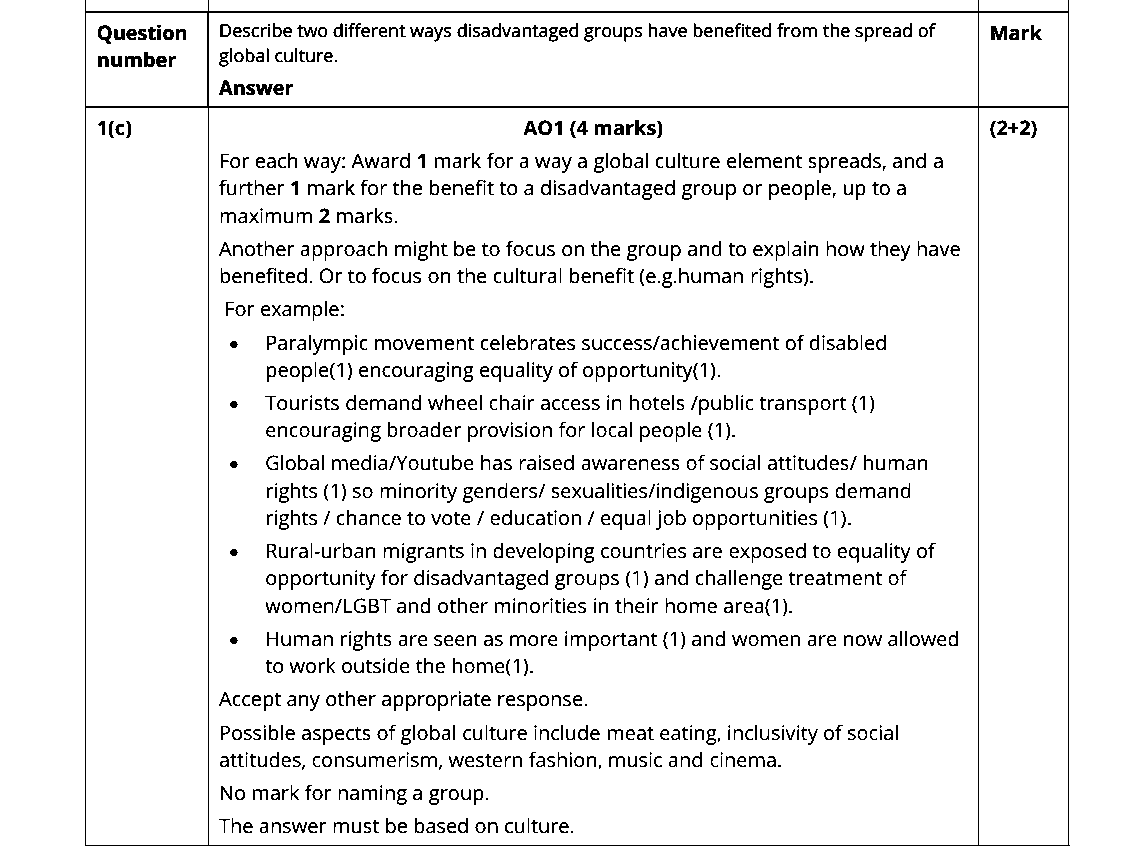
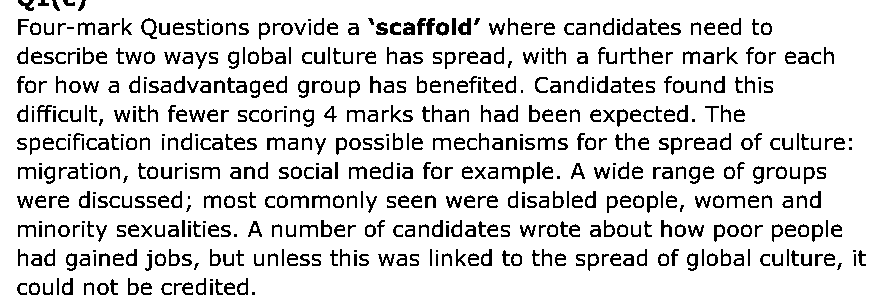
Four-mark Questions provide a ‘scaffold’ where candidates need to describe two ways global culture has spread, with a further mark for each for how a disadvantaged group has benefited. Candidates found this difficult, with fewer scoring 4 marks than had been expected. The specification indicates many possible mechanisms for the spread of culture: migration, tourism and social media for example. A wide range of groups were discussed; most commonly seen were disabled people, women and minority sexualities. A number of candidates wrote about how poor people had gained jobs, but unless this was linked to the spread of global culture, it could not be credited.
Notes from the mark scheme and report
Two ways x (spread of global culture + benefit to a disadvantaged group): Paralympic movement and disabled people, tourists' demand for wheelchair access, global media raising awareness of rights of women, minority sexualities and indigenous groups
report: 'Candidates found this difficult, with fewer scoring 4 marks than had been expected'
jobs for the poor not linked to culture scored nothing
June 2019 · AS Paper 2 · Q1(e)12 marksAO1=3, AO2=912-mark essay
Resources for question 1
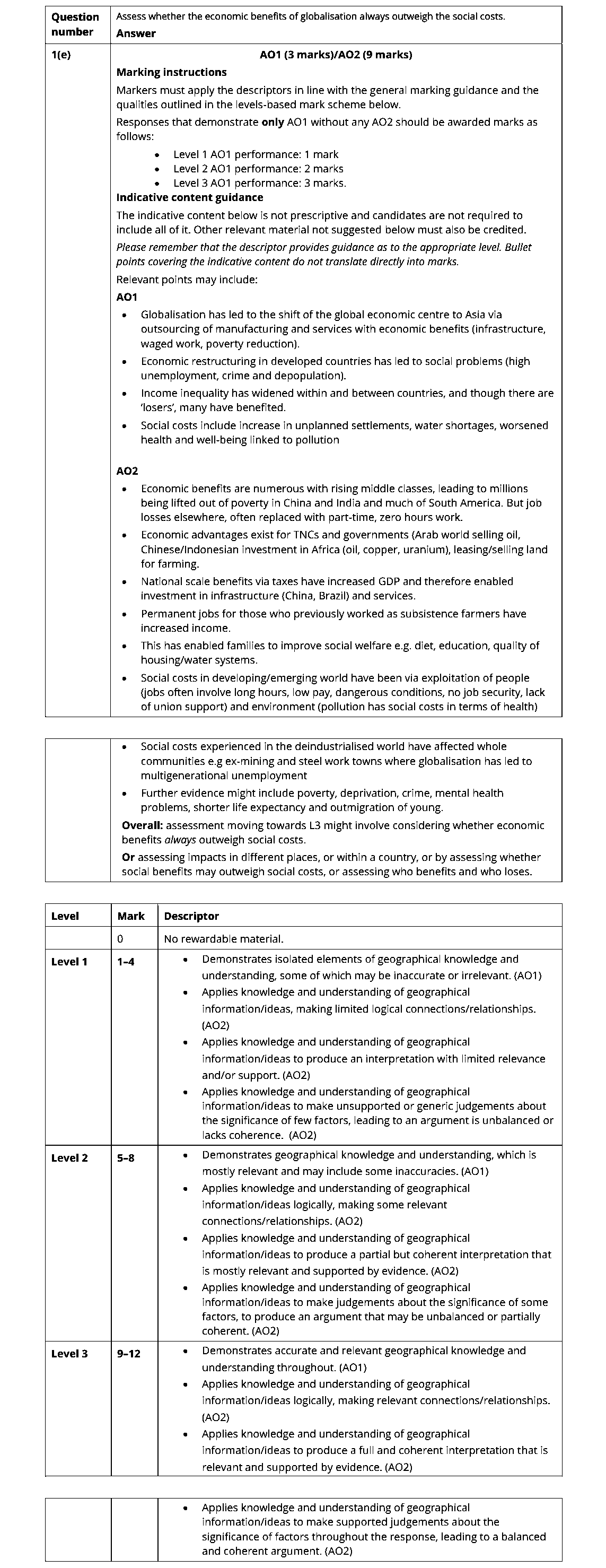
Mark scheme, including the levels and indicative content
Examiner's comment
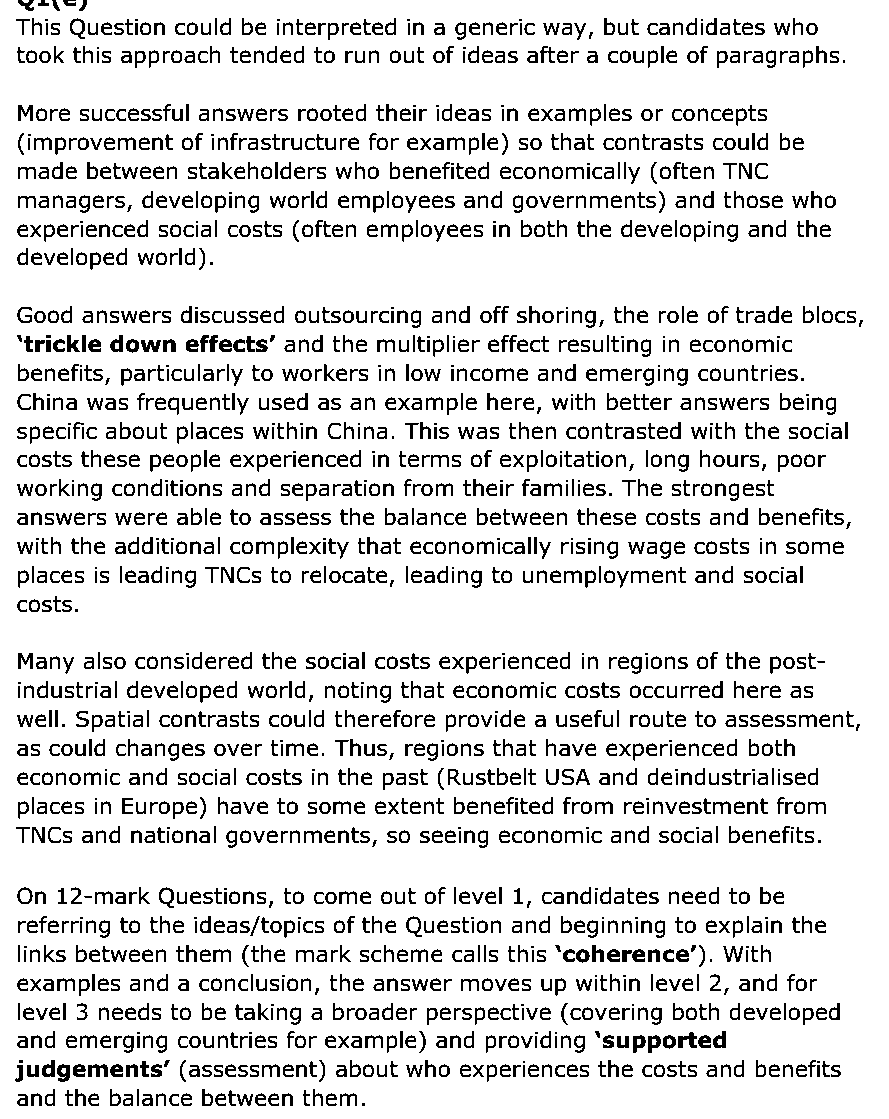
This Question could be interpreted in a generic way, but candidates who took this approach tended to run out of ideas after a couple of paragraphs. More successful answers rooted their ideas in examples or concepts (improvement of infrastructure for example) so that contrasts could be made between stakeholders who benefited economically (often TNC managers, developing world employees and governments) and those who experienced social costs (often employees in both the developing and the developed world). Good answers discussed outsourcing and off shoring, the role of trade blocs, ‘trickle down effects’ and the multiplier effect resulting in economic benefits, particularly to workers in low income and emerging countries. China was frequently used as an example here, with better answers being specific about places within China. This was then contrasted with the social costs these people experienced in terms of exploitation, long hours, poor working conditions and separation from their families. The strongest answers were able to assess the balance between these costs and benefits, with the additional complexity that economically rising wage costs in some places is leading TNCs to relocate, leading to unemployment and social costs. Many also considered the social costs experienced in regions of the post- industrial developed world, noting that economic costs occurred here as well. Spatial contrasts could therefore provide a useful route to assessment, as could changes over time. Thus, regions that have experienced both economic and social costs in the past (Rustbelt USA and deindustrialised places in Europe) have to some extent benefited from reinvestment from TNCs and national governments, so seeing economic and social benefits. On 12-mark Questions, to come out of level 1, candidates need to be referring to the ideas/topics of the Question and beginning to explain the links between them (the mark scheme calls this ‘coherence’). With examples and a conclusion, the answer moves up within level 2, and for level 3 needs to be taking a broader perspective (covering both developed and emerging countries for example) and providing ‘supported judgements’ (assessment) about who experiences the costs and benefits and the balance between them.
Notes from the mark scheme and report
Weigh economic gains of the global shift (jobs, infrastructure, poverty reduction, e.g. China) against social costs (exploitation, long hours, family separation, unplanned settlements) in emerging and deindustrialised regions
generic answers ran out of ideas
Level 3 needs supported judgements across developed and emerging places
June 2018 · Paper 2 · Q1(a)4 marksAO1=4Short answer
Mark scheme
Examiner's comment
These short answer questions are more challenging than they first appear (see also 3ai, 4ai, 5a and 6a), and relatively few candidates scored full marks. In this question, candidates were asked to explain a reason why the global shift of industry has had a negative impact on some people in the developed world. The question asked for only one reason, which must then be extended, developed or exemplified for further marks. Therefore, selecting a suitable initial reason is crucial, as it needs to be broad enough for development. Most candidates were able to explain that unemployment or similar occurred, which could then be extended with the idea that lower cost labour was available elsewhere. Further developments frequently seen included lower spending on local services, out-migration, a spiral of decline and impacts on mental health. Another point seen frequently explained that the unemployed workers lacked the skills for new jobs in tertiary or quaternary employment. Only one mark is available for exemplification, which needs to be a detailed point, for example, a place, an industry and several job losses. Commonly seen were detailed points on Detroit, Leicester and Middlesbrough. This response scored 4 marks. Marks are awarded for cheaper labour (1) available in developing countries, leading to redundancies in the UK (1), exemplified through a detailed point about Teesside job losses as SSI moved out (1). One further mark was awarded for the spiral of decline and deindustrialisation. Each of these could have been explained more fully and linked to the 'people' in the question, but full marks have already been obtained. It is good to use terminology where you can as it shows geographical knowledge and understanding. This response scored 3 marks. Marks are awarded for loss of jobs (repeated throughout the answer), the detail about BT call centre jobs being relocated to India and thirdly the reduction in labour costs. In this response, the obvious omission is a further detail about how communities and individuals in the UK have been affected as a result of job losses. Avoid repeating the same detail in your answer as a point can only be credited once.
Notes from the mark scheme and report
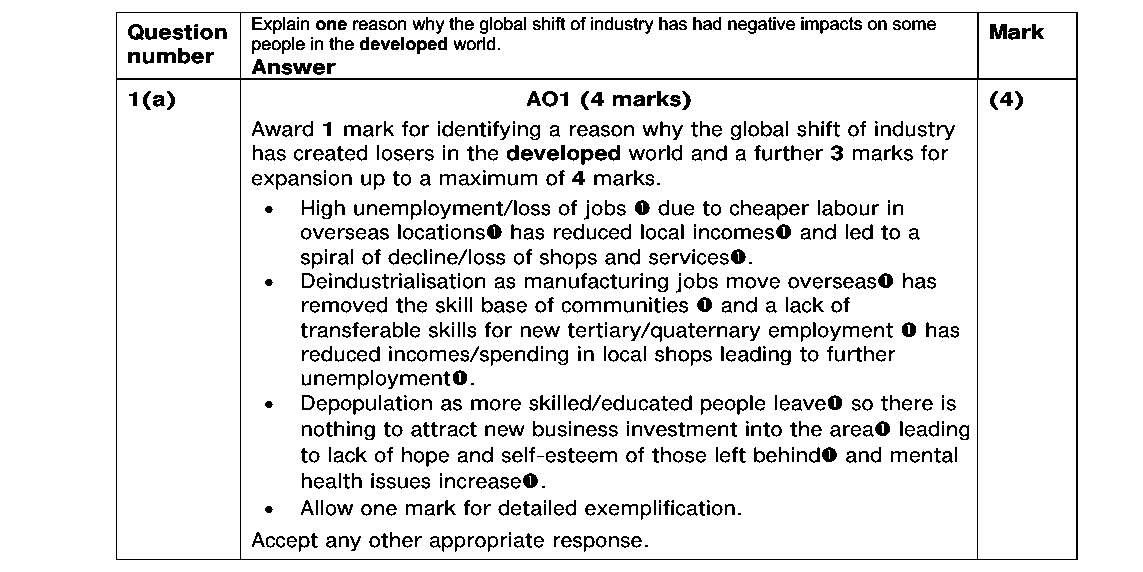
One reason developed in a chain of four: job losses as manufacturing moves to cheaper labour overseas, lower incomes, spiral of decline in shops and services, skills mismatch for new tertiary/quaternary work, out-migration of the young
report: 'more challenging than they first appear', few scored full marks
choose a reason broad enough to develop
June 2018 · Paper 2 · Q1(b)12 marksAO1=3, AO2=912-mark essay
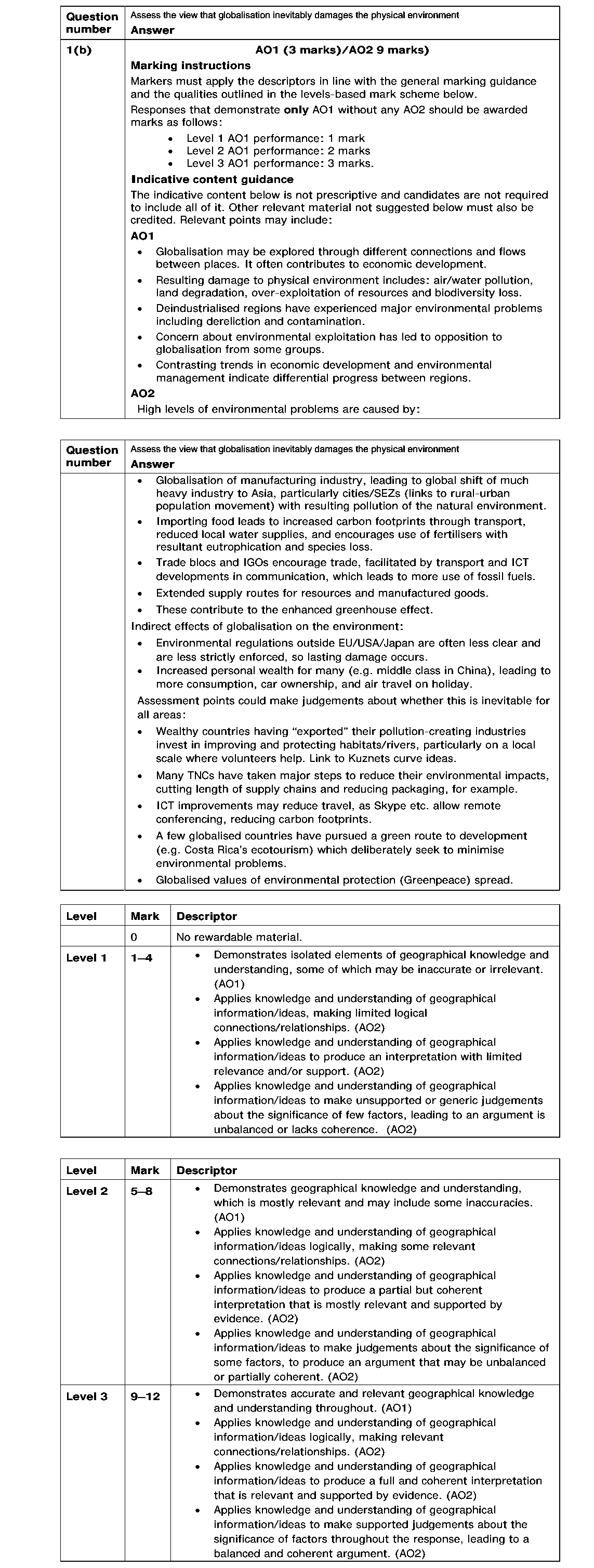
Mark scheme, including the levels and indicative content
Examiner's comment
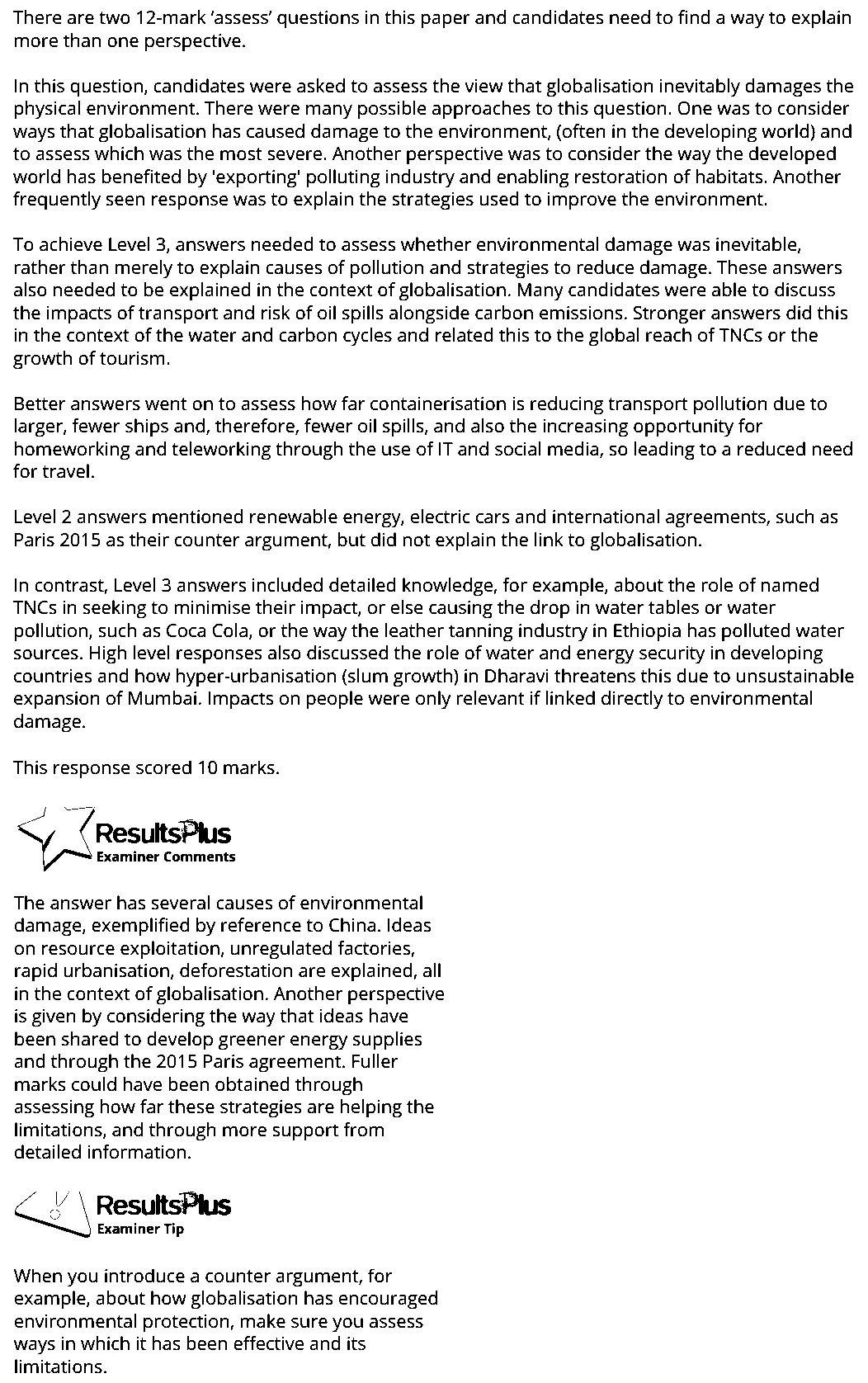
There are two 12-mark ‘assess’ questions in this paper and candidates need to find a way to explain more than one perspective. In this question, candidates were asked to assess the view that globalisation inevitably damages the physical environment. There were many possible approaches to this question. One was to consider ways that globalisation has caused damage to the environment, (often in the developing world) and to assess which was the most severe. Another perspective was to consider the way the developed world has benefited by 'exporting' polluting industry and enabling restoration of habitats. Another frequently seen response was to explain the strategies used to improve the environment. To achieve Level 3, answers needed to assess whether environmental damage was inevitable, rather than merely to explain causes of pollution and strategies to reduce damage. These answers also needed to be explained in the context of globalisation. Many candidates were able to discuss the impacts of transport and risk of oil spills alongside carbon emissions. Stronger answers did this in the context of the water and carbon cycles and related this to the global reach of TNCs or the growth of tourism. Better answers went on to assess how far containerisation is reducing transport pollution due to larger, fewer ships and, therefore, fewer oil spills, and also the increasing opportunity for homeworking and teleworking through the use of IT and social media, so leading to a reduced need for travel. Level 2 answers mentioned renewable energy, electric cars and international agreements, such as Paris 2015 as their counter argument, but did not explain the link to globalisation. In contrast, Level 3 answers included detailed knowledge, for example, about the role of named TNCs in seeking to minimise their impact, or else causing the drop in water tables or water pollution, such as Coca Cola, or the way the leather tanning industry in Ethiopia has polluted water sources. High level responses also discussed the role of water and energy security in developing countries and how hyper-urbanisation (slum growth) in Dharavi threatens this due to unsustainable expansion of Mumbai. Impacts on people were only relevant if linked directly to environmental damage. This response scored 10 marks. The answer has several causes of environmental damage, exemplified by reference to China. Ideas on resource exploitation, unregulated factories, rapid urbanisation, deforestation are explained, all in the context of globalisation. Another perspective is given by considering the way that ideas have been shared to develop greener energy supplies and through the 2015 Paris agreement. Fuller marks could have been obtained through assessing how far these strategies are helping the limitations, and through more support from detailed information. When you introduce a counter argument, for example, about how globalisation has encouraged environmental protection, make sure you assess ways in which it has been effective and its limitations.
Notes from the mark scheme and report
Damage: global shift brings air and water pollution to SEZs and Asian cities, food miles, resource over-exploitation, transport emissions
counter: developed countries exported pollution and restored habitats (Kuznets curve), TNC supply-chain greening, ICT cutting travel, ecotourism (Costa Rica), environmental movement
judge 'inevitably'
June 2018 · AS Paper 2 · Q1(c)(i)1 markAO3=1Calculation
Resources for question 1
Mark scheme
Examiner's comment
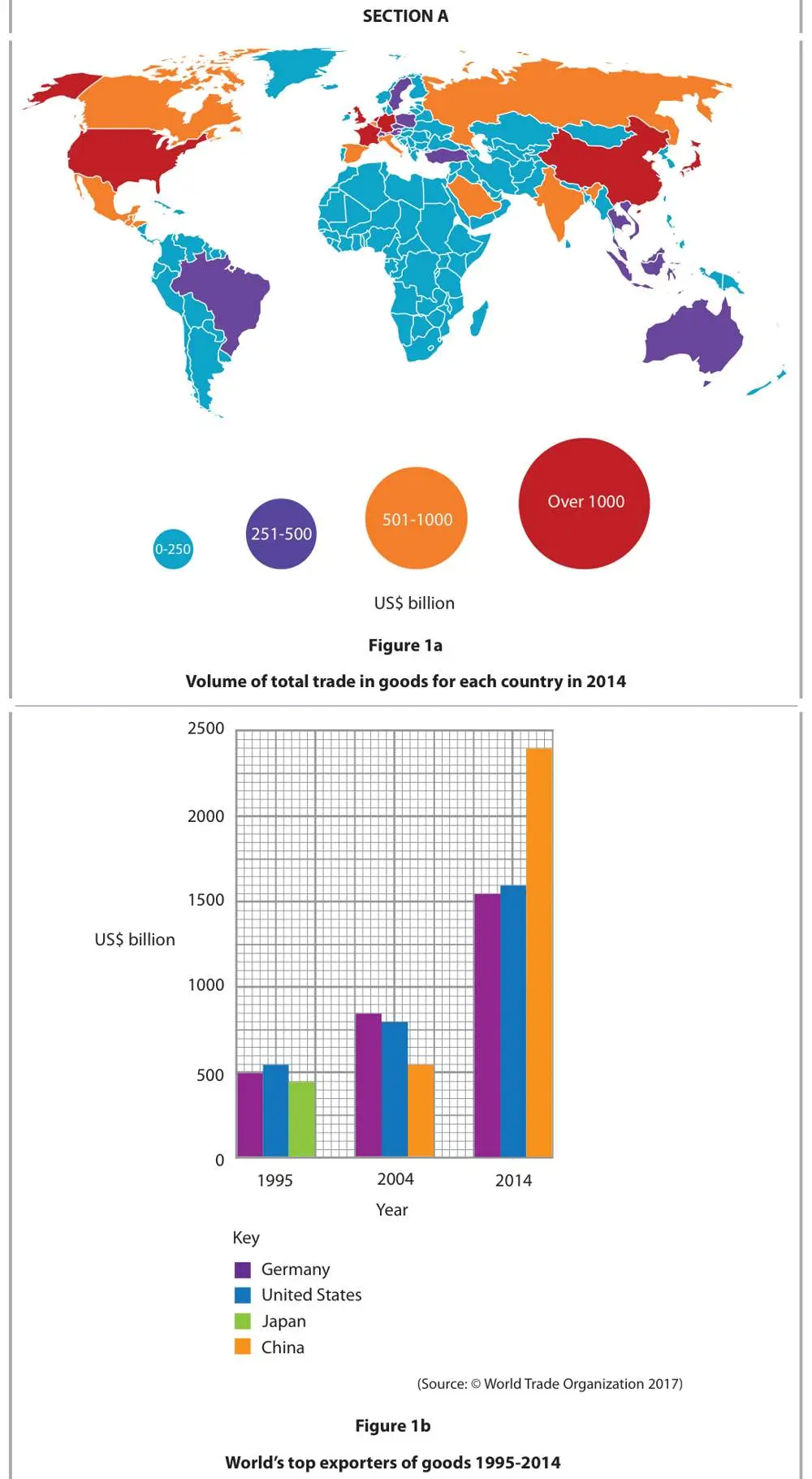
Most candidates were able to read the graph data accurately and perform the subtraction required. Some tried to turn this into a percentage. Reading the question carefully is essential.
Notes from the mark scheme and report
Answer: 1850 US$ billion (2400 - 550)
a simple difference, some wrongly turned it into a percentage
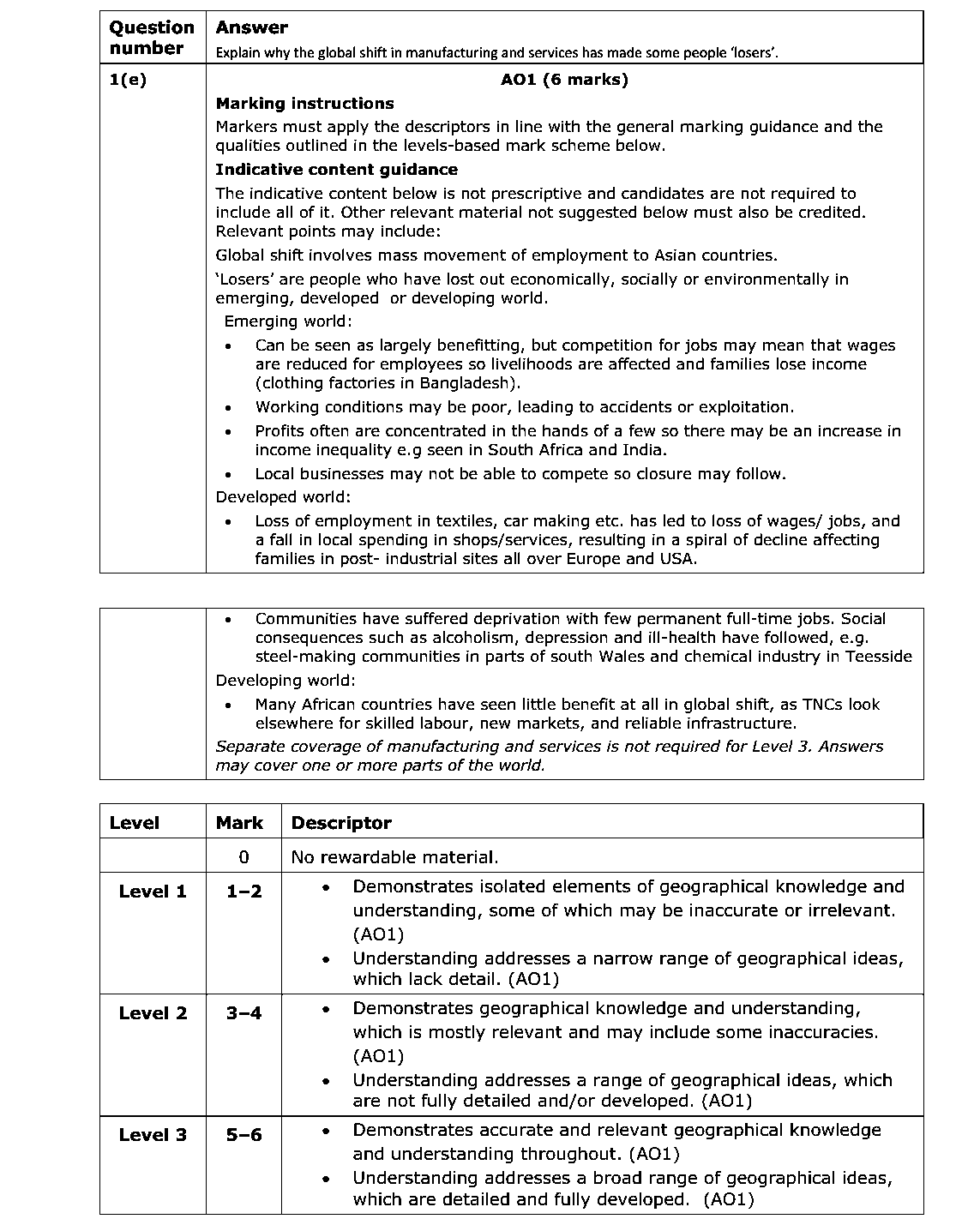
June 2018 · AS Paper 2 · Q1(e)6 marksAO1=6Extended response
Resources for question 1
Mark scheme, including the levels and indicative content
Examiner's comment
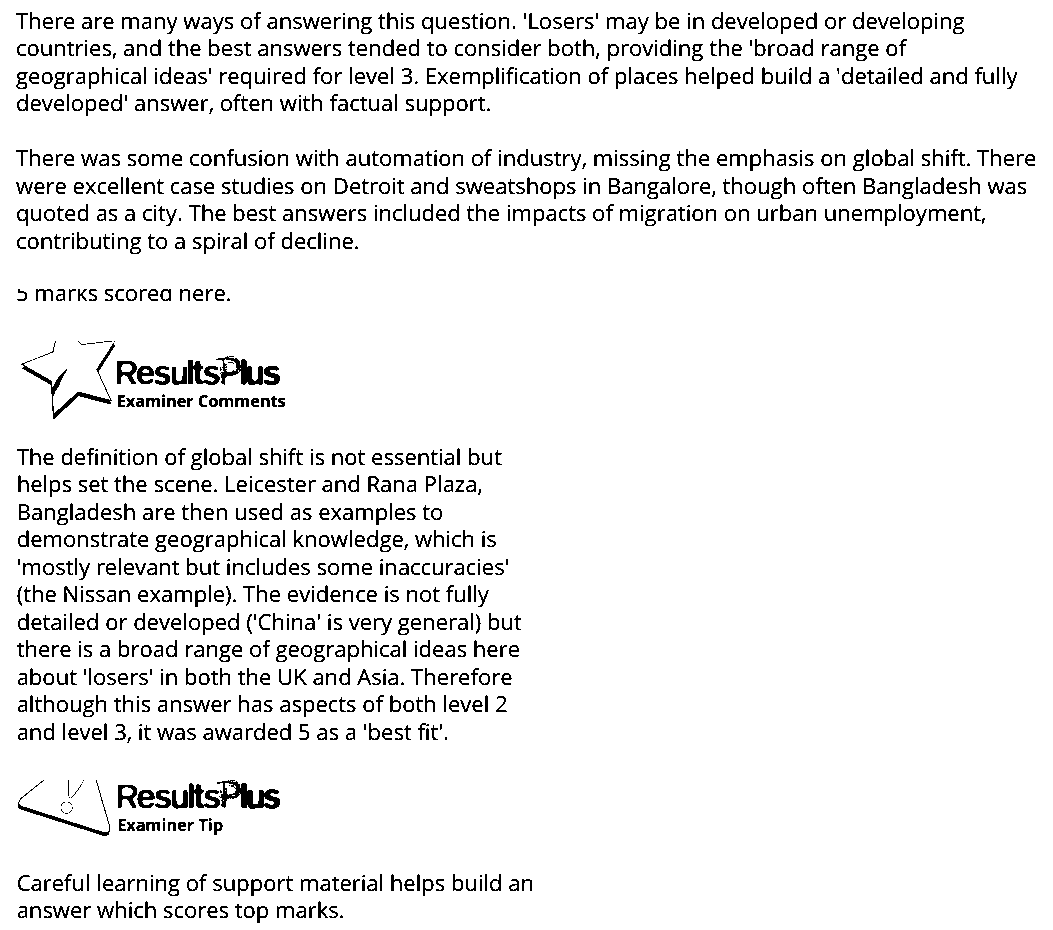
There are many ways of answering this question. 'Losers' may be in developed or developing countries, and the best answers tended to consider both, providing the 'broad range of geographical ideas' required for level 3. Exemplification of places helped build a 'detailed and fully developed' answer, often with factual support. There was some confusion with automation of industry, missing the emphasis on global shift. There were excellent case studies on Detroit and sweatshops in Bangalore, though often Bangladesh was quoted as a city. The best answers included the impacts of migration on urban unemployment, contributing to a spiral of decline. 5 marks scored here. The definition of global shift is not essential but helps set the scene. Leicester and Rana Plaza, Bangladesh are then used as examples to demonstrate geographical knowledge, which is 'mostly relevant but includes some inaccuracies' (the Nissan example). The evidence is not fully detailed or developed ('China' is very general) but there is a broad range of geographical ideas here about 'losers' in both the UK and Asia. Therefore although this answer has aspects of both level 2 and level 3, it was awarded 5 as a 'best fit'. Careful learning of support material helps build an answer which scores top marks.
Notes from the mark scheme and report
Losers in developed countries (deindustrialisation, unemployment, e.g. Detroit) and in developing countries (sweatshop wages, exploitation, pollution, unplanned settlements)
best covered both with examples
some confused global shift with automation
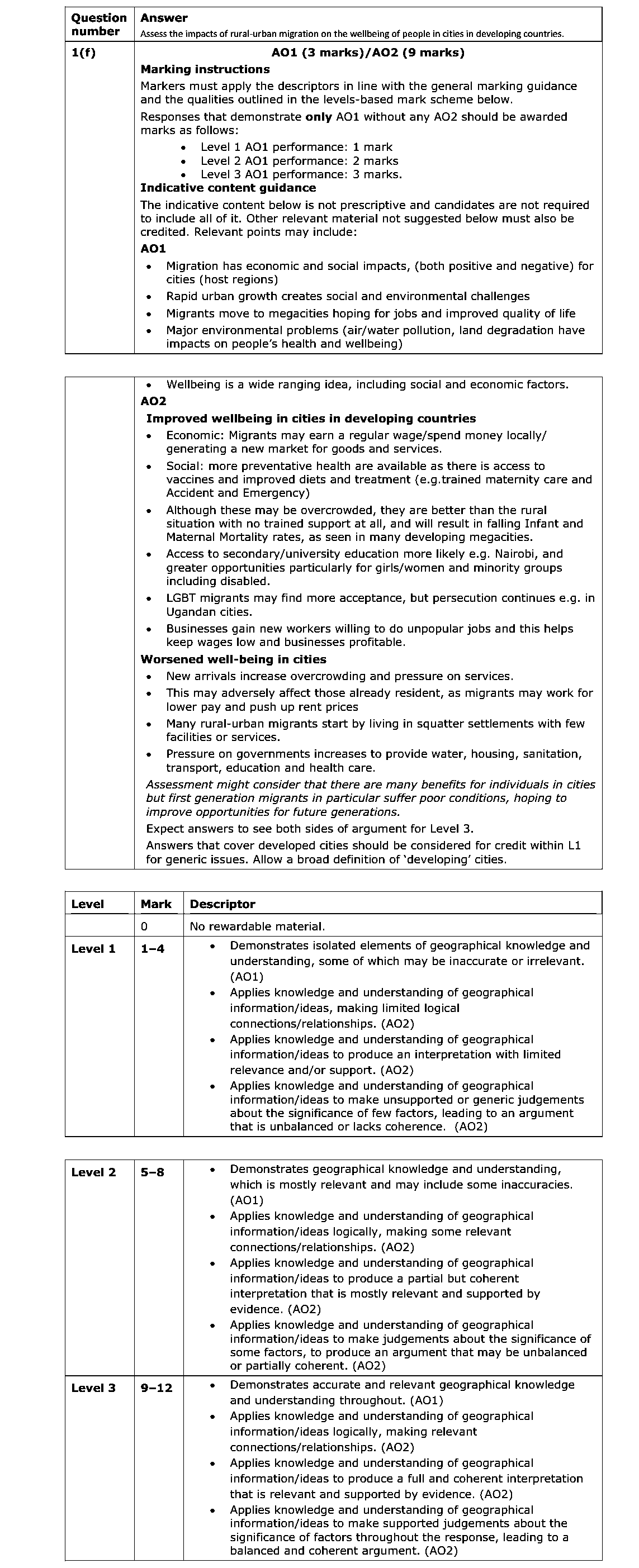
June 2018 · AS Paper 2 · Q1(f)12 marksAO1=3, AO2=912-mark essay
Resources for question 1
Mark scheme, including the levels and indicative content
Examiner's comment
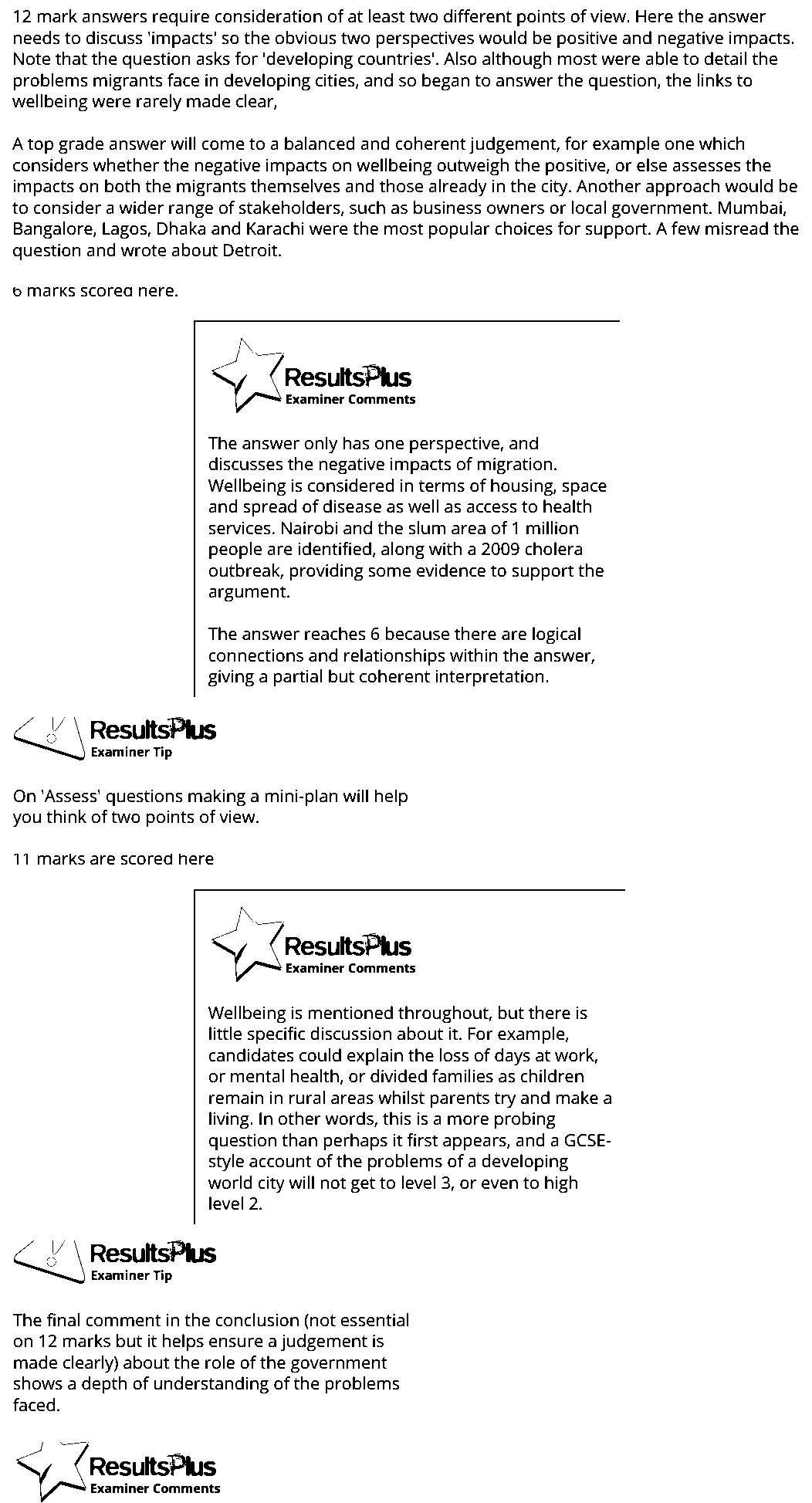
12 mark answers require consideration of at least two different points of view. Here the answer needs to discuss 'impacts' so the obvious two perspectives would be positive and negative impacts. Note that the question asks for 'developing countries'. Also although most were able to detail the problems migrants face in developing cities, and so began to answer the question, the links to wellbeing were rarely made clear, A top grade answer will come to a balanced and coherent judgement, for example one which considers whether the negative impacts on wellbeing outweigh the positive, or else assesses the impacts on both the migrants themselves and those already in the city. Another approach would be to consider a wider range of stakeholders, such as business owners or local government. Mumbai, Bangalore, Lagos, Dhaka and Karachi were the most popular choices for support. A few misread the question and wrote about Detroit. 6 marks scored here. The answer only has one perspective, and discusses the negative impacts of migration. Wellbeing is considered in terms of housing, space and spread of disease as well as access to health services. Nairobi and the slum area of 1 million people are identified, along with a 2009 cholera outbreak, providing some evidence to support the argument. The answer reaches 6 because there are logical connections and relationships within the answer, giving a partial but coherent interpretation. On 'Assess' questions making a mini-plan will help you think of two points of view. 11 marks are scored here Wellbeing is mentioned throughout, but there is little specific discussion about it. For example, candidates could explain the loss of days at work, or mental health, or divided families as children remain in rural areas whilst parents try and make a living. In other words, this is a more probing question than perhaps it first appears, and a GCSE- style account of the problems of a developing world city will not get to level 3, or even to high level 2. The final comment in the conclusion (not essential on 12 marks but it helps ensure a judgement is made clearly) about the role of the government shows a depth of understanding of the problems faced.
Notes from the mark scheme and report
Weigh positive (jobs, services, remittances, education) against negative (slums, informal work, pollution, overcrowded services) impacts on wellbeing in developing-country cities (e.g. Mumbai, Karachi)
links to wellbeing rarely made clear
reach a balanced judgement
Work with an Edexcel Geography tutor
Essays stuck in the middle levels, or losing marks on the data questions? Book a trial lesson with a specialist Edexcel Geography tutor.