Examiner's comment
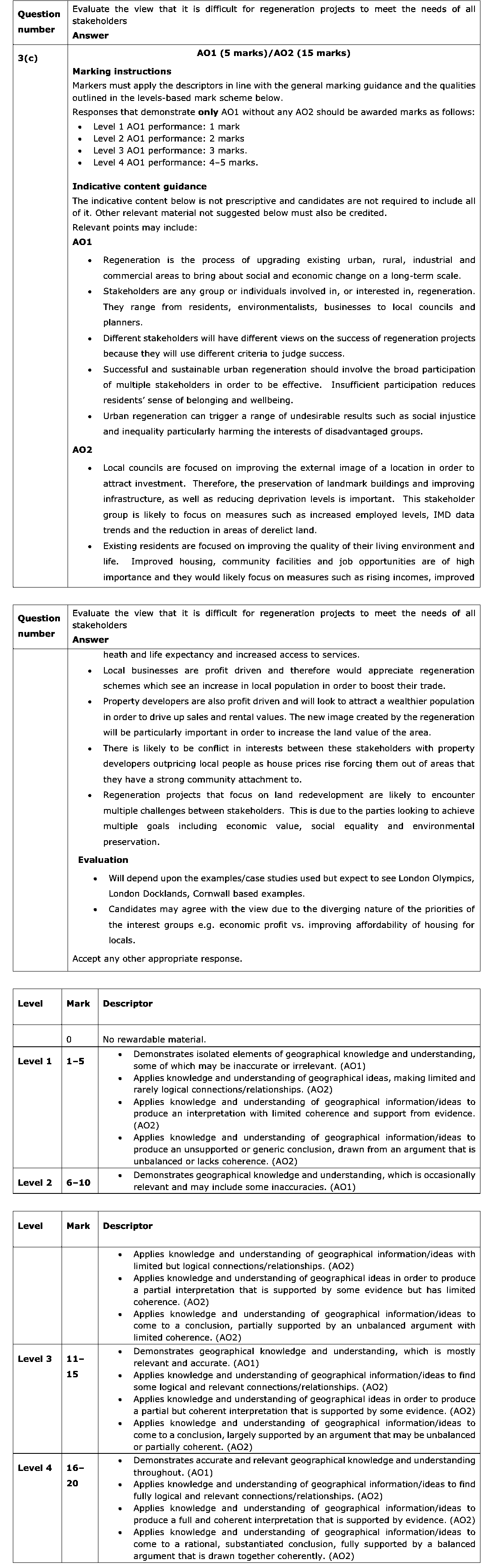
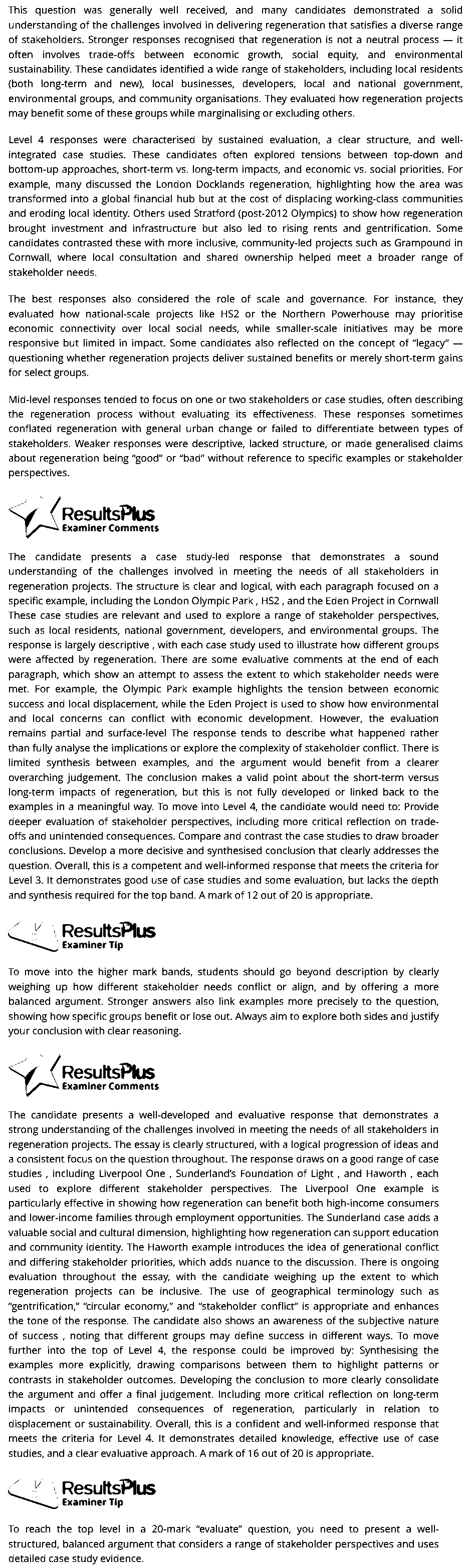
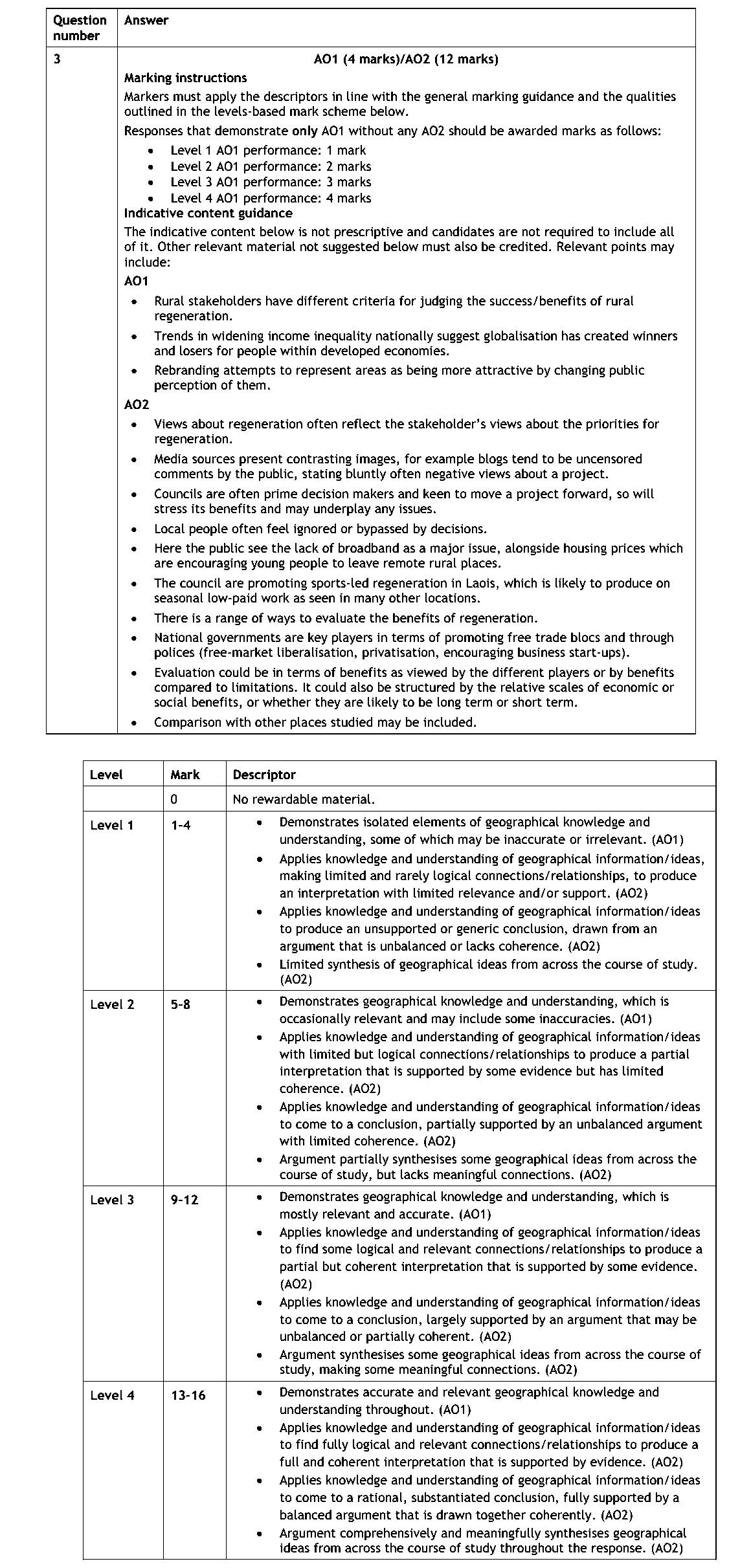
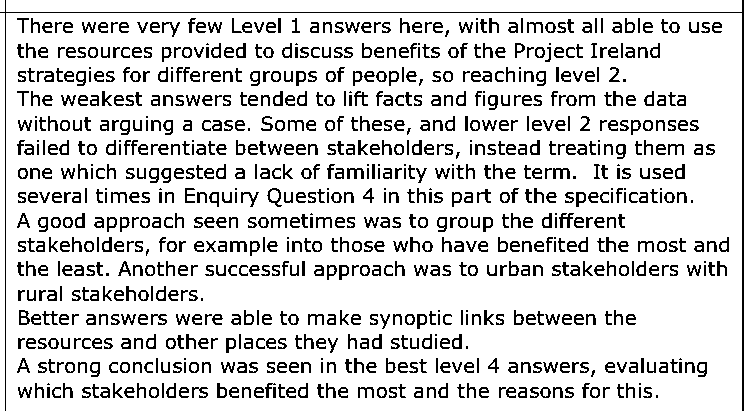
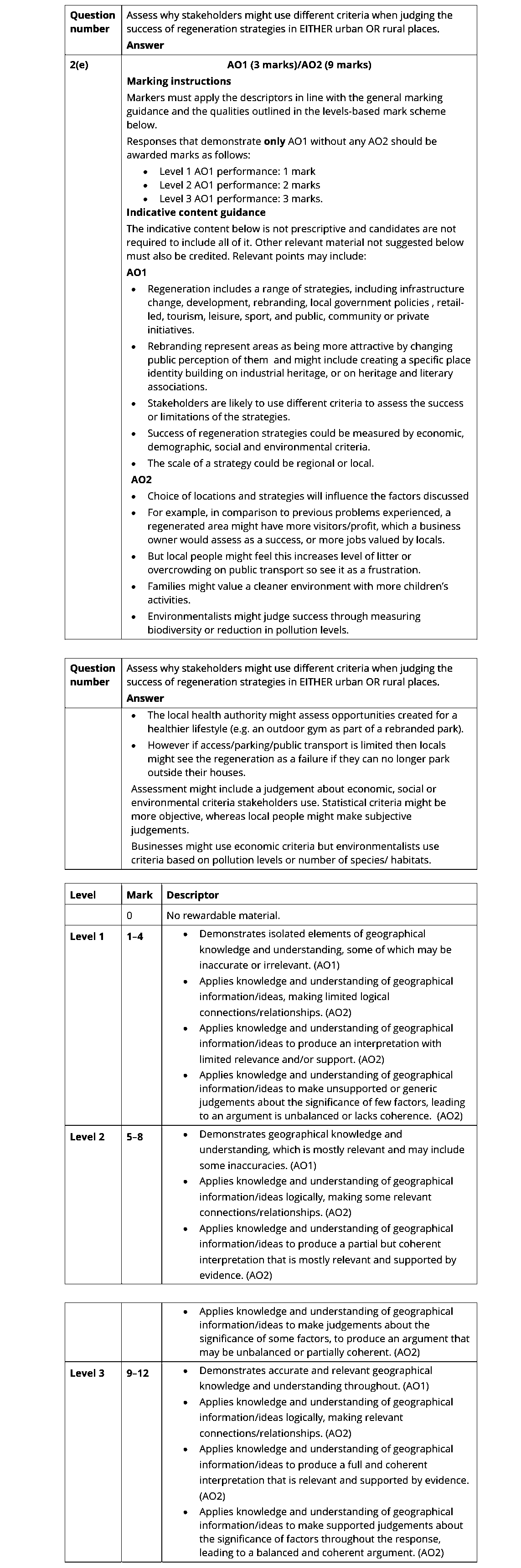
This question was generally well received, and many candidates demonstrated a solid understanding of the challenges involved in delivering regeneration that satisfies a diverse range of stakeholders. Stronger responses recognised that regeneration is not a neutral process — it often involves trade-offs between economic growth, social equity, and environmental sustainability. These candidates identified a wide range of stakeholders, including local residents (both long-term and new), local businesses, developers, local and national government, environmental groups, and community organisations. They evaluated how regeneration projects may benefit some of these groups while marginalising or excluding others. Level 4 responses were characterised by sustained evaluation, a clear structure, and well- integrated case studies. These candidates often explored tensions between top-down and bottom-up approaches, short-term vs. long-term impacts, and economic vs. social priorities. For example, many discussed the London Docklands regeneration, highlighting how the area was transformed into a global financial hub but at the cost of displacing working-class communities and eroding local identity. Others used Stratford (post-2012 Olympics) to show how regeneration brought investment and infrastructure but also led to rising rents and gentrification. Some candidates contrasted these with more inclusive, community-led projects such as Grampound in Cornwall, where local consultation and shared ownership helped meet a broader range of stakeholder needs. The best responses also considered the role of scale and governance. For instance, they evaluated how national-scale projects like HS2 or the Northern Powerhouse may prioritise economic connectivity over local social needs, while smaller-scale initiatives may be more responsive but limited in impact. Some candidates also reflected on the concept of “legacy” — questioning whether regeneration projects deliver sustained benefits or merely short-term gains for select groups. Mid-level responses tended to focus on one or two stakeholders or case studies, often describing the regeneration process without evaluating its effectiveness. These responses sometimes conflated regeneration with general urban change or failed to differentiate between types of stakeholders. Weaker responses were descriptive, lacked structure, or made generalised claims about regeneration being “good” or “bad” without reference to specific examples or stakeholder perspectives. The candidate presents a case study-led response that demonstrates a sound understanding of the challenges involved in meeting the needs of all stakeholders in regeneration projects. The structure is clear and logical, with each paragraph focused on a specific example, including the London Olympic Park , HS2 , and the Eden Project in Cornwall These case studies are relevant and used to explore a range of stakeholder perspectives, such as local residents, national government, developers, and environmental groups. The response is largely descriptive , with each case study used to illustrate how different groups were affected by regeneration. There are some evaluative comments at the end of each paragraph, which show an attempt to assess the extent to which stakeholder needs were met. For example, the Olympic Park example highlights the tension between economic success and local displacement, while the Eden Project is used to show how environmental and local concerns can conflict with economic development. However, the evaluation remains partial and surface-level The response tends to describe what happened rather than fully analyse the implications or explore the complexity of stakeholder conflict. There is limited synthesis between examples, and the argument would benefit from a clearer overarching judgement. The conclusion makes a valid point about the short-term versus long-term impacts of regeneration, but this is not fully developed or linked back to the examples in a meaningful way. To move into Level 4, the candidate would need to: Provide deeper evaluation of stakeholder perspectives, including more critical reflection on trade- offs and unintended consequences. Compare and contrast the case studies to draw broader conclusions. Develop a more decisive and synthesised conclusion that clearly addresses the question. Overall, this is a competent and well-informed response that meets the criteria for Level 3. It demonstrates good use of case studies and some evaluation, but lacks the depth and synthesis required for the top band. A mark of 12 out of 20 is appropriate. To move into the higher mark bands, students should go beyond description by clearly weighing up how different stakeholder needs conflict or align, and by offering a more balanced argument. Stronger answers also link examples more precisely to the question, showing how specific groups benefit or lose out. Always aim to explore both sides and justify your conclusion with clear reasoning. The candidate presents a well-developed and evaluative response that demonstrates a strong understanding of the challenges involved in meeting the needs of all stakeholders in regeneration projects. The essay is clearly structured, with a logical progression of ideas and a consistent focus on the question throughout. The response draws on a good range of case studies , including Liverpool One , Sunderland’s Foundation of Light , and Haworth , each used to explore different stakeholder perspectives. The Liverpool One example is particularly effective in showing how regeneration can benefit both high-income consumers and lower-income families through employment opportunities. The Sunderland case adds a valuable social and cultural dimension, highlighting how regeneration can support education and community identity. The Haworth example introduces the idea of generational conflict and differing stakeholder priorities, which adds nuance to the discussion. There is ongoing evaluation throughout the essay, with the candidate weighing up the extent to which regeneration projects can be inclusive. The use of geographical terminology such as “gentrification,” “circular economy,” and “stakeholder conflict” is appropriate and enhances the tone of the response. The candidate also shows an awareness of the subjective nature of success , noting that different groups may define success in different ways. To move further into the top of Level 4, the response could be improved by: Synthesising the examples more explicitly, drawing comparisons between them to highlight patterns or contrasts in stakeholder outcomes. Developing the conclusion to more clearly consolidate the argument and offer a final judgement. Including more critical reflection on long-term impacts or unintended consequences of regeneration, particularly in relation to displacement or sustainability. Overall, this is a confident and well-informed response that meets the criteria for Level 4. It demonstrates detailed knowledge, effective use of case studies, and a clear evaluative approach. A mark of 16 out of 20 is appropriate. To reach the top level in a 20-mark “evaluate” question, you need to present a well- structured, balanced argument that considers a range of stakeholder perspectives and uses detailed case study evidence.
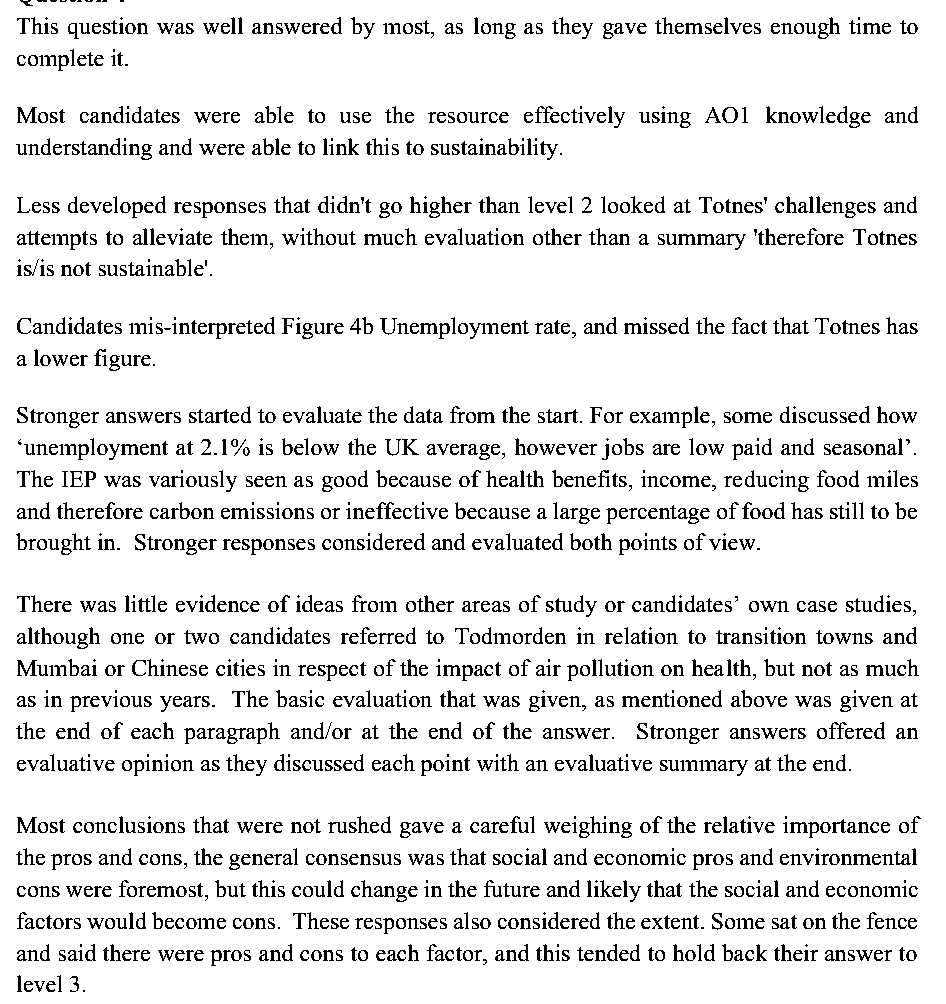
![Examiner's report extract for June 2025 Paper 2 question 3(c)]()