5 Study the resources in Section B of the Resource Booklet. Evaluate the view that China is more likely than India to become a global superpower by the middle of this century.
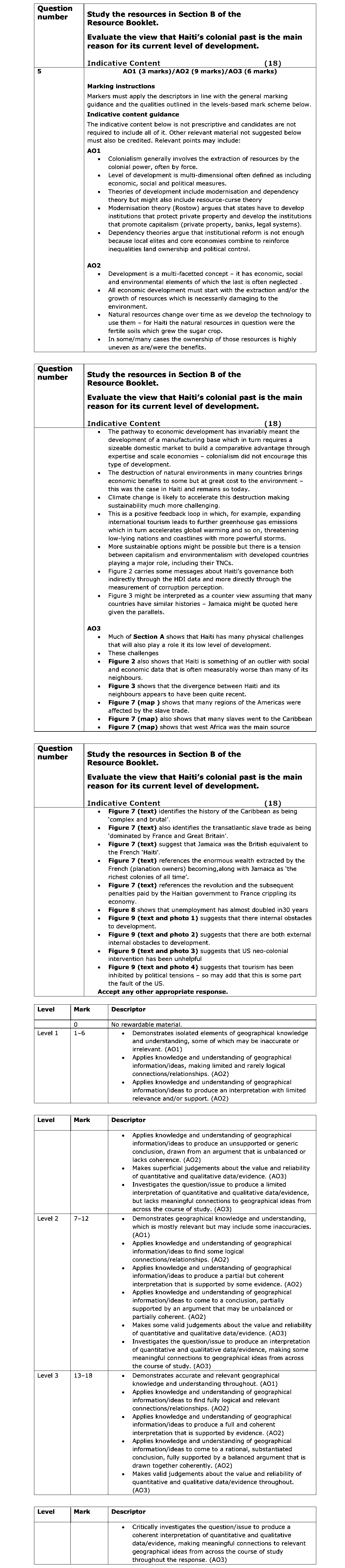
5 Study the resources in Section B of the Resource Booklet. Evaluate the view that Haiti’s colonial past is the main reason for its current level of development.
Tap a question to zoom it. The figures open above it; the mark scheme (with its levels and indicative content) and the examiner's comment open underneath.
June 2025 · Paper 2 · Q2(a)4 marksAO1=4Short answer
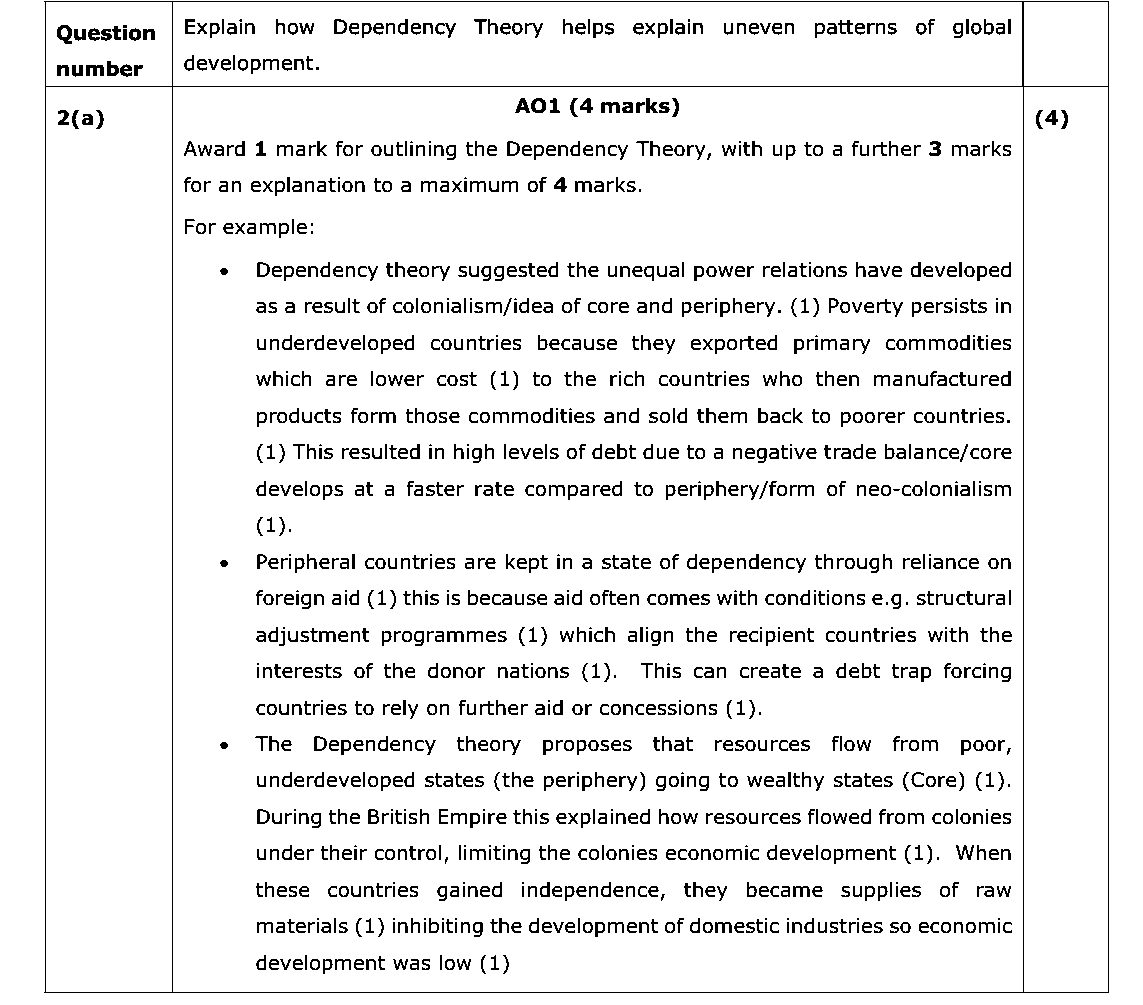
Mark scheme
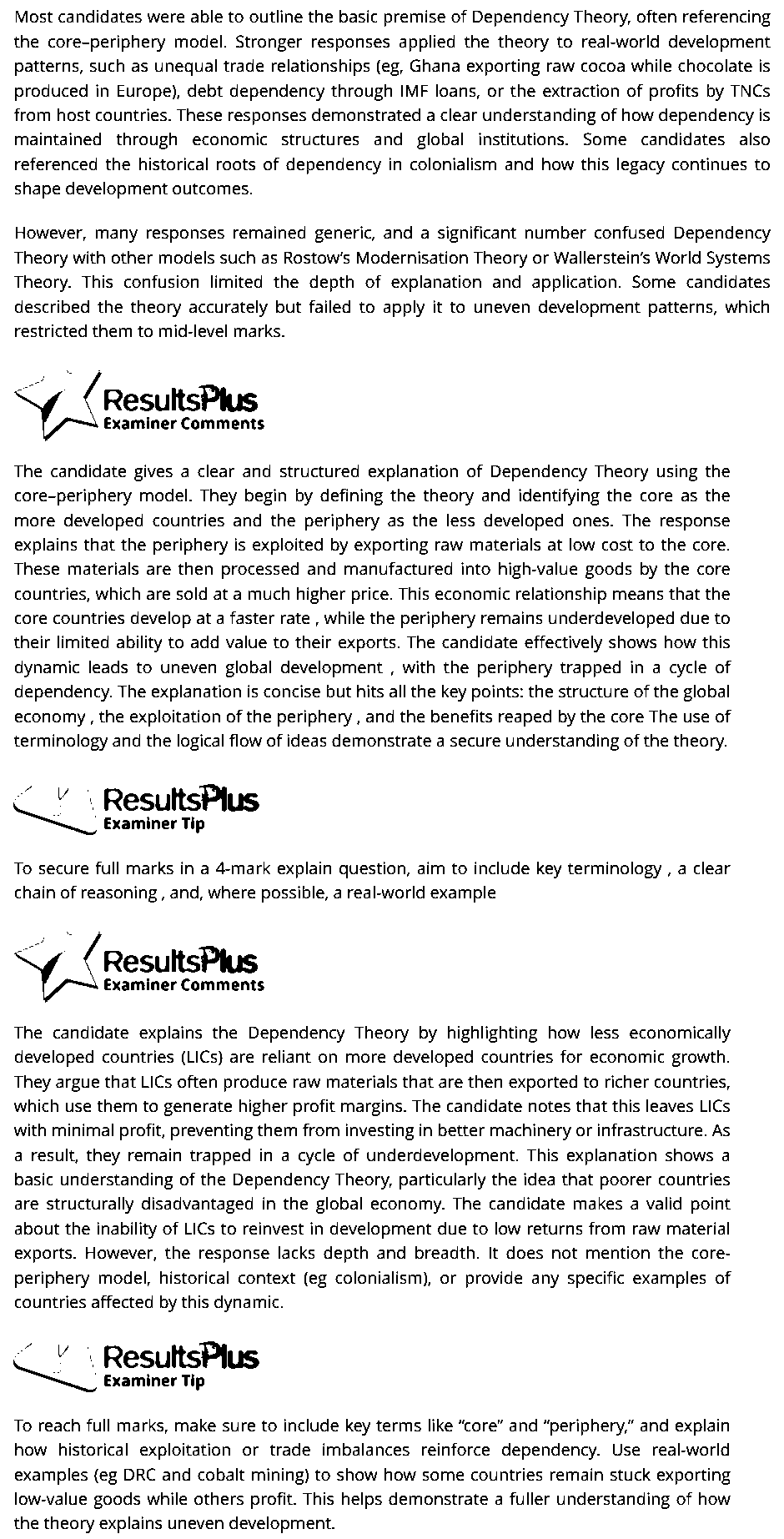
Examiner's comment
Most candidates were able to outline the basic premise of Dependency Theory, often referencing the core–periphery model. Stronger responses applied the theory to real-world development patterns, such as unequal trade relationships (eg, Ghana exporting raw cocoa while chocolate is produced in Europe), debt dependency through IMF loans, or the extraction of profits by TNCs from host countries. These responses demonstrated a clear understanding of how dependency is maintained through economic structures and global institutions. Some candidates also referenced the historical roots of dependency in colonialism and how this legacy continues to shape development outcomes. However, many responses remained generic, and a significant number confused Dependency Theory with other models such as Rostow’s Modernisation Theory or Wallerstein’s World Systems Theory. This confusion limited the depth of explanation and application. Some candidates described the theory accurately but failed to apply it to uneven development patterns, which restricted them to mid-level marks. The candidate gives a clear and structured explanation of Dependency Theory using the core–periphery model. They begin by defining the theory and identifying the core as the more developed countries and the periphery as the less developed ones. The response explains that the periphery is exploited by exporting raw materials at low cost to the core. These materials are then processed and manufactured into high-value goods by the core countries, which are sold at a much higher price. This economic relationship means that the core countries develop at a faster rate , while the periphery remains underdeveloped due to their limited ability to add value to their exports. The candidate effectively shows how this dynamic leads to uneven global development , with the periphery trapped in a cycle of dependency. The explanation is concise but hits all the key points: the structure of the global economy , the exploitation of the periphery , and the benefits reaped by the core The use of terminology and the logical flow of ideas demonstrate a secure understanding of the theory. To secure full marks in a 4-mark explain question, aim to include key terminology , a clear chain of reasoning , and, where possible, a real-world example The candidate explains the Dependency Theory by highlighting how less economically developed countries (LICs) are reliant on more developed countries for economic growth. They argue that LICs often produce raw materials that are then exported to richer countries, which use them to generate higher profit margins. The candidate notes that this leaves LICs with minimal profit, preventing them from investing in better machinery or infrastructure. As a result, they remain trapped in a cycle of underdevelopment. This explanation shows a basic understanding of the Dependency Theory, particularly the idea that poorer countries are structurally disadvantaged in the global economy. The candidate makes a valid point about the inability of LICs to reinvest in development due to low returns from raw material exports. However, the response lacks depth and breadth. It does not mention the core- periphery model, historical context (eg colonialism), or provide any specific examples of countries affected by this dynamic. To reach full marks, make sure to include key terms like “core” and “periphery,” and explain how historical exploitation or trade imbalances reinforce dependency. Use real-world examples (eg DRC and cobalt mining) to show how some countries remain stuck exporting low-value goods while others profit. This helps demonstrate a fuller understanding of how the theory explains uneven development.
Notes from the mark scheme and report
Outline the theory (colonial legacy, core and periphery) for 1 mark then explain: primary commodity exports, debt and negative trade balance, aid conditionality (SAPs) and neo-colonialism
many confused it with Rostow or World Systems Theory
June 2025 · Paper 3 · Q38 marksAO1=4, AO3=4Extended responseHard
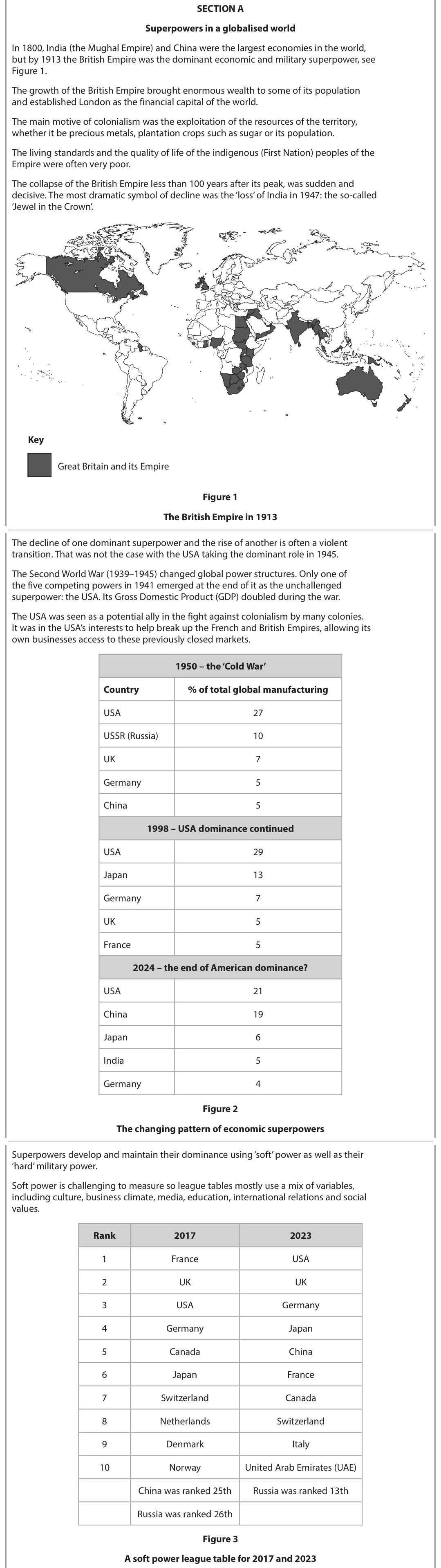
Resources for question 3
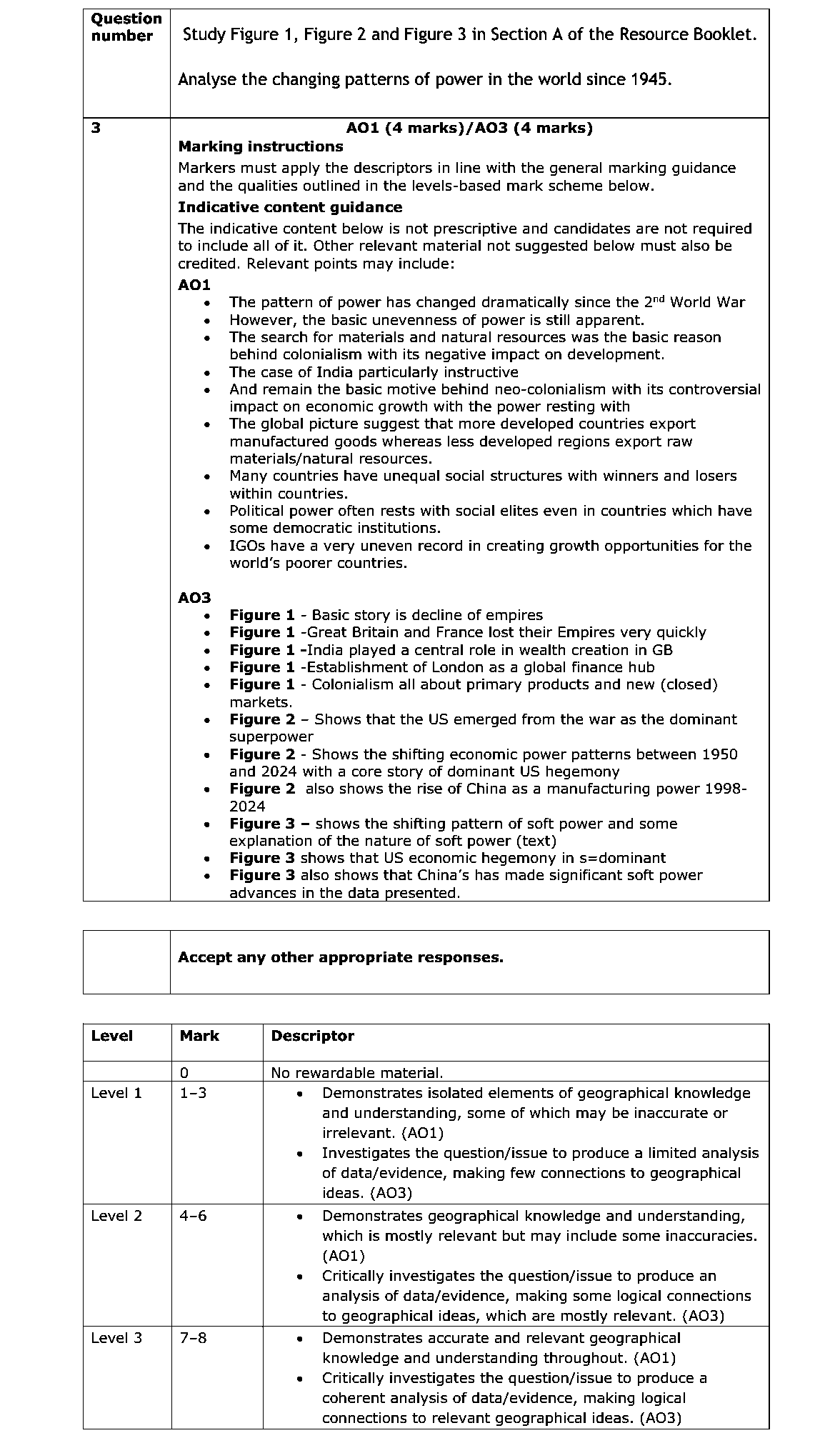
Mark scheme, including the levels and indicative content
Examiner's comment
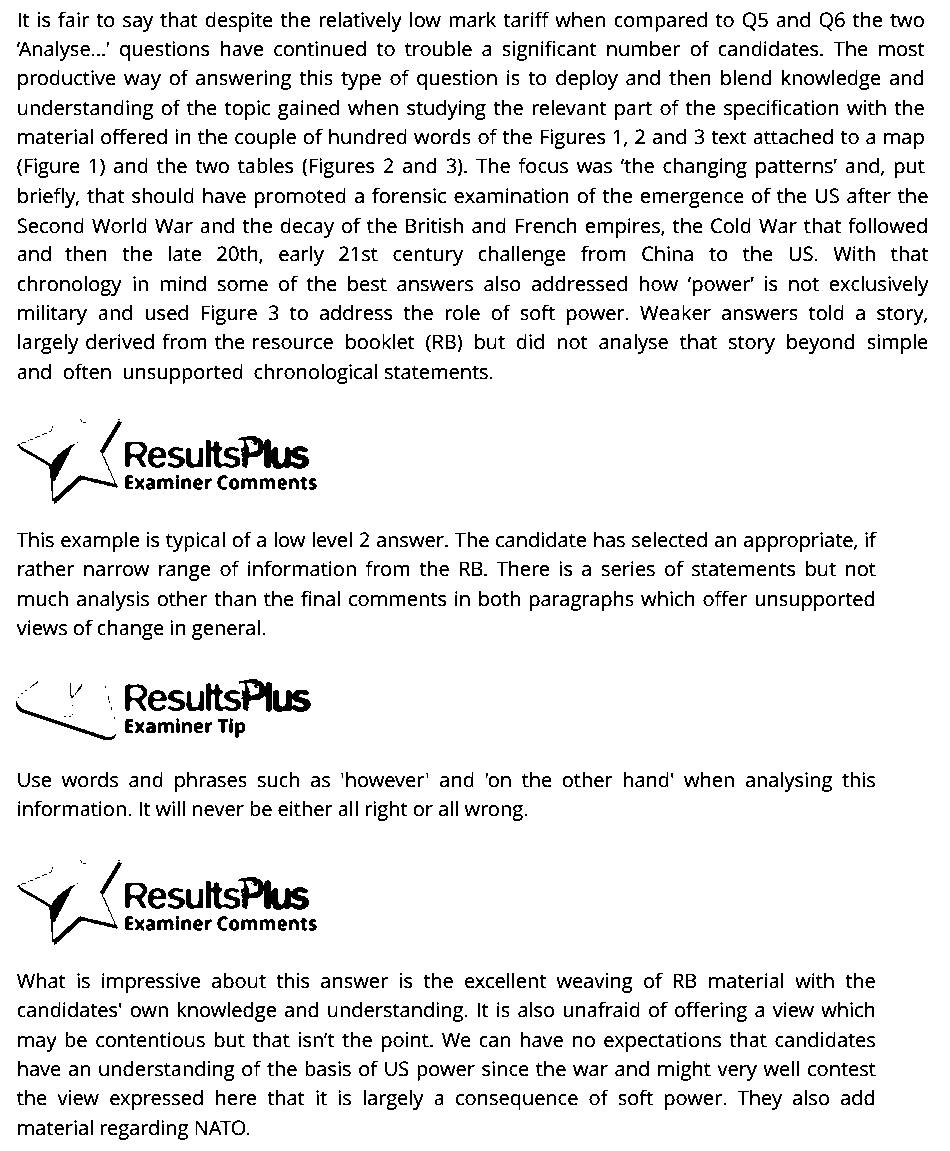
It is fair to say that despite the relatively low mark tariff when compared to Q5 and Q6 the two ‘Analyse…’ questions have continued to trouble a significant number of candidates. The most productive way of answering this type of question is to deploy and then blend knowledge and understanding of the topic gained when studying the relevant part of the specification with the material offered in the couple of hundred words of the Figures 1, 2 and 3 text attached to a map (Figure 1) and the two tables (Figures 2 and 3). The focus was ‘the changing patterns’ and, put briefly, that should have promoted a forensic examination of the emergence of the US after the Second World War and the decay of the British and French empires, the Cold War that followed and then the late 20th, early 21st century challenge from China to the US. With that chronology in mind some of the best answers also addressed how ‘power’ is not exclusively military and used Figure 3 to address the role of soft power. Weaker answers told a story, largely derived from the resource booklet (RB) but did not analyse that story beyond simple and often unsupported chronological statements. This example is typical of a low level 2 answer. The candidate has selected an appropriate, if rather narrow range of information from the RB. There is a series of statements but not much analysis other than the final comments in both paragraphs which offer unsupported views of change in general. Use words and phrases such as 'however' and 'on the other hand' when analysing this information. It will never be either all right or all wrong. What is impressive about this answer is the excellent weaving of RB material with the candidates' own knowledge and understanding. It is also unafraid of offering a view which may be contentious but that isn’t the point. We can have no expectations that candidates have an understanding of the basis of US power since the war and might very well contest the view expressed here that it is largely a consequence of soft power. They also add material regarding NATO.
Notes from the mark scheme and report
Use Figures 1-3: decline of British and French empires, USA dominant after 1945, Cold War bipolarity, China's manufacturing challenge (19% v USA 21% in 2024), soft power rankings (China 25th, Russia 26th)
report: 'Analyse' questions 'continued to trouble a significant number of candidates'
weaker answers retold the resource chronologically without analysis
June 2025 · Paper 3 · Q518 marksAO1=3, AO2=9, AO3=618-mark essay
Resources for question 5
Mark scheme, including the levels and indicative content
Examiner's comment
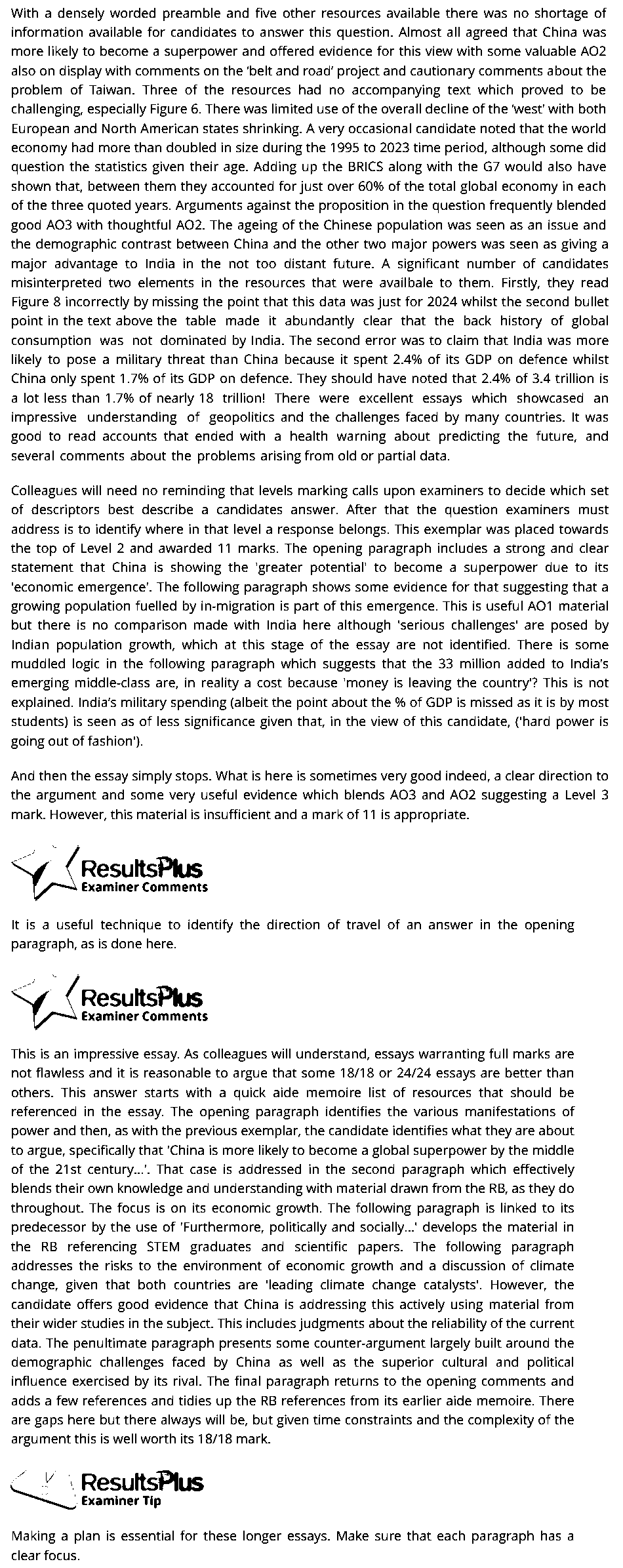
With a densely worded preamble and five other resources available there was no shortage of information available for candidates to answer this question. Almost all agreed that China was more likely to become a superpower and offered evidence for this view with some valuable AO2 also on display with comments on the ‘belt and road’ project and cautionary comments about the problem of Taiwan. Three of the resources had no accompanying text which proved to be challenging, especially Figure 6. There was limited use of the overall decline of the ‘west’ with both European and North American states shrinking. A very occasional candidate noted that the world economy had more than doubled in size during the 1995 to 2023 time period, although some did question the statistics given their age. Adding up the BRICS along with the G7 would also have shown that, between them they accounted for just over 60% of the total global economy in each of the three quoted years. Arguments against the proposition in the question frequently blended good AO3 with thoughtful AO2. The ageing of the Chinese population was seen as an issue and the demographic contrast between China and the other two major powers was seen as giving a major advantage to India in the not too distant future. A significant number of candidates misinterpreted two elements in the resources that were availbale to them. Firstly, they read Figure 8 incorrectly by missing the point that this data was just for 2024 whilst the second bullet point in the text above the table made it abundantly clear that the back history of global consumption was not dominated by India. The second error was to claim that India was more likely to pose a military threat than China because it spent 2.4% of its GDP on defence whilst China only spent 1.7% of its GDP on defence. They should have noted that 2.4% of 3.4 trillion is a lot less than 1.7% of nearly 18 trillion! There were excellent essays which showcased an impressive understanding of geopolitics and the challenges faced by many countries. It was good to read accounts that ended with a health warning about predicting the future, and several comments about the problems arising from old or partial data. Colleagues will need no reminding that levels marking calls upon examiners to decide which set of descriptors best describe a candidates answer. After that the question examiners must address is to identify where in that level a response belongs. This exemplar was placed towards the top of Level 2 and awarded 11 marks. The opening paragraph includes a strong and clear statement that China is showing the 'greater potential' to become a superpower due to its 'economic emergence'. The following paragraph shows some evidence for that suggesting that a growing population fuelled by in-migration is part of this emergence. This is useful AO1 material but there is no comparison made with India here although 'serious challenges' are posed by Indian population growth, which at this stage of the essay are not identified. There is some muddled logic in the following paragraph which suggests that the 33 million added to India’s emerging middle-class are, in reality a cost because 'money is leaving the country'? This is not explained. India’s military spending (albeit the point about the % of GDP is missed as it is by most students) is seen as of less significance given that, in the view of this candidate, ('hard power is going out of fashion'). And then the essay simply stops. What is here is sometimes very good indeed, a clear direction to the argument and some very useful evidence which blends AO3 and AO2 suggesting a Level 3 mark. However, this material is insufficient and a mark of 11 is appropriate. It is a useful technique to identify the direction of travel of an answer in the opening paragraph, as is done here. This is an impressive essay. As colleagues will understand, essays warranting full marks are not flawless and it is reasonable to argue that some 18/18 or 24/24 essays are better than others. This answer starts with a quick aide memoire list of resources that should be referenced in the essay. The opening paragraph identifies the various manifestations of power and then, as with the previous exemplar, the candidate identifies what they are about to argue, specifically that 'China is more likely to become a global superpower by the middle of the 21st century…'. That case is addressed in the second paragraph which effectively blends their own knowledge and understanding with material drawn from the RB, as they do throughout. The focus is on its economic growth. The following paragraph is linked to its predecessor by the use of 'Furthermore, politically and socially…' develops the material in the RB referencing STEM graduates and scientific papers. The following paragraph addresses the risks to the environment of economic growth and a discussion of climate change, given that both countries are 'leading climate change catalysts'. However, the candidate offers good evidence that China is addressing this actively using material from their wider studies in the subject. This includes judgments about the reliability of the current data. The penultimate paragraph presents some counter-argument largely built around the demographic challenges faced by China as well as the superior cultural and political influence exercised by its rival. The final paragraph returns to the opening comments and adds a few references and tidies up the RB references from its earlier aide memoire. There are gaps here but there always will be, but given time constraints and the complexity of the argument this is well worth its 18/18 mark. Making a plan is essential for these longer essays. Make sure that each paragraph has a clear focus.
Notes from the mark scheme and report
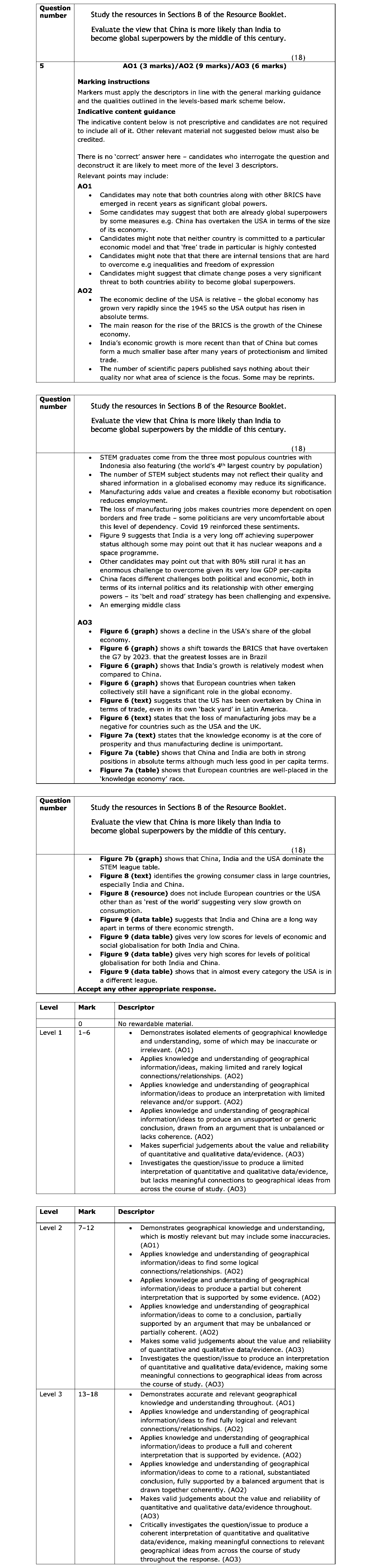
Use Section B (Figures 6-9): BRICS share of world economy, China's GDP 17.9 v India 3.4 trillion, scientific papers, STEM graduates, consumer growth, HDI and globalisation ranks
Belt and Road and Taiwan
China's ageing v India's young population
misreading Figure 8 (2024 only) was common
most agreed China more likely
June 2024 · Paper 2 · Q2(b)12 marksAO1=3, AO2=912-mark essay
Mark scheme, including the levels and indicative content
Examiner's comment
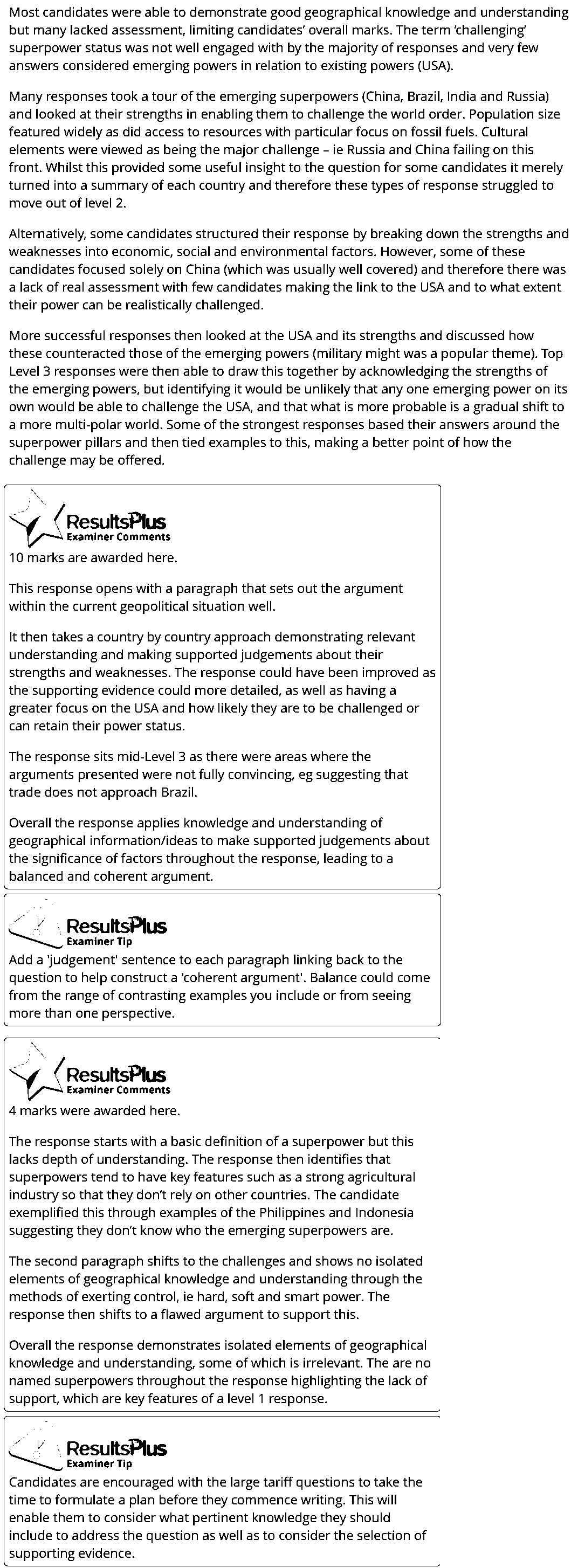
Most candidates were able to demonstrate good geographical knowledge and understanding but many lacked assessment, limiting candidates’ overall marks. The term ‘challenging’ superpower status was not well engaged with by the majority of responses and very few answers considered emerging powers in relation to existing powers (USA). Many responses took a tour of the emerging superpowers (China, Brazil, India and Russia) and looked at their strengths in enabling them to challenge the world order. Population size featured widely as did access to resources with particular focus on fossil fuels. Cultural elements were viewed as being the major challenge – ie Russia and China failing on this front. Whilst this provided some useful insight to the question for some candidates it merely turned into a summary of each country and therefore these types of response struggled to move out of level 2. Alternatively, some candidates structured their response by breaking down the strengths and weaknesses into economic, social and environmental factors. However, some of these candidates focused solely on China (which was usually well covered) and therefore there was a lack of real assessment with few candidates making the link to the USA and to what extent their power can be realistically challenged. More successful responses then looked at the USA and its strengths and discussed how these counteracted those of the emerging powers (military might was a popular theme). Top Level 3 responses were then able to draw this together by acknowledging the strengths of the emerging powers, but identifying it would be unlikely that any one emerging power on its own would be able to challenge the USA, and that what is more probable is a gradual shift to a more multi-polar world. Some of the strongest responses based their answers around the superpower pillars and then tied examples to this, making a better point of how the challenge may be offered. 10 marks are awarded here. This response opens with a paragraph that sets out the argument within the current geopolitical situation well. It then takes a country by country approach demonstrating relevant understanding and making supported judgements about their strengths and weaknesses. The response could have been improved as the supporting evidence could more detailed, as well as having a greater focus on the USA and how likely they are to be challenged or can retain their power status. The response sits mid-Level 3 as there were areas where the arguments presented were not fully convincing, eg suggesting that trade does not approach Brazil. Overall the response applies knowledge and understanding of geographical information/ideas to make supported judgements about the significance of factors throughout the response, leading to a balanced and coherent argument. Add a 'judgement' sentence to each paragraph linking back to the question to help construct a 'coherent argument'. Balance could come from the range of contrasting examples you include or from seeing more than one perspective. 4 marks were awarded here. The response starts with a basic definition of a superpower but this lacks depth of understanding. The response then identifies that superpowers tend to have key features such as a strong agricultural industry so that they don’t rely on other countries. The candidate exemplified this through examples of the Philippines and Indonesia suggesting they don’t know who the emerging superpowers are. The second paragraph shifts to the challenges and shows no isolated elements of geographical knowledge and understanding through the methods of exerting control, ie hard, soft and smart power. The response then shifts to a flawed argument to support this. Overall the response demonstrates isolated elements of geographical knowledge and understanding, some of which is irrelevant. The are no named superpowers throughout the response highlighting the lack of support, which are key features of a level 1 response. Candidates are encouraged with the large tariff questions to take the time to formulate a plan before they commence writing. This will enable them to consider what pertinent knowledge they should include to address the question as well as to consider the selection of supporting evidence.
Notes from the mark scheme and report
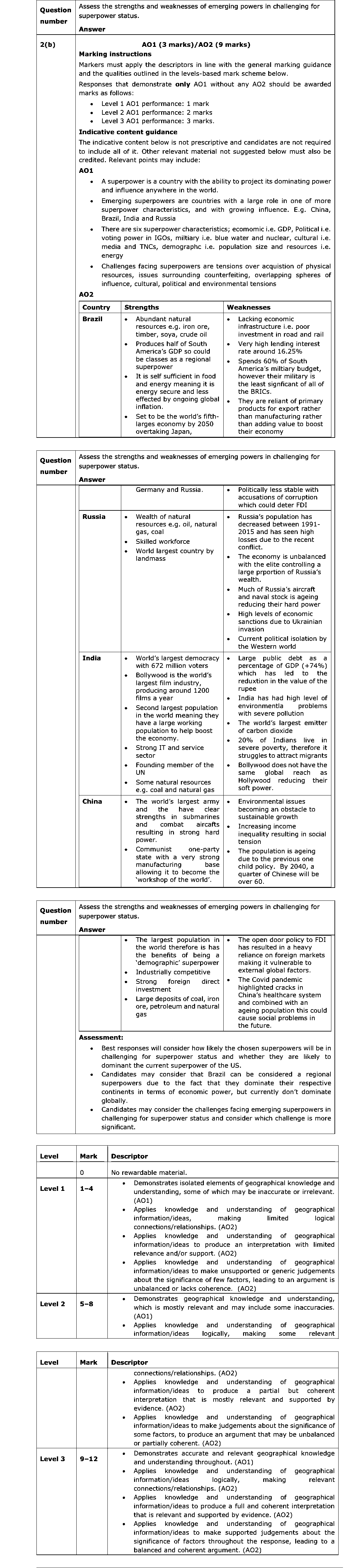
Strengths and weaknesses of BRICs (economic, political, military, cultural, demographic, resources) relative to the USA
most toured China, Brazil, India, Russia without assessing 'challenging' existing powers, so stuck in Level 2
June 2024 · Paper 3 · Q518 marksAO1=3, AO2=9, AO3=618-mark essay
Resources for question 5
Mark scheme, including the levels and indicative content
Examiner's comment
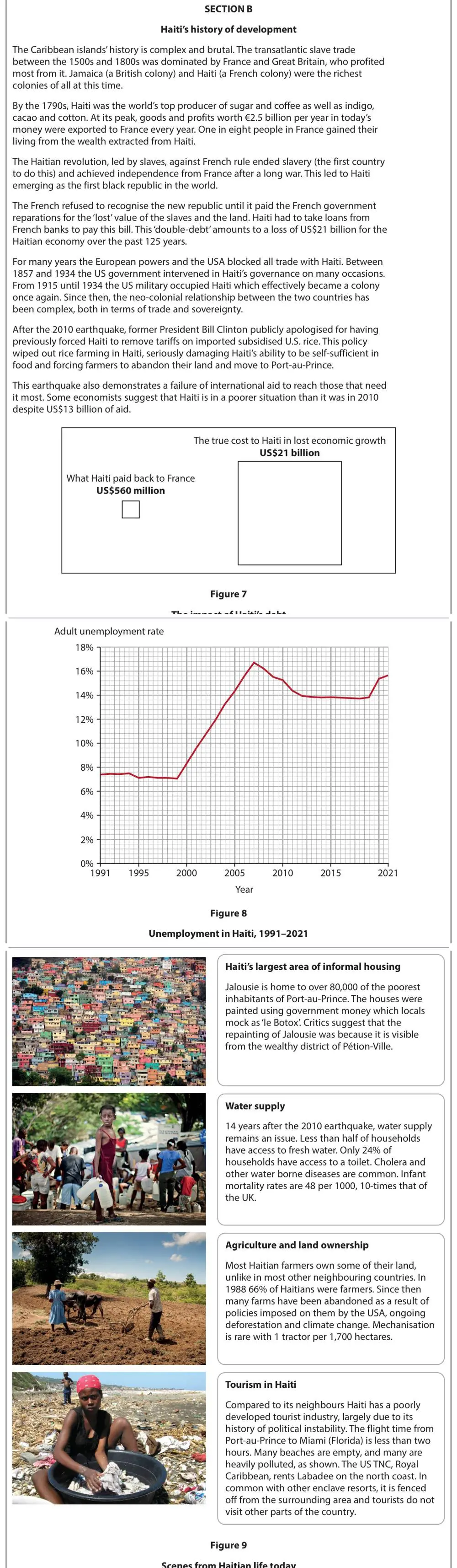
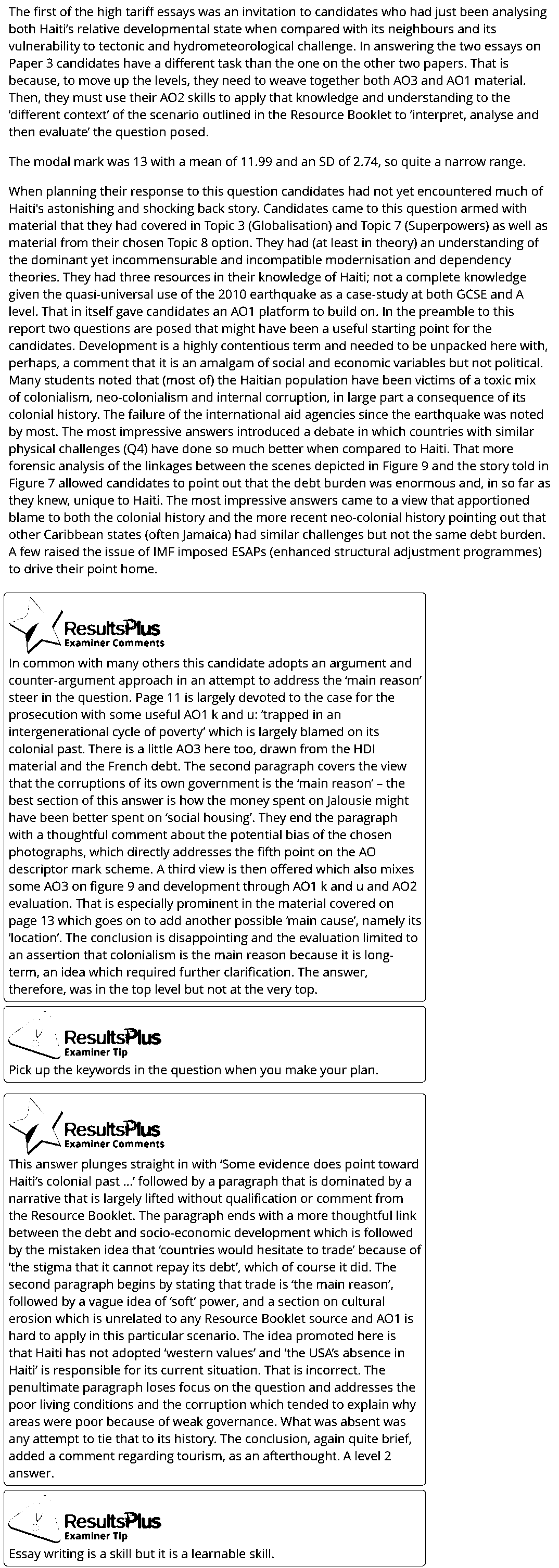
The first of the high tariff essays was an invitation to candidates who had just been analysing both Haiti’s relative developmental state when compared with its neighbours and its vulnerability to tectonic and hydrometeorological challenge. In answering the two essays on Paper 3 candidates have a different task than the one on the other two papers. That is because, to move up the levels, they need to weave together both AO3 and AO1 material. Then, they must use their AO2 skills to apply that knowledge and understanding to the ‘different context’ of the scenario outlined in the Resource Booklet to ‘interpret, analyse and then evaluate’ the question posed. The modal mark was 13 with a mean of 11.99 and an SD of 2.74, so quite a narrow range. When planning their response to this question candidates had not yet encountered much of Haiti's astonishing and shocking back story. Candidates came to this question armed with material that they had covered in Topic 3 (Globalisation) and Topic 7 (Superpowers) as well as material from their chosen Topic 8 option. They had (at least in theory) an understanding of the dominant yet incommensurable and incompatible modernisation and dependency theories. They had three resources in their knowledge of Haiti; not a complete knowledge given the quasi-universal use of the 2010 earthquake as a case-study at both GCSE and A level. That in itself gave candidates an AO1 platform to build on. In the preamble to this report two questions are posed that might have been a useful starting point for the candidates. Development is a highly contentious term and needed to be unpacked here with, perhaps, a comment that it is an amalgam of social and economic variables but not political. Many students noted that (most of) the Haitian population have been victims of a toxic mix of colonialism, neo-colonialism and internal corruption, in large part a consequence of its colonial history. The failure of the international aid agencies since the earthquake was noted by most. The most impressive answers introduced a debate in which countries with similar physical challenges (Q4) have done so much better when compared to Haiti. That more forensic analysis of the linkages between the scenes depicted in Figure 9 and the story told in Figure 7 allowed candidates to point out that the debt burden was enormous and, in so far as they knew, unique to Haiti. The most impressive answers came to a view that apportioned blame to both the colonial history and the more recent neo-colonial history pointing out that other Caribbean states (often Jamaica) had similar challenges but not the same debt burden. A few raised the issue of IMF imposed ESAPs (enhanced structural adjustment programmes) to drive their point home. In common with many others this candidate adopts an argument and counter-argument approach in an attempt to address the ‘main reason’ steer in the question. Page 11 is largely devoted to the case for the prosecution with some useful AO1 k and u: ‘trapped in an intergenerational cycle of poverty’ which is largely blamed on its colonial past. There is a little AO3 here too, drawn from the HDI material and the French debt. The second paragraph covers the view that the corruptions of its own government is the ‘main reason’ – the best section of this answer is how the money spent on Jalousie might have been better spent on ‘social housing’. They end the paragraph with a thoughtful comment about the potential bias of the chosen photographs, which directly addresses the fifth point on the AO descriptor mark scheme. A third view is then offered which also mixes some AO3 on figure 9 and development through AO1 k and u and AO2 evaluation. That is especially prominent in the material covered on page 13 which goes on to add another possible ‘main cause’, namely its ‘location’. The conclusion is disappointing and the evaluation limited to an assertion that colonialism is the main reason because it is long- term, an idea which required further clarification. The answer, therefore, was in the top level but not at the very top. Pick up the keywords in the question when you make your plan. This answer plunges straight in with ‘Some evidence does point toward Haiti’s colonial past …’ followed by a paragraph that is dominated by a narrative that is largely lifted without qualification or comment from the Resource Booklet. The paragraph ends with a more thoughtful link between the debt and socio-economic development which is followed by the mistaken idea that ‘countries would hesitate to trade’ because of ‘the stigma that it cannot repay its debt’, which of course it did. The second paragraph begins by stating that trade is ‘the main reason’, followed by a vague idea of ‘soft’ power, and a section on cultural erosion which is unrelated to any Resource Booklet source and AO1 is hard to apply in this particular scenario. The idea promoted here is that Haiti has not adopted ‘western values’ and ‘the USA’s absence in Haiti’ is responsible for its current situation. That is incorrect. The penultimate paragraph loses focus on the question and addresses the poor living conditions and the corruption which tended to explain why areas were poor because of weak governance. What was absent was any attempt to tie that to its history. The conclusion, again quite brief, added a comment regarding tourism, as an afterthought. A level 2 answer. Essay writing is a skill but it is a learnable skill.
Notes from the mark scheme and report
Section B (Figures 7-9): slavery and extraction by France, the US$21bn 'double debt', US occupation 1915-1934 and neo-colonial trade policy (Clinton rice tariffs), v corruption, hazards, deforestation, failed aid after 2010
use modernisation and dependency theory
define development
best apportioned blame between colonial past and other factors
mean 12, mode 13
June 2023 · Paper 2 · Q2(b)12 marksAO1=3, AO2=912-mark essay
Mark scheme, including the levels and indicative content
Examiner's comment
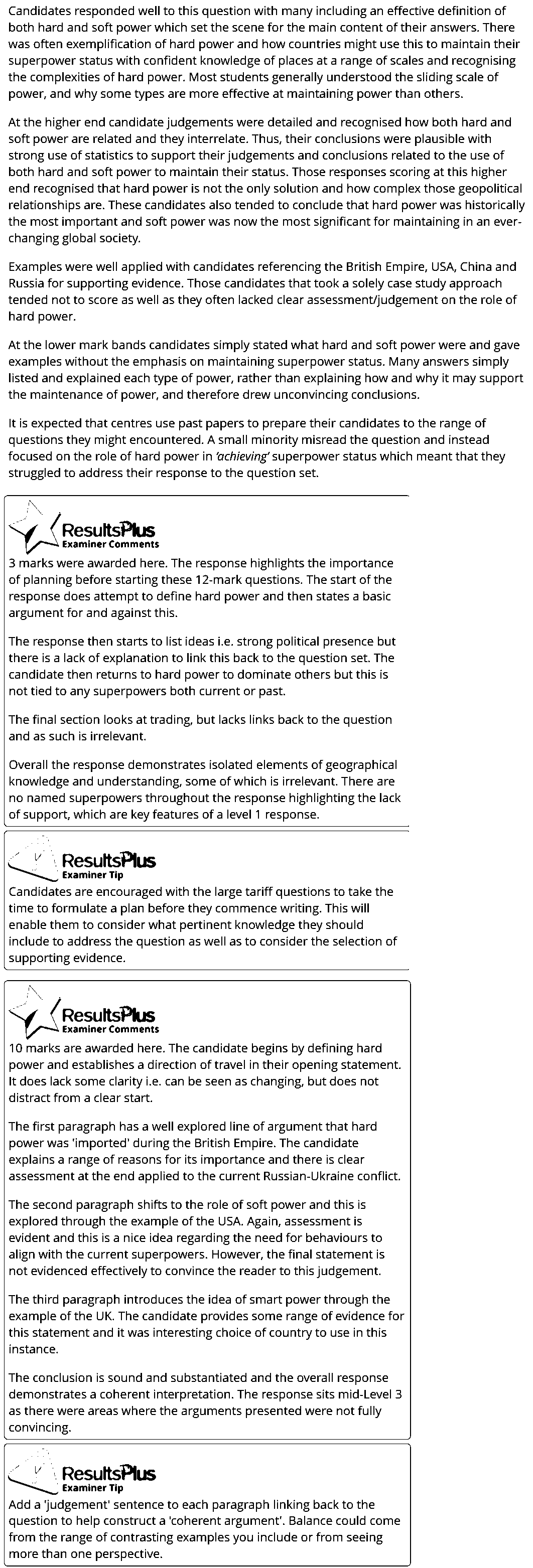
Candidates responded well to this question with many including an effective definition of both hard and soft power which set the scene for the main content of their answers. There was often exemplification of hard power and how countries might use this to maintain their superpower status with confident knowledge of places at a range of scales and recognising the complexities of hard power. Most students generally understood the sliding scale of power, and why some types are more effective at maintaining power than others. At the higher end candidate judgements were detailed and recognised how both hard and soft power are related and they interrelate. Thus, their conclusions were plausible with strong use of statistics to support their judgements and conclusions related to the use of both hard and soft power to maintain their status. Those responses scoring at this higher end recognised that hard power is not the only solution and how complex those geopolitical relationships are. These candidates also tended to conclude that hard power was historically the most important and soft power was now the most significant for maintaining in an ever- changing global society. Examples were well applied with candidates referencing the British Empire, USA, China and Russia for supporting evidence. Those candidates that took a solely case study approach tended not to score as well as they often lacked clear assessment/judgement on the role of hard power. At the lower mark bands candidates simply stated what hard and soft power were and gave examples without the emphasis on maintaining superpower status. Many answers simply listed and explained each type of power, rather than explaining how and why it may support the maintenance of power, and therefore drew unconvincing conclusions. It is expected that centres use past papers to prepare their candidates to the range of questions they might encountered. A small minority misread the question and instead focused on the role of hard power in ‘achieving’ superpower status which meant that they struggled to address their response to the question set. 3 marks were awarded here. The response highlights the importance of planning before starting these 12-mark questions. The start of the response does attempt to define hard power and then states a basic argument for and against this. The response then starts to list ideas i.e. strong political presence but there is a lack of explanation to link this back to the question set. The candidate then returns to hard power to dominate others but this is not tied to any superpowers both current or past. The final section looks at trading, but lacks links back to the question and as such is irrelevant. Overall the response demonstrates isolated elements of geographical knowledge and understanding, some of which is irrelevant. There are no named superpowers throughout the response highlighting the lack of support, which are key features of a level 1 response. Candidates are encouraged with the large tariff questions to take the time to formulate a plan before they commence writing. This will enable them to consider what pertinent knowledge they should include to address the question as well as to consider the selection of supporting evidence. 10 marks are awarded here. The candidate begins by defining hard power and establishes a direction of travel in their opening statement. It does lack some clarity i.e. can be seen as changing, but does not distract from a clear start. The first paragraph has a well explored line of argument that hard power was 'imported' during the British Empire. The candidate explains a range of reasons for its importance and there is clear assessment at the end applied to the current Russian-Ukraine conflict. The second paragraph shifts to the role of soft power and this is explored through the example of the USA. Again, assessment is evident and this is a nice idea regarding the need for behaviours to align with the current superpowers. However, the final statement is not evidenced effectively to convince the reader to this judgement. The third paragraph introduces the idea of smart power through the example of the UK. The candidate provides some range of evidence for this statement and it was interesting choice of country to use in this instance. The conclusion is sound and substantiated and the overall response demonstrates a coherent interpretation. The response sits mid-Level 3 as there were areas where the arguments presented were not fully convincing. Add a 'judgement' sentence to each paragraph linking back to the question to help construct a 'coherent argument'. Balance could come from the range of contrasting examples you include or from seeing more than one perspective.
Notes from the mark scheme and report
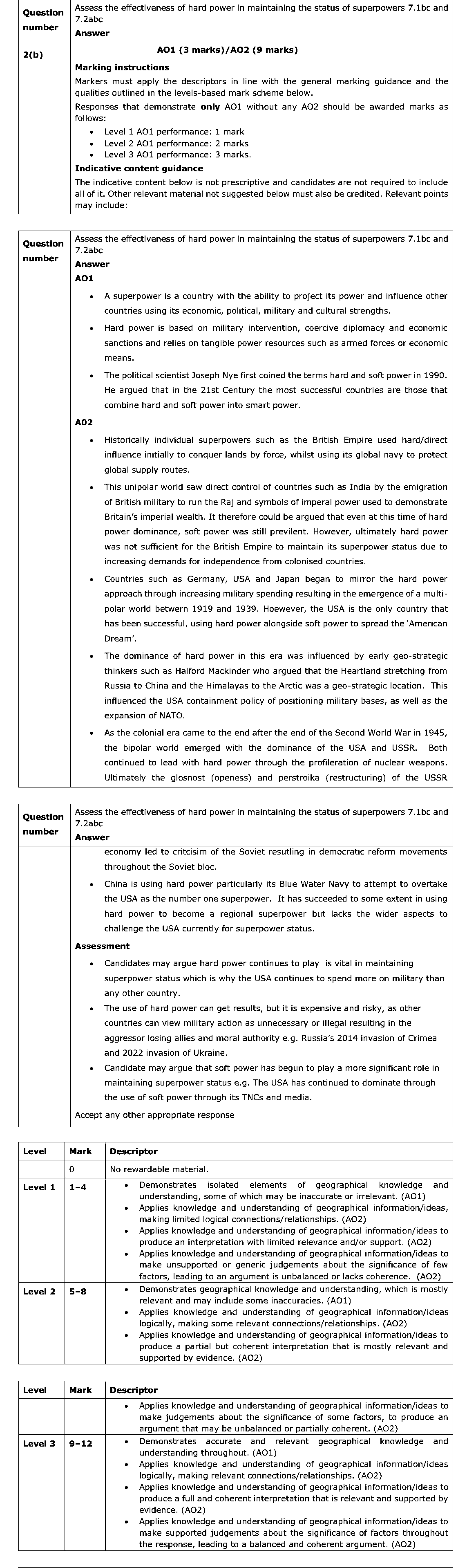
Define hard and soft power
military spending, bases, nuclear weapons, sanctions (USA, Russia, China) v soft power, smart power and economic power
best answers judged how hard and soft power interrelate, with statistics
November 2021 · Paper 2 · Q2(a)(i)2 marksAO3=2CalculationHard
Resources for question 2
Mark scheme
Examiner's comment
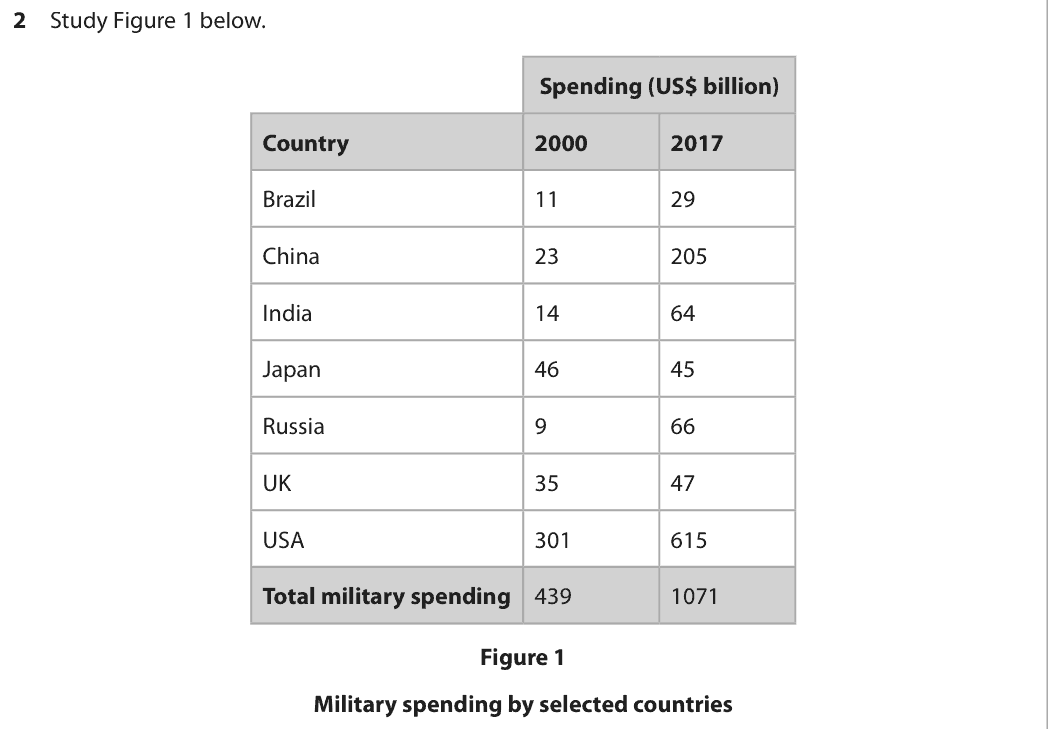
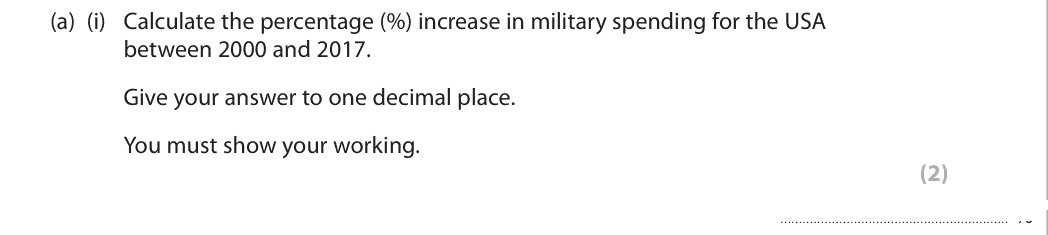
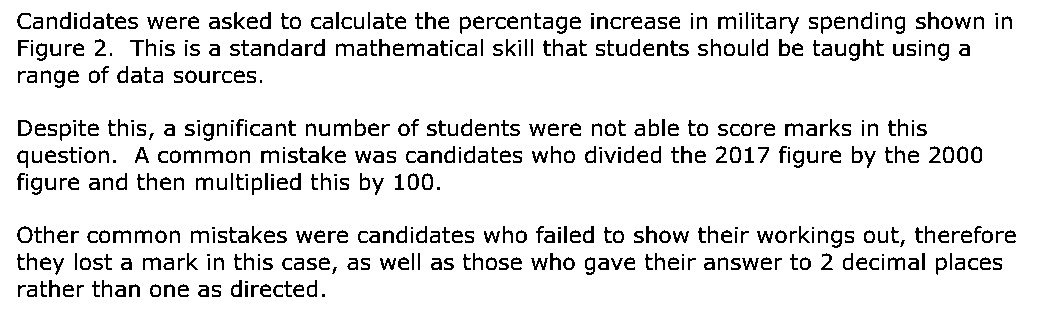
Candidates were asked to calculate the percentage increase in military spending shown in Figure 2. This is a standard mathematical skill that students should be taught using a range of data sources. Despite this, a significant number of students were not able to score marks in this question. A common mistake was candidates who divided the 2017 figure by the 2000 figure and then multiplied this by 100. Other common mistakes were candidates who failed to show their workings out, therefore they lost a mark in this case, as well as those who gave their answer to 2 decimal places rather than one as directed.
Notes from the mark scheme and report
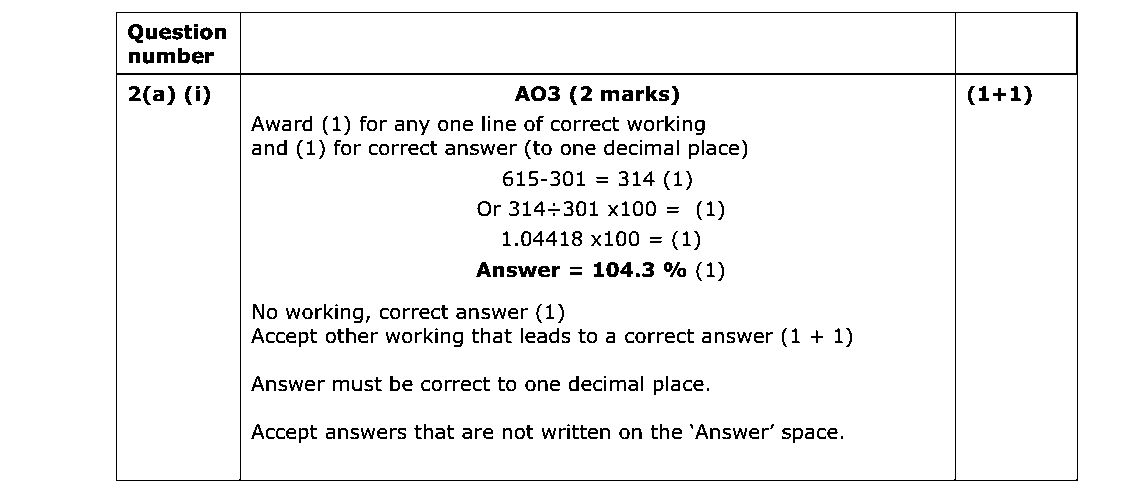
Answer: 104.3% ((615 - 301) ÷ 301 x 100)
1 mark working, 1 mark answer to 1 d.p.
report: 'a significant number of students were not able to score marks', commonly dividing 2017 by 2000
others omitted working or gave 2 d.p.
November 2021 · Paper 2 · Q2(a)(ii)1 markAO3=1Calculation
Resources for question 2
Mark scheme
Examiner's comment
In this second maths based question candidates were asked to calculate the ratio of military spending in USA vs China. A number of students were unable to simply the ratio down by dividing both sets of data by the greatest common factor. In this case candidates needed to divide both data sets by 205 to gain a ratio of 3:1.
Notes from the mark scheme and report
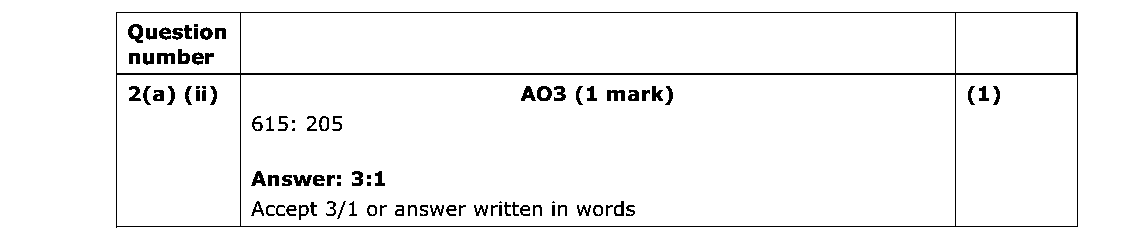
Answer: 3:1 (615:205, divide both by 205)
3/1 or words accepted
some could not simplify the ratio
November 2021 · Paper 2 · Q2(a)(iii)1 markAO3=1Data response
Resources for question 2
Mark scheme
Examiner's comment
This one-mark question asked candidates to identify the country with the fastest growth rate in military spending. Candidates on the whole were successful in identifying China, however some stated that the USA had the fastest growth rate. In this question candidates could have worked this out by taking the 2017 spending and dividing this by the 2000 spending and multiplying this by 100.
Notes from the mark scheme and report
Answer: China (23 to 205 billion, about +790%, faster than Russia)
some wrongly said the USA, which had the largest absolute rise
November 2021 · Paper 2 · Q2(a)(iv)12 marksAO1=3, AO2=912-mark essay
Resources for question 2
Mark scheme, including the levels and indicative content
Examiner's comment
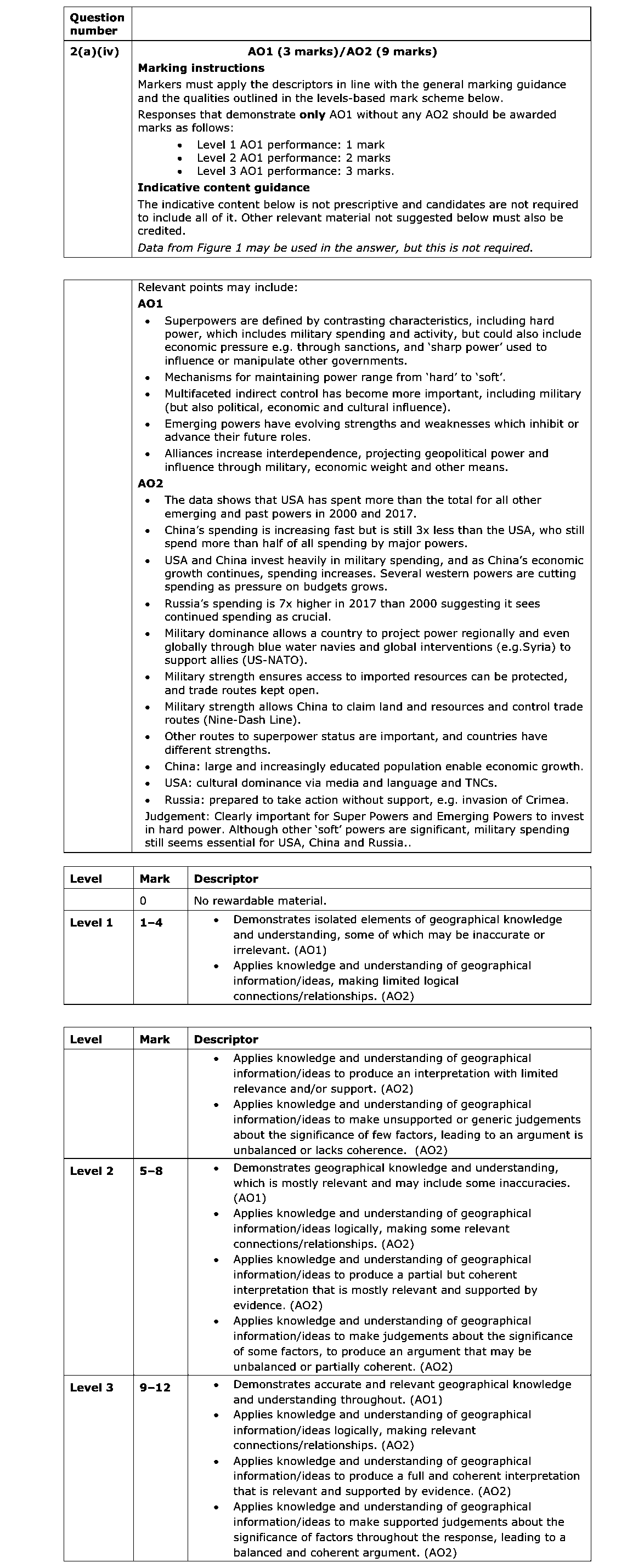
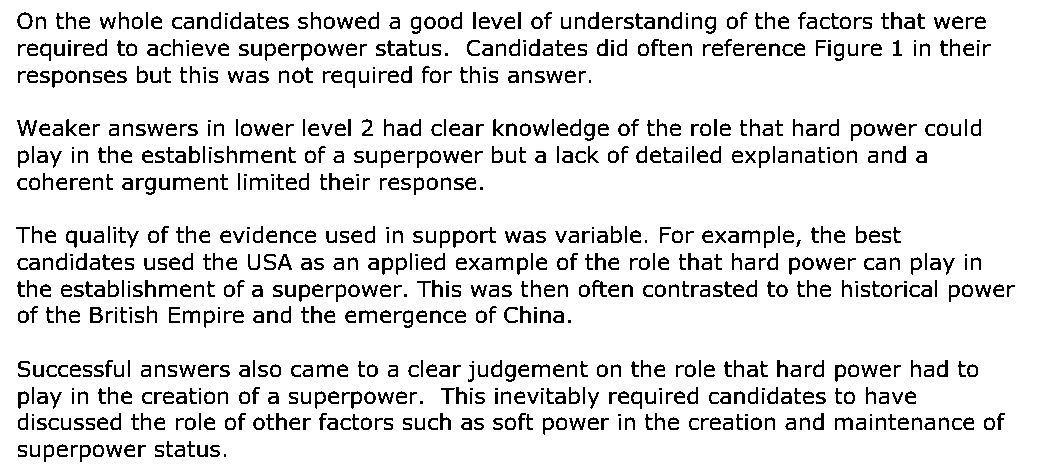
On the whole candidates showed a good level of understanding of the factors that were required to achieve superpower status. Candidates did often reference Figure 1 in their responses but this was not required for this answer. Weaker answers in lower level 2 had clear knowledge of the role that hard power could play in the establishment of a superpower but a lack of detailed explanation and a coherent argument limited their response. The quality of the evidence used in support was variable. For example, the best candidates used the USA as an applied example of the role that hard power can play in the establishment of a superpower. This was then often contrasted to the historical power of the British Empire and the emergence of China. Successful answers also came to a clear judgement on the role that hard power had to play in the creation of a superpower. This inevitably required candidates to have discussed the role of other factors such as soft power in the creation and maintenance of superpower status.
Notes from the mark scheme and report
Hard power (military spending, sanctions, sharp power) v soft power, economic and cultural influence, alliances
examples USA, China, Russia
Figure 1 not required
best answers reached a clear judgement on the role of hard power relative to soft power
October 2020 · Paper 3 · Q14 marksAO1=4Short answer
Mark scheme
Examiner's comment
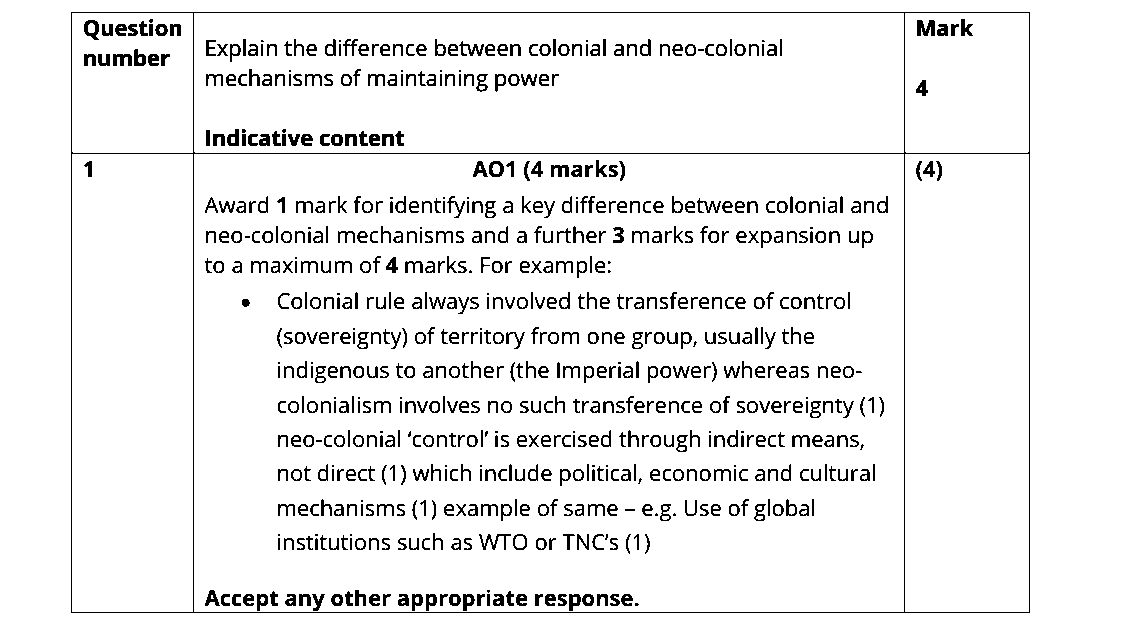
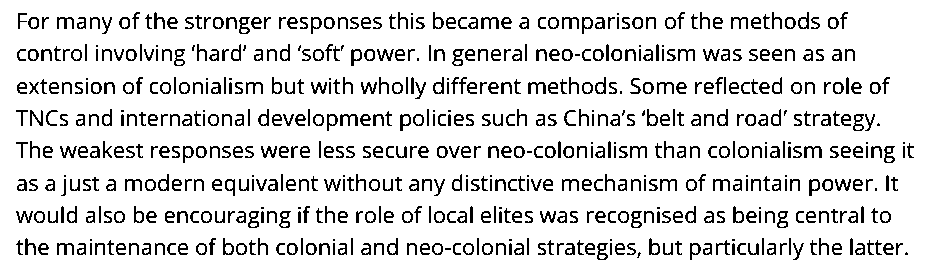
For many of the stronger responses this became a comparison of the methods of control involving ‘hard’ and ‘soft’ power. In general neo-colonialism was seen as an extension of colonialism but with wholly different methods. Some reflected on role of TNCs and international development policies such as China’s ‘belt and road’ strategy. The weakest responses were less secure over neo-colonialism than colonialism seeing it as a just a modern equivalent without any distinctive mechanism of maintain power. It would also be encouraging if the role of local elites was recognised as being central to the maintenance of both colonial and neo-colonial strategies, but particularly the latter.
Notes from the mark scheme and report
Colonial rule transfers sovereignty and uses direct (often military) control
neo-colonialism keeps formal independence but uses indirect political, economic and cultural control (IGOs such as the WTO, TNCs, aid, debt, China's Belt and Road)
weak answers saw neo-colonialism as just a modern colonialism
recognise the role of local elites
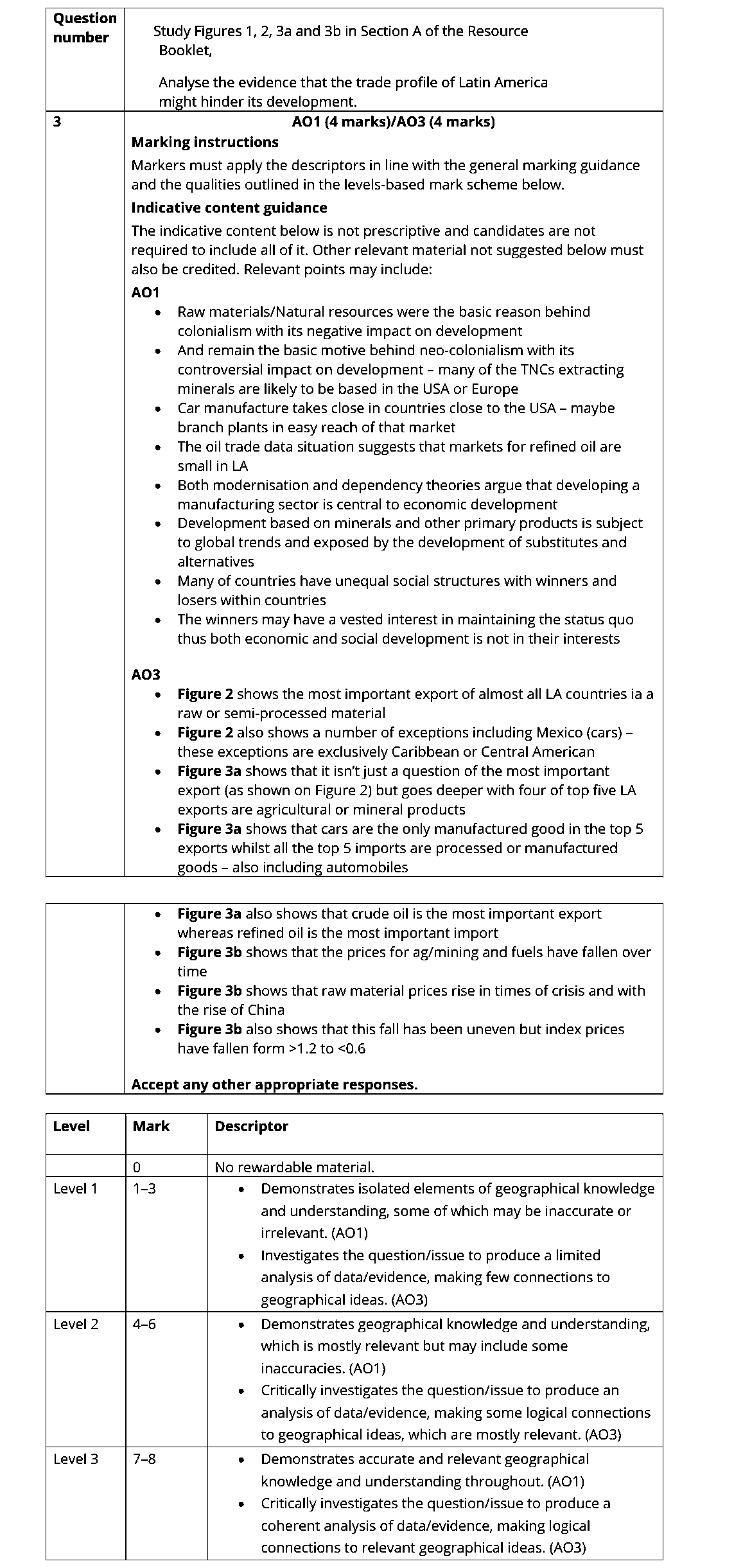
October 2020 · Paper 3 · Q38 marksAO1=4, AO3=4Extended responseHard
Resources for question 3
Mark scheme, including the levels and indicative content
Examiner's comment
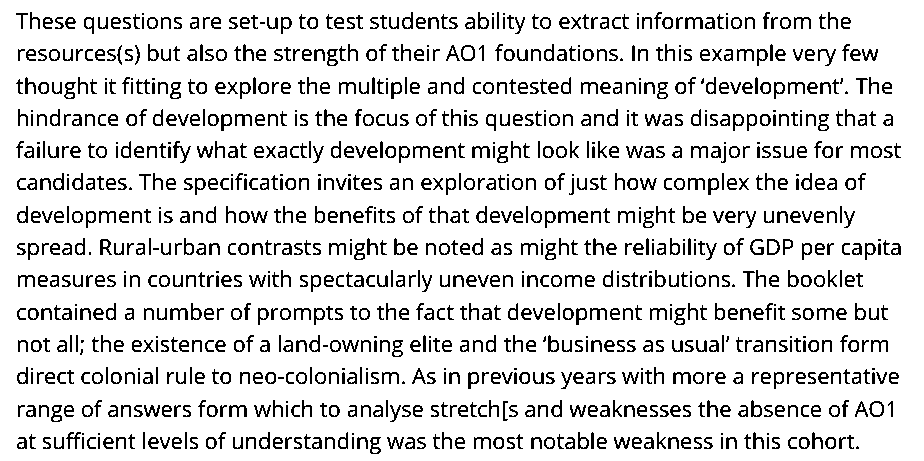
These questions are set-up to test students ability to extract information from the resources(s) but also the strength of their AO1 foundations. In this example very few thought it fitting to explore the multiple and contested meaning of ‘development’. The hindrance of development is the focus of this question and it was disappointing that a failure to identify what exactly development might look like was a major issue for most candidates. The specification invites an exploration of just how complex the idea of development is and how the benefits of that development might be very unevenly spread. Rural-urban contrasts might be noted as might the reliability of GDP per capita measures in countries with spectacularly uneven income distributions. The booklet contained a number of prompts to the fact that development might benefit some but not all; the existence of a land-owning elite and the ‘business as usual’ transition form direct colonial rule to neo-colonialism. As in previous years with more a representative range of answers form which to analyse stretch[s and weaknesses the absence of AO1 at sufficient levels of understanding was the most notable weakness in this cohort.
Notes from the mark scheme and report
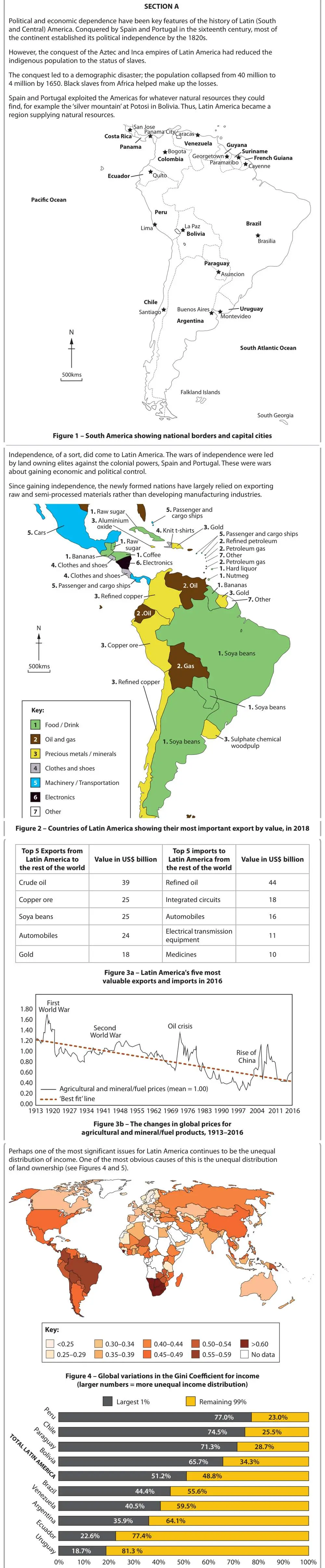
Use Figures 1-3b: most countries' main export is a raw material (Mexico cars the exception)
4 of top 5 exports primary while imports are manufactured (crude oil out, refined oil in)
commodity prices falling long-term from above 1.2 to below 0.6 and volatile
dependency and modernisation theory
report: most failed to say what 'development' means, a major issue for most candidates
October 2020 · Paper 3 · Q624 marksAO1=4, AO2=12, AO3=824-mark essayHard
Resources for question 6
Mark scheme, including the levels and indicative content
Examiner's comment
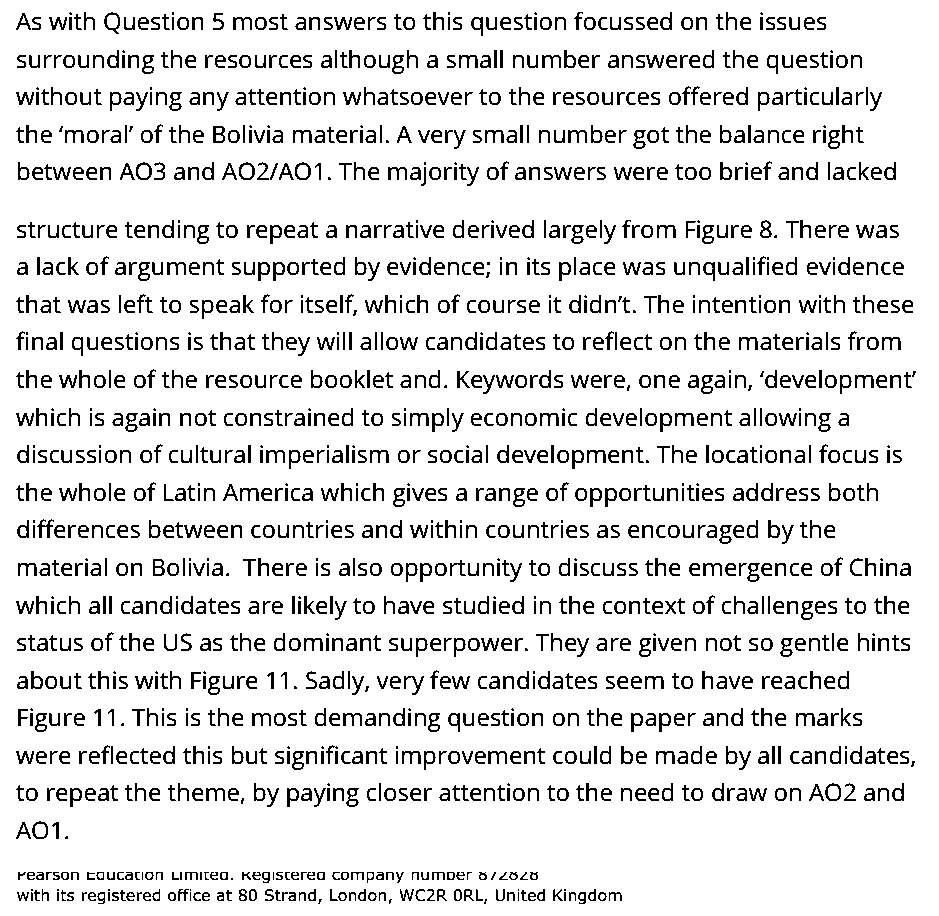
As with Question 5 most answers to this question focussed on the issues surrounding the resources although a small number answered the question without paying any attention whatsoever to the resources offered particularly the ‘moral’ of the Bolivia material. A very small number got the balance right between AO3 and AO2/AO1. The majority of answers were too brief and lacked structure tending to repeat a narrative derived largely from Figure 8. There was a lack of argument supported by evidence; in its place was unqualified evidence that was left to speak for itself, which of course it didn’t. The intention with these final questions is that they will allow candidates to reflect on the materials from the whole of the resource booklet and. Keywords were, one again, ‘development’ which is again not constrained to simply economic development allowing a discussion of cultural imperialism or social development. The locational focus is the whole of Latin America which gives a range of opportunities address both differences between countries and within countries as encouraged by the material on Bolivia. There is also opportunity to discuss the emergence of China which all candidates are likely to have studied in the context of challenges to the status of the US as the dominant superpower. They are given not so gentle hints about this with Figure 11. Sadly, very few candidates seem to have reached Figure 11. This is the most demanding question on the paper and the marks were reflected this but significant improvement could be made by all candidates, to repeat the theme, by paying closer attention to the need to draw on AO2 and AO1. with its registered office at 80 Strand, London, WC2R 0RL, United Kingdom
Notes from the mark scheme and report
Figure 8 US interventions (backyard), US-dominated IGOs and TNCs v Bolivia under Morales (nationalised gas, lithium, links with China), Figure 11 rail project funded by China and Europe
development is not only economic
report: most answers too brief and narrative from Figure 8, very few reached Figure 11
the most demanding question
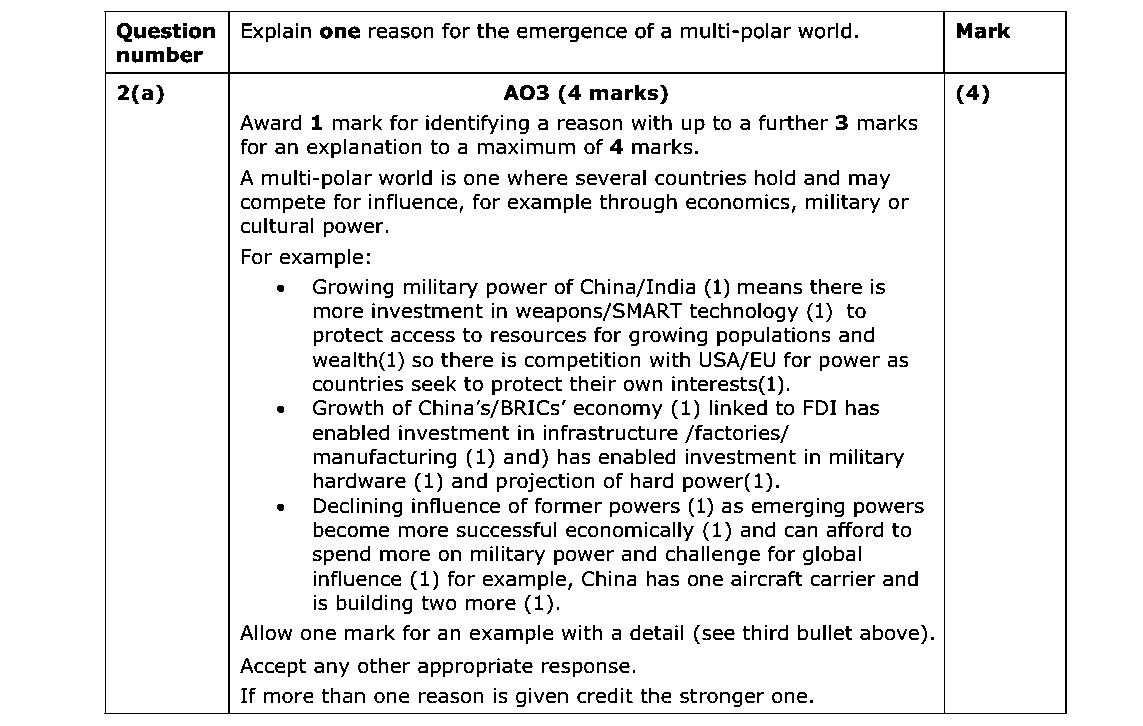
June 2019 · Paper 2 · Q2(a)4 marksAO3=4Short answer
Mark scheme
Examiner's comment
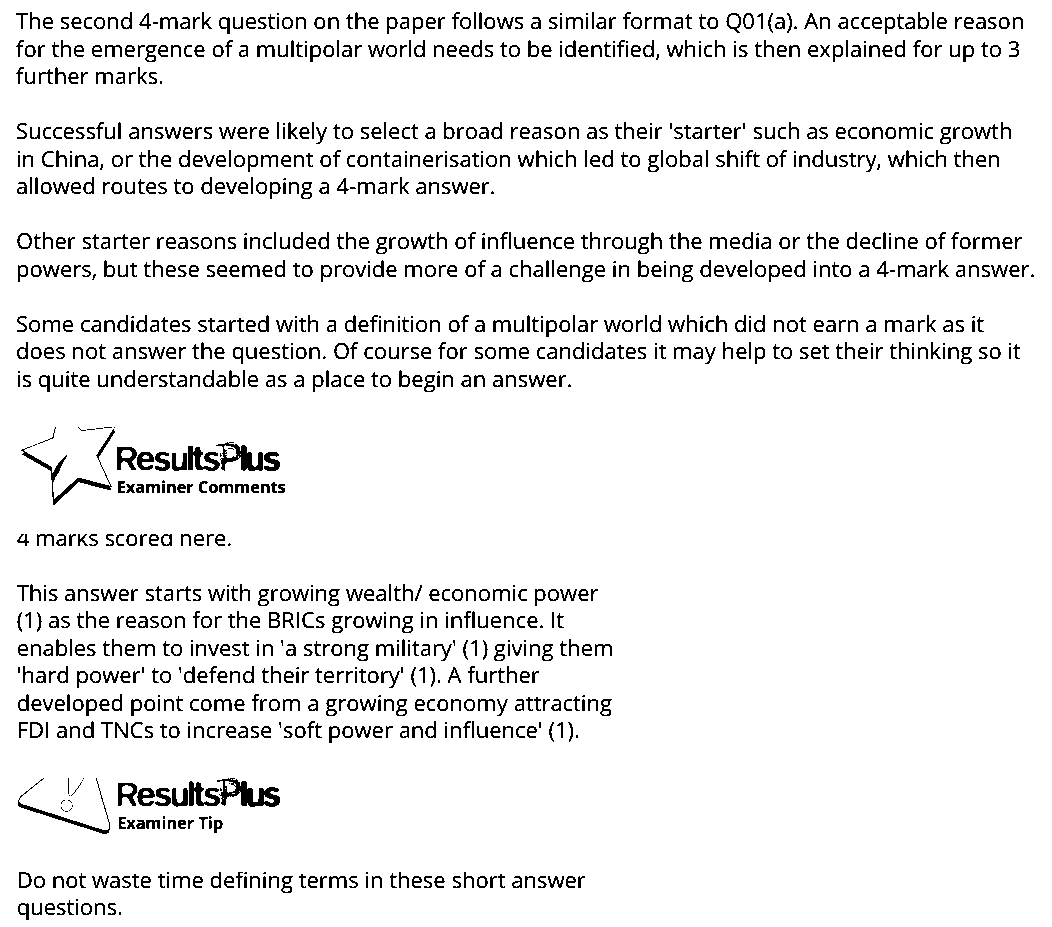
The second 4-mark question on the paper follows a similar format to Q01(a). An acceptable reason for the emergence of a multipolar world needs to be identified, which is then explained for up to 3 further marks. Successful answers were likely to select a broad reason as their 'starter' such as economic growth in China, or the development of containerisation which led to global shift of industry, which then allowed routes to developing a 4-mark answer. Other starter reasons included the growth of influence through the media or the decline of former powers, but these seemed to provide more of a challenge in being developed into a 4-mark answer. Some candidates started with a definition of a multipolar world which did not earn a mark as it does not answer the question. Of course for some candidates it may help to set their thinking so it is quite understandable as a place to begin an answer. 4 marks scored here. This answer starts with growing wealth/ economic power (1) as the reason for the BRICs growing in influence. It enables them to invest in 'a strong military' (1) giving them 'hard power' to 'defend their territory' (1). A further developed point come from a growing economy attracting FDI and TNCs to increase 'soft power and influence' (1). Do not waste time defining terms in these short answer questions.
Notes from the mark scheme and report
One reason developed: economic growth of China/BRICs (FDI, global shift, containerisation) funds military power and influence, declining former powers
a definition of multipolar earns no mark
June 2019 · Paper 3 · Q14 marksAO1=4Short answerHard
Mark scheme
Examiner's comment
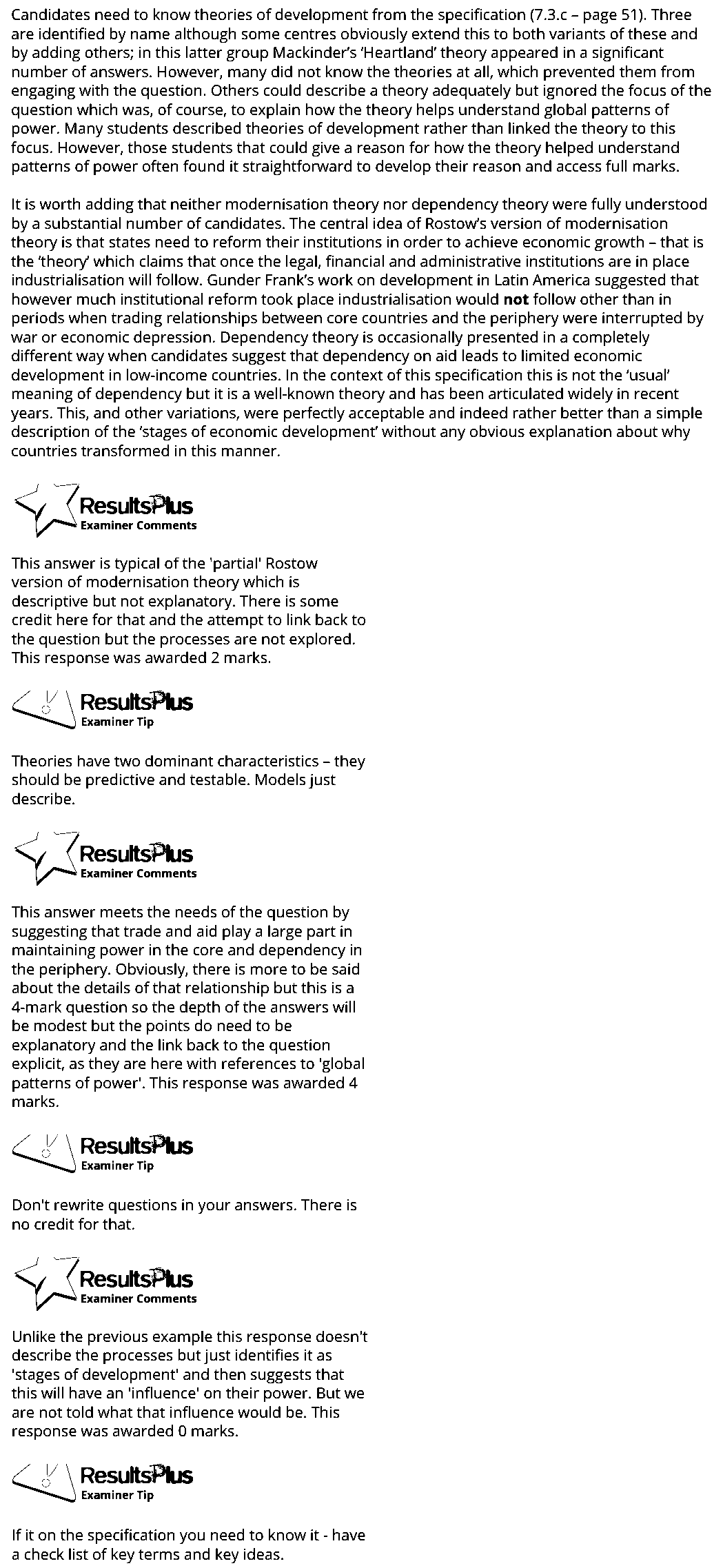
Candidates need to know theories of development from the specification (7.3.c – page 51). Three are identified by name although some centres obviously extend this to both variants of these and by adding others; in this latter group Mackinder’s ‘Heartland’ theory appeared in a significant number of answers. However, many did not know the theories at all, which prevented them from engaging with the question. Others could describe a theory adequately but ignored the focus of the question which was, of course, to explain how the theory helps understand global patterns of power. Many students described theories of development rather than linked the theory to this focus. However, those students that could give a reason for how the theory helped understand patterns of power often found it straightforward to develop their reason and access full marks. It is worth adding that neither modernisation theory nor dependency theory were fully understood by a substantial number of candidates. The central idea of Rostow’s version of modernisation theory is that states need to reform their institutions in order to achieve economic growth – that is the ‘theory’ which claims that once the legal, financial and administrative institutions are in place industrialisation will follow. Gunder Frank’s work on development in Latin America suggested that however much institutional reform took place industrialisation would not follow other than in periods when trading relationships between core countries and the periphery were interrupted by war or economic depression. Dependency theory is occasionally presented in a completely different way when candidates suggest that dependency on aid leads to limited economic development in low-income countries. In the context of this specification this is not the ‘usual’ meaning of dependency but it is a well-known theory and has been articulated widely in recent years. This, and other variations, were perfectly acceptable and indeed rather better than a simple description of the ‘stages of economic development’ without any obvious explanation about why countries transformed in this manner. This answer is typical of the 'partial' Rostow version of modernisation theory which is descriptive but not explanatory. There is some credit here for that and the attempt to link back to the question but the processes are not explored. This response was awarded 2 marks. Theories have two dominant characteristics – they should be predictive and testable. Models just describe. This answer meets the needs of the question by suggesting that trade and aid play a large part in maintaining power in the core and dependency in the periphery. Obviously, there is more to be said about the details of that relationship but this is a 4-mark question so the depth of the answers will be modest but the points do need to be explanatory and the link back to the question explicit, as they are here with references to 'global patterns of power'. This response was awarded 4 marks. Don't rewrite questions in your answers. There is no credit for that. Unlike the previous example this response doesn't describe the processes but just identifies it as 'stages of development' and then suggests that this will have an 'influence' on their power. But we are not told what that influence would be. This response was awarded 0 marks. If it on the specification you need to know it - have a check list of key terms and key ideas.
Notes from the mark scheme and report
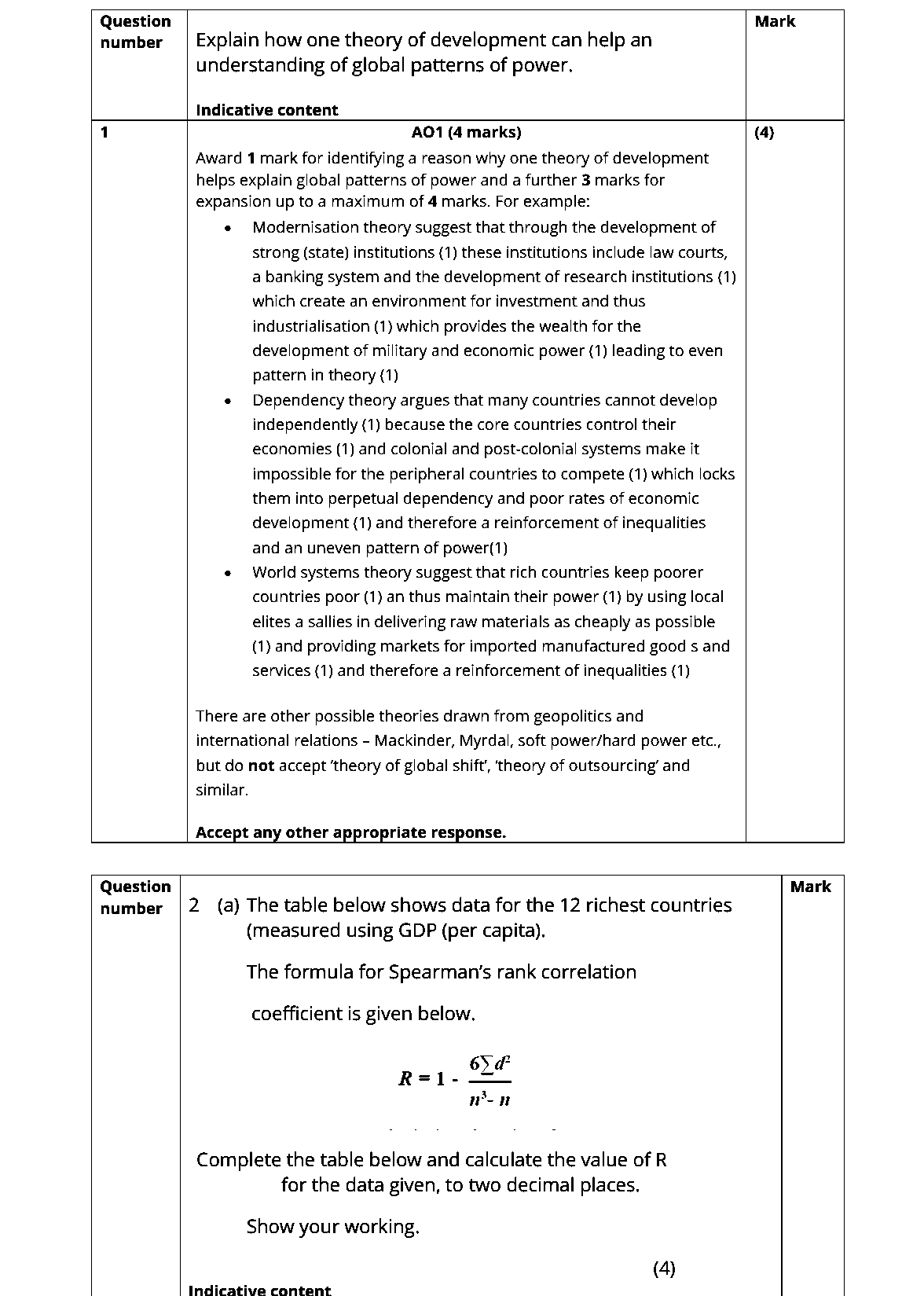
One theory + 3 marks of expansion linked to patterns of power: modernisation (institutions, investment, industrialisation), dependency (core controls periphery, colonial legacy locks in unequal power), world systems (core keeps periphery supplying cheap raw materials)
report: 'many did not know the theories at all' and many described a theory without linking it to power
June 2019 · Paper 3 · Q2(a)4 marksAO3=4Calculation
Mark scheme
Examiner's comment
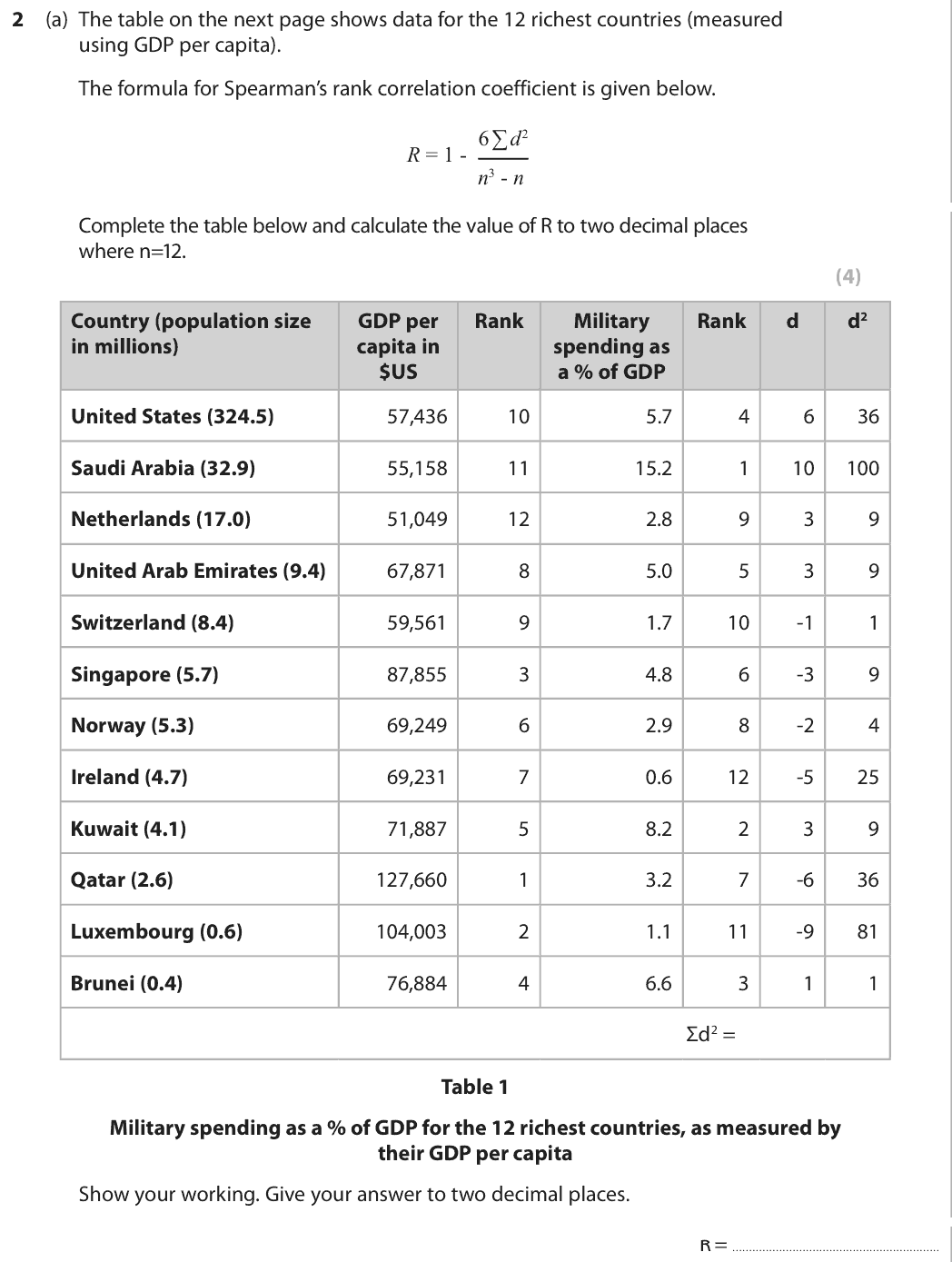
Candidates need to be taught to evidence every stage of their working. They must also be very careful not to make negative numbers positive for no reason. As centres look to the future it is important that they have a check-list of statistical methods and techniques that can be legitimately examined. These include some quite straightforward elements which are easy to overlook in the collective eagerness to cover the more complex methodologies. They also need to be aware of the limitations of these techniques because these will often be part of their answer to Q02(b).
Notes from the mark scheme and report
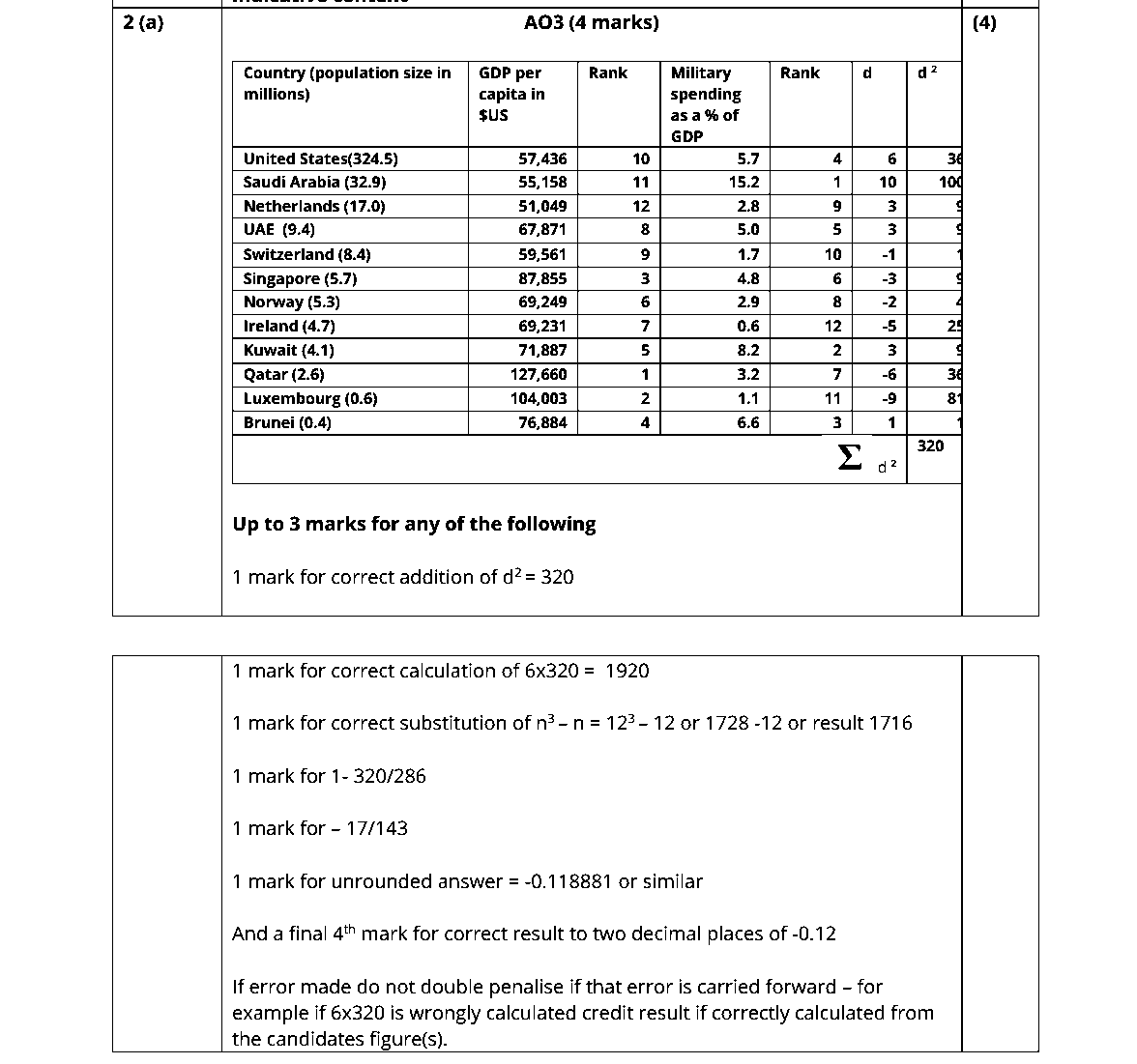
Answer: R = -0.12 (Σd² = 320
1 - 1920 ÷ 1716 = -0.1189)
up to 3 marks for working steps + 1 for answer to 2 d.p.
error carried forward not double-penalised
show every stage and do not make negatives positive
June 2019 · Paper 3 · Q2(b)4 marksAO3=4Calculation
Mark scheme
Examiner's comment
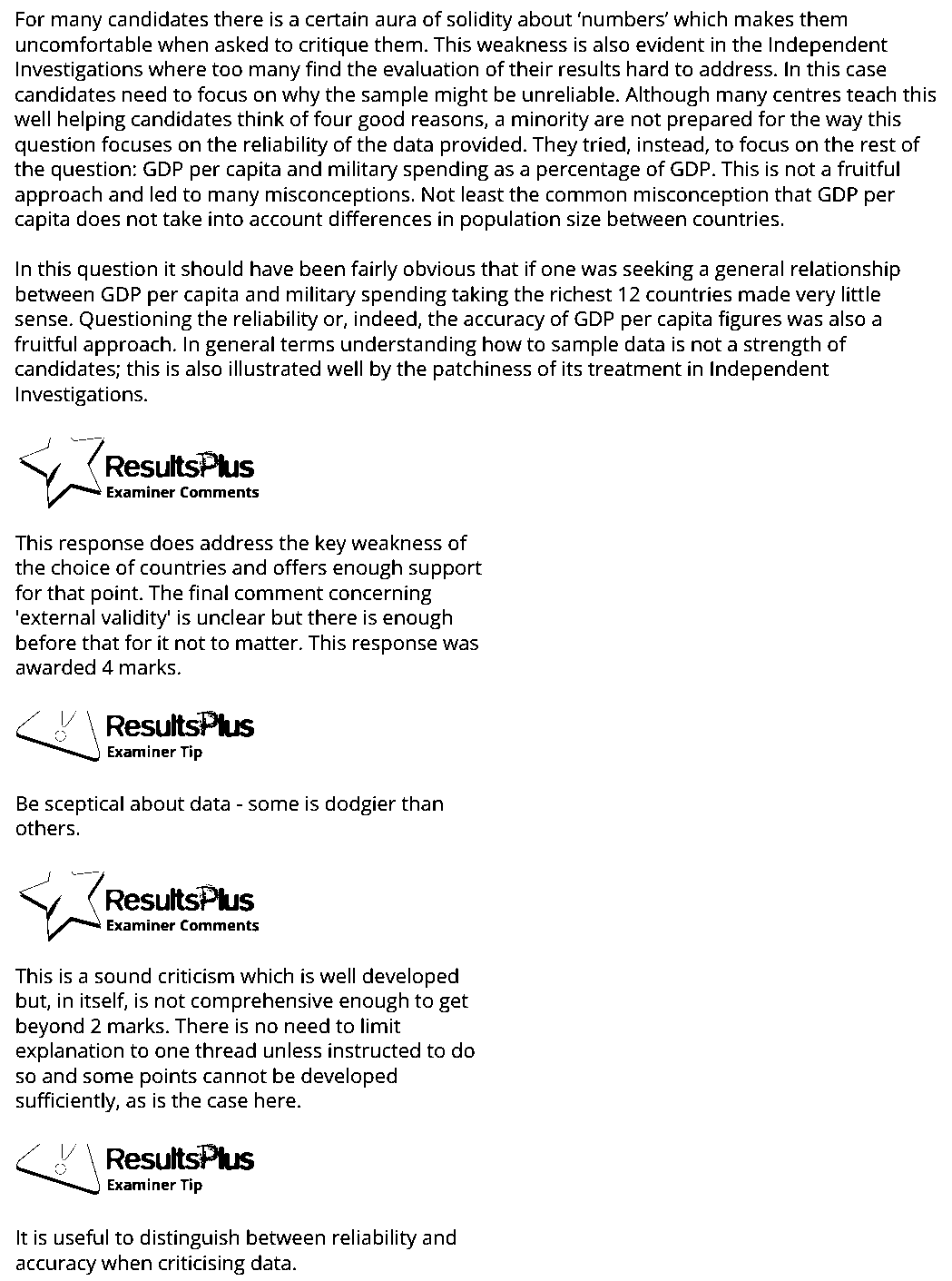
For many candidates there is a certain aura of solidity about ‘numbers’ which makes them uncomfortable when asked to critique them. This weakness is also evident in the Independent Investigations where too many find the evaluation of their results hard to address. In this case candidates need to focus on why the sample might be unreliable. Although many centres teach this well helping candidates think of four good reasons, a minority are not prepared for the way this question focuses on the reliability of the data provided. They tried, instead, to focus on the rest of the question: GDP per capita and military spending as a percentage of GDP. This is not a fruitful approach and led to many misconceptions. Not least the common misconception that GDP per capita does not take into account differences in population size between countries. In this question it should have been fairly obvious that if one was seeking a general relationship between GDP per capita and military spending taking the richest 12 countries made very little sense. Questioning the reliability or, indeed, the accuracy of GDP per capita figures was also a fruitful approach. In general terms understanding how to sample data is not a strength of candidates; this is also illustrated well by the patchiness of its treatment in Independent Investigations. This response does address the key weakness of the choice of countries and offers enough support for that point. The final comment concerning 'external validity' is unclear but there is enough before that for it not to matter. This response was awarded 4 marks. Be sceptical about data - some is dodgier than others. This is a sound criticism which is well developed but, in itself, is not comprehensive enough to get beyond 2 marks. There is no need to limit explanation to one thread unless instructed to do so and some points cannot be developed sufficiently, as is the case here. It is useful to distinguish between reliability and accuracy when criticising data.
Notes from the mark scheme and report
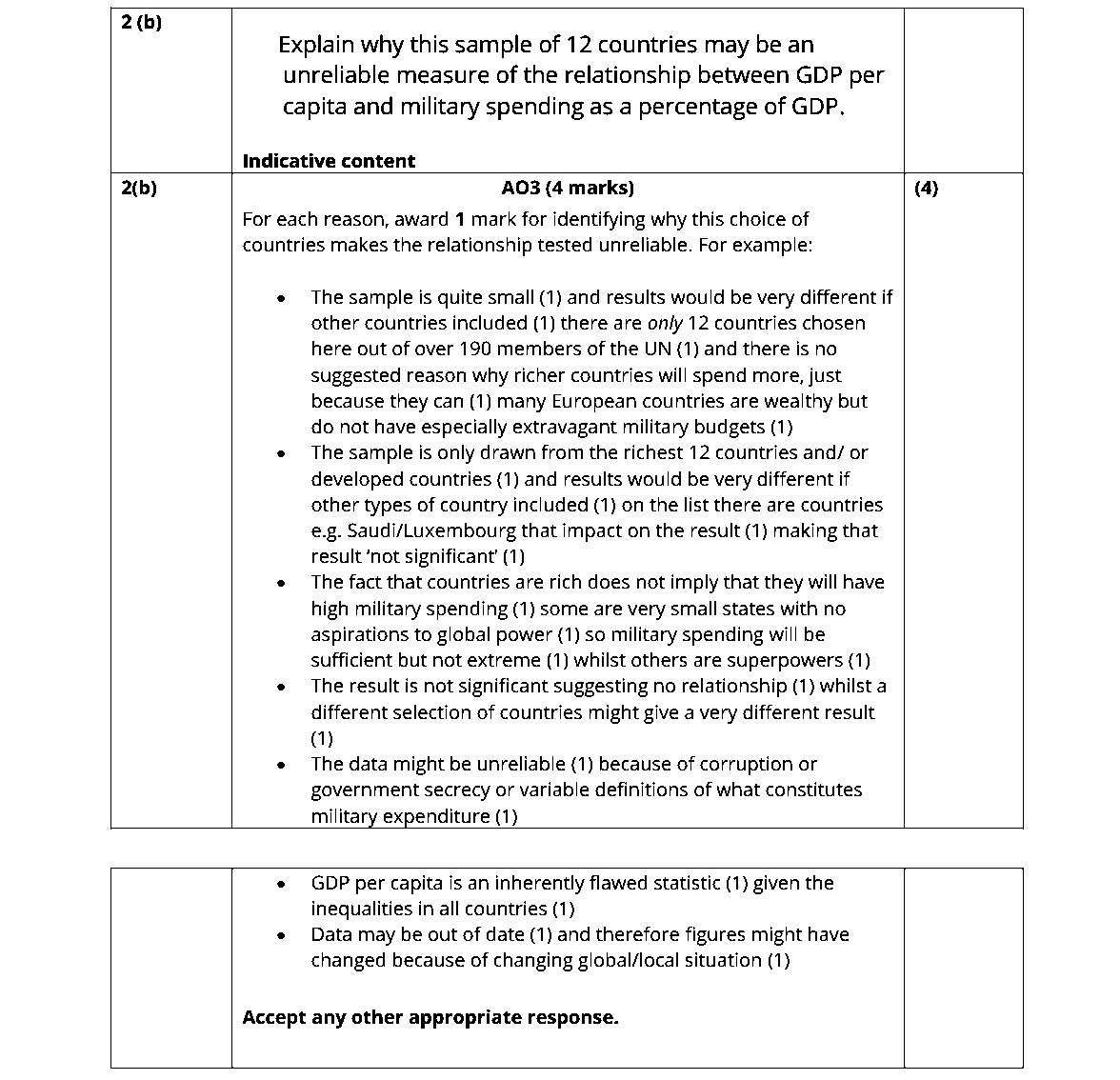
Sample too small (12 of over 190 UN members)
only the richest countries, so unrepresentative
outliers (Saudi Arabia 15.2%, Luxembourg) distort
small rich states have no global ambitions
result not significant
many critiqued GDP per capita and military spending instead of the sample
June 2018 · Paper 2 · Q2(a)(i)4 marksAO3=4Calculation
Mark scheme
Examiner's comment
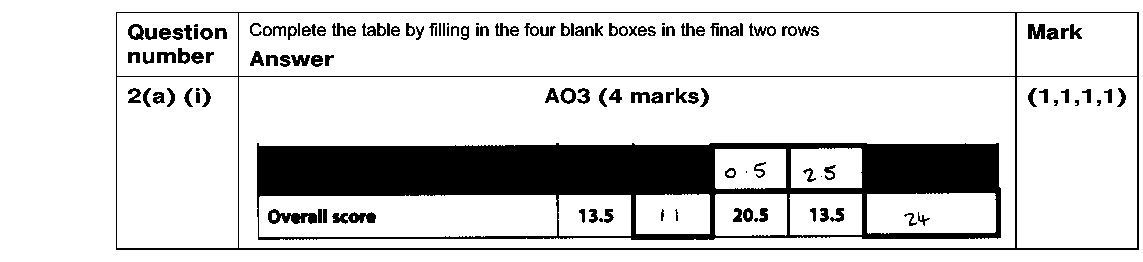
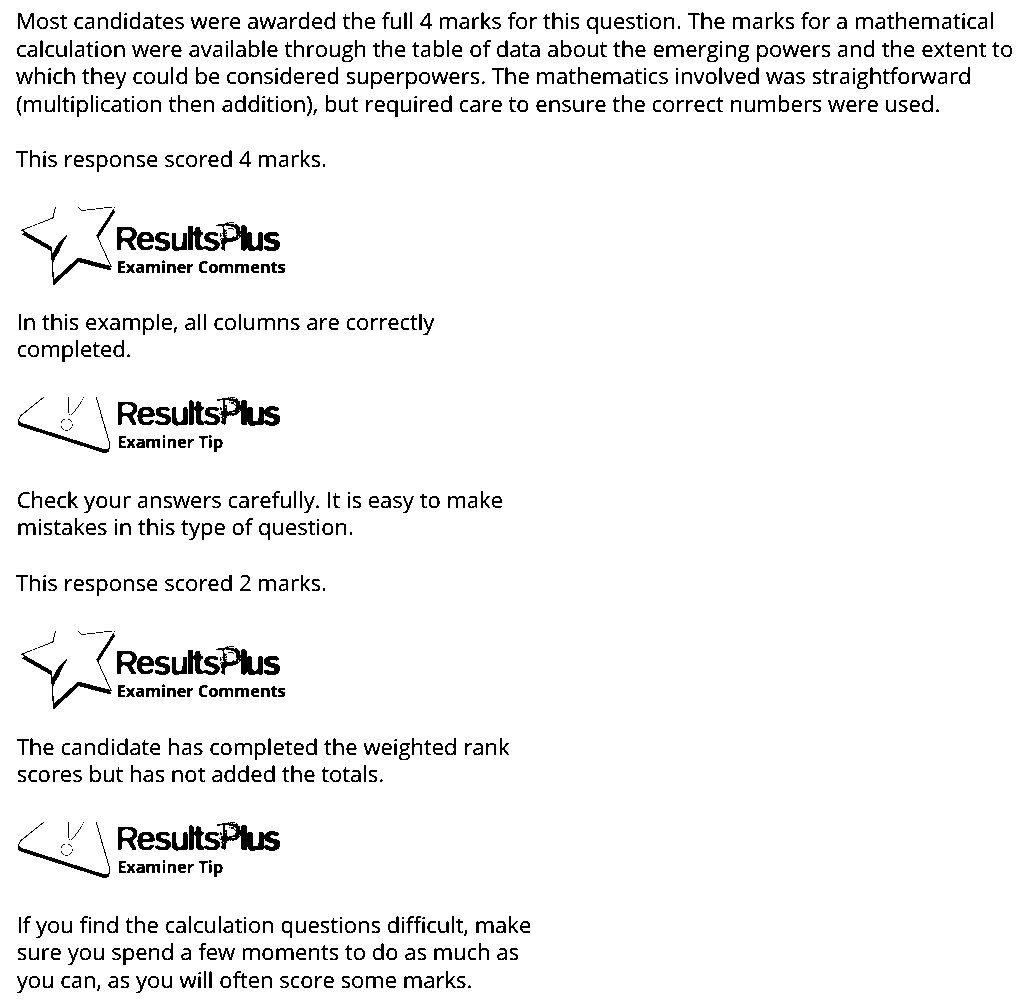
Most candidates were awarded the full 4 marks for this question. The marks for a mathematical calculation were available through the table of data about the emerging powers and the extent to which they could be considered superpowers. The mathematics involved was straightforward (multiplication then addition), but required care to ensure the correct numbers were used. This response scored 4 marks. In this example, all columns are correctly completed. Check your answers carefully. It is easy to make mistakes in this type of question. This response scored 2 marks. The candidate has completed the weighted rank scores but has not added the totals. If you find the calculation questions difficult, make sure you spend a few moments to do as much as you can, as you will often score some marks.
Notes from the mark scheme and report
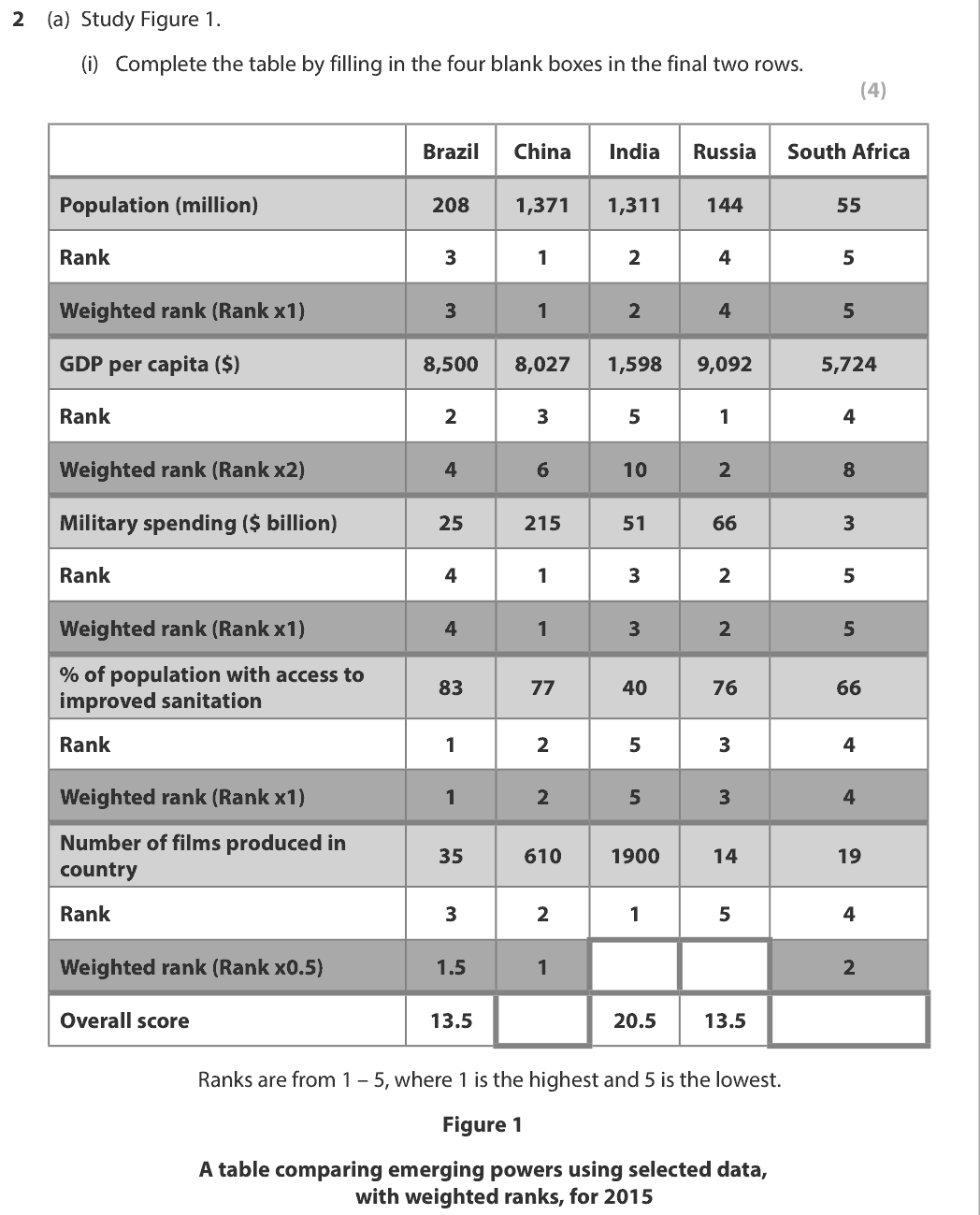
Answers: India weighted rank 0.5, Russia 2.5, China overall score 11, South Africa overall score 24
one mark each
multiply rank by weighting then add
some completed the weighted ranks but not the totals
June 2018 · Paper 2 · Q2(a)(ii)12 marksAO1=3, AO2=912-mark essay
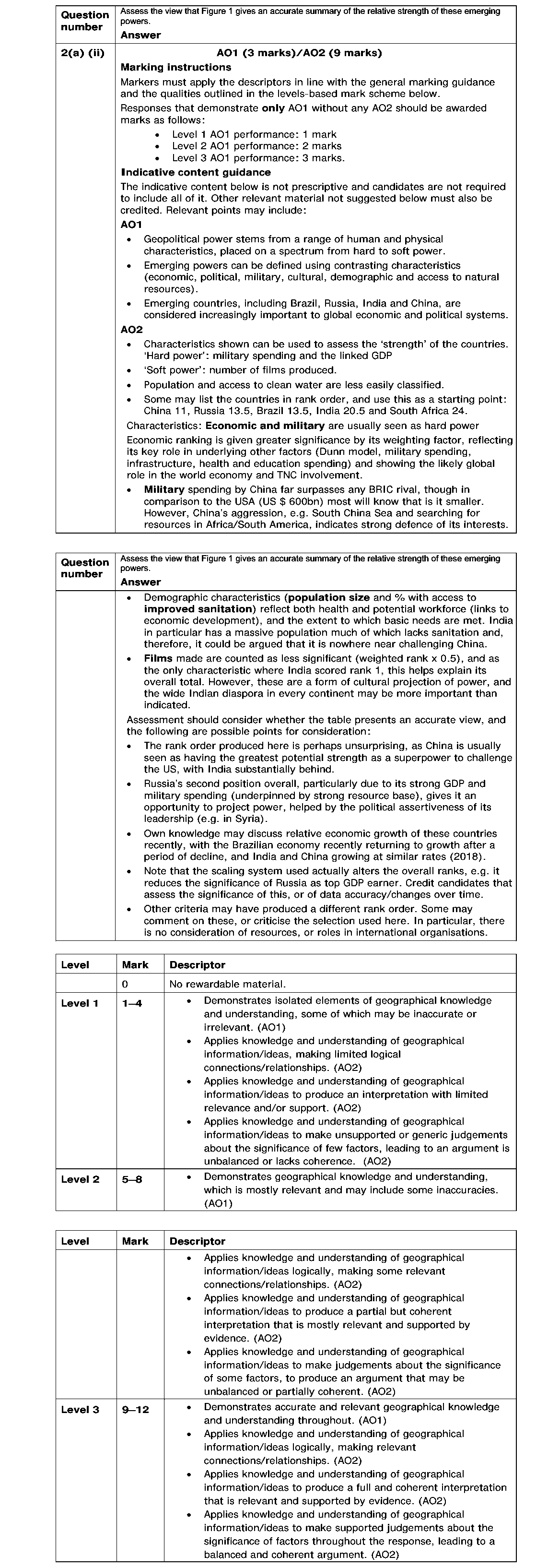
Mark scheme, including the levels and indicative content
Examiner's comment
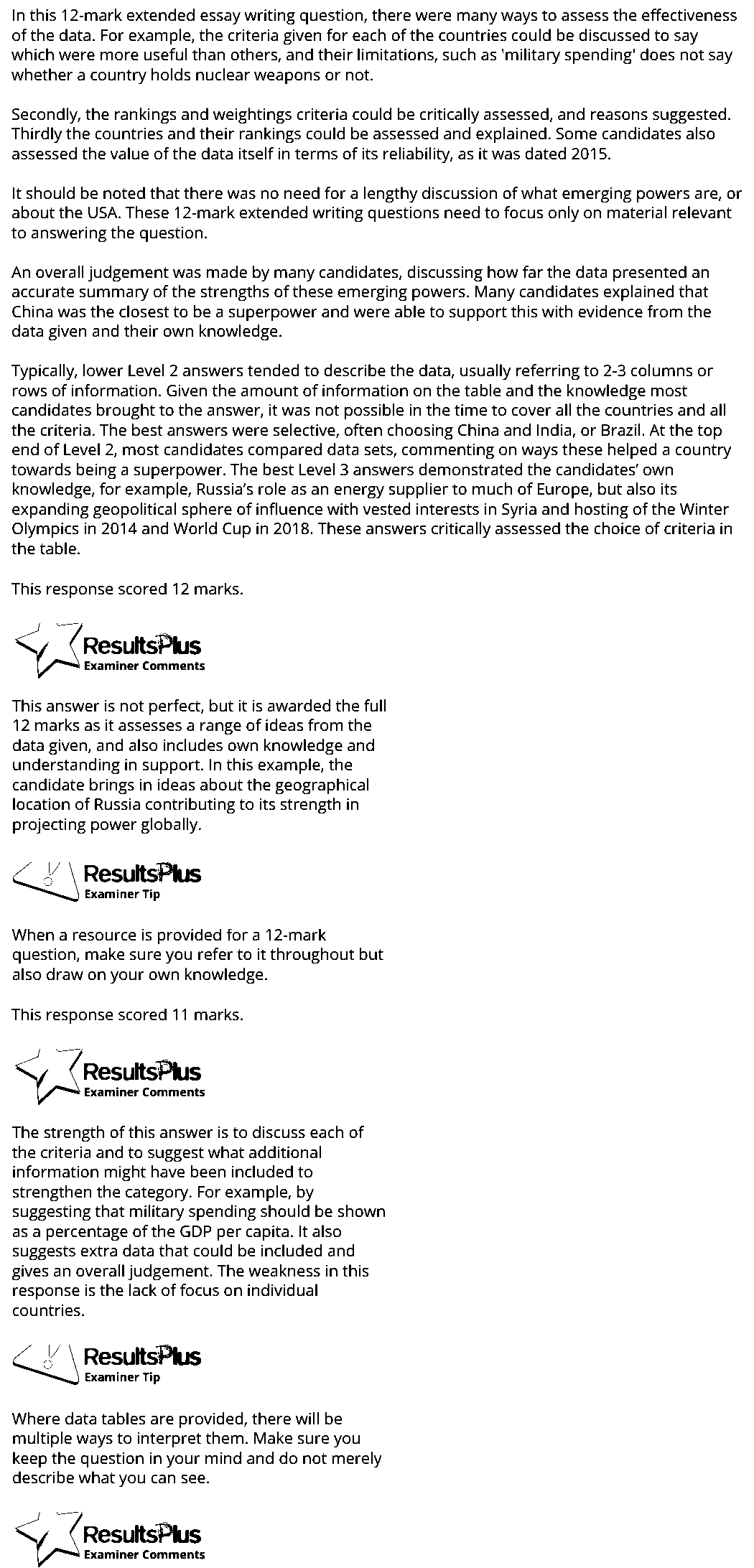
In this 12-mark extended essay writing question, there were many ways to assess the effectiveness of the data. For example, the criteria given for each of the countries could be discussed to say which were more useful than others, and their limitations, such as 'military spending' does not say whether a country holds nuclear weapons or not. Secondly, the rankings and weightings criteria could be critically assessed, and reasons suggested. Thirdly the countries and their rankings could be assessed and explained. Some candidates also assessed the value of the data itself in terms of its reliability, as it was dated 2015. It should be noted that there was no need for a lengthy discussion of what emerging powers are, or about the USA. These 12-mark extended writing questions need to focus only on material relevant to answering the question. An overall judgement was made by many candidates, discussing how far the data presented an accurate summary of the strengths of these emerging powers. Many candidates explained that China was the closest to be a superpower and were able to support this with evidence from the data given and their own knowledge. Typically, lower Level 2 answers tended to describe the data, usually referring to 2-3 columns or rows of information. Given the amount of information on the table and the knowledge most candidates brought to the answer, it was not possible in the time to cover all the countries and all the criteria. The best answers were selective, often choosing China and India, or Brazil. At the top end of Level 2, most candidates compared data sets, commenting on ways these helped a country towards being a superpower. The best Level 3 answers demonstrated the candidates’ own knowledge, for example, Russia’s role as an energy supplier to much of Europe, but also its expanding geopolitical sphere of influence with vested interests in Syria and hosting of the Winter Olympics in 2014 and World Cup in 2018. These answers critically assessed the choice of criteria in the table. This response scored 12 marks. This answer is not perfect, but it is awarded the full 12 marks as it assesses a range of ideas from the data given, and also includes own knowledge and understanding in support. In this example, the candidate brings in ideas about the geographical location of Russia contributing to its strength in projecting power globally. When a resource is provided for a 12-mark question, make sure you refer to it throughout but also draw on your own knowledge. This response scored 11 marks. The strength of this answer is to discuss each of the criteria and to suggest what additional information might have been included to strengthen the category. For example, by suggesting that military spending should be shown as a percentage of the GDP per capita. It also suggests extra data that could be included and gives an overall judgement. The weakness in this response is the lack of focus on individual countries. Where data tables are provided, there will be multiple ways to interpret them. Make sure you keep the question in your mind and do not merely describe what you can see.
Notes from the mark scheme and report
Critique Figure 1: choice of criteria (military spend says nothing of nuclear weapons, films as soft power), weightings (GDP x2), ranks hide scale (China's spending far above others), 2015 data now dated, missing criteria (resources, IGO membership)
China 11 but Russia and Brazil tied 13.5
judge how accurate the summary is
Work with an Edexcel Geography tutor
Essays stuck in the middle levels, or losing marks on the data questions? Book a trial lesson with a specialist Edexcel Geography tutor.