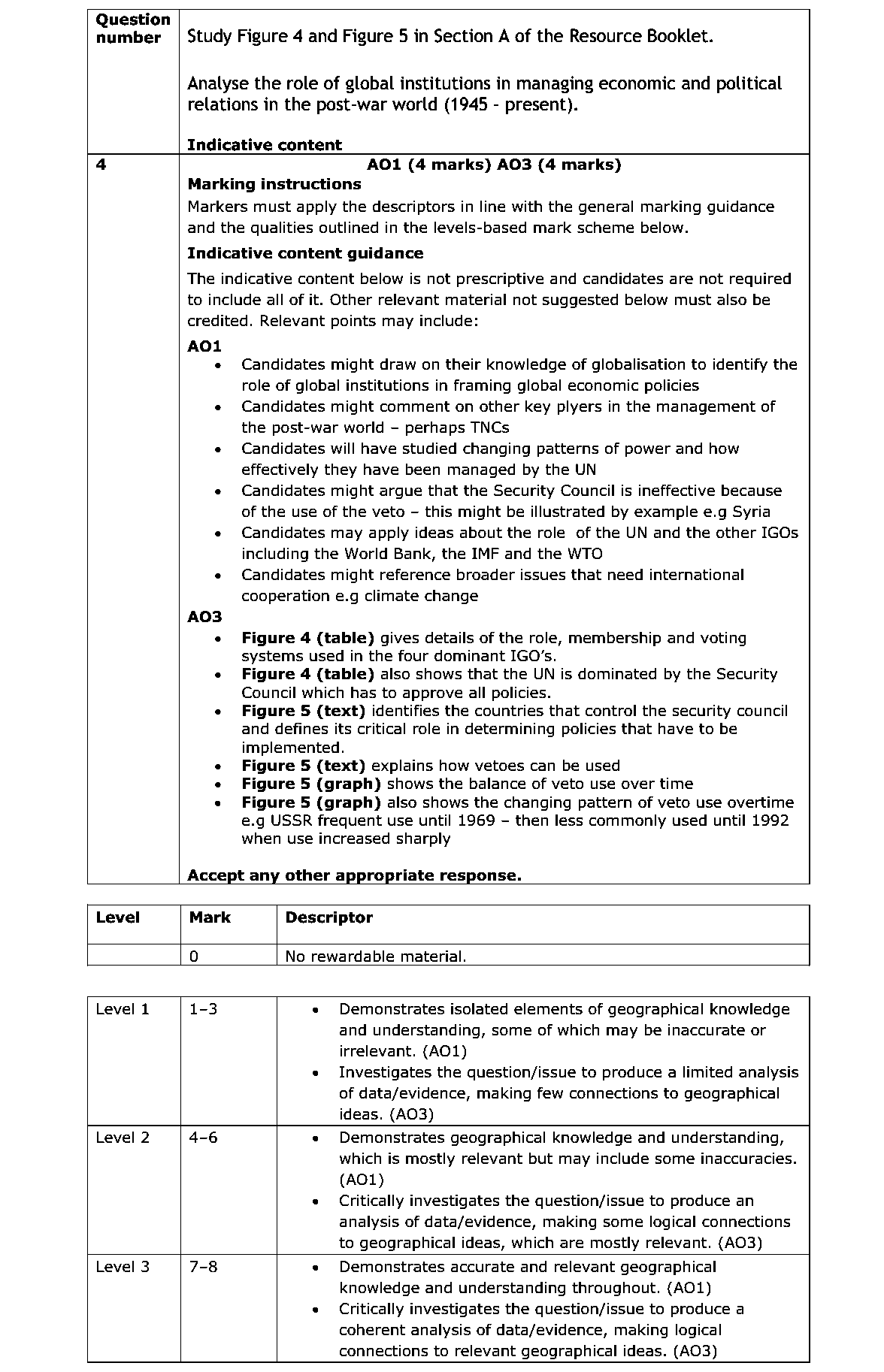
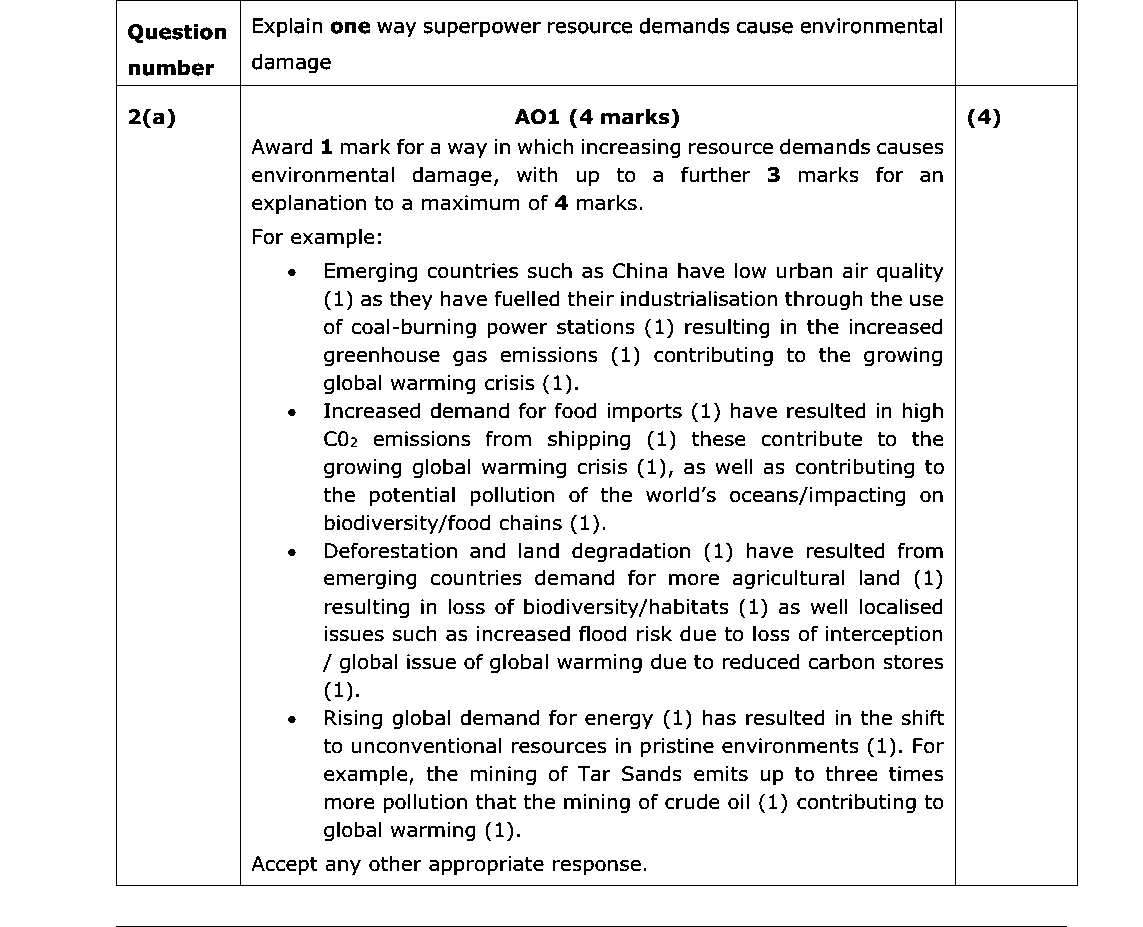
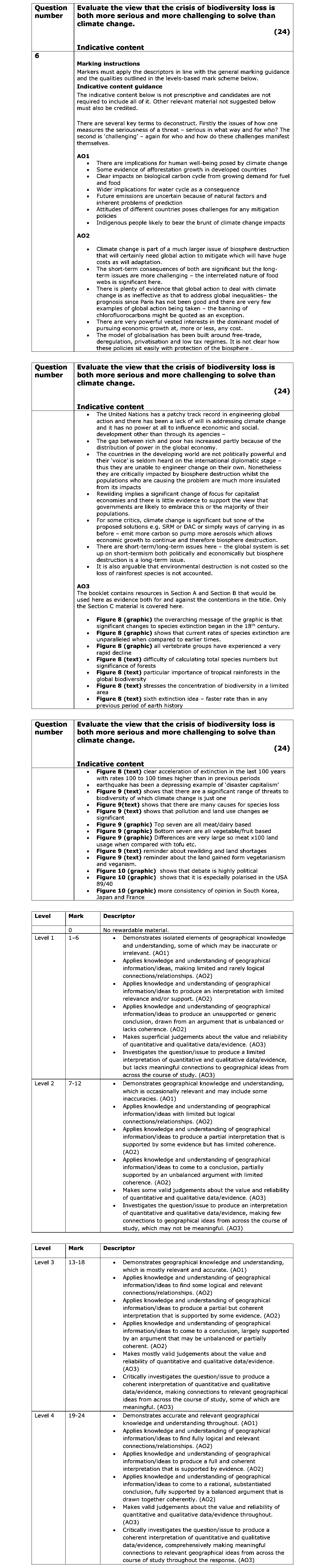
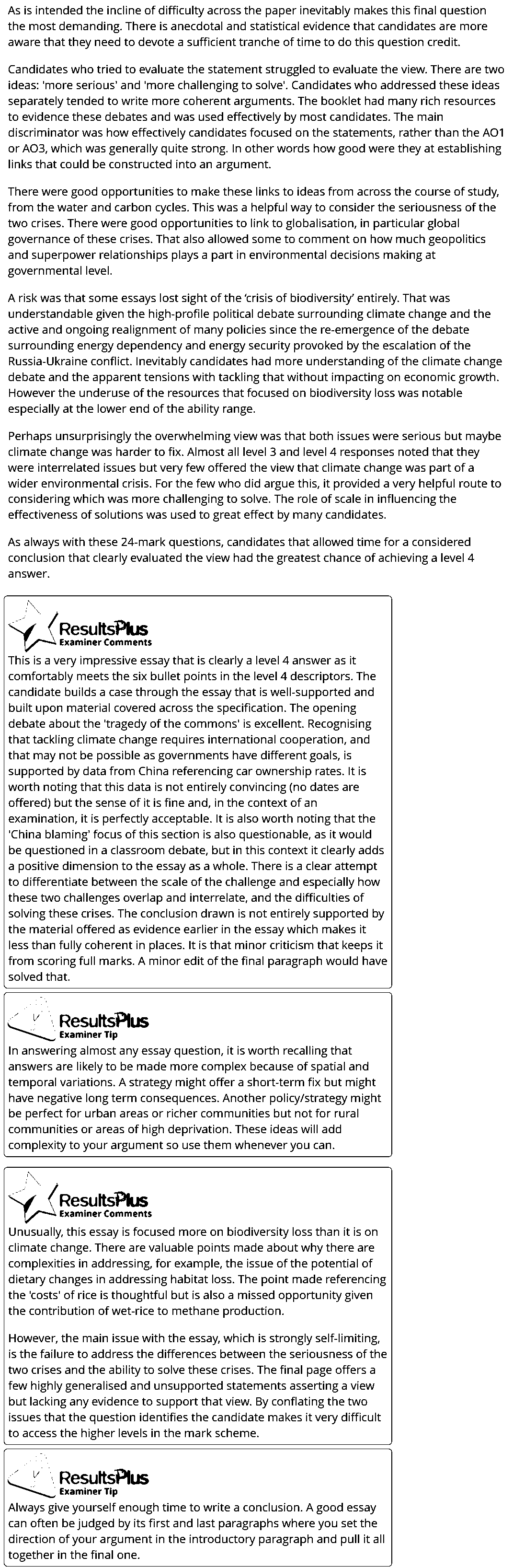
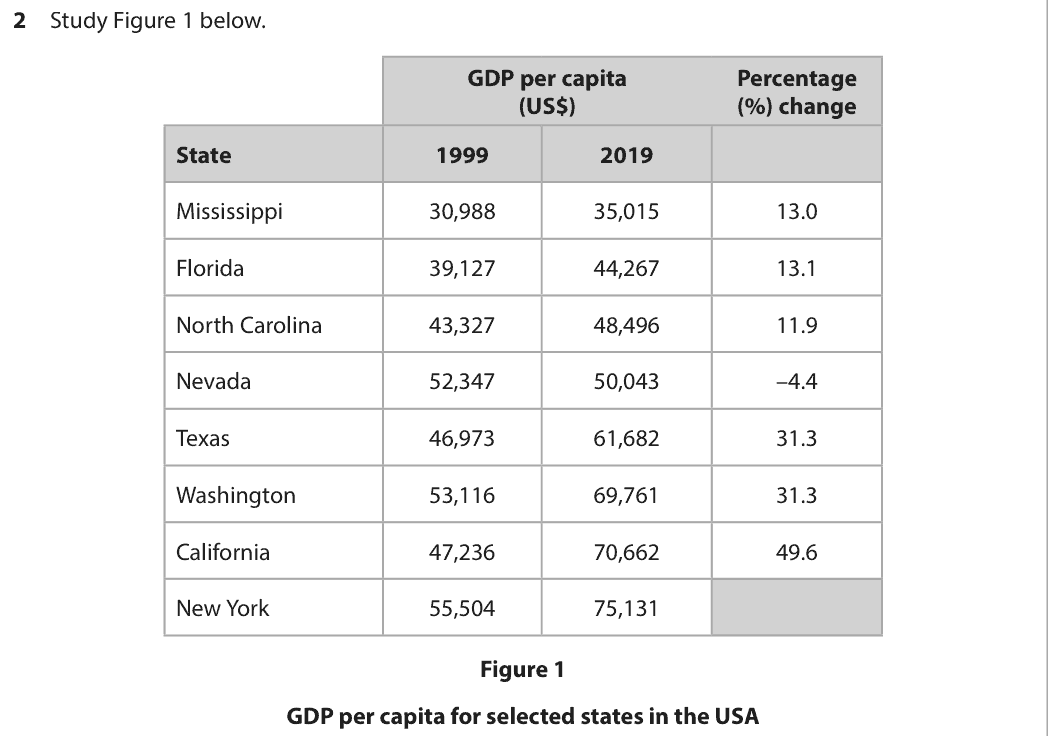
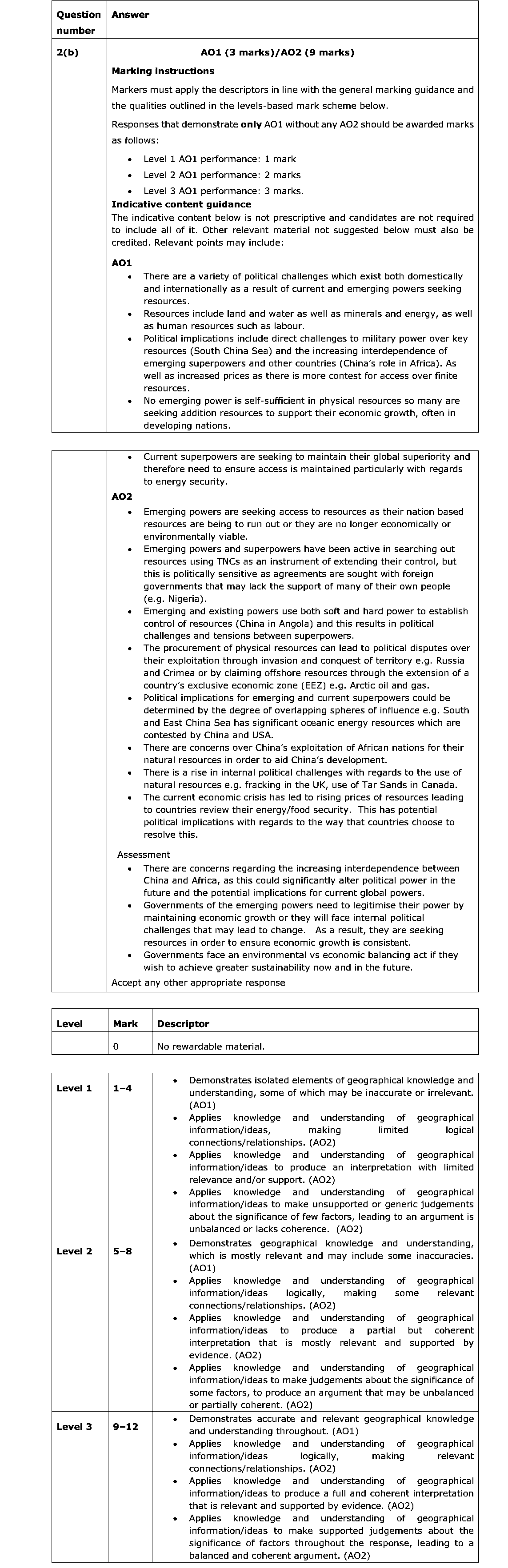
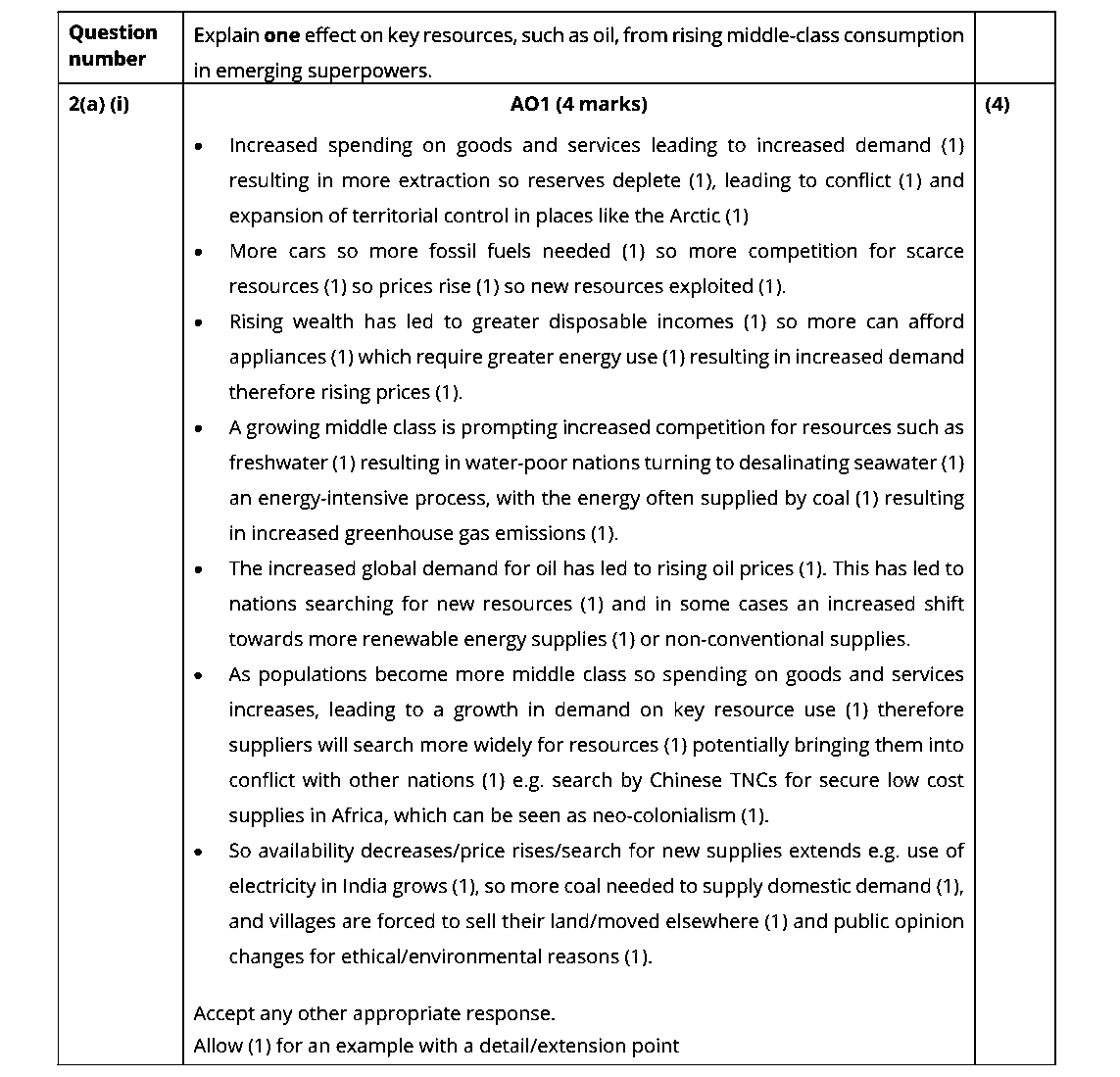
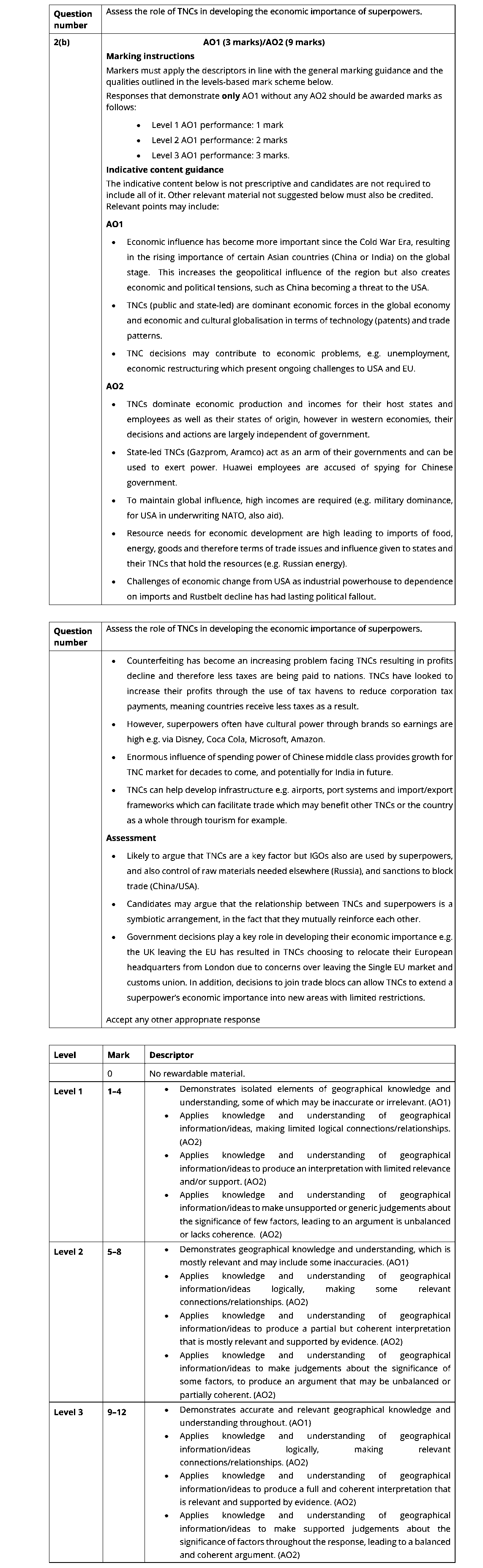
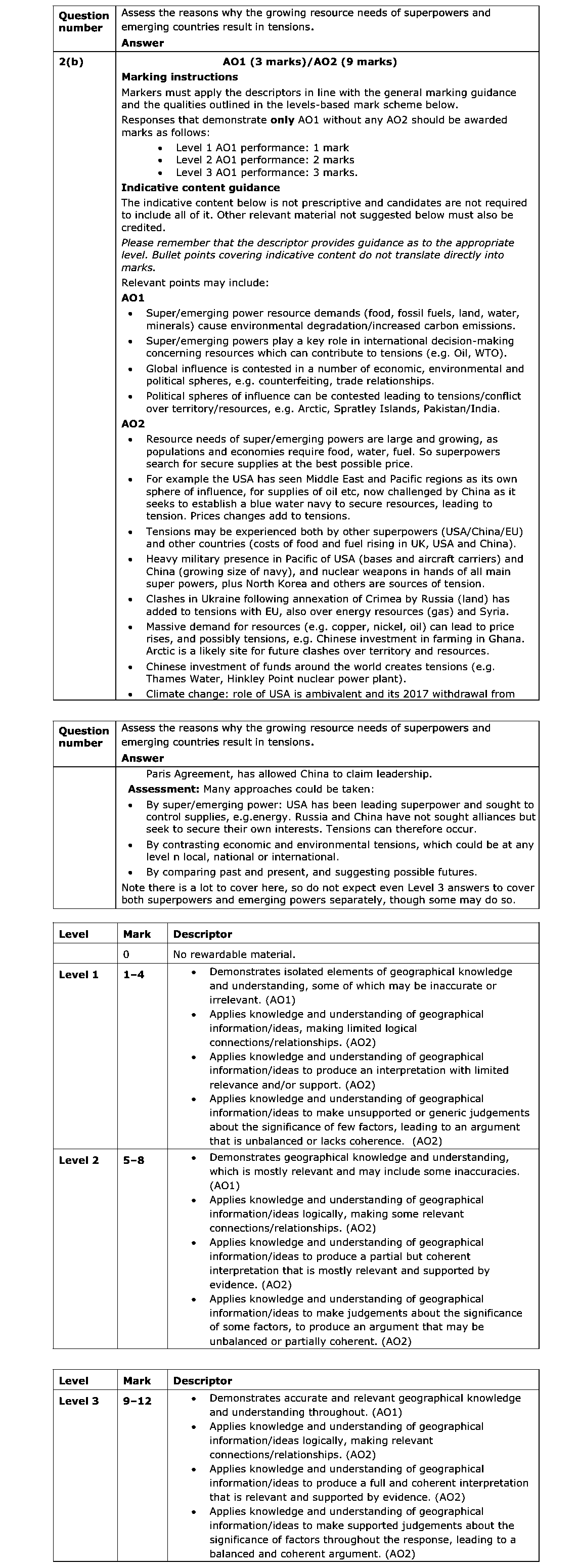
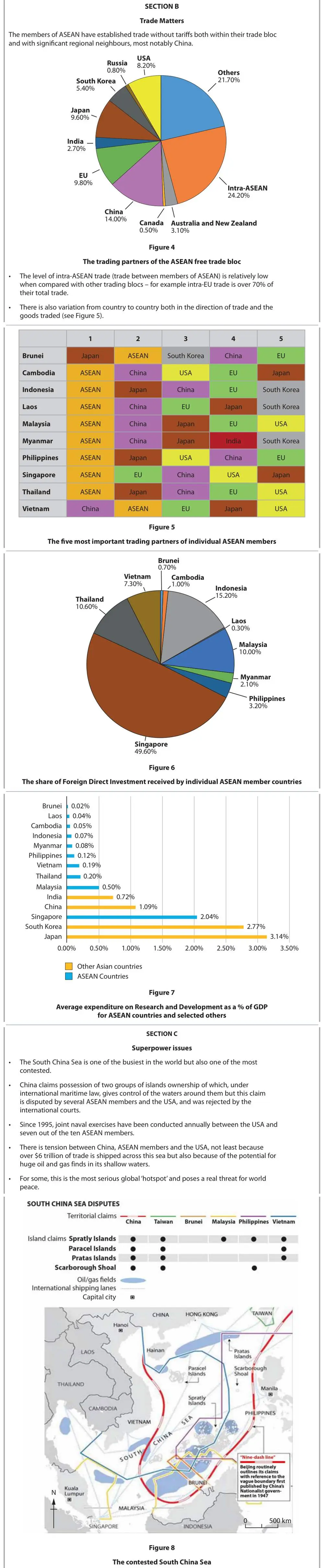
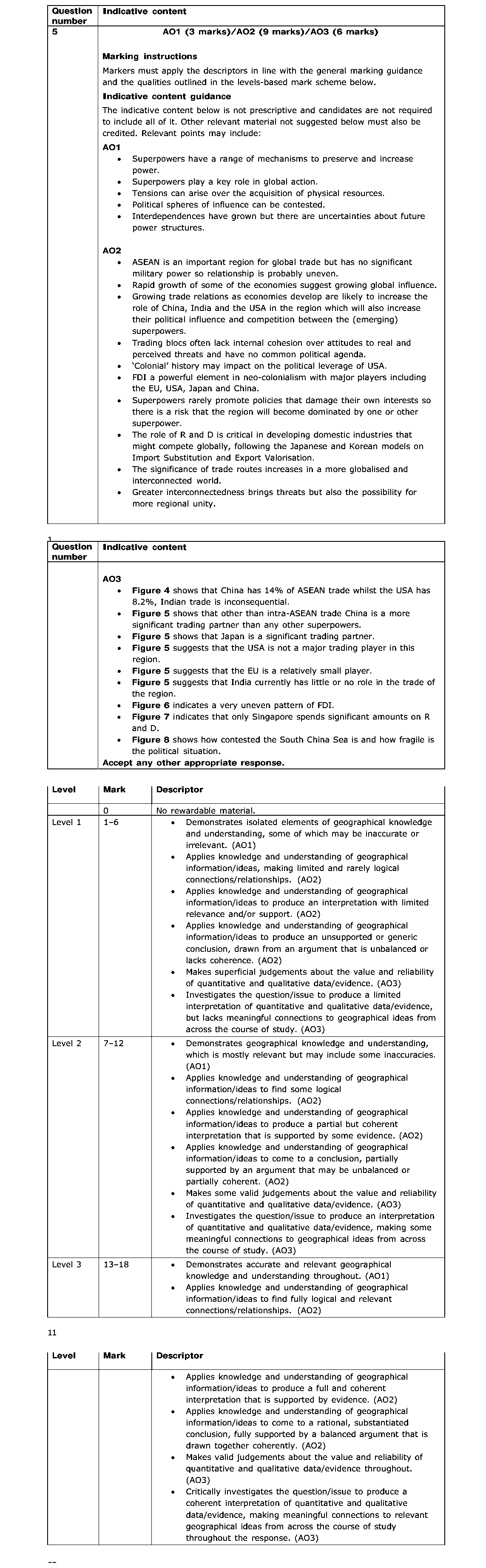
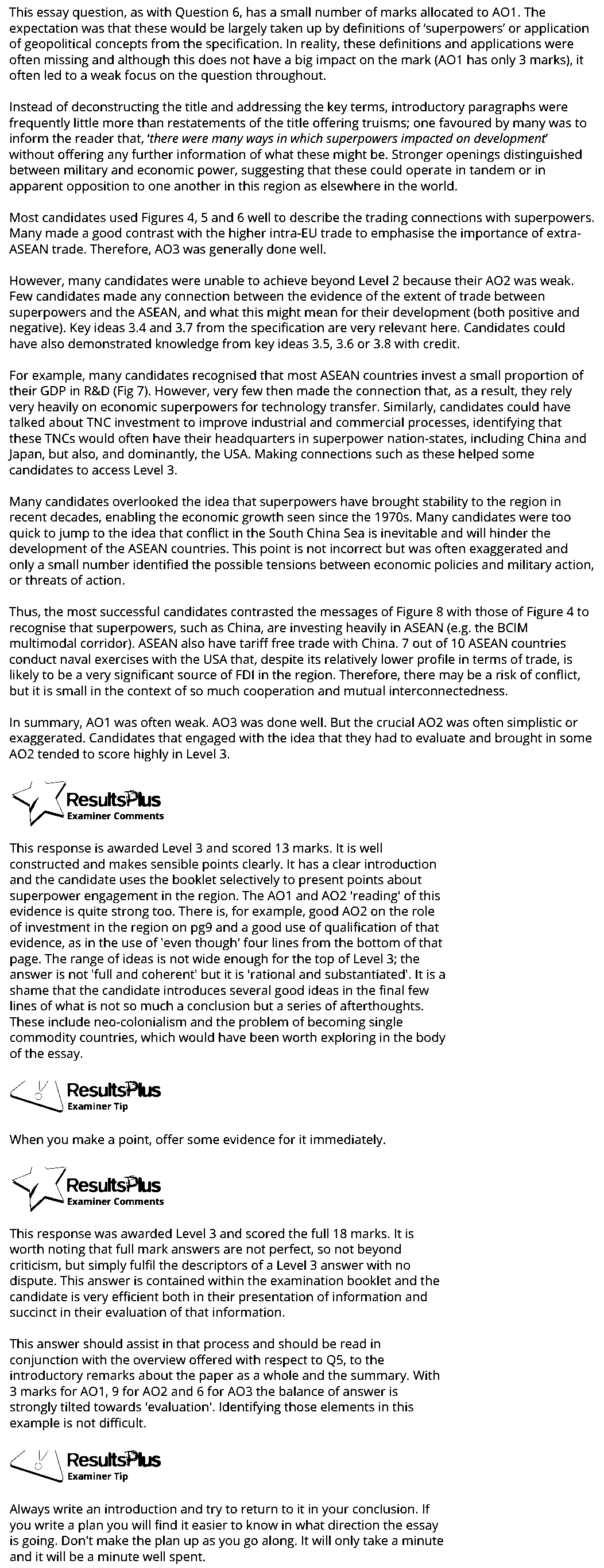
Mark scheme, including the levels and indicative content
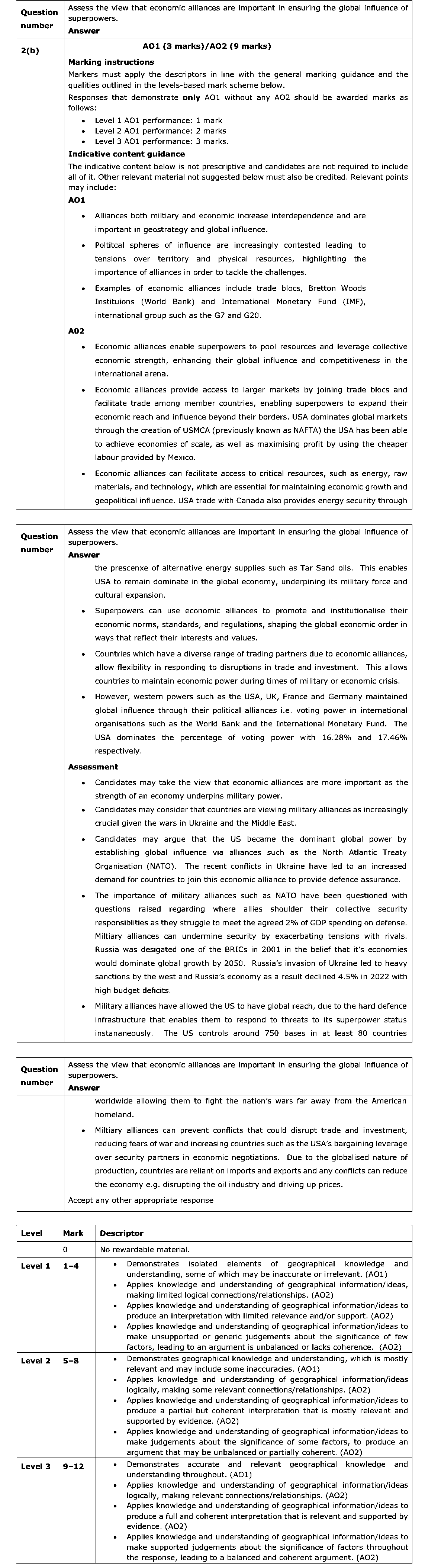
Examiner's comment
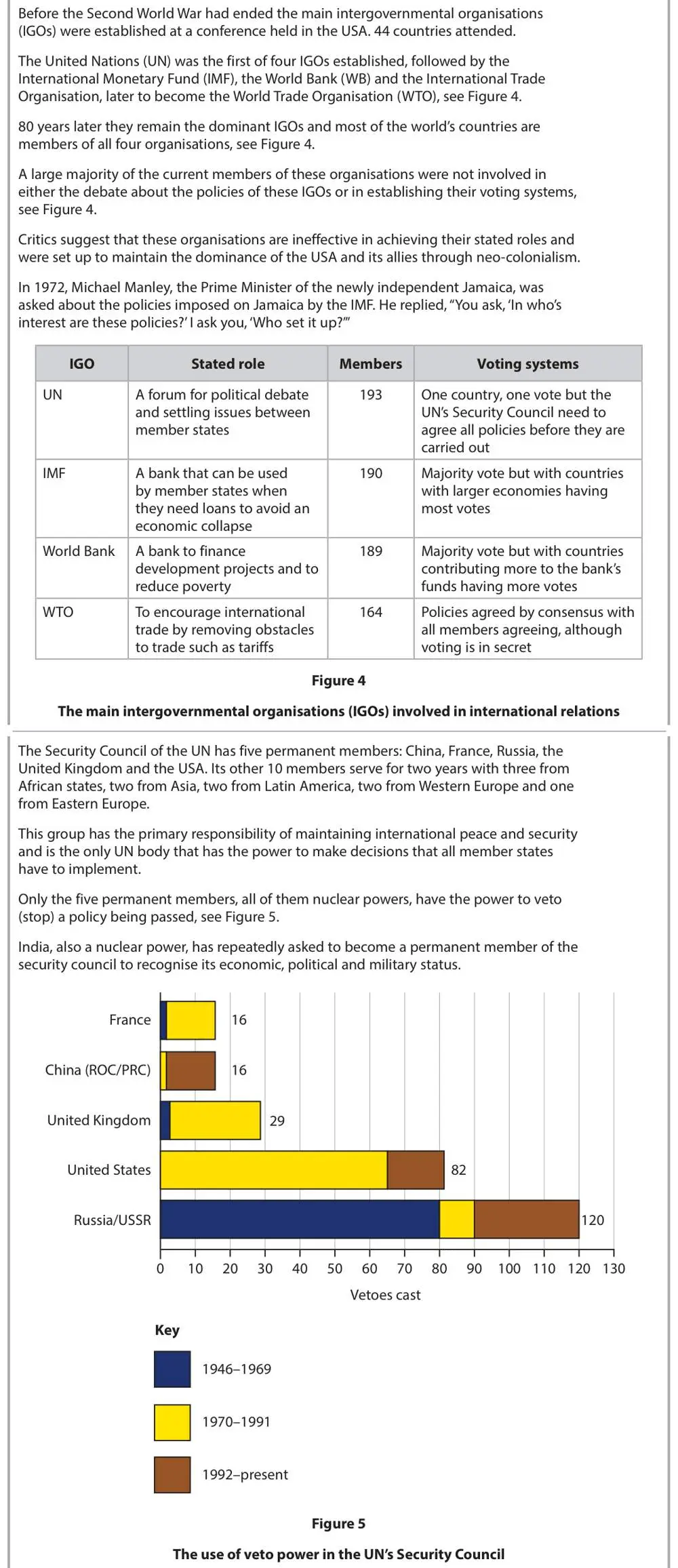
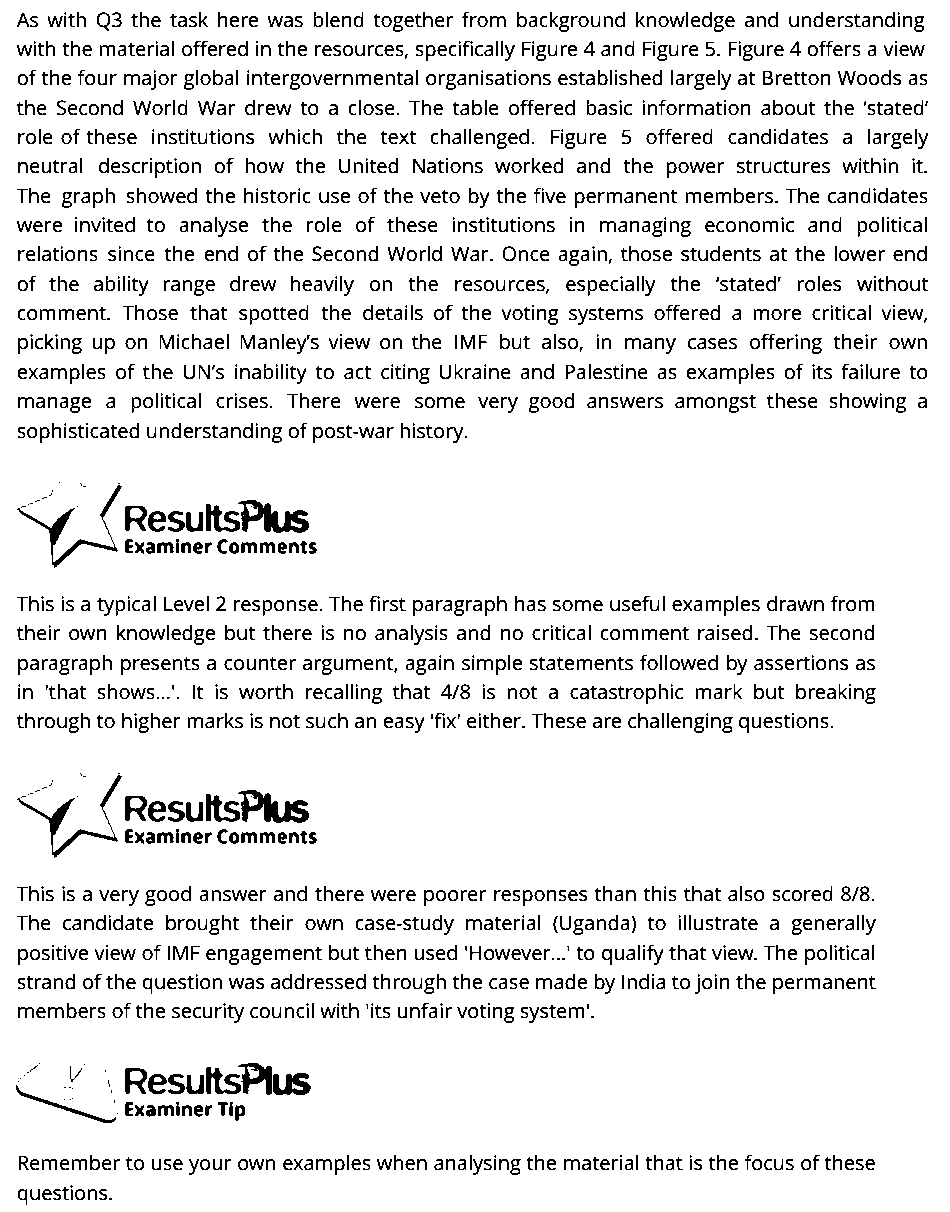
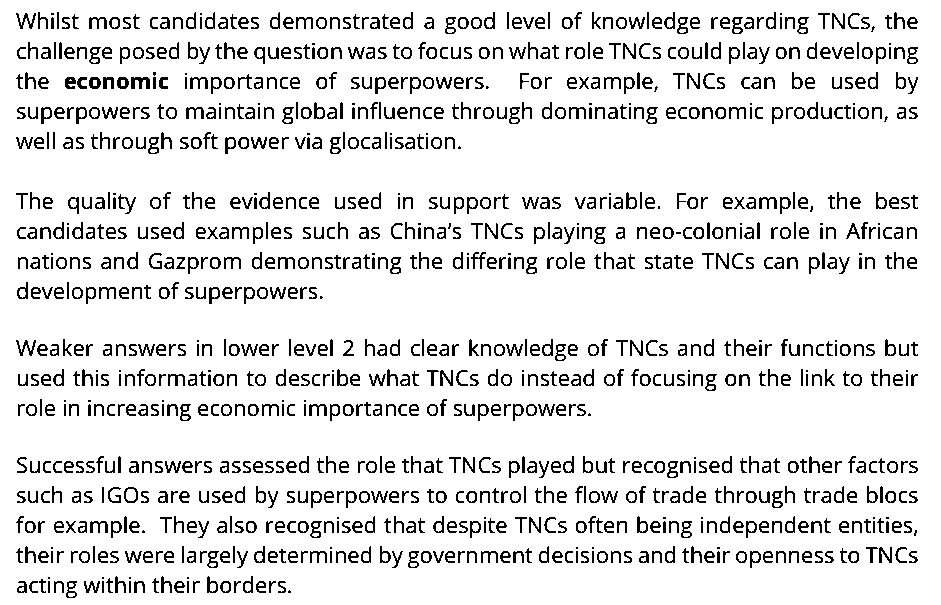
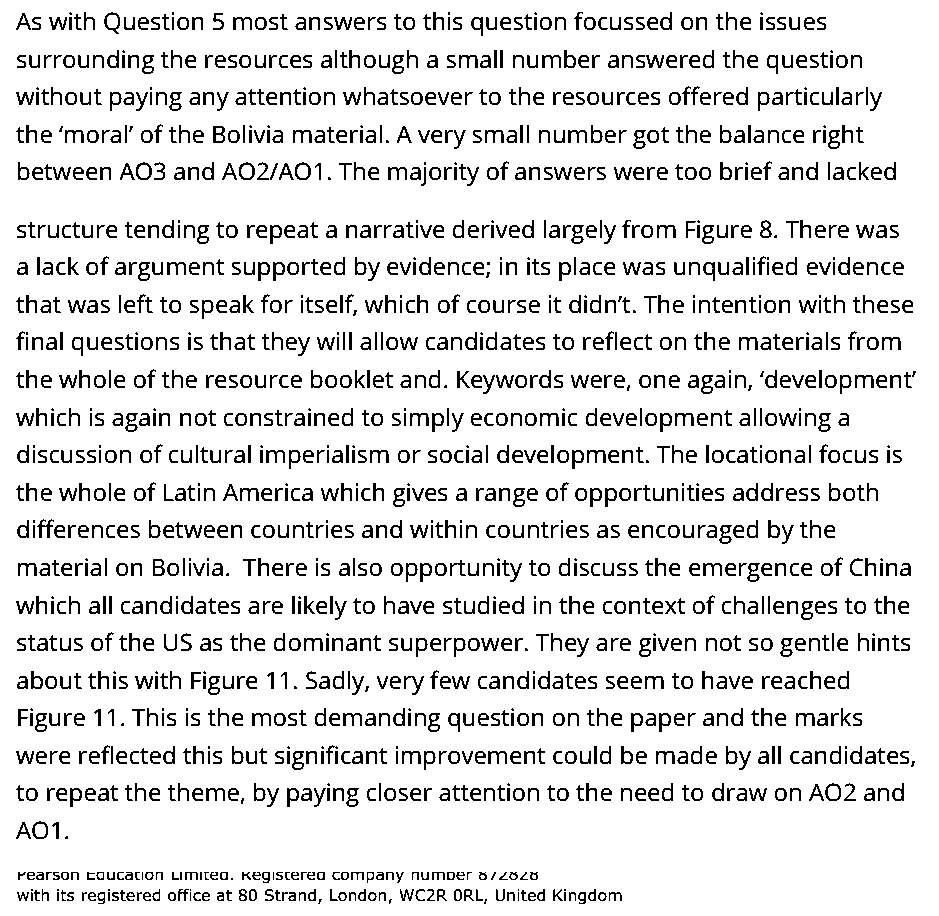
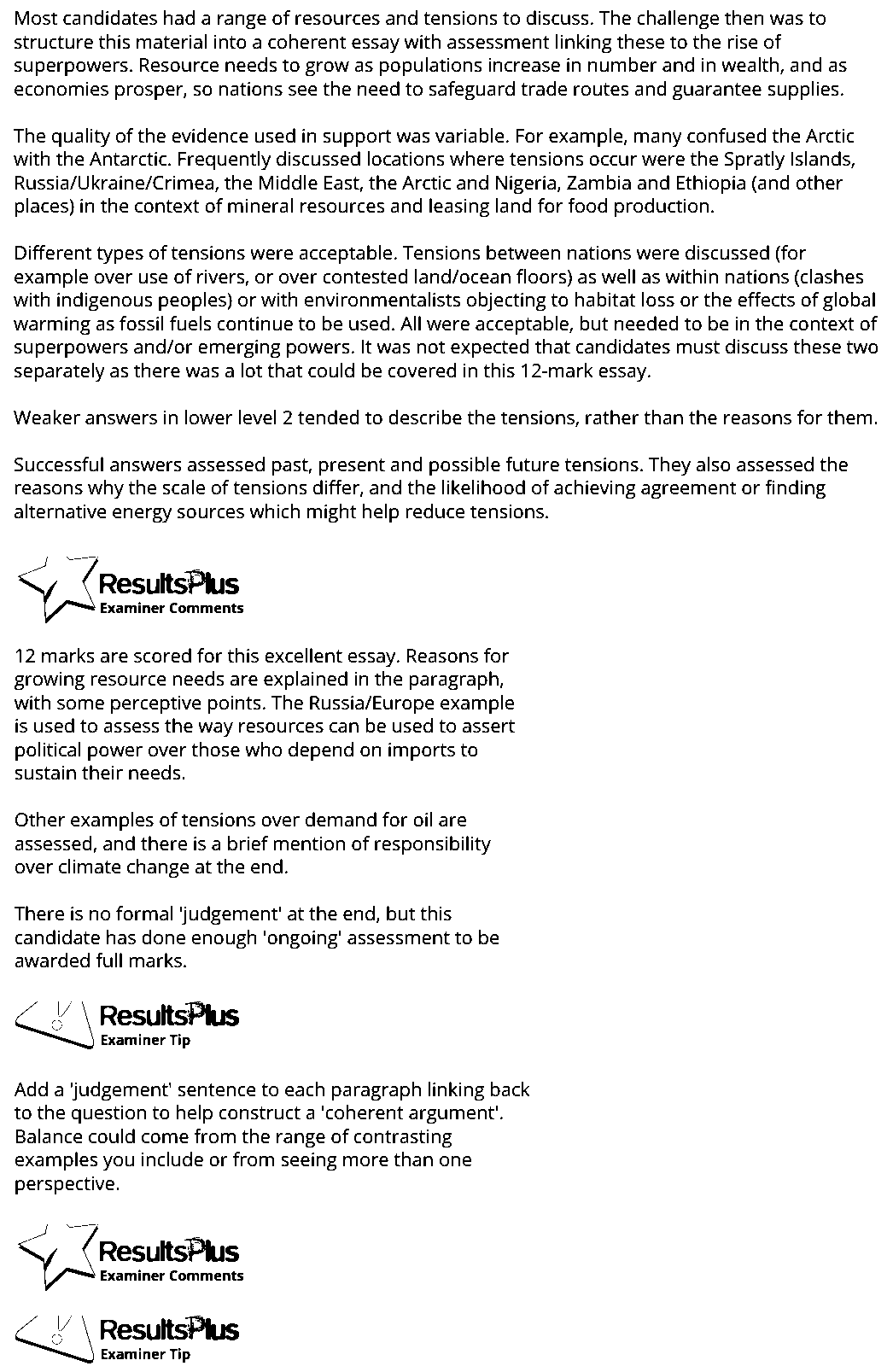
This question produced a wide range of responses and proved to be a strong differentiator across the cohort. Most candidates were able to identify at least one economic alliance, with the most frequently mentioned being the G7, EU, and USMCA (formerly NAFTA). Stronger responses demonstrated a clear understanding of how these alliances support superpower influence through mechanisms such as trade liberalisation, foreign direct investment (FDI), and the imposition of economic norms and rules. For example, high-level responses often discussed the role of the International Monetary Fund (IMF) and World Bank (WB) in promoting neoliberal economic policies through Structural Adjustment Programmes (SAPs), with specific examples such as Jamaica or Ghana used to illustrate how these policies extend the influence of core superpowers like the USA. Candidates who reached Level 3 typically structured their responses around two or more alliances and evaluated their effectiveness in supporting global influence. These responses often included comparative analysis, such as contrasting the USA’s influence through the IMF and WTO with China’s use of the Belt and Road Initiative (BRI) and the Asian Infrastructure Investment Bank (AIIB). Some candidates also considered the limitations of economic alliances, noting that military or cultural power may be more significant in certain contexts. For instance, while the EU wields considerable economic influence, its lack of unified military power was cited as a limiting factor in global geopolitics. Mid-level responses tended to be more descriptive, often explaining what economic alliances are and how they function, but without clearly linking them to the concept of global influence. These responses frequently lacked depth in their examples or failed to evaluate the relative importance of economic alliances compared to other forms of power. Some candidates focused too narrowly on one alliance or conflated economic and military alliances, discussing NATO or military interventions without evaluating their relevance to the question. At the lower end, candidates often misunderstood the term “economic alliance” altogether, interpreting it as any form of international cooperation or simply listing examples of superpowers without linking them to alliances. Some responses drifted into general discussions of what makes a country a superpower, focusing on GDP, military strength, or population size, without addressing the role of alliances. The candidate presents a competent response that demonstrates a reasonable level of knowledge and understanding of the topic. The answer engages with the question and attempts to explore the implications of global disconnection, particularly in relation to economic and trade organisations. The candidate identifies a valid point about the potential limitations faced by countries that are excluded from global trade networks, suggesting that this could hinder access to markets and reduce economic competitiveness. This shows an awareness of the broader consequences of isolation in a globalised economy. However, the response contains a factual inaccuracy—specifically, the claim that China is disconnected from economic and trade organisations. This undermines the strength of the argument, as China is in fact a key player in global trade and a member of major institutions such as the World Trade Organisation (WTO). While this error detracts from the overall credibility of the response, the candidate does attempt to present a counterargument, which is a positive feature. They acknowledge that some countries may pursue self-sufficiency or benefit from protectionist policies, indicating an understanding that global integration is not universally beneficial. The use of supporting evidence is present but limited in scope and precision. The examples provided are not fully developed, and the analysis lacks depth. There is some attempt at assessment, but it remains superficial and does not fully explore the implications or weigh the relative importance of the factors discussed. The structure of the response is clear enough to follow, but the argument would benefit from more detailed evidence and a stronger evaluative conclusion. Overall, this is a solid Level 2 response that meets the criteria for a mid-range mark. It shows some understanding and attempts analysis, but inaccuracies and limited evaluation prevent it from reaching Level 3. A mark of 6 out of 12 is appropriate, reflecting a response with potential but in need of refinement in both content and clarity. To strengthen your evaluation in a 12-mark question, make sure you clearly weigh up both sides of the argument This response uses good examples like the USA’s involvement in NAFTA and China’s economic ties with Africa to support the view that economic alliances help superpowers maintain global influence. However, to reach the top level, you should develop your counter-argument more fully For example, explore how soft power (like cultural influence or media) or military alliances (like NATO) might be more important than economic ones. A well-balanced conclusion that reflects on the relative importance of different types of power will help you access the higher mark bands. The candidate presents a well-informed and structured response that demonstrates a clear understanding of the multifaceted nature of global influence. The answer is rooted in accurate and relevant knowledge, with appropriate use of geographical terminology that enhances the clarity and academic tone of the argument. The candidate effectively explores the role of economic factors in shaping global influence, while also acknowledging the significance of non-economic dimensions such as military alliances and cultural connections. This broadens the scope of the response and reflects a more holistic grasp of the topic. A key strength of the response lies in its attempt to balance perspectives. The candidate introduces counterarguments that consider how soft power—through cultural exports or diplomatic ties—can rival or even outweigh economic dominance in certain contexts. This is supported by examples, though the evidence could be more specific and detailed to fully substantiate the claims. The inclusion of a perceptive point about the reduction in national sovereignty adds analytical depth, showing an awareness of the trade-offs that come with global integration and influence. This insight elevates the response beyond simple description and into more evaluative territory. The ongoing assessment throughout the essay is another positive feature, as the candidate does not simply list factors but attempts to weigh their relative importance. However, the final paragraph lacks the synthesis needed to fully consolidate the argument. A more developed conclusion that clearly draws together the economic and non-economic strands of the discussion would have strengthened the overall coherence and impact of the response. Additionally, while the ideas are strong, the answer would benefit from more precise supporting evidence—such as named countries, organisations, or case studies—to reinforce key points and push the response further into the top of Level 3. Overall, this is a competent and thoughtful response that meets the criteria for Level 3. It demonstrates a good understanding of the topic, with some insightful analysis and a balanced approach. With a more robust conclusion and stronger use of evidence, it could have achieved a higher mark. A score of 10 is appropriate, reflecting a solid performance with clear potential for refinement. To reach the top level in a 12-mark “assess” question, make sure your argument is well- balanced and clearly structured A strong summary should weigh up the relative importance of economic alliances compared to other forms of power, rather than simply listing them. This helps demonstrate a sustained and evaluative judgement , which is key for accessing the highest marks
Notes from the mark scheme and report
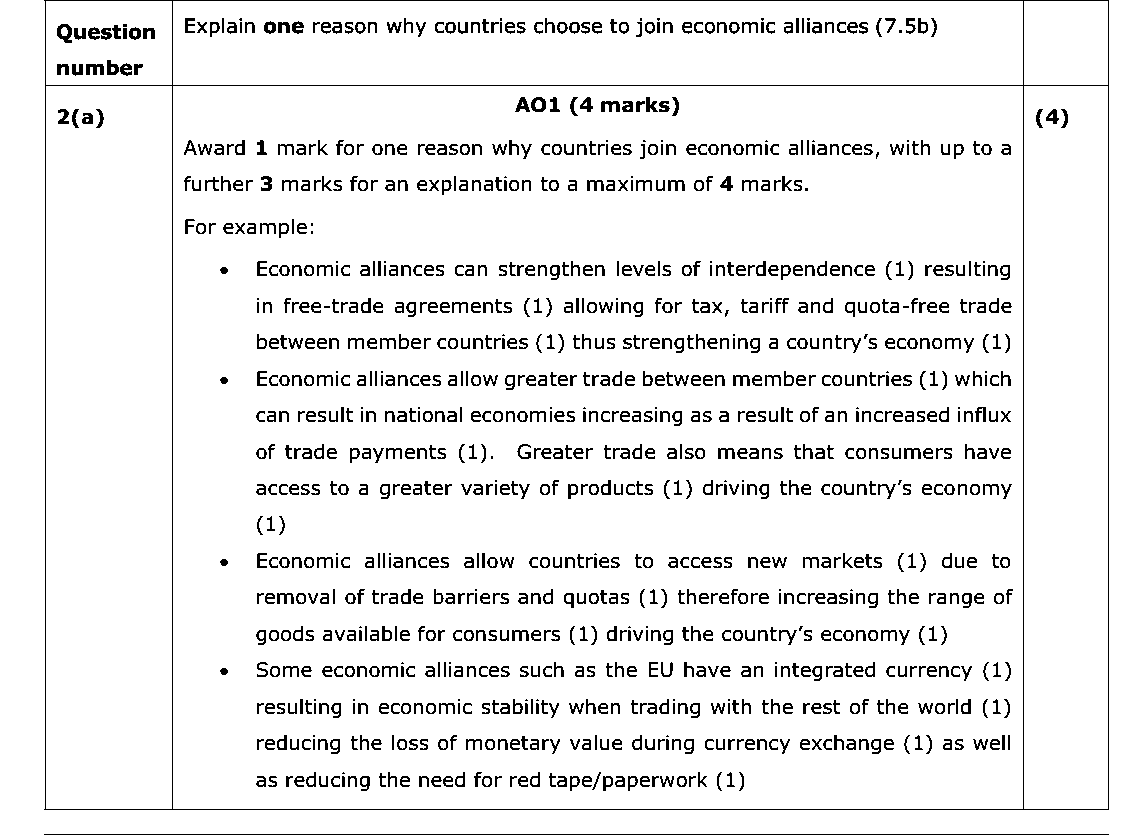
- Economic alliances (EU, USMCA, G7, G20, World Bank and IMF) pool resources, open markets and spread neoliberal norms (SAPs in Jamaica, Ghana)
- weigh against military alliances (NATO), cultural soft power and unilateral hard power
- a strong differentiator
- Level 3 evaluated two or more alliances