Tap a question to zoom it. The figures open above it; the mark scheme (with its levels and indicative content) and the examiner's comment open underneath.
June 2025 · Paper 1 · Q4(d)12 marksAO1=3, AO2=912-mark essay
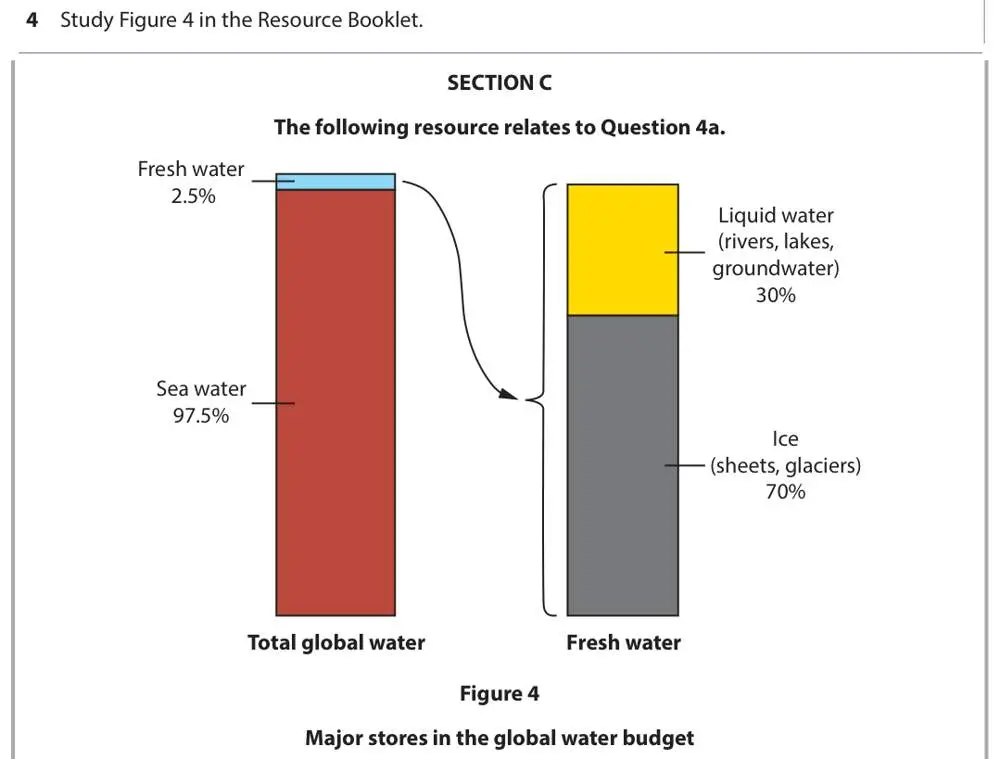
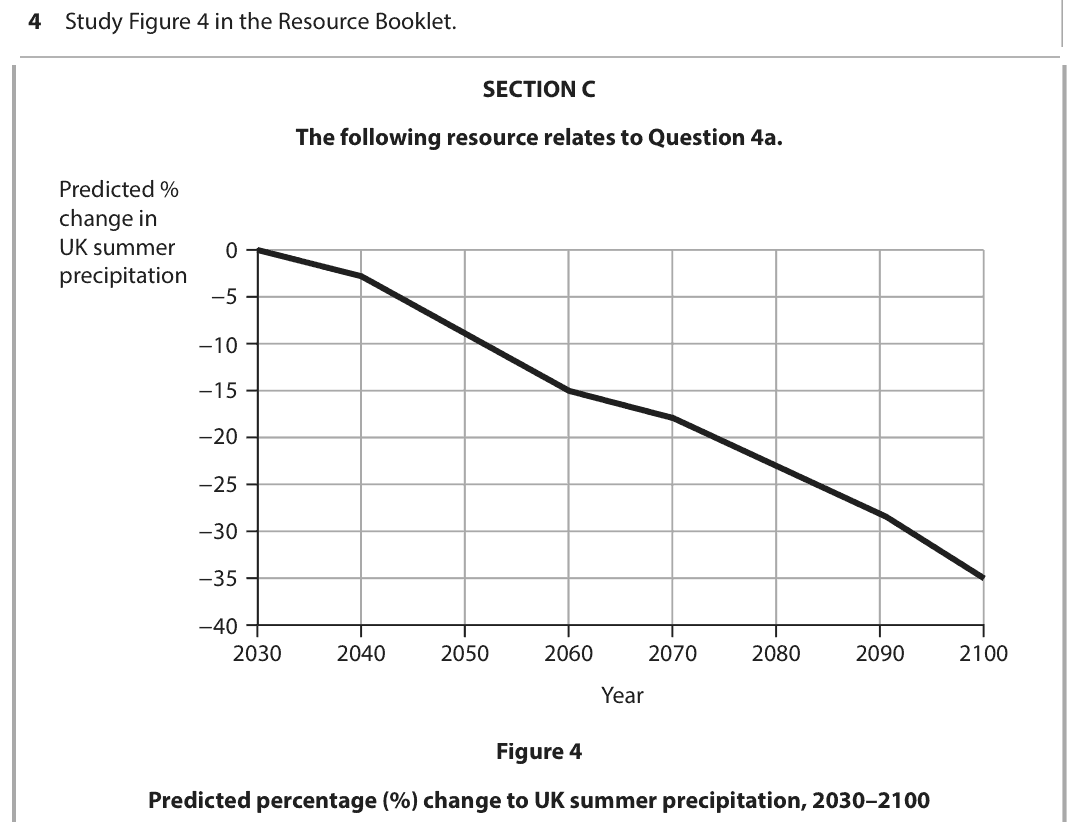
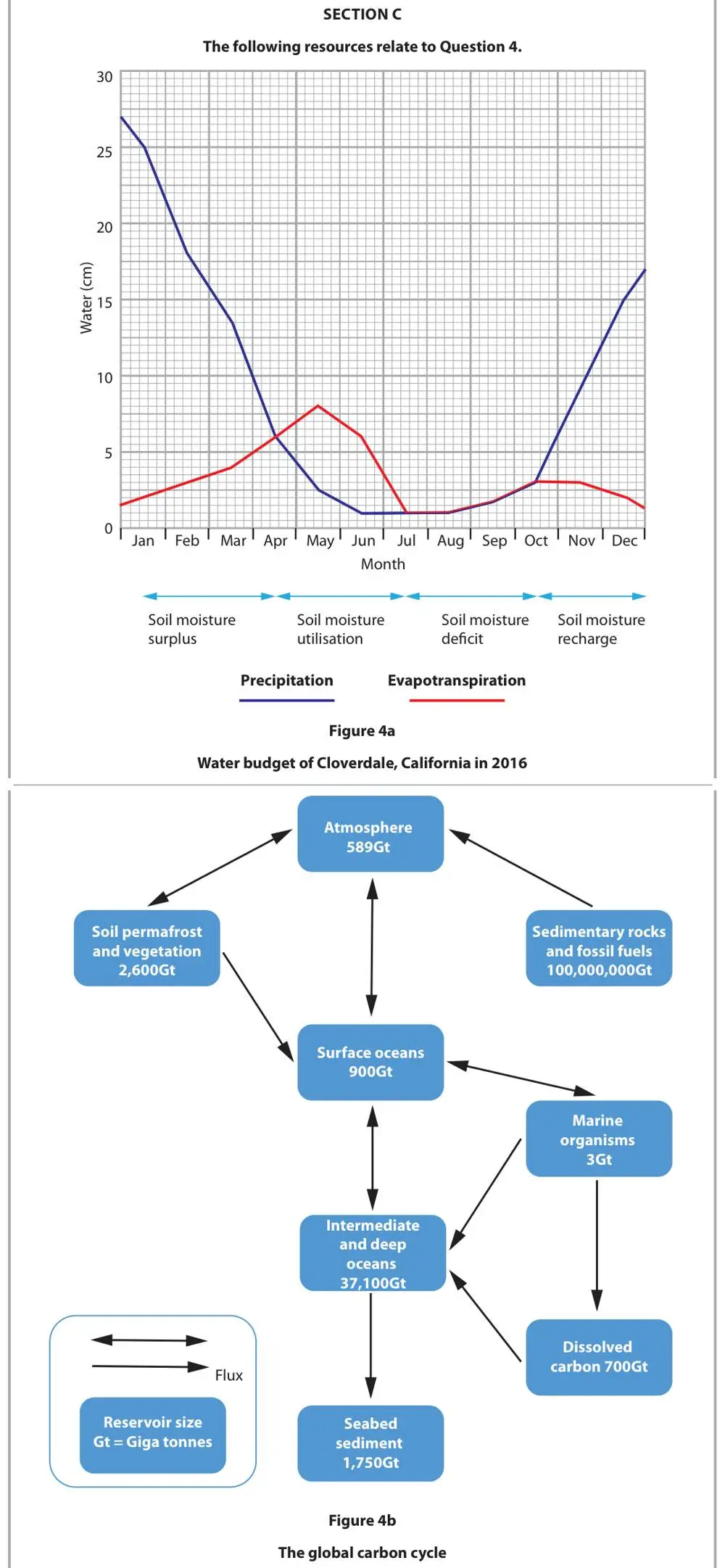
Resources for question 4
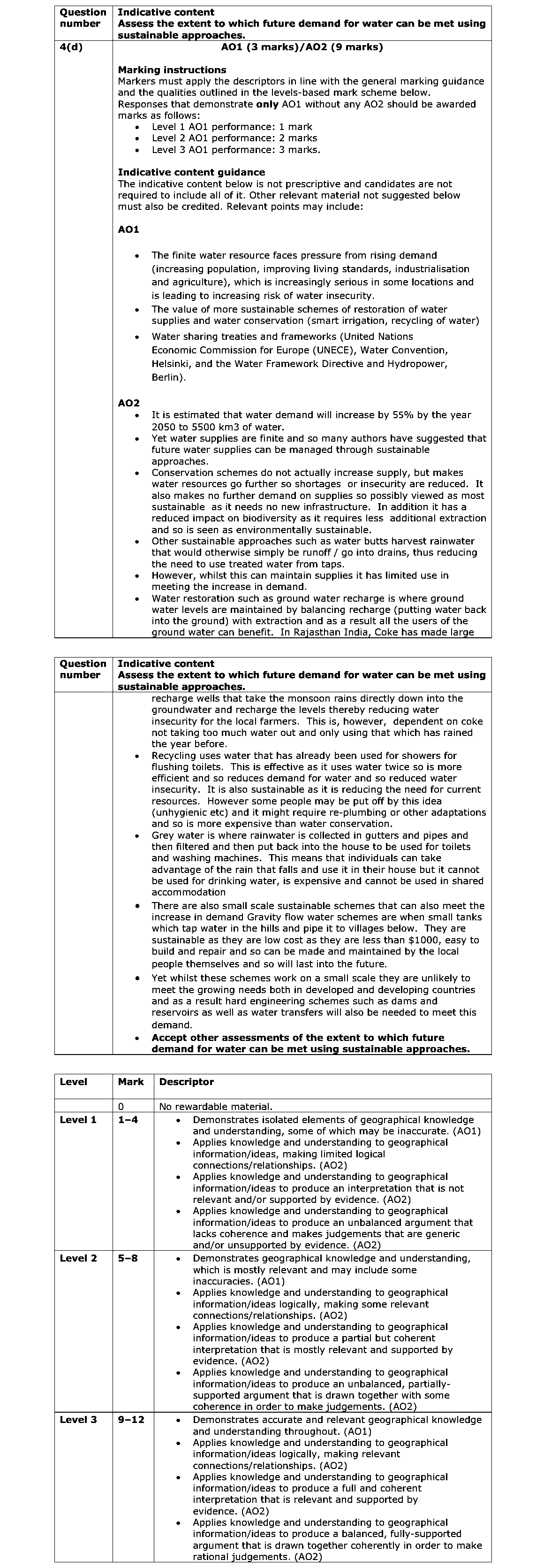
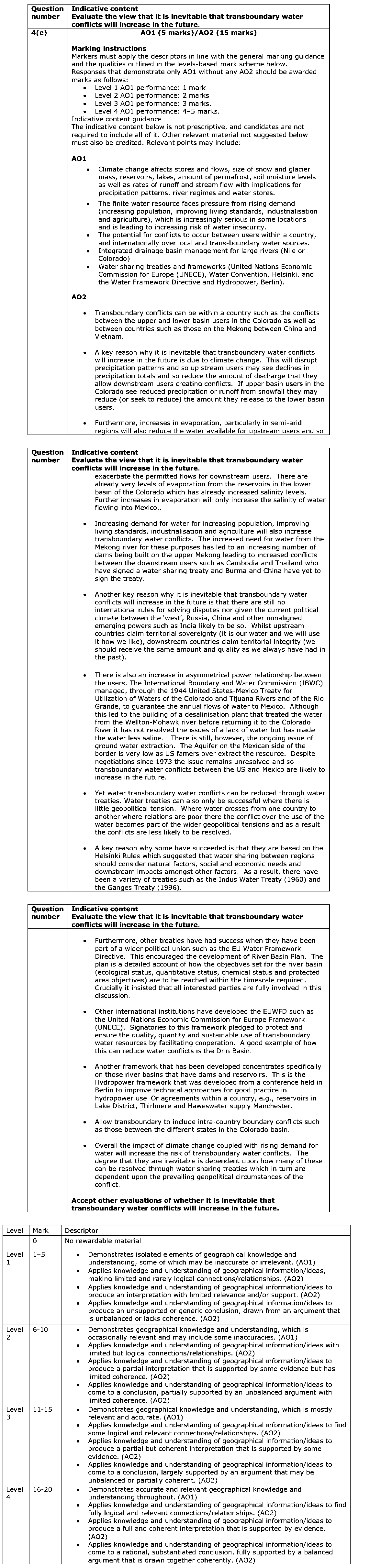
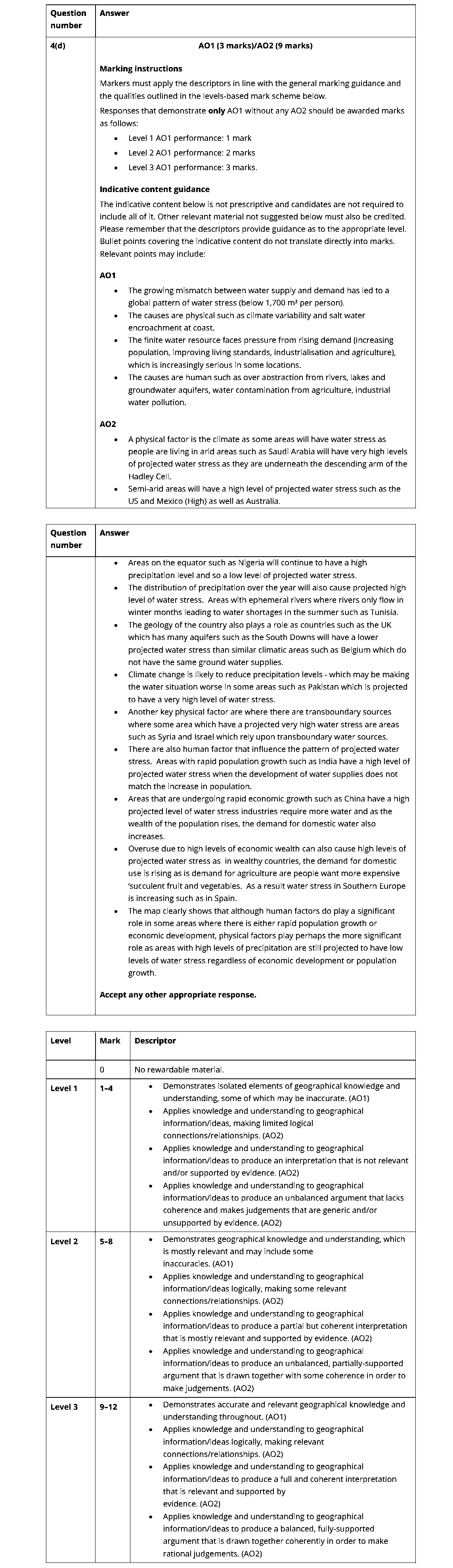
Mark scheme, including the levels and indicative content
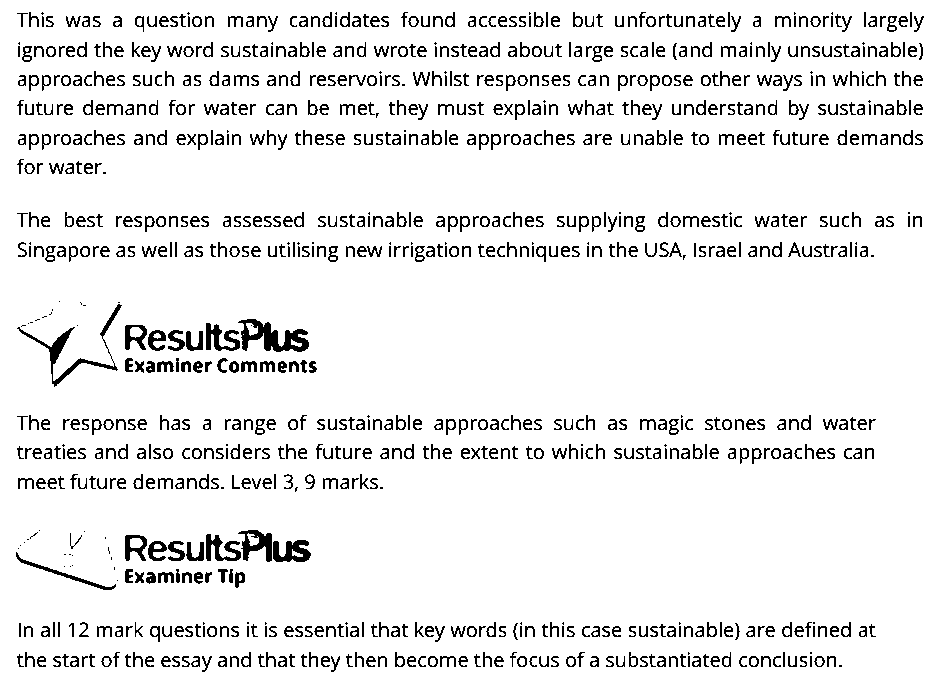
Examiner's comment
This was a question many candidates found accessible but unfortunately a minority largely ignored the key word sustainable and wrote instead about large scale (and mainly unsustainable) approaches such as dams and reservoirs. Whilst responses can propose other ways in which the future demand for water can be met, they must explain what they understand by sustainable approaches and explain why these sustainable approaches are unable to meet future demands for water. The best responses assessed sustainable approaches supplying domestic water such as in Singapore as well as those utilising new irrigation techniques in the USA, Israel and Australia. The response has a range of sustainable approaches such as magic stones and water treaties and also considers the future and the extent to which sustainable approaches can meet future demands. Level 3, 9 marks. In all 12 mark questions it is essential that key words (in this case sustainable) are defined at the start of the essay and that they then become the focus of a substantiated conclusion.
Notes from the mark scheme and report
Sustainable approaches: water recycling and NEWater (Singapore), smart and drip irrigation (Israel, Australia), rainwater harvesting, magic stones, treaties
weigh against rising demand and climate change
dams and transfers are not sustainable approaches
June 2024 · Paper 1 · Q4(e)20 marksAO1=5, AO2=1520-mark essay
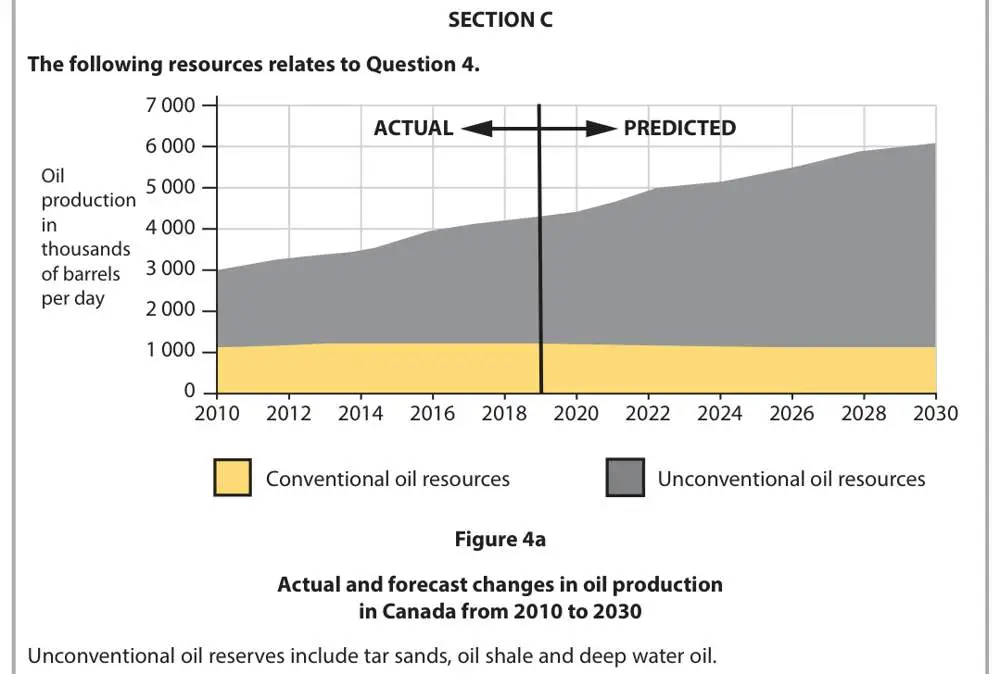
Resources for question 4
Mark scheme, including the levels and indicative content
Examiner's comment
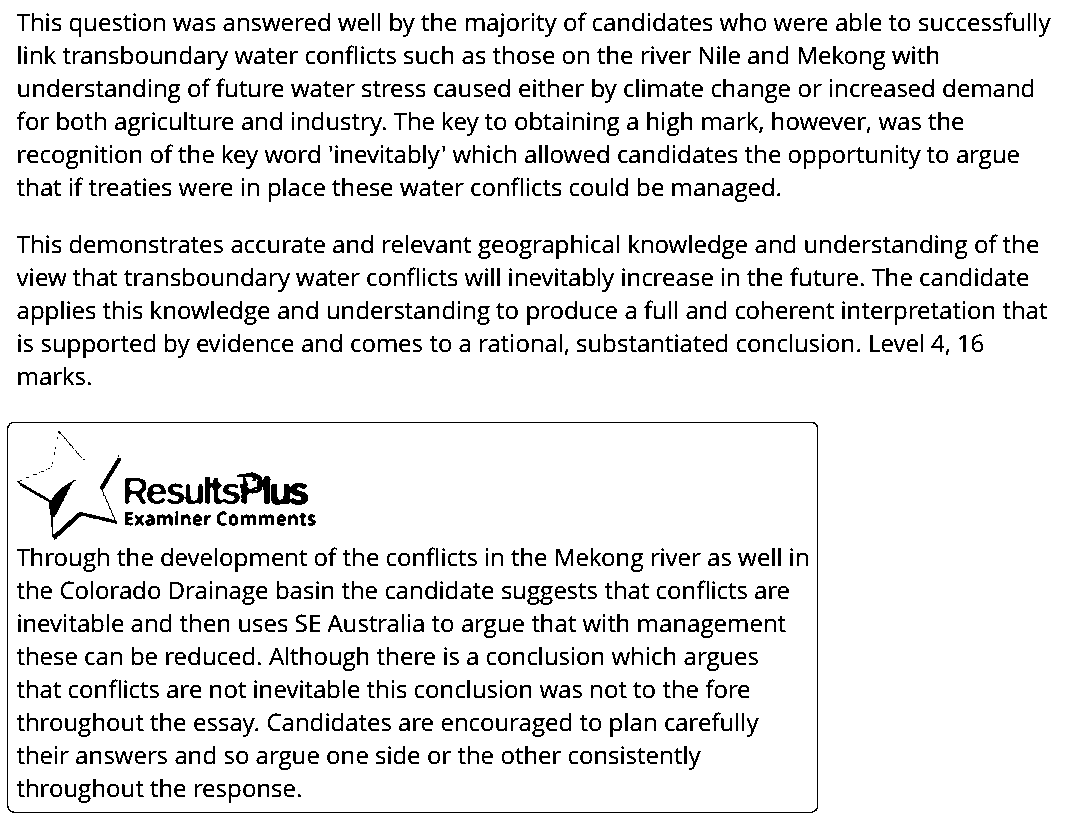
This question was answered well by the majority of candidates who were able to successfully link transboundary water conflicts such as those on the river Nile and Mekong with understanding of future water stress caused either by climate change or increased demand for both agriculture and industry. The key to obtaining a high mark, however, was the recognition of the key word 'inevitably' which allowed candidates the opportunity to argue that if treaties were in place these water conflicts could be managed. This demonstrates accurate and relevant geographical knowledge and understanding of the view that transboundary water conflicts will inevitably increase in the future. The candidate applies this knowledge and understanding to produce a full and coherent interpretation that is supported by evidence and comes to a rational, substantiated conclusion. Level 4, 16 marks. Through the development of the conflicts in the Mekong river as well in the Colorado Drainage basin the candidate suggests that conflicts are inevitable and then uses SE Australia to argue that with management these can be reduced. Although there is a conclusion which argues that conflicts are not inevitable this conclusion was not to the fore throughout the essay. Candidates are encouraged to plan carefully their answers and so argue one side or the other consistently throughout the response.
Notes from the mark scheme and report
Use trans-boundary rivers (Nile/GERD, Mekong, Indus)
weigh future water stress from climate change and demand against treaties and cooperation (e.g. Indus Waters Treaty, Helsinki Rules)
a reasoned judgement on 'inevitably' is needed
June 2023 · Paper 1 · Q4(c)8 marksAO1=8Extended response
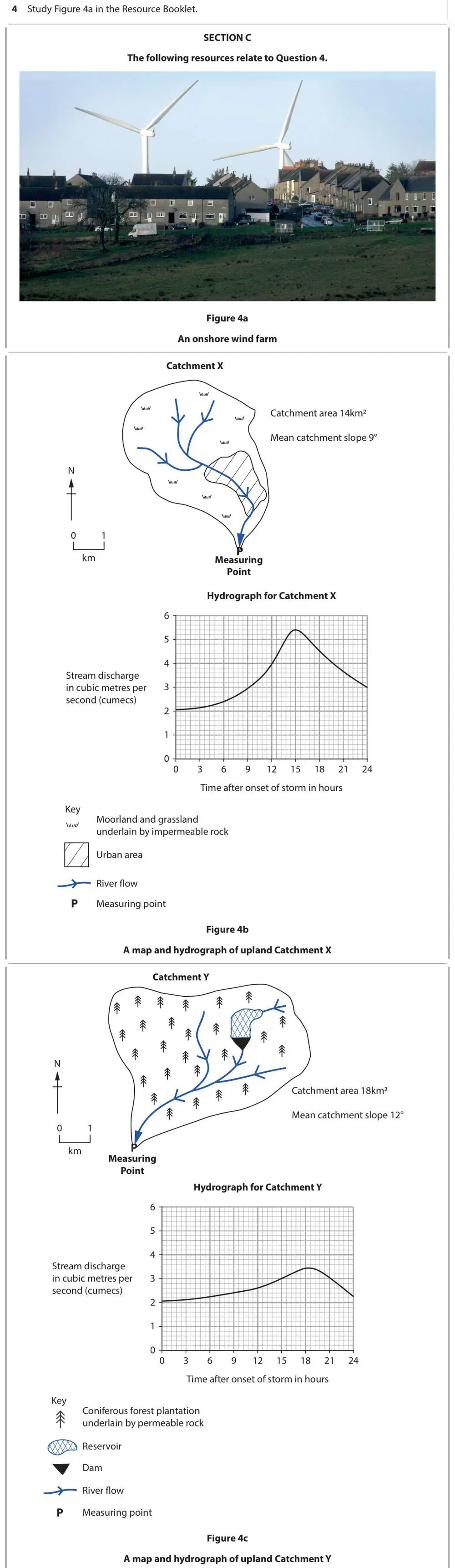
Resources for question 4
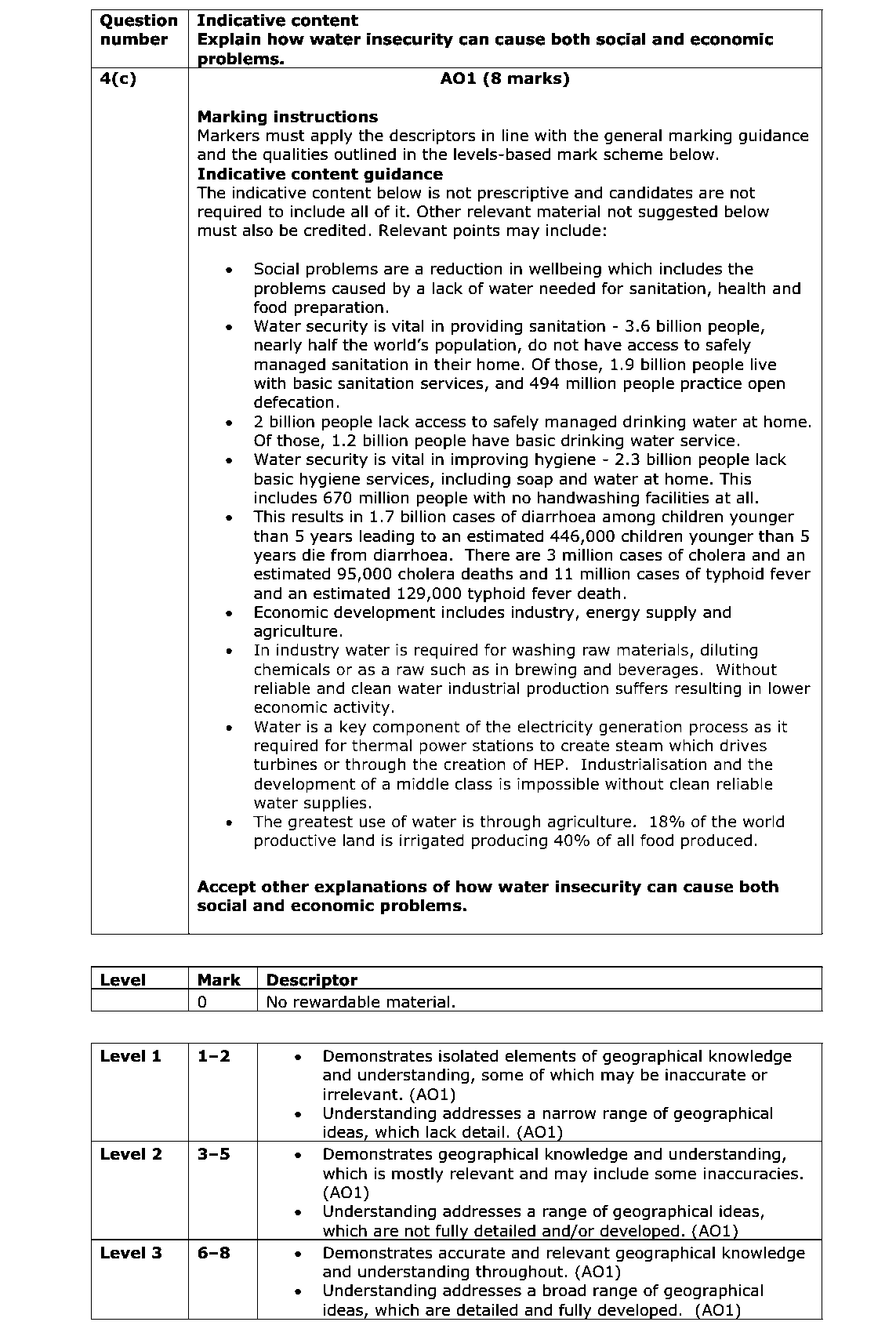
Mark scheme, including the levels and indicative content
Examiner's comment
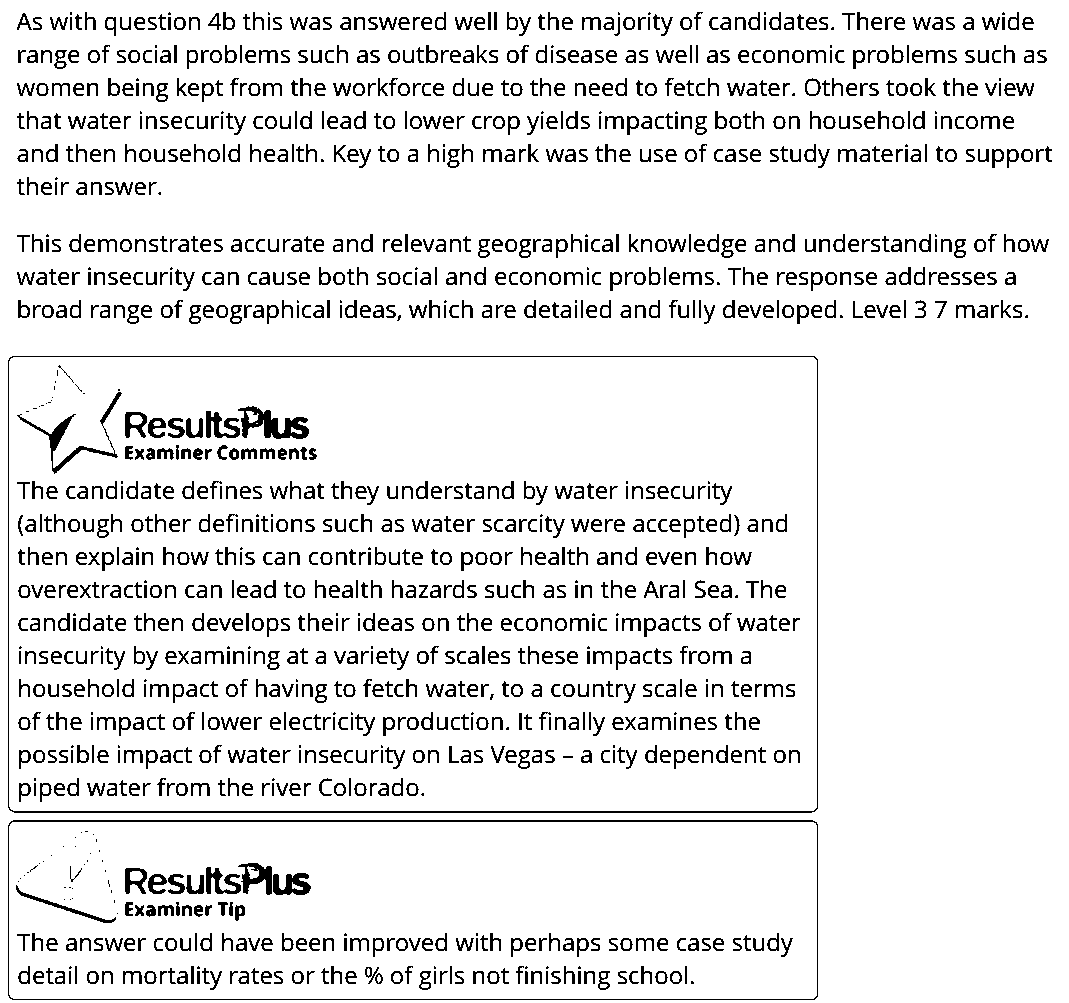
As with question 4b this was answered well by the majority of candidates. There was a wide range of social problems such as outbreaks of disease as well as economic problems such as women being kept from the workforce due to the need to fetch water. Others took the view that water insecurity could lead to lower crop yields impacting both on household income and then household health. Key to a high mark was the use of case study material to support their answer. This demonstrates accurate and relevant geographical knowledge and understanding of how water insecurity can cause both social and economic problems. The response addresses a broad range of geographical ideas, which are detailed and fully developed. Level 3 7 marks. The candidate defines what they understand by water insecurity (although other definitions such as water scarcity were accepted) and then explain how this can contribute to poor health and even how overextraction can lead to health hazards such as in the Aral Sea. The candidate then develops their ideas on the economic impacts of water insecurity by examining at a variety of scales these impacts from a household impact of having to fetch water, to a country scale in terms of the impact of lower electricity production. It finally examines the possible impact of water insecurity on Las Vegas – a city dependent on piped water from the river Colorado. The answer could have been improved with perhaps some case study detail on mortality rates or the % of girls not finishing school.
Notes from the mark scheme and report
Social: sanitation, drinking water, hygiene, diarrhoea and cholera deaths, women and girls fetching water
economic: industry, energy (thermal power, HEP), irrigated agriculture (18% of land, 40% of food)
use case-study detail
November 2021 · Paper 1 · Q4(e)20 marksAO1=5, AO2=1520-mark essay
Resources for question 4
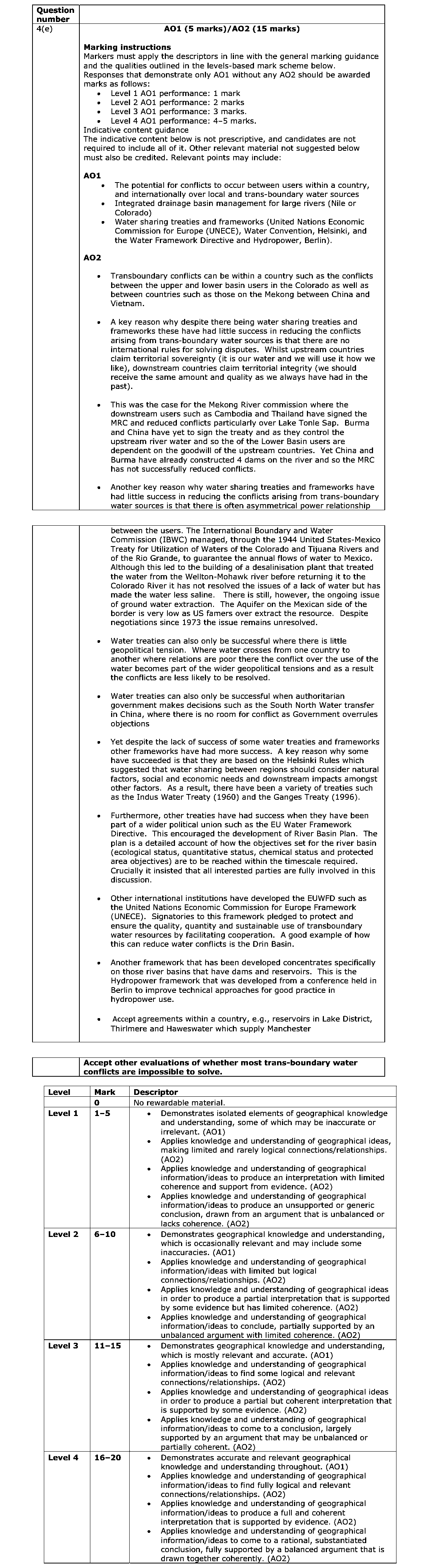
Mark scheme, including the levels and indicative content
Examiner's comment
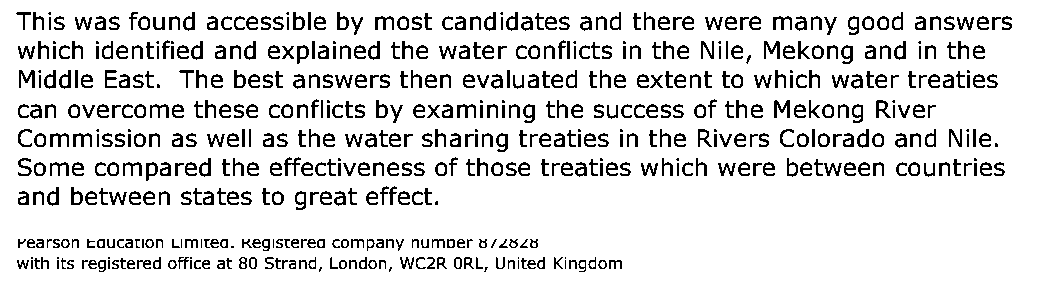
This was found accessible by most candidates and there were many good answers which identified and explained the water conflicts in the Nile, Mekong and in the Middle East. The best answers then evaluated the extent to which water treaties can overcome these conflicts by examining the success of the Mekong River Commission as well as the water sharing treaties in the Rivers Colorado and Nile. Some compared the effectiveness of those treaties which were between countries and between states to great effect. with its registered office at 80 Strand, London, WC2R 0RL, United Kingdom
Notes from the mark scheme and report
Weigh conflicts on the Nile (GERD), Mekong, Colorado and Middle East against treaties and frameworks (Mekong River Commission, Indus Waters Treaty, Helsinki rules, UNECE convention)
a judgement on 'impossible' is needed
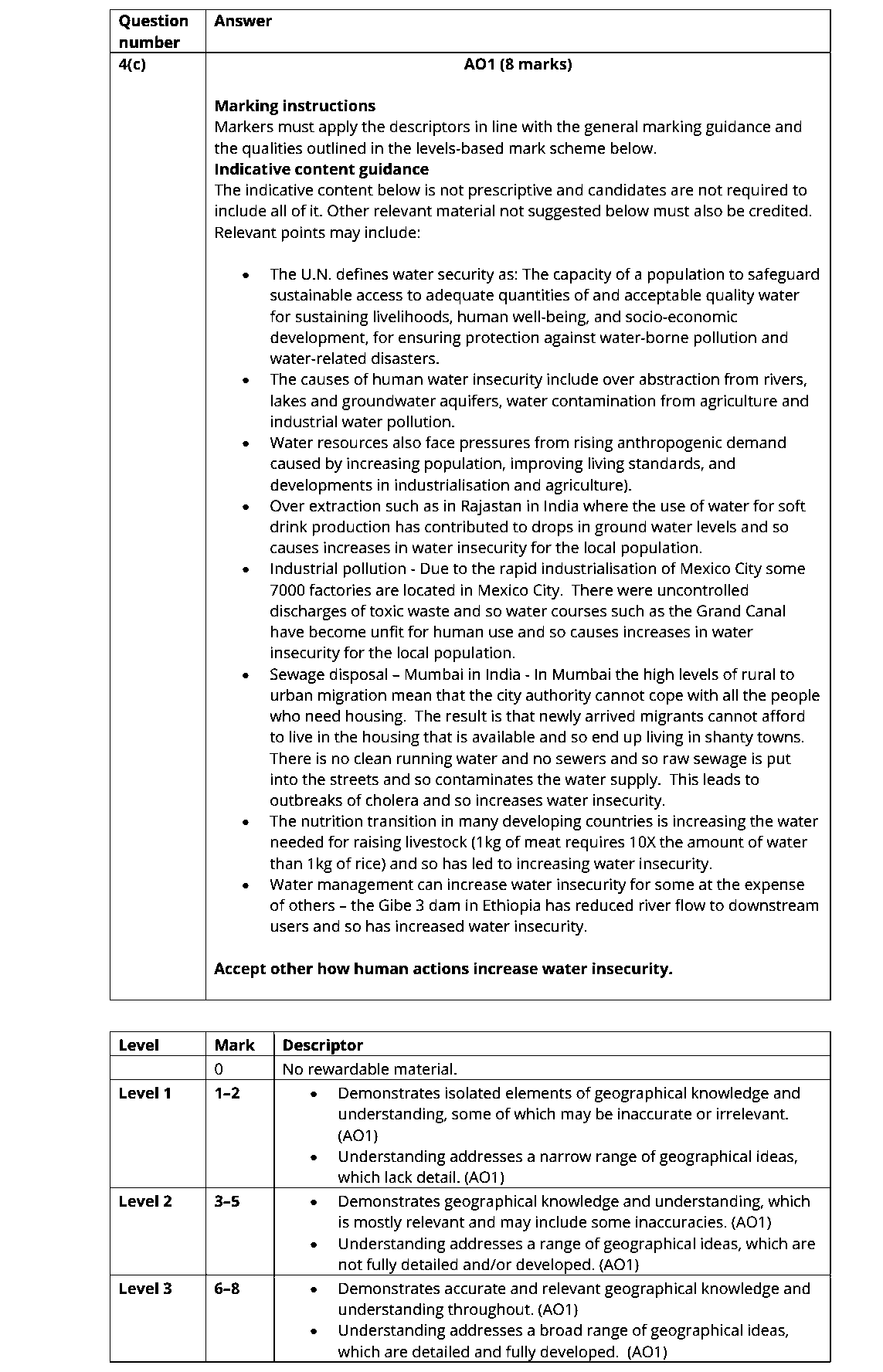
October 2020 · Paper 1 · Q4(c)8 marksAO1=8Extended response
Resources for question 4
Mark scheme, including the levels and indicative content
Examiner's comment
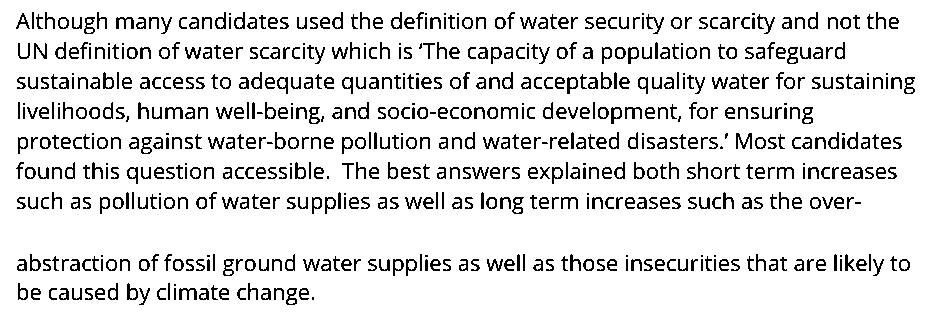
Although many candidates used the definition of water security or scarcity and not the UN definition of water scarcity which is ‘The capacity of a population to safeguard sustainable access to adequate quantities of and acceptable quality water for sustaining livelihoods, human well-being, and socio-economic development, for ensuring protection against water-borne pollution and water-related disasters.’ Most candidates found this question accessible. The best answers explained both short term increases such as pollution of water supplies as well as long term increases such as the over- abstraction of fossil ground water supplies as well as those insecurities that are likely to be caused by climate change.
Notes from the mark scheme and report
Over-abstraction of rivers and aquifers (fossil water), pollution from agriculture and industry, rising demand, dams and transfers, climate change
cover short- and long-term effects
use the UN definition of water security
June 2019 · Paper 1 · Q4(d)12 marksAO1=3, AO2=912-mark essayHard
Resources for question 4
Mark scheme, including the levels and indicative content
Examiner's comment
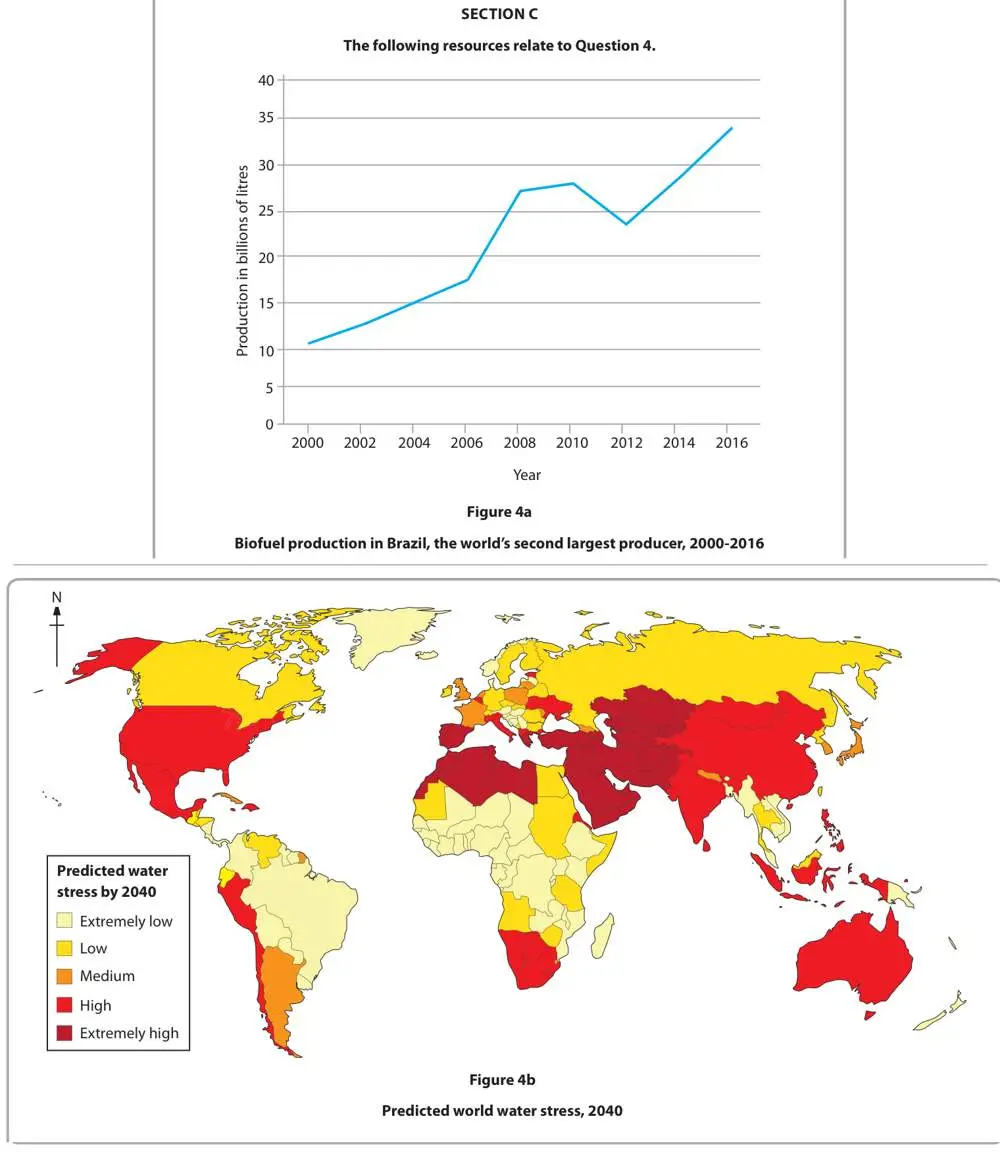
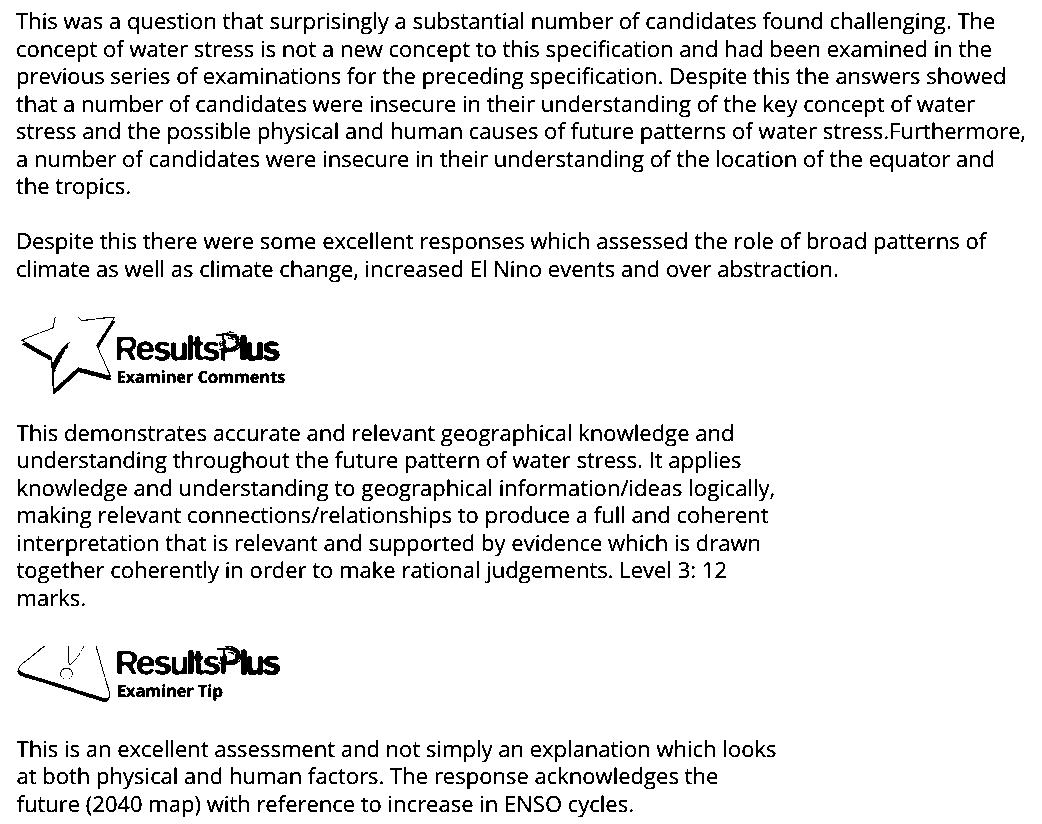
This was a question that surprisingly a substantial number of candidates found challenging. The concept of water stress is not a new concept to this specification and had been examined in the previous series of examinations for the preceding specification. Despite this the answers showed that a number of candidates were insecure in their understanding of the key concept of water stress and the possible physical and human causes of future patterns of water stress.Furthermore, a number of candidates were insecure in their understanding of the location of the equator and the tropics. Despite this there were some excellent responses which assessed the role of broad patterns of climate as well as climate change, increased El Nino events and over abstraction. This demonstrates accurate and relevant geographical knowledge and understanding throughout the future pattern of water stress. It applies knowledge and understanding to geographical information/ideas logically, making relevant connections/relationships to produce a full and coherent interpretation that is relevant and supported by evidence which is drawn together coherently in order to make rational judgements. Level 3: 12 marks. This is an excellent assessment and not simply an explanation which looks at both physical and human factors. The response acknowledges the future (2040 map) with reference to increase in ENSO cycles.
Notes from the mark scheme and report
Use Figure 4b: arid subtropics (Middle East, North Africa, Australia), ENSO and climate change, salt-water encroachment v human demand (population, irrigation, over-abstraction) in USA, China, India
report: 'a substantial number of candidates found challenging', insecure on the concept of water stress and on locating the tropics
June 2019 · Paper 1 · Q4(e)20 marksAO1=5, AO2=1520-mark essay
Resources for question 4
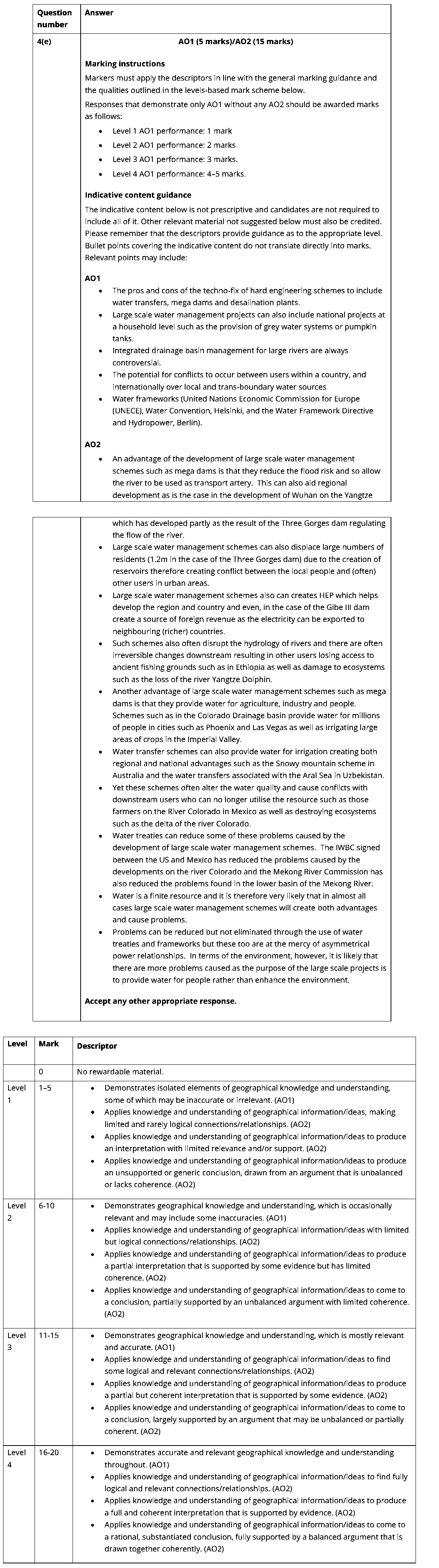
Mark scheme, including the levels and indicative content
Examiner's comment
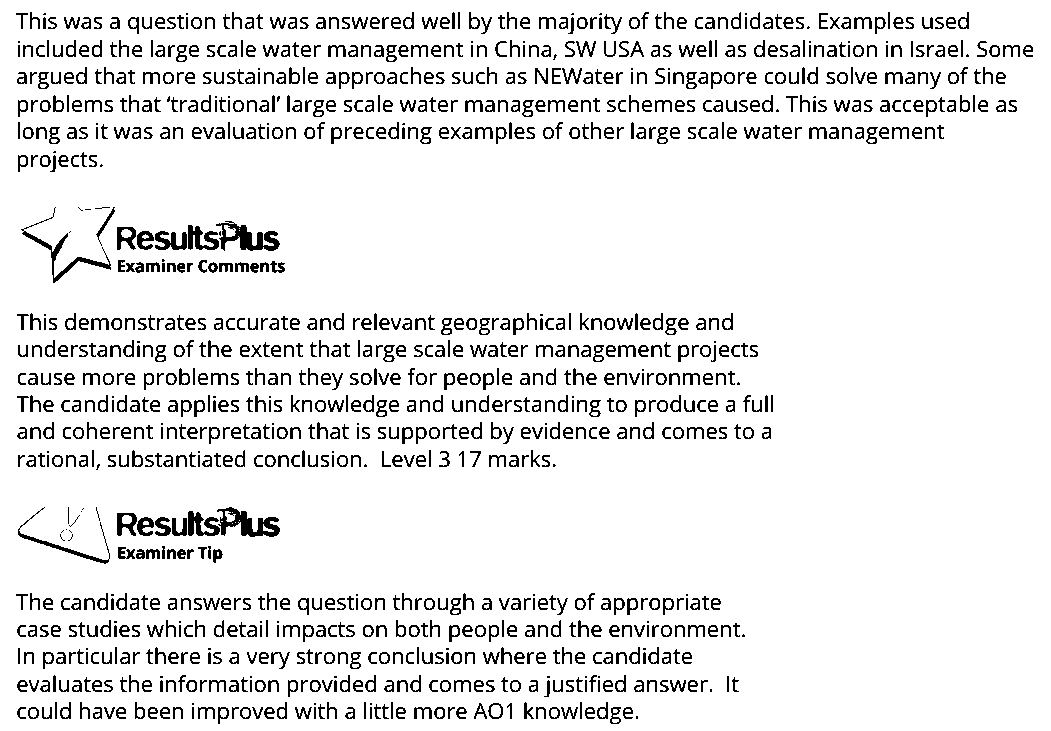
This was a question that was answered well by the majority of the candidates. Examples used included the large scale water management in China, SW USA as well as desalination in Israel. Some argued that more sustainable approaches such as NEWater in Singapore could solve many of the problems that ‘traditional’ large scale water management schemes caused. This was acceptable as long as it was an evaluation of preceding examples of other large scale water management projects. This demonstrates accurate and relevant geographical knowledge and understanding of the extent that large scale water management projects cause more problems than they solve for people and the environment. The candidate applies this knowledge and understanding to produce a full and coherent interpretation that is supported by evidence and comes to a rational, substantiated conclusion. Level 3 17 marks. The candidate answers the question through a variety of appropriate case studies which detail impacts on both people and the environment. In particular there is a very strong conclusion where the candidate evaluates the information provided and comes to a justified answer. It could have been improved with a little more AO1 knowledge.
Notes from the mark scheme and report
Mega dams (Three Gorges), water transfers (South-North in China), desalination (Israel), Colorado basin in SW USA: water supply and HEP v displacement, ecosystem damage, sediment loss and trans-boundary conflict
compare with sustainable schemes (Singapore NEWater)
answered well by most
June 2018 · Paper 1 · Q4(c)8 marksAO1=8Extended response
Resources for question 4
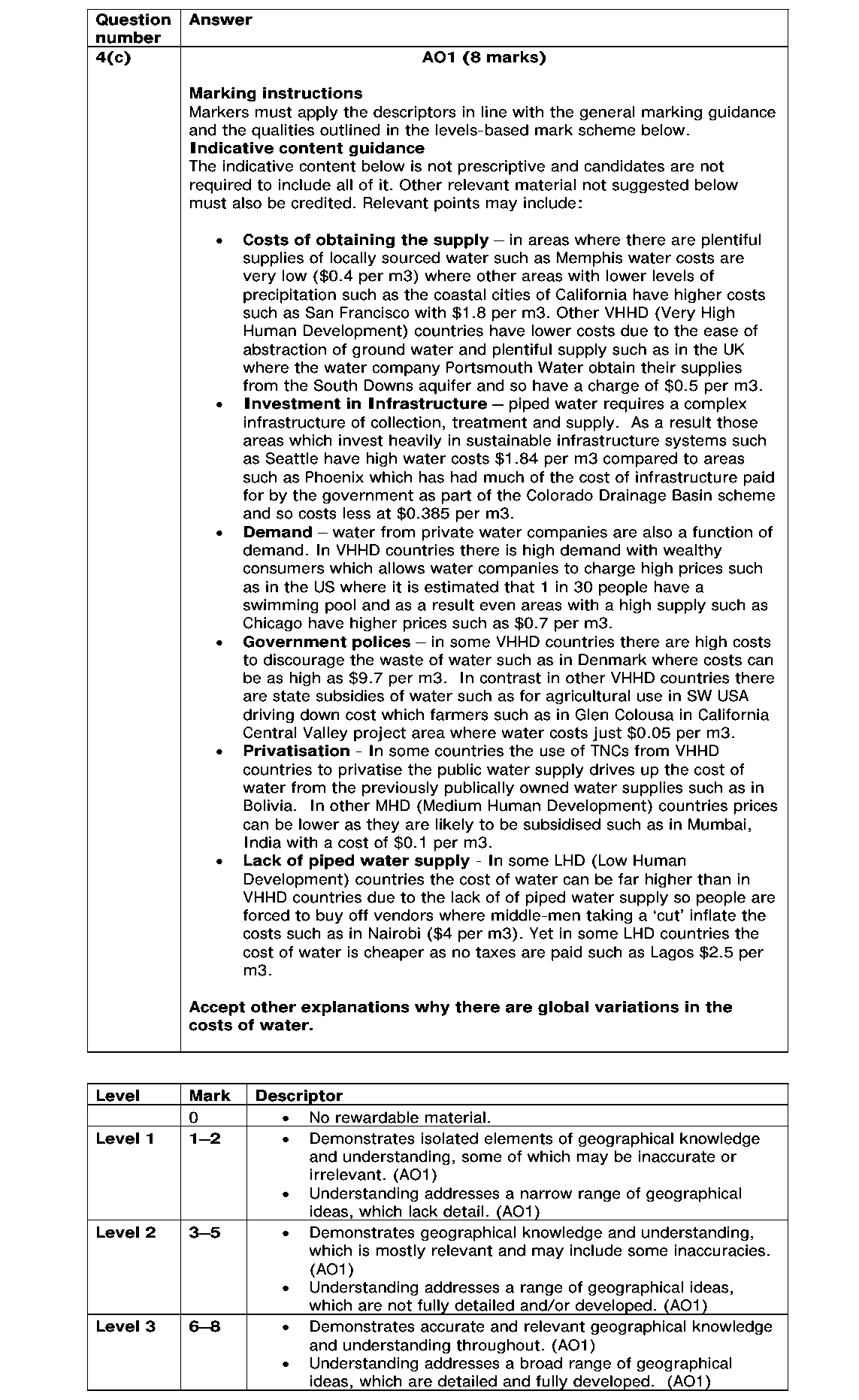
Mark scheme, including the levels and indicative content
Examiner's comment
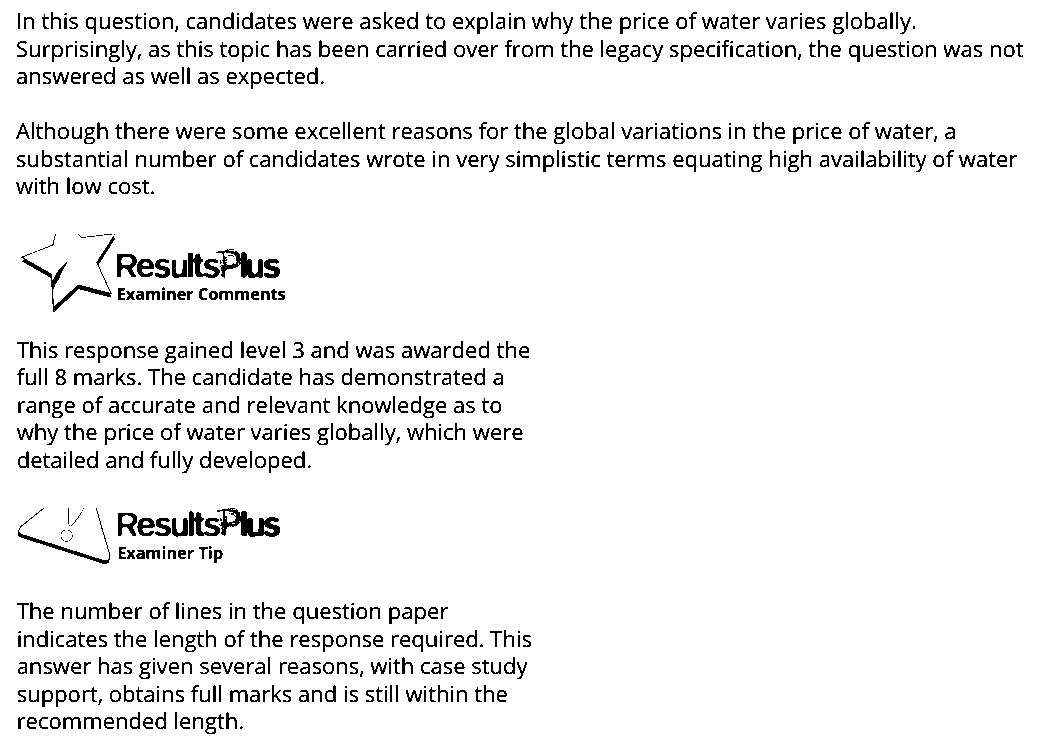
In this question, candidates were asked to explain why the price of water varies globally. Surprisingly, as this topic has been carried over from the legacy specification, the question was not answered as well as expected. Although there were some excellent reasons for the global variations in the price of water, a substantial number of candidates wrote in very simplistic terms equating high availability of water with low cost. This response gained level 3 and was awarded the full 8 marks. The candidate has demonstrated a range of accurate and relevant knowledge as to why the price of water varies globally, which were detailed and fully developed. The number of lines in the question paper indicates the length of the response required. This answer has given several reasons, with case study support, obtains full marks and is still within the recommended length.
Notes from the mark scheme and report
Physical v economic scarcity, cost of treatment, transfer and desalination, privatisation and subsidies, ability to pay
not simply 'more water, lower price'
report: not answered as well as expected, many simplistic
Work with an Edexcel Geography tutor
Essays stuck in the middle levels, or losing marks on the data questions? Book a trial lesson with a specialist Edexcel Geography tutor.