Mark scheme
Examiner's comment
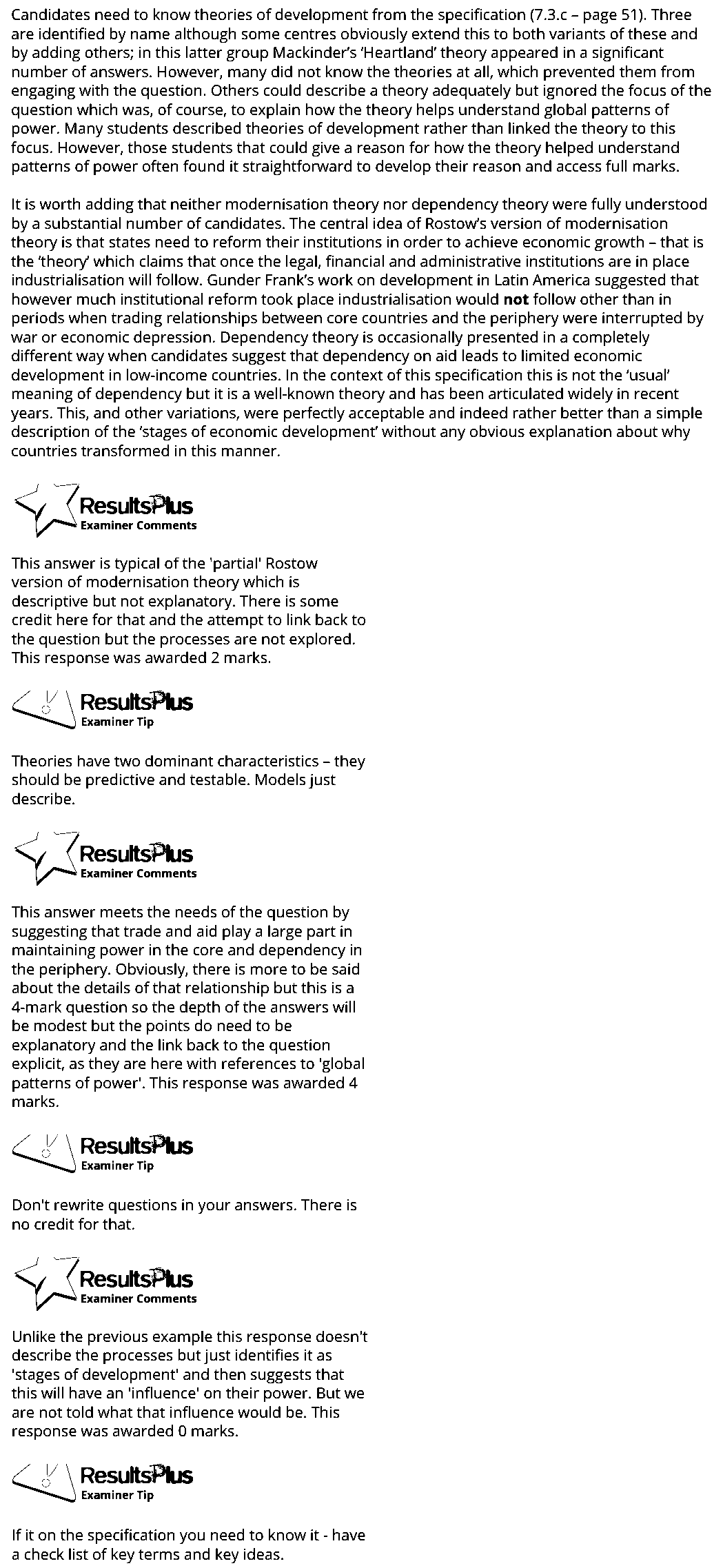
Candidates need to know theories of development from the specification (7.3.c – page 51). Three are identified by name although some centres obviously extend this to both variants of these and by adding others; in this latter group Mackinder’s ‘Heartland’ theory appeared in a significant number of answers. However, many did not know the theories at all, which prevented them from engaging with the question. Others could describe a theory adequately but ignored the focus of the question which was, of course, to explain how the theory helps understand global patterns of power. Many students described theories of development rather than linked the theory to this focus. However, those students that could give a reason for how the theory helped understand patterns of power often found it straightforward to develop their reason and access full marks. It is worth adding that neither modernisation theory nor dependency theory were fully understood by a substantial number of candidates. The central idea of Rostow’s version of modernisation theory is that states need to reform their institutions in order to achieve economic growth – that is the ‘theory’ which claims that once the legal, financial and administrative institutions are in place industrialisation will follow. Gunder Frank’s work on development in Latin America suggested that however much institutional reform took place industrialisation would not follow other than in periods when trading relationships between core countries and the periphery were interrupted by war or economic depression. Dependency theory is occasionally presented in a completely different way when candidates suggest that dependency on aid leads to limited economic development in low-income countries. In the context of this specification this is not the ‘usual’ meaning of dependency but it is a well-known theory and has been articulated widely in recent years. This, and other variations, were perfectly acceptable and indeed rather better than a simple description of the ‘stages of economic development’ without any obvious explanation about why countries transformed in this manner. This answer is typical of the 'partial' Rostow version of modernisation theory which is descriptive but not explanatory. There is some credit here for that and the attempt to link back to the question but the processes are not explored. This response was awarded 2 marks. Theories have two dominant characteristics – they should be predictive and testable. Models just describe. This answer meets the needs of the question by suggesting that trade and aid play a large part in maintaining power in the core and dependency in the periphery. Obviously, there is more to be said about the details of that relationship but this is a 4-mark question so the depth of the answers will be modest but the points do need to be explanatory and the link back to the question explicit, as they are here with references to 'global patterns of power'. This response was awarded 4 marks. Don't rewrite questions in your answers. There is no credit for that. Unlike the previous example this response doesn't describe the processes but just identifies it as 'stages of development' and then suggests that this will have an 'influence' on their power. But we are not told what that influence would be. This response was awarded 0 marks. If it on the specification you need to know it - have a check list of key terms and key ideas.
Notes from the mark scheme and report
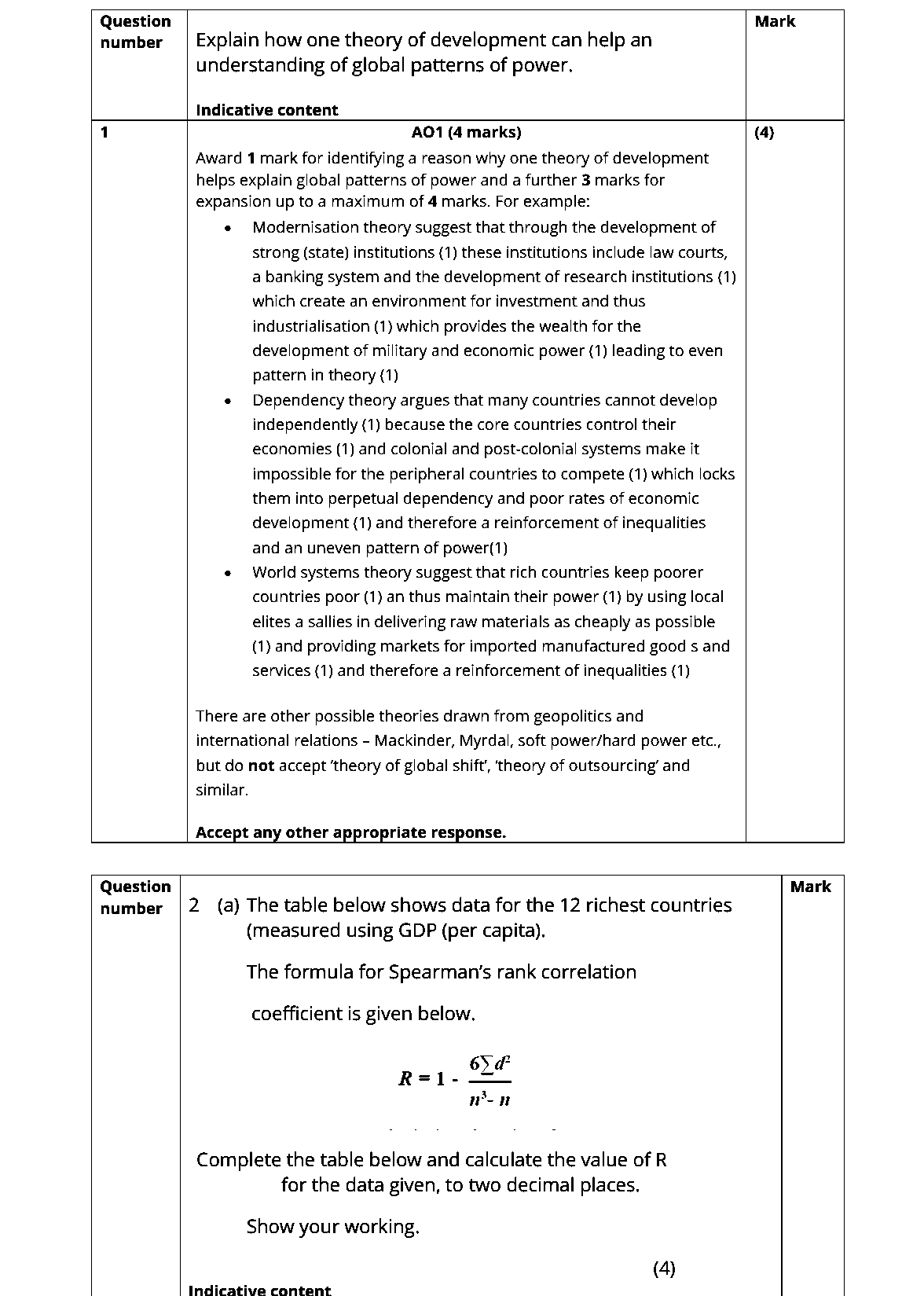
- One theory + 3 marks of expansion linked to patterns of power: modernisation (institutions, investment, industrialisation), dependency (core controls periphery, colonial legacy locks in unequal power), world systems (core keeps periphery supplying cheap raw materials)
- report: 'many did not know the theories at all' and many described a theory without linking it to power