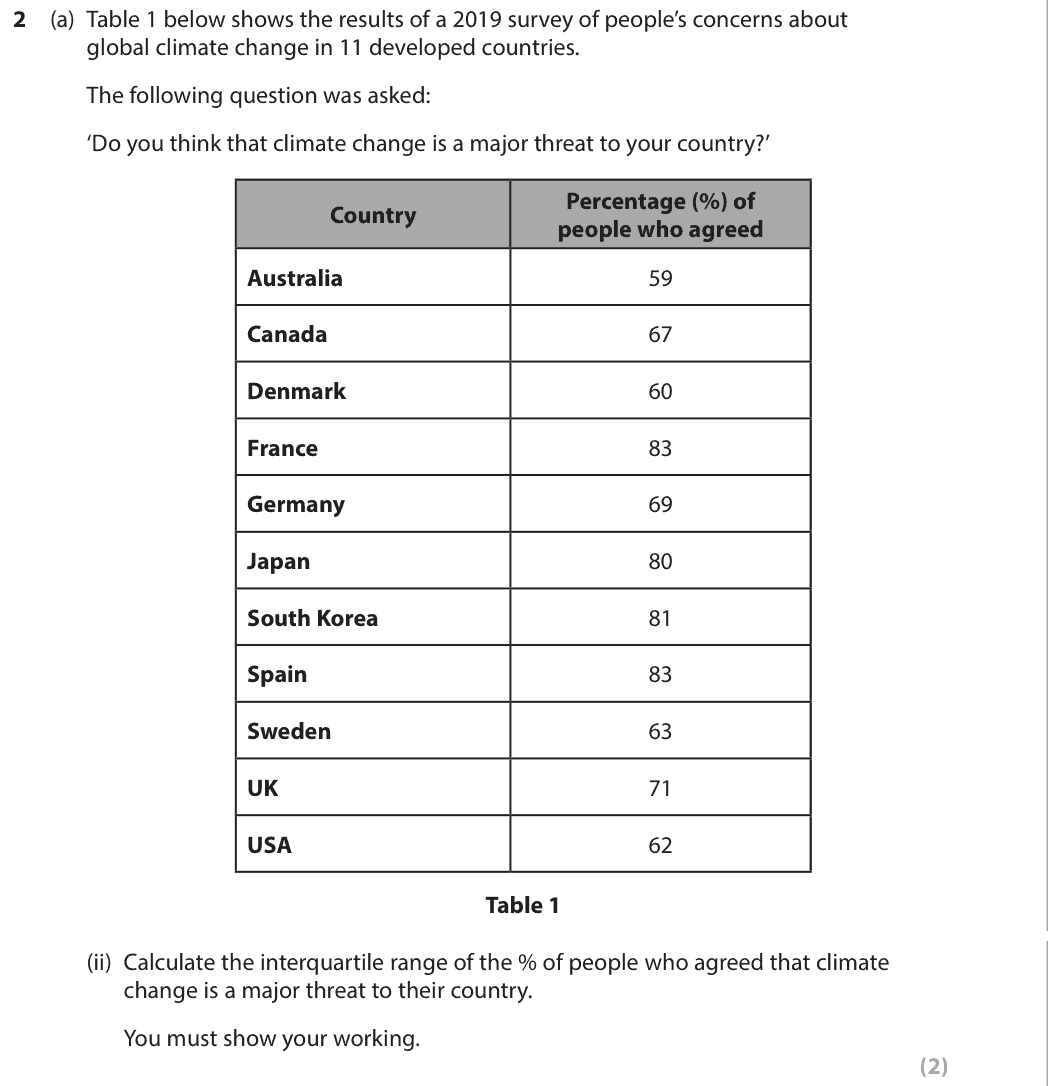
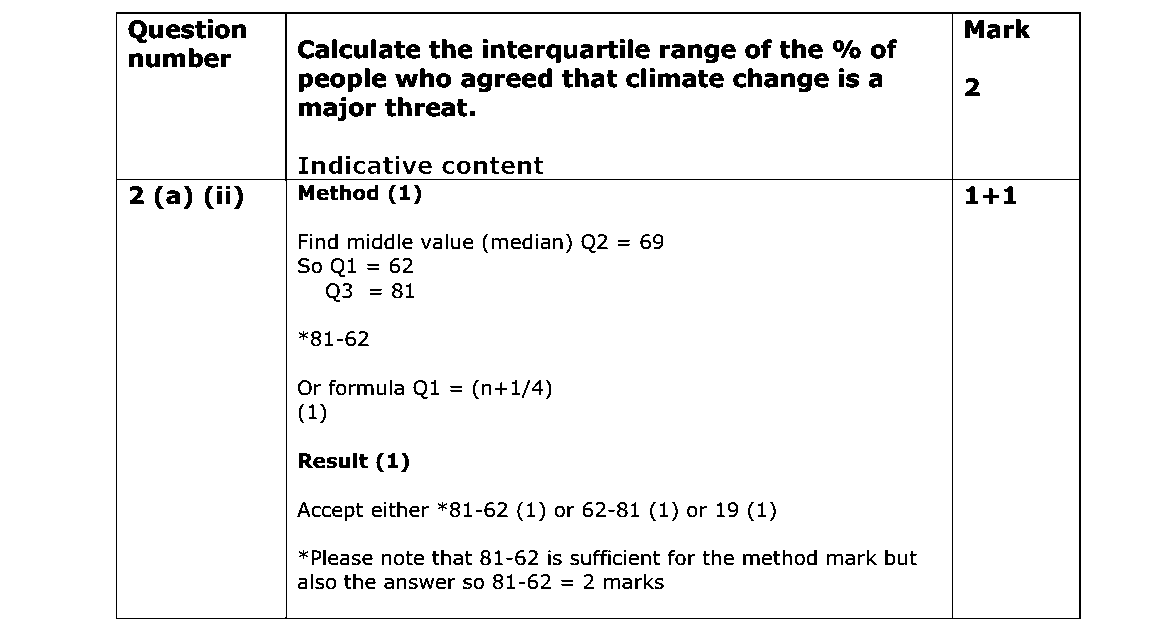
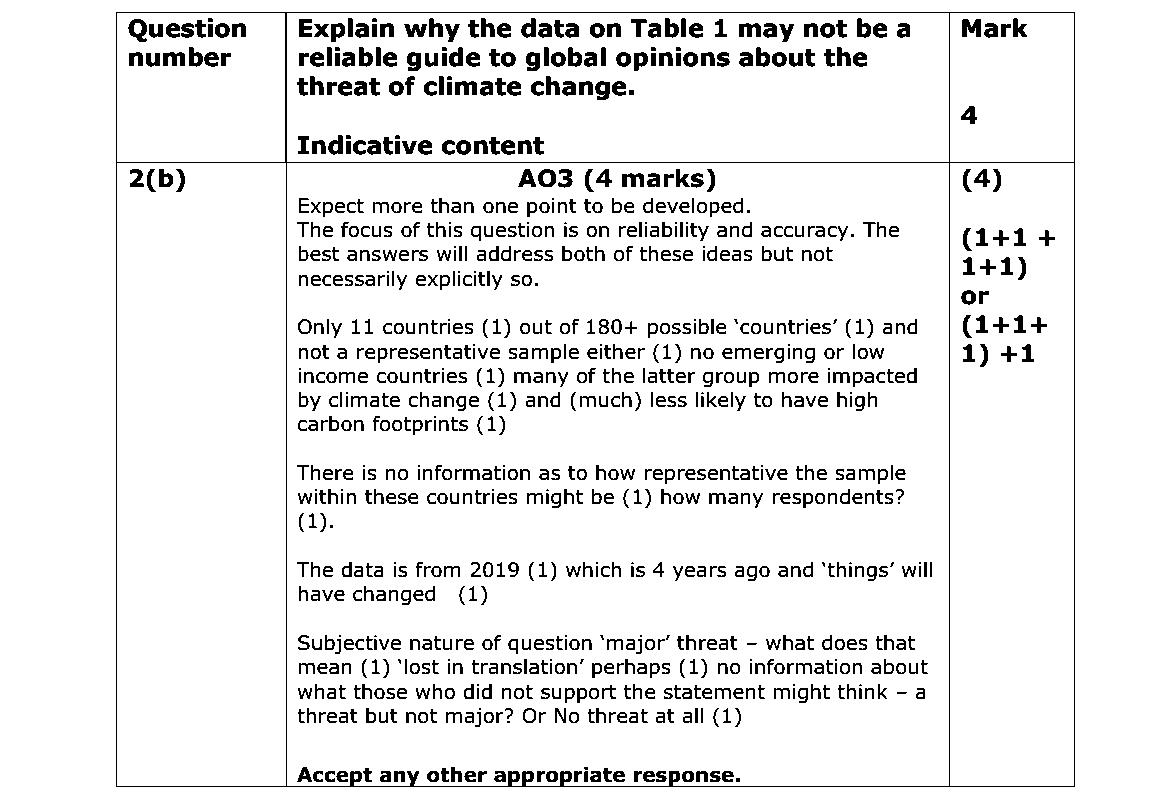
Examiner's comment
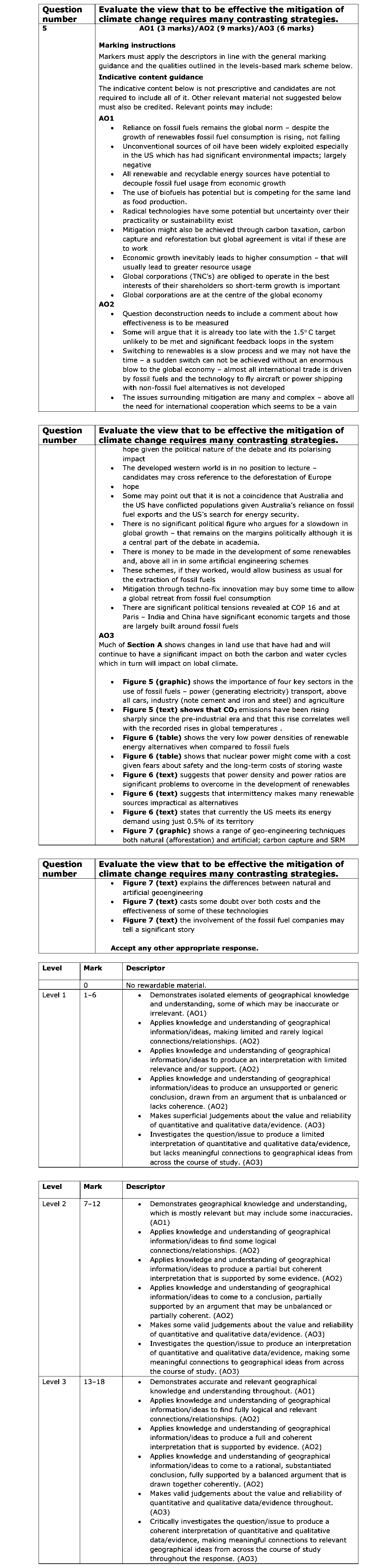
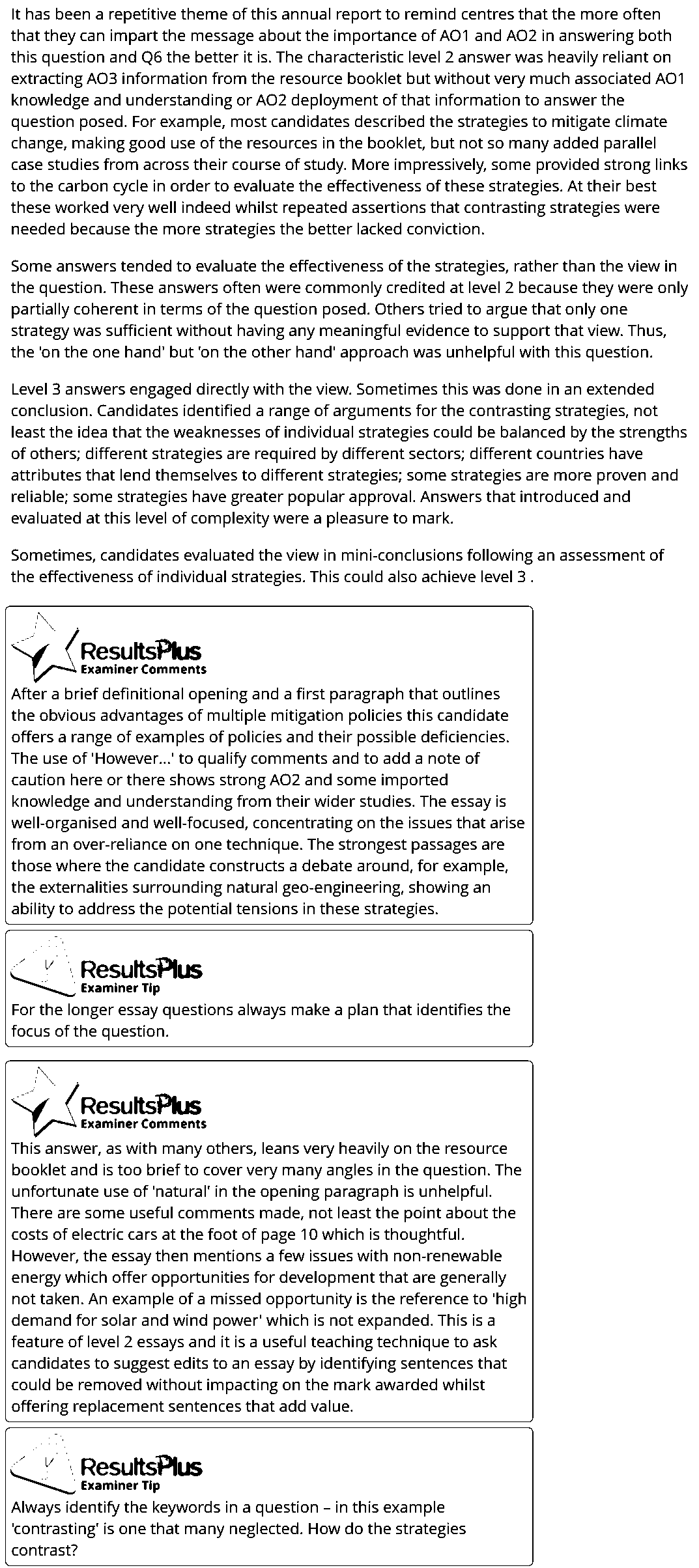
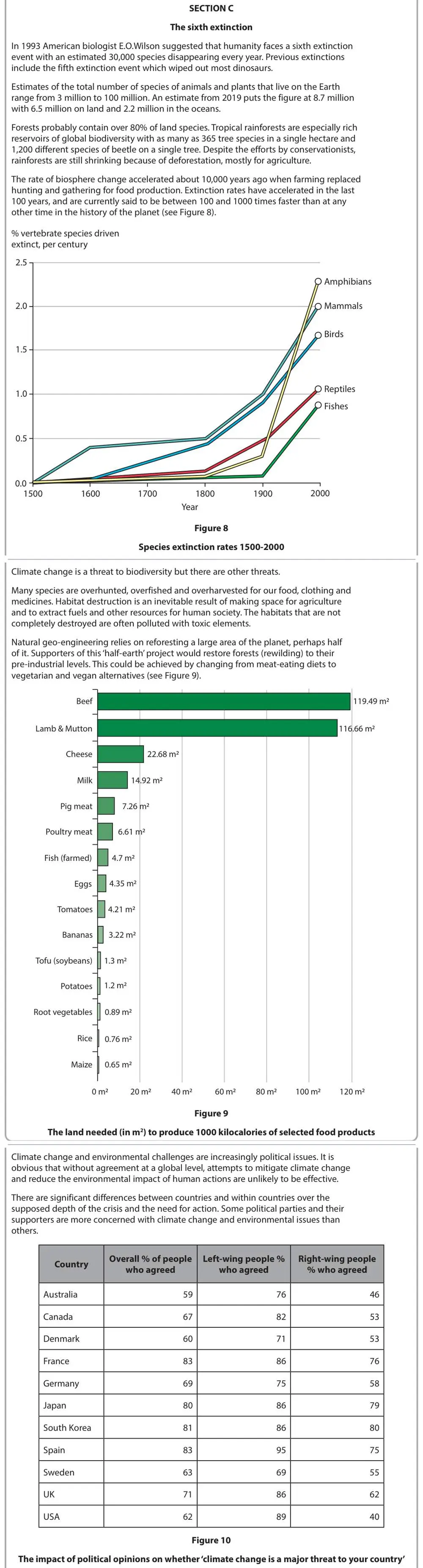
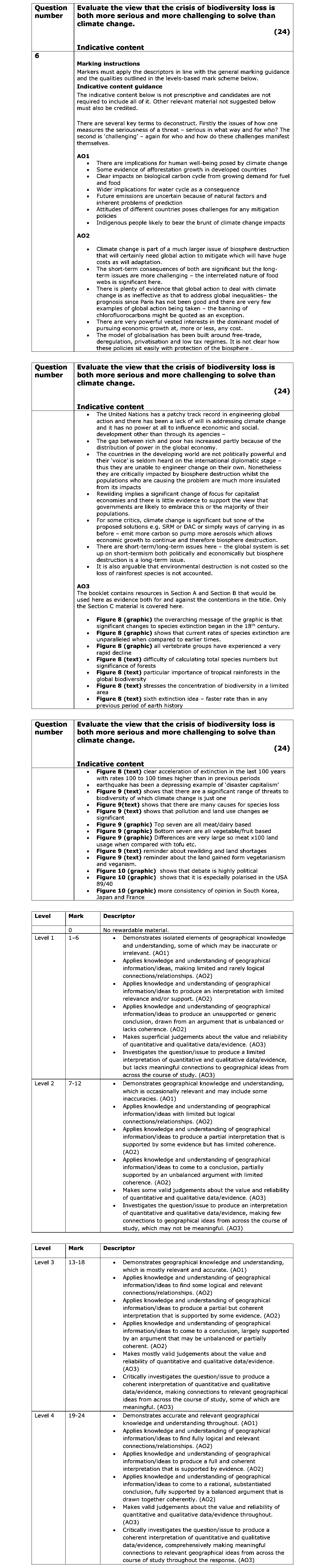
As is intended the incline of difficulty across the paper inevitably makes this final question the most demanding. There is anecdotal and statistical evidence that candidates are more aware that they need to devote a sufficient tranche of time to do this question credit. Candidates who tried to evaluate the statement struggled to evaluate the view. There are two ideas: 'more serious' and 'more challenging to solve'. Candidates who addressed these ideas separately tended to write more coherent arguments. The booklet had many rich resources to evidence these debates and was used effectively by most candidates. The main discriminator was how effectively candidates focused on the statements, rather than the AO1 or AO3, which was generally quite strong. In other words how good were they at establishing links that could be constructed into an argument. There were good opportunities to make these links to ideas from across the course of study, from the water and carbon cycles. This was a helpful way to consider the seriousness of the two crises. There were good opportunities to link to globalisation, in particular global governance of these crises. That also allowed some to comment on how much geopolitics and superpower relationships plays a part in environmental decisions making at governmental level. A risk was that some essays lost sight of the ‘crisis of biodiversity’ entirely. That was understandable given the high-profile political debate surrounding climate change and the active and ongoing realignment of many policies since the re-emergence of the debate surrounding energy dependency and energy security provoked by the escalation of the Russia-Ukraine conflict. Inevitably candidates had more understanding of the climate change debate and the apparent tensions with tackling that without impacting on economic growth. However the underuse of the resources that focused on biodiversity loss was notable especially at the lower end of the ability range. Perhaps unsurprisingly the overwhelming view was that both issues were serious but maybe climate change was harder to fix. Almost all level 3 and level 4 responses noted that they were interrelated issues but very few offered the view that climate change was part of a wider environmental crisis. For the few who did argue this, it provided a very helpful route to considering which was more challenging to solve. The role of scale in influencing the effectiveness of solutions was used to great effect by many candidates. As always with these 24-mark questions, candidates that allowed time for a considered conclusion that clearly evaluated the view had the greatest chance of achieving a level 4 answer. This is a very impressive essay that is clearly a level 4 answer as it comfortably meets the six bullet points in the level 4 descriptors. The candidate builds a case through the essay that is well-supported and built upon material covered across the specification. The opening debate about the 'tragedy of the commons' is excellent. Recognising that tackling climate change requires international cooperation, and that may not be possible as governments have different goals, is supported by data from China referencing car ownership rates. It is worth noting that this data is not entirely convincing (no dates are offered) but the sense of it is fine and, in the context of an examination, it is perfectly acceptable. It is also worth noting that the 'China blaming' focus of this section is also questionable, as it would be questioned in a classroom debate, but in this context it clearly adds a positive dimension to the essay as a whole. There is a clear attempt to differentiate between the scale of the challenge and especially how these two challenges overlap and interrelate, and the difficulties of solving these crises. The conclusion drawn is not entirely supported by the material offered as evidence earlier in the essay which makes it less than fully coherent in places. It is that minor criticism that keeps it from scoring full marks. A minor edit of the final paragraph would have solved that. In answering almost any essay question, it is worth recalling that answers are likely to be made more complex because of spatial and temporal variations. A strategy might offer a short-term fix but might have negative long term consequences. Another policy/strategy might be perfect for urban areas or richer communities but not for rural communities or areas of high deprivation. These ideas will add complexity to your argument so use them whenever you can. Unusually, this essay is focused more on biodiversity loss than it is on climate change. There are valuable points made about why there are complexities in addressing, for example, the issue of the potential of dietary changes in addressing habitat loss. The point made referencing the 'costs' of rice is thoughtful but is also a missed opportunity given the contribution of wet-rice to methane production. However, the main issue with the essay, which is strongly self-limiting, is the failure to address the differences between the seriousness of the two crises and the ability to solve these crises. The final page offers a few highly generalised and unsupported statements asserting a view but lacking any evidence to support that view. By conflating the two issues that the question identifies the candidate makes it very difficult to access the higher levels in the mark scheme. Always give yourself enough time to write a conclusion. A good essay can often be judged by its first and last paragraphs where you set the direction of your argument in the introductory paragraph and pull it all together in the final one.
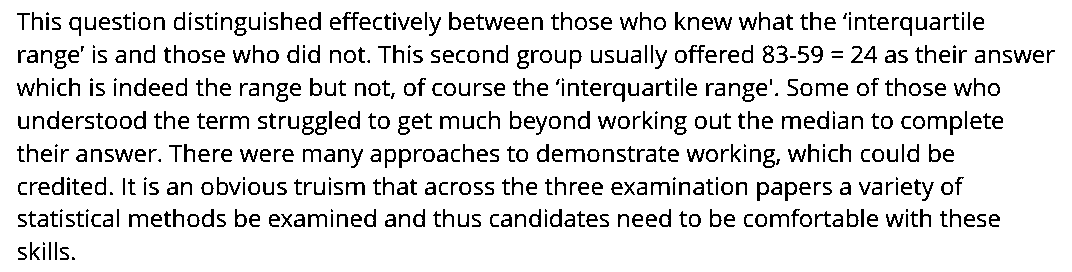
![Examiner's report extract for June 2023 Paper 3 question 6]()