Examiner's comment
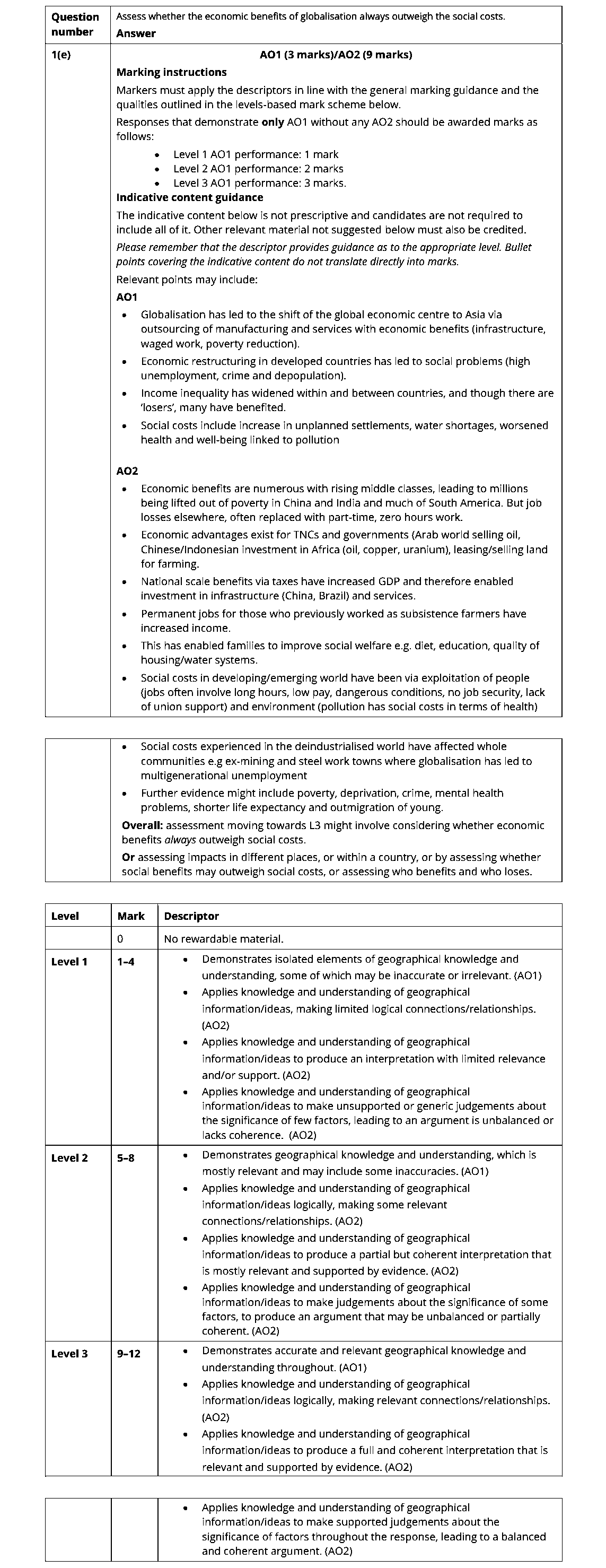
This Question could be interpreted in a generic way, but candidates who took this approach tended to run out of ideas after a couple of paragraphs. More successful answers rooted their ideas in examples or concepts (improvement of infrastructure for example) so that contrasts could be made between stakeholders who benefited economically (often TNC managers, developing world employees and governments) and those who experienced social costs (often employees in both the developing and the developed world). Good answers discussed outsourcing and off shoring, the role of trade blocs, ‘trickle down effects’ and the multiplier effect resulting in economic benefits, particularly to workers in low income and emerging countries. China was frequently used as an example here, with better answers being specific about places within China. This was then contrasted with the social costs these people experienced in terms of exploitation, long hours, poor working conditions and separation from their families. The strongest answers were able to assess the balance between these costs and benefits, with the additional complexity that economically rising wage costs in some places is leading TNCs to relocate, leading to unemployment and social costs. Many also considered the social costs experienced in regions of the post- industrial developed world, noting that economic costs occurred here as well. Spatial contrasts could therefore provide a useful route to assessment, as could changes over time. Thus, regions that have experienced both economic and social costs in the past (Rustbelt USA and deindustrialised places in Europe) have to some extent benefited from reinvestment from TNCs and national governments, so seeing economic and social benefits. On 12-mark Questions, to come out of level 1, candidates need to be referring to the ideas/topics of the Question and beginning to explain the links between them (the mark scheme calls this ‘coherence’). With examples and a conclusion, the answer moves up within level 2, and for level 3 needs to be taking a broader perspective (covering both developed and emerging countries for example) and providing ‘supported judgements’ (assessment) about who experiences the costs and benefits and the balance between them.
![Examiner's report extract for June 2019 Paper 2 question 1(e)]()