Examiner's comment
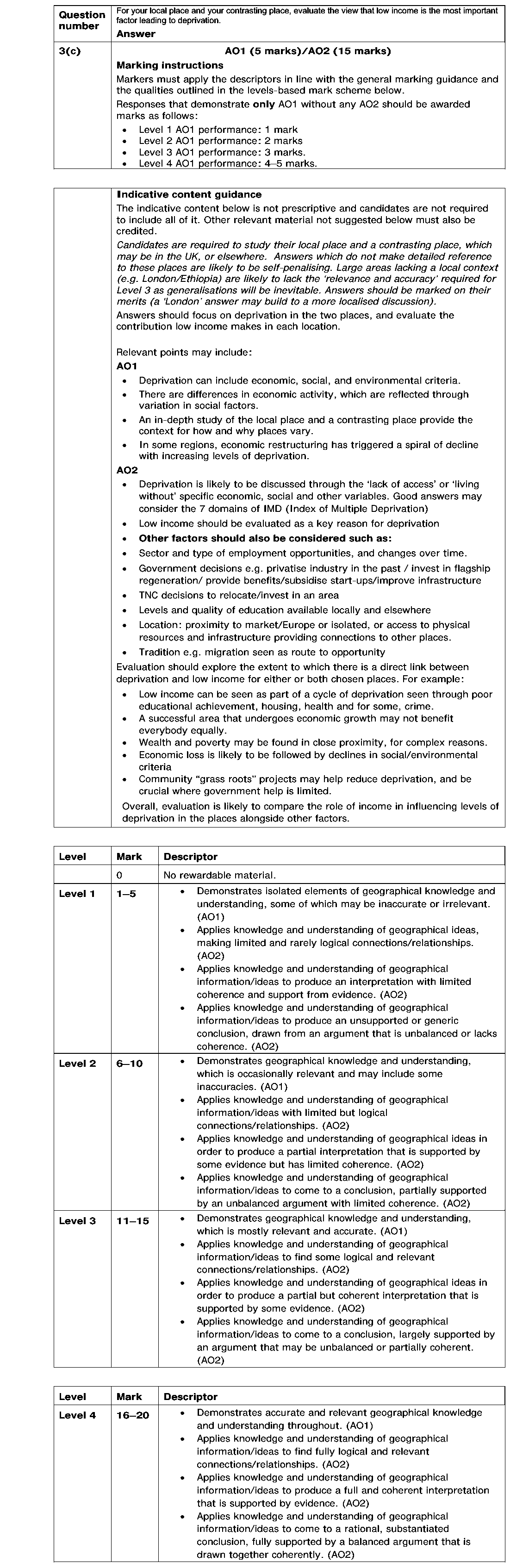
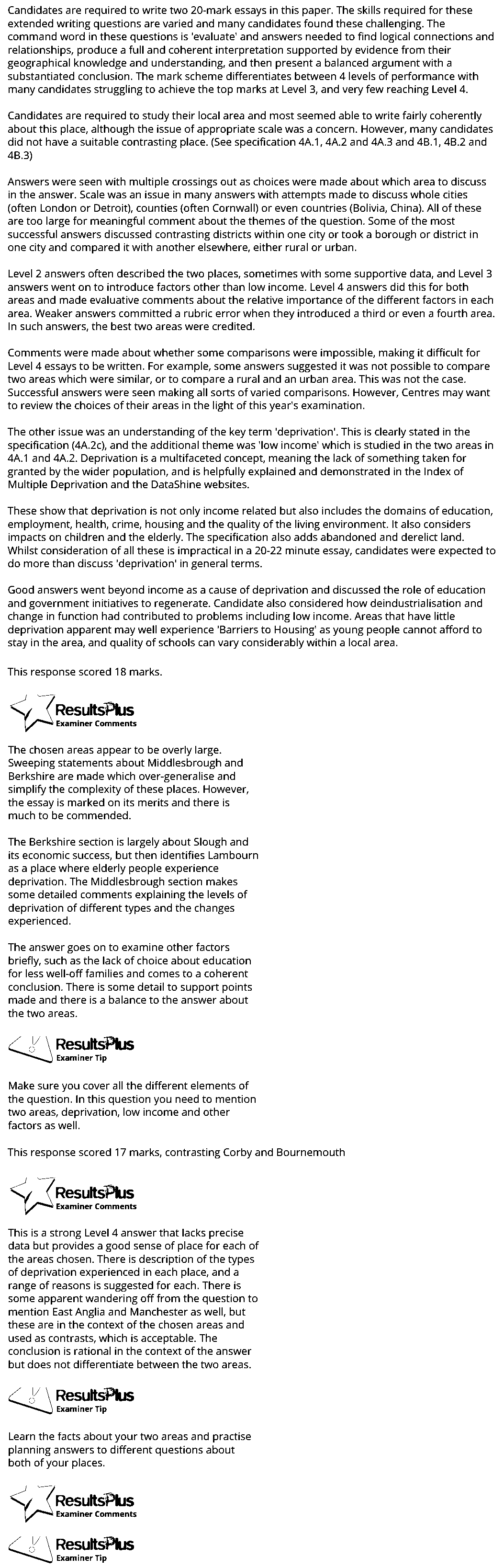
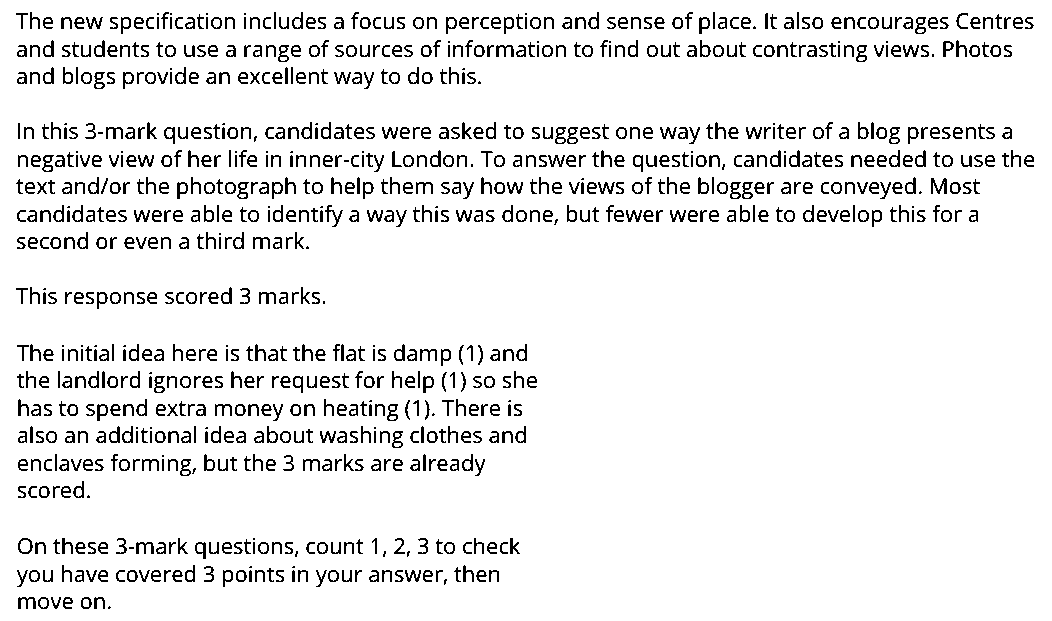
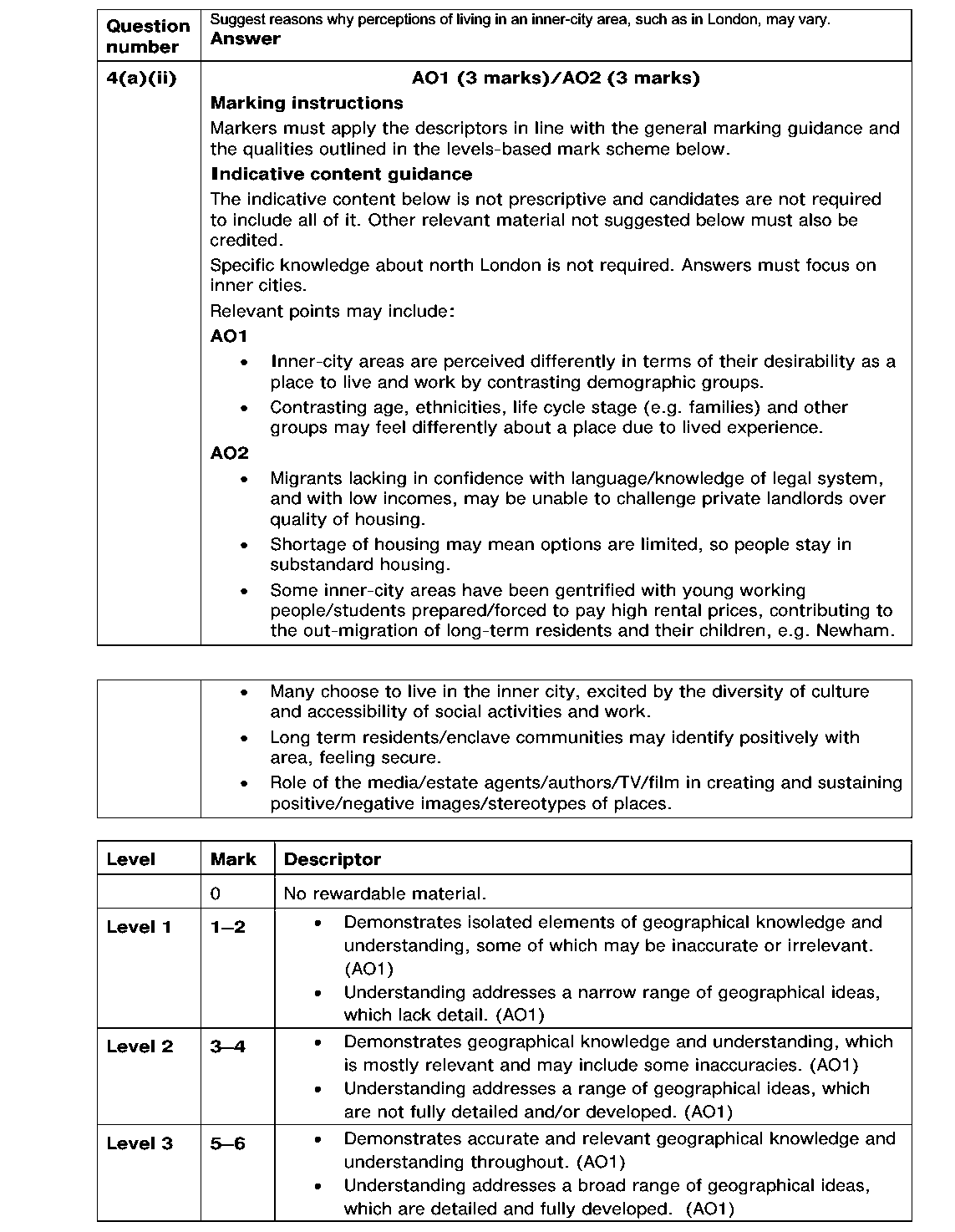
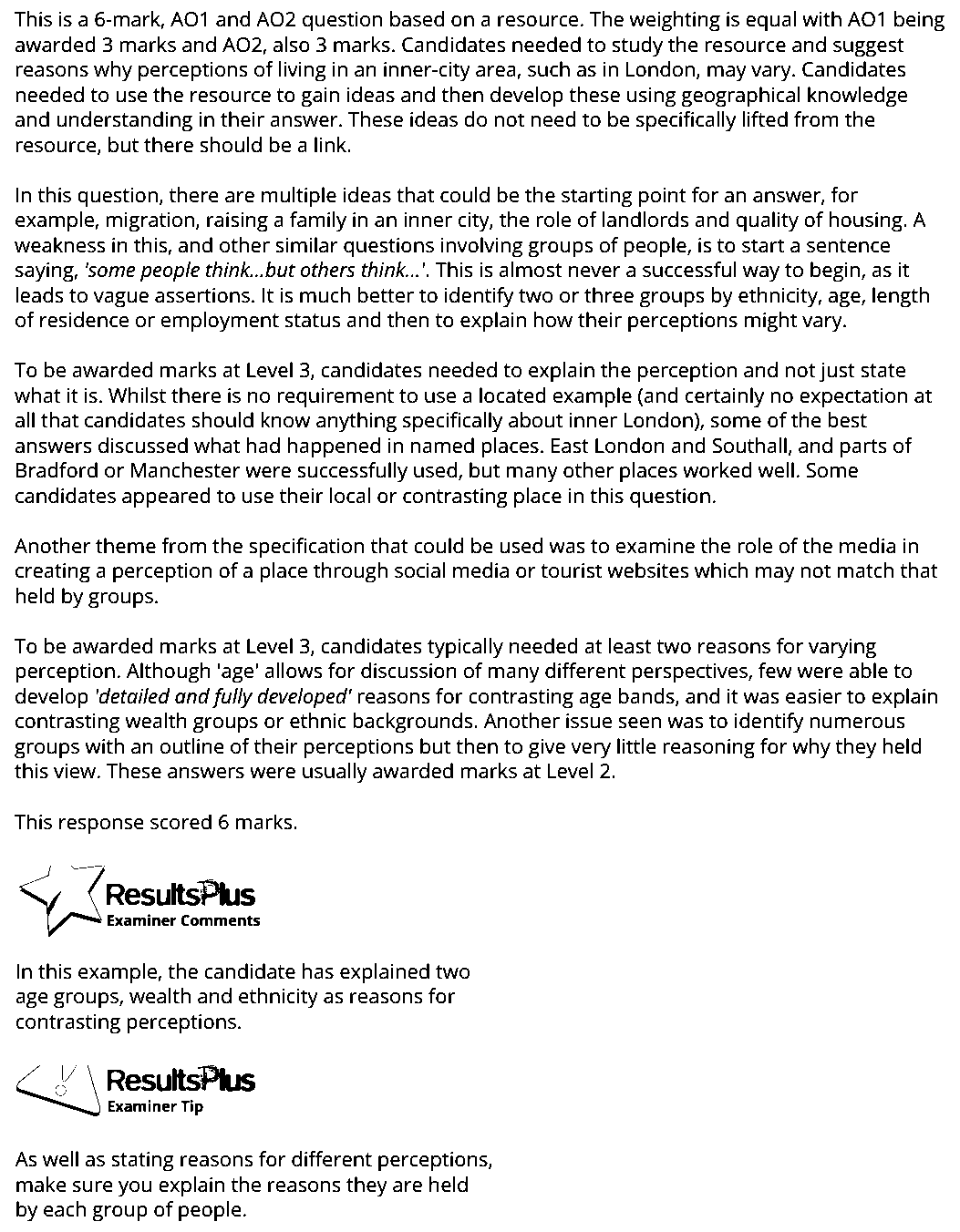
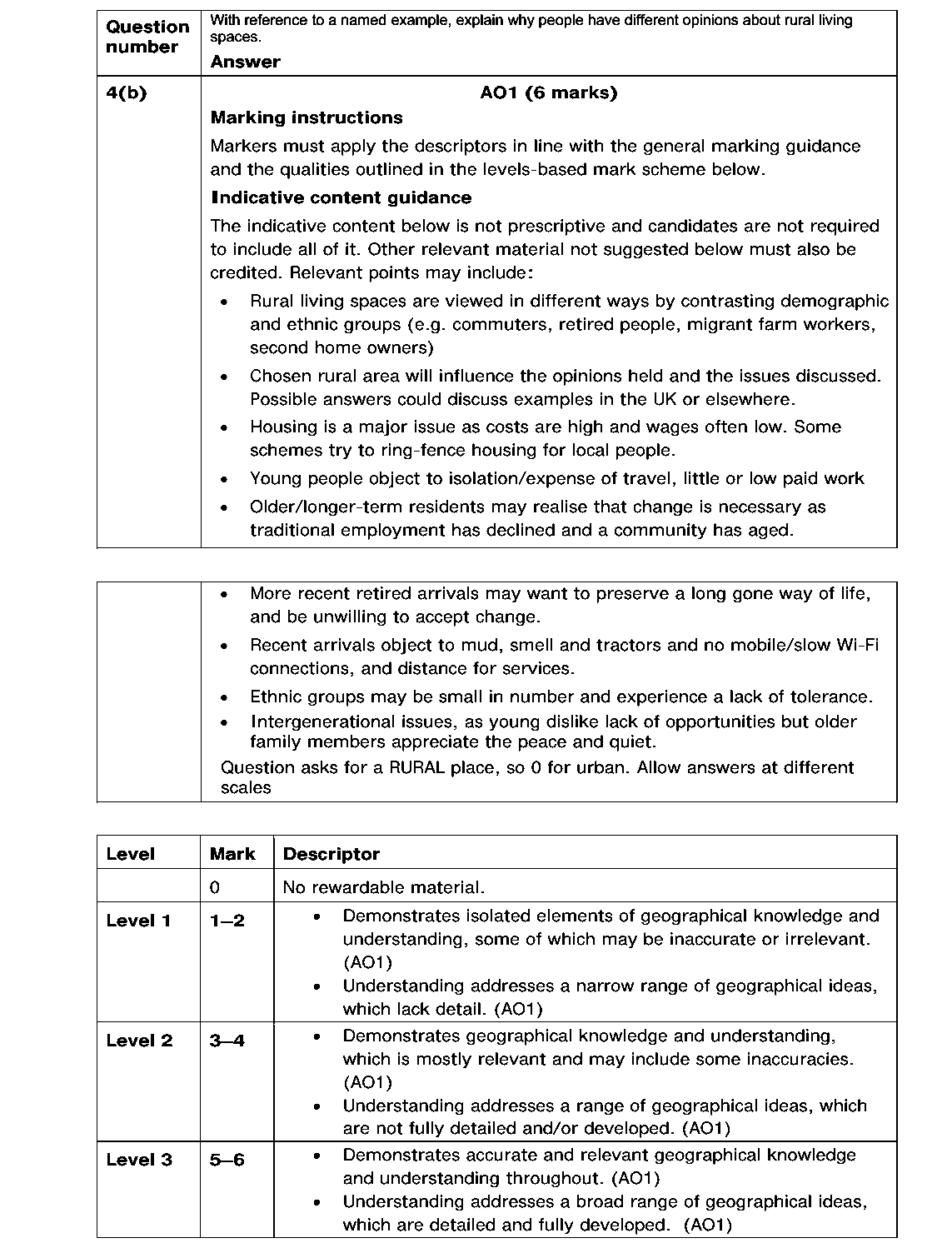
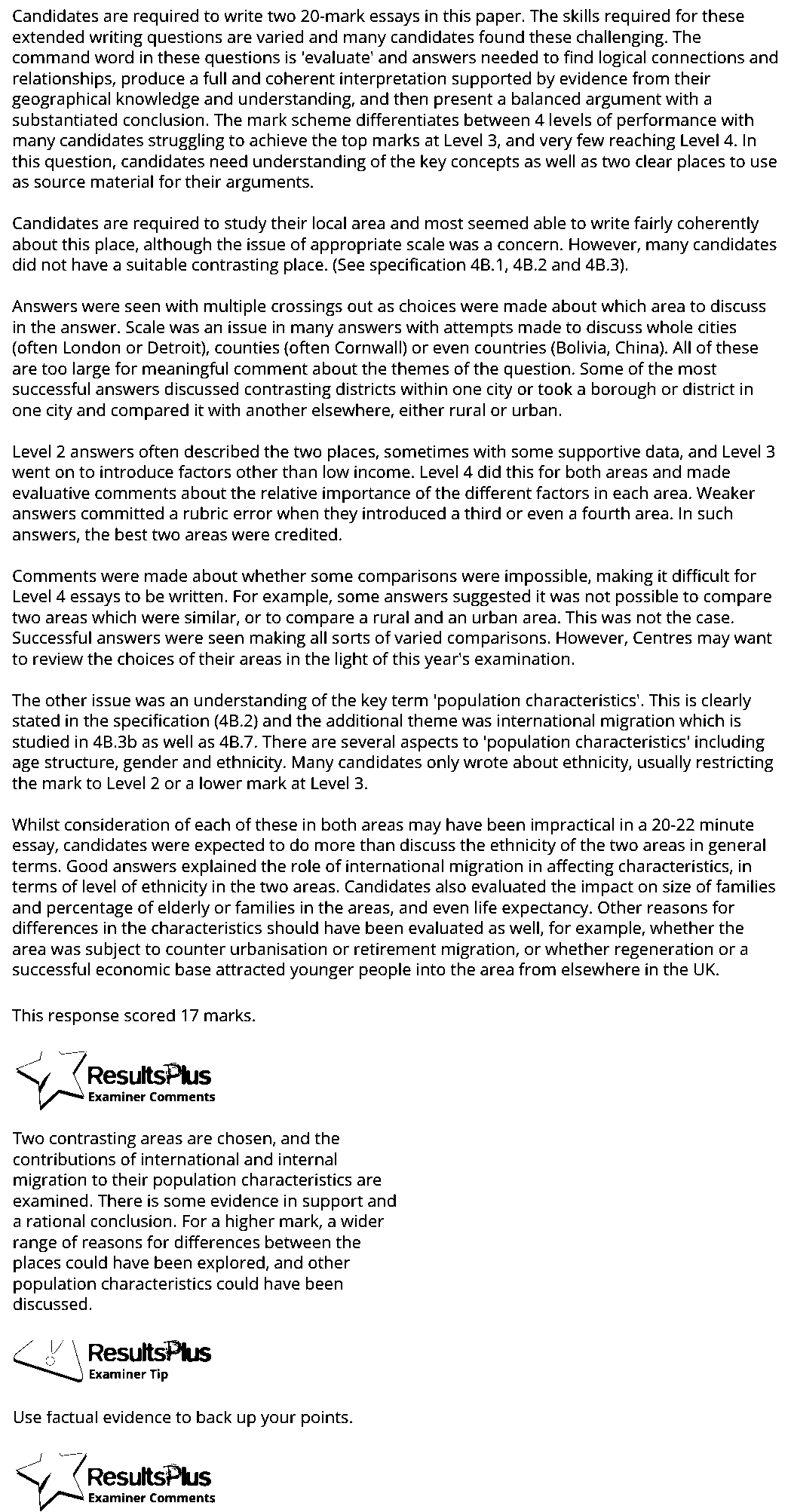
Candidates are required to write two 20-mark essays in this paper. The skills required for these extended writing questions are varied and many candidates found these challenging. The command word in these questions is 'evaluate' and answers needed to find logical connections and relationships, produce a full and coherent interpretation supported by evidence from their geographical knowledge and understanding, and then present a balanced argument with a substantiated conclusion. The mark scheme differentiates between 4 levels of performance with many candidates struggling to achieve the top marks at Level 3, and very few reaching Level 4. Candidates are required to study their local area and most seemed able to write fairly coherently about this place, although the issue of appropriate scale was a concern. However, many candidates did not have a suitable contrasting place. (See specification 4A.1, 4A.2 and 4A.3 and 4B.1, 4B.2 and 4B.3) Answers were seen with multiple crossings out as choices were made about which area to discuss in the answer. Scale was an issue in many answers with attempts made to discuss whole cities (often London or Detroit), counties (often Cornwall) or even countries (Bolivia, China). All of these are too large for meaningful comment about the themes of the question. Some of the most successful answers discussed contrasting districts within one city or took a borough or district in one city and compared it with another elsewhere, either rural or urban. Level 2 answers often described the two places, sometimes with some supportive data, and Level 3 answers went on to introduce factors other than low income. Level 4 answers did this for both areas and made evaluative comments about the relative importance of the different factors in each area. Weaker answers committed a rubric error when they introduced a third or even a fourth area. In such answers, the best two areas were credited. Comments were made about whether some comparisons were impossible, making it difficult for Level 4 essays to be written. For example, some answers suggested it was not possible to compare two areas which were similar, or to compare a rural and an urban area. This was not the case. Successful answers were seen making all sorts of varied comparisons. However, Centres may want to review the choices of their areas in the light of this year's examination. The other issue was an understanding of the key term 'deprivation'. This is clearly stated in the specification (4A.2c), and the additional theme was 'low income' which is studied in the two areas in 4A.1 and 4A.2. Deprivation is a multifaceted concept, meaning the lack of something taken for granted by the wider population, and is helpfully explained and demonstrated in the Index of Multiple Deprivation and the DataShine websites. These show that deprivation is not only income related but also includes the domains of education, employment, health, crime, housing and the quality of the living environment. It also considers impacts on children and the elderly. The specification also adds abandoned and derelict land. Whilst consideration of all these is impractical in a 20-22 minute essay, candidates were expected to do more than discuss 'deprivation' in general terms. Good answers went beyond income as a cause of deprivation and discussed the role of education and government initiatives to regenerate. Candidate also considered how deindustrialisation and change in function had contributed to problems including low income. Areas that have little deprivation apparent may well experience 'Barriers to Housing' as young people cannot afford to stay in the area, and quality of schools can vary considerably within a local area. This response scored 18 marks. The chosen areas appear to be overly large. Sweeping statements about Middlesbrough and Berkshire are made which over-generalise and simplify the complexity of these places. However, the essay is marked on its merits and there is much to be commended. The Berkshire section is largely about Slough and its economic success, but then identifies Lambourn as a place where elderly people experience deprivation. The Middlesbrough section makes some detailed comments explaining the levels of deprivation of different types and the changes experienced. The answer goes on to examine other factors briefly, such as the lack of choice about education for less well-off families and comes to a coherent conclusion. There is some detail to support points made and there is a balance to the answer about the two areas. Make sure you cover all the different elements of the question. In this question you need to mention two areas, deprivation, low income and other factors as well. This response scored 17 marks, contrasting Corby and Bournemouth This is a strong Level 4 answer that lacks precise data but provides a good sense of place for each of the areas chosen. There is description of the types of deprivation experienced in each place, and a range of reasons is suggested for each. There is some apparent wandering off from the question to mention East Anglia and Manchester as well, but these are in the context of the chosen areas and used as contrasts, which is acceptable. The conclusion is rational in the context of the answer but does not differentiate between the two areas. Learn the facts about your two areas and practise planning answers to different questions about both of your places.
![Examiner's report extract for June 2018 Paper 2 question 3(c)]()