November 2020: A-level Paper 2, Human geography

120 marks · 23 question parts (every option is included) · Paper, mark scheme and report on AQA's site · Printed for the cancelled summer 2020 exams
Question by question

QTopicMarksAOType
1.1 International trade and access to markets 4mark schemePoint-marked
1.2 Globalisation and global systems 6mark schemeData analysis
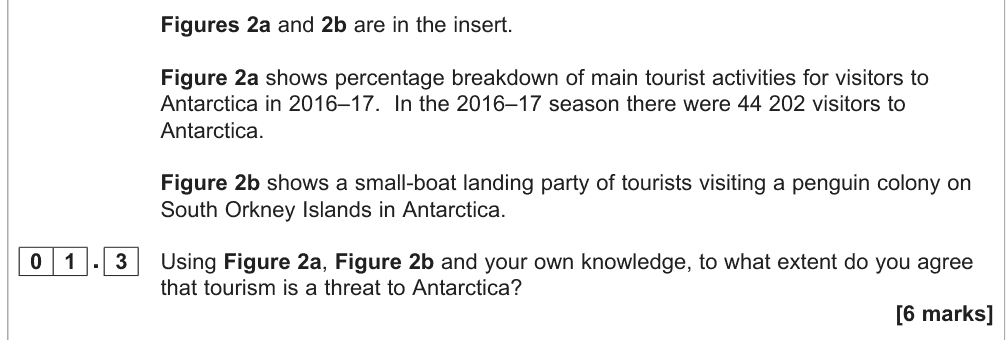
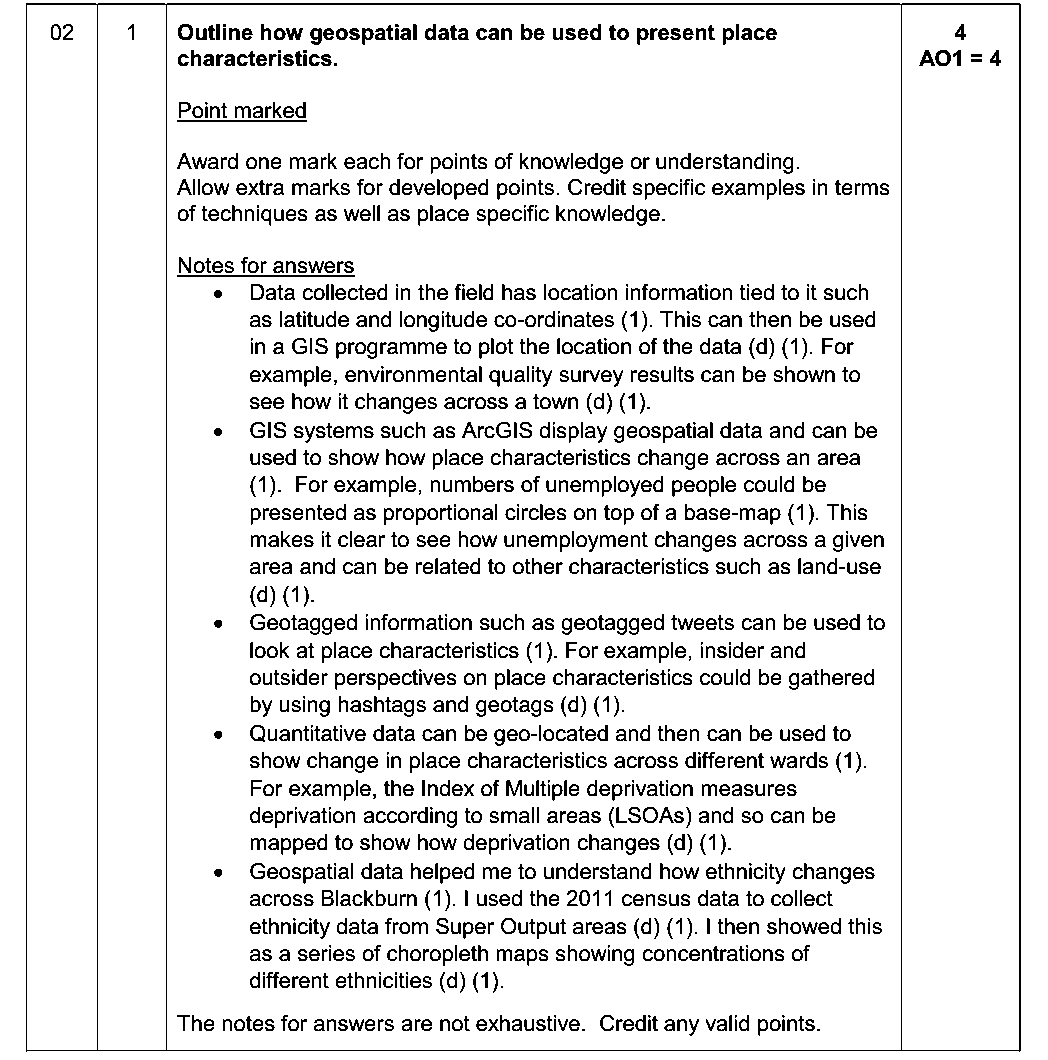
1.3 The global commons: Antarctica 6mark schemeStimulus
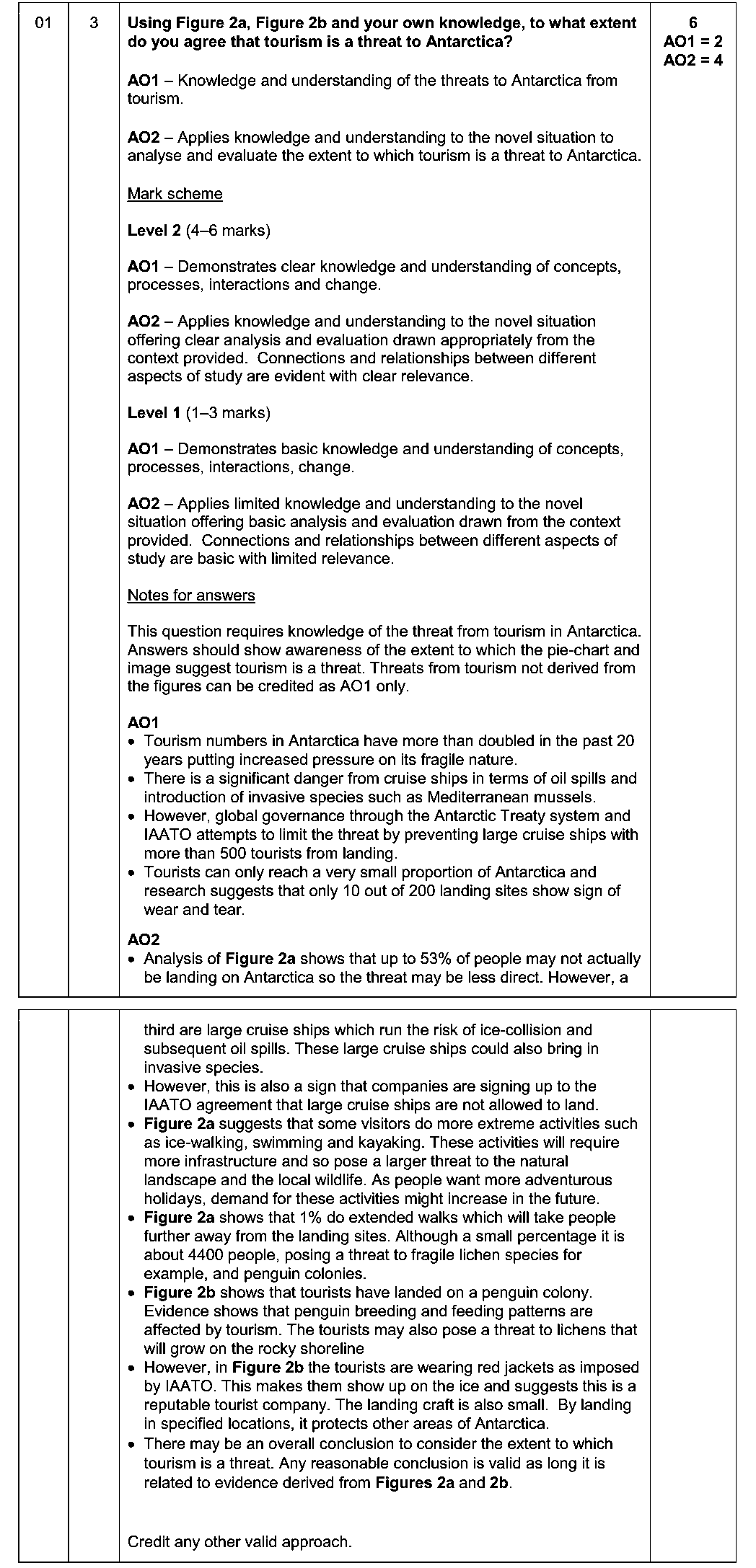
1.4 Global governance, International trade and access to markets 20mark schemeEssay
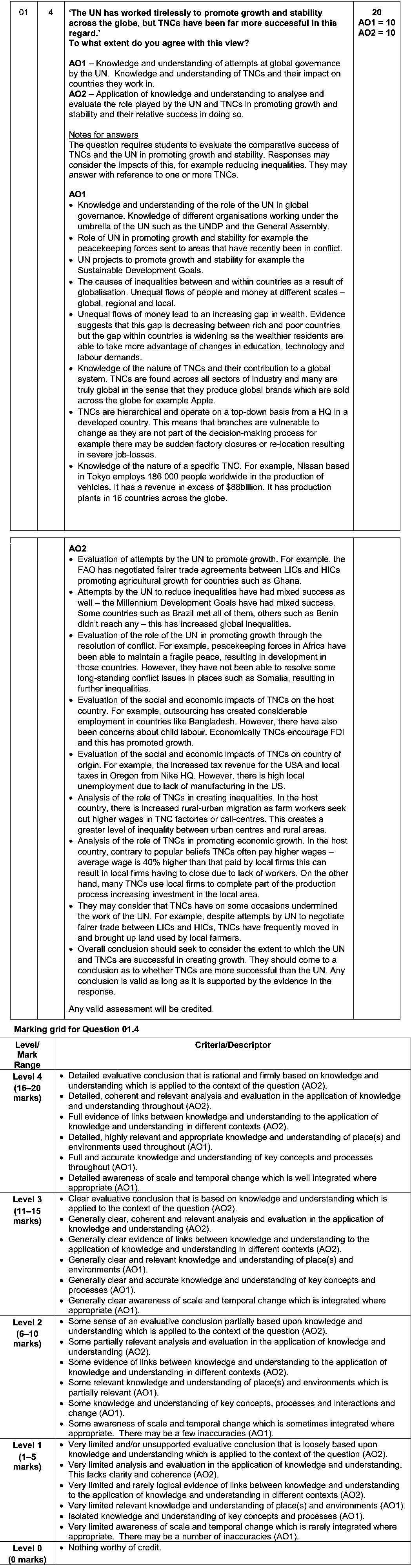
2.1 Place studies and changing places skills 4mark schemePoint-marked
2.2 Places: meaning and representation, The nature and importance of places 6mark schemeData analysis
2.3 Places: meaning and representation 6mark schemeStimulus
2.4 Place studies and changing places skills, Places: relationships and connections, Globalisation and global systems 20mark schemeSynoptic
3.1 Urban climate, Urban waste and other environmental issues 4mark schemePoint-marked
3.2 Urban forms and social and economic issues 6mark schemeData analysis
3.3 Urban forms and social and economic issues 9mark schemeStimulus
3.4 Urbanisation 9mark schemeEssay
3.5 Urban drainage, Sustainable urban development 20mark schemeEssay
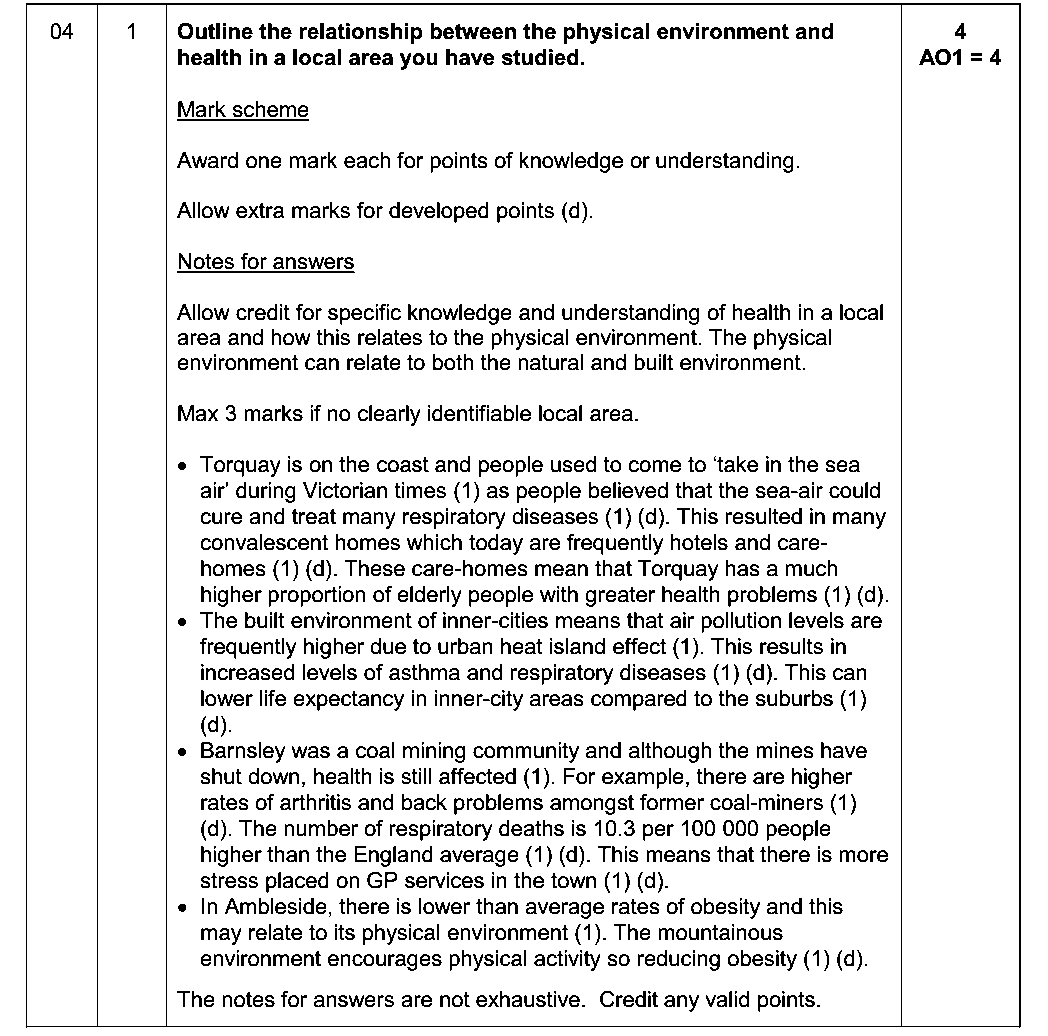
4.1 Population change and population futures, Environment, health and well-being 4mark schemePoint-marked
4.2 Environment, health and well-being 6mark schemeData analysis
4.3 Population change and population futures 9mark schemeStimulus
4.4 Environment and population 9mark schemeEssay
4.5 Environment, health and well-being 20mark schemeEssay
5.1 Resource development and natural resource issues 4mark schemePoint-marked
5.2 Mineral security 6mark schemeData analysis
5.3 Resource development and natural resource issues, Energy security 9mark schemeStimulus
5.4 Water security 9mark schemeEssay
5.5 Mineral security, Water security 20mark schemeEssay

The questions

1.11.21.31.42.12.22.32.43.13.23.33.43.54.14.24.34.44.55.15.25.35.45.5
November 2020 · Paper 2 · Q1.1 4 marks mark scheme Point-marked international trade
Explain how differential access to markets can impact on economic well-being.
[4 marks]
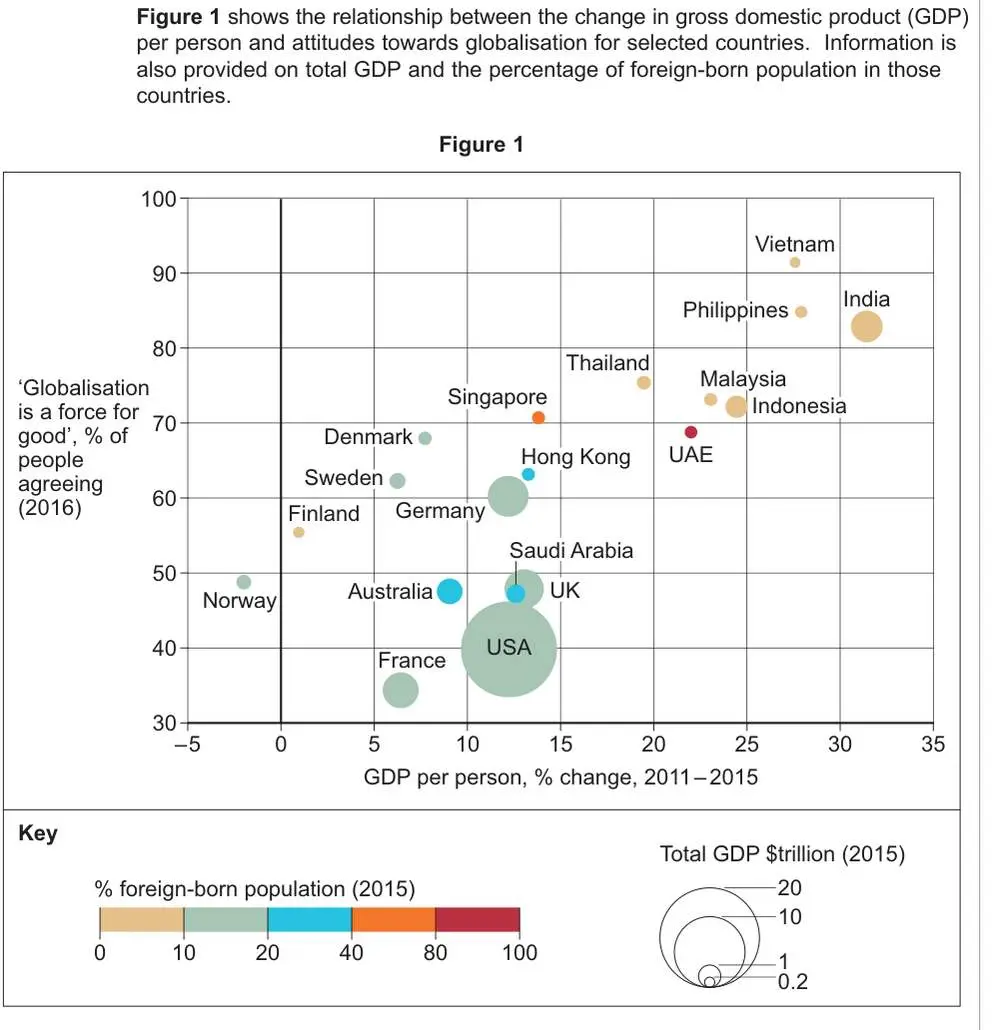
Figure 1 shows the relationship between the change in gross domestic product (GDP)
per person and attitudes towards globalisation for selected countries.  Information is
also provided on total GDP and the percentage of foreign-born population in those
countries.
Figure 1
100
Vietnam
90
Philippines
India
80
Thailand
‘Globalisation
Malaysia
Singapore
Indonesia
is a force for
70
good’, % of
Denmark
people
Hong Kong
UAE
agreeing
Sweden
(2016)
60
Germany
Finland
Saudi Arabia
50
Norway
Australia
UK
40
USA
France
30
– 5
0
5
10
15
20
25
30
35
GDP per person, % change, 2011 – 2015
November 2020 · Paper 2 · Q1.2 6 marks mark scheme Data analysis globalisation
Figure 1Figure 1, November 2020 Paper 2
Key
Total GDP $trillion (2015)
% foreign-born population (2015)
20
10
0
10
20
40
80
100
1
0.2
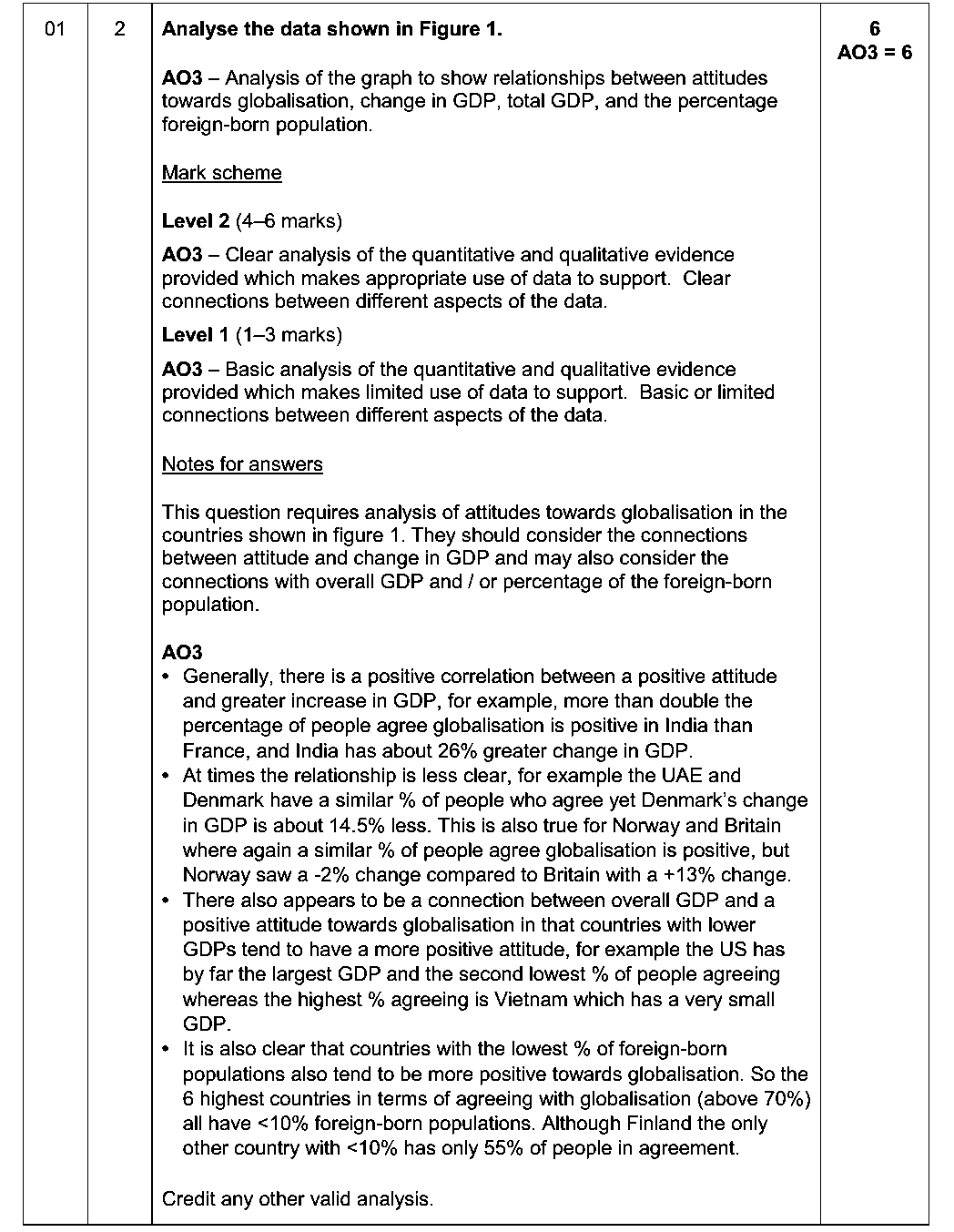
Analyse the data shown in Figure 1.
[6 marks]
November 2020 · Paper 2 · Q1.3 6 marks mark scheme Stimulus antarctica
Figures 2a, 2bFigure 2a, November 2020 Paper 2Figure 2b, November 2020 Paper 2
Figures 2a and 2b are in the insert.
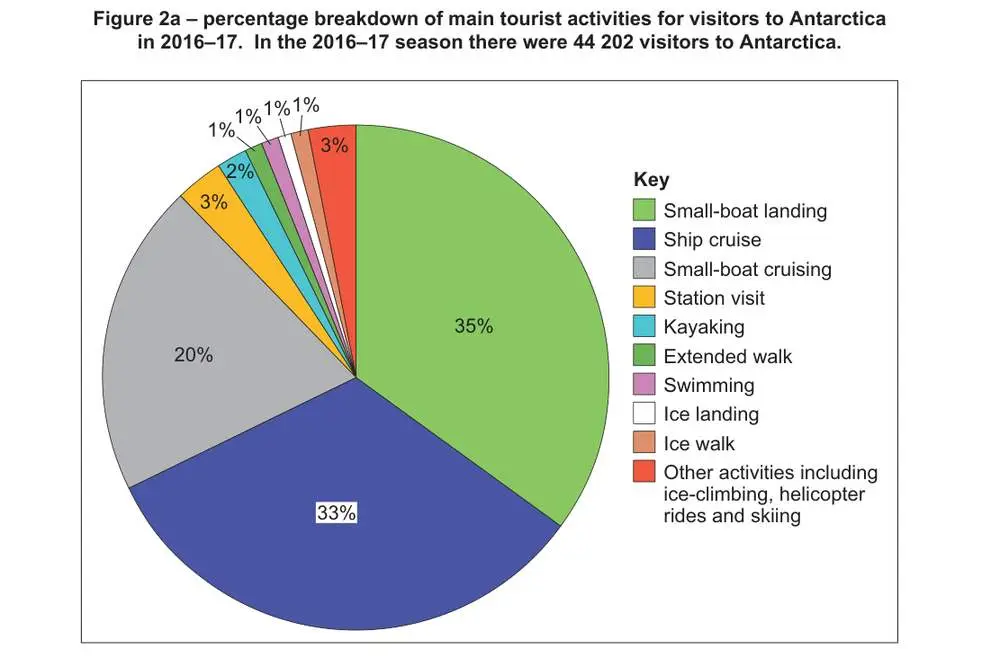
Figure 2a shows percentage breakdown of main tourist activities for visitors to
Antarctica in 2016–17.  In the 2016–17 season there were 44 202 visitors to
Antarctica.
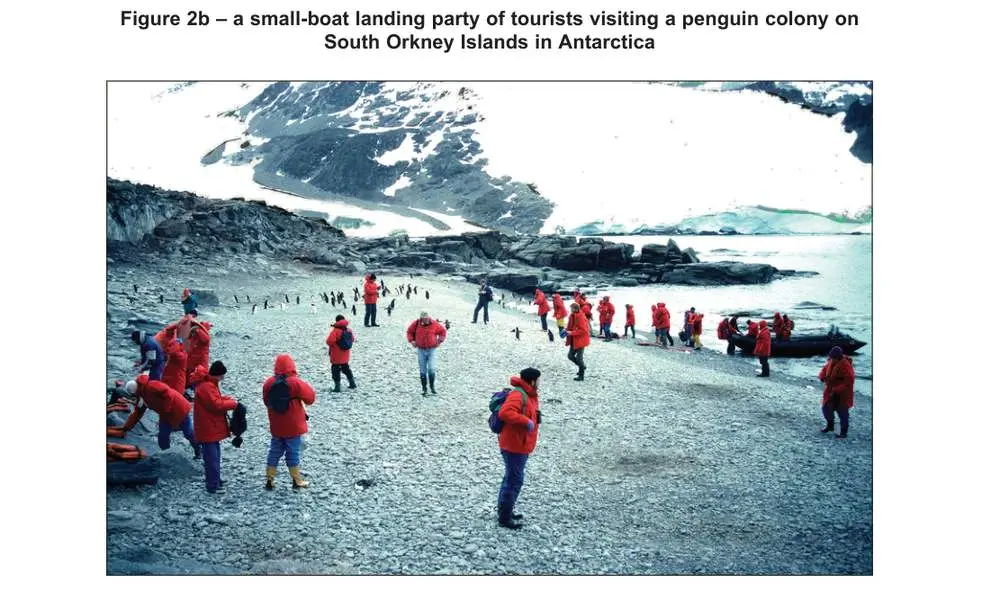
Figure 2b shows a small-boat landing party of tourists visiting a penguin colony on
South Orkney Islands in Antarctica.
Using Figure 2a, Figure 2b and your own knowledge, to what extent do you agree
that tourism is a threat to Antarctica?
[6 marks]
November 2020 · Paper 2 · Q1.4 20 marks mark scheme 20-mark essay global governanceinternational trade
‘The UN has worked tirelessly to promote growth and stability across the globe, but
TNCs have been far more successful in this regard.’
To what extent do you agree with this view?
[20 marks]
November 2020 · Paper 2 · Q2.1 4 marks mark scheme Point-marked place studies
Outline how geospatial data can be used to present place characteristics.
[4 marks]
November 2020 · Paper 2 · Q2.2 6 marks mark scheme Data analysis meaning representationnature of places
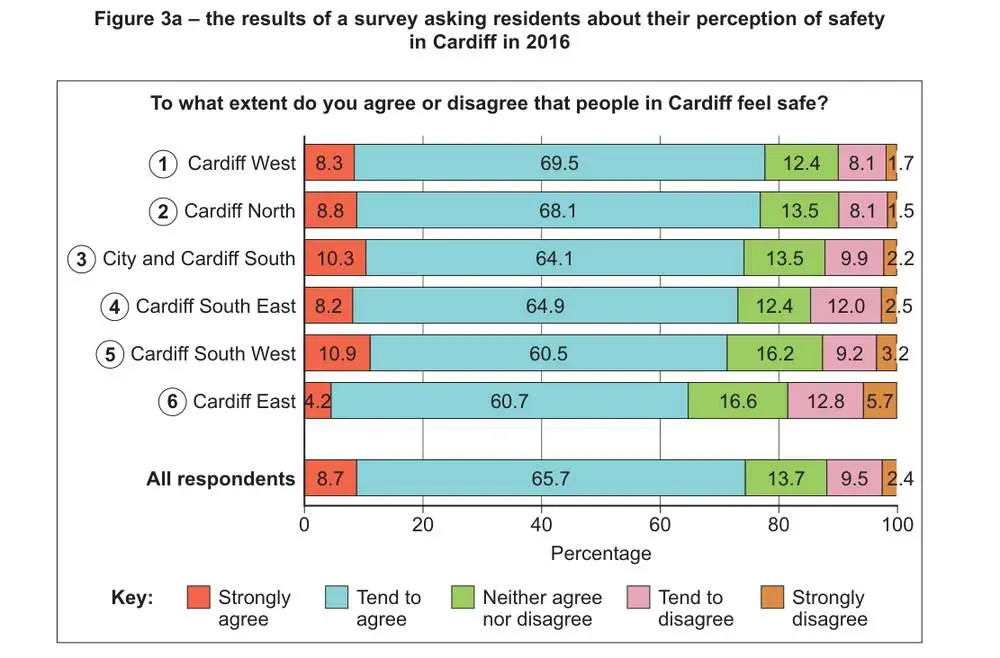
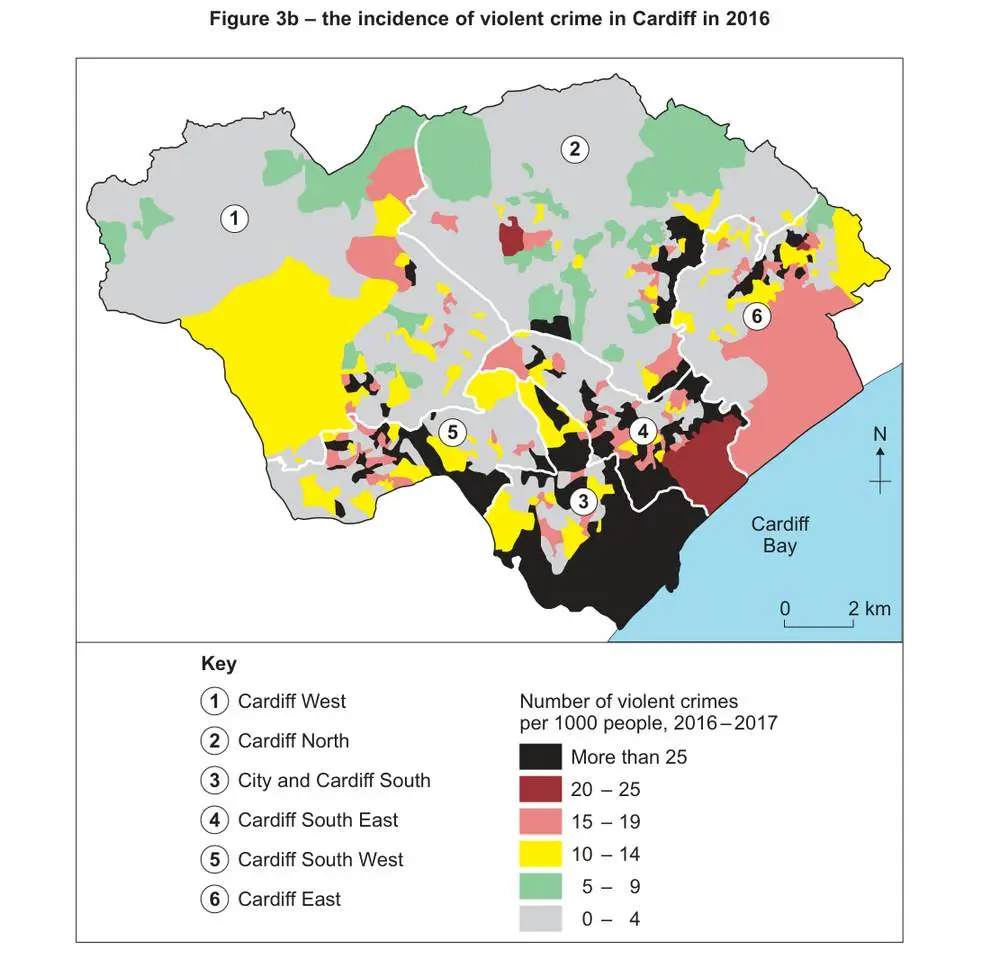
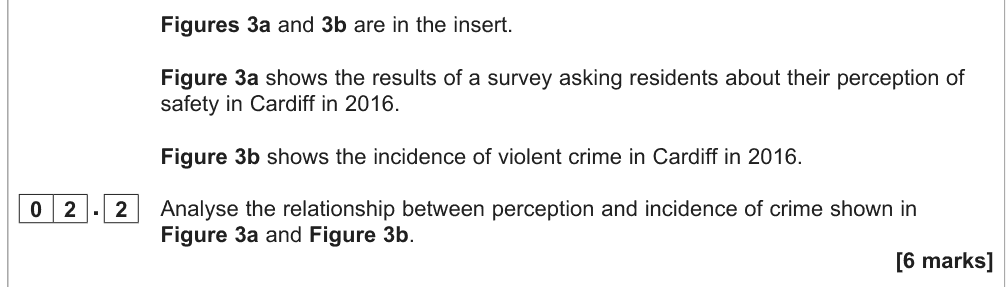
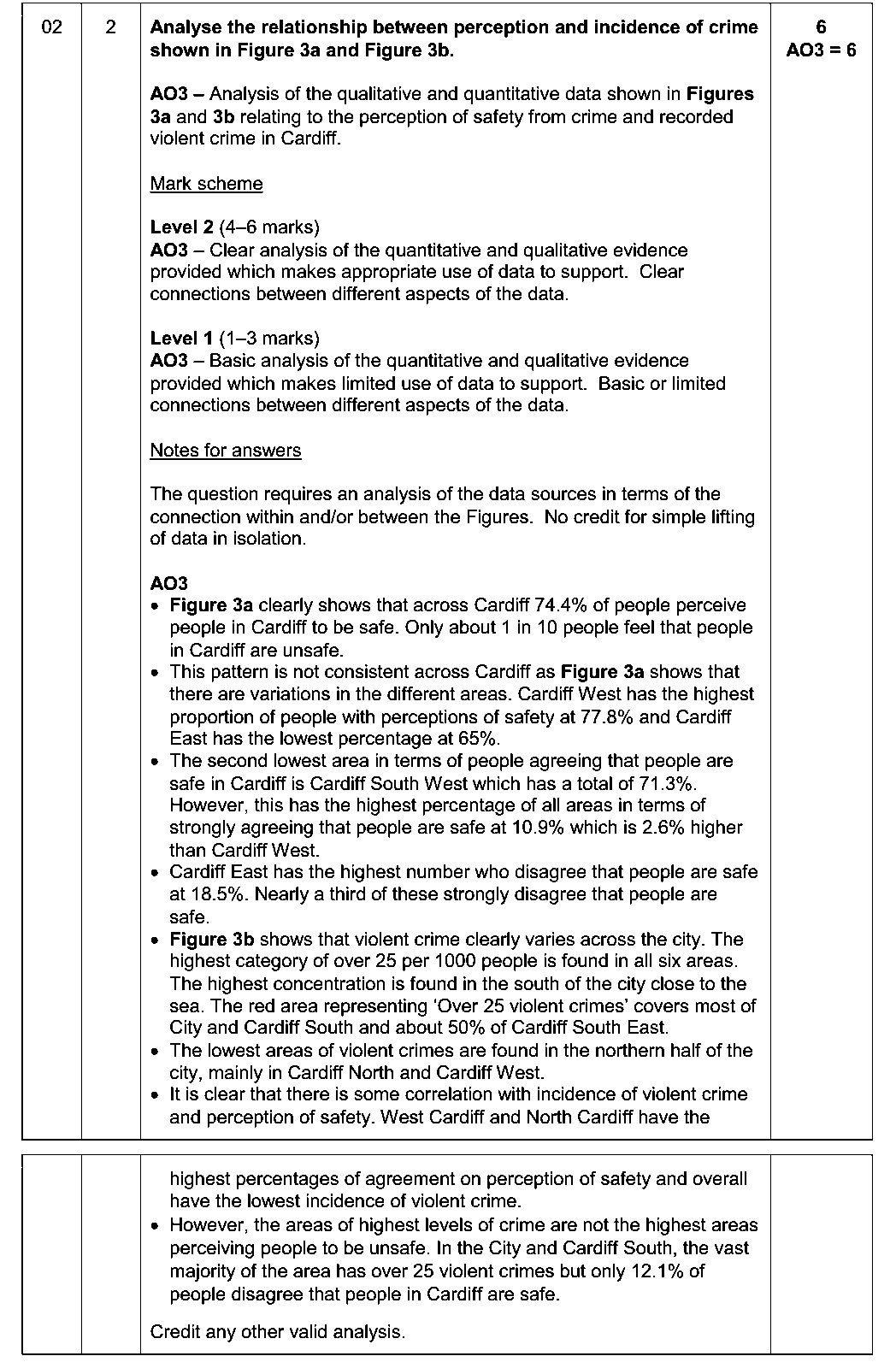
Figures 3a, 3bFigure 3a, November 2020 Paper 2Figure 3b, November 2020 Paper 2
Figures 3a and 3b are in the insert.
Figure 3a shows the results of a survey asking residents about their perception of
safety in Cardiff in 2016.
Figure 3b shows the incidence of violent crime in Cardiff in 2016.
Analyse the relationship between perception and incidence of crime shown in
Figure 3a and Figure 3b.
[6 marks]
November 2020 · Paper 2 · Q2.3 6 marks mark scheme Stimulus meaning representation
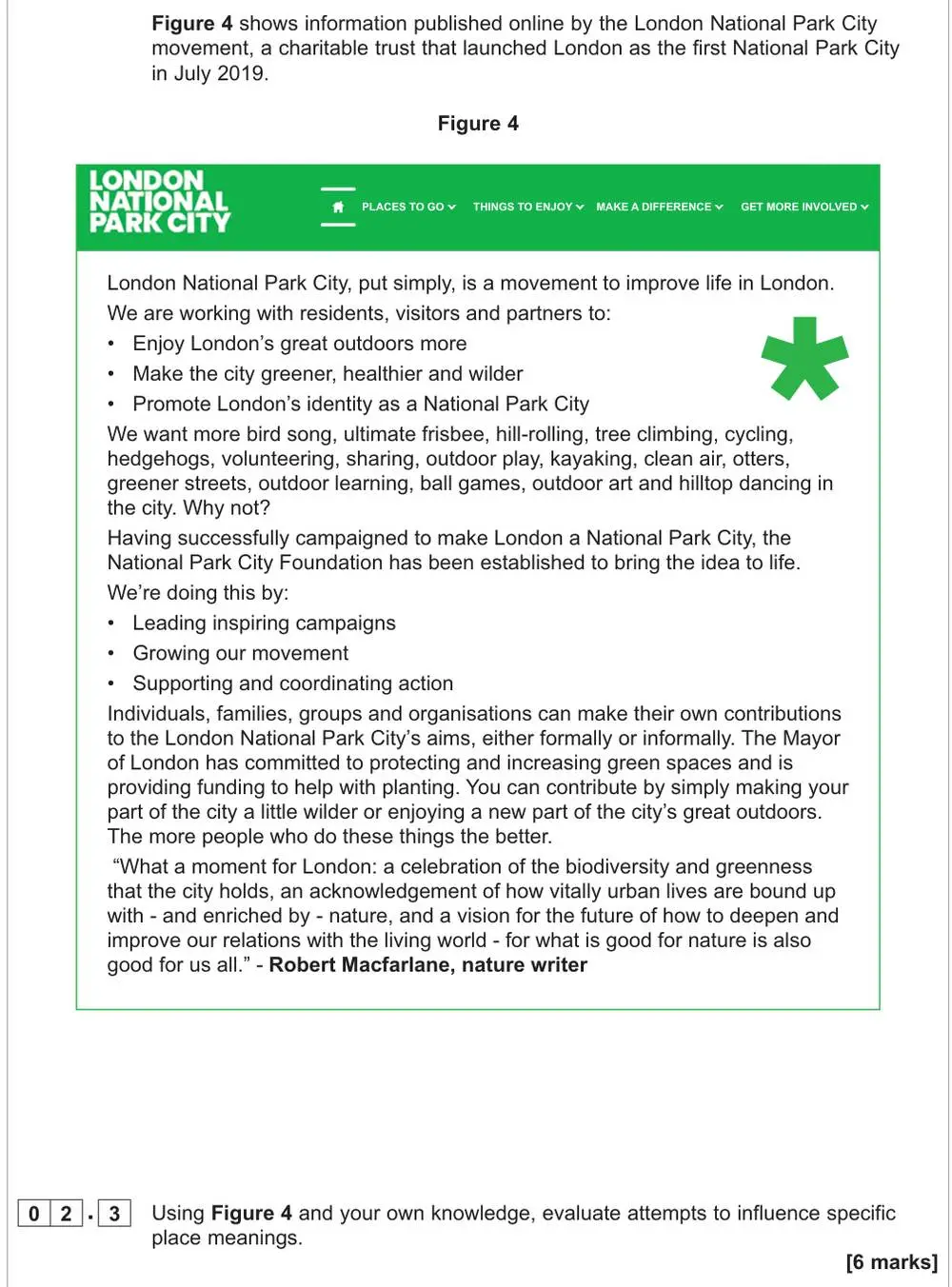
Figure 4 shows information published online by the London National Park City
movement, a charitable trust that launched London as the first National Park City
in July 2019.
Figure 4
PLACES TO GO
THINGS TO ENJOY
MAKE A DIFFERENCE
GET MORE INVOLVED
London National Park City, put simply, is a movement to improve life in London.
We are working with residents, visitors and partners to:
• Enjoy London’s great outdoors more
• Make the city greener, healthier and wilder
• Promote London’s identity as a National Park City
We want more bird song, ultimate frisbee, hill-rolling, tree climbing, cycling,
hedgehogs, volunteering, sharing, outdoor play, kayaking, clean air, otters,
greener streets, outdoor learning, ball games, outdoor art and hilltop dancing in
the city. Why not?
Having successfully campaigned to make London a National Park City, the
National Park City Foundation has been established to bring the idea to life.
We’re doing this by:
• Leading inspiring campaigns
• Growing our movement
• Supporting and coordinating action
Individuals, families, groups and organisations can make their own contributions
to the London National Park City’s aims, either formally or informally. The Mayor
of London has committed to protecting and increasing green spaces and is
providing funding to help with planting. You can contribute by simply making your
part of the city a little wilder or enjoying a new part of the city’s great outdoors.
The more people who do these things the better.
“What a moment for London: a celebration of the biodiversity and greenness
that the city holds, an acknowledgement of how vitally urban lives are bound up
with - and enriched by - nature, and a vision for the future of how to deepen and
improve our relations with the living world - for what is good for nature is also
good for us all.” - Robert Macfarlane, nature writer
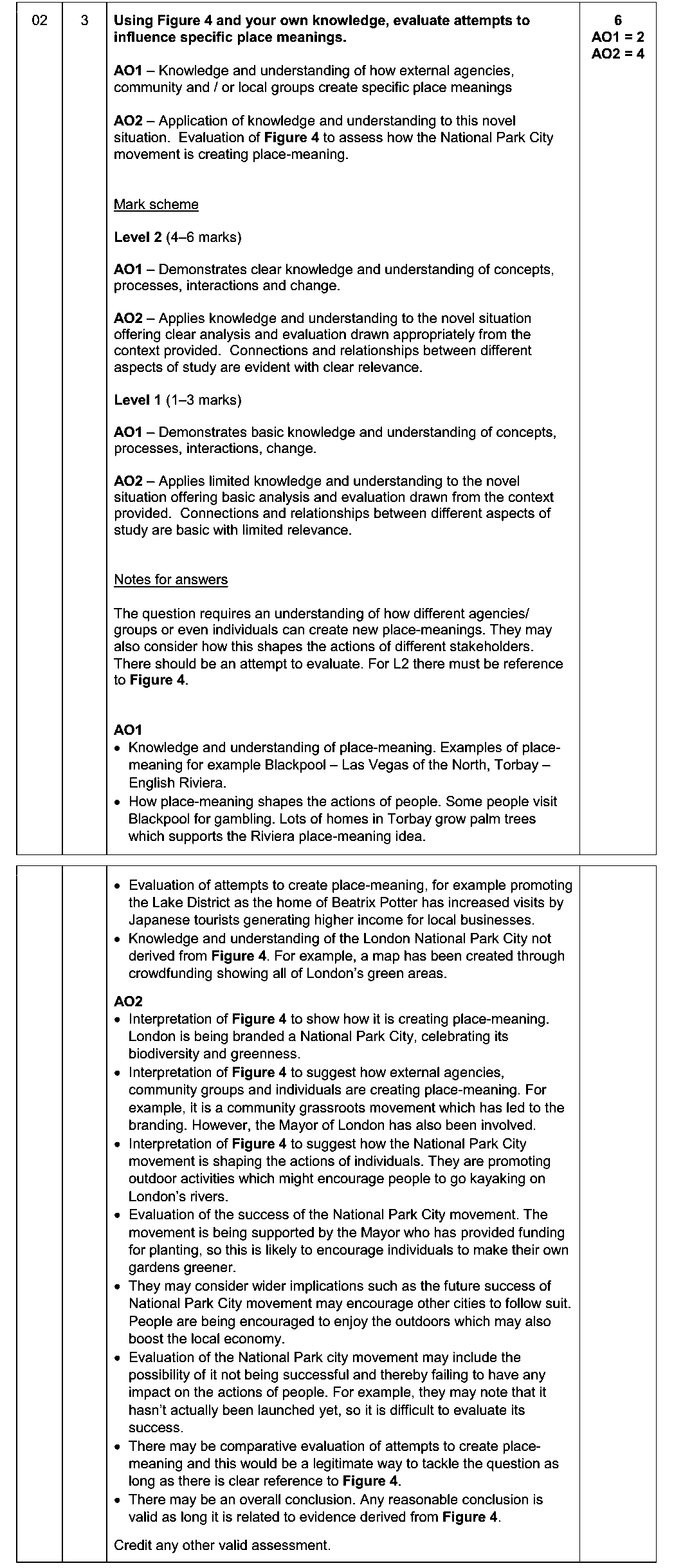
Using Figure 4 and your own knowledge, evaluate attempts to influence specific
place meanings.
[6 marks]
November 2020 · Paper 2 · Q2.4 20 marks mark scheme Synoptic place studiesrelationships connectionsglobalisation
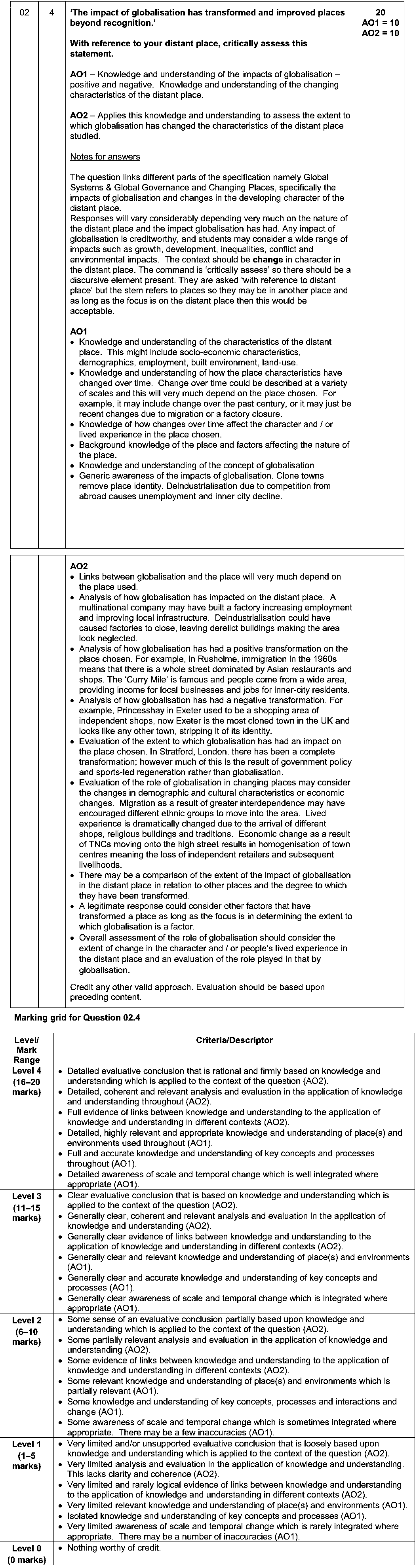
‘The impact of globalisation has transformed and improved places beyond
recognition.’
With reference to your distant place, critically assess this statement.
[20 marks]
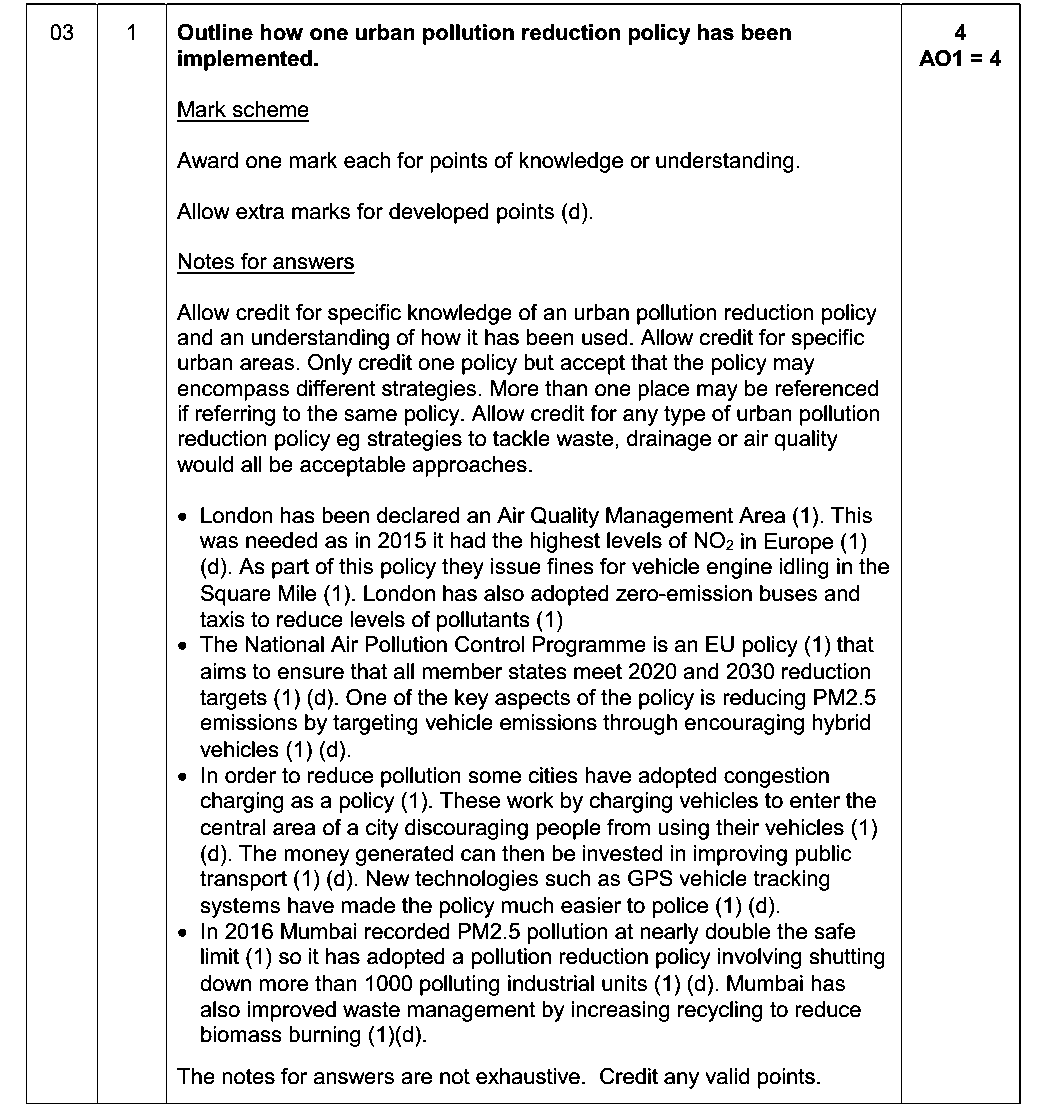
November 2020 · Paper 2 · Q3.1 4 marks mark scheme Point-marked urban climateurban waste
Outline how one urban pollution reduction policy has been implemented.
[4 marks]
November 2020 · Paper 2 · Q3.2 6 marks mark scheme Data analysis urban forms
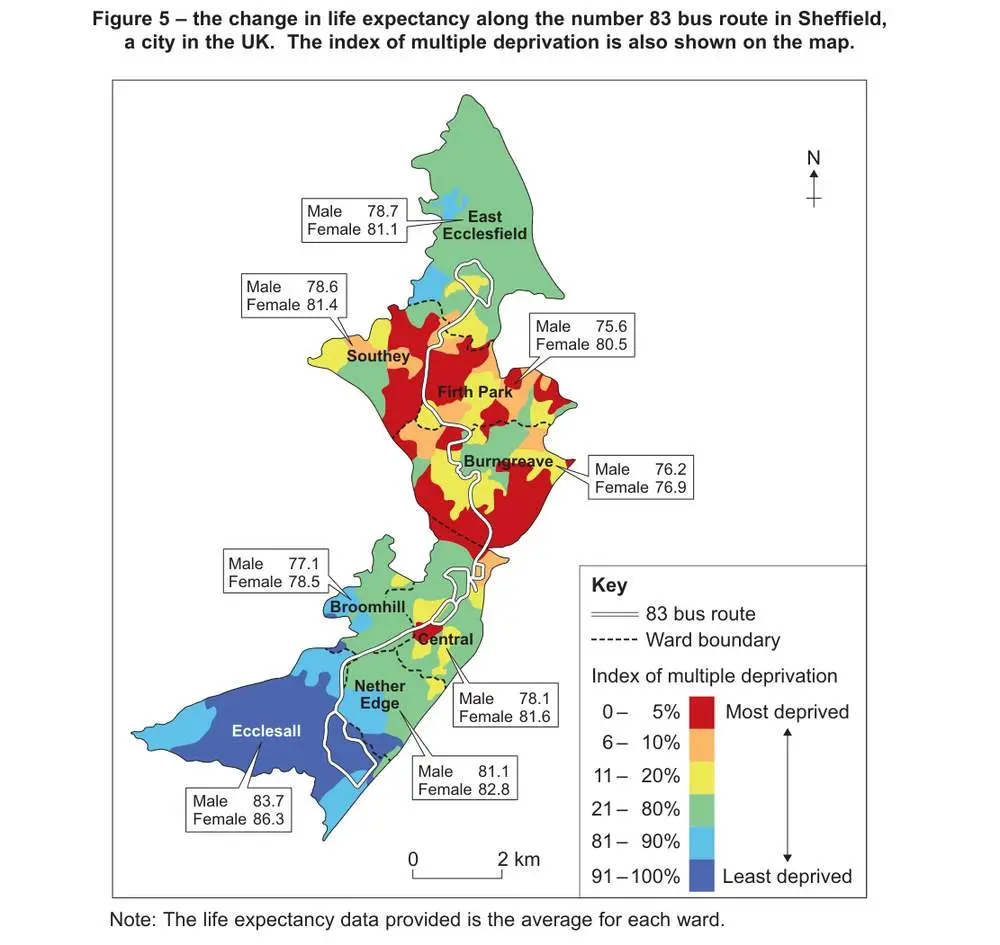
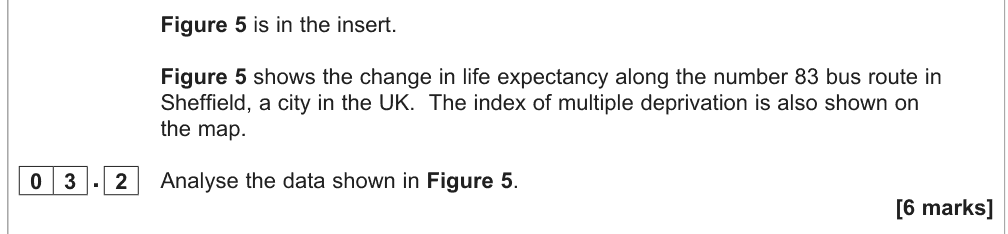
Figure 5Figure 5, November 2020 Paper 2
Figure 5 is in the insert.
Figure 5 shows the change in life expectancy along the number 83 bus route in
Sheffield, a city in the UK.  The index of multiple deprivation is also shown on
the map.
Analyse the data shown in Figure 5.
[6 marks]
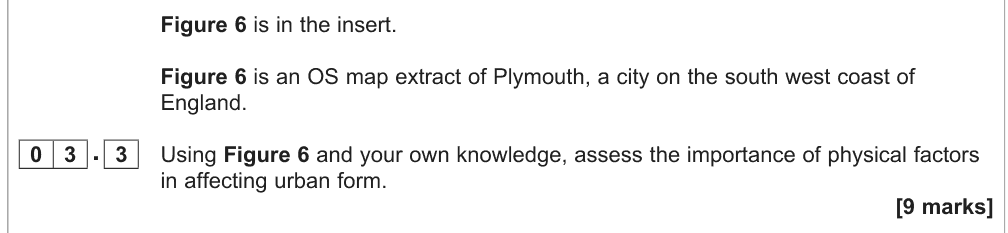
November 2020 · Paper 2 · Q3.3 9 marks mark scheme Stimulus urban forms
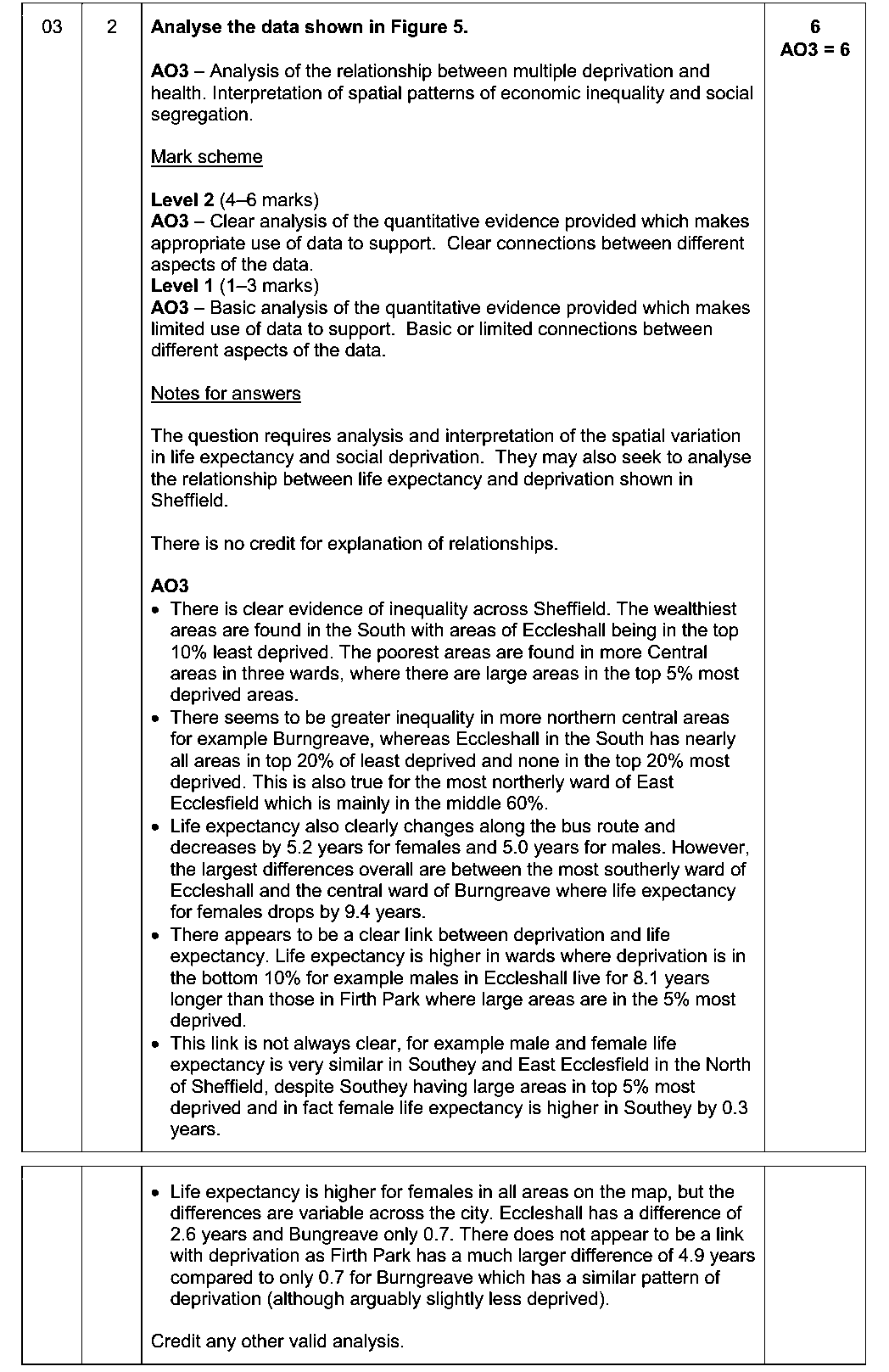
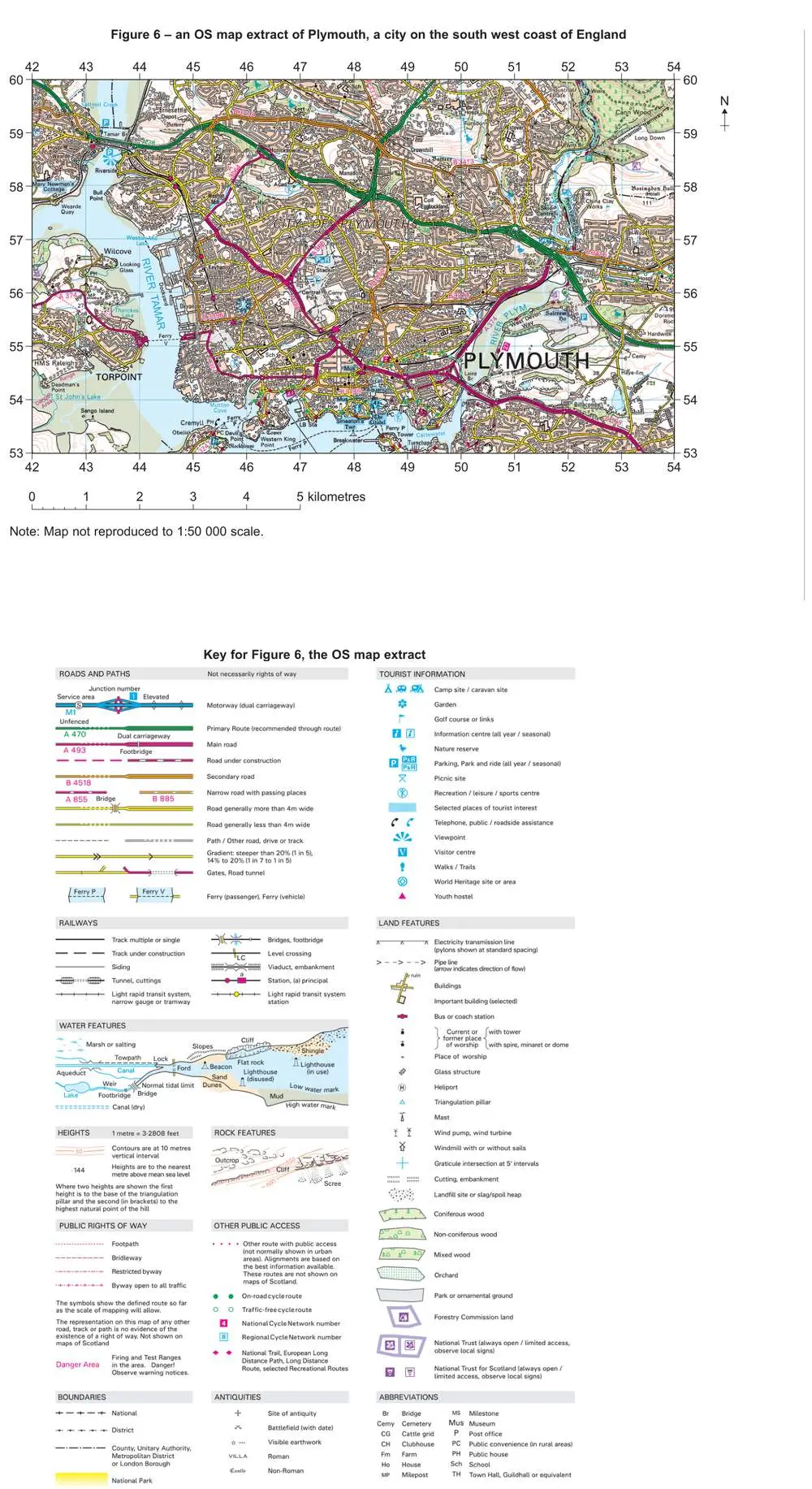
Figure 6Figure 6, November 2020 Paper 2

A figure for this question was removed from AQA's published paper for copyright reasons.

Figure 6 is in the insert.
Figure 6 is an OS map extract of Plymouth, a city on the south west coast of
England.
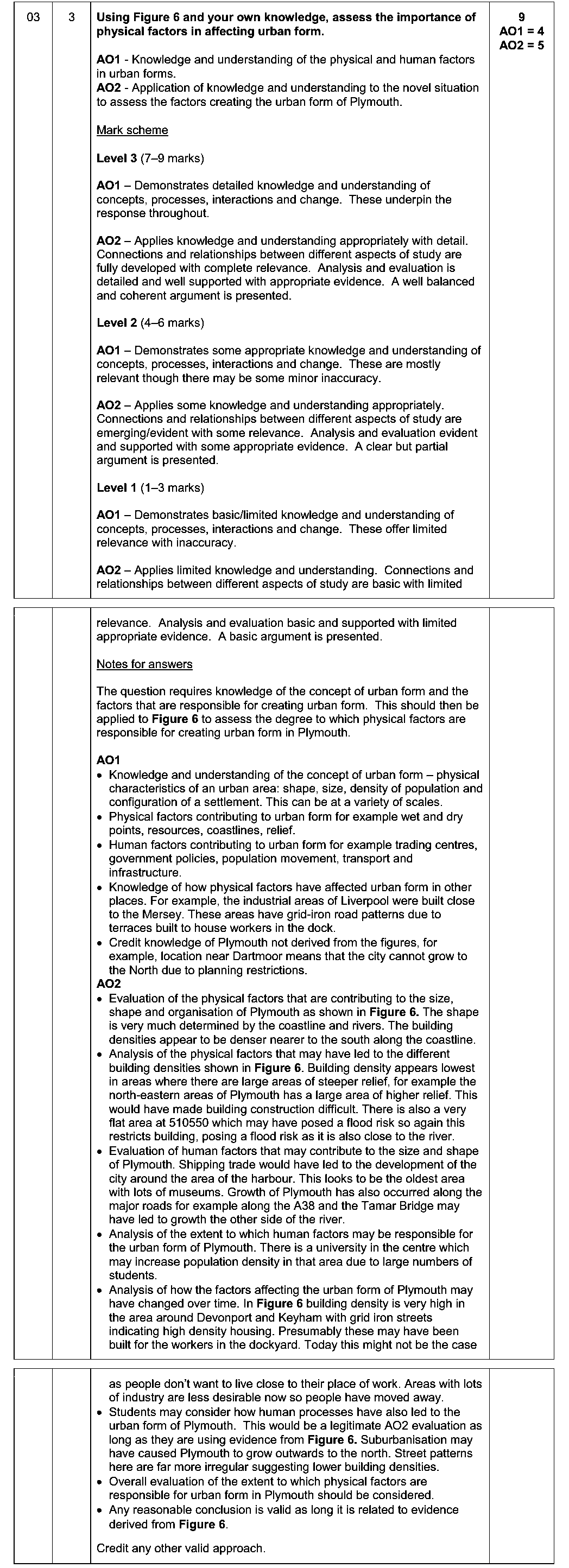
Using Figure 6 and your own knowledge, assess the importance of physical factors
in affecting urban form.
[9 marks]
November 2020 · Paper 2 · Q3.4 9 marks mark scheme 9-mark essay urbanisation
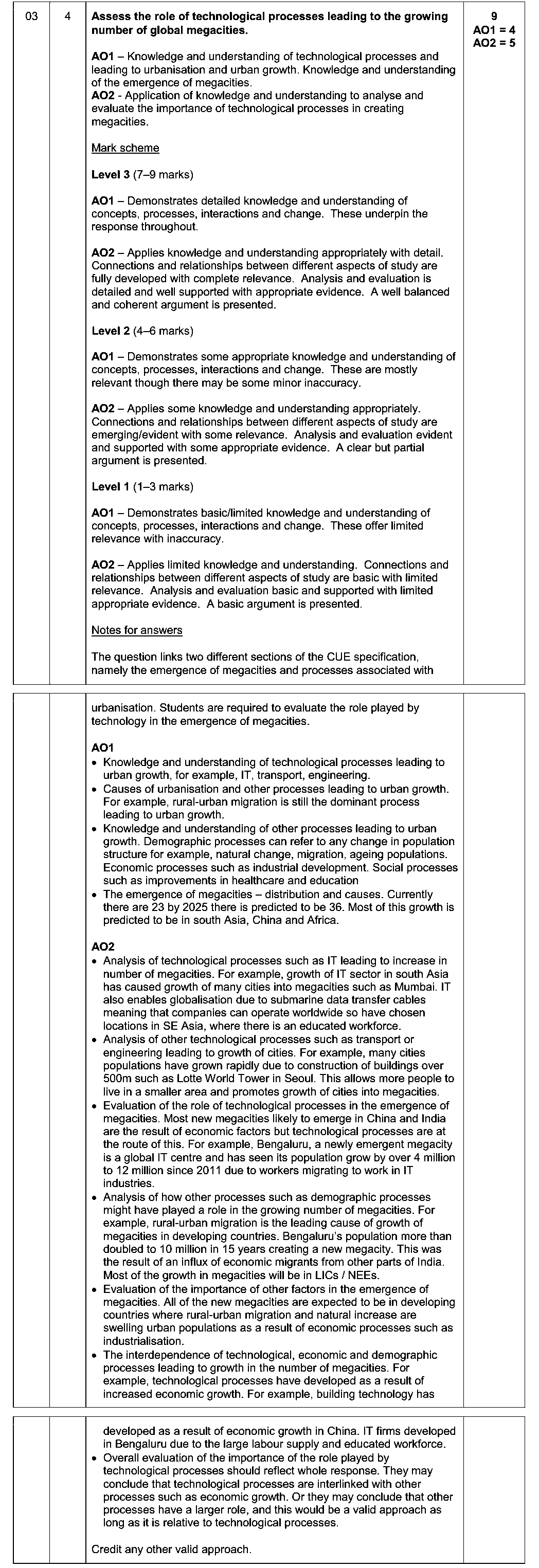
Assess the role of technological processes leading to the growing number of global
megacities.
[9 marks]
November 2020 · Paper 2 · Q3.5 20 marks mark scheme 20-mark essay urban drainagesustainable cities
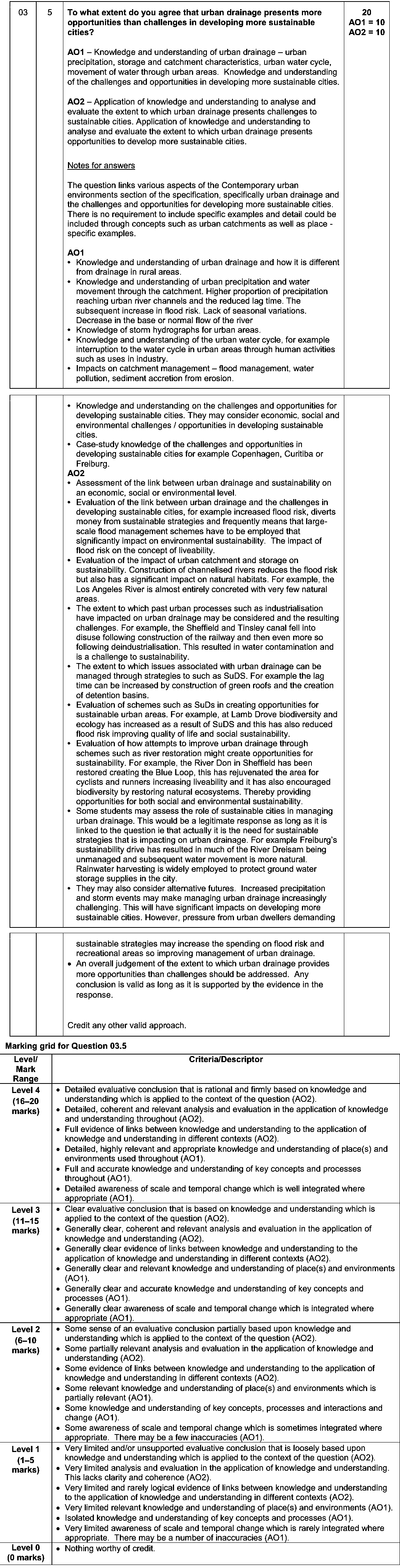
To what extent do you agree that urban drainage presents more opportunities than
challenges in developing more sustainable cities?
[20 marks]
November 2020 · Paper 2 · Q4.1 4 marks mark scheme Point-marked population changehealth wellbeing
Outline the relationship between the physical environment and health in a local area
you have studied.
[4 marks]
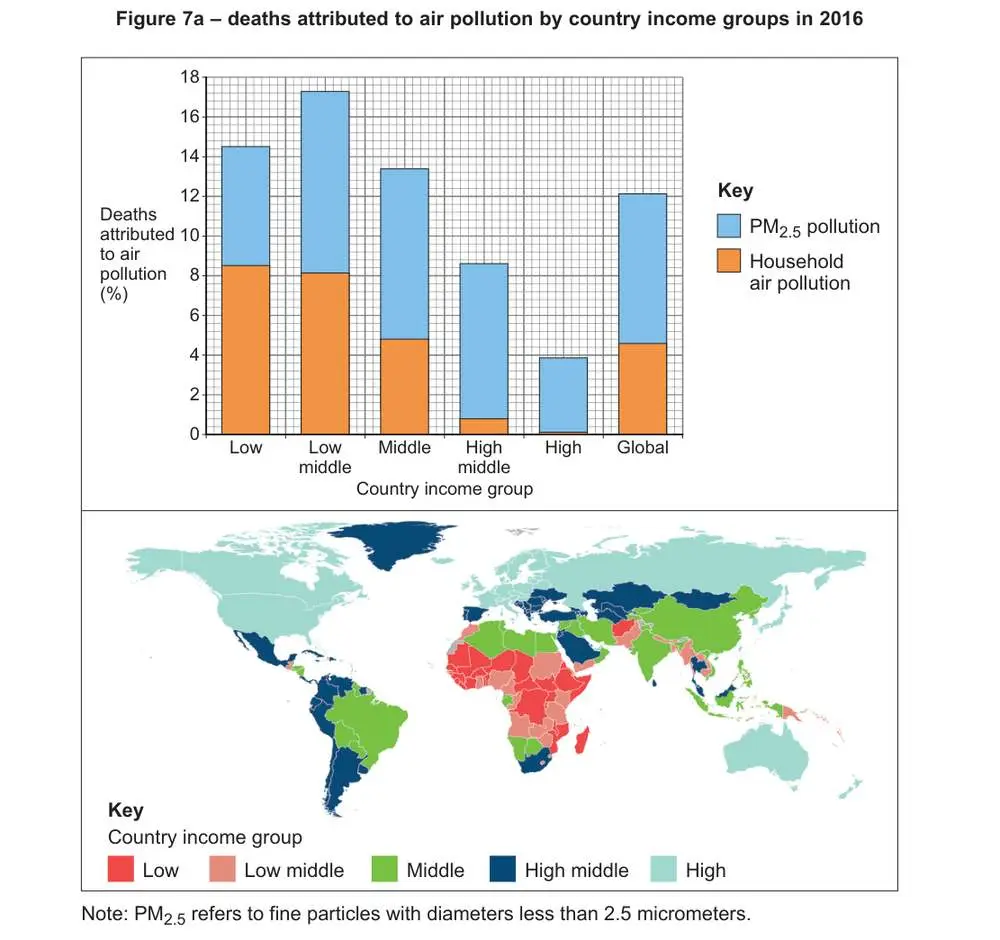
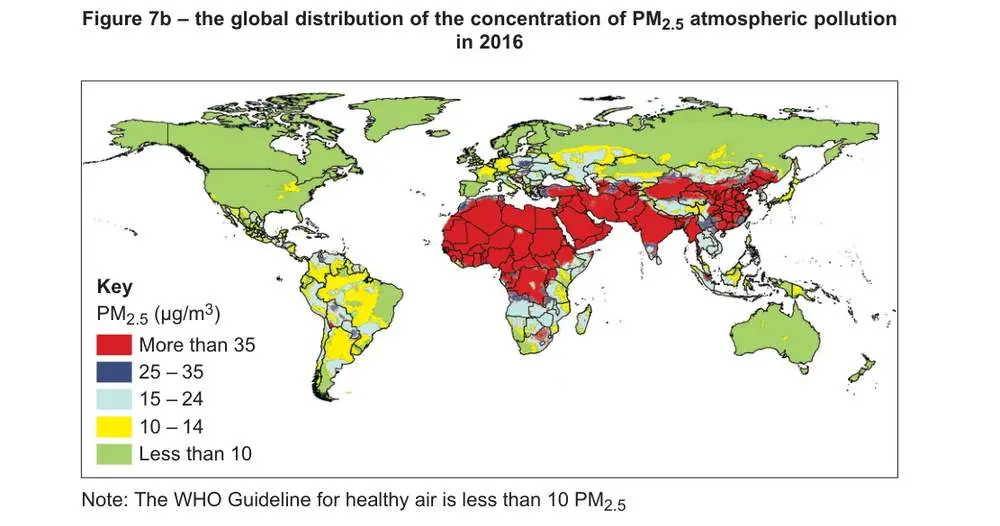
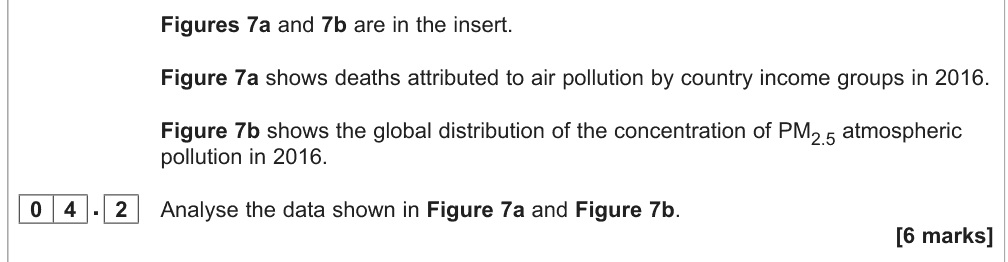
November 2020 · Paper 2 · Q4.2 6 marks mark scheme Data analysis health wellbeing
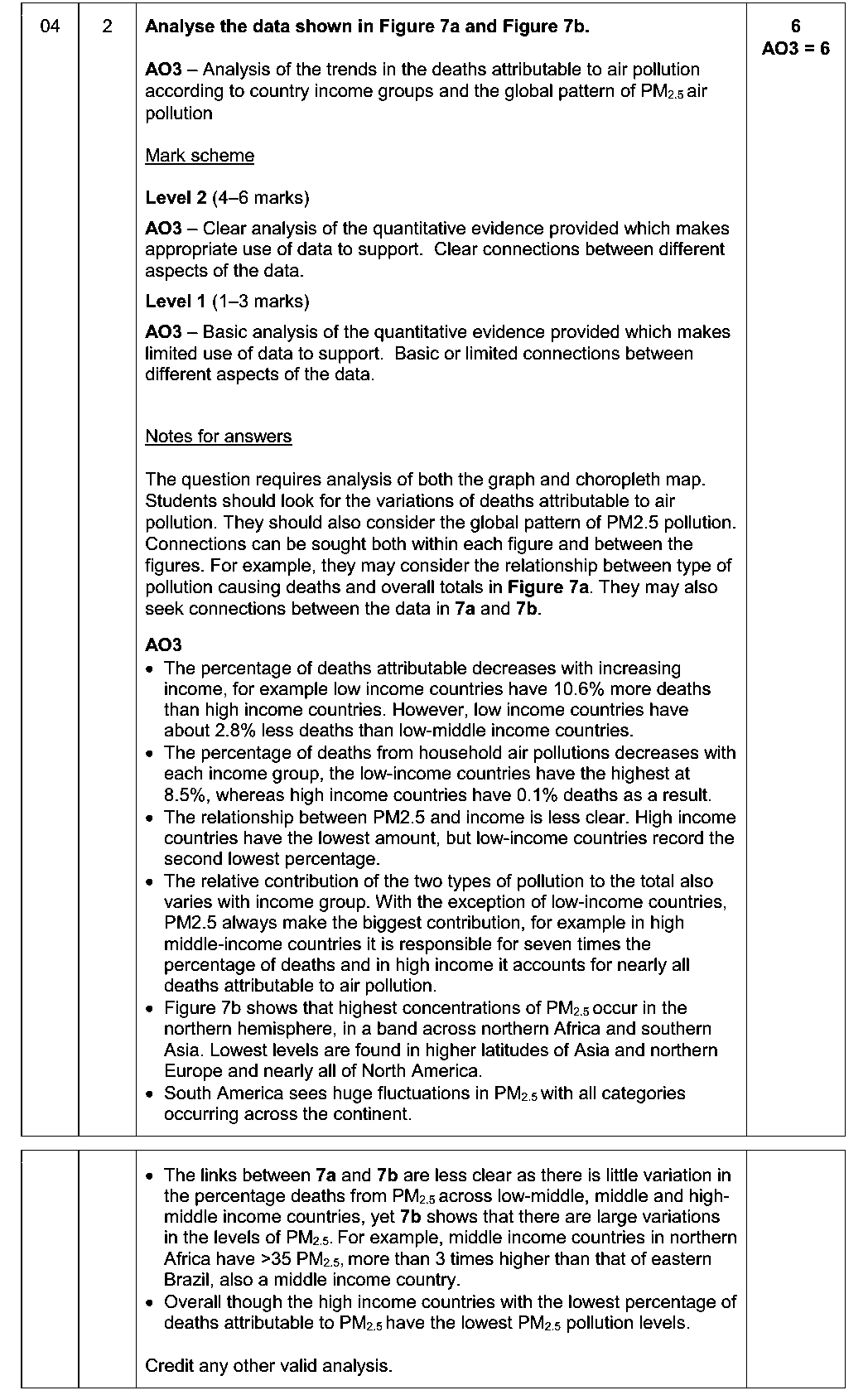
Figures 7a, 7bFigure 7a, November 2020 Paper 2Figure 7b, November 2020 Paper 2
Figures 7a and 7b are in the insert.
Figure 7a shows deaths attributed to air pollution by country income groups in 2016.
Figure 7b shows the global distribution of the concentration of PM2.5 atmospheric
pollution in 2016.
Analyse the data shown in Figure 7a and Figure 7b.
[6 marks]
November 2020 · Paper 2 · Q4.3 9 marks mark scheme Stimulus population change
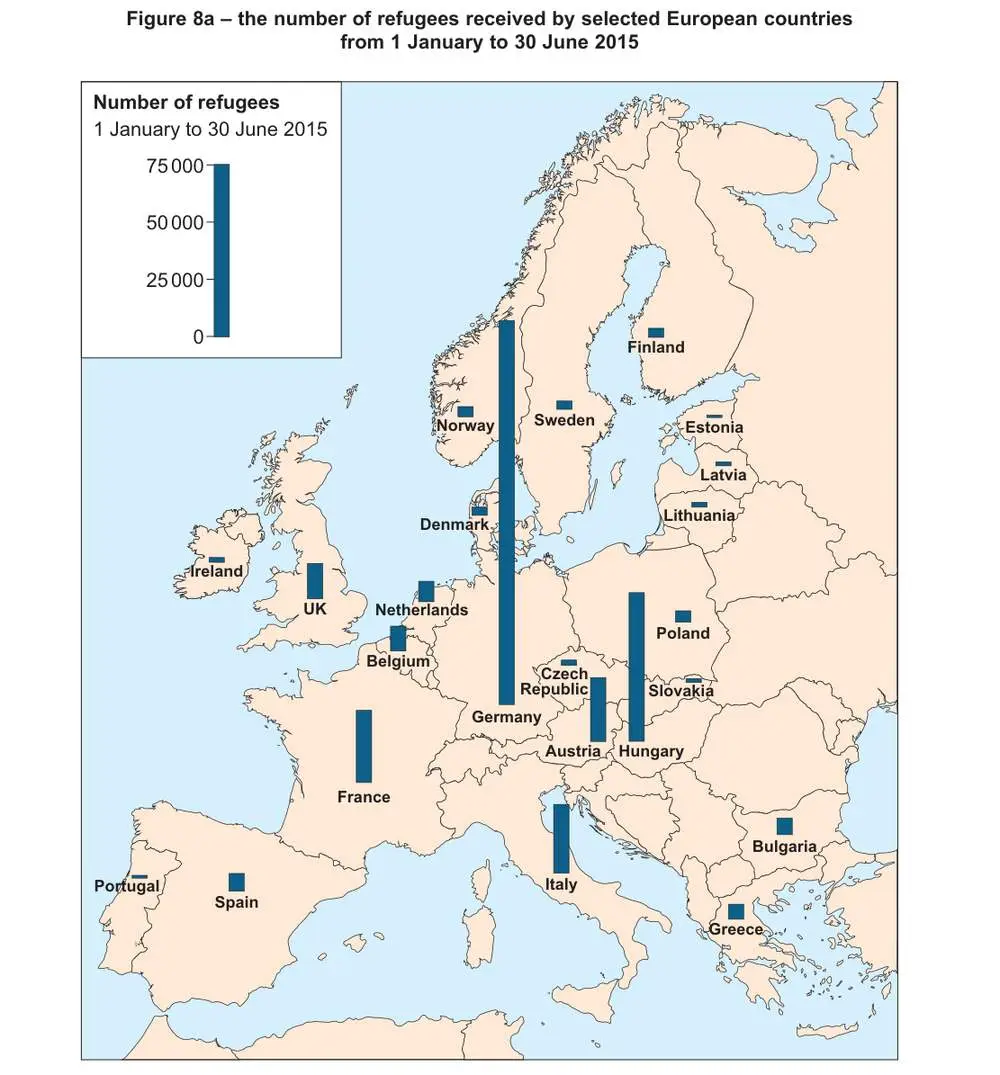
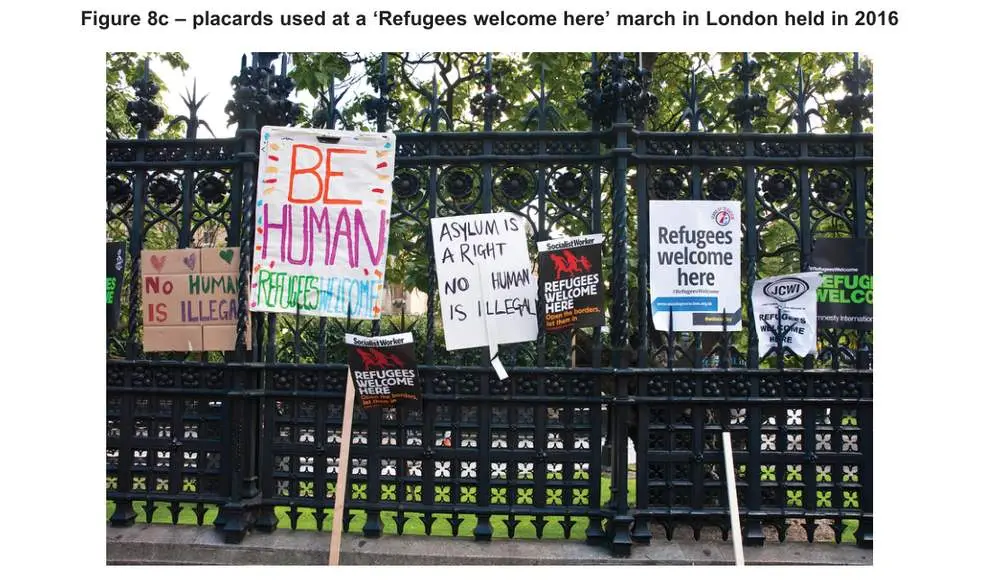
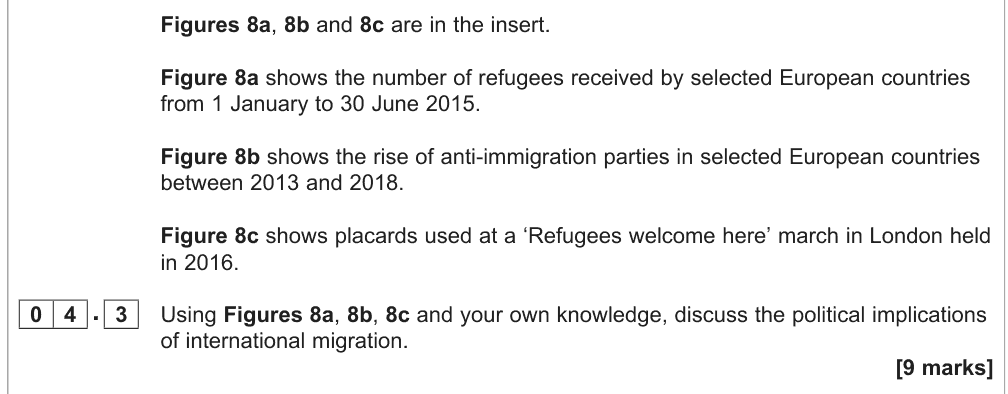
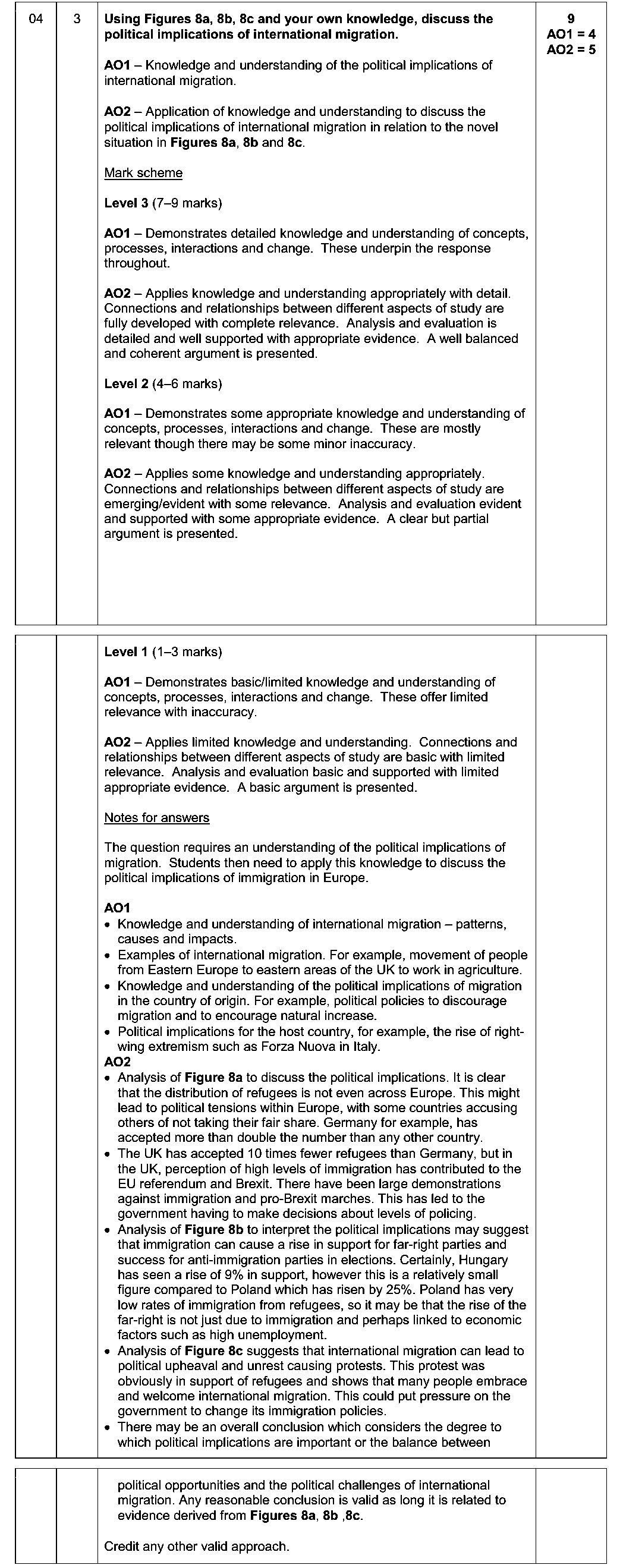
Figures 8a, 8b, 8cFigure 8a, November 2020 Paper 2Figure 8b, November 2020 Paper 2Figure 8c, November 2020 Paper 2
Figures 8a, 8b and 8c are in the insert.
Figure 8a shows the number of refugees received by selected European countries
from 1 January to 30 June 2015.
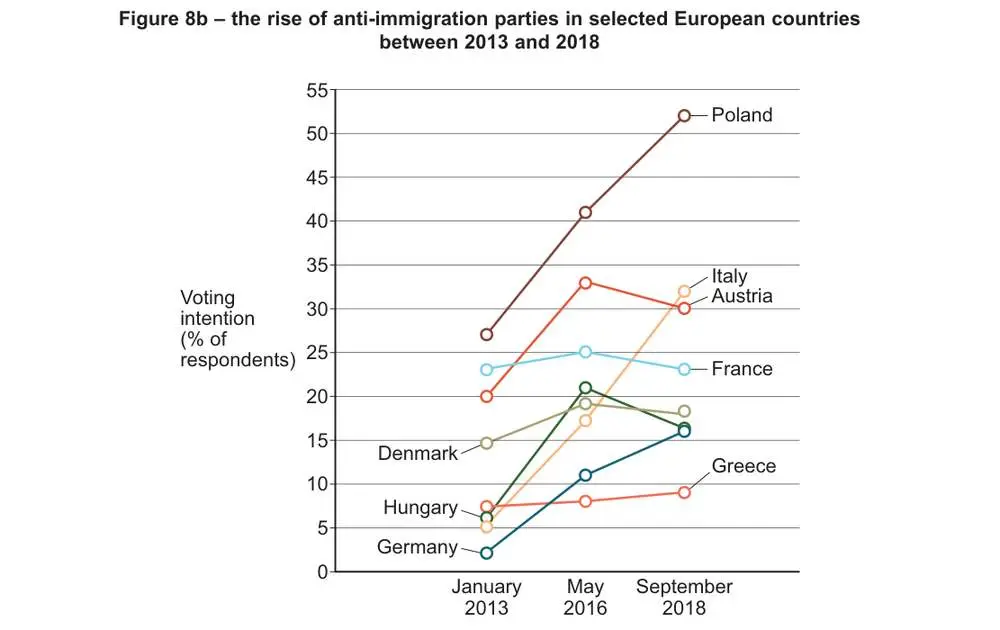
Figure 8b shows the rise of anti-immigration parties in selected European countries
between 2013 and 2018.
Figure 8c shows placards used at a ‘Refugees welcome here’ march in London held
in 2016.
Using Figures 8a, 8b, 8c and your own knowledge, discuss the political implications
of international migration.
[9 marks]
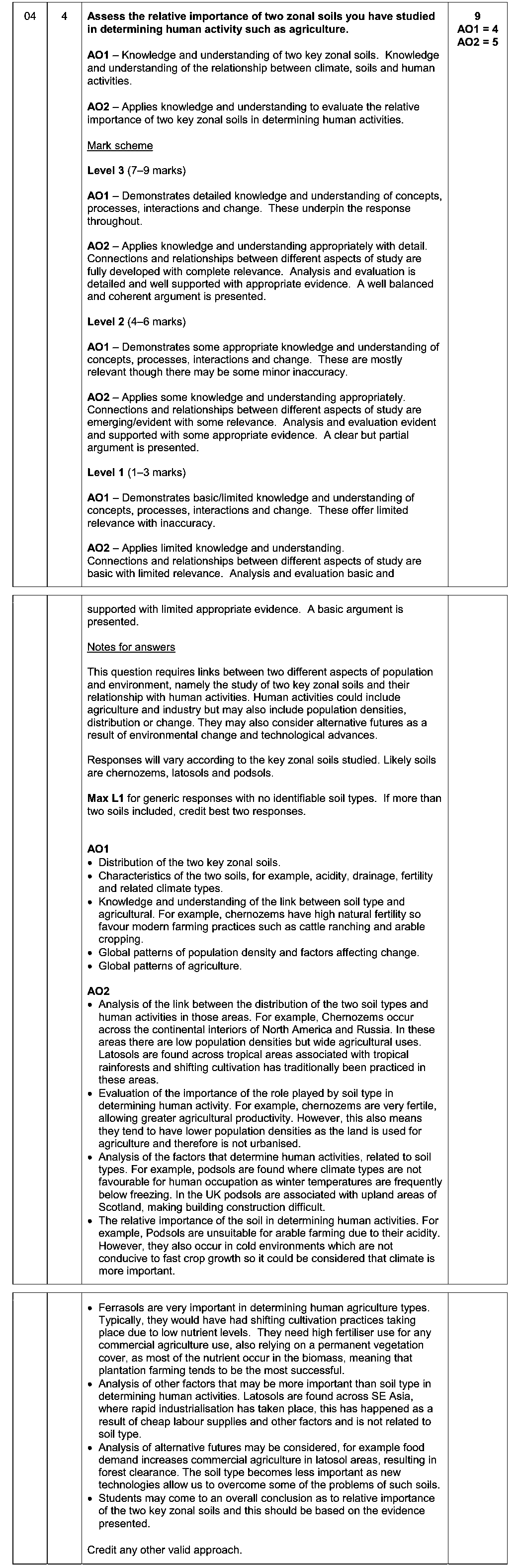
November 2020 · Paper 2 · Q4.4 9 marks mark scheme 9-mark essay population environment
Assess the relative importance of two zonal soils you have studied in determining
human activity such as agriculture.
[9 marks]
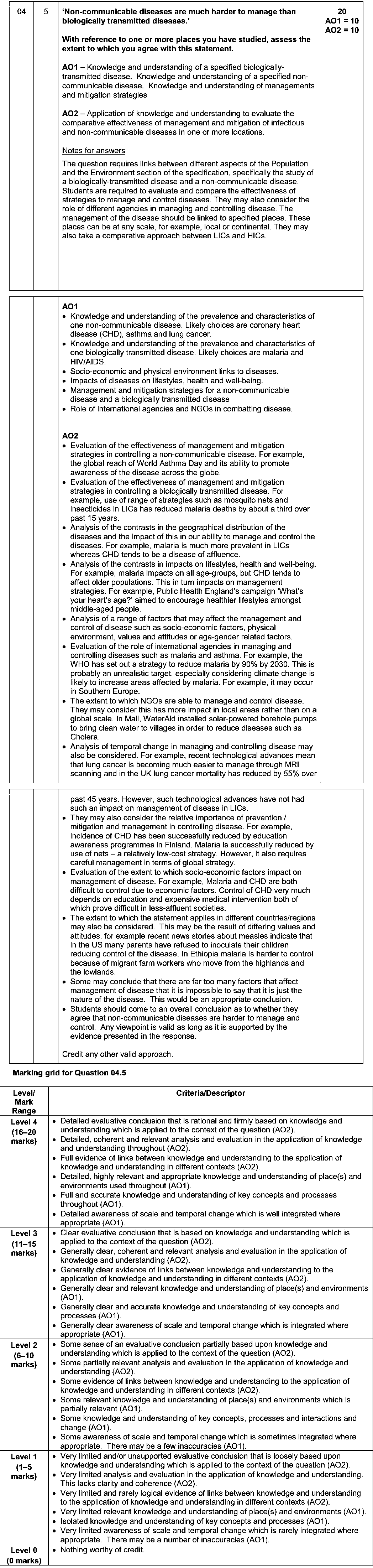
November 2020 · Paper 2 · Q4.5 20 marks mark scheme 20-mark essay health wellbeing
‘Non-communicable diseases are harder to manage than biologically transmitted
diseases.’
With reference to one or more places you have studied, assess the extent to which
you agree with this statement.
[20 marks]
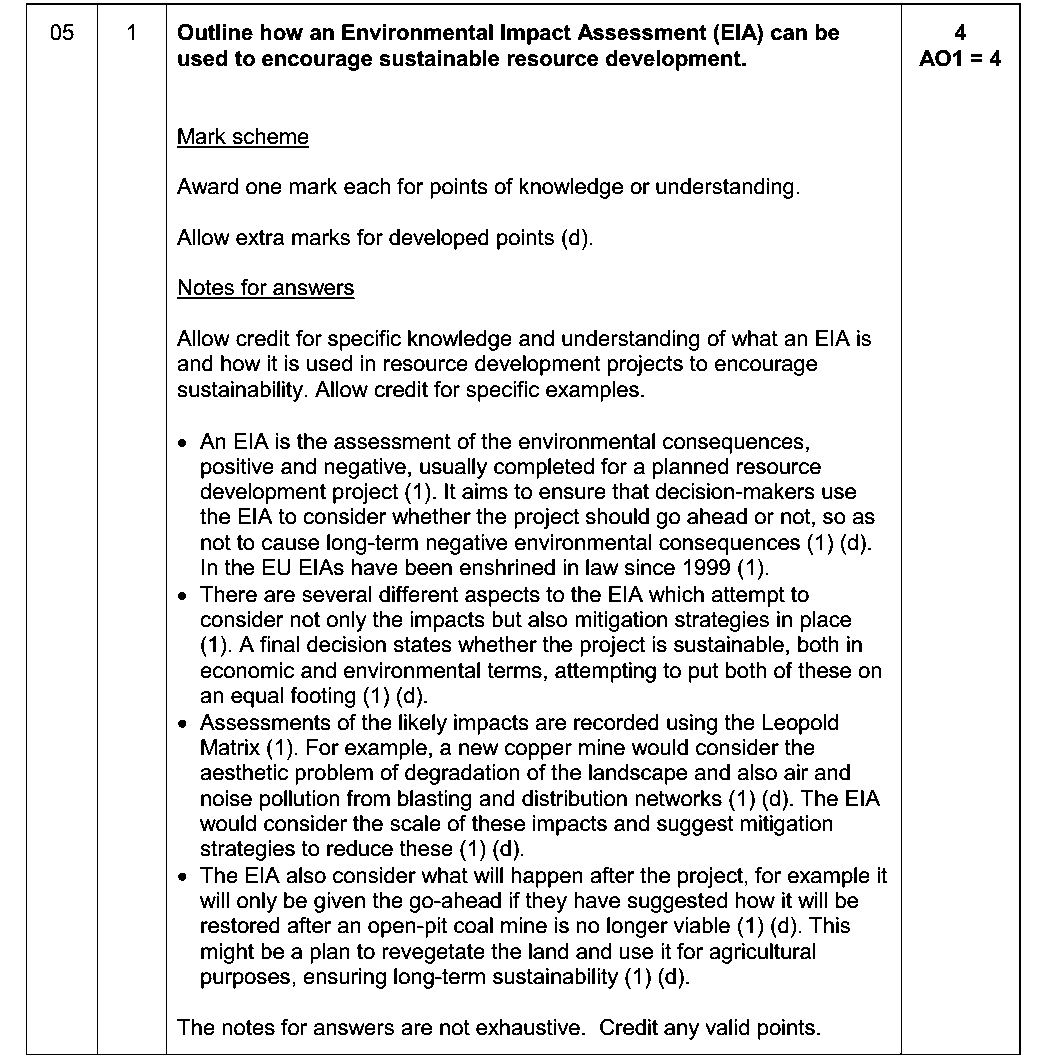
November 2020 · Paper 2 · Q5.1 4 marks mark scheme Point-marked resource development
Outline how an Environmental Impact Assessment (EIA) can be used to encourage
sustainable resource development.
[4 marks]
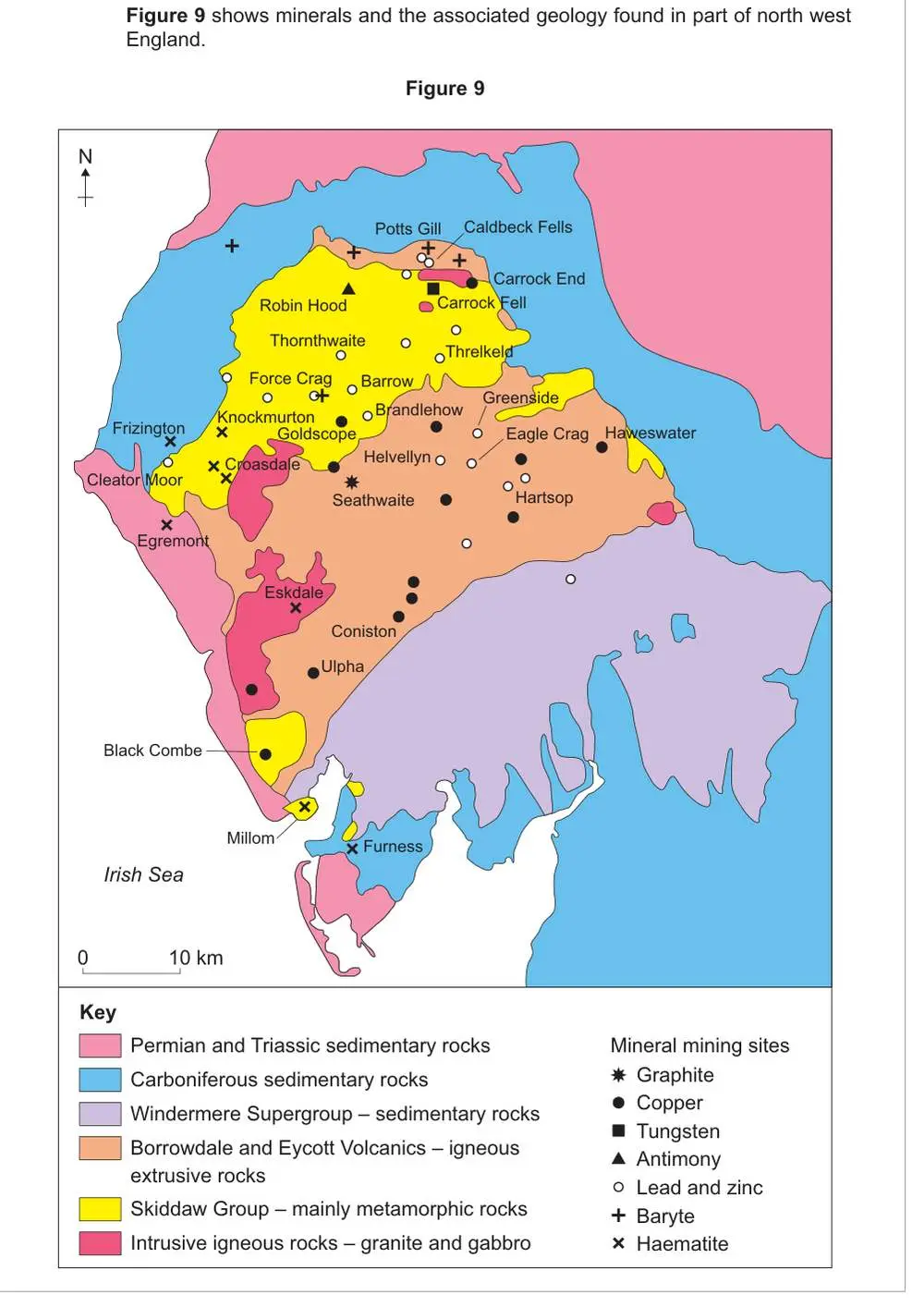
Figure 9 shows minerals and the associated geology found in part of north west
England.
Figure 9
N
Potts Gill
Caldbeck Fells
Carrock End
Robin Hood
Carrock Fell
Thornthwaite
Threlkeld
Force Crag
Barrow
Greenside
Knockmurton
Brandlehow
Frizington
Goldscope
Eagle Crag
Haweswater
Croasdale
Helvellyn
Cleator Moor
Seathwaite
Hartsop
Egremont
Eskdale
Coniston
Ulpha
Black Combe
Millom
Furness
Irish Sea
0
10 km
November 2020 · Paper 2 · Q5.2 6 marks mark scheme Data analysis mineral security
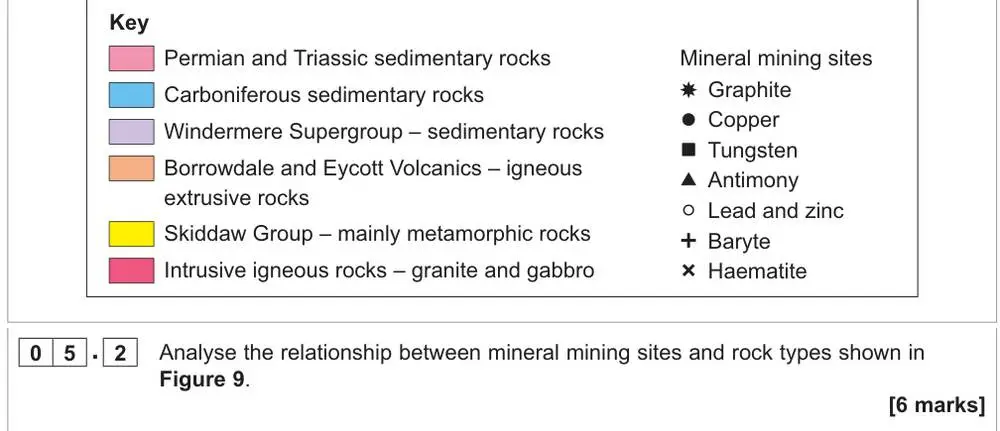
Figure 9Figure 9, November 2020 Paper 2
Key
Permian and Triassic sedimentary rocks
Mineral mining sites
Carboniferous sedimentary rocks
Graphite
Windermere Supergroup – sedimentary rocks
Copper
Tungsten
Borrowdale and Eycott Volcanics – igneous
Antimony
extrusive rocks
Lead and zinc
Skiddaw Group – mainly metamorphic rocks
Baryte
Intrusive igneous rocks – granite and gabbro
Haematite
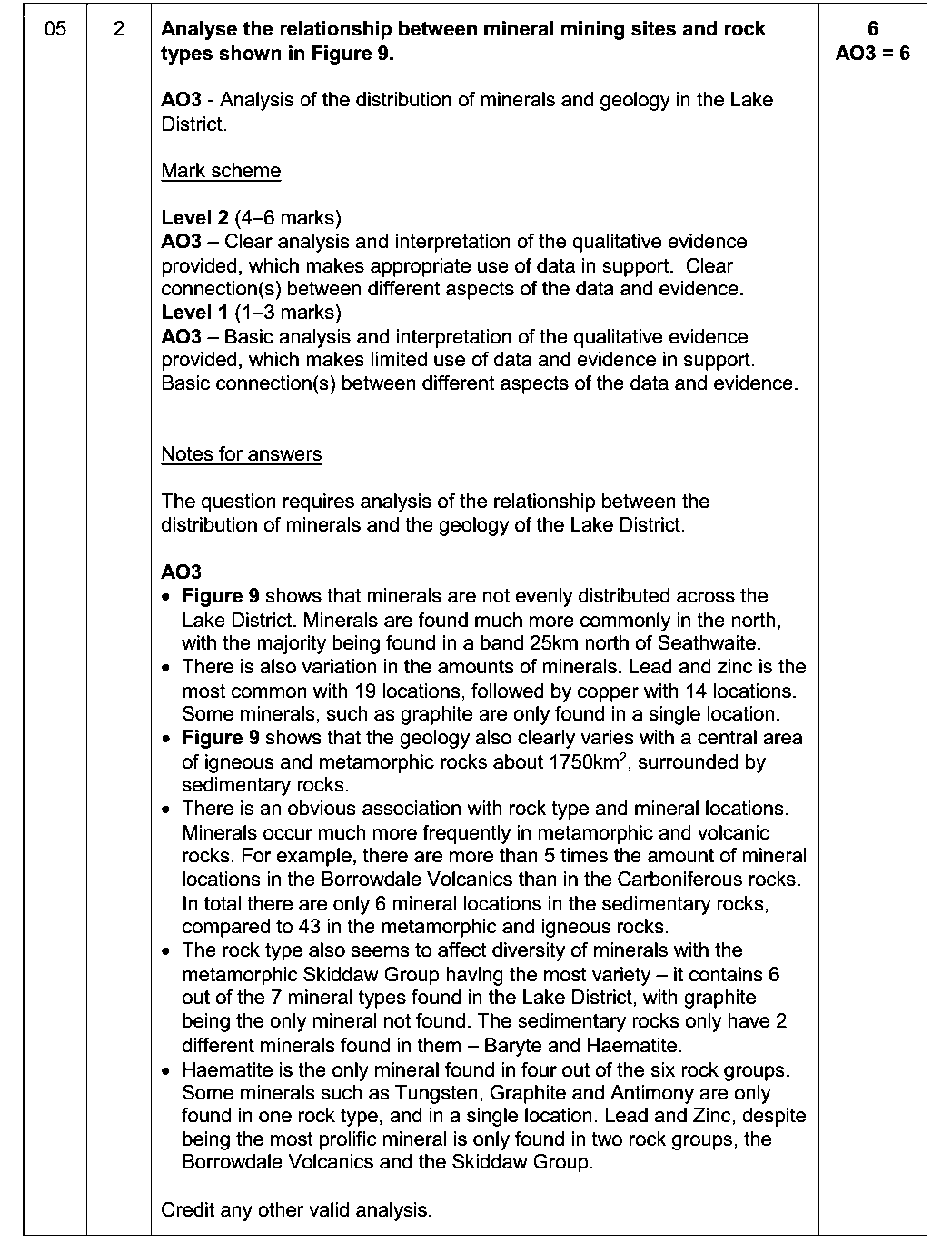
Analyse the relationship between mineral mining sites and rock types shown in
Figure 9.
[6 marks]
November 2020 · Paper 2 · Q5.3 9 marks mark scheme Stimulus resource developmentenergy security
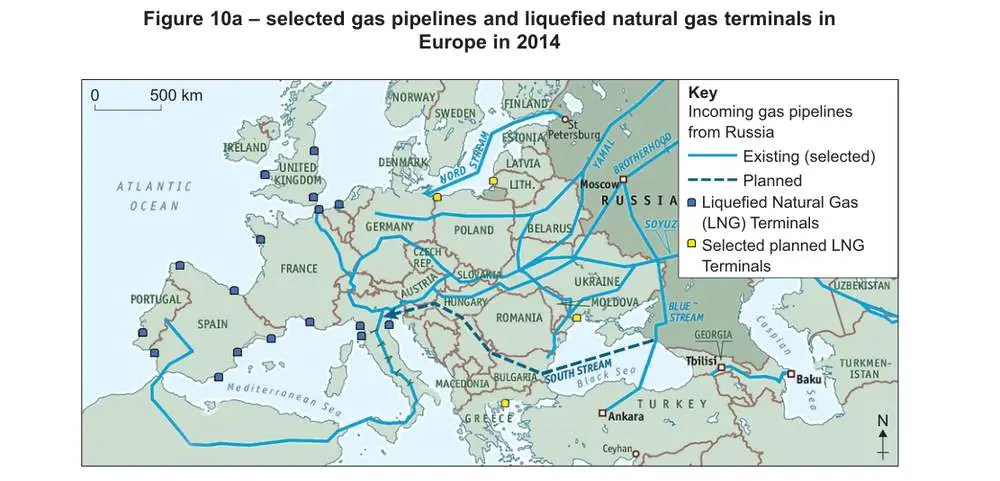
Figures 10a, 10bFigure 10a, November 2020 Paper 2Figure 10b, November 2020 Paper 2

A figure for this question was removed from AQA's published paper for copyright reasons.

Figures 10a and 10b are in the insert.
Figure 10a shows selected gas pipelines and liquefied natural gas terminals in
Europe in 2014.
Figure 10b shows gas consumption and the level of dependence on Russian gas
in 2014.
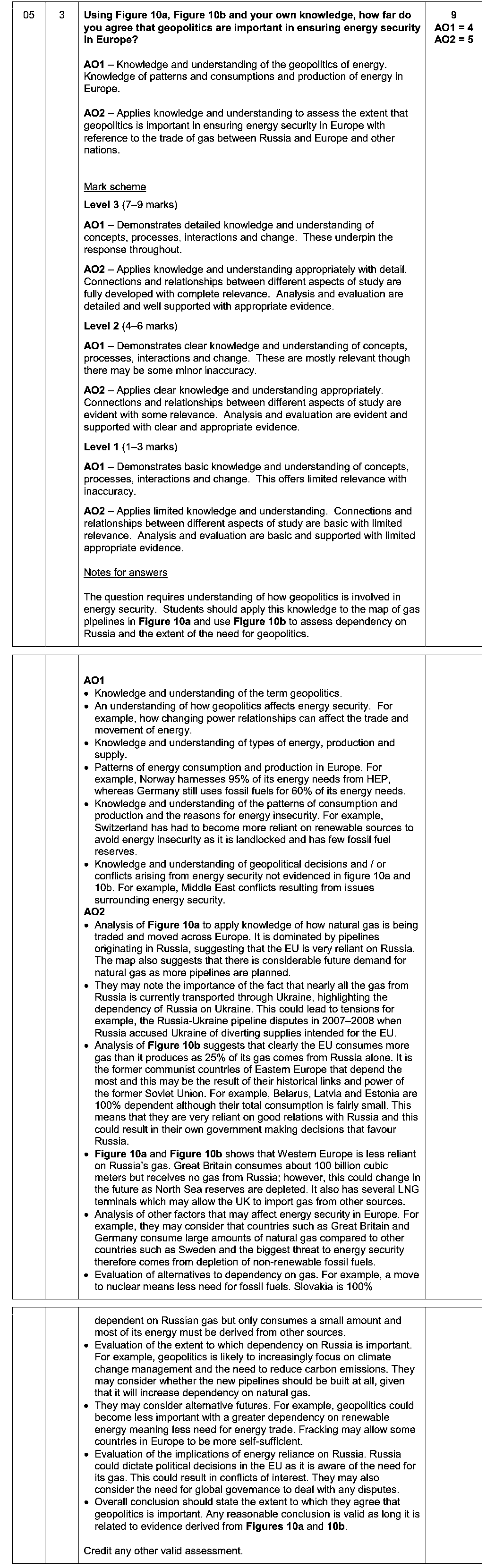
Using Figure 10a, Figure 10b and your own knowledge, how far do you agree that
geopolitics are important in ensuring energy security in Europe?
[9 marks]
November 2020 · Paper 2 · Q5.4 9 marks mark scheme 9-mark essay water security
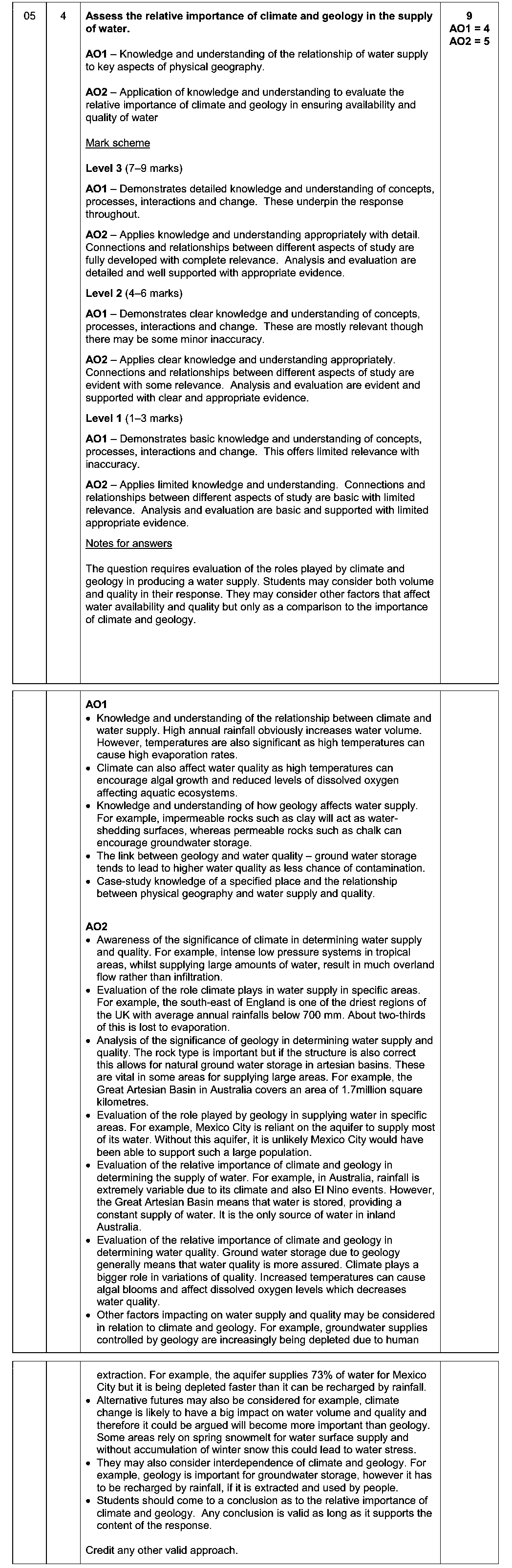
Assess the relative importance of climate and geology in the supply of water.
[9 marks]
November 2020 · Paper 2 · Q5.5 20 marks mark scheme 20-mark essay mineral securitywater security
‘The environmental impacts of ore extraction will always be greater than that of water
supply schemes.’
With reference to a major ore extraction scheme and a major water supply scheme,
assess the extent to which you agree with this statement.
[20 marks]

Work with an AQA Geography tutor

Want a paper marked and gone through with you? Message us.

Prefer email? Send an enquiry

If you are under 18, please include a parent's contact details. Enquiries go to enquiries@alevelgeographytutor.com and are deleted once handled. All tutoring is online.