Examiner's comment
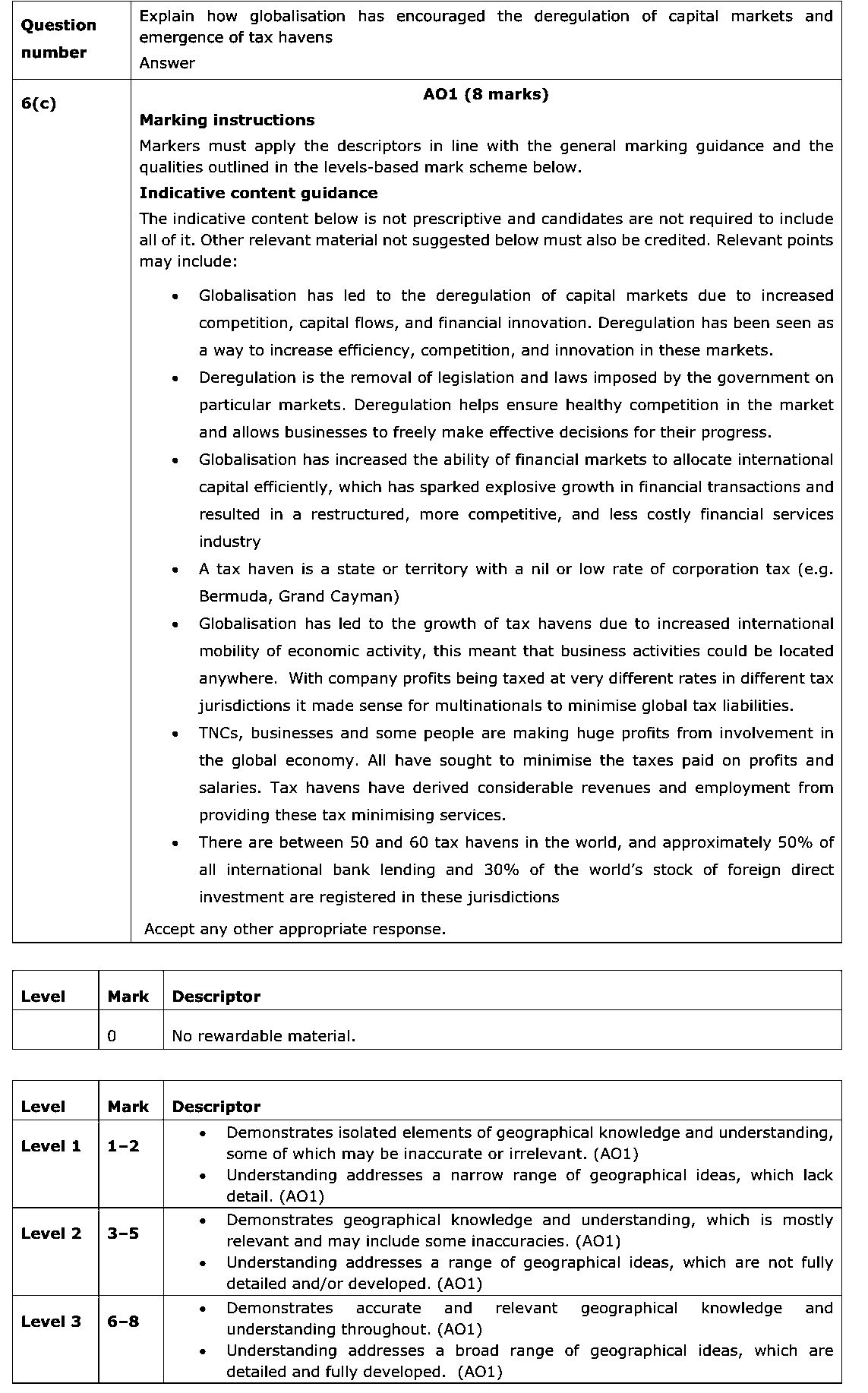
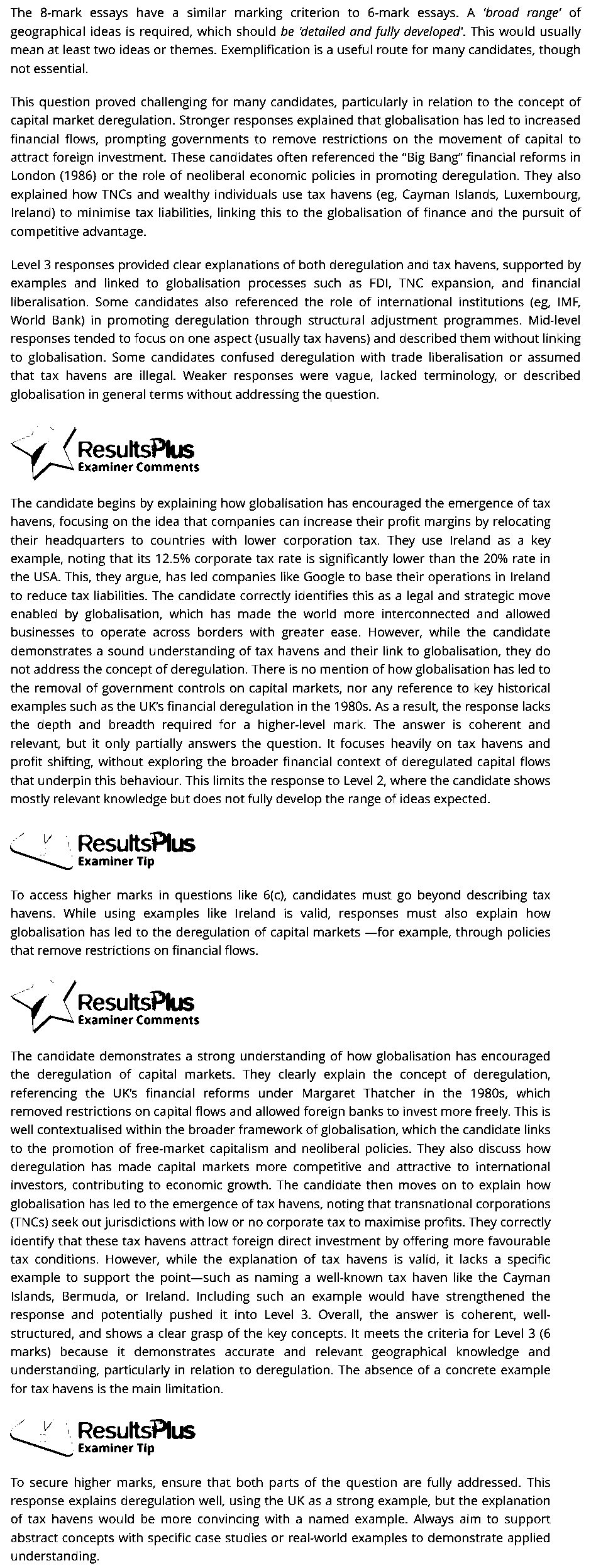
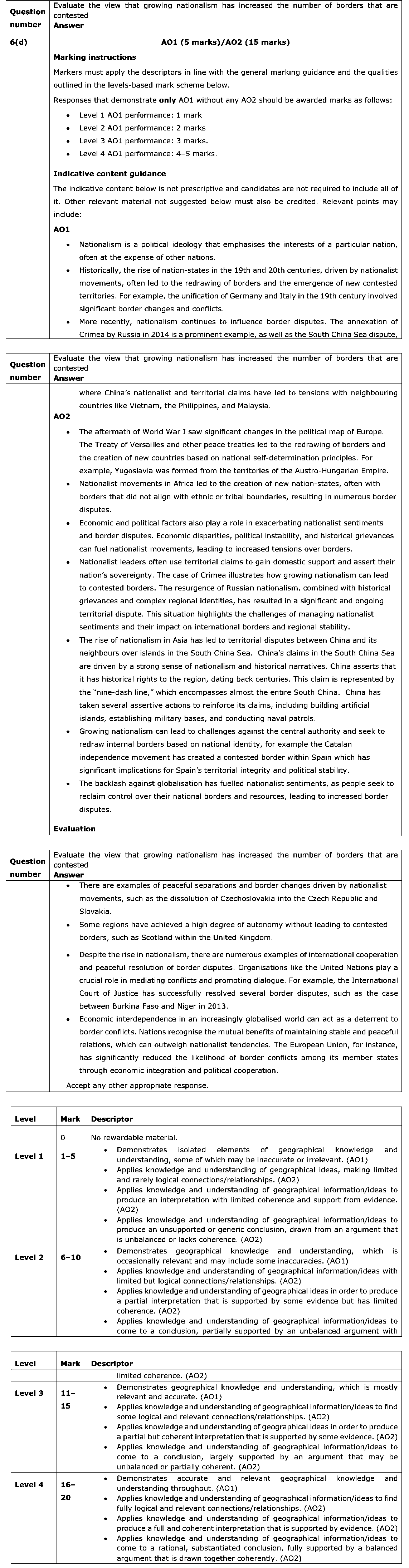
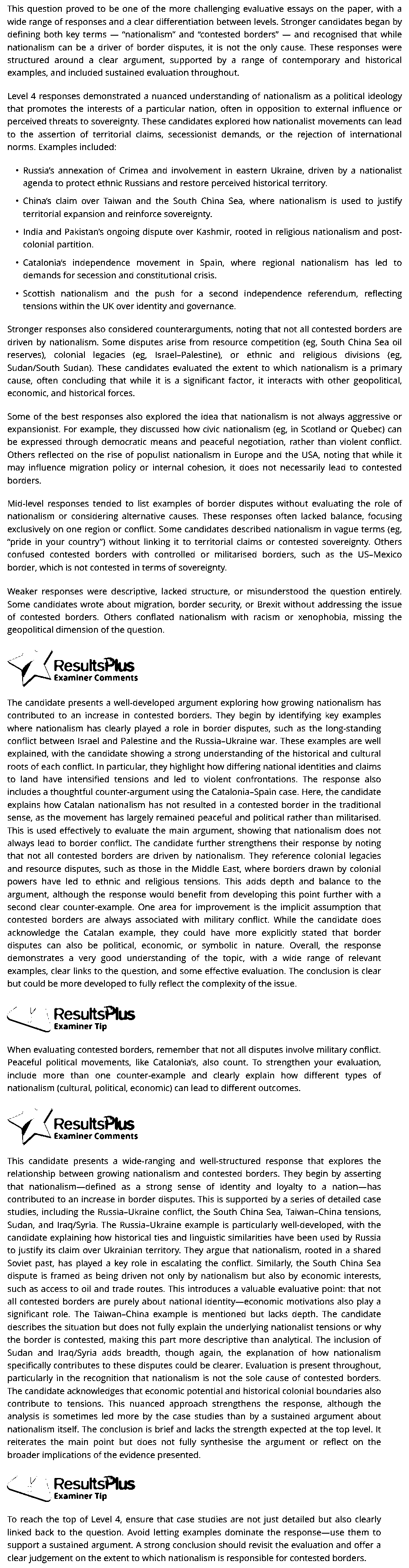
This question proved to be one of the more challenging evaluative essays on the paper, with a wide range of responses and a clear differentiation between levels. Stronger candidates began by defining both key terms — “nationalism” and “contested borders” — and recognised that while nationalism can be a driver of border disputes, it is not the only cause. These responses were structured around a clear argument, supported by a range of contemporary and historical examples, and included sustained evaluation throughout. Level 4 responses demonstrated a nuanced understanding of nationalism as a political ideology that promotes the interests of a particular nation, often in opposition to external influence or perceived threats to sovereignty. These candidates explored how nationalist movements can lead to the assertion of territorial claims, secessionist demands, or the rejection of international norms. Examples included: • Russia’s annexation of Crimea and involvement in eastern Ukraine, driven by a nationalist agenda to protect ethnic Russians and restore perceived historical territory. • China’s claim over Taiwan and the South China Sea, where nationalism is used to justify territorial expansion and reinforce sovereignty. • India and Pakistan’s ongoing dispute over Kashmir, rooted in religious nationalism and post- colonial partition. • Catalonia’s independence movement in Spain, where regional nationalism has led to demands for secession and constitutional crisis. • Scottish nationalism and the push for a second independence referendum, reflecting tensions within the UK over identity and governance. Stronger responses also considered counterarguments, noting that not all contested borders are driven by nationalism. Some disputes arise from resource competition (eg, South China Sea oil reserves), colonial legacies (eg, Israel–Palestine), or ethnic and religious divisions (eg, Sudan/South Sudan). These candidates evaluated the extent to which nationalism is a primary cause, often concluding that while it is a significant factor, it interacts with other geopolitical, economic, and historical forces. Some of the best responses also explored the idea that nationalism is not always aggressive or expansionist. For example, they discussed how civic nationalism (eg, in Scotland or Quebec) can be expressed through democratic means and peaceful negotiation, rather than violent conflict. Others reflected on the rise of populist nationalism in Europe and the USA, noting that while it may influence migration policy or internal cohesion, it does not necessarily lead to contested borders. Mid-level responses tended to list examples of border disputes without evaluating the role of nationalism or considering alternative causes. These responses often lacked balance, focusing exclusively on one region or conflict. Some candidates described nationalism in vague terms (eg, “pride in your country”) without linking it to territorial claims or contested sovereignty. Others confused contested borders with controlled or militarised borders, such as the US–Mexico border, which is not contested in terms of sovereignty. Weaker responses were descriptive, lacked structure, or misunderstood the question entirely. Some candidates wrote about migration, border security, or Brexit without addressing the issue of contested borders. Others conflated nationalism with racism or xenophobia, missing the geopolitical dimension of the question. The candidate presents a well-developed argument exploring how growing nationalism has contributed to an increase in contested borders. They begin by identifying key examples where nationalism has clearly played a role in border disputes, such as the long-standing conflict between Israel and Palestine and the Russia–Ukraine war. These examples are well explained, with the candidate showing a strong understanding of the historical and cultural roots of each conflict. In particular, they highlight how differing national identities and claims to land have intensified tensions and led to violent confrontations. The response also includes a thoughtful counter-argument using the Catalonia–Spain case. Here, the candidate explains how Catalan nationalism has not resulted in a contested border in the traditional sense, as the movement has largely remained peaceful and political rather than militarised. This is used effectively to evaluate the main argument, showing that nationalism does not always lead to border conflict. The candidate further strengthens their response by noting that not all contested borders are driven by nationalism. They reference colonial legacies and resource disputes, such as those in the Middle East, where borders drawn by colonial powers have led to ethnic and religious tensions. This adds depth and balance to the argument, although the response would benefit from developing this point further with a second clear counter-example. One area for improvement is the implicit assumption that contested borders are always associated with military conflict. While the candidate does acknowledge the Catalan example, they could have more explicitly stated that border disputes can also be political, economic, or symbolic in nature. Overall, the response demonstrates a very good understanding of the topic, with a wide range of relevant examples, clear links to the question, and some effective evaluation. The conclusion is clear but could be more developed to fully reflect the complexity of the issue. When evaluating contested borders, remember that not all disputes involve military conflict. Peaceful political movements, like Catalonia’s, also count. To strengthen your evaluation, include more than one counter-example and clearly explain how different types of nationalism (cultural, political, economic) can lead to different outcomes. This candidate presents a wide-ranging and well-structured response that explores the relationship between growing nationalism and contested borders. They begin by asserting that nationalism—defined as a strong sense of identity and loyalty to a nation—has contributed to an increase in border disputes. This is supported by a series of detailed case studies, including the Russia–Ukraine conflict, the South China Sea, Taiwan–China tensions, Sudan, and Iraq/Syria. The Russia–Ukraine example is particularly well-developed, with the candidate explaining how historical ties and linguistic similarities have been used by Russia to justify its claim over Ukrainian territory. They argue that nationalism, rooted in a shared Soviet past, has played a key role in escalating the conflict. Similarly, the South China Sea dispute is framed as being driven not only by nationalism but also by economic interests, such as access to oil and trade routes. This introduces a valuable evaluative point: that not all contested borders are purely about national identity—economic motivations also play a significant role. The Taiwan–China example is mentioned but lacks depth. The candidate describes the situation but does not fully explain the underlying nationalist tensions or why the border is contested, making this part more descriptive than analytical. The inclusion of Sudan and Iraq/Syria adds breadth, though again, the explanation of how nationalism specifically contributes to these disputes could be clearer. Evaluation is present throughout, particularly in the recognition that nationalism is not the sole cause of contested borders. The candidate acknowledges that economic potential and historical colonial boundaries also contribute to tensions. This nuanced approach strengthens the response, although the analysis is sometimes led more by the case studies than by a sustained argument about nationalism itself. The conclusion is brief and lacks the strength expected at the top level. It reiterates the main point but does not fully synthesise the argument or reflect on the broader implications of the evidence presented. To reach the top of Level 4, ensure that case studies are not just detailed but also clearly linked back to the question. Avoid letting examples dominate the response—use them to support a sustained argument. A strong conclusion should revisit the evaluation and offer a clear judgement on the extent to which nationalism is responsible for contested borders.
![Examiner's report extract for June 2025 Paper 2 question 6(d)]()