Examiner's comment
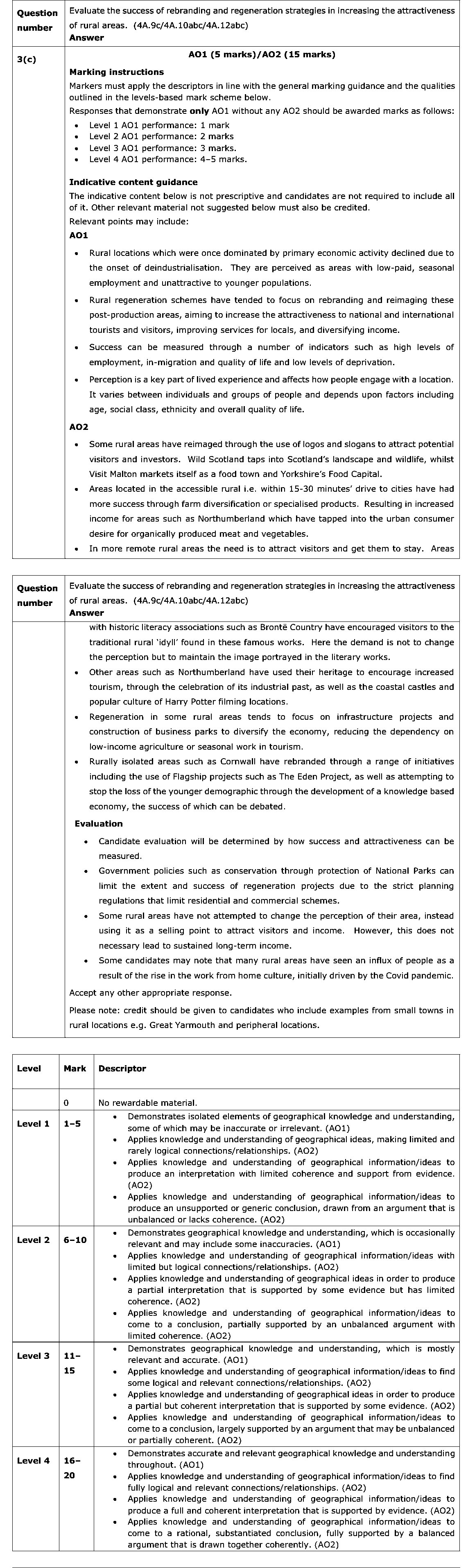
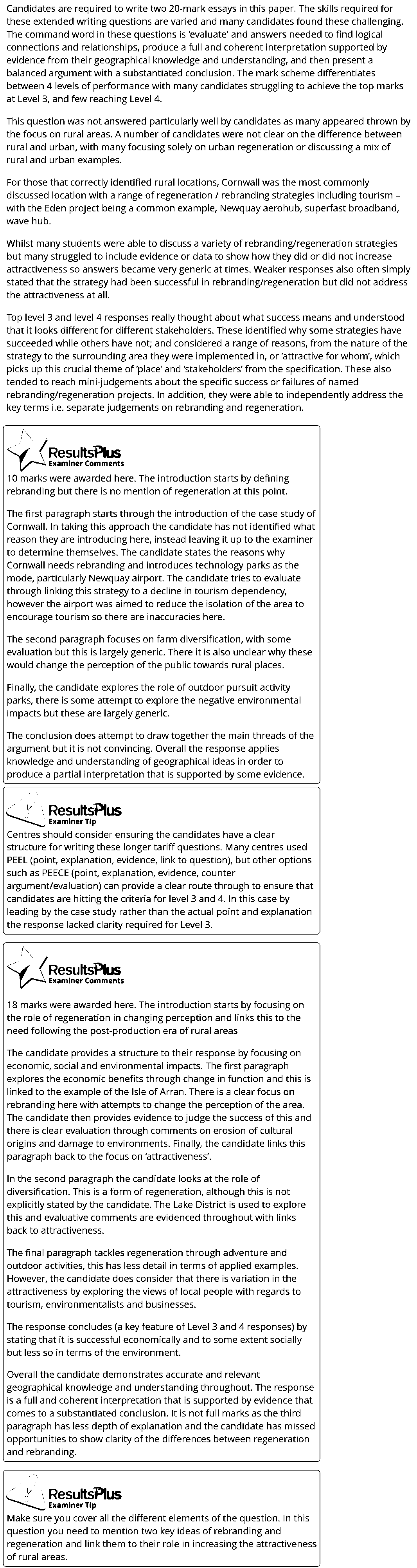
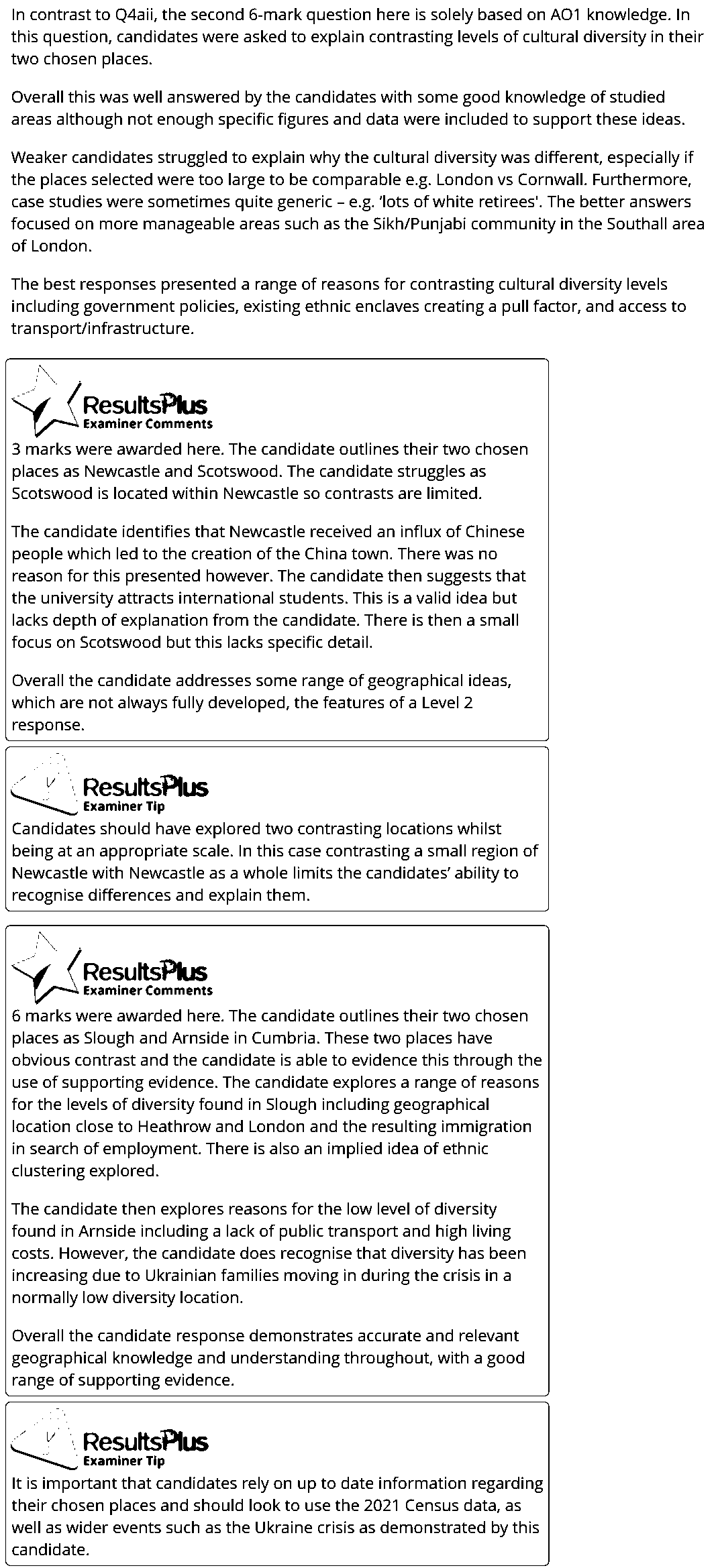
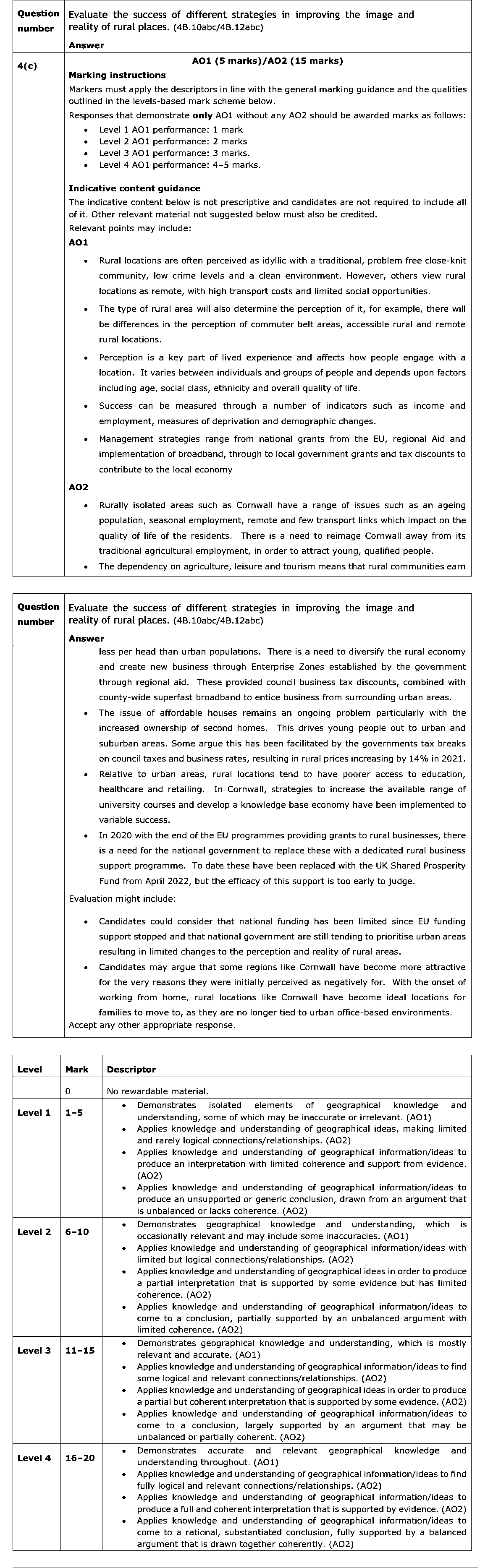
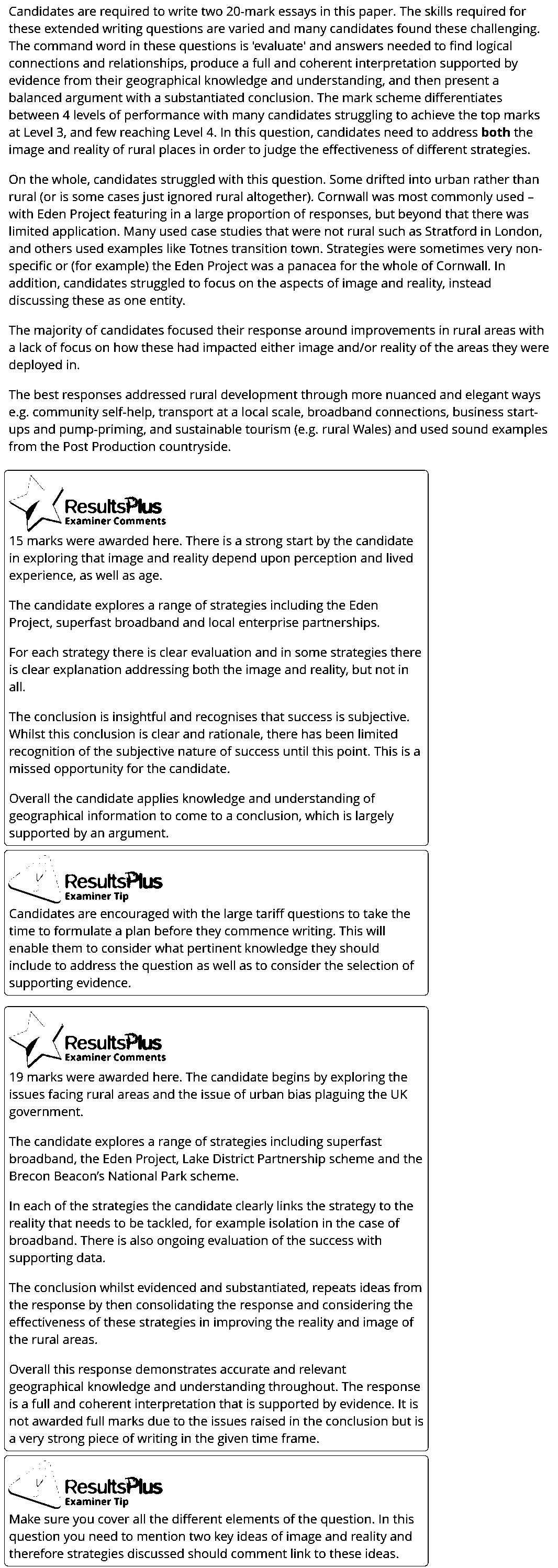
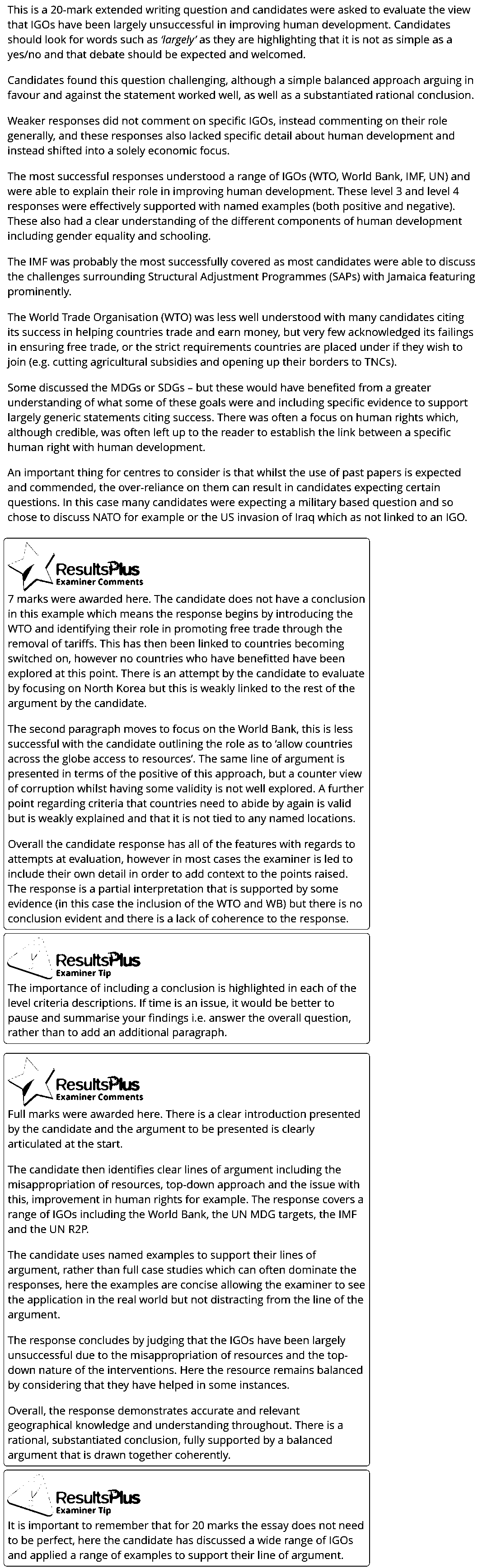
Candidates are required to write two 20-mark essays in this paper. The skills required for these extended writing questions are varied and many candidates found these challenging. The command word in these questions is 'evaluate' and answers needed to find logical connections and relationships, produce a full and coherent interpretation supported by evidence from their geographical knowledge and understanding, and then present a balanced argument with a substantiated conclusion. The mark scheme differentiates between 4 levels of performance with many candidates struggling to achieve the top marks at Level 3, and few reaching Level 4. This question was not answered particularly well by candidates as many appeared thrown by the focus on rural areas. A number of candidates were not clear on the difference between rural and urban, with many focusing solely on urban regeneration or discussing a mix of rural and urban examples. For those that correctly identified rural locations, Cornwall was the most commonly discussed location with a range of regeneration / rebranding strategies including tourism – with the Eden project being a common example, Newquay aerohub, superfast broadband, wave hub. Whilst many students were able to discuss a variety of rebranding/regeneration strategies but many struggled to include evidence or data to show how they did or did not increase attractiveness so answers became very generic at times. Weaker responses also often simply stated that the strategy had been successful in rebranding/regeneration but did not address the attractiveness at all. Top level 3 and level 4 responses really thought about what success means and understood that it looks different for different stakeholders. These identified why some strategies have succeeded while others have not; and considered a range of reasons, from the nature of the strategy to the surrounding area they were implemented in, or ‘attractive for whom’, which picks up this crucial theme of ‘place’ and ‘stakeholders’ from the specification. These also tended to reach mini-judgements about the specific success or failures of named rebranding/regeneration projects. In addition, they were able to independently address the key terms i.e. separate judgements on rebranding and regeneration. 10 marks were awarded here. The introduction starts by defining rebranding but there is no mention of regeneration at this point. The first paragraph starts through the introduction of the case study of Cornwall. In taking this approach the candidate has not identified what reason they are introducing here, instead leaving it up to the examiner to determine themselves. The candidate states the reasons why Cornwall needs rebranding and introduces technology parks as the mode, particularly Newquay airport. The candidate tries to evaluate through linking this strategy to a decline in tourism dependency, however the airport was aimed to reduce the isolation of the area to encourage tourism so there are inaccuracies here. The second paragraph focuses on farm diversification, with some evaluation but this is largely generic. There it is also unclear why these would change the perception of the public towards rural places. Finally, the candidate explores the role of outdoor pursuit activity parks, there is some attempt to explore the negative environmental impacts but these are largely generic. The conclusion does attempt to draw together the main threads of the argument but it is not convincing. Overall the response applies knowledge and understanding of geographical ideas in order to produce a partial interpretation that is supported by some evidence. Centres should consider ensuring the candidates have a clear structure for writing these longer tariff questions. Many centres used PEEL (point, explanation, evidence, link to question), but other options such as PEECE (point, explanation, evidence, counter argument/evaluation) can provide a clear route through to ensure that candidates are hitting the criteria for level 3 and 4. In this case by leading by the case study rather than the actual point and explanation the response lacked clarity required for Level 3. 18 marks were awarded here. The introduction starts by focusing on the role of regeneration in changing perception and links this to the need following the post-production era of rural areas The candidate provides a structure to their response by focusing on economic, social and environmental impacts. The first paragraph explores the economic benefits through change in function and this is linked to the example of the Isle of Arran. There is a clear focus on rebranding here with attempts to change the perception of the area. The candidate then provides evidence to judge the success of this and there is clear evaluation through comments on erosion of cultural origins and damage to environments. Finally, the candidate links this paragraph back to the focus on ‘attractiveness’. In the second paragraph the candidate looks at the role of diversification. This is a form of regeneration, although this is not explicitly stated by the candidate. The Lake District is used to explore this and evaluative comments are evidenced throughout with links back to attractiveness. The final paragraph tackles regeneration through adventure and outdoor activities, this has less detail in terms of applied examples. However, the candidate does consider that there is variation in the attractiveness by exploring the views of local people with regards to tourism, environmentalists and businesses. The response concludes (a key feature of Level 3 and 4 responses) by stating that it is successful economically and to some extent socially but less so in terms of the environment. Overall the candidate demonstrates accurate and relevant geographical knowledge and understanding throughout. The response is a full and coherent interpretation that is supported by evidence that comes to a substantiated conclusion. It is not full marks as the third paragraph has less depth of explanation and the candidate has missed opportunities to show clarity of the differences between regeneration and rebranding. Make sure you cover all the different elements of the question. In this question you need to mention two key ideas of rebranding and regeneration and link them to their role in increasing the attractiveness of rural areas.
![Examiner's report extract for June 2023 Paper 2 question 3(c)]()